What if everyone who ever lived kept an indestructible diary. Imagine reading what all our ancestors thought throughout their lifetimes. I don’t believe in an afterlife, but this could be the form of one. I’ve often wondered what my parents thought as they were growing up and got older. I’ve also wondered about my grandparents and what they thought about their lives. If they had written down their thoughts and were saved in some way, I could read them now. I wish I had a magic lamp and three wishes. This is how I’d use one of them.
I’ve always been somewhat interested in genealogy. However, just seeing names with dates of birth and death isn’t good enough. Whenever I see a genealogy chart I ask: Who were they, what did they think, what did they do?
The past is gone, so we can’t worry about that now. Although I have read accounts of people wanting to program an AI based on everything they could find out about someone they loved who died. The theory is if we programmed everything we know about a person, say Mark Twain or Ernest Hemingway into an AI, it might act like those men. That sounds creepy. On the other hand, one of my favorite science fiction stories, “Appearance of Life” by Brian W. Aldiss involved the protagonist finding memory cubes by two people who had been married and died years apart and putting them on a shelf so they talked to each other. It was both moving, tragic, and pathetic all at once.
Reading books by famous writers and biographies about them does convey a sense of who they were and how they reacted to their times. And biographies about famous people who left no writings of their own lack something. Look at the four Gospels — if only Jesus had written something himself.
Blogging offers the potential to do what I’m talking about. What if the Library of Congress archived all blogs. Would people in the 22nd century find our blogs interesting? What about the 43rd century?
If you pay attention to serious fiction and films, much of the trouble conveyed about the characters and interactions with other characters is due to a lack of communication. A good example is Celeste Ng’s first novel, Everything I Never Told You. Think about every person you ever loved, hated, or worked with, and what it would mean if you read their inner thoughts? Or at least the thoughts they wanted to share?
Also, it’s important to know that our thoughts are not coherent. Writing is the way we learn this. You’ll never know yourself only by thinking. Writing is a way to sculpt thoughts into something recognizable. Writing is the way to learn about yourself, and reading is the way to learn about other people.
Remember being back in school and all the emotional turmoil and conflicts caused by relationships, perceived relationships, and lack of relationships? Would we have been better people, kinder people, more self-aware people, if we had all blogged back then and read each others’ thoughts? Weren’t a lot of our problems as kids because we hid inside of ourselves and only speculated about our classmates? Would there be more or less school shootings if all the kids knew each other better?
Not only would growing up blogging help with self-expression, and communication, but it would have made us better learners and scholars. I’ve already written about “Blogging in the Classroom.”
I also wrote, “77 Things I Learned From Writing 1000 Blog Essays” which was mostly about how blogging is a great self-improvement tool. One of the main reasons I blog is it helps keep my mind together.
But I mostly wish everyone I knew blogged so I could learn more about them. Lately, I’ve been noticing how little we really communicate with one another. We have our public persona, and we hide the rest. I’ve noticed how many people as they grow older withdraw into themselves. We tend to just chat. Is that because we have given up on relationships? Or because we have more worries about ourselves and don’t want to worry about other people?
For some reason, we consume fiction hours a day. And it’s not the kind of fiction where we learn about people. It’s the kind that helps us forget and hide. Wouldn’t our lives be better if we learned more about real people and not imaginary people?
On the other hand, we are bombarded with personal problems and information overload every day. Maybe we watch television because we had enough of reality and real people? Even extroverts who crave constant social activity often stay at a shallow level of communication. Could the fact that we don’t all blog, or communicate deeply imply that’s what we prefer?
This essay is about remembering something that never happened and the theories I’ve developed to explain my memory hallucination.
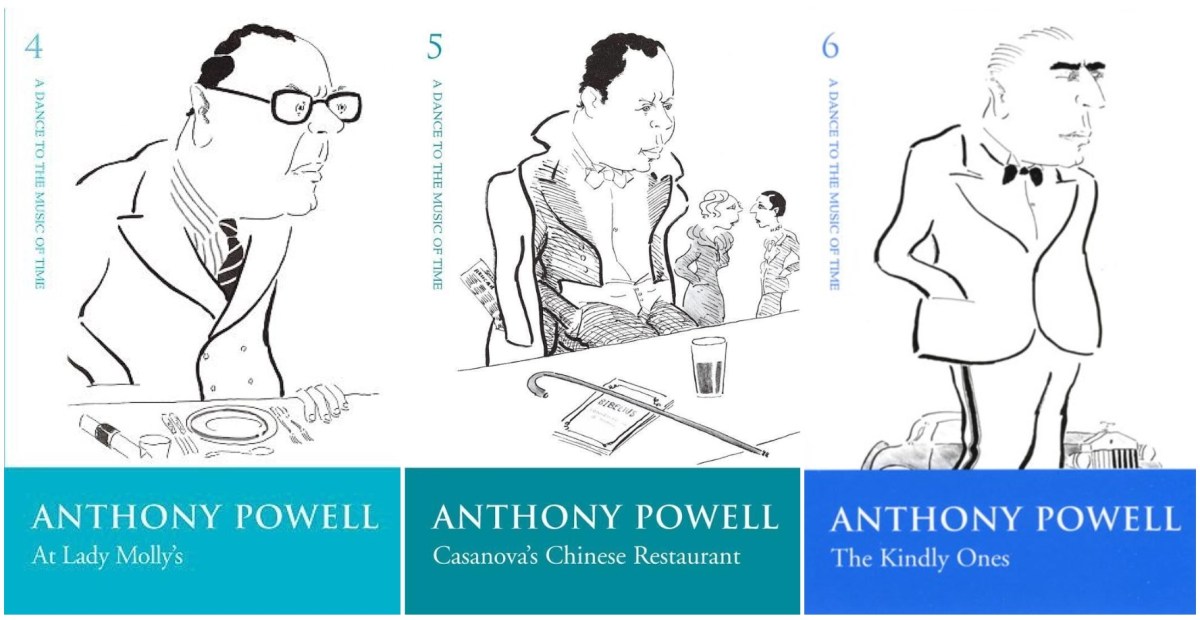
While reading The Kindly Ones by Anthony Powell, the sixth novel in a twelve-novel series called A Dance to the Music of Time, I had the constant feeling I had read it before. Several scenes throughout the novel seemed so familiar that I felt like I had studied them over several readings. I always assumed it was because I had twice watched the four-part miniseries based on the books. I’m sure that accounts for the general sense I’ve read The Kindly Ones before, but not the intense sense of remembering specific scenes. Yesterday I replayed the portion of the miniseries that deals with the most remembered scene and it merely skims over a very long detailed scene in the book.
A Dance to the Music of Time is about Nick Jenkins and his life from the 1920s through the 1960s. It’s not a Roman à clef but Anthony Powell based Nick on his own life. It’s a fictional exploration of memory, so it’s rather ironic that I’m having memory problems reading it.
There were many scenes that felt I had read before, but I just assumed they were in the miniseries. However, one scene was intensely vivid and familiar. It was the long scene where Nick Jenkins met Bob Duport years after Nick had had an affair with Duport’s wife Jean That affair was chronicled in an early novel in the series. So those pages recall events that happened in earlier novels, but it also has much new information that wasn’t in the earlier novels. The most vivid scene involved Nick wanting to avoid the subject of Jean, but Bob slowly getting around to talking about her. Bob starts describing the men he knew Jean had affairs with and what they were like. Bob kept making a case that Jean was attracted to men who were assholes and even admits to being one himself. Nick doesn’t know if Bob is intentionally insulting him or accidentally torturing him.
In recent years I have become distrusting of my memory for many reasons. The first is, memories often feel faulty. But that sense of faultiness is the kind we associate with dementia. I’m now exploring memory delusions.
I’ve read a number of books about the limitations of memory, and I’ve come to assume memories are unreliable. The best book I’ve read on this is Jesus Before the Gospels by Bart D. Ehrman. You wouldn’t think a book about Jesus would be the best place to learn about the limitations of memory, but it’s the best I’ve found.
If the television miniseries wasn’t where I acquired my pre-knowledge of that scene in The Kindly Ones, where did it come from? My first thought was to wonder if I had read the book before? I checked my reading log, a listing of books I’ve read since 1983, and it wasn’t there. Now, there have been times when I forgot to record a book read, but I don’t think that happened in this case. Why would I read the sixth book of a series out of order?
Another possibility is I listened to it in my sleep. Books 4-6 are in a combined edition on my Audible edition, a total of 21 hours. Theoretically, I could have fallen asleep and my unconscious mind heard it. This happens all the time. But I wake up, usually, in minutes, but no more than an hour, and shut off the book. I always scroll back to a scene I’m positive I listened to the day before. I’m almost positive I didn’t let this whole book play while I was sleeping with The Kindly Ones. Because of an overactive bladder, the longest stretch I can sleep at night is two hours.
I do have a wild and crazy theory. What if certain human experiences become part of what Jung called our collective unconscious? I know this is New Age woo-woo, but it’s a thought. It might explain why some people think they are reincarnated, or some instances of Deja vu.
I have two less wild theories, ones I think might be closer to the truth. One involves prediction, and the other involves resonating with tiny universal fragments.
The novels in A Dance to the Music of Time feel like an autobiography. The novel series is not a Roman clef, but they were inspired by Powell’s own life and the people he knew. I’m thinking they create such a detailed sense of Nick Jenkins, especially after six novels, that when I got to the scene with Bob, I felt like I was Nick, and the encounter felt so real that I had experienced it as if I was remembering it.
The second theory is somewhat like the basis of holograms. If you cut one up, it will still show the whole picture, just fuzzier. Even a tiny fragment of a hologram will still show the entire image, but just very fuzzy. This second theory suggests that any scene involving a man meeting the husband of the woman he had an affair with will trigger a resonating memory response. I can’t recall any specific similar scene in fiction or real life that matches this, but that doesn’t mean I haven’t and just don’t remember it.
This hologram fragment theory might explain all Deja vu experiences. Our mind remembers things in generalized tokens, and sometimes we confuse the token from one event with another. If you think about this, you’ll probably recall this happening to you. The other day I asked Susan if I had gotten the mail, and she said, yes, you got a book. I said, no, that was yesterday. I was quite positive. I even convinced Susan that it was true. A few hours later I remembered that yesterday was the 4th of July and there was no mail. I have a “got the mail” token in my brain and it makes me feel like I’ve always gotten the mail. But it’s not really specific to any single event of getting the mail.
A recent episode of 60 Minutes on Google’s AI called Bard offers another theory. Bard was asked to explain inflation, which it did, and offered five books on the subject with descriptions of the books. When CBS fact-checked that list days later they discovered the books didn’t exist. CBS asked Google about this. They were told this was an AI phenomenon called hallucination. Evidently, AIs will just make up shit whenever they feel like it. Maybe what I experienced was a memory hallucination.
Google’s Bard performed another scary feat. It taught itself to read and write in a language it wasn’t trained on, and without being asked. Maybe my brain just tricked me into thinking I had read this book before?
And there’s one last idea. Last night I dreamed of a variation of an episode of a TV show Susan and I watched last evening. The dream didn’t involve characters from the TV show, but people I know. But the dream put me, and people I know in the same exact situation. Have you ever wondered how our brain can generate so much endless dream content? What if the same mental mechanism that generates dreams also creates our memories and beliefs? What if that mechanism works like Bard?
I’ve always liked Roman à clef fiction, or fiction that is highly biographical. I’ve always been obsessed with memory. I’m ready to finally read Proust, who is the authorial authority on fictionalizing memory. Some people compare Anthony Powell to Proust, others hate that comparison. Proust fans don’t think Powell was heavy-duty enough. I think they each had their own approach to remembering their life. Powell may have been an extrovert and Proust an introvert, and the differences in their prose were caused by that and not the quality of writing. But I also think the differences involve the different ways of how memory works.
I’ve been playing The Beatles all this week and I noticed something that has me thinking about it a lot. The first two Beatles albums Please Please Me and With the Beatles came out in 1963 in the United Kingdom but I didn’t hear them until after February 9, 1964, when The Beatles appeared on the Ed Sullivan Show. Obviously, some Americans heard Fab Four songs before then because there were mobs at the airport and 73 million people watched Ed’s show that night.
When do you remember first hearing the Beatles? I got interested in those dates because I was going to write an essay about what I remembered about The Beatles from 1964, but it bothered me I was recalling my 1964 but the tunes were from 1962 and 1963. America and England were out of sync by over a year.
Why hadn’t I heard the Beatles on the radio in 1963? Starting in 1962, I listened to Top 40 music several hours a day on WQAM and WFUN AM radio stations in Miami, so I should have heard The Beatles’ songs if they were released. I just don’t remember hearing them at all in 1963.
“Love Me Do/P.S. I Love You” was released in England on October 5, 1962, but not until April 24, 1964, in the U.S., when it reached #1 on the Billboard Hot 100 chart. Beatlemania could have started in late 1962, or early 1963 — why didn’t it?
“Please Please Me/From Me To You” was the Beatles’ 2nd single in England, released on January 11, 1963. It reached #1 on the New Music Express and Melody Maker charts. “Please Please Me/Ask Me Why” was the first Beatles single released in the United States on February 25, 1963, but failed to chart. Some radio stations around the country played this single but it got no screaming fans and was forgotten. “Please Please Me” reached #35 in Chicago on March 8 on their local charts, and again on March 15, but disappeared after that.
“Please Please Me/From Me To You” was re-released in the U.S. on January 3, 1964, and made it to #3 on Billboard. Again, it was obvious that Americans loved the Beatles, but why did we wait until 1964 to love them? This makes me want to write an alternate history science fiction story about Beatlemania hitting America during Christmas of 1962. And it can’t be all Capitol’s fault.
Three more singles by the Beatles were released in the U.K. in 1963: “From Me To You/Thank You Girl” on 4/11/63, “She Loves You/I’ll Get You” on 8/23/63, and “I Want To Hold Your Hand/This” on 11/29/63. Did Americans visiting England bring back these singles and albums? Weren’t there any word-of-mouth from the jet setters?
According to Wikipedia, 34 songs were recorded by the Beatles in 1962 and 1963. Capitol turned down the opportunity to put them out, and a little label, Vee-Jay snapped up the rights. Vee-Jay planned to release Introducing… The Beatles, a repackaged of the UK album Please Please Me in July of 1963, but Vee-Jay didn’t get it out until January 10, 1964. Then Beatlemania hit and Capitol took back the rights.
Theoretically, I could have heard some of the Beatles songs in 1963 on WQAM or WFUN in Miami, but I don’t think so. What if Beatlemania had arrived a year earlier? Would that have launched The Sixties sooner? The 1960s up until the assassination of John F. Kennedy on November 22, 1963, never felt like the legendary times we call The Sixties. 1960 to 1963 felt like the 1950s.
The Sixties, at least to me, began when The Beatles appeared on Ed Sullivan. Seeing them that night felt like Dorothy opening the door in The Wizard of Oz when the film went from black and white to Technicolor. The magic of the Sixties ended for me with Charles Manson and Altamont. In 1970, The Beatles broke up, my father died, and I moved from Miami to Memphis. That’s when I felt The Seventies began.
I was going to write an essay comparing The Beatles’ first two albums against their competition. In America, our first two Beatles albums in 1964 were a mixture of songs from the UK 1963 albums and 1962-1963 singles plus some cuts from the third and fourth British Beatles albums recorded in 1964. It’s all rather confusing if I wanted to understand music as a product of its times.
Here’s an overview of what The Beatles were doing in 1963. As they were writing those songs, or doing covers of American songs, it was 1963. But they made a social and psychological impact on us in 1964. That delay fascinates me.
This week I played all the Beatles albums from Please Please Me (UK 1963) to The Beatles (White Album) (UK/US 1968). I can play all the albums through Sgt. Pepper’s Lonely Hearts Club Band (1967) over and over and did this week. All the songs appeal to me. Each album was a unique masterpiece. Things completely fell apart with The Beatles (White Album). (George Martin and others thought it should have been a single album. I agree completely. The White album feels like a single album with a bunch of outtakes and demos.)
Even though I loved all those Beatles albums through 1967, I’ve only put a few of their songs on my Top 1000 playlist on Spotify. I’ve been wondering why for a long time. I want to compare The Beatles’ songs to the hits that came out at the same time that I love better. But when I saw the dates when the first two albums came out were from 1963, I wondered if should I compare those songs to songs coming out in 1964 when I first heard those Beatles songs, or to songs that were coming out in 1963 when The Beatles recorded their songs?
As I listened to the Beatles’ albums this week it was obvious with each album John, Paul, George, and Ringo progressed in creative sophistication. But then so did pop hits each year. In America, those 1964 Beatles releases stomped the 1964 American releases. But shouldn’t they be compared to 1963 songs?
Finally, could I have heard some Beatles songs in 1963 and they just made no impact on me? Did it take Beatlesmania to get us to love The Beatles? And could the reason I put so few of their songs on my Top 1000 playlist is because Beatlesmania and The Sixties ended in 1969?
[The photo above was probably taken in 1972-1973. It should do to show what I looked like in 1973. Jim Connell is on the left. I’m on the right. Connell was 6’4″ so I look tall and skinny. I’m much lower to the ground and wider today.]
How many memories can our brains hold? Is there a limit, like a hard drive? I know from experience there are limitations on accessing memories, so I assume there are storage limits. However, countless random forgotten experiences burble to the surface of my mind daily. And at night I have an apparently limitless supply of visual settings and characters to film my dreams.
I’ve always been obsessed with wanting perfect recall. Aren’t the things we obsessed over what we want and can’t have? 2023 is the 50th anniversary of 1973. I shall use that year for testing my memory in this essay.
This is not another nostalgic look back in time. In fact, I feel the golden glow of nostalgia is finally starting to wear off. 1973 is one of the least remembered years in my mind. At this moment I can’t recall anything specific I did in 1973. I know I was doing stuff, and some of my vaguer memories might have taken place that year, but for now, I just don’t remember what I was doing. I’m not even sure where I was living at the time.
Think of this essay as a cold case. I’m going to go through old drawers and paperwork looking for clues and use the internet to find out what was happening in the world at large to see if that triggers any memories of 1973.
Unfortunately, around 1975-77 I went into a Buddhist phase and gave away or threw away a lot of my possessions. I intentionally tossed most of my personal mementos because I didn’t want to be attached to them or be hung up on the past. I regret that now because I destroyed all my letters, photos, slides, 8mm films, and copies of my APAzines. When my mother died in 2007 I inherited all her photos and mementos. She kept a lot of my report cards. And over the years people have given me photos and old letters. Plus I have my college transcripts — if I can find them. Physical clues are theoretically slim, but I shall look for them.
I shall use full names in case some of my lost friends are Googling their own names. Who knows, maybe it might cause a reconnection.
Sadly, many of my close friends from the 1970s have died. My old roommate Greg Bridges has moved away and I’ve lost contact with him. 1973 was well before I met my wife in 1977. I’m still in contact with my old high school buddy Connell, and my sister Becky is still alive. Becky married in 1971 and moved to Dallas, so she won’t remember much of my 1973. Most of my relatives have also died, at least the ones I saw the most in 1973.
I did not remember a visit to Dallas in 1973 with Carol Suter and Jim Connell until after writing the first draft of this essay. The act of writing has caused memories to float to the surface. Sometimes it took hours, sometimes days to recall. I shall note these delayed experiences in italics.
I’ve written an essay like this before, in 2019, for the 50th anniversary of when I graduated high school. This time I want to go deeper into reconstructing the past. One of the best books I’ve read about being a historian is Jesus Before the Gospels by Bart D. Ehrman.
Ehrman covers all the sources of evidence a historian uses to reconstruct the past and discusses the effectiveness of each. Ehrman shows how memory is unreliable. He also shows how unreliable eyewitnesses are too. Even if I had lots of memories of 1973 I couldn’t trust them. Not everything I write here will be truly reliable. One of the most damning pieces of evidence Ehrman reviewed in his book was about a professor who had his students write down where they were and what they saw and felt the day after 9/11. Then a decade later he tracked down many of those students and asked them to write down what they remembered about 9/11. Several wrote something entirely different. But here’s the kicker. Some of those students who were shown their original essay written the day afterward claimed they didn’t believe what they had written. They believed their memory!
The first piece of evidence I found is a transcript from Memphis State University (now the University of Memphis).
I was a terrible college student. I dropped out many times. I hardly ever did homework, and it’s amazing I got grades as good as these. During 1971-1972 I attended State Technical Institute Memphis. There I majored in a two-year computer science degree. I loved computers, but the focus was on COBOL and getting a job in a bank. I decided I didn’t want that and transferred to Memphis State in 1973. This only came back to me as I studied the transcript.
Many of these courses are general requirements but the ones that weren’t, remind me of when I was searching for a major. I remember now I was considering history, sociology, English, and anthropology. Although, at some point, maybe even when I quit State Tech, I was considering getting a library degree. I needed a B.S. degree before moving to Knoxville to get an M.L.S. degree (Master of Library Science). I just can’t remember.
I remember liking Byzantine history but not the course. It required too much real work. I don’t know why I made an F in “U.S. Southern History Since 1865” since I made an A in “U. S. History Since 1865.” I have absolutely no memory of taking that course. I took “Southern Literature” in the Spring of 1974 and got an A. I also took two Library Science courses that spring, which backs up my memory theory that I was thinking about becoming a librarian.
One course I distinctly remember is “ENGL 3501 English Grammar” because it was about grammar theory and was really hard. And I have trouble with ordinary grammar. What improved my grade was writing a paper on computer translation of languages. I was really into that subject and I impressed the professor.
I lived at 140 Eastview Drive in Memphis during that year because that’s where I remember writing the paper on computer translation. I was sharing a duplex apartment with Greg Bridges who was my science fiction buddy. We went to conventions and produced a fanzine on Gestetner mimeograph which the two of us co-owned with Dennis McHaney. Another buddy John Williamson lived next door in the duplex across the driveway. We got our friend Claude Saxon to move onto this street too, just a couple doors down. We pictured ourselves creating a hippie-like commune by getting all our friends to move to Eastview. It was a rundown neighborhood in 1973, and it’s worse now in 2022. Here’s what it looks like today from Google Maps.
One of the reasons why my grades were falling off was having so much fun at the time. I was into fandom and a member of two APAs – Spectator Amateur Press (SAPS) and Southern Fandom Press Alliance (SFPA). I was also going to lots of rock concerts and smoking a lot of weed with many friends. Two that I remembered a day later were Tom and Sara. I ended up dating Sara’s sister Alice in 1975.
It was while Greg and I lived in this Eastview duplex that he worked on the Programs committee at Memphis State and he got Fred Pohl, John Brunner, and James Gunn to come and do a two-day seminar. The three writers took Greg and me to lunch and we got to listen to them talk about the old days for a couple hours before Pohl and Gunn had to go to the airport. Then we spent the afternoon taking John Brunner around Memphis. He wanted to see the Lorraine Hotel because he was the president of the Martin Luther King society in London. This was before it was renovated. Then Brunner took Greg and me out to dinner at a Mexican restaurant on Union Avenue before we took him to the airport.
I was able to document this from a fanzine article Greg Bridges wrote for Memphen 279 in 2002. The internet has become my real auxiliary memory. Pohl, Brunner, and Gunn were in Memphis on November 22 and 23 1972. That’s before 1973, and earlier than I thought. I assumed 1973 or 1974. But, can I trust Greg’s memory. I hope he had some kind of physical evidence.
I’ve always told people I never lived anyplace longer than 18 months during the 1970s. His date puts me in Eastview in 1972 and I’m pretty sure I moved out in the summer of 1975. I remember 1975 because that’s the year Born to Run by Bruce Springsteen came out. If Greg’s dates are correct I lived on Eastview for almost three years, maybe longer. That completely contradicts what I believed for years.
To me, the 10th, 11th, and 12th grades seemed like the longest years in my memory. I went to three different high schools in two states while living in four different houses. There’s got to be more to 1973. I was twenty-one for eleven months of 1973, that should have been a special time. I suppose going to college filled up the time in a way that made it seem quick and not memorable.
I found a timeline I made years ago. It gives me a few clues. Jim Connell came to visit me and he, Carol Suter, and I drove in Carol’s yellow Gremlin to Dallis to see my sister Becky and her husband Skip Suter, Carol’s brother. That was when I first met Becky’s future second husband Larry Gamer. I was very impressed with him since he was a computer programmer.
Another thing I remember is making a trip to Cape Kennedy with Carol. Her mother asked Carol and me to drive her nephew and niece back home to Titusville. They had been staying with Carol’s mother. Their father, Carol’s uncle, worked at NASA and he took Carol and me to his job site at a communication facility on base. While we were there they taped conversations with Skylab 3, which operated from July 7, 1973, to September 25, 1973. This was when we were out of school and could have made the trip. After we dropped off the kids, Carol and I drove to Gainesville to see my old friend Jim Connell. I remember sleeping on the floor in a communal house. But I’m not sure of this memory. It might have been another trip with Carol. But Gainesville would have been close to Titusville. I do remember we went by Six Flaggs in Atlanta. That’s when I saw Helen Reddy in concert.
I made that timeline decades ago to help me remember all the places I lived. It confirmed the trip to Gainesville. It said the Helen Reddy concert was on 8/31/73. It also said Carol and I went to see Edgar Winter and Dr. John the next day, 9/1/73.
So far I’ve been able to prove I took 12 college courses and visited Dallas, Atlanta, Gainesville, and Cape Kennedy in 1973. That’s something but not much.
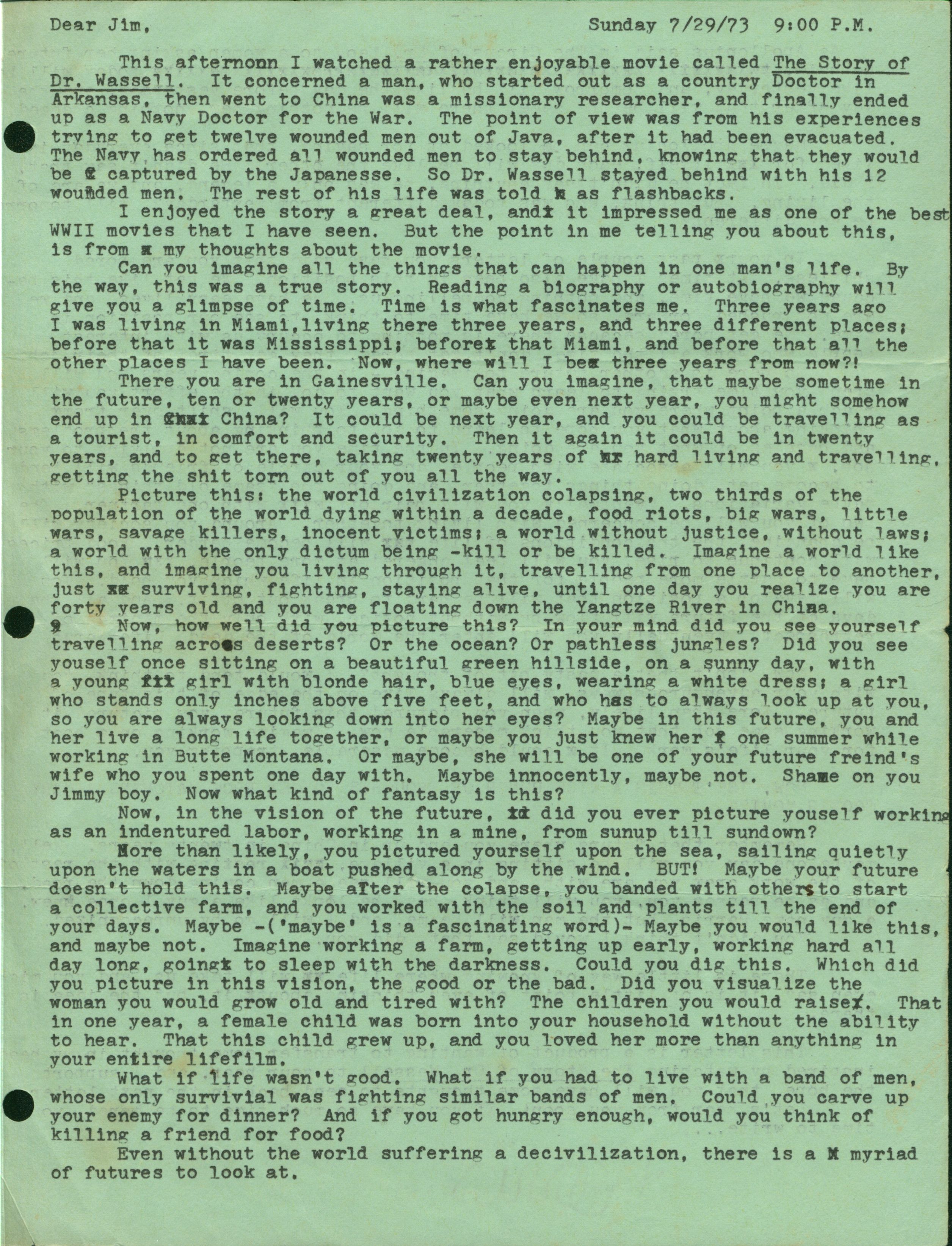
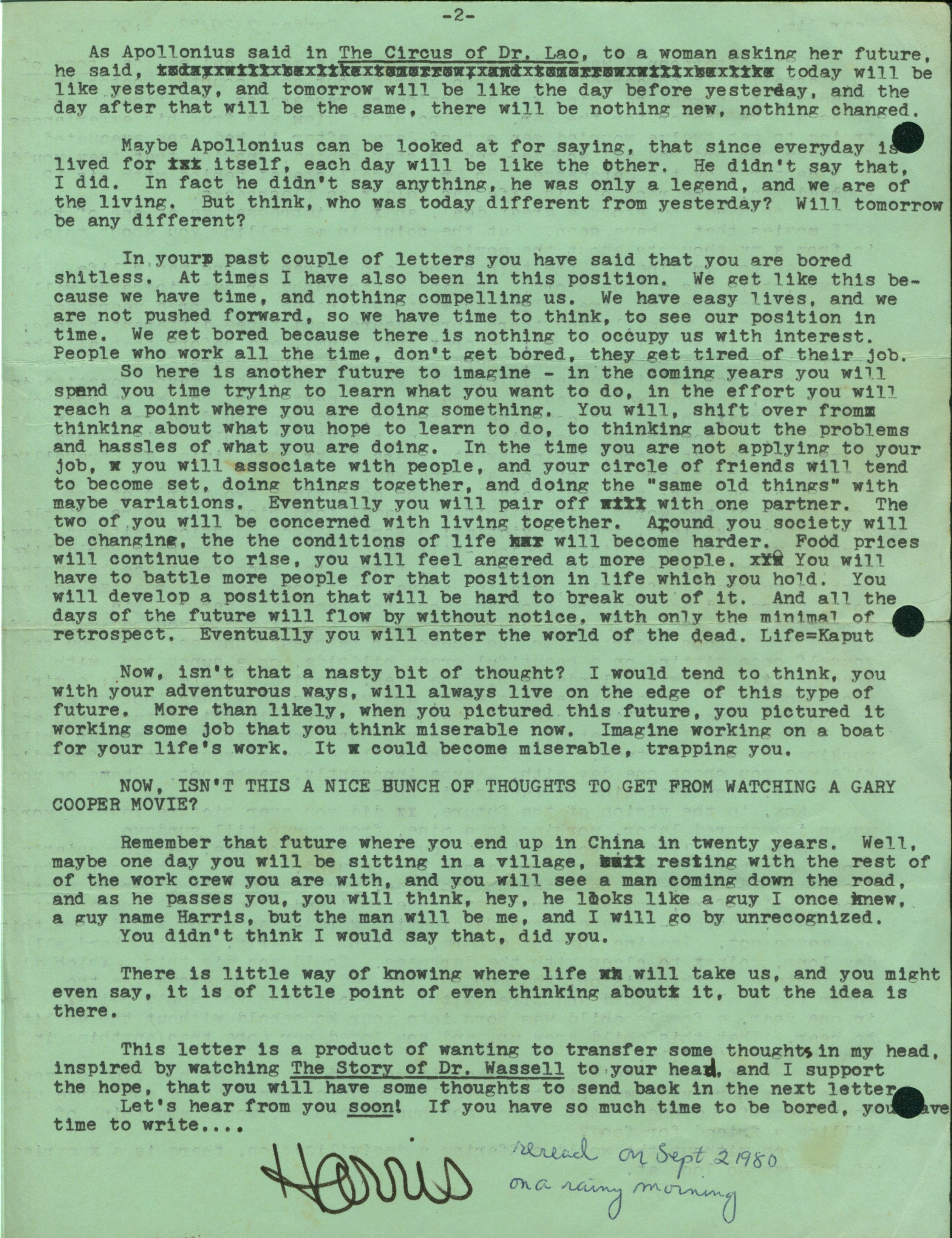
I have found one letter from 7/29/73 that I wrote Connell which he returned in 1980. I wrote Connell hundreds of pages of letters, which he kept in a box, but his mother threw out sometime in the 1970s. I’d give anything to have that box now. Here’s the letter:
There’s something woo-woo in that letter. In the third-to-the-last paragraph on page one, I asked Connell to imagine a future where he has a daughter born deaf. Connell’s stepdaughter went deaf several years ago after having to take some major antibiotics.
This letter is also weird because it sounds like me now. But then I was trying to imagine the future and now I’m trying to reconstruct the past.
I had Connell read the letter to see what he remembered. He didn’t remember the letter but he thought we thought many more thoughts per second back then than we do now because the letter impressed him with my stream of ideas.
I don’t remember taking any photographs from 1973. I don’t think I owned a camera. That really limits my recall.
A day later I remembered that not only did I own a camera, but so did Greg Bridges and John Williamson. That we had built a darkroom, in the living-room closet at the house on Eastview and considered ourselves amateur photographers. I still don’t think we took pictures of ourselves. We were all into nature photography and macro photography. I did take several rolls of film using Carol as my model. Plus we made super8mm movies. Williamson was into various creative hobbies and even made silkscreen images. He made a silkscreen cover for my SAPS apazine After the Goldrush. I through all that out in my later Buddhist phase.
I’m now out of physical evidence to prove my existence in 1973. Wikipedia’s timeline of major events of 1973 triggers little for me. Neither the 1972-73 nor 1973-74 TV schedule triggers any memories. I’m not sure we watched TV at the Eastview house or even owned a TV.
In my letter above I review a movie. I can’t remember where I watched it. I sometimes rode my bike over to my mother’s house to watch TV there. Today I had a vague memory of a black and white TV in an old wooden cabinet sitting in a tiny living room that had one ugly couch. This memory was in black and white. All my memories of that Eastview living room are in black and white. I think it must have been dark and dingy.
In this post about 50 albums from 1973, I remember many of them, but most of them I bought later. The only ones I think I bought in 1973 were Brothers and Sisters by the Allman Brothers Band, ‘Pronounced ‘Leh-‘nerd ‘Skin-‘nerd’ by Lynyrd Skynyrd, Over-Nite Sensation by Frank Zappa and the Mothers of Invention, Goodbye Yellow Brick Road by Elton John, and Piano Man by Billy Joel.
I was able to verify going to a few concerts by recalling them and verifying the dates on the internet. Carol Suter and I went to see Elton John on October 11, 1973, at the Mid-South Coliseum for the Goodbye Yellow Brick Road tour. We also saw him one other time, but I can’t remember if it was in 1972 or 1974. Carol hurt my feelings because she said she would go with me to see Billy Joel during the Piano Man when he was at Lafeyette’s for several days but then went with someone else. I now wished I had seen Billy Joel before he was famous.
I also saw Frank Zappa twice during the 1970s. He was in Memphis in March of 1973, but I can’t verify I was at that concert, but I think it was around the time of Over-Night Sensation. I and my friends went to a lot of concerts during these years. It seemed like every week some big act would perform, often two or three at a time. And the tickets were less than ten dollars back then.
If I would go to the library and look at the microfilm of the Commerical Appeal for 1973 I could verify all those concerts probably. I might even dredge up some other 1973 events I remembered or attended.
Here are the most remembered science fiction books from 1973. I don’t remember reading any of them during that year. Greg and I were both science fiction collectors. I’m pretty sure I subscribed to F&SF that year because I had collected over 200 back issues. But I probably also subscribed to Galaxy, Analog, Amazing, and Fantastic. I also remember building several large bookcases for my collection. They were the same size as a sheet of 1/4″ plywood. I used 1 x 8-inch planks for the shelves and plywood for the backing. They were huge. Greg used giant metal shelves in his room. We even had bookcases in the hall and living room.
Greg and I also published fanzines, traded fanzines, and subscribed to fanzines. Our favorite was Richard Geis’s Science Fiction Review. A few years ago I bought most of them again on eBay and scanned them for the Internet Archive. Probably if I reread the 1973 issues it would trigger many memories.
A memory that came to me on the second day of writing this essay was about my Raleigh 3-speed bicycle. I didn’t have a car that year. When I needed a car I’d ride my bike over to my mom’s house and borrow her car. I rode that bike all over Memphis. Once, and I don’t remember when I visited Connell in Miami and he told me to bring my bike on the airline. I did. And we rode it all over Coconut Grove, where I used to live. I loved that bike. I have no idea what happened to it. That saddens me.
Well, this research is running too long for a blog post, but I think you get the idea. We can remember a lot. Especially if we have triggers. I often have vivid memories of the past pop into my head unbidden. It makes me wonder if everything is recorded and if the bottleneck is the mechanism of recall.
I’m sure if I kept at this experiment I could write a whole book about memory and what I could eventually remember from 1973. I doubt many would want to read it. I’m not even sure anyone will want to read all that I’ve written here. Most people don’t seem very interested in remembering the past. I even know people who say they intentionally try to forget the past and throw away anything that makes them recall it. That horrifies me. I hate that I went through that Buddhist phase.
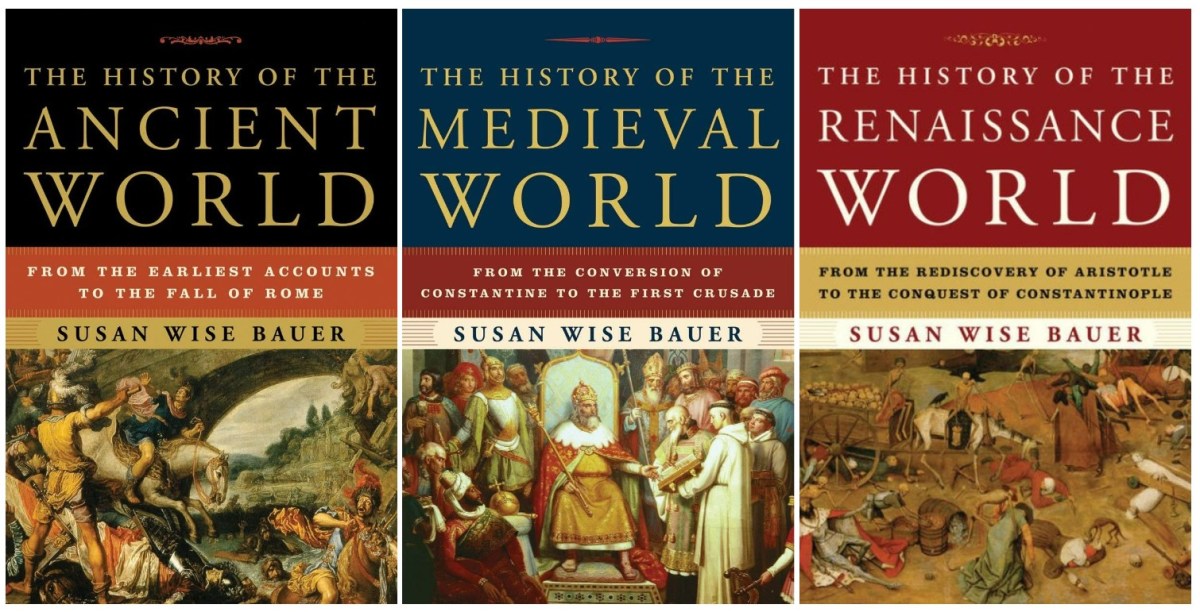
I’m not going to try and review Susan Wise Bauer’s three-volume history of the world. It’s just too much. I’m just going to give you my impression of what they are like and let you decide if you want to read them. I got all three audiobooks on sale at Audible and at least one of the Kindle editions on sale, maybe two. So if you want to try one, wait for a sale. Although, I sort of wish I had gotten the hardback editions too. I find I actually read more if I listen to audiobook editions or read Kindle editions, but the hardbacks would let me just dip back into them from time to time.
Here are their titles. Their subtitles are more accurate than the main titles. Links are to the Kindle edition.
First off, I knew very little of the history that Bauer presents. However, and this is a huge warning, it’s nearly all about wars, conquests, rulers, and reigns. If you like history with a story or interpretation, these books aren’t for you. It’s just the facts mam. And it’s relentless. It took me most of 2022 to get through seventy hours of audiobook listening because I could only handle it in spurts. All three volumes equal the length of some audiobook versions of the King James version of the Bible.
On the other hand, I was very impressed with Bauer’s writing. It’s concise and fascinating. She often refers to period sources, which I liked a lot. And she would reference later art and literature that looks back on history. I was impressed by how much poets and artists from the 18th and 19th centuries knew about history. We just aren’t the classical scholars people used to be.
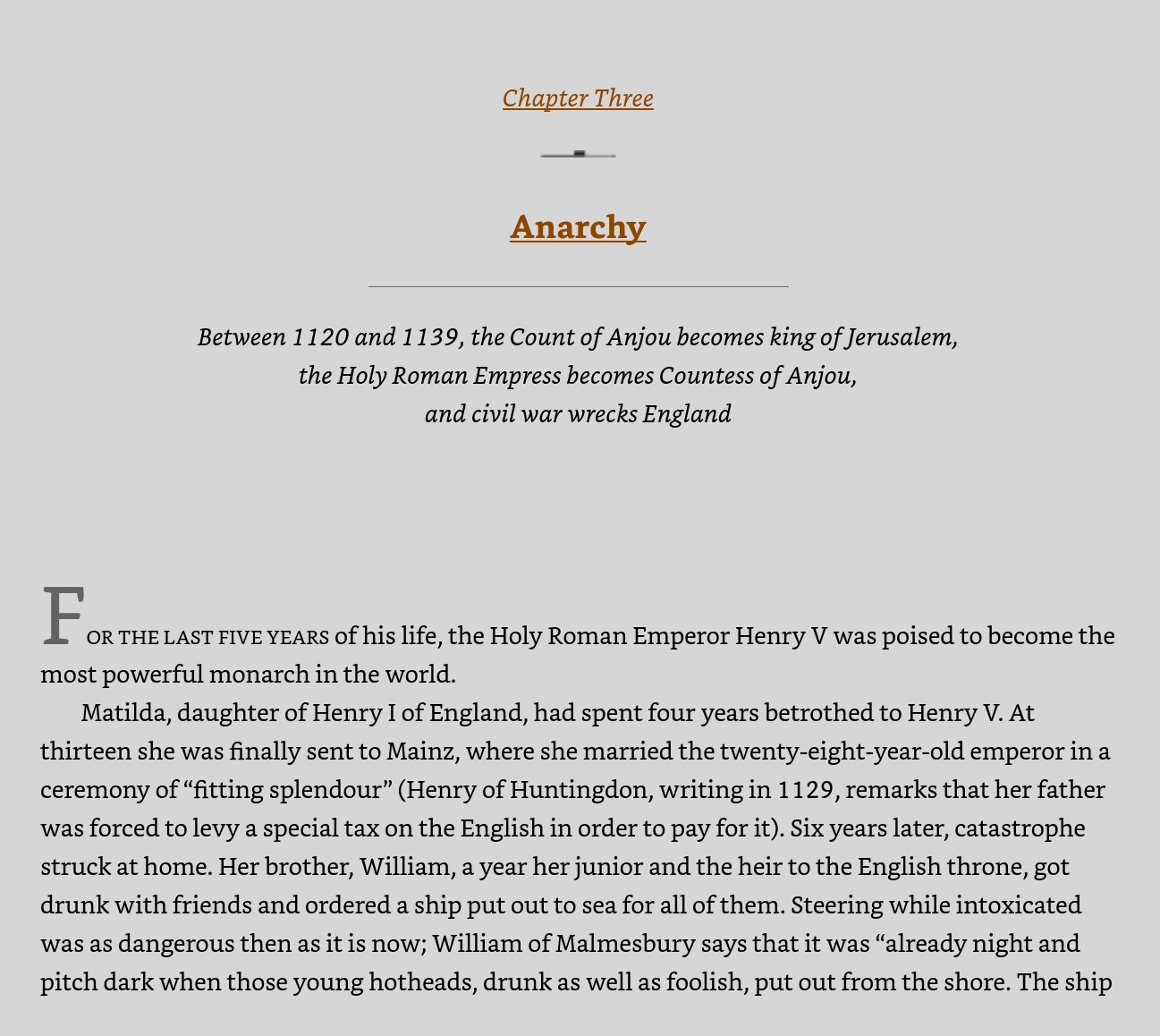
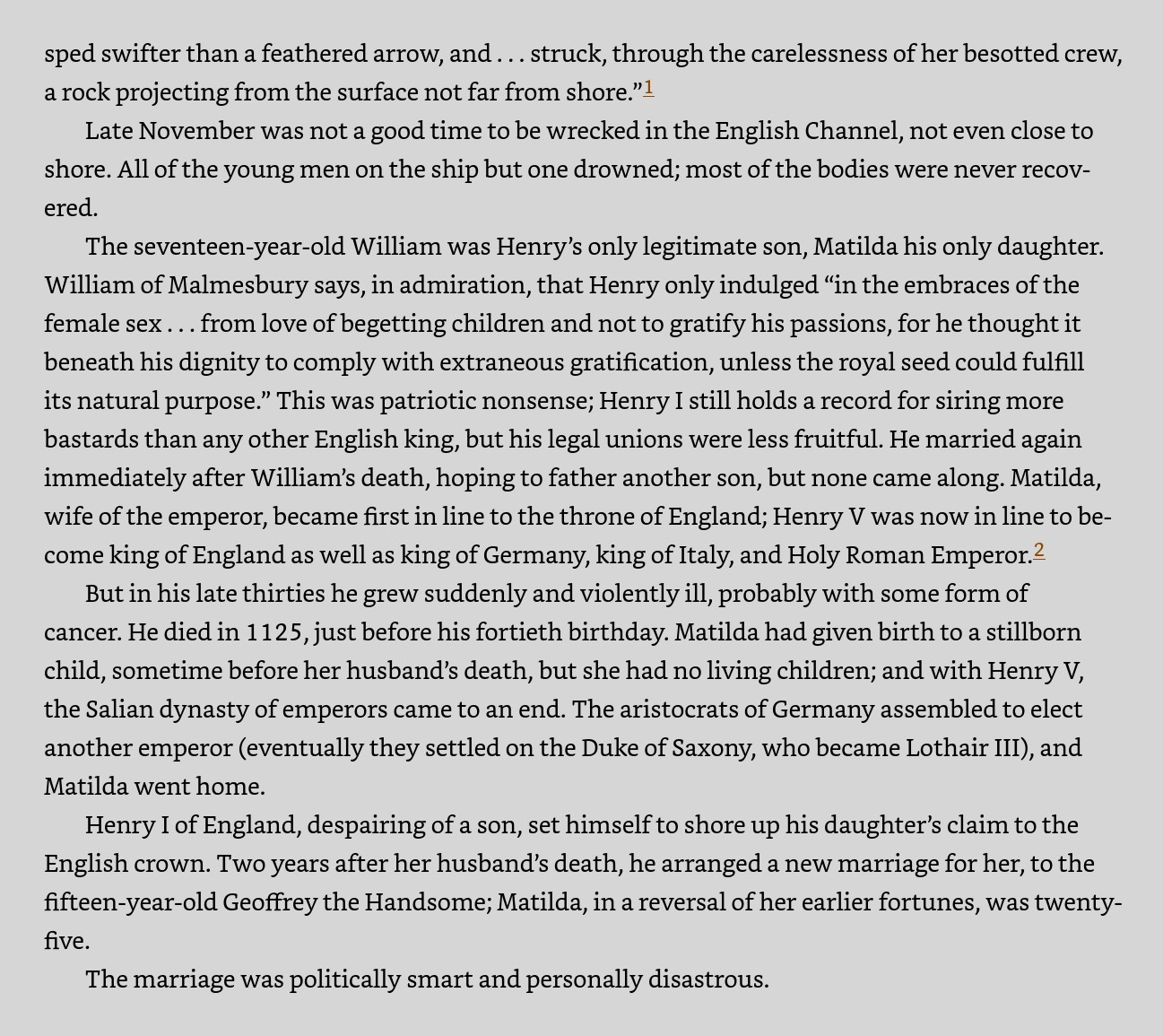
Here is a sample from The History of the Renaissance World to give you an idea of Bauer’s prose and focus.
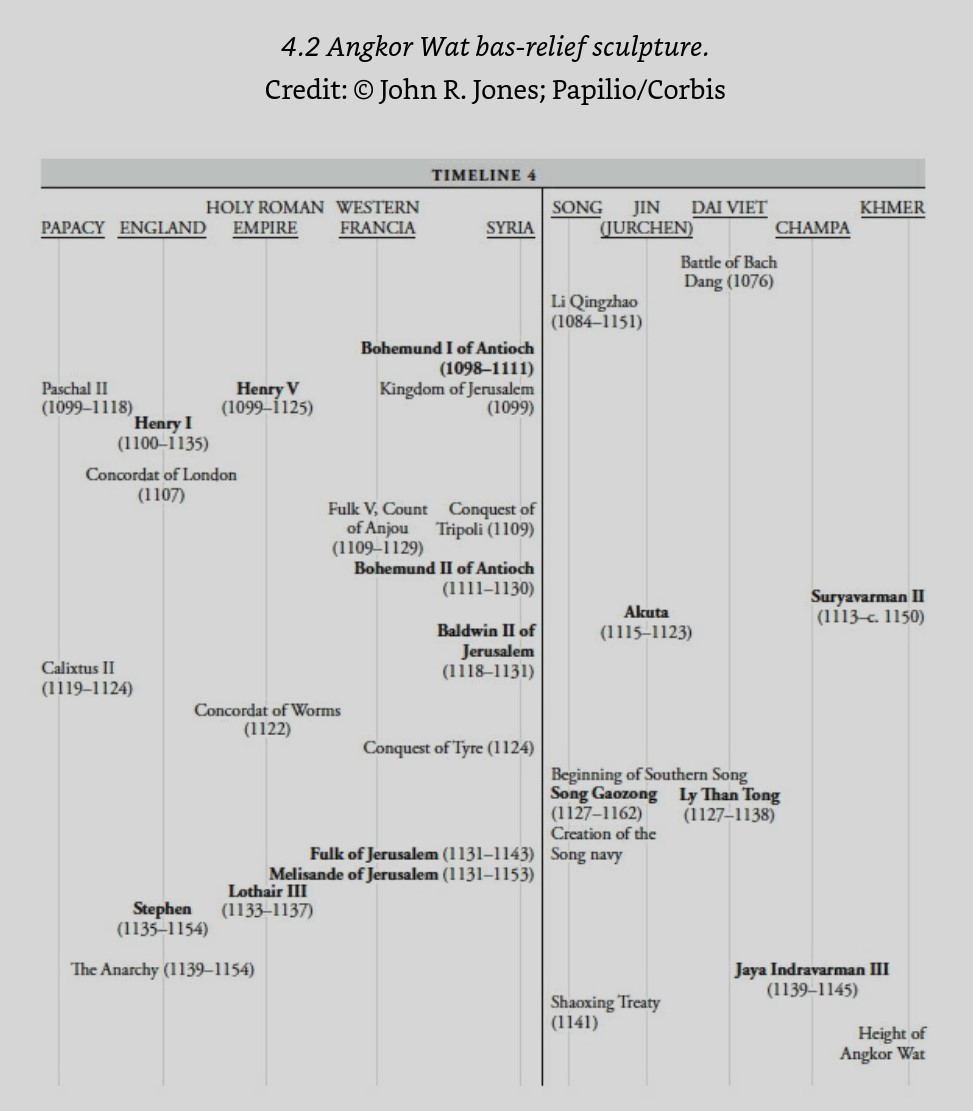
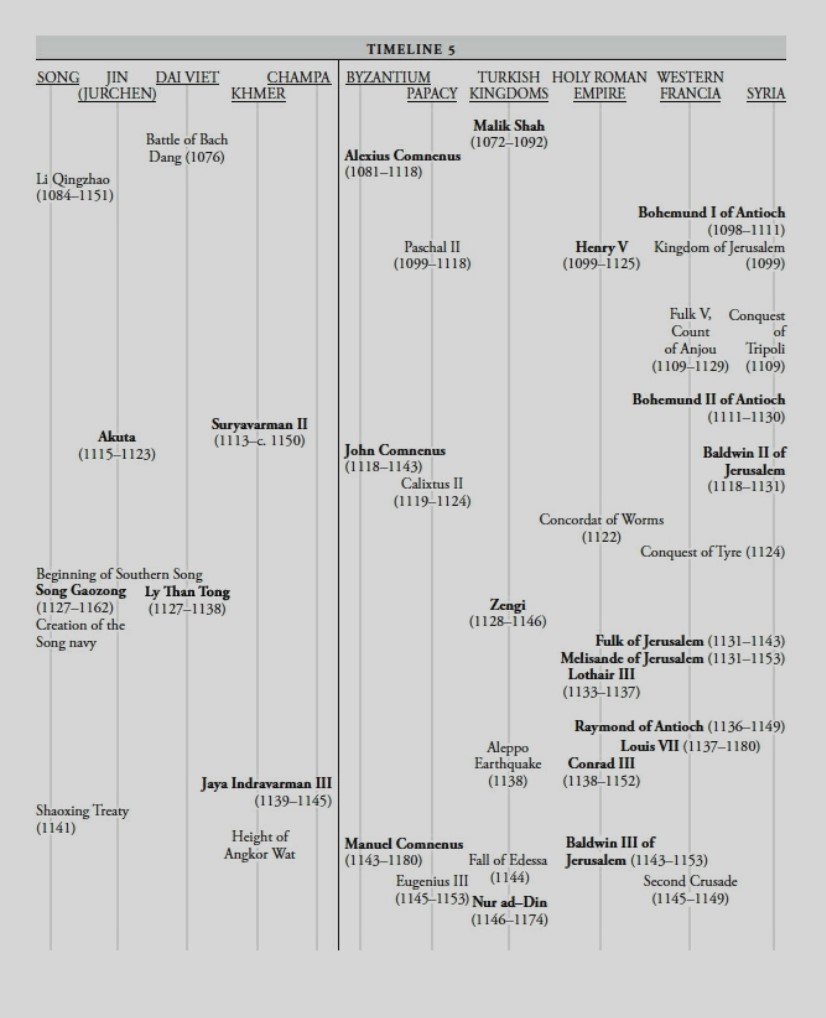
If you’ve ever been curious about all those Kings of England and France, then these books are for you. Another reason why I like Bauer’s history books is she covers more than the Western world. She jumps to the East and the New World too. Here are two timelines for a sample of how she jumps around. If you note the years, you’ll see that she almost goes year by year. These cover just a few chapters in the Renaissance book.
And each mention on the timelines mostly leads to a short game-of-thrones-like conflict. Human history is amazingly like HBO’s Game of Thrones. However, the TV show is much less violent and evil compared to history. And that’s the main takeaway I got from reading these three volumes of history. Most of humanity throughout history has suffered from the ambitions of a few. The people of history that have led us have nearly always led us into suffering. There are no “Great” leaders in history even if they have been bestowed that title.
I know there is a movement among conservatives to fight what’s called Critical Race Theory being taught in schools. Conservatives don’t want their children to feel bad about themselves. Well, they shouldn’t read any history then. Anyone who idolizes any leader from the past, or glorifies any era is deluding themselves. Anyone who gets easily depressed should not read these books or any history books that cover history honestly.
That’s another lesson from reading these books. We glamorize history. If you compare the movies made about the Crusades or the Middle Ages to what really happen, you realize we’re lying to ourselves. Knights and crusaders were not nice people and were definitely not chivalrous. Heroes are not what we think. Joseph Campbell was full of bullshit when he described the mythology by the hero. So was Tolkien. If you feel romantic about any story dealing with aristocracy then you are fooling yourself.
We have whitewashed history so thoroughly that many people long for the past. The whole heroic fantasy industry is just childish make-believe. Even dark violent fantasies like Game of Thrones are clean and nice in comparison to history. If Hollywood made films based on Bauer’s history books and filmed things as they happened I doubt few people could psychologically handle them.
I can’t say I recommend Bauer’s History of the World series. I’m glad I read them. I might even read them again. Many have recommended we study history so we won’t repeat it. After reading these books I’m now confident we can’t break out of the loop.
When I was a kid I wanted to know the truth. Obviously, we can’t handle the truth. I keep trying. Studying history is like pistol-whipping myself to handle a little more truth. I face reality in tiny bits and then run back to escapist hiding, but I always poke my head out once in a while for a little bit more of reality.
Now that I’ve read these books I’m going to go hide for a while.





 Auxiliary Memory