Should I Forget Dorothy?

by James Wallace Harris, Monday, February 17, 2020

Being part of history is the gold standard for being long remembered. Pop culture fame can also get you remembered, but not as long. Geneology is probably the common way we ordinary folks will be remembered, especially if we’re neither historical or famous. Writers and artists often like to believe they will achieve immortality through their works, and that was certainly true for Homer, Shakespeare, Austen, and Dickens. Sadly, being published today usually proves a poor bet at avoiding literary obscurity.

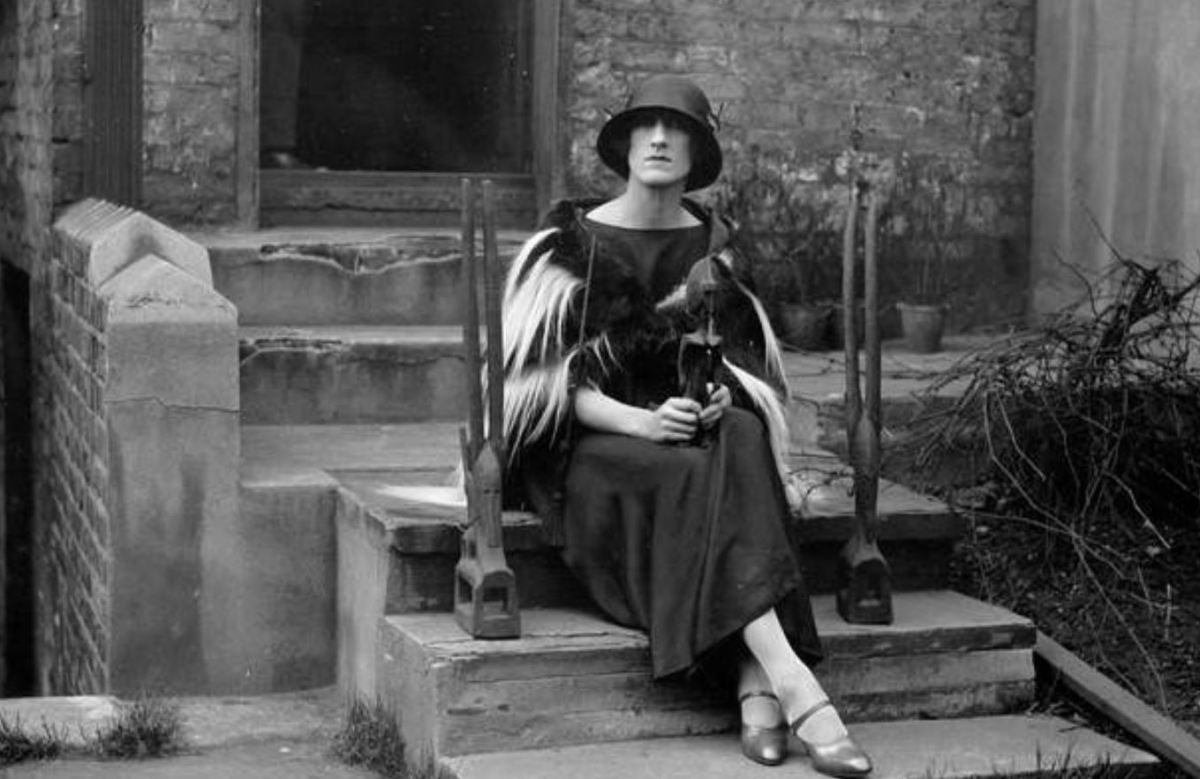
Through some weird accident of circumstances, I have become the repository for the memory for Dorothy Rachel Melissa Walpole who wrote under the name Lady Dorothy Mills. I maintain the website ladydorothymills.com. Last year it got a total of 175 visitors, but most of them leave almost immediately. It’s a very static site because I seldom find new information about her. I used to get a query about her every year or two, but it’s been years now since I’ve heard from anyone asking about Lady Mills.

Lady Dorothy Mills wrote fifteen books from 1916-1931, nine novels, and six nonfiction books, all long out of print. I own all of them except her first novel Card Houses and the last Jungle!. She is most famous for writing five travel books capitalizing on the idea of an aristocratic European woman traveling alone in Africa, South America, and the Middle East in the 1920s. She achieved a minor amount of fame. As far as I can tell only 26 used copies of her books are for sale right now, and most of those are the nonfiction titles. Of the 5 copies of her novels, two are the German versions of The Dark Gods. Most of these volumes have been on the market for years. There is little interest in her work.

I’m trying to decide if it’s worth my effort to convert her books into digital texts so I can submit them to Project Gutenberg. It would be a terrific amount of work and its doubtful anyone would read them. But I’d hate to see Lady Mills become completely forgotten. I’ve been trying to come up with reasons to convince people to try her books. Right now it’s almost impossible to get ahold of any kind of edition to read. I’ve wondered if there were free ebook editions available would a few readers give her a chance?

I’m currently reading The Laughter of Fools from 1920. It’s about a young woman living with her aunt and uncle after her father dies. I’m not sure of the time period yet, but you have to imagine a Downton Abbey type of setting. Lady Mills was the daughter of an Earl and grew up in a manor house on a country estate. I assume her life was somewhat like Crawley girls, as Lady Mills was about their age. She would have been 23 in 1912, the year the story began. Lady Mills’ mother was also a rich American woman. However, Lady Mills married a poor American man, and from what I can infer, her father wasn’t as forgiving as Lord Grantham. Lady Mills went out into the world to make it own her own.

The girl in The Laughter of Fools is named Louise, and Lady Mills’ mother was named Louise. I have to wonder how much of herself she put in this character. Louise finds life with her aunt and uncle boring and eventually gets permission to go on a vacation for her health. Her guardians believe she is being supervised by a proper English lady, but Louise gets to run around with an arty bohemian crowd. This opens up a whole new world for her. I imagine the same thing happened to Lady Mills.

I wish I had a copy of Lady Mills’ first novel, Card Houses published in 1916. That was the year she married Capt. Arthur Mills. It might reveal more about her early life and personality. I get the feeling her first few novels were about the life she knew and that social set, and her later novels were fantasy or science fiction. Her travel books were about becoming an independent woman.

I can’t say that The Laughter of Fools is good literature. I only find it interesting for four reasons. First and primary, I’m looking for clues about Lady Mills. Second, I enjoy the Downton Abbey resonating vibes. Third, it tells about life in England during a very literary period — the book adds a few details that I don’t find in Woolf, Huxley, Forster, and others of that era. Finally, it’s about a woman breaking free in a time when few did. But mostly the novel’s appeal is trying to figure out what Lady Dorothy Mills was like and why she became a writer.

I still don’t know what kind of person she was. Would I have liked her? Or was she a weirdo, or even a Lady Asshole? Does she deserve to be remembered or is there a reason why everyone is forgetting her? I feel like I’ve fed a stray cat and now I’m responsible for its care.

Small items about her come up for sale every once in a while but they can be expensive. And if I really wanted to pursue this project properly I’d need to travel to England and do some real research. That is almost not going to happen. Still, I might try converting one book, The Laughter of Fools and see if anyone reads it. It would be nice to see if anyone else gets anything out of her. Sooner or later, I’d like to find a younger person to inherit the caretaking of this strange cat.

JWH


Can Humanity Move to an Eco-Paradigm?

by James Wallace Harris, Sunday, February 9, 2020

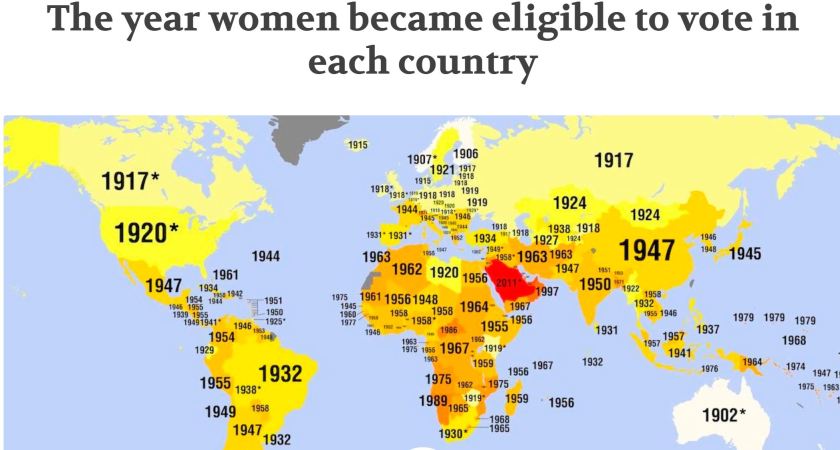
Humanity has gone through a number of major paradigm shifts. Probably the most famous is the Copernican revolution when we realized Earth wasn’t the center of the universe. I’m guessing the biggest recent shift was in the 20th century when we realized women were not inferior to men. But as you can see from this map of when women became eligible to vote that a paradigm shift is slow and doesn’t hit all at once. (Source.)

When women could vote

We need to shift to a new economic paradigm where capitalism protects the environment. Many environmentalists feel we need to jettison capitalism to save the Earth, but I don’t believe that’s possible. Capitalism is how humans survive, how they feed, clothe, and shelter themselves. Current capitalism is killing the Earth, and will eventually make the planet uninhabitable for ourselves and other species.

The present paradigm assumes the Earth is a storehouse of consumable resources for the taking. Our basic drive, which comes from our reptilian and mammalian portions of our brain pushes us to take and not give. We struggle for resources, mates, and raising our offspring. It’s quite natural. The greed we’re seeing in conservative political movements around the world is a natural survival mechanism. Everyone is programmed to grab all they can before its gone.

It really is survival of the fittest on a vast scale. Under the existing paradigm, the strong will survive with abundance while they take everything from the weak who won’t. Like I said, it’s the way of nature, it is natural — if you consider humans are animals. But can we transcend our animal nature? Can we use our neo-cortex to become something different? Moving to an Eco-paradigm means transcending our animal nature.

For our species to survive will require moving to this new paradigm. Some have called it Lifeboat Earth. That’s an apt metaphor, but most people don’t like its grim connotations. Probably a better term to promote would be Eco-Capitalism. That’s why we’re hearing so much about the Green New Deal.

My liberal friends and I are becoming philosophically depressed over current trends in American politics. Conservative American politics means many things, but to me, it represents a rejection of the new paradigm. Conservative philosophy has always been backward-facing, stay-the-course, return to the good old days thinking. To protect its beliefs, conservative philosophy has become anti-science, and anti-environmentalism.

I see the U.S. 2020 presidential election as a referendum, with two choices on the ballot. Keep the old paradigm, or move to the new paradigm. I’m sure most voters will see it in terms of their own special interests.

The reason why I wrote my last essay about cognitive tools we used to work with reality is to understand how people think about this referendum. The Republicans have clearly defined what they want, but the Democrats haven’t. Most liberals just want to replace Trump, but obviously, Republicans will do anything to get what they want, including following such a repugnant leader. Democrats are arguing over who should be their leader, and not what they want. They are under the illusion they are fighting Trump, but what they are fighting is what the Republicans want. And what the Republicans want is not to change.

The world seemed to be moving to the new Eco-paradigm but then conservative movements around the globe emerged. My philosophical question of the day: Can humanity move to the new Eco-paradigm? I’m not asking will we, but can we.

When we look at the map of women’s suffrage and see that it took a hundred years to change (and it’s far from finished), that I have to wonder if it will take any less time to move to the new eco-paradigm. (And do we have the time?)

The Atlantic is running “Why Men Vote for Republicans, and Women Vote for Democrats” that provides some additional data for my conundrum. It appears that women are a driving force in liberal politics. We are changing, but are we changing fast enough? And like the backlash against the Equal Rights Amendment by conservative women, many women have chosen to maintain a conservative path.

I’ve been reading more and more articles about political burn-out. That old adage about not letting the bastards wear you down has new relevance. I know that I and some of my liberal friends are being worn down. This makes me feel we won’t make it to the new paradigm.

The 2020 election will give me exact numbers on how my fellow citizens feel. We still have ten months of political turmoil. Who knows, lots could happen. Liberals want it to be a vote about Trump, but I’m starting to see that’s an illusion. The Republicans have clearly defined what they want. The majority of the conservatives want a world where they can grab all the can, keep all they can, have no regulations on the grabbing, and spend the least on fixing up the nation or helping the needy. A minority of conservatives want to fight for certain religious beliefs that challenge liberal values.

The Democrats don’t have a clear goal. To the Republicans all the Democrats want is to give way their money. The Democrats haven’t made a Green New Deal their primary goal. They spend a lot of time talking about the environment and immigration, but they appear to make expensive social programs their deciding issues, and some of those issues don’t even have universal appeal to liberals. Republicans know their key desires and vote in lockstep.

I believe the young are more concerned with the new eco-paradigm, but I’m afraid too many of them have completely given up on political action.

Right now, I don’t believe we’ll make it to the new paradigm shift. I suppose if we suffered some truly catastrophic natural disasters, way larger in scope than the present disasters, we might start pulling together. But that might only cause more fighting in the lifeboat.

Readers might think I’m psychologically depressed because of this essay. I’m not. I might be philosophically down, but not personally down. I have a stoic existential psyche. What happens is what happens. We all want reality to be what we want, but our reality is what is. I’m just trying to guess where humankind is going. I want to imagine what the future might be after I die. But guessing the future is next to impossible. Yet, it amuses me to try.

JWH


What A Difference 23 Years Make

by James Wallace Harris, Thursday, October 31, 2019

Society is constantly changing and evolving, and so does the popular culture it produces. Starting in 1959, and into the early 1960s, there were a number of court cases that profoundly changed pop-culture by removing various censorship laws. It allowed movies to portray graphic sex and violence, and include nudity and profanity. This was especially noticeable in movie westerns. Westerns in the 1950s seem very different from those in the 1970s, and we can see the transitioning in the 1960s. Millennials and later generations probably have no idea what pop-culture was like before their time, and just accept today’s movies as a norm. If you live long enough, you can see that movies change.

My favorite westerns generally come from the 1940s and 1950s. The other night I watched The Missouri Breaks (1976) with Jack Nicholson and Marlon Brando which had a much different view of the old west. In many ways it was more realistic – we see people going to outhouses, using profanity, having sex, showing a bit of nudity, wearing dirty raggedy clothes, and so on. The characters seem more like real people and have complex problems and psychologies. Too often in older westerns, characters wore not only clean clothes which they changed often, but ones that look like they came from fashion designers. Most folks in the historical west wore the same clothes for many days, seldom bathed, and usually owned a tiny wardrobe. Just compare the two versions of True Grit.

Living conditions in The Missouri Breaks seemed repulsive to me, and it lacked heroes and heroines. It’s not a feel-good western, like Shane (1953).  Who wouldn’t want to be Shane (Alan Ladd), who would want to be Robert E. Lee Clayton (Marlon Brando)? Of course, Brando’s over-the-top performance does weird-out the overall vibe of The Missouri Breaks, but then such characterizations have become more common as we approach the present day. The recent Joker movie is one example.

If we compare the west of Shane with The Missouri Breaks does it even feel like the same historical era? Is it really the same genre? There are violent people in both films because the essence of westerns is violence. You’d think I should be comparing the two characters the audience wants to see die in the end, Jack Wilson (Jack Palance) and Robert E. Lee Clayton. Both films feature ranchers who hire gunmen (Palance and Brando) but the issue of who the good guys are is confused. In Shane, the good guys are hardworking homesteaders, and in The Missouri Breaks, they are horse thieves, train robbers, and maybe murderers. If we are for law and order, then David Braxton (John McLiam) the rancher and Robert E. Lee Clayton should be our heroes. They’re not.

Remember in Shane, Shane is a gunman just like Jack Wilson, but he’s trying to change, and live under law and order. Shane is the homesteaders’ gunman, but he’s the hero of the picture because he fights the rancher who bullies the homesteaders. Shane sides with law and order. Robert E. Lee Clayton is hired by the rancher to kill rustlers and murderers and appears to be for law and order. The trouble is Clayton takes psychotic pleasure in his job.

What happened in those 23 years from 1953 to 1976 that remade westerns? Shane is a killer, but one we side with. In The Missouri Breaks, we side with Tom Logan (Jack Nicholson) who is a horse thief, train robber, and probably killer too. (We never know who kills the rancher’s foreman.) Of course, in westerns, the audience always sides with a killer, because westerns nearly always resolve conflicts with a killing. Before the 1960s we sided with the white hats against the black hats, but it seems sometimes in the 1960s, everyone started wearing gray hats.

Shane, the Alan Ladd character, knows killing is bad. He wants to avoid killing, but in the end, he is pushed into it to save the people he loves. The audience admires him. But Robert E. Lee Clayton, the Marlon Brando character, delights in killing and justifies his behavior by killing horse thieves, train robbers, and murderers, people we should be against, but we despise Robert E. Lee Clayton and rejoice when he is killed. And in the last fifty years, we’ve seen both the hero/anti-hero and bad guys kill more and more people in westerns. Brando’s bizarre performance was only a bellwether.

Tom Logan, the Jack Nicholson character, is an anti-hero. Yet, even when anti-heroes are as charming as Robert Redford and Paul Newman in Butch Cassidy and the Sundance Kid (1969), should we really like and admire them? It is true that the old west criminals were more colorful than dull hardworking people who actually built the west.

Something happened to the westerns in the 1960s. Before that the good people were nicer, but so were the bad people. Sure, the bad guys of the old west were mean, and psycho killers too, but they weren’t as disturbing as modern bad guys. Between the westerns of the 1950s and the 1970s, we see the bodies counts rise in each film, and we see more depraved violence. The profanity, nudity, and sex are the upfront obvious differences, but I also think there is a shift in how westerns present killing. Intentionally modern westerns of the 1970s like McCabe and Mrs. Miller, Pat Garrett and Billy the Kid, Little Big Man, A Man Called Horse, Judge Roy Bean, etc. worked hard to redefine the western in terms of artistic storytelling but also in presenting old west history with a different psychological perspective. In some ways, this shift became most visible with Once Upon a Time in the West (1968).

When did good guys v. bad guys become neurotics v. psychos? When did westerns go from gunfights to serials killers and mass shooters? In the Old West, the most famous gunfight (O.K. Corral) three men died. In modern westerns, the body counts are so high that most viewers stop counting.

Sure, TV cowboys of the 1950s did a lot more killing than their movie counterparts. By one estimate, Marshall Dillon in Gunsmoke killed between 138 men and 7 women to 303 people over a 20-year period. However, if we consider each episode a separate story, the violence is far less.

Maybe I like the westerns of the 1940s and 1950s because I find the death of the bad guy at the end of the film a satisfying resolution to the story. Watching modern westerns feel more like we’re Romans at the Colosseum, desiring non-stop killing. We’re not there for the story, but for the slaughter. Films like the Hateful 8 are designed to feed our need for gunplay porn. If people watch sex porn because they’re not getting laid and want to vicarious pretend having sex, then why do we enjoy so many killings in movies today? Is it because we’re not getting to kill all the people we want and vicariously find release in the pretend killings?

I believe body counts began to escalate in the westerns of the 1960s, starting with The Magnificent Seven (1960) and ending with The Wild Bunch (1969). I still loved these westerns, especially as a kid, and even when I felt they were becoming silly in their efforts to top themselves with gimmicky plots, explosions, and ways of killing people. However, as I’m getting older, I question my fondness for such killathon westerns. I admit I love TV shows like Breaking Bad, Game of Thrones, and Westworld, but I’m also wondering about myself too.

Westerns 1

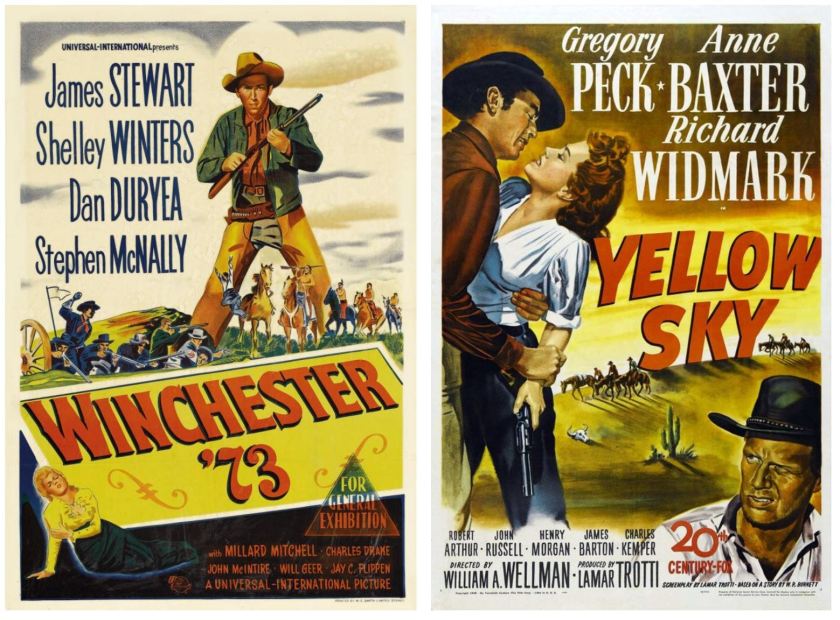
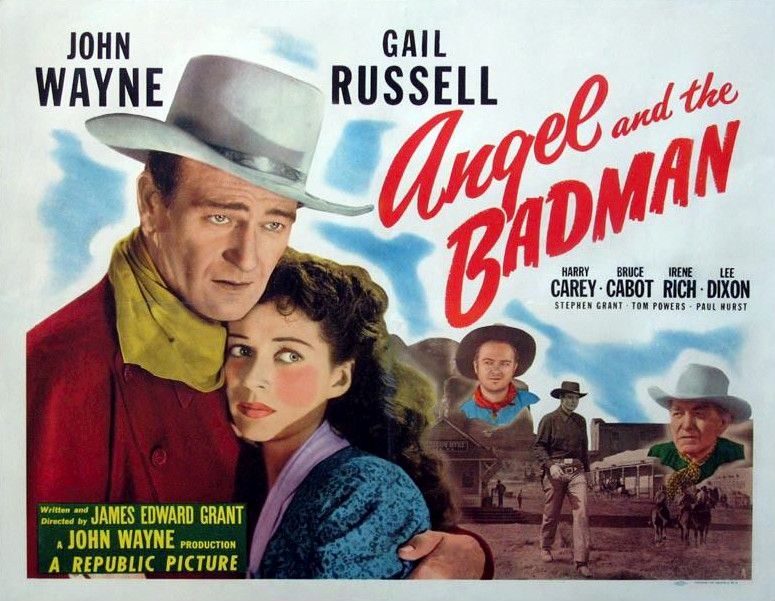
These days I’d much rather rewatch Winchester ’73, Yellow Sky, Colorado Territory, Rawhide, Angel and the Badman, Shane, Three Godfathers, Tall in the Saddle, and movies like them. I don’t know if it’s nostalgia, or turning back the clock to enjoy movies when there were fewer killings per film. I was taught in school that the ancient Greeks didn’t allow violence on stage in their plays. All violence had to happen off-stage. I’m not ready to go that far. I do like the realism of modern westerns. The sex, nudity, and profanity are fine. I’ve just got to wonder about the kill-porn addiction we’ve acquired.

Angel_badman

We have become a nation that worships guns. Notice how often we see people posing with guns, and how often we see them in pop culture. The interesting thing about westerns is we see a historical era where people lived by the gun but were moving toward a gun-free civilization. Westerns represent a time just before all the cowboys would hang up their guns. (Watch the wonderful Angel and the Badman.) We’re now living in a time where everyone wants to strap on a gun. Is this the undoing of civilization?

Isn’t it rather ironic that in the old west, Republicans were the advocates for gun control? They were for laws, regulations, order, progress, cities, and civilization back in the 19th century. Doesn’t it seem they want to bring back the wild west now? Aren’t old westerns really propaganda for gun control? In some ways, new westerns seem to counter the philosophy of old westerns.

But then we have one last problem. Were any westerns ever like the historical west? Or, are westerns really the pop culture snapshots of the people and times in which they were made? If that’s so, we live in some pretty strange times if we judge ourselves by the movies we see in the theaters today.

JWH

Maybe Common Assumptions Are Wrong

by James Wallace Harris, Thursday, October 10, 2019

We make a lot of assumptions that we believe are true. That life will get better. That our children will have more than we did. That every kid should go to college and achieve all their dreams. That technology will solve our ecological problems. That humanity is destined to spread across space and colonize the galaxy. Overall, we think positive and assume we have unlimited potential. But what if these are false assumptions?

Today on Mike Brotherton’s Facebook page he linked to “Humans will not ‘migrate’ to other planets, Nobel winner says.” Brotherton is a professor of science and a science fiction author and he didn’t like what Michel Mayor said about our chances of interstellar travel. Whenever scientists, including some science fiction fans, question our final frontier destiny, many science fiction fans will quote Arthur C. Clarke’s famous Three Laws:

  1. When a distinguished but elderly scientist states that something is possible, he is almost certainly right. When he states that something is impossible, he is very probably wrong.
  2. The only way of discovering the limits of the possible is to venture a little way past them into the impossible.
  3. Any sufficiently advanced technology is indistinguishable from magic.

It’s their trump card to play against any skepticism about an unlimited future. The common assumption among science fiction fans is we’re destined to colonize the galaxy and we’ll overcome all the obstacles of physics to do so. There are no limits to our hubris. I had faith in that space travel destiny when I was young but I’m losing it in my old age.

What if belief in a Star Trek destiny is delusional? What if our species is destined to always live on Earth, or maybe colonize Mars, a few moons, and build some space habitats? Why is it so important to believe we’ll eventually create a galactic civilization? Why is it so important to believe humans have unlimited potential when everything in this reality has limitations? Are science fiction fans behaving like the faithful believing in miracles?

The more we study the problems of space travel the more it seems an unlikely enterprise for biological creatures. However, space seems perfect for robots with artificial intelligence. Maybe our children won’t colonize space, but our digital descendants will.

If you study history it’s obvious that things constantly change. Even in my life much has changed. It’s hard to predict anything. I replied to Brotherton that I thought the odds are 99.99999% we won’t colonize exoplanets. He said, show my work. I wish I could. I’m not like Mayor, I’m not saying it won’t happen, but my hunch is it’s very unlikely. I’m not good at math, but I think my reply suggests 1 chance in 100,000,000. One in a hundred million events happen. It’s like winning a big lottery. So maybe, I was being overly optimistic. I probably should have added two or three more nines. All I can say is after a lifetime of reading about how hard interstellar travel will be, and how hard it is for the human body to adapt to an environment that it wasn’t designed for, my gut hunch is our species is destined to live out its entire existence on Earth. That means most space opera is no more scientific than Tolkien.

I feel that’s a crushing thought to science fiction fans. I assume it’s like Christians hearing from atheists that God and heaven don’t exist. I didn’t take to Christianity when growing up but embraced science fiction as my religion. I’m now becoming an atheist to my religion. However, I am getting old, and skepticism clouds my thoughts. I no longer believe free-market capitalism is sustainable. I no longer believe every kid should go to college. I no longer believe our children should be bigger consumers than we were. Our species is very adaptable. I think whatever changes increased CO2 brings we’ll adapt. I also believe our human nature doesn’t change, so I also expect we’ll keep consuming everything in sight even though it will lead to our self-destruction.

We’re about to reach the limits of growth by our current methods of growing. That doesn’t mean we won’t adapt to a new way of growing. If the world doesn’t need seven billion people with college degrees we’ll find out what it does need. If Earth can’t handle seven billion people all living the American standard of living, we’ll adapt to something new too. Humans might even adapt to living in microgravity or in lower and higher 1G gravity. We might even create life extension or cold sleep allowing for slow travel to the stars. It’s technically possible to get humans to another star system, but the odds are going to be tremendous. It’s not a given. I don’t think Mike Brotherton realized a 99.99999% chance is like a person winning a billion-dollar Lotto jackpot. It has happened.

Quoting Clarke’s Third law is no more valid than saying “Believing in Jesus will get you to heaven.” Faith does not change reality. Clarke’s laws aren’t science, but hunches, like my figure of doubt. From everything we know now, migrating to other planets is an extreme long shot. We can’t calculate the odds, but any figure we give should be daunting. Anyone assuming it’s 100% to happen is in just as much scientific statistical trouble as saying it’s a 100% chance it won’t happen.

I’m just a doubter. In my old age, I realize now that if science fiction wanted to be more positive, more enlightened, and more encouraging, it should imagine how our species could live on Earth without going anywhere. Even if a few of us go to the stars, most of us will stay here. Dreaming of greener pastures on the far side of Orion might not be our ultimate destiny. Maybe our final frontier is figuring out how to live on Earth.

JWH


The Uneducated Unkindness of Youth Censoring the Past

by James Wallace Harris, Wednesday, September 25, 2019

Yesterday I read, “The Cult Books That Have Lost Their Cool” by Hephzibah Anderson at the BBC online. Anderson snidely dismisses several novels that were considered classics by my generation. Of course, when I was young I was just as quick to dismiss the works my parents loved. History has shown us that revolutionaries tend to eliminate people and art that don’t meet the standards of the new zeal. As an old person, and evidently part of an old guard, I’m seeing more of my history dismissed, causing artists and artists to disappear from pop-culture consciousness. It feels like agism censorship.

I can accept that the young have judged us harshly and found us morally wanting. What annoys me is they don’t have any sympathy for human frailty, and quite often I feel their social media kangaroo courts are conducted without examining the actual evidence. Take for example Anderson’s assessment of Jack Kerouac’s On the Road:

Based on a road trip from New York to Mexico with Beat muse Neal Cassady, Kerouac wrote what would become the Beatnik’s bible in just three weeks. It took six years to get published and more than half a century later, it exudes tiresome stoner machismo. Kerouac pokes fun at gay people, and isn’t much better where women and black people are concerned. A few years back, a spate of books and films inspired only a flicker of revived interest in his legacy. Boorish egotist or inspired prophet? The jury isn’t just out, it left the building long ago, dancing after the hippies who supplanted the Beats.

I can’t believe Anderson has even read the book. She says Kerouac pokes fun at gay people, but of the three main characters, Kerouac is straight, Ginsberg is gay, and Cassady is happy to have sex with almost anyone. And these men practically worship black jazz musicians. Kerouac hardly takes a machismo stance. He portrays himself with endless faults and emotional weaknesses. Kerouac was like Proust, he struggled to make sense of his life by fictionalizing it. The term beat deals with Kerouac’s existential angst over living in the 1940s and early 1950s. On the Road is about seeking freedom from an oppressive materialistic society. Anderson assumes it is some kind of bro road epic. If anything, Kerouac portrays the beats as Quixotic figures tilting at windmills. It’s a realistic portrait of the times, of men, women, gays, minorities, Mexicans, ethnic groups, and so on. It’s a sad, beat story about looking for kicks and being kicked down. It’s not pretty, but it is honest. Anderson has no sympathy for Kerouac’s suffering and struggle.

Nor is Anderson sympathetic to The Catcher in the Rye by J. D. Salinger:

Poor Holden Caulfield. Mired in a funk for more than half a century, the angst-ridden ‘everyteen’ is now regarded by the cool kids as being a bit – well, self-indulgent. His ennui is, if not exclusively a rich-white-boy problem, then certainly nothing compared with looming climate collapse and other woes weighing on the minds of his 21st-Century peers. Plus, in the era of helicopter parenting and geo-tagging, not to mention hyper-vigilant mental-health awareness, the idea that a depressed teen could simply go Awol in New York City for a couple of days is increasingly hard to indulge.

Just because Kerouac and Holden Caulfield don’t meet modern moral standards of 21st-century young people they are shunned and ridiculed. But here’s the thing, every generation is different. Should we erase the past because it’s different? Sure these people are morally and ethically wanting by today’s higher consciousness, but they are still human beings trying to make sense of life by what they knew at the time. The point of reading old books is to understand the past, to see it for what it was, not what we want it to be.

Dismissing Kerouac or Sallinger is cold and callous. Dismissing these writers is a kind of censoring the past. You can’t perfect the present by erasing the past. The ironic thing is Kerouac and Sallinger were revolutionaries like Anderson, wanting young readers to know that the times were changing. Of course, they did their own rejecting of the past too. That’s how it goes. But it’s better to see the bigger picture.

I wonder how Anderson will feel when she’s my age and someone her age now dismisses the cherished art and artists that shaped her generation?

I don’t really expect things to change. I always felt sorry for Kerouac. Kerouac and my father lived about the same years and died young from alcoholism. I wrote an essay years ago called “The Ghosts That Haunt Me” about Mark Twain, Jack Kerouac, Louisa May Alcott, and Philip K. Dick. These writers had painful lives, but they were outstanding in their soulful writing trying to make sense of those lives. It pisses me off that someone would blithely dismiss them for being uncool. I’m also sensitive about forgotten authors – see my page for Lady Dorothy Mills who has practically disappeared. It just seems hurtful to me that any writer would encourage readers to stop reading any author.

To be honest, I was like Anderson when I first read Kerouac when I was young. I thought it was a novel about thrills. But with every decade of life On the Road changes. I’ve been on the road for more years than Kerouac ever got to live. It takes a long time to really understand what beat means. Hephzibah, don’t be so quick to dismiss On the Road. Read it again when you’re older.

JWH