2022 Book #4 – The Horse The Wheel and Language by David W. Anthony

by James Wallace Harris, 1/26/22

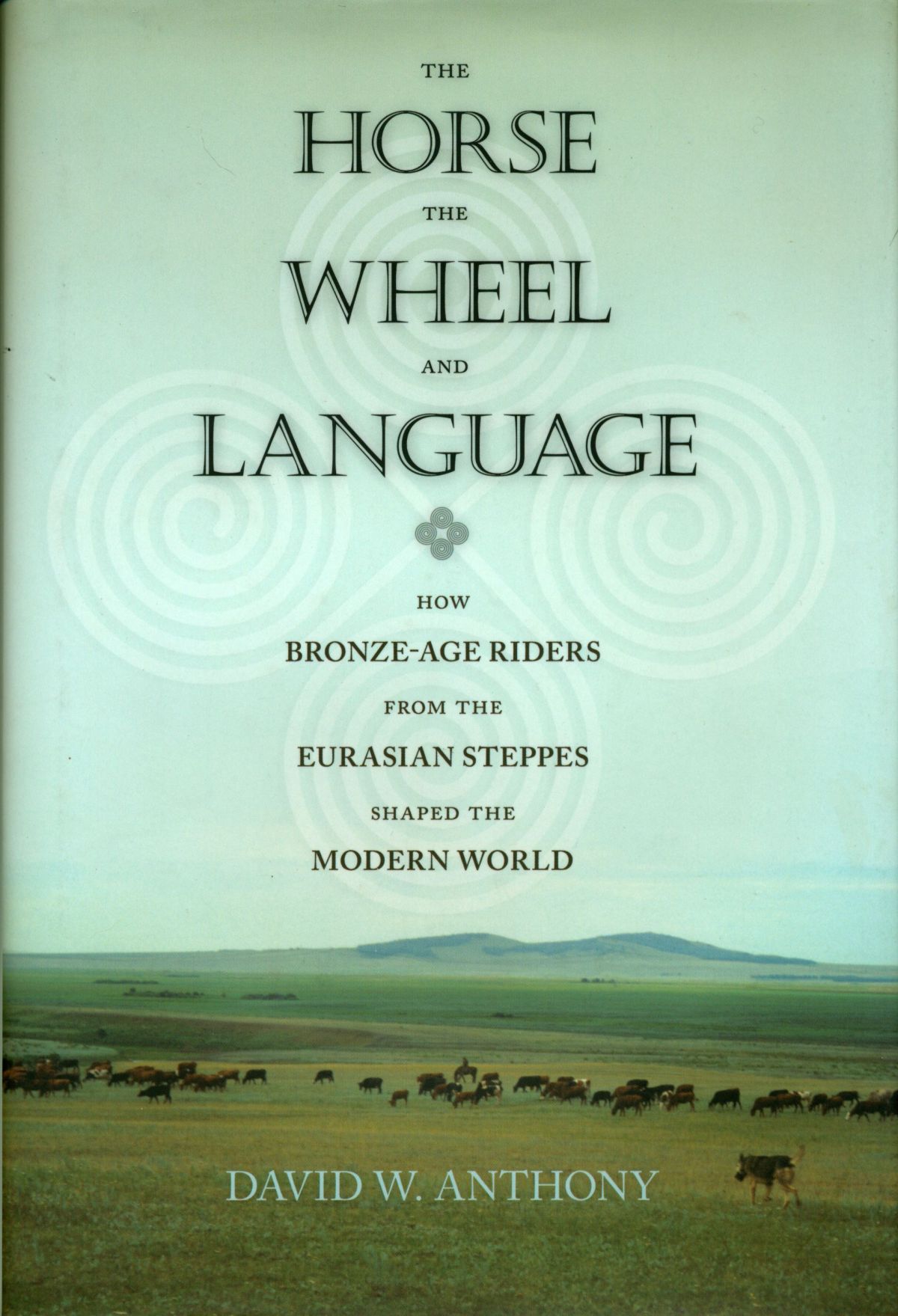
Reading about the past is calming my anxieties about the future. The Horse The Wheel and Language: How Bronze-Age Riders from the Eurasian Steppes Shaped the Modern World by David W. Anthony is not a book I recommend to the casual reader. I expected it to be a popular science book about archaeology, but it turned out to be something much heavier. It’s a scientific work, probably used as a supplemental textbook. I found listening and reading the book to be rewarding and inspiring but it’s not fun. However, it has caused me to do a lot of philosophical pondering.

I won’t try to describe the book, Wikipedia has done an extremely detailed job with hyperlinks. If you want to know what the book is like, here is Anthony giving a lecture. This is exactly like listening to the audiobook.

I bought this book years ago and never read it and gave it to the library book sale. Then I read a popular article about linguistic anthology and decided I wanted to try it again and found a used copy. Still, I didn’t read it. Finally, I found an audiobook version that made it more accessible. I’m glad I had the physical book to refer to, because of its many complex charts and illustrations. This was a rewarding read, but I just want people to know it’s real science, not even popular science, and the going is tough. It took me weeks to listen to it all. Mainly, I want to talk about how I reacted to the book.

For years I’ve been troubled, even disturbed that our species lack real effort to combat climate change. For almost thirty years I’ve been waiting for governments and citizens to change their ways. I now realize that was naive of me. People don’t change. Not that I’ve given up complete hope, but all the evidence tells me our global civilization will never do anything significant about climate change.

That has inspired some existential insights. I expected humanity to grab control of reality and do everything it could to freeze the environment to its 1850-1950 weather patterns and maintain that as a steady-state forever. Once I started studying archaeology I realized that weather has always been changing over our species lifetime, and even for the whole lifetime of the Earth. Humans have always adapted to new weather patterns. It’s probably too fantastic to think we’ll control the weather.

Reading The Horse The Wheel and Language showed that humans have never stayed the same either. We’re constantly changing. Civilizations come and go all the time. Reading and watching documentaries about history and archaeology is teaching me that change is constant. That old saying, “the only thing constant is death and taxes” is true.

On its own specific subject The Horse The Wheel and Language is fascinating, but like I said, I not going to recommend you run out and buy it. Most of it is one giant infodump describing several societies around the Russian Steppes from about 4000-1200 BCE. The most interesting chapters were the early ones about the Indo-European languages and how linguists infer what the Proto-Indo-European language was like, and more specifically to this book, where in the world did the speakers of the Proto-Indo-European language lived.

Anthony claims by looking at the array of words in an ancient language and comparing it to the array of objects that archeologists have unearthed, we might pinpoint where those people could have lived. For example, if a language has the word for a wagon, but no wagons are ever found, it’s a not likely match. Or if a language has a lot of words for raising sheep, and lots of sheep bones were found, we might be getting warm. Of course, it’s much more complicated than that. For example, linguists can show how words from adjacent civilizations have passed into a language. I found all this fascinating, but overwhelming.

This is why the words Horse and Wheel are in the title. Only certain early civilizations had horses and wheels. For a long time, horses were only hunted for food. Then they were domesticated for food. Then came riding horses, and finally using horses to pull carts, then wagons. This made me think about how we’ll adapt to climate change. We’ll invent housing, clothing, lifestyles, jobs, political parties, etc. to adapt.

One thing I was amazed to learn was just how many different groups of people existed in a small area in prehistory that we know about. Most people when they think of ancient civilizations think of Egyptians, Babylonians, Greeks, Persians, and a few others. To me, the Russian Steppes and nearby lands sounded like North America before Columbus with countless tribes of nomadic and agrarian peoples.

For a while when reading the book I thought of making a timeline/list of civilizations to memorize but I soon realized that could become a lifetime project. I’ve ordered an archaeology textbook to help me get a bigger picture, but I’m not sure how big of a picture I can manage. Reading this book also made me crave maps, so I ordered a couple of atlases.

Many of these early civilizations lasted hundreds or even thousands of years. That made me think about how often world maps have changed in my lifetime. If the United States of America doesn’t make it to its 300th birthday it won’t be alone. All the descriptions of past changes of civilizations due to climate change, war, technology, disease, etc., make me wonder about what America might be like in the 22nd century. I now understand we can’t keep the weather of the 1950s forever, or the politics of the 1790s, or the technology of the 2020s.

About 85 million people died in the decade before I was born due to WWII, or about 3% of the world’s population. We’ve already put enough CO2 in the atmosphere to kill that many or more by the end of this century. Since we’re not going to stop adding CO2 anytime soon, billions will probably die in the 22nd century. Percentage-wise, civilizations have seen that kind of population reduction before.

I believe conservatives wanted to preserve the social climate of the 1950s, while liberals wanted to keep the weather environment of the 1950s. Neither will get what they want. All the demographics on Americans and America will be so much different in the 22nd century that we wouldn’t recognize either.

I need to stop speculating or worrying so about the future. Studying the past is philosophical liberating for me, but I’m not sure how much I should pursue it either, but I will. Living in the now is what’s important. And that’s why most people don’t worry about the future. I doubt for most of humanity’s existence the future was even a concept. I also assume the reason why so many people embrace various forms of denial is they don’t want to know the future because deep down they fear change. But change is coming. We can’t stop it.

JWH

2022 Book #2 – Bewilderment by Richard Powers

by James Wallace Harris, 1/16/21

I often wonder how young people today feel about the future. The only way to have hope is through massive acts of denial. Susan and I never had children, so I don’t know what it’s like to answer their questions as they grow up. Do you lie? Do you hide the news? What do you tell them about the metal detectors in the schools? How do you explain our handling of pandemics or climate change? What do you teach your kids about race relations and the politics of hate? What do you tell your kids about the thousands of failures we are facing as a society?

This is the core of the new novel by Richard Powers. Bewilderment is about raising a nine-year-old kid with emotional problems. He’s probably on the autism spectrum but is very high functioning. He probably has other learning disorders, but nothing is definite. He has trouble in school and his teachers want to medicate him with powerful psychoactive drugs. He has hair-trigger tantrums. His mother has died. How would you cope with such a kid? To make matters worse, the setting is the near future where things have gotten even worse than today. Imagine what the U.S. would be like if Trump was on his third term.

Bewilderment is not marketed as science fiction, but it’s set slightly into the future and talks about technology that might be possible soon. The story often references science fiction and uses its techniques, so I do consider it a science fiction novel. It’s the most gut-wrenching science fiction novel since Flowers for Algernon. If that novel wrecked you emotionally, you might not want to read this one. I found this one even more emotionally devastating.

Theo Byrne is the widower father of Robin (Robbie), a nine-year-old boy who is smart enough to know that humanity is on an insane self-destructive path and he can’t stop asking why. Robbie relentlessly wonders why his father, his teachers, or any of the adults he meets don’t act rationally. Robbie acts out, sometimes violently, sometimes in tantrums, demanding truth and honesty. Robbie is the one sighted person in the land of the blind. Robbie is the person we should all be. And Theo is constantly at his wit’s end trying to help his son.

Teachers want to control Robbie with psychoactive meds, and Theo is looking for any solution but that. Theo is a great dad. He constantly tries to engage Robin in insightful learning. Theo has two tools for calming Robbie. One, he calls on his memory of reading 2,000 paperback science fiction novels for engaging stories to divert Robbie from his meltdowns. Second, Theo is a scientist developing simulations of exoplanets for the day a new space telescope will be launched. He gets Robbie involved in these possible worlds that could be discovered soon. The basis of Theo’s work is to develop as many simulations as he can, so when the telescope detects certain conditions with an exoplanet they can match it to the simulations and quickly understand what we might be seeing.

Theo uses his simulations to visualize being on other planets to engage Robbie’s attention. This works at times, but often it only fuels Robbie’s awareness of what we’re doing to the planet Earth. For a nine-year-old, Robin can extrapolate brilliantly. His bullshit detector never fails.

Bewilderment progresses through one year of Theo’s and Robin’s life. Robbie is obsessed with memories of his dead mother, who was a lawyer for all the save-the-world causes. It’s through learning about his mother that Robbie finds some hope of controlling his emotions.

Like I said, most people will not consider Bewilderment a real science fiction novel. Bewilderment doesn’t have spaceships, galactic empires, time travel, robots, or dystopias — well, other than our own. The reason I like to think of Bewilderment as a science fiction novel is it uses all the sense of wonder I grew up with to give us hope for the real future we’re about to enter.

Unfortunately, Bewilderment shows our science fiction dreams are going to fail us. Or more exactly, we are going to fail them. The rap sheet for our species is long. The list of what we’re destroying grows every day. One of the things Richard Powers believes we’re destroying is our positive science fiction dreams. That like me, he worries about what hopes young people can still find in science fiction.

Science fiction has always been about hopes and fears regarding the future. What happens when science fiction only has fears to work with?

JWH

The Post-Doom Reading List

by James Wallace Harris, 12/23/21

I’m listening to a wonderful book right now, The Reading List by Sara Nisha Adams which came out in August. It’s set in London. Someone is going around leaving little notes that say:

Just in case you need it:

- To Kill a Mockingbird
- Rebecca
- The Kite Runner
- The Life of Pi
- Pride and Prejudice
- Little Women
- Beloved
- A Suitable Boy

The novel is about the people who find those lists, read the books, and how reading changed their lives. Any bookworm should love this book, and most Goodreads reviewers do. I highly recommend the audiobook version because the narrators do the ethnic accents which make the book extra charming.

This inspires me to create my own list of favorite feel-good novels. If I went around leaving a list of books for people to read in these trying times, my eight would be:

We’re living through some hard times and I appreciate books with characters who overcome big difficulties. I’m moving into what I call my Post-Doom Philosophy. I’ve concluded that humanity will not solve its existential problems. Just not in our nature. And it will be better to concentrate on uplifting outselves.

I’m reminded of The Myth of Sisyphus by Albert Camus. Our present situation is beyond absurd, one I can’t change. I accept that we’re already in a collapsing civilization, we just don’t know how long it will take before a new paradigm shift emerges. Some civilizations collapse in decades, Rome took centuries. Everyone eventually dies, and all civilizations eventually collapse. We can’t wish either away. We’ve always had the problem of what to do in our last years of life, and just by coincidence this century, we’ll also have to consider what to do in the last decades of our civilization. It’s an interesting philosophical and spiritual challenge.

Just because the future looks bleak we shouldn’t feel all gloom and doom.

My friend Linda and I have a two-person book club where we read mostly nonfiction books together and discuss them on the phone each Sunday afternoon. We’ve read many books about the problems of the world. Linda just texted me asking if we could avoid such books in 2022 and pick books like The Soul of the Octopus by Sy Montgomery. She wants more delightful books. I couldn’t agree more.

If you were making a list of eight nonfiction books to leave around to inspire people, what would they be? What would your list of favorite inspiring novels be?

JWH

Sometimes We Really Do Want More Government Regulations

by James Wallace Harris, 4/27/21

Please watch this fifteen minute video from NBC News. It is the most insightful news story I’ve encountered this year because it encapsulates many of the essential issues about the future.

This video illustrates why lack of regulations and resource management leads to ordinary citizens and the environment losing to big business. Corporations and people with money wanting to make more money are searching the globe for places where they can get any kind of competitive edge with their investments. Basically, big business and rich individuals will gentrify every last acre on the planet, pricing ordinary people off their land.

Southeast Arizona has very little surface water and rainfall. For decades homeowners, family owned farms and ranches, and towns have been sipping off the top of their aquifer. As long as rains replenish that aquifer, life in the desert is sustainable. However, global corporations have discovered this Arizona land is essentially unregulated and the water is there for the the price of sinking deeper wells. This makes it profitable for corporations from around the world to exploit this area. Raising hamburgers and cattle feed in the desert seems insane until you realize the real value of water.

Water is the new gold rush, and some locales are trading their water for jobs and investments. However, once that water is gone, that locale, that environment will die. Keep an eye on this trend. You’ll see it everywhere once you start looking.

As the corporations put millions into exploiting this land, drilling ever deeper into the aquifer, they have gained control of the land because ordinary people can’t afford to extend their wells deeper, and are thus force to sell out and move. Local control over land is going to disappear.

A kind of corruption is taking place. Politicians back the corporations because they follow the money. Notice how toady the politician is in this video. People who don’t own land and just want jobs align themselves with the corporations. And even though the corporations claim they are there for the long haul, the reality is they are there as long as they can make a profit. Once they suck the aquifer dry or it becomes too costly to pump that water out of the ground, they will leave.

This is happening all over the world. The long term results is the total land area that is sustainable for life on Earth is shrinking. The dynamics of what’s happening here also reveals various kinds of inequality in action. Ordinary people can’t compete. Neither can nature. Basically, outsiders with money have all the power. If the local government had regulations about land and water use they could preserve their old way of life. They could build a sustainable society. Corporations have played the democratic system to get what they want. Read Dark Money by Jane Meyer or Evil Geniuses by Kurt Anderson for fuller explanations.

Right now we have an exploitation society. The rules are simple. Anything you can do that others can’t stop you from doing, you can do. Individuals can’t compete against corporations. And since corporations are rigging the laws, there’s little people can do – unless people take back their democracy. But it might be too late. There is little demand for sustainability. Corporations want to make money, and individuals want jobs. Unless people can create jobs that coexist with sustainable economies, things won’t change.

When you watch this video think about the two opposing groups. On one hand, you have the global demand for meat and dairy, which includes all of us, and a few individuals who have been living in southeast Arizona for decades. Corporations just fulfill the global demand. But what if the global demand becomes greater for sustainability and the environment? We all have to want it, or it won’t happen.

JWH

Will We Reach Herd Intelligence Before We Crash Our Civilization?

by James Wallace Harris, 4/19/21

  • Collapsed: How Societies Choose to Fail or Succeed by Jared Diamond
  • Falter: Has the Human Game Begun to Play Itself Out? by Bill McKibben
  • Seaspiracy – a documentary on Netflix

All indicators point to the collapse of civilization sometimes this century. Despite all the press about this perfect storm of self destruction, few people are willing to worry, and even fewer willing to do anything. Must the conclusion be that failure is our only option?

Most of humanity is either preoccupied with personal problems, or if they contemplate the future at all, assume our species will muddle through as it always has in the past. All the evidence suggests otherwise, that the biosphere cannot absorb the impacts of Homo sapiens without a significant destabilization of its system, which in turn will alter the course of civilization.

Civilizations have always come and gone, and so have species. Nothing lasts forever, not even the Earth or the Sun. It’s rather disheartening to consider what we could have become. We almost had the intelligence to create a global civilization that could have lasted thousands, if not millions of years. Theoretically, we still have a chance, but few people who think about such things give that chance much hope. It would have required everyone pulling together towards a common cause, and we’re just not that kind of species.

However, don’t worry, don’t get depressed or do anything irrational. No need to become a prepper assuming an Armageddon is just around every corner. The collapse of civilization will probably be so slow you might not even notice it. Humans are very adaptable to hard times and excellent at rationalizing things aren’t what they seem. Just take every day one day at a time and enjoy the passing parade of history.

As an individual who reads many books and watch many documentaries like the ones above, I keep thinking we should be doing something. But I realize there’s a problem with that assumption. First, we all need to be doing the same thing, and second, we should all stop what we’ve been doing our whole lives. Now is that going to happen? Is humanity a ship that can be steered or a bullet on a trajectory? It really comes down to the Serenity Prayer,

God grant me the serenity to accept the things I cannot change,
Courage to change the things I can,
and Wisdom to know the difference.

It’s the last line that’s so hard to achieve. What can we change, and what can’t we change? Theoretically we could change everything in society if we could just change ourselves. Is it Pollyannaish to think we could, and fatalistic to think we can’t? I wonder if people have always believed in God just to redirect that burden of responsibility?

If you read the above books maybe you will also ask who is smart enough to understand and solve these problems? If we built giant AI minds that could think their way through these immense challenges, would we take their advice? Aren’t we too egotistical to listen? Or even if a God spoke directly to the world would we obey? I’m not sure that’s in our nature either.

Maybe the only path an individual can take and stay sane is learning to accept and endure. But that doesn’t seem to be the way either because too many people today are angry. Anger means still trying to control. If you watch the news pay attention to anger. Too many hate what’s happening to them. And it’s on both sides of the political spectrum. All the people who fight for freedom and all the people who want rules and regulations are motivated by anger. That’s what I dread about the collapse of civilization, living with all these angry people. And the only solution to that is find a place away from them, but that’s not really possible either, is it?

This is a strange book review. But I find it’s getting harder and harder to review books like these by talking about the issues they cover. I’m down to evaluating their emotional impact. The penultimate question is: Can we do anything? The answer is yes. The ultimate question is: Will we? I used to hope that was a yes too, but my faith is fading.

JWH