
by James Wallace Harris, Sunday, December 31, 2017
Last week I wrote “Blogging in the Classroom” but I don’t think I got my intended idea across. I’m going to try again. It’s been almost 60 years since I first learned to read and write. I imagine those skills are taught very differently today. And to be honest, I’m quite ignorant about what happens in 21st-century classrooms. That means my suggestions below could be completely impractical. However, I read several articles a day in The New York Times and Flipboard and often they are about the problems of education. Everyone wants to solve this problem, including me.
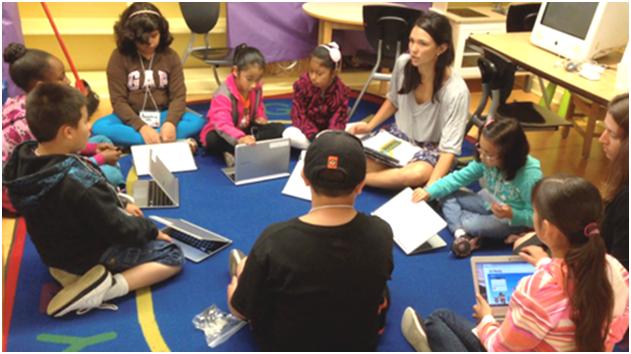
I am very fond of thought experiments. I love exploring “If I knew then what I know now.” I also love applying technology to problems, including social problems. What inspired my previous essay was “What if I had started blogging when I first learned to read and write back in the late 1950s?” I further refined that thought experiment to include: “What if all kids had to blog their homework, book reports, tests, papers, essays, etc. whenever they wrote something for their teacher that work was open to everyone in the class to read?” My theory was peer pressure would have made me try much harder. And I would have loved having a history of my educational progress. But I’m not sure if that essay got at the heart of what I was thinking. I thought I’d rewrite it and make my intent clearer. (Notice that I’m using blogging to improve my writing, self-expression, and how I organize and present my thoughts.)
A subset of educational goals includes:
- Getting students to become expert readers
- Getting students to become expert writers
- Getting students to master grammar, rhetoric, and logic
- Getting students to think for themselves
- Getting students to communicate abstract concepts clearly
- Getting students to learn on their own
- Getting students to learn how to teach others
Generally, this is done by a top-down teacher-student relationship. In modern times we work to get students to work cooperatively but the real focus is grades and test scores. Basically, we shovel knowledge at kids and then test them from time to time to see how much they retain. The reason I never liked school, nor was a good student, is because I never felt involved in the process. I never saw why I should cooperate with the educational system. Years later I learned why, but not while I was in school. And pleasing teachers or my parents was never an issue with me. I never had a mentor nor did my parents try to mentor me. I don’t know what percentage of students are like me, but what I’m going to suggest could motivate such kids.
Education has a lot of problems, mostly stemming from declining budgets and political attacks on the system. Plus, we expect children to learn too much. And we’re constantly trying to find one pedagogy that succeeds with all students. Then there’s the problem that we’re constantly experimenting without real evidence. And we throw way too much technology at the problem. Thus, I know what I’m suggesting is probably unwise. However, I would like to see more experiments with basic reading, writing, math, and science. I’m suggesting we use technology to do this. My whole experiment could be refashioned to use only paper and pencils but it would be slower. Humans have developed a symbiosis with computers and I think we need to accept that.
I believe the wild success of social media tells us a lot about educational psychology. We want to communicate. We want to be understood. We want acceptance. We want to be involved with other people with similar interests. For a planet with an overpopulation problem, too many people are lonely. We have a governmental system based on democracy, but we can’t reach any significant levels of agreement. And too much of our social interaction is based on anger, resentment, hatred, and that’s leading to more and more violence. We’re confrontational rather than cooperative. We’re narrow-minded rather than broadminded. We can only see our self-centered needs rather than empathetically understanding the needs of others. And most people have a poor grasp of reality, prone to embracing delusions.
What I propose is we switch students from handing in schoolwork to the teacher via paper and email, and instead post to their blog so that it’s public. I believe learning to read and write based on our fellow students’ efforts will improve our own and make us better human beings. Students should own their own blogs and not use school supplied blogging software. If students used their own blogs they’d be documenting their educational development for life. Students should sign up with WordPress, Blogger, or other international services and give their URLs to their teachers. Teachers should publish these links to all their students and require their students to read and comment on each other’s work.
All too often using blogging in the classroom is about teaching blogging. That by itself is of little educational value. Just another trendy effort to promote technology in schools. What I’m suggesting is teachers require students to take tests, do homework, write reports, all on their blogs, with the results be public. Grading can be private but I’m not sure if it’s even needed. Grades and standardized tests rank students unfairly and inaccurately, so why bother? What we really want is for each student to be the best person they can be by teaching every student that people have different talents and lack of talents. Failing at math doesn’t make you a dummy. It either means you lack a mental facility for math or you aren’t trying hard enough. Learning the limits of either is very important. Seeing how other people work will teach you about your own limitations and how to improve your best skills. We need to embrace the theory of multiple intelligences and recognize we’re not going to be great at all of them.
What we really want is for students to search for their talents and improve them. We want to teach them generalized learning skills that can be applied to any subject, talent, or endeavor. And I believe blogging can help do this. Peer pressure is very powerful. It can be cruel, but it can also be inspirational. If 25 students read what their 24 fellow students were doing it would show them far more possibilities than what one teacher can show them. We need to grow up knowing how other people think rather than constantly trying to figure out how to think for a test.
Let’s use an example. Let’s imagine the teacher posts this question on Friday afternoon: “Why did American go to the Moon in the 1960s?” When students first try this system, most will go to Wikipedia and write up a summary. On Monday the teacher can assign everyone to read everyone else’s essays and discuss the results. The teacher can show how easy efforts lead to simple thinking. The teacher can ask the students to look for unique or deeper interpretations. The teacher can guide the discussion about common ideas and dissenting opinions. The teacher can then assign the students to write another essay challenging students to find source material that no other student is likely to find. The teacher can tell the students to seek out complex and multi-plex explanations.
The goal of this assignment is to teach research and writing history. With every assignment, the goals of improving reading and writing will be involved. We will also be promoting thinking and writing clearly. Students will be encouraged to use statistics and infographics. Students will be encouraged to analyze each other’s motive for expressing a point-of-view. Students will be encouraged to debate each other’s results. Students will be encouraged to combine their research and collaborate. Students should be encouraged to find consensus they can agree upon, but with everyone playing the devil’s advocate. We need to teach about fake and false information. We also need to teach students how not to be intellectual bullies, trolls, and assholes.
Then the teacher should assign their students to write yet another version of this essay so that it competes and encompasses the results of the other students. The teacher should encourage students to write their best version — the one they want the world to read. Most writing classes I’ve taken only urge students to submit one draft. It’s very important to teach students to go through multiple drafts.
Students should be encouraged to critique each other’s writing but taught how to do it kindly. The goal is for each student is to have 25 mentors (24 fellow students and 1 teacher).
Blogging is hard and time-consuming, so I don’t know how practical it is to integrate into a standard curriculum. However, I do believe the 10,000-hour rule applies here. I would suggest one hour a day of essay writing and a couple hours a week reading/critiquing other students’ work. That should accumulate 10,000 hours from grade 3 to grade 12. If computers are available in the classroom I’d recommend typing in tests and other schoolwork and sometimes spending time on discussing other students’ work. A major educational goal is to learn how other people think through reading their work and how to think clearly yourself by writing for others.
Mastering typing and software tools lead to much faster writing and rewriting. I would allow grammar and spelling checkers because they constantly nag writers to improve on the basics. Using them are almost like playing video games because you want to beat them.
JWH
(Goodby 2017 – Hello 2018)


 “Reality is that which, when you stop believing in it, doesn’t go away.”

 Auxiliary Memory