Who, What, When, Where, Why, and How of Being

by James Wallace Harris, 2/15/25

At 73 I’m starting to feel I’m running out of time. I keep having this nagging thought I should have done something, or should be doing something before time runs out. But what? I am immensely grateful for existing but was I supposed to do something while I am or was here? Would knowing who I was explain what I was? Would knowing when and where I was explain how and why I got here? And would knowing all those answers reveal my existential duties?

I just finished reading Orbital by Samatha Harvey which recently won the 2024 Booker Prize. Orbital is the kind of novel that inspires the questions above.

The story is set a few years hence on the International Space Station just as we’re sending astronauts to the Moon again. The book doesn’t have a plot but is a beautiful description of working in space. Harvey’s novel concludes by conveying a tremendous sense of wonder inspired by Carl Sagan’s Cosmic Calendar (large version). The Cosmic Calendar compares the timeline of the universe to one year. Everything since the Scientific Revolution would have happened in the last second of the Cosmic Calendar.
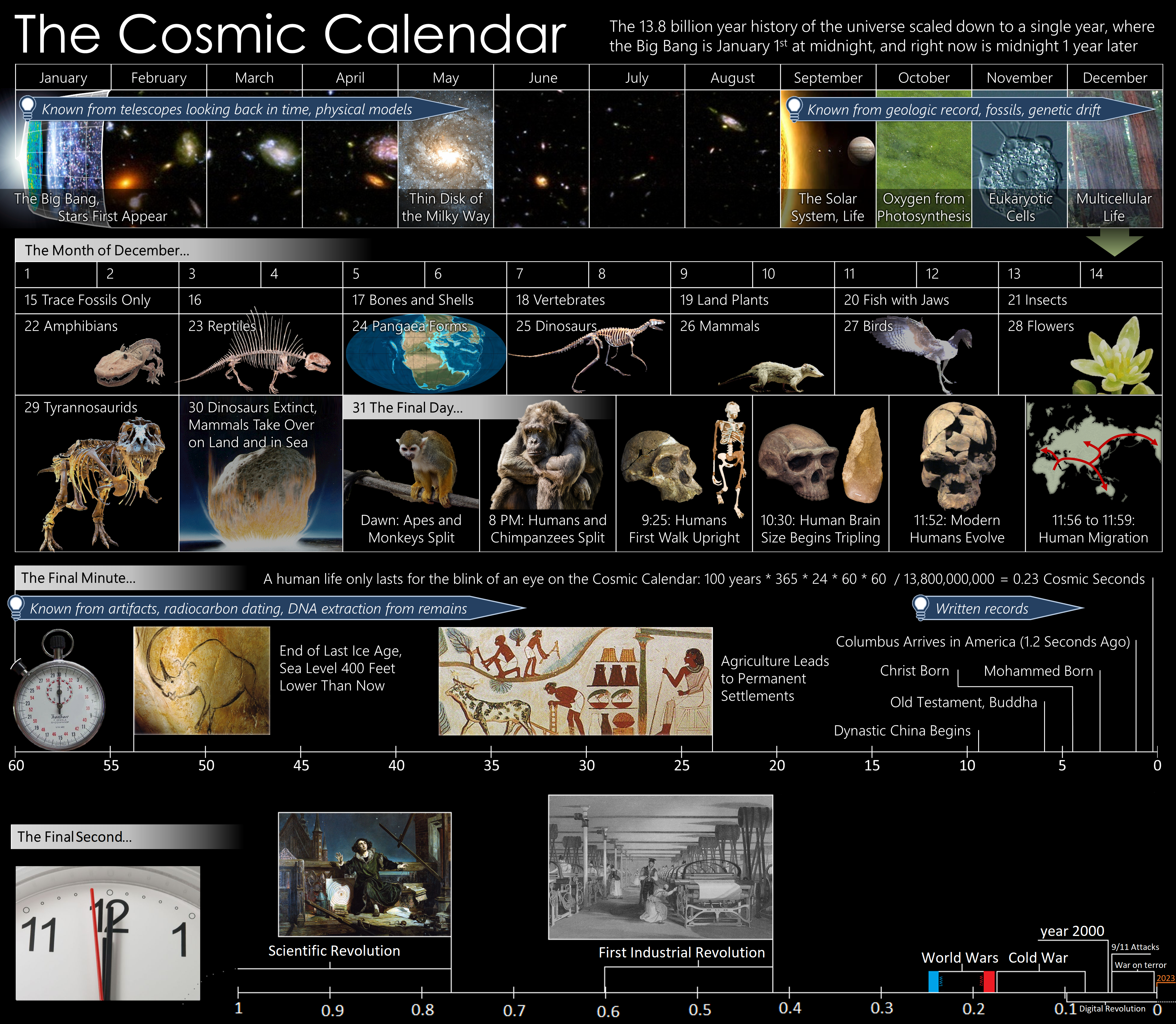
The Cosmic Calendar is a beautiful metaphor to contemplate ontology. How did we get here? There are two main theories. God implies a top-down creation. Evolution suggests a bottom-up development. Each has its paradox. Who created God? Or, how did something come from nothing? Studying cosmology makes it hard to believe in God. How could a single being create all that vastness? What if the universe is God? That’s pantheism. It makes God equal to Evolution but leaves us still with the problem of how things started.

The Cosmic Calendar answers for When.

But do we really need to know how things got started? Shouldn’t we just ask: What is our place in the universe? Scientists are now theorizing that we might exist in a multiverse. In other words, no matter how large we look into the cosmos, there’s always more. On the other hand, no matter how small we look into the subatomic, there’s always something smaller. This is beautifully illustrated by the famous Charles and Ray Eames video of The Powers of Ten from 1977.

The Powers of Ten answers for Where. More importantly, it reveals there are many domains. We might observe the cosmos or even the domain of the atom or quantum, but do they matter to who we are and what we should be doing? Shouldn’t our domain be a hundred meters?

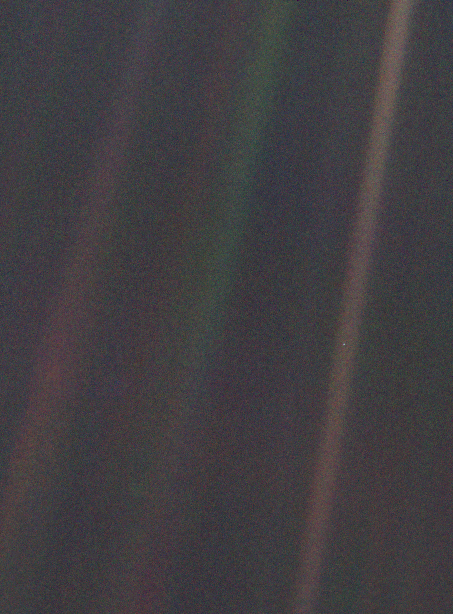
Carl Sagan wrote a book The Pale Blue Dot based on a photograph of Earth taken by Voyager 1 while it passed Saturn. If you look closely, you will see a blue dot. That’s Earth. It’s hard to think we’re significant to the universe. Then think about the Milky Way as seen from the edge of the universe. It wouldn’t be visible at all. It’s beyond conceivable to imagine how small we are compared to all of existence. How can we be significant? How can we have a purpose?
It’s important to think of ourselves relative to the domain in which we live. Many people are depressed by watching the news but isn’t the domain of the Earth too big for one person? Isn’t it ego and delusion to think our purpose could be to organize a nation, city, or even something as small as a neighborhood? I have trouble keeping my house and yard in order.

Lately, I’ve been working in the yard. After fifteen years of neglect, the backyard is overrun with tangled wild growth. Every day I spend a little time trying to conquer my tiny plot of wilderness. At 73, that effort pushes the limits of my physical abilities. I use most of the energy I have left keeping the house somewhat neat. It’s not really clean. I also must spend precious vitality on personal finances, shopping, and general living and maintenance.

Yet, I keep thinking I should be doing something more. I’m not sure what. Maybe it’s having a purpose or making my mark in a small way. This would answer the question of who. And maybe why.

I’ve been using Ancestry.com and learning about genealogy. What did my parents expect of me? What did my grandparents expect of their grandchildren? I have thirty-two ancestors if I go back five generations. Did they expect anything? At most, they expected me to keep the gene line going. Well, that’s where I’ve failed.

I recently read Parable of the Sower by Octavia E. Butler. The story is about the United States suffering an economic apocalypse. The main character felt the need to have a purpose in life, even when everything bad was happening. She decided God was change and our purpose was to affect God/change. That’s a kind of pantheism. What if existence is just trying to become everything that could possibly exist?

Under Butler’s theory, my purpose is to shape myself. To constantly change. Well, I’ve certainly been doing that my whole life.

Right now I’m working on changing myself, my relationships, my house, and my yard. Mother nature was changing the way it wanted the yard. It might seem pointless, but wrestling control from Mother Nature and changing the yard into what I want does give me existential purpose. It’s essentially meaningless in the long run. But maybe our purposes should be limited to a time and place. To a domain. Think small.

I can change myself somewhat. I can change my house and yard. Somewhat. But I can’t change other people. Or anything larger in life.

Maybe that explains how and why.

JWH

Will We Ever Be Able to Know Why There is Something and Not Nothing?

by James Wallace Harris, 6/29/24

Is there one question you’d love to know the answer to before you die? For me, it’s always been “Why is there something rather than nothing?” Religious people want to believe God created everything, but there’s always that one smart kid who asks: What created God? We get into the problem of infinite regression. Of course, there’s the famous story by a scientist where the punchline is: “Turtles all the way down.”

Science has been trying to answer this question forever. At the small end, we have elementary particles in the Standard Model, with scientists and mathematicians speculating they came about because of strings or other concepts. At the large scale, cosmologists think the universe might be part of a multiverse. But don’t we have the same problem? What creates strings and multiverses? It’s something tinier or larger all the way down or up.

I must assume I will never know the answer to the question that gives me the most existential angst. I used to think as a kid, when we die, we’re finally told the answer to all our questions. But if I find myself in another dimension after death, I’m just going to ask: “What created this place?”

Maybe the answer that leads to happiness is to ask questions that can be answered. To focus on a smaller domain of existence. If I reduce the domain to planet Earth, I’d ask: “What happens to humans after runaway climate change?” It’s possible to speculate with some possibilities of getting the answer close to what might happen. But is such speculation useful?

If I reduce the domain to the United States. I guess the question right now that most people are asking: “Who will be elected president in November?” Until the debate Thursday night, we assumed it would be one of two possibilities. But have things changed? Don’t things always change?

I think I need to reduce the domain again. On a very personal level I’d like to know: “What is time.” And I don’t mean where in the Earth’s rotation, or orbit about the sun. No, I want to know: “What makes reality grow from one moment to the next?” Nothing stays the same. So, what is the smallest degree of change perceptible? Is it the vibration of subatomic particles? Is it the fields and forces that make up those particles? What is one tick of reality’s clock?

This is why I’m currently reading books like The Order of Time by Carlo Ravelli and On the Origin of Time by Thomas Hertog. I struggle to understand what these books are telling me. Is it possible to understand physics without understanding mathematics and science at the graduate level? I can vaguely sense what I think they’re talking about, but I might be deluding myself.

I do think time might be the key to why there’s something and not nothing, but I’m not sure we can ever grasp the reality of spacetime. I’m certainly no Einstein or Hawking. I don’t even understand science at an eighth-grade general science teaching level. To me, comprehending time is closer to being a meditating Buddhist.

What question would you love to know the answer to?

JWH

The Soul v. Evolved Consciousness

by James Wallace Harris, Saturday, August 19, 2017

I keep trying to understand the core cause of our polarized political conflict that’s pushing us to destroy our current civilization. We have the knowledge and technology needed to solve our problems but we don’t apply them. We choose to viciously fight among ourselves instead. Self-interest is winning over group survival. Decade after decade I keep wondering why. I keep refining my theories, and the current one says this conflict originates in a divide between theology and philosophy.

Most people don’t think in terms of theology or philosophy, so how could cognitive tools be the cause of so much hatred? People act on beliefs without being aware of their beliefs or the origins of their actions. My current theory explores if we’re divided by a fundamental sense of self: either assuming we have an immortal soul or an evolving consciousness.

Because science cannot explain why we’re conscious animals the origins of consciousness remain open to interpretation from theology and philosophy. Of course, even when science can overwhelmingly explain such mechanisms as evolution, many people refuse to accept science because of their innate theology, even when they can’t explain that theology in words or logic. But where does theology come from? Why do some people process reality with a theological perspective and other people with a philosophical or scientific perspective?

Humans are not rational creatures. We are rationalizing animals. Our thoughts are not logical, but seek to reinforce our desires. The perfect lab animal for studying this irrationality of humanness is Donald Trump. From my perspective, humans are the product of billions of years of evolution and we’re currently at a paradigm shift of consciousness, where half of us perceive reality in the old paradigm and half in the new.

The old paradigm assumes God created us, giving us immortal souls with time in this existence being temporary because there’s a greater existence after death. The new paradigm is reality is constantly evolving. I use the word “reality” to mean everything. We used to say, “the universe” to mean everything, but it now appears our universe is part of a multiverse, and even that might not be everything. So, I call everything by the term “reality.” It includes all space, time, dimensions, and everything we’ve yet to discover or imagine.

Humans are bubbles of conscious self-awareness popping into this reality that eventual burst. I believe our consciousness minds evolved out of brain evolution, which evolved out of biology, and biology evolved out chemistry, and chemistry evolved out of physics, and physics evolved out of cosmology. Other people believe a superior being called God using the magical power of the Word created us.

It comes down to the soul v. evolved consciousness. Humans whose thoughts arise out of a belief foundation of the soul perceive reality differently from humans whose thoughts arise out of the belief we’re a product of evolution. I don’t think it’s a matter of conscious choice either. I’m guessing our unconscious minds work based on how each paradigm has wired our brains. Obviously, only one paradigm explains our true existence, but individuals live their lives perceiving reality from one or the other paradigm. That perceptual different makes all the cultural, social and political differences.

The people who act like they have souls want to shape reality based on their beliefs, and the people who act like they are evolved consciousnesses want to shape reality according to their beliefs. This causes our political/social/cultural divide. People with souls don’t care what happens to this planet, people with evolving consciousness think this planet is vital.

The Eternal Now and Time Travel

This morning while taking a shower I began thinking about now.  Here I was, a naked 62 year old male, in a 1950s pink tile room, wondering what was going on concurrently in the rest of reality as I soaped up.  My wife would be just getting to work in her office in Birmingham.   1.3 light seconds away, events are happening on the Moon, several light minutes away Mars and the Sun are doing their thing, stuff is also happening around Alpha Centauri, four and half light years away, then 2,538,000 light years away the Andromeda galaxy is speeding towards our galaxy, and who knows how many billions of light years is the edge or the universe, or what’s beyond and how far it extends. 

Everywhere there is something happening, as I take my shower.  We’re all in an eternal now.

I try to imagine Einstein’s space-time concept and how it might affect things.  But to me, it seems logical to think there is a universal now that happens everywhere, even into adjacent universes in the multiverse, or even adjacent multiverses.  Could there ever be two nows?  Or multiple nows?  Isn’t death just losing touch with the now?  And didn’t the eternal now exist even before I existed?  Isn’t consciousness tuning into the now?

As as science fiction fan I love the concept of time travel, but isn’t time travel the attempt to go to another now?  If there is only one eternal now, then that will be impossible.  We see artifacts of the past, and anticipate the future, so we assume both places exist – but do they?  When we see the Andromeda galaxy in the sky, we’re seeing what it looked like 2,538,000 years ago.  It’s actually much closer.

Recently scientists created a computer simulation of the universe.  I wonder if it’s how it looks in the eternal now, or how we see through timed artifacts?  Everything we perceive about reality is time delayed.  We aren’t looking out our eyes, but at reprocessed information, so there’s a slight delay.  If I talk to my friend Connell in Miami, a thousand miles away, there’s a slight delay in the phone signals.  The eternal now is everywhere, but we experience it inside our heads, and all that input about reality is delayed.  The visual field I see in front of me as I type is a tiny fraction of a second late from the eternal now.

The theory of an all powerful, all knowing God is quite interesting to think about regarding the eternal now.  If God is not limited by the speed of light, God would see everything at once in the eternal now.  But would this deity also see the past and future all at once too?  Or does God inhabit the moment like everyone and everything else?  It’s hard for me to believe in God knowing how big reality is, especially if the eternal now has always existed, and will always continue to exist.  Infinity is such a mind-bashing number.

We often ask when did time start, and when does it end.  And we often imagine the beginning of space and matter.  But do we ever wonder about the origin of the eternal now?  If there was only one Big Bang moment, then that was the beginning of time, space and now, but it’s starting to look like there wasn’t just one Big Bang.  No matter how many universes there might be, won’t there only be just one eternal now?  Isn’t it the same now here as it is fifty-five universes over from ours?

I think we’re hung up on birth and death, beginnings and endings, because we have one of each, but maybe reality and the eternal now doesn’t.  As a kid I wondered who made God like other kids, and why wasn’t there nothing.  How could existence start at all.  My conclusion?  That non-existence nothing can’t exist.  That it’s impossible.  If it could, it would have, but since it didn’t, it can’t.  It hurts our heads to comprehend why non-existence isn’t so.  Logic tells us there should have been an origin.  Our minds can’t get beyond cause and effect.  We know nothing lasts forever, but maybe one thing does, the eternal now.

We spend our lives pursuing religion, philosophy and science trying to understand the origins of existence, but in the end the answer is always beyond our small brains to comprehend.  And even if we built an AI Mind the size of Jupiter, would it be large enough to know?  Even if God existed, would God know?  Would not a being that could comprehend all of reality have to ask:  Where did I come from?  How did I get here?  Doesn’t any being asking the ultimate ontological question end up with “It’s turtles all the way down!”

pugs-00121

The Hindu tell us to “Be Here Now” – but where else could we go?

JWH – 5/9/14

Time Reborn by Lee Smolin–Why Time Actually Exists

What is time?  Philosophically and scientifically, that’s a hard question to answer.  Can anyone even tell us how many books have been written about time?  Here are some of my questions: 

  • Is there one eternal now that exists everywhere, throughout all of reality, in this universe, and all the other universes of the multiverse? 
  • Is time just the 4th dimension?  Does the first three dimensions move through a fourth?
  • Does time actually exist, or is it just an illusion?
  • Why and how do we feel time?
  • What is the smallest unit of time? 
  • If something has been ticking since the Big Bang, what is that tick?
  • Is time mental or physical?
  • Will time stop if the average temperature of the universe reaches 0 degrees Kelvin?
  • Is time just change?  The motion of atoms, the turning of the Earth, our orbit around the sun, the unfolding of existence since the Big Bang?
  • Is the astronaut traveling near the speed of light, 300 hundred years ahead of us, time traveling?  How could two twins move into two different nows? 
  • Is the now of this space-time different from the now of another space-time universe somewhere else in the multiverse, or is there one universal now in all of reality? 
  • Are the past and future illusions? 
  • Is there a beginning or end of time? 
  • Is time travel possible? 
  • Are there beings that see all of time at once, as if we’re looking across a vast three dimensional space? 
  • Is there anything outside of time?
  • Do animals sense time?
  • Would time exist without us?
  • Is it possible to have two nows? 
  • If there is only now, does it matter what time it is?
  • If we didn’t measure time would we think it existed?

time reborn

Time Reborn by Lee Smolin, is a book about physics by a physicist who makes a scientific case for time to be real, and what that means philosophically and for physics.  If you are not a physicist, or a fan of popular science books, I’m not sure if I can recommend this book to you as fun reading.  It is hard to comprehend all the subtle implications involved with the physics of time.  However, if you have a philosophical bent, it might be worth considering.  Smolin is making a case that time exists, that it has a direction, and that reality is evolving. 

Classical physics always models the universe in mathematics, and quite often time either doesn’t exist, doesn’t matter, or the equations work regardless of the direction of time.  Ever since Einstein, scientists have searched for a grand unified theory of everything, hoping to find elegant equations that explained reality.  Smolin rejects this goal by making a case that the universe can’t completely be described in mathematics.

To the average person, with common sense, they will reply, “Duh!”  Isn’t it obvious that time exists.  Isn’t obvious that time has a direction.  Isn’t it obvious that mathematics can’t explain everything.  Our everyday reality is very far from Big Bang cosmology and quantum physics.  Physicists are trying to explain everything, and often it’s easy to ignore the immediate world.  When you’re number crunching complex equations to explain reality it’s easy to think time can be ignored, or even space.  But black box simulations of the universe aren’t modeling the real universe.

It’s hard to know exactly what Smolin is saying because he gives us so many possibilities to consider, but the epilogue suggests why he wrote the book, to make a philosophical statement.  What I got out of the book might not be what Smolin intended, but here’s how I read him.

Smolin wants us to accept time.  He wants us to reject the siren song of the timeless.  He warns us to be wary of timeless concepts of the universe, whether it’s religion, whether its a mathematical expression, whether it’s a simulation, or even Platonic ideals.  Mathematics can approximate some features of the universe, models can simulate some features, but ultimately, people like Max Tegmark and Juan Maldacena are wrong.  And reality is neither a creation of God or solipsistic dream.

If time is real, and the universe is evolving, either from the Big Bang, or earlier causes in the multiverse, and there is a universal now, with a past and a future.  Smolin doesn’t say it directly, but reality isn’t about us.  He’s against the anthropomorphic principle.  Realty would have existed without us.  We just accidently happened to evolve in a universe that is suitable for life – it wasn’t created for us.

Ultimately, there are limits to what science can see or detect, and to understand.  We can’t know why there is something rather than nothing.  We have a lot more we can learn about this universe, and we may even learn something about the multiverse, but the ultimate cause of existence is probably beyond physics.  To say that time exists does not mean we can prove time origin and end.

That’s the problem with humans.  Our religious and philosophical natures want timeless answers to the big ontological questions.  Physicists want timeless equations to explain everything.  The implication is, if time really exists, then timeless answers don’t.

Ever since I’ve finished this book I’ve tried to meditate on time.  To slow my thoughts and focus, hopefully to catch the ticking of time passing.  But I can’t.  All I can do is notice the slightest changes of things around me.  I feel if nothing moved, time would stop, but there’s always something moving.  We live in an eternal now. 

We have no recollection of events before our existence, nor will we be aware of things after we’re gone. 

We can only be here now.

JWH – 3/31/14