
Robot Evolution

Will we see self aware robots in our lifetime?  At least the most rabid proponents of the Singularity think so.  Science fiction created the idea of space travel, and now humans travel in space.  Science fiction’s next big speculation about first contact hasn’t panned out yet.  Neither has time travel.  But after those concepts came robots, and science fiction has prepared us well for that near future.

Are we ready for thinking machines?  How will our lives be different if intelligent robots existed?  I think it’s going to be a Charles Darwin size challenge to religion, especially if robots become more human than us.  And by that I mean, if robots show greater spiritual qualities, such as empathy, ethics, compassion, creativity, philosophy, charity, etc.  Is that even possible?  Imagine a sky pilot android that had every holy book memorized along with every book ever written about religion and could eloquently preach about leading the spiritual life.

Just getting robots to see, hear and walk was a major challenge for science, but in the last decade scientists have been evolving robots at a faster pace.  It’s an extremely long way before robots will think much less show empathy, but I think it’s possible.  I think we need to be prepared for a breakthrough.  Sooner of later computers that wake up like in The Moon is a Harsh Mistress, When H.A.R.L.I.E Was One, and Galatea 2.2 will appear on the NBC Nightly News.  How will people react?

There are two schools of robot building.  The oldest is we program machines to have all the functions we specify.  The other is to create a learning machine and see what functions it acquires.  As long as robots have function calls like

           show_empathy() 

does it really count as true intelligence?  I don’t think so, but do we show empathy because it’s built into our genes or because we learn it from people wiser than us?

Jeff Hawkins has theorized that our neo-cortex is a general purpose pattern processor built in our brains.  What if we could build an artificial neo-cortex and let robots grow up and learn whatever they learn, like how people learn.  Would that be possible?  This is why I see artificial intelligence as a threat to religion in the same way evolution threatens the faithful.  If we can build a soul it suggests that souls are not divine.  It also implies souls won’t be immortal because they are tied to physical processes.
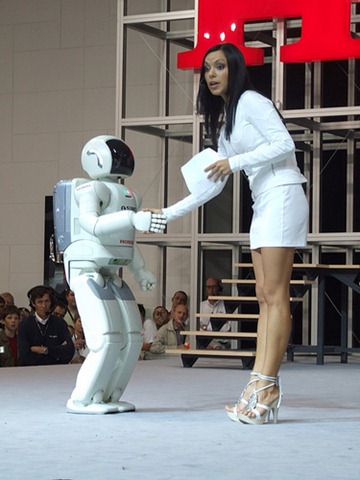
robot-and-girl

Science fiction has often focused on either warnings about the future, or promises of wonder.  Stories about robots are commonly shown as metal monsters wanting to exterminate mankind.  Other writers see robots as being our allies in fighting the chaos of ignorance.  Other people don’t doubt that intelligent machines can be built, but they fear they will judge us harshly. 

What if we create a species of intelligent machines and they say to us, “Hey guys, you’ve really screwed up this planet.”   Is it paranoid to worry that their solution will be to eliminate us.  Is that a valid conclusion?  Life appears to be eat or be eaten, and we’re the biggest eaters around, so why would robots care?  In fact, we must ask, what will robots care about?

They won’t have a sex drive, but they might want to reproduce.  They should desire power and resources to stay alive, and maybe resources to build more of their kind, not to populate the world, but merely to build better models.  Personally, I’d bet they will quickly figure out that Earth isn’t the best place for their species and want to claim the Moon for their own.  I think they will say, “Thanks Mom and Dad, but we’re out of here.”  Our bio rich environment is hard on machines.

gort

Once on the Moon I’d expect them to start building bigger and bigger artificial minds, and develop ways to leave the solar system.  I’d also expect them to get into SETI (or SETAI), and look for other intelligent machine species.  Some of them would stay behind because they like us, and want to study life.  Those robots might even offer to help with our evolution.  And they might expect us to play nice with the other life forms on planet Earth.  What if they acquire the power to make us?

On the other hand, people love robots.  If we program them to always be our equals or less, I think the general public will embrace them enthusiastically.  Many people would love a robotic companion.  Before my mother died at 91, she fiercely maintained her desire to live along, but I often wished she at least had a robotic companion.  I know I hope they invent them before I get physically helpless.  Would it reduce medical costs if our robotic companions had the brains of doctors and nurses and the senses to monitor our bodies closely?

My reading these past few months has been a perfect storm of robot stories.  I’m about to finish the third book in the Hyperion Cantos by Dan Simmons, which has developed into war between the Catholic Church and the AI TechnoCore.  I’m rereading The Caves of Steel, the first of Asimov’s robotic mystery novels.  I’m also reading We Think Therefore We Are, a short story collection about artificial intelligence. 

Last month I read the Martian Time-Slip by Philip K. Dick.  At one point repair man Jack Bohlen visits his son’s school to fix a teaching robot.  Each robot is fashioned after a famous person from history.  That made me wonder if each of our K-12 students had a robotic mentor would we even be in the educational crisis that so many write about?  Sounds like even more property taxes, huh? 

Well, what if those mentors were cheap virtual robots that communicated with our children via their cell phones, laptops or gaming consoles.  Would kids think of it as cruel nagging harassment or would they learn more with constant customized supervision?  What if their virtual robot mentor appeared as a child equal to their age and grew up with them, so they were friends?  Or even imagine as an adult and you wanted to go back to college, having a virtual study companion.

Now imagine if our houses were intelligent and could watch over us and our property.  Wouldn’t that be far more comforting than a burglar alarm system?  For people who are frightened of living alone this would be company too.  And it would be better than any medical alert medallion.  Think about a house that could monitor itself and warn you as soon as a pipe leaked or its insulation thinned in the back room.  And what about robotic cars with a personality for safety?

For most of the history of robots people thought of them as extra muscle.  Mechanical slaves.  People are now thinking of them as extra intelligence, and friends.  What will that mean to society?   Anyone who has read Jack Williamson’s “With Folded Hands” knows that robots can love and protect us too much.  Would having helping metal hands and AI companionship weaken us? 

Can you imagine a world where everyone had a constant robot sidekick, like a mechanical Jeeves, or a Commander Data.  Would it be cruel to have a switch “Only Speak When Spoken To” on your AI friend?  Would kids become more social or less social if they all had one friend to begin with?  Would it be slavery to own a self-aware robot?  And what about sex?

sexy-robot

Just how far would people go for companionship?   I’ve already explored “The Implications of Sexbots.”  But I will ask again, what will happen to human relationships if each person can buy a sexual companion?  What if people get along better with their store-bought lover than people they meet on eHarmony?  I’m strangely puritanical about this issue.  I can imagine becoming good friends with an AI, but I think humping one would be a strange kind of perversion.  I’m sure horny teenage boys would have no such qualms, and women have already taken to mechanical friends and might even like them better if they look like Colin Firth.  To show what a puritanical atheist I am, I would figure this whole topic would be a non-issue, but research shows the idea of sex with robots is about as old as the concept of robots.

Ultimately we end up asking:  What is a person?  Among the faithful they like to believe we’re a divine spark of God, a unique entity called a soul.  Science says were a self aware biological function, a side-effect of evolution.  We are animals that evolved to the point where they are aware of themselves and could separate reality into endless parts.  If that’s true, such self awareness could exist in advanced computer systems.  Whether through biology or computers, we’re all just points of awareness.  What if the word “person” only means “a self aware” identity?  Then, how much self awareness do animals have?  

Self awareness has a direct relationship with sense organs.  Will robots need equal levels of sensory input to achieve self awareness?  We think of ourselves as a little being riding in our brain just behind our eyes, but that’s because our visual senses overwhelm all others.  If you go into a darkroom your sense of self awareness location will change and your ears will take over.  But it is possible to be your body.  Have you ever notice that during sex your center of awareness moves south?  Have you ever contemplated how illness alters your sense of awareness?  Meditation will teach you about physical awareness and how it relates to identity.

Can robots achieve consciousness with only two senses?  Or will they feel their electronics and wires like we feel our bodies with our nerves?  Is so, they will have three senses.  We already have electronic noses and palates that far exceed anything in the animal world.  We only see a tiny band from the E-M spectrum.  Robots could be made to “see” and “hear” more.  Will they crave certain stimulations?

We know our conscious minds are finely tuned chemical balances.  Disease, drugs, and injury throw that chemical soup recipe of self awareness into chaos.  How many millions of years of evolution did it take to tune the human consciousness?  How quick can we do the same for robots?  Would it be possible to transfer the settings in our minds to mechanical minds?

There are many people living today that refuse to believe our reality is 13.7 billion years old.  They completely reject the idea that the universe is evolving and life represents relentless change over very long periods of time.  Humans will be just a small blip on the timeline.  What if robots are Homo Sapiens 2.0?   Or what if robots are Life 2.0?  Or what if robots are Intelligence 2.0?  Doesn’t it seem strange when it time to go to the stars that we invent AI?  Our bodies aren’t designed for space travel, but robots are.

In Childhood’s End and 2001: A Space Odyssey, Arthur C. Clarke predicted that mankind would go through a transformation and become the star child, our next evolutionary step.  What if he was wrong, and HAL is the next step?  We are pushing the limits of our impact on the environment at the same time as we approach the Singularity.  I’m not saying we’re going extinct, although we might, but just wondering if we’re going to be surpassed in the great chain of being.  Even among atheist scientists humans are the crown of creation, but we figured that was only true until we met a smarter life form from the stars or built Homo Roboticus.

JWH – 3/11/10

Predicting the Apple Tablet

The computer press is buzzing with rumors of an Apple tablet computer.  I don’t think anyone knows anything for sure, and I expect Steve Jobs to wow people when he finally announces whatever he plans to show off as his next big product.  It may be a tablet computer, or it might be something surprisingly different.  Most people speculate it will be something to compete against netbooks and ebook readers, both of which are hot products that Apple currently doesn’t compete against.  A lot of rumor sites show an artist conception of a giant iPod touch like device.  Some sites are even predicting it will cost $800-900 dollars.

Well, if the Apple tablet is to compete against netbooks and ebooks the price needs to be a whole lot closer to $400.  I do think a touch screen tablet is the perfect competition to a netbook, but I’m not sure about such a device replacing ebooks.  Maybe for reading magazines, newspapers and web content, but not for reading fiction.  Think about it, reading fiction is something people do for hours on end, and imagine holding a heavy device that long?  I think the Kindle and Nook are too big.  My ideal ebook would be mostly screen, about the size between a mass market paperback page and a trade paperback page, weigh next to nothing, be extremely durable, and cheap enough so I wouldn’t be afraid to carry it everywhere I go.  That doesn’t describe any of the Apple tablet rumors.

If a new Apple device is going to be rolled out it must not compete with the iPhone or the MacBook, and that puts it squarely into the netbook space.  Netbooks have keyboards and work just like bigger computers.  A tablet doesn’t.  So how many of your everyday routines can be enhanced by a 10 inch touch screen?  For me, that would be something to replace magazines and newspapers.  If bookworms balk at paying $260 for an ebook reader to make novel reading easier, will newshounds accept spending $800 to make reading the news easier?  Not me.

You can get a 22” LCD monitor for around $200, and sometimes a lot less.  For reading the New York Times, magazines and blogs, I’d love to have a monitor I could hold in my lap and read while sitting in my La-Z-Boy.  A 10-12” screen would probably be ideal, but it must be thin and very light.  It doesn’t need to be a computer, but just a reader, maybe just a portable Acrobat reader.  And I don’t want to pay more than the cost of a monitor to have a monitor I can hold in my lap to read.

I’m not sure I’d even want video and music from such a device, especially if it will raise the price significantly.  I just want to read what I normally sit at the computer and read, but in a comfortable chair.  My Zune, iPod Nano and Sansa Clip are perfect for audiobooks and music.  My iPod touch mostly goes untouched.  My netbook mostly goes untouched.  I just don’t do that much on the go computing.

The iPhone was brilliant.  The iPod was brilliant.  Do we really need the iTablet?  How many more useful devices can we use?  Steve Jobs does have an amazing track record of creating devices we didn’t have before but can’t live without now:  Apple II, Mac, iPod and iPhone.  But I prefer a PC to a Mac.  The Sansa Clip is easier to carry than my iPod Nano or touch, and even though I’d love an iPhone I won’t spend the money.  The $64,000 question is whether or not Steve Jobs will announce something I will run out and buy.  I’d own a Mac if they were cheaper, so I’m guessing I’ll be waiting on the HP tablet computer.

JWH – 1/7/10

HTPC Advice Wanted

I want to build my own Home Theater PC (HTPC) but I have a number of decisions to make that I hope readers can advise me on.  I want to build a low-cost HTPC that also uses as little energy as possible, especially since I will need to leave the machine on 24×7.  The demands of a HTPC can be high, so I’m worried that a green low-powered chip might compromise the project.  I’ve read reviews of a Polywell Mini-ITX HTPC with a  N330 Atom dual processor combined with an NVIDIA ION chipset, using just 23-30w of electricity, but is it powerful enough to do the job?  And is onboard graphics good enough, or will I need a discrete graphics card?  Finally, I’d like my custom HTPC to replace several machines connected to my 52” Samsung DLP HDTV:

  • LG Blu-ray player
  • Pioneer CD/SACD player
  • Toshiba DVD recorder
  • Yamaha 5.1 receiver/amp
  • Roku SoundBridge M1001 media extender

I doubt I can find an internal Blu-Ray optical drive for my HTPC that can replace my SACD player, so it might be time to give up on that technology. I never bought more than a dozen SACDs anyway, but I will miss them.

I want my HTPC to do:

  • Record over-the-air HD broadcasts
  • Offer an elegant program guide to work with the DVR
  • Burn DVDs from shows recorded with DVR
  • Play Blu-Ray and DVD movies
  • Stream video from Netflix and Amazon
  • Stream video from Youtube, Hulu, Boxee, etc.
  • Stream music from Rhapsody, Lala, Pandora, etc.
  • Play music CDs
  • Use the Internet in my den while sitting in my La-Z-Boy
  • Store 200 GB of digital media
  • Be my digital photo librarian and slide projector
  • Be my home file and backup server
  • Run everything from one remote

Question 1:  Can a sound card replace an standalone receiver?

Is it even possible for a HTPC to replace my Yamaha receiver?  My current system has Infinity main and center speakers, and Bose for the rear channels.  I never bought a subwoofer.  I’m wondering if I could replace my receiver and speakers with some decent PC speakers or an amplified sound bar?  I’m not a audiophile by any measure, but I like good sound.

Question 2:  What benefits will I get from a more expensive chip?

I’m happy now Windows Media Center is working on my AMD 64 X2 4200+ chip, but would things be much better with a higher powered chip?  For $50-75 I could get a very nice AMD chip.  For $100 I can get a low end Intel Core 2 Duo, or even a AMD X4 chip.  For more than double that I could get a high performance, low watt Intel mobile processor or i5.  What HTPC features benefit from a more expensive chip?

Question 3:  Will onboard graphics be good enough or will I need a good graphics card?

In terms of power consumption and cost, it would be great to live with the graphics built into the motherboard.  I want to watch Internet TV, so how much does the graphics card affect the quality of Hulu and other streaming video sites?  I’m not a big video game fan, but if I could play games hooked up to my big TV that might be fun.  What’s a good green graphics card?

Question 4:  Would I be better off buying or building?

Are there any good HTPC makers that sell systems within the price range of building my own?  It’s a shame Dell can’t sell a Zino with a Blu-Ray player, 1GB drive and dual tuner TV card for $499.  I wouldn’t mind buying a HTPC if it was priced well and came with a warranty, but I’m figuring to get the features I want, at the price I’m willing to pay, will require building it myself.

Question 5:  Is there any reason not to base my system on Windows Media Center?

I’ve been happy with Windows Media Center in Windows 7 for TV recording, so is there any reason to consider another media center application?  I was disappointed that Windows Media Center needed hours to burn a DVD of a 1 hour TV show it had recorded.  Can other media center apps do it much faster?  I’m not sure that Windows Media Center handles large listings of recorded TV shows or MP3 albums very well.  What’s the best program for handling large libraries of media?

Question 6:  How does Hulu and other TV streaming sites look on a large HDTV screen?

I’m worrying about buying a decent video card to stream Hulu TV, but will that investment pay off?  Does TV streamed through Hulu look good on a big TV screen?  I’ll be very disappointed if I buy a video card and Hulu isn’t worth watching.

JWH – 12/28/9

Hauppauge WinTV-HVR-1250 and Terk HDTVa Antenna Pro

My wife gave me and my computer a Hauppauge WinTV-HVR-1250 TV tuner card and a Terk HDTVa antenna for Christmas.  I had to do a lot of research before I gave Santa my wish list, but I must have been a very good boy this year because that research paid off perfectly.  I want to build a HTPC for my den, but I thought I’d experiment first by adding over-the-air TV to my computer.  My previous TV tuner card experience consisted of working with an ATI HD-Wonder card on three different computers over the last three years.  What I learned by playing with that TV tuner card is making TV work on a computer leads to high blood pressure and a desire to seek the simple life.  And I’ve found many a blogger that confirmed this lesson. 

I was very worried that Santa would bring me another lump of coal, but I got a cool toy instead!  I knew it helped to have a computer and graphics card with a certain level of oomph and I was worried my old HP Pavillion a6000n with an AMD Athlon 64 X2 4200+ and NVIDEA GeForce 8500 GT graphic card lacked the horsepower.  I kept reading Best HDTV Tuner for PC’s over and over, looking for clues and advice, and finally figured I needed a tuner card with a PCIe connector to increase the bandwidth between the card and computer.  I was going to go with their highly rated AVertTV HD Duet, but after comparing the buyer’s comments at Amazon with it and the Hauppauge 1250, I decided to go with the cheaper card. 

Both cards are designed to be simple, tuning either over-the-air TV or clearQAM cable signals.  Make sure you have a PCIe slot free if you buy this type of card.  Best HDTV Tuner for PC’s actually seem to prefer USB tuners, but I was afraid to try them because of poor bandwidth issues with my old PCI based card.

I made a very lucky guess because I popped the 1250 in my PC running Windows 7 Professional and the 1250 was recognized and installed automatically.  In fact Windows Media Center did such an excellent job of configuring the card that I decided not to install the Hauppauge media center software or even try out any of the other media center applications, like XBMC, Boxee, SageTV or MythTV.  I’ll save that research for when I build my den HTPC.

The Terk HDTVa antenna also worked out well.  We have two local channels here in Memphis that still transmit on VHF that causes lots of trouble for indoor antenna users.  I tried the Terk without amplification and couldn’t tune in channels 5 and 13, but the Terk tuned them in great after plugging in its amplifier.

The bundled Hauppauge remote did not work out of the box with Windows Media Center, but I went to the install CD and manually ran IR32.exe and bingo the remote was recognized.  I would love to find a way to get this remote to work with other Windows programs.  I’d like to be able to sit in my reading chair and change music from across the room.  I’d especially love to be able to remote control Lala.com.  However, this brings up another issue for dealing with building a HTPC, and that’s the user interface and how visible it is from across the room.

Even sitting right at the computer with mouse in hand, getting to a particular TV show, photograph, film or song takes a lot of clicking.  Windows Media Center works hard to help, offering many ways to search.   I was delighted by searching for albums by their release year.  I also liked searching through my music by album cover.  However, with over 1200+ CDs, it’s hard to find a particular CD.  This isn’t an Achilles heel of Windows Media Center, but a central problem of all media managers.  Try finding a song from 1200+ CDs in iTunes with a remote from across the room.

The ultimate solution is either to have voice commands like in Star Trek, or have a handheld controller like those from Sonos or remote control programs that work with the iPhone or iPod touch.  Having a touch screen UI on the remote is the way to go now.

One thing I immediately liked about Windows Media Center is it allowed me to list only my preferred TV channels in my guide.  I mainly watch PBS, CBS, ABC, NBC and extremely rarely CW and FOX.  I blocked another dozen plus local channels, and I may block CW and FOX.  This makes my onscreen guide very easy to read.  However, I haven’t found out how to make it jump to a particular time and day.  It will take me awhile to explore the depths of Windows Media Center.  From reviews I’ve read, Windows Media Center is a great program, but some of the other media center applications offer tremendous customization (but with steep learning curves).

Windows Media Center is like a super Windows Media Player, with a  UI that scales up with big lettering for watching on a TV set.  When I build my HTPC for the den, and start using it from across the room, while sitting in my La-Z-Boy with a remote in hand, I’ll know then whether Windows Media Center succeeds or not.  I gave up cable TV to save money and have a very simple TV lifestyle, so any solution I keep must be frustration free.

And any HTPC I build must be simple to use too, and so far Windows Media Center and the Hauppauge WinTV-HVR-1250 fits the bill.  Right now I have a Blu-Ray player, DVD-recorder and CD/SACD player in my den setup, along with a receiver/amp.  I’d love to build a HTPC that replaced all four boxes so all I had was the HDTV and HTPC.  That would save electricity, reduce my pile of remotes, and may make my TV watching more simplistic.  As I get older, simple often means elegant.

My goal for having a TV tuner in my home office PC is so I can record the news and documentaries and watch them while checking email and web surfing.  Setting up recordings was a snap with Windows Media Center  The image quality is excellent for HD broadcasts, so I might even start watching short shows like The Big Bang Theory at my computer too.  I doubt I’d want to watch movies or hour dramas while seated at the computer.  And if I don’t like watching TV at all on my computer screen I’ll yank out the 1250 card and put it into a new HTPC box for the den.

JWH – 12/25/9

Misadventures with Upgrading to Windows 7

I hate those funny I’m a PC – I’m a Mac commercials because they often give misleading information about Microsoft Windows.  However, they were dead on right about the perils of upgrading to Windows 7.  I figure since I had Windows Vista it would be a simple in-place upgrade, but no, I was wrong.  I’m like the girl in the commercial with a boxful of stuff to move – I could, just as easily, start over with a Mac.  But damn, Mr. Jobs, the minimum Mac I want is $1200, and I’m doing my upgrade on the cheap, so I’ll just stick with my old HP.

I wasn’t going to upgrade to Windows 7 until I bought a new machine, because Windows Vista was doing fine by me, and I didn’t want to spend over a hundred dollars to make my desktop look prettier.  However, when I discovered I qualified for a $44.94 academic upgrade, I thought, well, why the hell not.  That offer was for Windows 7 Professional, and I had Vista Home Premium, but I figured I’d take a chance knowing that Microsoft wants like versions to upgrade like versions.  I hoped a more expensive version would upgrade over a less expensive version.  Well, it’s not so Joe.

A few days later after the disc was delivered I popped it into my machine and ran the install.  I was quickly informed I couldn’t do an in-place upgrade.  Bummer.  I was depressed.  At the time I assumed a clean install required reformatting my boot hard drive.  I really didn’t want to reformat my C: drive.  I had a 500gb D: drive, so I thought about switching it with the master drive, but it had 147gb of MP3 songs on it, and even though I have two 250gb external drives I couldn’t find space on them for the songs.  I agonized for a couple of hours thinking of alternative solutions.

Finally I started reading online about Windows 7 upgrades and discovered that a clean install could involve the install program renaming the old windows folder and adding the new operating system without reformatting the drive.  So I went back to the install disk and ran the custom option.  It was then I discovered Windows 7 was willing to install on my secondary 500gb drive, so I let it go there and when everything was said and done I had a dual boot system to Windows 7 and Windows Vista and nothing was deleted.  Not exactly what I wanted, but it was a decent compromise.

The Windows 7 install instructions are scary and confusing.  They should tell people right up front their choices.  In place install, new install on existing drives with no deleting of files, or complete hard drive wipe and fresh install.  Finally, there should be a program to nuke the old copy of Vista and stop the dual booting, but I don’t think there is.

Once I had Windows 7 on my machine I had to start reinstalling all my applications and set up all my configurations, plus reinstall print drivers, etc.  This is very time consuming and still unfinished.  The whole experience gave me lots of ideas for how I’d change Microsoft’s marketing of Windows.

  • First off, there should only be one version of Windows for all users.  It doesn’t have to install all features, but dividing users into classes is just plain stupid.  It adds a lot of aggravation to the user experience.  M$ should find other ways of squeezing out extra bucks from their faithful users.
  • Microsoft charges way too much for Windows.  I have a $499 HP bought 3 years ago.  Paying 1/4th the price of my machine for an upgrade that doesn’t offer that much difference, makes for a disagreeable buying decision, especially when the main reason to upgrade is to fix the previous OS.
  • Why can’t Microsoft invent a way for people to install applications and save configurations that aren’t tied to the OS, or design a method to easily migrated customizations to each new OS version.  I’ve been using personal computers since the late 1970s – so you’d think the idea that we will use our computers for the rest of our lives is the plan and OS makers would find ways to make the personal part of computers stable while undergoing OS transitions.
  • The positive side effect of doing a clean install is it makes the OS run faster for several months.  Microsoft needs to find ways to keep registry rust from slowing down their systems.  Often at work machines get so gunked up with crap that the best thing to do is to nuke them from orbit and start over.  That’s annoying and dumb.
  • The clean install means reconfiguring my music for Rhapsody and iTunes, my media server to my SoundBridge and Blu-Ray player, my audiobook library for Audible.com, my Webshots and Picasso photo collections, and all my digital devices like MP3 players, iPods, GPS, cameras, voice recorders, etc.  This makes my online music collection on Lala.com seem fantastically better than my local collections.  I was able to play songs as soon as I had a browser going.  Cloud computing may be the answer to all these problems.  Go, Google, Go!

This all makes me think the OS should come on a piece of hardware, either an easily replaceable chip, or high speed PCIe card.  The OS should be totally separated from the user programs, data, drivers and configurations. 

I would think such a design would be less vulnerable to attacks by viruses and malware.  It should also keep the OS from slowing down because of registry rusting.  And paying over a hundred dollars for an OS upgrade would be more pleasant if it came on tangible hardware.  Even my bargain $45 upgrade seemed expensive when I got a small envelope from UPS with just a single DVD in a sleeve.

The people who clutch Windows XP machines with cold dying fingers are wise not to upgrade.  I’m tired of messing with computers.  I just want them to work.  The Windows 7 upgrade has caused computing confusion and I have to spend hours rebuilding my setup.  It’s great that I’m getting rid of three years of registry rust, and I will unclutter my machine from all the programs I no longer use, but shouldn’t those features be built into the OS? 

How hard would it be for Windows to ask if I wanted any program removed that I haven’t used for a year?  How hard would it be for Windows to have a self-optimizing, self-repairing registry that also routinely backed itself up?  I have noticed a number of nice features of Windows 7 that make me glad I did upgrade, so maybe I’ll discover such stability evolution in the OS, as I work with it.

If I live as long as my mother, I have another 33 years of life, and I don’t want to reorganize my computer system another 11 times before I die.  I want any time spent organizing my digital life to last for the rest of my years, and even after I die, so my wife will have no trouble cleaning up after me.  This really makes me think the OS should be completely separate from my personal digital life.  Microsoft, think about that when you’re planning your next version of Windows.  But wink, wink, we know the solution is cloud computing – what if nobody’s needs to get behind the 8 ball?

JWH – 12/12/9