Reading Comprehension: Books vs. Audiobooks

by James Wallace Harris, 1/3/24

At 72, I’m still learning how to read.

I recently finished the audiobook of The Simulacra by Philip K. Dick and started to write a review for my science fiction blog. That’s when I realized I needed to read the book with my eyes before I could write a proper review. The Simulacra was a complex novel involving several plot threads and dozens of named characters. (Read the plot summary at Wikipedia. Get the book at Amazon.)

From my audiobook experience I found the book compelling, fun, and I was always anxious to get back to listening to the story. I was never confused by what was going on, but when I tried to summarize the novel for my review, I discovered I couldn’t recall all the details I needed to make a coherent description of the story. There were just too many science-fictional concepts. Nor could I describe all the plot threads without researching them.

I won’t describe the book in detail, I’ll do that in my review, but for now, The Simulacra is about a post-apocalyptic world where China attacked America with atomic missiles in 1980, and the U.S. government and Germany combined to form a totalitarian regime called The United States of Europe and America (USEA). It appears to be run by a captivating 23-year-old first lady named Nicole Thibodeaux. However, she has been married to five presidents and always remains young. Since this book was written in the summer of 1963, I assume Dick was inspired by Jackie Kennedy because Nicole spends most of her time charming people, decorating the White House and gardens, and putting on nightly cultural events. But Nicole is also ruthless enough to have people summarily executed, evidently wielding unlimited power. She has access to time travel no less, and one subplot involves her negotiating with Nazis to change the course of WWII. Other subplots involve an insane psychic pianist Nicole wants to play at the White House, the outlawing of psychiatry pushed by the pharmaceutical industry, what happens to the last legal psychiatrist, a pair of ordinary guys who have a jug band that plays classical music who want to perform at the White House, a trio of sound engineers who are trying to chase down the psychic pianist to record, and a small company that hopes to get the contract to construct the next president. This long paragraph barely scratches the surface of the whole novel.

My failure of completely understanding the novel from listening to the audiobook was partly due to aging memory and partly due to the complexity of Dick’s prose. I could have hashed out several thousand words describing what I remembered, although it would have been a bundle of vague impressions. Summarizing what PKD was trying to do was evasive from just listening to the audiobook.

Audiobooks are bad for remembering exact details, which I knew, but was painfully revealed when I tried to read the novel and take notes. I called up The Simulacra on my PC in the Kindle app on the left side of the screen, and launched Obsidian, a note taking program on the left side of the screen. I started reading The Simulacra again, but with my eyes. After two days, getting to the 29% read position on the Kindle edition, I had twenty-eight names, twenty-six plot points, several lists of other details, and several quotes in my notes. I figure there are three to five main plot threads, each involving three or more characters.

More than that, I realized Philip K. Dick had riffed on hundreds of ideas. As I read them, I remembered them, but I realized that while listening, I had not put most of them within the context of the story. It wasn’t until my second reading that I saw all these hundreds of creative speculations as being part of one jigsaw puzzle picture. And I’m not talking about the characters and plots. I’m talking about worldbuilding.

Rereading with my eyes allowed me to stop and ponder. Rereading allowed me to remember the bigger picture. However, listening to the audiobook let me enjoy the story more. The narrator, Peter Berkrot, did voices for each of the characters, and acted out their personalities. Listening to the novel, it felt like I was listening to an old-time radio drama where many actors performed a story.

At one point I got too tired to read and went to bed. But before I fell asleep, I listened to the part I had just read. Berkrot expressed emotions I had not picked up while reading with my eyes, but recalling the scenes made me realize that Dick had put them there. In other words, Berkrot had found aspects of the text I missed and was pointing them out with sound.

Over the ten years since I’ve retired, I’ve been learning the value of rereading books. In fact, I now feel reading a story just once is unfair to the author. It takes two or more readings to see the author’s vision. Reading a work of fiction just once provides one layer of understanding. It’s when we see multiple layers within a work that we start to truly understand it.

Switching back and forth between reading with my eyes and reading with my ears reveals both methods have their advantages. If I read once with one sense organ and reread with another, the two combine to create reading synergy.

For most of my life, I’ve always been concerned with reading more books, but the wisdom I’m gaining from getting old is showing me that both speed reading and reading lots of books is a distraction from deep reading.

Right now, I’d recommend:

  1. Listen to an audiobook for the first reading to get the big picture.
  2. Reread with a physical book or ebook to get the details. Read slowly and stop often to ponder.
  3. Write a review to make deeper sense of a book. Putting things into words pushes us to make sense of things.
  4. Read reviews and scholarly articles to get other perspectives.
  5. Reread the book again to bring it all together.

This is what I’m working on with The Simulacra by Philip K. Dick. It’s not considered one of Dick’s better works, but I’m trying to discover if there is more to the novel than its current reputation.

JWH
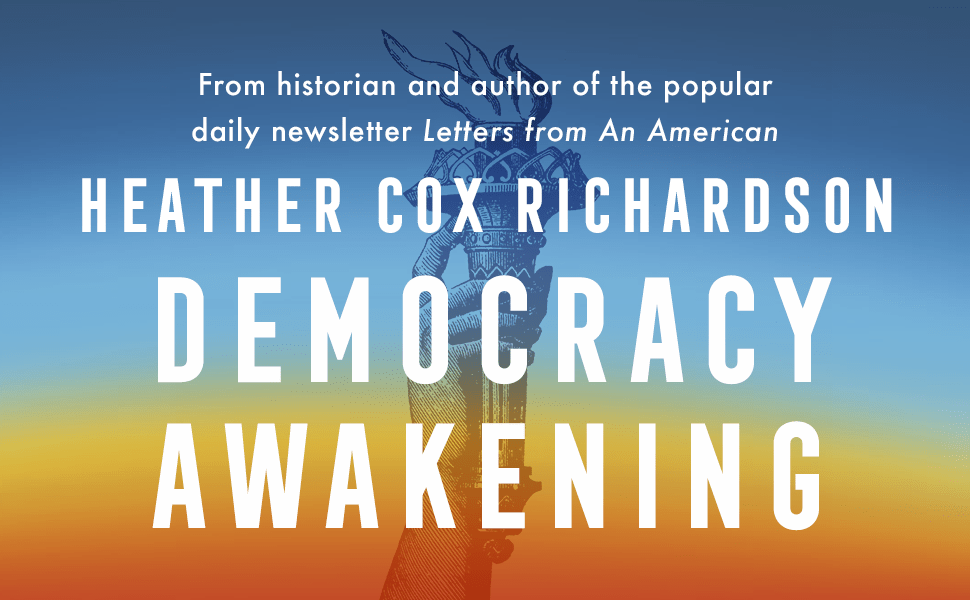
Democracy Awakening by Heather Cox Richardson – Review Part One

by James Wallace Harris

Americans have general thought of America as a democracy, although it’s never been a true democracy. When the United States of America was first created a limited number of white males could vote. As time progressed more white males were allowed to vote. As liberals and radicals influenced politics, they advocated for wider suffrage state by state. See this timeline for details, but the Fifteenth Amendment in 1870 gave black men the vote, and in 1920 the Nineteenth amendment was passed that gave women the vote in all states. Whites have always suppressed black voters, and even some men still resent women voting. And political parties have always tried to control who could vote and how, and even suppressing voting.

A true democracy would allow every citizen over a certain age to vote, or universal suffrage. Before the 21st century most Americans didn’t see that as a problem, but as ethnic demographics have changed it has turned some Americans against democracy.

America is supposed to have a representative democracy, but it inspired the formation of political parties supported by various special interest groups fighting for power. In America Awakening Heather Cox Richardson describes how we’ve reached the current state where liberals advocate more democracy and conservatives push for less, apparently wanting authoritarian rule instead. Authoritarians general promote some ideal in the past as the authority of how things should be govern. Most modern American authoritarians look to either the Founding Fathers and the Constitution or to God and The Bible, or a combination of both. Modern American authoritarian leaders tend to be white and paternalistic, and their followers tend to want a strong man, or strong father figure, although more women are wanting to be Republican leaders too.

Richardson says it’s important to understand that many terms like conservative, liberal, radical, Republican, and Democrat have changed over the centuries. In the 19th century Republicans were for African Americans voting, and for gun laws, and in the early 20th century, for regulations on corporations. In the 19th century and through the first half of the 20th century, Democrats tried to keep African Americans from having the vote. The Republican and Democratic parties went through a polarity change in the 1960s. Richardson says its important understand how words have changed meaning because authoritarians often abuse them and justify their abuse by claiming history supports their new definitions. In other words, history gets distorted and abused.

I’m reviewing Democracy Awakening because I think it’s an important book everyone should read for the 2024 U.S. presidential election, but also to push my ability to remember. I love reading nonfiction books, but their information often feels like it goes in one ear and out the other. I can only retain what I learn in the vaguest way. Since I’m also reading about memory and aging, I’ve decided to read Democracy Awakening differently. I’m going to distill what Richardson is saying into my own words but in some concise form that I hope I can remember. I’ll do that in a series of blog posts, outlines, tables, etc.

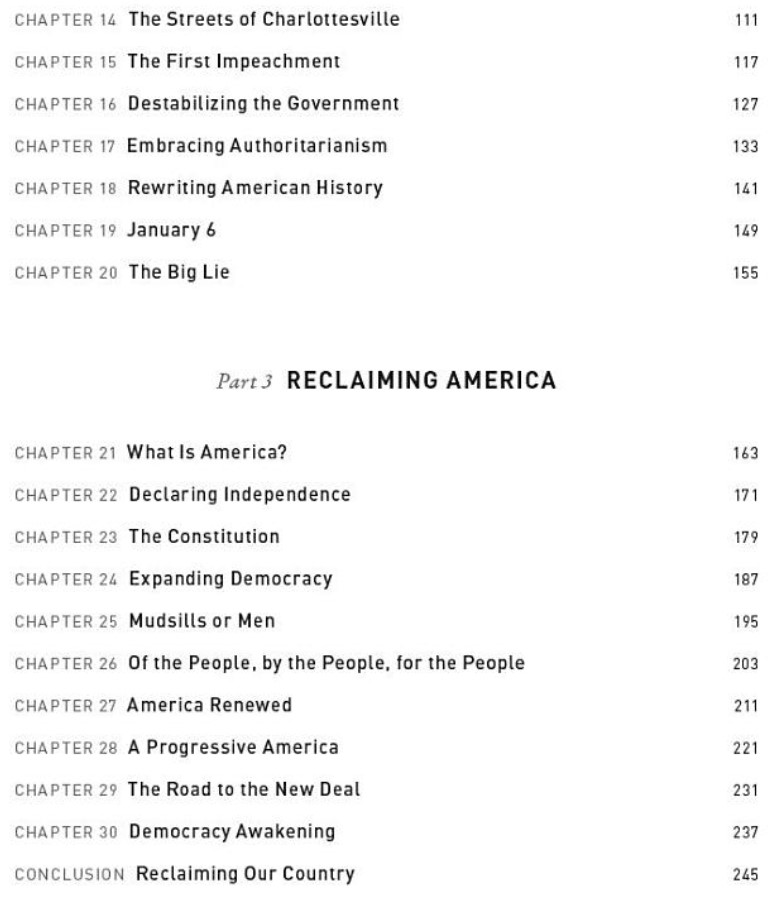
My friend Linda and I are reading Democracy Awakening together and for our first discussion we are covering Part 1, Chapters 1-10, which I hope to cover today. Here is the Table of Contents.

Because I’ve also read other books on this subject already, including watching related documentaries and YouTube videos, I’m going to reference them in this series to show how there’s a synergy in my reading.

Heather Cox Richardson is a history professor who has specialized on the history of the Republican Party through a series of books. I have not read these books, but I have read some about each and it gives me confidence that Richardson is an expert on this subject. On the internet there are zillions of people claiming to be knowledgable on specific subjects but when you check into their creditials, you find little to back their claim of authority.

Richardson makes her points by citing historical events. I wish I could remember all the cited dates and important changes in history because they show an evolution of how we got to today. The first ten chapters progress mostly in a linear fashion, so I hope to eventually create a timeline.

Richardson also quotes significant papers, speeches, books, and other sources to reveal how concepts emerged that cause people to seek political change. Just the history of African Americans seeking Civil Rights reveals many connections to how conservatives and liberals changed their parties and political goals. I’d like to make a list of the most significant quotes to remember. And I’d like to read the books Richardson references, including books by conservative writers. But this will take a lot of time.

And there’s another problem, both conservatives and liberals use the Founding Fathers as historical authority even though members of both political parties distort history for their cause. Republicans like to cite the past, both the Founding Fathers, and The Bible, as how to create or interpret laws. This is rediculous. 2023 isn’t 1776, or 800 BCE. Yet, reading Richardson’s book Democracy Awakening shows the democracy we have today is constantly changing, and how those changes comes from actions in the past.

It is well documented that Republicans feel the United States took a wrong turn in the 1930s when FDR’s administration created the New Deal. They’ve been trying to undo it ever since. And their methods and philosophy of why and how have evolved over the decades. Part of that evolution is moving away from democracy, which is what Richardson’s book is about.

Richardson believes we didn’t fall into fascism in the 1930s because the United States has a long history of various groups fighting for suffrage. That the history of United States is one of a ruling class struggling to keep power from various groups of people wanting to vote. This includes poor whites, African Americans, women, and immigrants. The current Republicans know they cannot win with universal suffrage and fair elections and so they have to do an end run around democracy.

Republicans formed coalitions with special interest groups that the leaders of the party have no interest in supporting. What has changed is the special interest groups have taken over the power from the old Republican elites. Neither the Republicans nor Democrats have a clear majority with voters, and depend on Independents who swing their votes.

The main problem revealed in the first part of Democracy Awakening is the country is dividing itself into two camps. Those who want an authoritarian government based on their version of the Founding Fathers and their version of Christianity, and those people who want universal suffrage and a true democracy.

The authoritarians cannot get what they want by existing voting laws and population demographics. That’s why they are undermining the election process. Since majority rule is 50%, these two groups are polarized. Neither Republicans or Democrats have a majority. They depend on swing votes from Independents.

What I’m hoping to see in the next two parts is whether or not Richardson thinks democracy can survive. I was recently terrified by a New York Times essay, “Trump Has a Master Plan for Destroying the ‘Deep State’” by Donald P. Moynihan. In it Moynihan says Trump has three goals which I’ll take out of context and quote here:

The first is to put Trump loyalists into appointment positions. Mr. Trump believed that “the resistance” to his presidency included his own appointees. Unlike in 2016, he now has a deep bench of loyalists. The Heritage Foundation and dozens of other Trump-aligned organizations are screening candidates to create 20,000 potential MAGA appointees. They will be placed in every agency across government, including the agencies responsible for protecting the environment, regulating workplace safety, collecting taxes, determining immigration policy, maintaining safety net programs, representing American interests overseas and ensuring the impartial rule of law.

...

The second part of the Trump plan is to terrify career civil servants into submission. To do so, he would reimpose an executive order that he signed but never implemented at the end of his first administration. The Schedule F order would allow him to convert many of these officials into political appointees.

Schedule F would be the most profound change to the civil service system since its creation in 1883. Presidents can currently fill about 4,000 political appointment positions at the federal level. This already makes the United States an outlier among similar democracies, in terms of the degree of politicization of the government. The authors of Schedule F have suggested it would be used to turn another 50,000 officials — with deep experience of how to run every major federal program we rely on — into appointees. Other Republican presidential candidates have also pledged to use Schedule F aggressively. Ron DeSantis, for example, promised that as president he would “start slitting throats on Day 1.”

...

The third part of Mr. Trump’s authoritarian blueprint is to create a legal framework that would allow him to use government resources to protect himself, attack his political enemies and force through his policy goals without congressional approval. Internal government lawyers can block illegal or unconstitutional actions. Reporters for The New York Times have uncovered a plan to place Trump loyalists in those key positions.

This is not about conservatism. Mr. Trump grew disillusioned with conservative Federalist Society lawyers, despite drawing on them to stock his judicial nominations. It is about finding lawyers willing to create a legal rationale for his authoritarian impulses. Examples from Mr. Trump’s time in office include Mark Paoletta, the former general counsel of the Office of Management and Budget, who approved Mr. Trump’s illegal withholding of aid to Ukraine. Or Jeffrey Clark, who almost became Mr. Trump’s acting attorney general when his superiors refused to advance Mr. Trump’s false claims of election fraud.

This is why I believe everyone should be reading Democracy Awakening. I believe Richardson’s book is defining what the 2024 election will truly mean at the deepest level.

JWH

On Rereading

by James Wallace Harris, 10/2/23

This week I started rereading Catch-22 by Joseph Heller, a novel first published in 1961. I was shocked by how much I disliked it. In my memory it was a terrific book. Back in 1970 I went to see Catch-22 the movie when it came out. I was so impressed I went to a bookstore, bought the book, went home, read it, and then went back to see the film again. For over fifty years I’ve thought of Catch-22 as a classic.

This week I listened to two hours of the novel before giving up. I can’t believe I ever loved that book. It’s sort of like how I feel when I catch Gilligan’s Island on TV, I can’t believe that in the eighth grade it was my favorite television show. Whenever I see a clip of Gilligan’s Island now, I assume I must have been brain damaged as a kid. I wondered the same thing when listening to Catch-22.

Maybe I’ve just lost my sense of humor. I loved Saturday Night Live when it came out back in 1975, but I’ve found it painful to watch for decades now. I’ve come to realize that I truly dislike lame satire. Heller appeared to take one absurdist point-of-view and stretched it out over a 21-hour audiobook. It felt like hearing a Who’s on First routine that never ended.

I came to the book expecting to find philosophical insight into WWII, and it just wasn’t there. Catch-22 is considered an anti-war classic, but I didn’t feel that in 2023. The film version of M.A.S.H. also came out in 1970. That was the height of the Vietnam War. Both stories felt like anti-war brilliance in 1970, but insane in 2023. Fifty-three years later, and after many other wars, such silliness no longer seems appropriate.

Obviously, I’ve changed over the decades, but I think there’s something else that’s changed. Postmodernism has crashed and burned. Postmodernism took us down a wrong path, and it’s time to retrace our steps.

I still reread my childhood favorite book, Have Space Suit-Will Travel which came out in 1958. It continues to work. It seems to be a genuine touchstone to my past. I find great insight into who I was as a kid and who I wanted to be when I grew up. To me, it was a science fiction version of Great Expectations — including the cynicism I give it in retrospect.

I also read an abridged version of Great Expectations in high school and have reread the full novel since. It seems to grow in maturity, especially as I read more about Charles Dickens. As a teenage boy I identified with Pip and his frustration with Estella. But as an old man, I figure Pip was a stand-in for the older 1858 Dickens, and Estella and Miss Havisham were stand-ins for Ellen Turan and her mother. The depth of Great Expectations grows with every rereading.

This morning I watched a video about rereading books by Anthony Vicino called “You Should Read These 12 Books Every Year.” Vicino is one of those people who want to get ahead in life quickly by reading self-help books. Because he wanted to succeed quickly, and many successful CEOs read fifty-two books a year, Vicino decided to read one hundred books in a year and get ahead twice as fast. What Vicino learned was to read fewer books. And rereading was the secret to success.

I’ve been thinking I need to do more rereading. This video made me wonder what twelve books I would reread every year. Would they be fiction or nonfiction? And would they be modern or postmodern? I’m starting to think we all took a wrong turn around 1960, at least in fiction. The trouble is since 1960 nonfiction has been overwhelming us with expanding knowledge that we need. Art and philosophy couldn’t handle that explosion of information and we got postmodernism.

I need to do a lot of rereading, and rethinking. What books will be ruined by my maturity and what books will reveal their own deeper maturity?

JWH

Books Do Furnish a Room by Anthony Powell

by James Wallace Harris, 9/16/23

Books Do Furnish a Room is book ten in Anthony Powell’s series A Dance to the Music of Time covering the years 1945-1947 in the fictional life of Nick Jenkins. After the war, England is rebuilding, food is rationed, liquor is scarce, and Nick is trying to make a living by reviewing books. I’ve read in Powell’s biography, Anthony Powell: Dancing to the Music of Time by Hilary Spurling that Powell was reviewing as many as twenty books a month to make ends meet. Sometimes I wish that A Dance to the Music of Time was a series of memoirs rather than novels because I’d love to know the basis for all the satire in Nick’s life.

For instance, two of the main characters in Books Do Furnish a Room are Pamela Widmerpool and X. Trapnel. Powell supposedly based them on Barbara Skelton and Julian Maclaren-Ross. They aren’t nice characters either. Pamela is a notorious emasculator of men, yet men can’t resist her. Trapnel is a talented posser who sponges off everyone he meets. Pamela is married to Kenneth Widmerpool, a character who is in all twelve novels of the series.

Nick met Widmerpool at school, where he was despised by the other boys for being fat, poor, and a loser. Yet throughout the novels, Widmerpool keeps climbing higher on the social ladder until he’s a member of Parliament. It is quite strange that he ends up with Pamela, an extremely beautiful woman.

Books Do Furnish a Room is about Fission magazine that Nick, Kenneth, and X. Trapnel all write for. It was backed by Erridge, Earl of Warminster, Nick’s brother-in-law, who dies at the beginning of the story. One of the founders of Fission is J. G. Quiggin who has been in earlier novels and is a Marxist. In fact, many of the characters in these books are left leaning. Powell suggests England was full of fellow travelers, communists, and Marxists, even Kenneth Widmerpool.

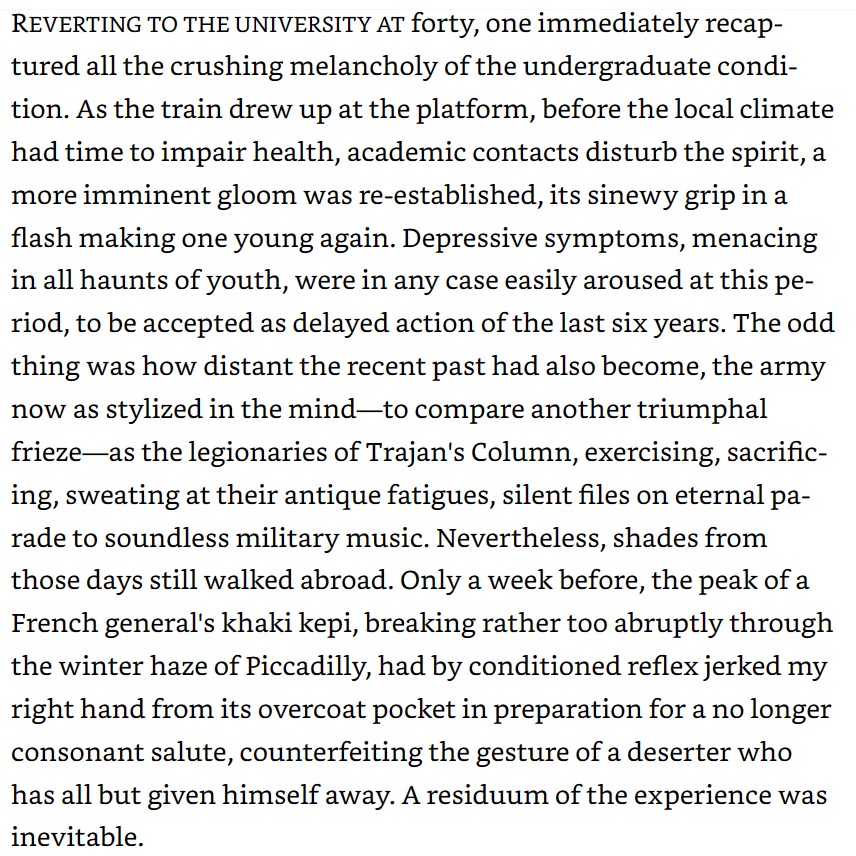
The hardest thing to describe about this story is the humor. It’s very dry. I remember hearing Powell’s prose being described as a cross between Evelyn Waugh and P. G. Wodehouse. In one of the opening scenes Pamela flees a funeral service during a bout of nausea, almost knocking down the pallbearers of Erridge. Later she vomits into a five-foot tall Chinese vase that may or may not be rare, and there’s a funny seen of several men trying to wash it out. But Powell’s slapstick scenes are rare. Most of his prose is like the opening paragraph:

Books do Furnish a Room begins the final trilogy of books in A Dance to the Music of Time, and it deals with the academic and literary world. The story begins with Nick meeting Sillery, his old school master again. Nick is also researching a book he’s writing on The Anatomy of Melancholy, a 1621 book by Robert Burton. This was a real book, and maybe if I knew it better, it might relate to this story. Throughout Books do Furnish a Room, Nick mentions many books, most of which are fictional. It’s a challenge to discern references to real works and works that belong only in Nick Jenkins’ reality. The most important made-up novel is Camel Ride to the Tomb by X. Trapnel. In the eleventh novel, Nick meets Trapnel’s biographer, so its importance stretches over two books.

There was a 1997 4-part miniseries based on A Dance to the Music of Time. You can get them on YouTube. It’s quite a rush job to cram twelve novels into four TV episodes that are less than two hours each. However, they do cover the highlights of the entire series. I’ve seen it twice and I’m watching parts of it for a third time. You can get a feel for Books Do Furnish a Room by watching the first third of this episode. (By the way, the actress that plays Pamela looks nothing like how I imagined her from the novel. But the scene I mentioned above is in this sequence.)

JWH

A Dance to the Music of Time: Autumn by Anthony Powell

by James Wallace Harris

The Valley of Bones, The Soldier’s Art, and The Military Philosophers are books seven, eight, nine in a twelve-volume series called A Dance to the Music of Time by Anthony Powell. The twelve books are about Nick Jenkins, written between 1951 and 1975, covering Jenkin’s fictional life from 1921 through 1971. The twelve volumes are sometimes published in four volumes named after the seasons. Books 7-9 are called Autumn, or the Third Movement. The series takes its name and theme from a 1640 painting by Nicolas Poussin.

The three books of the third movement cover the war years 1940-1945 and give a rather unique view of England during WWII. Nick Jenkins’ life somewhat resembles Anthony Powell’s life (1905-2000) and some of the characters are based on people he knew. Here is a description of Powell’s military career during WWII from Wikipedia. It is very much like what we read in the three novels. Although we aren’t told Nick won any awards or medals, but then he is a modest character that doesn’t like attention.

Upon the outbreak of the Second World War, Powell, at age 34, joined the British Army as a second lieutenant, making him more than 10 years older than most of his fellow subalterns, not at all well prepared for military life, and lacking in experience. Powell joined the Welch Regiment and was stationed in Northern Ireland at the time of air raids in Belfast. His superiors found uses for his talents, resulting in a series of transfers that brought him to special training courses designed to produce a nucleus of officers to deal with the problems of military government after the Allies had defeated the Axis powers. He eventually secured an assignment with the Intelligence Corps and additional training. His military career continued with a posting to the War Office in Whitehall, where he was attached to the section known as Military Intelligence (Liaison) overseeing relations with, and the basic material needs of, foreign troops in exile, specifically the Czechs, later with the Belgians and Luxembourgers, and later still the French. Later, for a short time, he was posted to the Cabinet Office, to serve on the Secretariat of the Joint Intelligence Committee, securing promotions along the way.

For his service in the Army, he received two General Service medals as well as the 1944 France and Germany Star for escorting a group of Allied military attaches from Normandy to Montgomery's 21st Army Group Tactical HQ in November 1944 three miles from Roermond, Holland then held by the Germans. For representing the interests of foreign armies in exile as a liaison officer he received the following decorations: the Order of the White Lion (Czechoslovakia), Oaken Crown (Luxembourg), Order of Leopold II (Belgium), and Luxembourg War Cross (Croix de Guerre -Luxembourg).[19]

After his demobilization at the end of the war, writing became his sole career.

I find Nick’s story of military training and life on the London home front quite fascinating since the last book I read was about a British bomber squadron and all the books work like a jigsaw puzzle to create one vast image. The most action Nick sees are air raids. In one sequence he describes how several of his friends were killed in a bombing raid, and in another he gives a description of living with V-1 attacks. I was particularly moved by Nick’s observations and contemplations when he attended the VE Day Thanksgiving Service at St. Paul’s Cathedral.

But you don’t read these books for military history. Powell was an observer of people, and so was Nick. Powell’s A Dance to the Music of Time is often compared to Marcel Proust’s seven-novel sequence In Search of Lost Time. However, Proust was very inward looking, and Powell was not. We learn little about Nick Jenkins in these novels because he likes to look outward. He is an observer of people, places, and society.

I love Powell’s books because there are so many characters that come and go. I am delighted whenever one returns. Powell’s characters are like real life people, reminding me of people I know who have come into my life and left, but sometimes I run into them again, or hear stories about them years later. That essentially describes the books in this series. It’s sad that in the third sequence, many of the characters I loved reading about die in the war. I was especially saddened by Charles Stringham story. Peter Templer tale ends too, in The Military Philosophers, but it is offstage and mysterious. and there’s plenty of Kenneth Widmerpool anecdotes. He’s everyone’s favorite, getting his own entry in Wikipedia.

The notable new character that enters in these three books is Pamela Flitton, a femme fatale of the first order. She’s a real piece of work and was based on Barbara Skelton, wife of Cyril Connolly. Skelton also wrote novels and memoirs, so now I must read her. Powell’s vicious portrayal of her makes me wonder if he got sued. Her character continues into the final three novels.

Powell’s reputation is on the decline, which is disappointing. He was friends with Evelyn Waugh, Henry Green, and other British writers of the 20th century, which means my TBR pile is growing. I’ve also discovered several articles about Powell and his friends on Google, but I can’t read those articles until I resubscribe to The New York Review of Books and The New Yorker. That could become a black hole that could capture me forever.

20th century British literature is gently pulling me away from science fiction. Part of that tugging comes from reading A Dance to the Music of Time. Science fiction is known for its world building and the vast fictional landscape created by English writers is becoming far richer and real than the sci-fi alien worlds I’ve lived with for six decades.

For the first six novels, I only rated them four stars in Goodreads, but these last three are five-star novels. I expect if I go back and reread the first six, I will bump up their ratings to five-stars too. And this is a series that I will need to reread. It has over three hundred named characters, and the web of interconnections they make is rich and baroque. It will draw me back in again.

JWH