Why Can’t I Let Go of Technology I Don’t Need?

by James Wallace Harris, Sunday, April 7, 2019

If you live long enough you realize that things have a lifespan too. When I was growing up there were payphones everywhere. I don’t see them anymore. They still exist, but they are dying off. I do miss them. I can imagine situations when I’d even want to use one so I think AT&T should maintain payphones. Of course, we should let AT&T just pull the plug on this outdated technology.

In my lifetime I’ve bought over 2,000 LPs and 2,000 CDs. I have no LPs anymore, and I’m down to about 700 CDs. I hardly ever play them. I’d like to get rid of my CDs because I’d like to use their space to store more books I won’t read but want to buy.  However, I struggle to let the last CDs go.

It’s not being able to let go that intrigues me. Why am I so attached to something that’s not being used? I know people that own everything they’ve ever bought, including their childhood toys. I’m not like that. If I kept every computer I’d ever owned, I’d need another bedroom just to store them. I actually like letting go of clutter. But not these CDs. Maybe I fear streaming music will fail.

I had no trouble giving up my LPs — I’ve done it several times in my life. That’s one of my problems. I get nostalgic for things I once owned and buy them again. I’ve built up at least four record collections. However, I think (I’m pretty sure this time) that I’m over LPs for good, and I’m almost sure I’m over CDs too. But not quite.

This week I was tempted to get back into the world of CDs again when I read about the Brennan B2. Its 2GB model can hold 5,000 CDs. I could put all my CDs on it, and then pack them away, or donate them to the library. The Brennan B2 connects to computers, stereos, phones, tablets, and just about anything that plays music. I could use my iPhone to call up any song from my collection and play it on the phone, or through my stereo system or on my HDTV.

The Brenna B2 is the perfect way to access a CD collection. Of course, (I chid myself) that I ripped my CD collection over a decade ago before I gave most of them away, and they are all on Amazon for me to play on my iPhone, iPad, computer, stereo or TV. But I don’t. Well, hardly ever. I just checked, and Amazon is still holding 1,792 of my albums for me. I was able to instantly play 45th Parallel by Oregon, an album I’d completely forgotten I bought. I probably should rip all those CDs I bought since that ripping project, but it would be a pain in the ass. And by the way, the reason I forgot I owned the Oregon CD is that I don’t like it. The reason why I only have 700 CDs now is I got rid of all the CDs I didn’t care about anymore.

So why am I thinking about CDs again? It’s that damn Brennan B2! It’s the coolest piece of technology I’ve seen in years. And when I read it’s built on top of a Raspberry Pi computer I believed it even cooler. But that inspired, “Hey, I could build my own CD server and save $679!”

Last night I was playing Spotify after I went to bed. I love dreaming while listening to music. And in my half-awake state, I told myself that the Brennan B2 could never match the convenience of Spotify or the size of its music library. So why am I agonizing over buying a Brennan B2 still? It’s become I’m still addicted to getting tech toys even though I have a lifetime of experience knowing I won’t use them for long.

I know in my heart of hearts I’d buy the Brennan B2, spend a couple of weeks ripping CDs to FLAC, build playlists, and then play with it for an afternoon. After that, I’d forget all about it. I see now that what I’m really thinking about doing, is spending $679 to have a couple weeks of tech toy playtime. By the way, that’s why I write these blogs sometimes, to think things through. But even this psychoanalysis through writing isn’t curing me of the urge to buy the Brennan B2.

I’m trying to talk myself now into getting out my Raspberry Pi that’s been sitting around doing nothing and building my own CD server. I even have a 1TB USB drive doing nothing to store those CDs that aren’t being played. I wonder if I could create a system that’s even half as nice as the Brennan B2? Did they write their software from scratch, or is it open source? I like the idea of accessing the music database through an IP address in a browser.

Of course, the Brennan B2 would be an amazing out-of-the-box experience.

No, no, no. This is crazy. Spotify lets me access millions of albums and I want to build a system that lets me access 700? Why don’t I realize this an idiotic urge? Well, the library sells old CDs for cheap. I could beef up my library considerably without spending too much. (Am I conveying my insanity well enough?)

There’s a joke in an old Woody Allen movie that he tells about a kid being told that masturbation will make him go blind. The kid replies, “Can I do it until I need glasses?”

That about sums up my ability to let go of technology I don’t need. I’m never ready to completely give it up.

JWH

The Elegance of Quiet Science Fiction Films

by James Wallace Harris, Friday, March 29, 2019

Advantageous (2015) is the kind of quiet science fiction film I love. It was directed by Jennifer Phang, who co-wrote it with Jacqueline Kim, the star of the film. Advantageous is currently streaming on Netflix and I have no memory of it ever coming to the theater (even though it has an 83% Rotten Tomatoes rating). I watched this movie with my friend Annie. She thought the show was only okay, but I loved it. But then my favorite science film is Gattaca. I prefer quiet science fiction movies without chases, explosions, and dazzling special effects. Annie prefers more action.

Advantageous is set in the near future where AI are taking jobs from people. Advantageous is about Gwen Koh (Jacqueline Kim) who is the spokesperson for a rejuvenation corporation who is being fired for looking too old. Gwen is desperate to get another job to keep paying for the expensive schooling for Jules (Samantha Kim), her daughter. In this future, the unspoken belief is its better to give jobs to men because if too many of them were unemployed it would cause civil unrest. Gwen feels Jules can only have a future if she has an elite education, and she’s willing to do anything give her daughter a future.

I don’t want to spoil the film, but let’s just say that Advantageous explores a number of popular current science fiction themes in written science fiction. The film is set in an unnamed city with a breathtaking skyline of ornate skyscrapers that are occasionally hit by terrorist explosions. The citizens of this future passively ignore these attacks as a powerful government deals with them without alarm. We are shown other flaws in this tomorrowland just as quietly. This is a utopian world that is beginning to reveal hairline cracks.

One requirement of enjoying quiet science fiction films is reading between subtle lines. It helps to be well-versed in written science fiction. Gwen is given a decision to make, a “Cold Equations” or “Think Like a Dinosaur” decision. If you don’t know these classic science fiction short stories you might not appreciate the impacts of her choice. The ideas in Advantageous have been explored in great detail in written science fiction. That makes me wonder if movie-only Sci-Fi fans will pick up on the finer points of this story.

Manohla Dargis over at the New York Times was less enthusiastic about the film than me:

Ms. Phang, who wrote the script with Ms. Kim, throws a lot into her movie — ideas about maternity, identity and technologies of the female body swirl alongside nods to the French New Wave — without always connecting the pieces. Eventually, a picture emerges that at times suggests a strange if alluring mash-up of “Stella Dallas” and Michel Foucault, with a smidgen of Jean-Luc Godard’s “Alphaville” and a hint of Margaret Atwood’s “The Handmaid’s Tale.” Ms. Phang has a way with spooky moods and interiors, and as a performer, Ms. Kim makes a fine accompanist, though she’s tamped down too much. It’s a kick to see how effectively Ms. Phang has created the future on a shoestring even if she hasn’t yet figured out how to turn all her smart ideas into a fully realized feature.

I thought Advantageous was fully realized. It set up all the science fictional speculation and then dealt with them in a satisfying way. It just didn’t cover everything explicitly, but quietly implied what we needed to know. Maybe that’s why this movie is an unknown gem. Too many filmgoers want action and obviousness. I watched the film last night and I’m already wanting to see it again. I’m sure there are little delights I’ve missed. Quiet films are perfect for meditation, they keep unfolding with additional viewing and contemplation.

JWH


Chocolate and Back Pain

by James Wallace Harris, Monday, March 18, 2019

I doubt many people will associate chocolate with back pain, but I’ve experienced a connection. I’ve been dealing with spinal stenosis for many years and I’ve learned how to control it with diet and exercise because pills that fight pain and inflammation bother my stomach. I’ve learned that food can cause inflammation. I hate this idea because it’s all my favorite foods that indirectly add to my back pain. Inflammation causes the stiffness and numbness which leads to pain. Most people learn to relax back pain with an anti-inflammation pill, but if you pay attention, avoiding certain foods also has an anti-inflammation effect.

I was doing great this year. I’ve been on 16:8 intermittent fasting since 9/21/18, and off junk food since 1/1/19. About ten days ago I started experimenting with a few minor treats. However, one thing led to another and I fell off the wagon, binging on chocolate for two days. What stopped me was stomach pains. As I’ve gotten older, my stomach has gotten wimpier. Not only had I gotten my back almost pain free and a good deal more limber, but also stabilized my stomach into its quiet state. Going off my diet quickly let me know that value of eating healthy.

I don’t know why, but in recent years my stomach has become extra sensitive to two of my most loved foods: peanut butter and chocolate. When my stomach started hurting I immediately quit my chocolate binge. That’s when I realized that my back had taken quite a setback, proving how much diet contributes to inflammation. I was back to walking hunched over with a slight limp. Just last week I commented to myself that I was feeling much sprier in ages.

When I feel good, I become weak to temptation.

Needless to say, I’m back on my diet. I keep thinking what I eat shouldn’t affect inflammation that much, but it does. I created the above headline to sound absurd hoping to entice people to read this essay. However, I searched on this title and lo and behold, other people are writing about chocolate and back pain too.

I hate having to give up everything I love to eat. But I feel like Pavlov’s dog. Certain foods now come with a kick in the gut or whack to the back. The trouble is I can only remember my conditioning for so long before temptation strikes again. I’m hoping I can remember the miserable stomach pains I felt Saturday and the back pains from yesterday.

JWH


Improving My Memory by Remembering the Science Fiction I Read in High School (1965-1969)

by James Wallace Harris, Monday, February 25, 2019

In recent years my ability to remember has become rather haphazard. I’ve even forgotten the names of some of my closest friends – at random times for several long unpleasant moments. My memory access times are just flaky. Retrieval times are their longest when I wake up in the middle of the night and can’t get back to sleep. It makes me wonder if memory functionality doesn’t correlate to the time of day.

However, in the past week, I’ve noticed a significant improvement in my recall ability. At first, I’ve even wondered if I’ve eaten something with memory-boosting vitamins. Or could I have increased my exercising or gotten better sleep? Then I remembered I’ve been dredging my deepest brain cells to recall my high school years. This was set off a few weeks ago when I realized 2019 was the 50th anniversary year of my release from the K-12 imprisonment.

Marshall-Brent

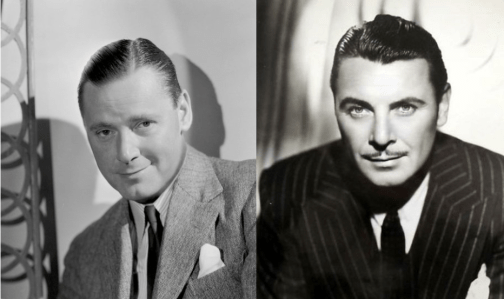
Has a prolonged effort to recall the past strengthened my memory muscles? The other night I watched Lifeboat, the 1944 Alfred Hitchcock film and the next day I could recall all the actors’ names. Last night I watched The Rains of Ranchipur, a 1955 film that starred George Brent. I never can remember his name and always confuse him with Herbert Marshall, whose name I never can remember either to great frustration. Here I am remembering both of their names. What has changed?

Has all my effort to remember somehow opened up clogged neural pathways?

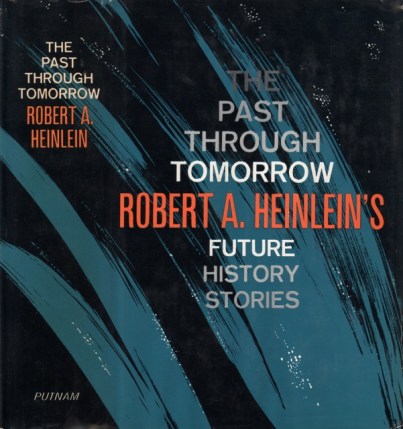
The Past Through Tomorrow by Robert A. Heinlein 1967

This morning I found a history of the Science Fiction Book Club. I joined it in early 1967, and the 1965-1969 monthly select list triggers memories of which books I bought during those years. I’m working to distinguish which books I bought from the Things to Come monthly sales flyer, and which I bought later. Making such a distinction helps to remember. My memory tells me the first book I ordered was The Past Through Tomorrow by Robert A. Heinlein. It was the April selection for 1967. But my memory tells me I got it in March. However, the sales flyers came weeks earlier so this memory could be true.

It just occurs to me that “the past through tomorrow” are ironic words to come up right now.

I often feel like a detective looking for clues to my own past. I know from personal experience and books to distrust memories. We constantly fool ourselves. We work on the assumption that our memories are accurate. They aren’t. That’s why I’m always looking for external clues to verify what I think I remember.

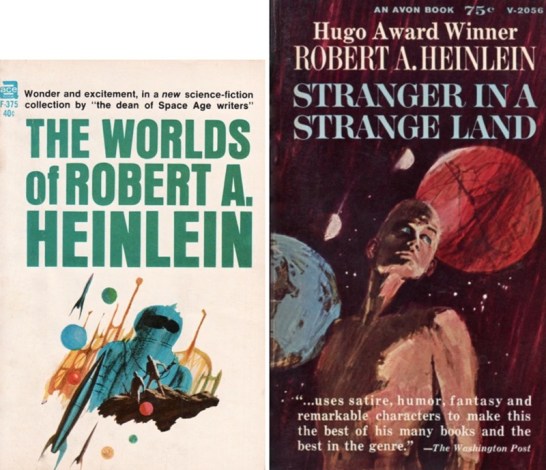
I’m pushing my memory to recall how I bought books during the 1965-1969 high school years. In the 8th and 9th grades (1963-65) I was getting books from my school libraries at Homestead Junior High and Cutler Ridge Junior High School. Around this time I started making money from cutting lawns and a paper route. The first books I remember buying new at a store were two paperbacks. Well, that’s not exactly true. In the 6th and 7th grade I ordered paperbacks from Scholastic Book flyers they gave out in class, and my mother gave me the money to buy them. But in 1965, but maybe early 1966, I remember going to a shopping center on my bike to buy The Worlds of Robert A. Heinlein and Stranger in a Strange Land on separate occasions They were from a spinning wire rack at the back of a drugstore. I just checked ISFDB.org and the first book was 1966 and the second 1964. So that validates my memory. Here are their covers as I first saw them back then:

First-Heinlein-books-I-bought

In August of 1966, we moved to Charleston, Mississippi, a very small town without a bookstore, but with a very tiny, very ancient, very dusty storefront library. Charleston’s drugstore had one twirling rack of books, but without science fiction. I bought Popular Science magazines instead. I also got a job throwing papers for the afternoon paper from Jackson. I got my first checking account at 15. This is when I first joined the Science Fiction Book Club. We moved back to Miami in March of 1967 to Coconut Grove, Florida, the oldest section of Miami (if I can trust my memory). It was here that I visited my first new bookstore, and even then it was half bookstore and half stationary store. It only had a couple of shelves for science fiction, but as of now, I can’t remember buying any specific books there.

I did get a job at the Kwik Chek in Coconut Grove in November of 1967. This is when I got my second checking account, at 16. With my first paycheck I remember being around $40, I ordered the twelve Heinlein juveniles in hardback directly from the publisher Charles Scribner’s Sons. (They cost $3.33 each, or $39.96 for the set, so that verifies.) I’ve forgotten how much postage I had to pay. Those books arrived on 2/18/68. I know that because I still have them. I had signed and dated them.

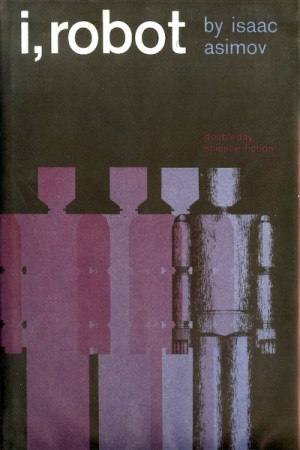
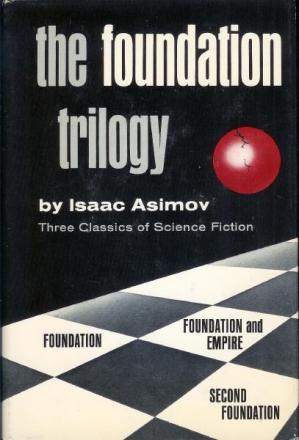
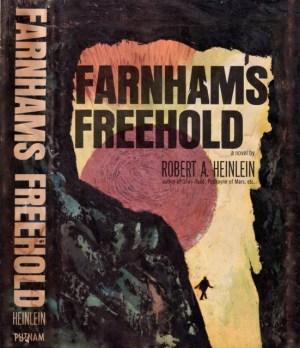
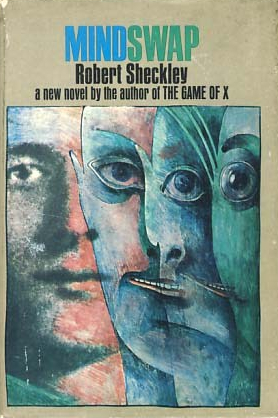
My collection of science fiction was growing. I had a two-shelf bookcase I built in shop class in the 9th grade. My collection took about half of one shelf. I can visualize myself shelving I, Robot and The Rest of the Robots by Isaac Asimov along with Farnham’s Freehold by Robert A. Heinlein. Using the listing of the Science Fiction Book Club I believe I added the following books to my bookshelf during 1967-69 years. This included buying some of SFBC’s older selections. Looking at the covers instantly verifies my memories. I’m also surprised by the famous SF books I didn’t buy during those years but bought much later once I discovered what they were. So some classic science fiction novels I read when they came out and others way afterward. This exercise is also teaching me which books I bought but didn’t read.

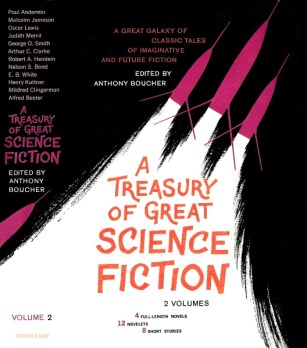
  • A Treasury of Great Science Fiction (2 volumes) edited by Anthony Boucher (January 1960)
  • I, Robot by Isaac Asimov (August 1963)
  • Glory Road by Robert A. Heinlein (September 1963)
  • The Foundation Trilogy by Isaac Asimov (October 1963)
  • Orphans of the Sky by Robert A. Heinlein (May 1964)
  • Farnham’s Freehold by Robert A. Heinlein (November 1964)
  • The Rest of the Robots by Isaac Asimov (December 1964)
  • Prelude to Mars by Arthur C. Clarke (August 1965)
  • Twice 22 by Ray Bradbury (March 1966)
  • Mindswap by Robert Sheckley (May 1966)
  • The Crystal World by J. G. Ballard (Summer, 1966)
  • Fantastic Voyage by Isaac Asimov (August 1966)
  • Earthblood by Keith Laumer and Rosel George Brown (January 1967)
  • The Artificial Man by L. P. Davies (Febrary 1967)
  • The Past Through Tomorrow by Robert A. Heinlein (April 1967)
  • Dangerous Visions edited by Harlan Ellison (December 1967)
  • Lord of Light by Roger Zelazny (January 1968)
  • Cryptozoic! by Brian W. Aldiss (May 1968)
  • 2001: A Space Odyssey by Arthur C. Clarke (September 1968)
  • The Last Starship from Earth by John Boyd (November 1968)
  • Nova by Samuel R. Delany (May 1969)
  • A Specter is Haunting Texas by Fritz Leiber (June 1969)
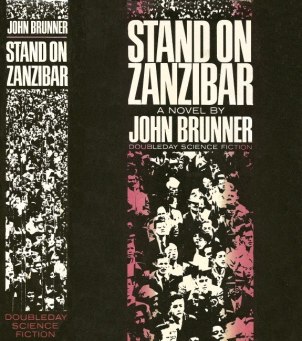
  • Stand on Zanzibar by John Brunner (July 1969)
  • Omnivore by Piers Anthony (July 1969)
  • The Pollinators of Eden by John Boyd (August 1969)
  • The Illustrated Man by Ray Bradbury (September 1969)
  • The Left Hand of Darkness by Ursula K. Le Guin (October 1969)
  • The Jagged Orbit by John Brunner (November 1969)

If you are still reading I hope this hasn’t been too boring watching me walk down memory lane. If it’s helping me to exercise my brain then I’ve got to keep doing it. During this period I also bought paperbacks, but not very often. It wasn’t until 1969-1970 that I got into buying used books in volume (by the cardboard box). That’s because I discovered flea markets and trade-in paperback bookstores. I especially remember three paperbacks I purchased during my high school years: Empire Star, Babel-17 and The Einstein Intersection. Samuel R. Delany was my second favorite author after Heinlein and my favorite 1960s science fiction writer. Delany was younger, so I felt he represented contemporary science fiction and Heinlein represented the 1940s and 1950s science fiction.

Looking at these titles really does define my reading memories from high school. And their dustjackets trigger old emotions. I wonder if that’s why my memory is improving All this remembering is stirring up the chemicals in my brain?

A Treasury of Great Science Fiction

I Robot by Isaac Asimov

The Foundation Trilogy by Isaac Asimov

Farnham's Freehold by Robert A. Heinlein

Earthblood by Laumer and Brown

Mindswap by Robert Sheckley

Omnivore by Piers Anthony

Stand on Zanzibar by John Brunner

JWH

I Wish I Had a Time Machine to Rescue My Dad

by James Wallace Harris

One of my favorite idle fantasies is to imagine how I would relive my life if my current mind could reincarnate into my younger self. Variations of this fantasy have included using a time machine to jump back in time to warn my younger self about the future, although I doubt young Jimmy would have taken older Jim’s advice. This week I’ve been struggling to remember everything I could from 50 years ago, and a new fantasy has occurred to me.

What if I had a time machine so I could go back and rescue my dad instead of me?

I know such fantasies are impossible, so why waste my time on them? But the science fiction reader in me loves the idea of creating my own alternate histories by playing “What if?” The challenge to these fantasies is to find the right point in time to divert the time stream. It occurred to me this morning that the moment to rescue my father was in the summer of 1967, but first I guess I should explain why my father needed help.

My father died in 1970 at age 49 when I was 18. My mother and father were alcoholics. My father was a steady drinker, but my mother would only hit the bottle in times of stress from her bipolar swings. My father loved being in the Air Force but was forced to retire after 22 years when he had a heart attack in 1964. Sitting at home without work made him drink more. Dad recovered, went back to work and had another heart attack. Dad recovered again, went back to work, and had a stroke. He even recovered from the stroke before he died of his final heart attack.

My father also had emphysema in his last years, requiring oxygen. But he continued to chain smoke Camels, eat meat and potatoes, and drink Seagram 7 all day long. His death certificate reported that his liver, lungs, appendix, and stomach were shot to hell. I’ve always figured his heart was very strong to survive all that. It made me wonder if he had ever tried to get healthy if he could have survived into old age. Or at least long enough for the two of us to get to know each other.

But my dad was not a happy man. When I was a kid I used to ask myself, “Was my father a drunk because my mother bitched all the time, or did my mother bitch all the time because my father was a drunk?” I’ve never blamed my parents about my upbringing. I survived by being totally selfish, and I figured it was every family member for themselves. Now that I’m older I feel guilty for being so selfish. I know as a kid I didn’t know enough to help them, or even how to be a better person myself. I just survived the best I could. I really don’t blame my parents, but I don’t think they were suited to have children.

Over the last few decades, I’ve come to believe that I and my sister were the main sources of my parents’ unhappiness. We just weren’t what they expected, and any effort to shape us into what they wanted only caused them endless suffering. Of course, it wasn’t easy on me and Becky either, but our youth gave us a vitality to survive. My father just couldn’t handle the emotional conflicts. My mom got better after my father died, especially with 1970s anti-depressants, but she suffered endless unhappiness for the rest of her life, mostly from trying to make Becky and I do what she wanted.

The photo above is my only proof that my parents were ever happy. It was taken in 1949 before they had me and Becky.

Over the decades I’ve tried to reconstruct who my dad was from memories of the people who knew him, but I’ve had little luck. I’m not sure I’ve ever gotten to talk with anyone who really knew him, and that includes my mother, who died in 2007. My father wasn’t much of a talker. He might have been before I knew him, but I now believe my mother, sister, and I drowned him out.

I have just 23 photographs of my father. All but three were taken before I was born, and two of those were with me as a toddler. I have no photographs of my father with my sister.

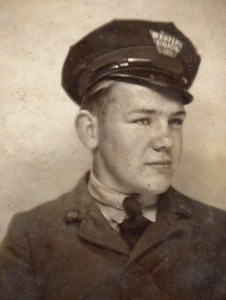
1936---George-Harris-photoshoppedMy father was born in Nebraska, in 1920, but moved when he was a little kid to Miami by 1923. He attended Miami Edison High School, but I’m not sure if he graduated there. I have a photo of him dressed for graduation that was taken in Homestead, Florida. Dad graduated in 1938 and I have his class photo, but I’m not sure if he graduated from Edison. I know he attended Edison for a while because I have a newspaper clipping about his class project. I know he worked as a Western Union delivery boy in high school because I have a photo of him in uniform from 1936. I have photos of my father in the service in 1942, but I’m not sure what he did between graduating in 1938 and joining the Army Air Corp in 1942. My father stayed in the Air Force after the war and married my mother in 1945.

My parents were first stationed in Washington, DC, and then Puerto Rico. I have several photographs of my mother and father living on the island and looking very happy. And when I was young they often talked fondly of life in Puerto Rico. I was born on the 6th wedding anniversary on November 25, 1951. There are two photographs of me with my father when I was a toddler, probably in 1952. The next and last photograph I have of my father was from Thanksgiving 1969. It’s blurry and everyone is almost unrecognizable. He died six months later.

I remembered something this morning that made me think the perfect time to rescue my dad would have been in the summer of 1967. 1964-1966 were bad years for my parents, and they separated from September 1966 to March 1967. My mother took me and my sister to live in Charleston, Mississippi to be near her family. We returned to Miami in March 1967 to live on West Trade Avenue, in Coconut Grove, Florida. I guess my father was trying to get his act together. He also started computer classes. I remember him coming home from class and telling me about how punch card codes worked. However, it wasn’t long before my mother and father were fighting again. And my mother and father were both on my sister case, and she was having none of it. I remember a lot of family fights. I tried to stay as far away from my family as possible. I slept on the screened-in back porch with the clothes washer. I had my radio, record player and science fiction books.

This would have been a perfect time to have tried to get to know my father. I don’t know if I could have convinced him to eat right, give up smoking and drinking, and maybe even exercise, but maybe he would have considered it on his own if someone had shown any interest in his life. I think he drank because he was lonely.

Taking computer classes in 1967 was a great time to break into the field. I started computer classes in 1971. If I had studied with him I would have had a great headstart too. We could have gotten to know each other. Maybe he would have tried harder.

Generally, when I have my time travel fantasies I’m thinking of time periods to change my life. Over the years I’ve decided the best time for me was the fall of 1963. If I could have talked my parents into letting me live with my grandmother instead of moving with them to South Carolina I believe my life would have been significantly different. In the fall of 1963, I went to three different 7th grade schools. I’ve always wondered what my life would have been like if I had lived in one place from 7th grade through the 12th. But now I see the pivotal moment in time for my dad was the summer of 1967.

I know we only get one life to live. There are no do-overs. I’m not religious, and I don’t believe in heaven. But I’ve long thought the idea of reincarnation was a wonderful concept, but not how the Hindus imagine it. I’ve always thought we should reincarnate in our own lives and have another chance of getting it right.

My father always worked two and three jobs. I hope he had great friends in the service. I know he loved bartending at NCO clubs and VFW clubs. He loved running bars, and I got to visit in some in those bars. I hope he had friends. I often wonder if he and his buddies consoled each other about wives and kids that didn’t understand them. But I’m not sure. Sometimes I imagine my father always being tight-lipped. Just holding it in.

I can only remember a handful of conversations I had with my dad. One time we were watching The Today Show before he took me to school and he went to work. This was also in that summer of 1967. They mentioned The Hobbit and my father said he knew about Bilbo Baggins. I didn’t know who Bilbo was at that time but remembered my dad saying that name, Bilbo Baggins, later when I finally read The Hobbit. It made me wonder what books my father read, what dreams he had about the future. He grew up in the heyday of the pulp magazines and old time radio. I wonder what stories and heroes he loved.

My father loved the military, and in 1967 I was very anti-war. I remember once my dad calling me a commie-pinko-faggot in anger. His dream for me was to join the ROTC and become an officer. I was having none of that. I ruined his fantasy for me. I later thought he should have been mature enough to understand me because I was too immature to understand him. But that was all part of the great generation gap. If my dad had lived he would have been a Fox News kind of guy. I don’t think we would have ever bridged the generation gap.

However, if I ever get hold of a time machine, I would try.

1969---Last-photo-of-Dad

JWH