If Ignorance is Bliss, is Knowing Suffering?

by James Wallace Harris, 6/27/24

This essay is about how keeping up with current events is hard on our mental health. Is there a point in becoming informed that turns self-destructive? Happiness seems to be a balance between knowing and not knowing, between learning and ignoring.

I’ve always been amazed by the amount of fiction we consume in our lives — the books, movies, television shows, plays, video games, role playing, comics, fantasizing, bullshitting, and so on. Is fiction our way of regulating our awareness of reality?

I’m trying to decide in this essay just how much news I should consume. I believe I have three basic choices:

  1. Ignorance really is bliss.
  2. Learn enough to maximize my own survival.
  3. Learn everything I can to answer why and maybe know what can be changed.

I also consider the first three lines of the Serenity Prayer practical advice:

God grant me the Serenity to accept the things I cannot change,
Courage to change the things I can, and
Wisdom to know the difference.

Mental health depends on knowing what can be changed and what cannot. I believe the old saying, “ignorance is bliss” is merely advising people not to try to change things. Eastern religion and philosophy are all about acceptance, and that might be one path to happiness, or at least contentment. Western religion and philosophy have always been about control, which often leads to frustration and unhappiness. However, Western religion and politics have always been delusional because they don’t know enough to wisely make changes. Too many people think they know, but don’t. And too many people pursuing ignorance follow the people who don’t know. In other words, even if you learn everything you probably won’t be able to do anything.

For most of my life I hoped humanity would evolve into a global humanistic society that was ecologically sustainable, maximizing freedom, and minimizing inequality. That’s obviously not going to happen. Instead, we’re returning to nationalism, xenophobia, and fascism. The growing consensus advocates: get all you can, protect what you have, and let the losers lose. Even Christians have become Darwinians.

The main message in the movies and television shows we consume is the good life is eating, screwing, buying, and travel. But hasn’t that made us the most invasive and destructive species on the planet?

I believe the fiction we consume, and the fantasies we chase, is our way of self-medicating a deep depression caused by seeing too much of reality. If I read or watch too many news programs, documentaries, or nonfiction books about what’s happening around the world I get bummed out and need to retreat. Is that the best thing to do? Or the only thing to do?

How much of learning about reality is educational, soul strengthening, and enlightening? Billions of people are suffering. How important is it to know that the majority of people on this planet spend a good deal of their lives in misery?

If you only watch NBC Nightly News, Fox News, MSNBC, or CNN, you’ll only end up worrying about problems in the United States. And that’s enough to depress most people. But if you take in news from around the world, it can deeply threaten your mental health.

I watch a lot of news from all over, and I’m convinced that our civilization is in decline. The number of failed nations grows every year. The number of weather catastrophes increases every year. Wars and famines are increasing. Life expectancies are declining. Economies are breaking down, and people are dying, becoming homeless or refugees, and suffering in ever-growing numbers. We’re lucky in the United States that we don’t suffer as much, but that’s why millions want to come here.

Decades ago, I stopped watching local news so I wouldn’t be depressed about crime. Even though I live in a high crime city, I seldom hear about it, and thus seldom worry. I could do the same thing with national and international news. That would be good for my mental wellbeing, but shouldn’t I do something?

Liberals believe society should alleviate suffering through laws. Conservatives want to solve the same problems by convincing everyone to pull themselves up by their bootstraps. The reality is liberals want to solve society’s problems by spending the conservative’s money, and the conservatives just want to ignore the problems and keep their money. And it seems the only problem politicians really want to solve is how to get reelected and feed their egos.

Civilization is coming undone. That’s all too obvious if you watch a lot of news and study local, state, federal, international, and world events. However, knowing, and even understanding the problems we face doesn’t empower us to solve them. We either solve them together, or not at all, and if you’re an ardent news watcher, you’ll know we’re living in an age where we don’t work together.

Here’s where I’d love to list and catalog all our problems and assess their chances of being solved. But that would take a book length bit of writing. I’m sure you see enough of the news to know about all the problems we face — or do you? Would knowing more help or hurt you?

I could construct a detailed taxonomy of all the problems we face. I could stop reading novels and watching television and study the heck out of current events. But other than finding enlightenment about why civilization is collapsing, are there any mental, spiritual, or psychological benefits to learning how and why we’re self-destructing?

The real question is: Can we do anything to stop our self-destruction if we all agreed to work together and knew the right solutions? Even if we banned all airplane travel, reduced car travel to a minimum, rebuilt the energy grid that maximized renewable energy, and we all became vegetarians, we’ve already put enough CO2 in the atmosphere to radically change the climate. We may have already destabilized the climate so it can’t be reversed.

And we don’t have to wait until the seas rise above New York and London before climate change will do us in. We’re about to see the collapse of the home insurance industry which will completely destabilize the economy around home ownership. Just that might bring about economic chaos.

I could go on. Aren’t we like cattle in a stockyard? Would knowing about the captive bolt pistol offer any personal benefit in our lives? Or is there a kind enlightenment to be achieved by figuring out how the system works?

JWH
What I Learned About Myself by Being Interviewed for a Podcast

by James Wallace Harris, 6/18/24

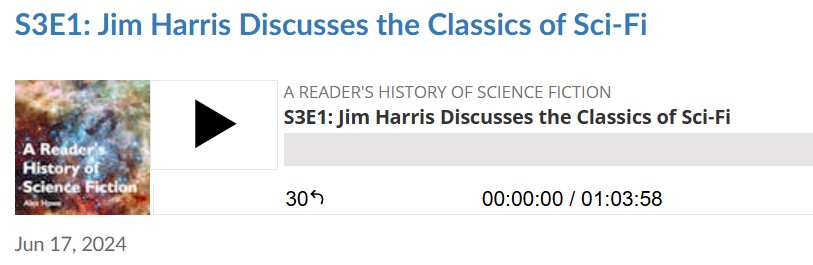
I was interviewed by Alex Howe for A Reader’s History of Science Fiction podcast about my Classics of Science Fiction list I’ve been maintaining since 1989. I was surprised by how much I learned about myself from the process.

I’m used to writing essays where I have all the time in the world to compose my thoughts. That’s not true in a conversation. I realized while I was being taped, and even more when I listened to the podcast, that conversation leaves no room for composing or editing thoughts on the fly. At my age I need lots of time to think. I also need time to find words I can’t remember.

I watch a lot of YouTube videos and I’m amazed by how some people can talk at length presenting a clearly organized topic without stumbling over their words. I know some TV talking heads work from scripts, but I’m not sure that’s common for podcasts and YouTube videos.

Some people are simply great talkers. They can clearly enunciate words and thoughts at a fast speaking pace. I can’t. I’m surprised by the number of people who want to be talking heads on TV, both as interviewer and interviewee. It requires skills I admire. Being interviewed revealed all those skills I lack.

After a couple of years of watching YouTube videos it’s also become apparent that even though anyone can host a YouTube channel, not everyone should. I’m astonished by how media ready some folks are, and how others are not. I’m not.

My mind is suited for print.

I was getting over a cold on the day I was interviewed, so my voice sounds rough. But that doesn’t bother me too much when I listen to the podcast. What makes me worry about my aging mind is how I failed to answer Alex’s questions clearly. I’m not sure anyone will understand our statistical system for identifying the most remembered science fiction books. On the other hand, I’m not sure I’ve ever been able to describe it in printed words well either.

One thing that Mike and I learned from building the database and generating the reports is visitors to the web site seldom read the supporting documentation. In fact, we dropped most of the documentation from the current system because, so few people read it. We now aim to make the database as simple to use as possible.

My failure to explain how our database works is more than my lack of verbal skills, but even with that excuse, I do think I should have expressed the concept better.

I’ve been interviewed before, about twenty years ago. Somehow The New York Times learned I listened to a lot of audiobooks and a reporter came to my office to ask me about that. I was one of several people they profiled. This was in the early days of Audible.com, and I guess they thought it news that people were switching from reading to listening. The reporter asked me several questions, but only some of my answers ended up in the paper. The amount of editing is the difference between print journalism, television shows, and podcasts.

The reason I prefer to express myself in an essay is I can edit my own thoughts. Being interviewed for a podcast was fun, and I thank Alex Howe for the honor. However, I’m not sure I’ll do it again.

JWH

What Susan and I are Watching in 2024

by James Wallace Harris, 6/14/24

For over a year now, Susan and I have developed a routine of watching television together every night at nine o’clock. After forty-seven years of marriage, it’s become extremely hard for us to find television shows we both enjoy. When we were younger and more romantic, we’d watch what the other liked even if we didn’t enjoy the show ourselves. But as we’ve gotten older and set in our ways, we both know what we like, and it’s seldom the same kind of TV series or movie. We now find it a challenge to pick a television we want to watch together. But when we do find one, it’s fun and bonding. We’ve recommended these shows to our friends, and we’ve gotten many positive reviews back. They are all recommended.

We just finished A Gentleman in Moscow based on the novel of the same name by Amor Towles. We subscribed to Paramount+ to see it because so many of my friends told me about loving the novel. It’s a wonderful story about a Russian aristocrat, Count Alexander Ilyich Rostov, surviving the communist revolution. The party would have executed him but thinks he wrote a revolutionary poem, so they condemn him to live in a luxury hotel for the rest of his life. If he leaves, he will be shot. The story covers the decades Rostov lives at the Hotel Metropol. The story started rather slowly but quickly became enchanting. I bought the novel but haven’t started listening to it yet.

Currently we start the evening with an episode of Why Women Kill on Paramount+. We love this show, which is a quirky light-hearted story about murder. It was created by Marc Cherry who also created Desperate Housewives. Normally, neither one of us likes watching TV involving gratuitous violence, but this one is an exception. Both of us look forward to seeing a new episode each night and we’re both going to be depressed when we finish all twenty episodes.

After Why Women Kill, we watch two episodes of Leave it to Beaver. We’re currently in season four. Beaver ran six seasons for a total of 234 episodes, and is available for free on many streaming services, but we watch it on Peacock+. We’re willing to pay $11.99/month to keep from having commercials interrupt our fun. I’m surprised by how much Susan, and I like this show, even though it’s incredibly old, and rather simplistic. And we don’t watch it for nostalgia, since neither one of us were fans of the show growing up.

It’s amazing how creative the writers are producing story after story set within a limited setting and story structure. I remember seeing some episodes when I was a kid back in the 1950s, and my memories left me believing Leave it to Beaver was all about the kids Beaver and Wally, but we’ve discovered it’s just as much about Ward and June, the parents.

I recently read an interview with Jerry Mathers who said the show intentionally avoided going for big laughs. If any scene turned out too funny, they cut it. They didn’t want the show to be about jokes. I’ve been looking at a few episodes of Make Room for Daddy (later renamed The Danny Thomas Show) that ran concurrent with Beaver, and thought it was often spoiled by setting up scenes around an all to obvious joke.

Leave it to Beaver is about parenting in the 1950s. It’s fascinating to see how much our culture has changed since then.

Before Why Women Kill and Leave it to Beaver, we watched Franklin and Manhunt on Apple TV+ and We We the Lucky Ones on Hulu. Susan and I have a lot of luck with TV series based on history. But I have issues with fictionalizing real events. These shows were quite compelling and enjoyable, but they made up stuff that didn’t happen. Manhunt is about the hunt for Lincoln’s assassin, John Wilkes Booth. Unfortunately, it makes us believe Edwin Stanton did things he never did. I should read the book it was based on.

We Were the Lucky Ones is also based on a novel by Georgia Hunter inspired by the true story of her Jewish family surviving Hitler’s occupation of Poland during WWII. The Kurc family was immensely lucky, but they endured years of horrible suffering before they could say that. Again, I want to read the book.

I have read a couple of biographies of Benjamin Franklin but did not know all the details revealed in Franklin on Apple TV+. The miniseries is about the eight years Franklin spent in France trying to convince the French to support the American Revolution. Again, I’ll have to read a book to find out if the show played fair and square with history.

We also caught up on several PBS Masterpiece shows, including MaryLand, Ridley Road and Mr. Bates vs The Post Office. All of these were excellent.

Maryland is about two sisters, Becca and Rosaline learning their mother, Mary, has died on the Isle of Man. When they go to identify her body, the police tell the women things about their mother they can’t believe. The two then discover their mother had a secret life on the Isle of Man that they and their father did not know about. The story was wonderful and is about what family members don’t tell each other. The Isle of Man was a beautiful location.

Ridley Road was about a fascist movement in England during the early 1960s, and how a Jewish family infiltrated the group. It was based on real events, but like most historical fiction, I’m not sure things happened the way they are portrayed. Again, I’d like to study these events in a book.

Finally, Mr. Bates vs. The Post Office was amazing. It’s based on a true story, about how the upper management of the British post office covered up problems with their computer system by prosecuted hundreds of innocent sub-postmasters for theft. PBS also is showing a documentary that covers the same events, and many of the scenes in the miniseries were directly taken from film clips from the news. You wouldn’t think this story would be interesting, but it was. The first episode was slow, but after that got to be a delightful story about real people. The scenic landscapes made me want to live in England.

Another show we absolutely loved was Lessons in Chemistry, on Apple TV+, but that was at the end of 2023. I loved the show so much I read the novel, which was even better than the miniseries.

JWH

The Agony and Ecstasy of Working in the Yard

by James Wallace Harris, 4/25/24

My backyard is an example of entropy in action. Working in my yard is a never-ending battle between chaos and order. If I had my wish, I’d move to a retirement condominium so I wouldn’t have to worry about a yard, or any kind of house maintenance. However, with rising HOA fees, and private equity takeovers, that wish could turn bad, and we’d be homeless. I see our paid for house as our last bastion of security, so I want to hang onto this home as long as possible.

Regarding yardwork, I must choose between two options. Either I pay someone to do it, or I do it myself. I’m not keen on either option. I’ve known lots of folks who got into gardening as they got older, and they found enjoyment and exercise in the pursuit. Right now, I strongly dislike working in my yard. I wonder if I can change my spots. Since I find hiring people frustrating, I’m agonizing over choosing between two things I don’t want to do.

My front yard is mostly weeds and dirt. My friend Annie told me how she was seeding her lawn with mini clover and told me about all its advantages. So, I ordered a couple pounds of mini clover seeds from Amazon. It’s been fun seeing it come up, that is until the lawn guys mowed the lawn for the first time this year. I had texted them to raise the cutting height to three inches. They didn’t. My front lawn was sheared so close to the ground that nearly everything green is gone. That annoyed the crap out of me. Like they say, if you want something done….

The mini clover can be trained to grow just 3-4 inches high, so after a few mowings it will require no more mowing. If I really want that to happen, I need to buy a mower and mow the lawn myself. Unfortunately, I don’t have any place to keep a mower. So, I’d also need to buy a storage shed. And if I fire my yard guys, I’d also need to buy a blower, trimmer, and chainsaw. And if I got into landscaping, like I need to do, I’d also need to buy a wheelbarrow and other gardening tools. This is getting expensive and a commitment.

My friend Leigh Ann hired a yard planner. He produced a 24-page document advising her on how to beautifully landscape her yard. I’m thinking about hiring him too, but I want him to advise me to create a simple easy-to-maintain lawn. I don’t want a beautiful, landscaped yard, but a yard the neighbors won’t feel embarrassed to see in the neighborhood.

Our house used to be Susan’s parents’ house. We bought it after they died. They loved working in the yard, and it was nicely landscaped. We’ve neglected the yard for thirteen years, and the landscaping has gone wild. I want a new landscape design that’s easy to maintain.

I rationalize letting it go wild was good for the environment. Birds, insects, and little creatures love it. We even have a possum living out back. However, twice now the utility company has had to hire a crew to cut a path to the power pole during power outages. They don’t tell us to keep our yard clean, but they do give us dirty looks and act mighty unfriendly.

One reason I don’t work in the yard is I have spinal stenosis, and I can only do a limited amount of physical work before I’m in a lot of pain. But I do believe I could put in twenty minutes a day. Susan absolutely refuses to work in the yard.

I theorize I might eventually conquer the yard by working twenty minutes a day and it might even be good for me. Hell, it could even turn into a hobby I enjoy. That seems to happen with a lot of older folks I know. On the other hand, I might invest thousands of dollars and want to give up in a month.

I really would like to make the mini clover work in the front yard. I’ve kind of enjoyed working with it. I go out twice a day to see how it’s doing. It does take a lot of watering, but if I can get it established, the mini clover is supposed to fix nitrogen in the soil and be minimal in maintenance. That would give me a sense of accomplishment if I pulled it off.

Reversing the entropy in the backyard will be a full-scale battle. I’ll need some dangerous power tools to conquer the reemerging forest. I’ll feel bad about killing all those wild bushes and baby trees, especially if they’re sanctuary to wildlife. However, if I want a yard that’s a yard, I will have to do that.

I’m just not sure what to do. I’ve been trying to get away from all my screens and do something real, and yard work is very real. I just don’t know if I can handle it, either physically or mentally. My friend Janis’ father still works in the yard, and he just turned ninety-nine. I wonder if his longevity and vitality come from yard work.

JWH

Why I Deleted Facebook and Twenty Other Apps from My iPhone

by James Wallace Harris, 4/21/24

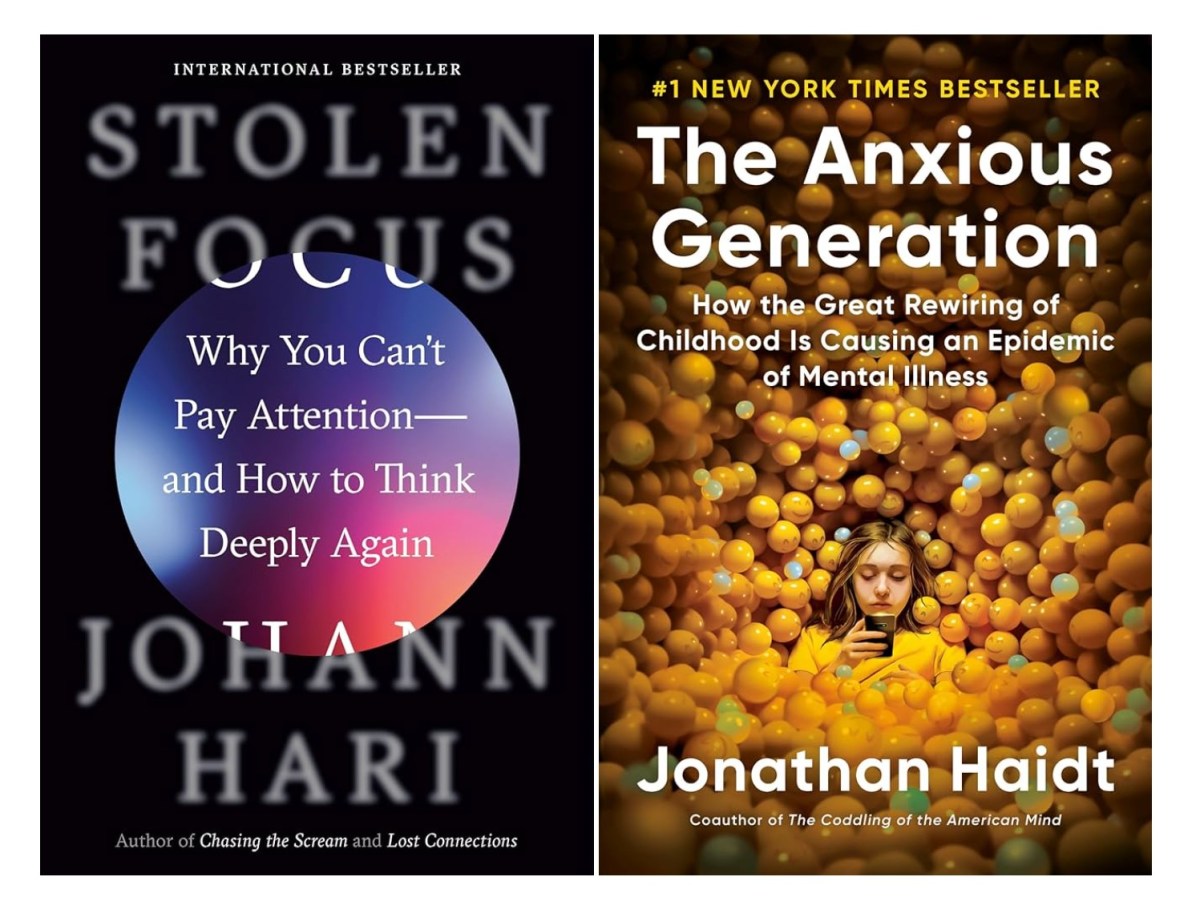
Lately, I’ve been encountering numerous warnings on the dangers of the internet and smartphones. Jonathan Haidt is promoting his new book The Anxious Generation. Even though it’s about how there’s increase mental illness in young girls using smartphones, I think it might tangentially apply to an old guy like me too.

Haidt was inspired to write his book because of reports about the sharp rise in mental illness in young people since 2010. That was just after the invention of the iPhone and the beginnings of social media apps. Recent studies show a correlation between the use of social media on smartphones and the increase reports of mental illness in young girls. I’m not part of Haidt’s anxious generation, but I do wonder if the internet, social media, and smartphones are affecting us old folks too.

Johann Hari’s book, Stolen Focus, is about losing our ability to pay attention, which does affect me. I know I have a focusing problem. I can’t apply myself like I used to. For years, I’ve been thinking it was because I was getting old. Now I wonder if it’s not the internet and smartphones. Give me an iPhone and a La-Z-Boy and I’m a happy geezer but not a productive one.

So, I’ve decided to test myself. I deleted Facebook and about twenty other apps from my iPhone. All the ones that keep me playing on my phone rather than doing something else. I didn’t quit Facebook, or other social media accounts, just deleted the apps off my phone. I figure if I need to use them, I’ll have to get my fat ass out of my La-Z-Boy and go sit upright at my desktop computer.

This little experiment has had an immediate impact — withdrawal symptoms. Without Facebook, YouTube, and all the other apps I kept playing with all day long, I sit in my La-Z-Boy thinking, “What can I do?” I rationalized that reading the news is good, but then I realized that I had way too many news apps. With some trepidation, I deleted The Washington Post, Ground News, Feedly, Reddit, Instapaper, and other apps, except for The New York Times and Apple News+.

I had already deleted Flipboard because it was one huge clickbait trap, but couldn’t that also be true of other news apps? They all demand our attention. When does keeping current turn into a news addiction? What is the minimum daily requirement of news to stay healthy and informed? What amount constitutes news obesity?

I keep picking up my iPhone wanting to do something with it, but there’s less and less to do. I kept The New York Times games app. I play Mini Crossword, Wordle, Connections, and Sudoku every morning. For now, I’m rationalizing that playing those games is exercise for my brain. They only take about 20-30 minutes total. And I can’t think of any non-computer alternatives.

I still use my iPhone for texting, phoning, music streaming, audiobooks, checking the weather, looking up facts, reading Kindle books, etc. The iPhone has become the greatest Swiss Army knife of useful tools ever invented. I don’t think I could ever give it up. Whenever the power goes out, Susan and I go through withdrawal anxiety. Sure, we miss electricity, heating, and cooling, but what we miss the most is streaming TV and the internet. We’ve experienced several three-day outages, and it bugs us more than I think it should.

One of the insights Jonathan Haidt provides is his story about asking groups of parents two questions?

  1. At what age were you allowed to go off alone unsupervised as a child?
  2. At what age did you let your children go off unsupervised?

The parents would generally say 5-7 for themselves, for 10-12 for their children. Kids today are overprotected, and smartphones let them retreat from the world even further. Which makes me ask: Am I retreating from the world when I use my smartphone or computer? Has the iPhone become like a helicopter parent that keeps me tied to its apron strings?

That’s a hard question to answer. Isn’t retiring a kind of retreat from the world? Doesn’t getting old make us pull back too? My sister offered a funny observation about life years ago, “We start off life in a bed in a room by ourselves with someone taking care of us, and we end up in bed in a room by ourselves with someone taking care of us.” Isn’t screen addiction only hurrying us towards that end? And will we die with our smartphones clutched tightly in our gnarled old fingers?

Is reading a hardback book any less real than reading the same book on my iPhone screen, or listening to it with earbuds and an iPhone? With the earbuds I can walk, work in the yard, or wash dishes while reading. Is reading The Atlantic from a printed magazine a superior experience than reading it on my iPhone with Apple News+?

Is looking at funny videos less of a life experience than playing with my cat or walking in the botanic gardens?

Haidt ends up advising parents to only allow children under sixteen to own a flip phone. He would prefer kids wait even longer to get a smartphone till they complete normal adolescent development, but he doesn’t think that will happen. I don’t think kids will ever go back to flip phones. The other day I noticed that one of the apps I had was recommended for age 4+ the App Store.

Are retired folks missing any kind of elder years of psychological development because we use smartphones? As a bookworm with a lifelong addiction to television and recorded music, how can I even know what a normal life would be like? I’m obviously not a hunter and gatherer human, or an agrarian human, or even a human adapted to industrialization. Is white collar work the new natural? Didn’t we live in nature too long ago for it to be natural anymore?

Aren’t we quickly adapting to a new hivemind way of living? Are the warnings pundits give about smartphones just identifying the side effects of evolving into a new human social structure? Is cyberization the new phase of humanity?

There were people who protested industrialization, but we didn’t reject it. Should we have? Now that there are people rejecting the hivemind, should we reject it too? Or jump in faster?

For days now I’ve been restless without my apps. I have been more active. I seeded my front lawn with mini clover and have been watering and watching it come in. I contracted to have our old bathtub replaced with a shower so it will be safer for Susan. I’ve been working with a bookseller to sell my old science fiction magazines. And I’ve been trying to walk more. However, I’ve yet to do the things I hoped to do when I decided to give up my apps.

It’s hard to tell the cause of doing less later in life. Is it aging? Is it endless distractions? Is it losing the discipline of work after retiring? Before giving up all my apps, I would recline in my La-Z-Boy and play on my iPhone regretting I wasn’t doing anything constructive. Now I sit in my La-Z-Boy doing nothing and wonder why I’m not doing anything constructive. I guess it’s taken a long time to get this lazy, so it might take just as long to overcome that laziness.

JWH