Why Did Martin Scorsese Donald Trump Us?

by James Wallace Harris, Saturday, June 15, 2019

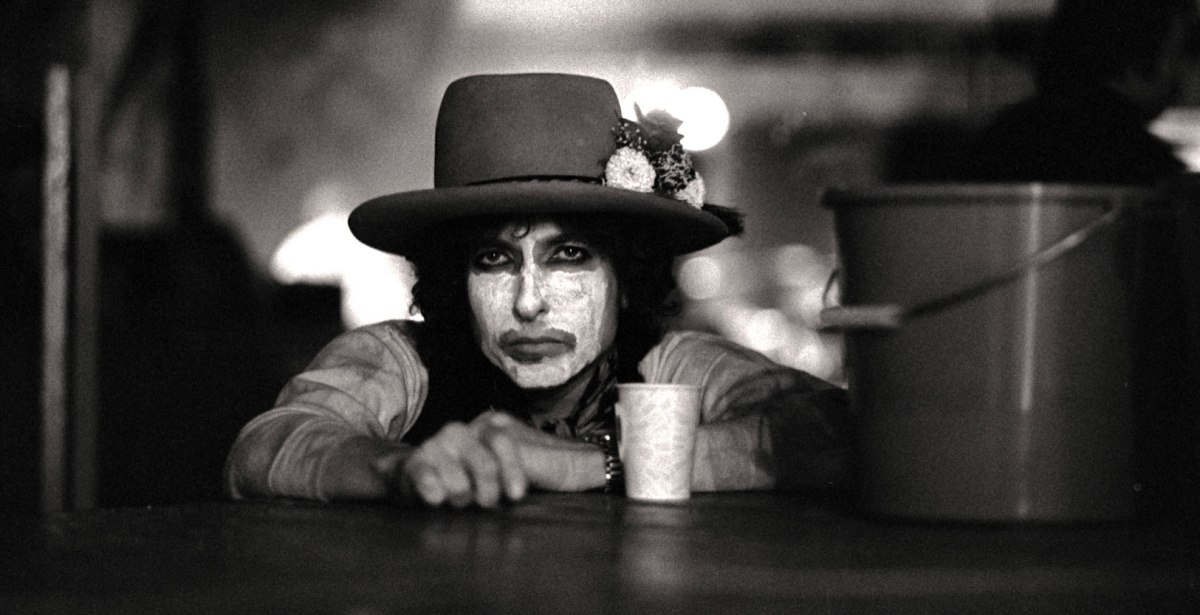
After watching Martin Scorsese new film Rolling Thunder Revue on Netflix I read The New Yorker’s piece by Richard Brody entitled ‘“Rolling Thunder Revue,” Reviewed: Martin Scorsese’s Slippery Chronicle of Bob Dylan in Concert.’ It seems all my favorite parts of the film were made up. I had been lied to, I had been Donald Trumped.

When Bob Dylan showed up in New York City at the beginning of the 1960s he became infamous for lying about his past. He told such tall tales that the people around him had to constantly access his reality distortion field. Ever since then reporters, biographers, and documentary filmmakers have sought the truth about Bob Dylan in the same way modern theological scholars have tried to unearth the truth about the historical Jesus.

Whenever I read the rare book that interviews Dylan or watch an even rarer documentary featuring Bob Dylan I hope to gain a bit of insight into the Dylan enigma. So is Scorsese’s film a documentary or mockumentary? What is fact or fiction? Is it 20 Feet from Stardom or This Is Spinal Tap? Scorsese chronicles the Rolling Thunder Revue which itself was a circus of make-believe that Dylan tried to put over that might have been great performance art or a creative fiasco. Should I judge Scorsese harshly for lying to me when he was trying to make sense of a bigger lie? Or was he merely trying to join in the same kind of fun and pull Dylanesque gags too? Dylan and all his friends took on assumed names and characters during the tour – but was that that meant to entertain or divert us from thinking about Dylan as Prophet of the Babyboomers.

But here’s the thing. Ever since Donald Trump crowned himself Emperor of Lies it’s very hard to take any kind of lying in fun. When I was growing up people generally shunned anyone who lied. No one likes to discover they’ve been lied to. Donald Trump is such a large black hole of lying that his massive lies rip apart reality. We have so much fake news and deep fake films that any kind of lying for fun is hard to take. Donald Trump has made any kind of lying a horrendous offense no matter how small or innocent. As far as I’m concerned he’s even ruined Santa Claus.

What’s even worse is how Donald Trump has made lying acceptable to tens of millions of Americans. But isn’t that what we all do? We rationalize which liars we accept. Christianity has made a religion out of piling on the fantasy. What truth Jesus might have said has been distorted by two thousand years of compounded lying. Donald Trump has become the international standard for measuring liars. So when I compare Scorsese’s little lies to his, they don’t seem so big. I loathe Republicans for accepting and promoting Donald Trump’s lies, so I now hate to see myself forgiving any liars. Plus, there’s the whole A Million Little Pieces by James Frey ordeal. We really want our nonfiction to be honest.

On the other hand, we all know colorful characters who play the class clown for life and we forgive them for their fabrications. Dylan has always passed himself off as a jester. In the mid-sixties when his fans were about to turn him into a guru of political truth, a Gandhi or Martin Luther King. Dylan freaked out. He began swearing he was just a song and dance man, a roving minstrel that sang clever tunes for your amusement.

Dylan retreated from the limelight after a 1966 motorcycle accident that some claimed may or may not have happened. He knew what the world did to their saviors. That was quite wise. When he returned to touring, first with The Band in 1974, and then with the Rolling Thunder Revue in 1975 he had to develop a new persona. The trouble was, even after he stopped writing protest songs that inspired a generation about injustice, he still wrote songs his fans felt spoke the truth with a capital T. Everyone wanted to be near this modern-day Jesus and decode remarkable parables.

Watching the films Don’t Look Back, Eat the Document, and now Rolling Thunder Revue shows what a crazy hurricane of true friends, fake friends, crazy fans, and sycophants that swirl around the man. No wonder Dylan is sick to death of trying to explain himself and enjoys making up his own myths. We know Dylan is a genius from the lyrics of his songs. He is closer to Shakespeare than any of us. Yet, I can’t help but feel his lying makes him like Donald Trump. Trump really has ruined tall-tale-telling, at least for me, if not for everybody.

All of this is not to pan Rolling Thunder Review. If you’re a Dylan fan I highly recommend it, just be careful being taken in by Sharon Stone, Stefan Van Dorp, and other trickster characters. I plan on watching the film again after studying the actual events. The trouble is original Rolling Thunder Revue was chaos. The original tour was meant to produce a film, but the result, Renaldo and Clara was so bad it’s has been hidden away for decades. Richard Brody did get to see it and says:

But too often Scorsese seems to be joining Dylan in dancing delicately around the past. After seeing “Rolling Thunder Revue,” I watched “Renaldo and Clara” for the first time—and I wish I hadn’t, because its strengths only serve to highlight Scorsese’s failures. Dylan and Sara, as the fictional Renaldo and Clara—a couple whose relationship is thrown into turmoil by a visit from another woman, the so-called Woman in White (played by Baez)—perform in scenes of psychodramatic intensity and romantic anguish. “Renaldo and Clara” also features a remarkable set of concert performances from the Rolling Thunder tour—and Dylan (who edited the film with Alk) treats them with a finer and keener touch than Scorsese does.

Now we have Scorsese’s film that covers up the original film. I now wish they’d release Renaldo and Clara to DVD so everyone else can compare to the two accounts. Trying to decipher Dylan is like trying to solve any of the major mysteries of history. It’s a fun task, but also akin to seeking gold in El Dorado.

JWH

What If Human Memory Worked Like A Computer’s Hard Drive?

by James Wallace Harris, Wednesday, June 12, 2019

Human memory is rather unreliable. What is seen and heard is never recalled perfectly. Over time what we do recall degrades. And quite often we can’t remember at all. What would our lives be like if our brains worked like computer hard drives?

Imagine that the input from our five senses could be recorded to files that are perfect digital transcriptions so when we play them back we’d see, hear, feel, taste, and touch exactly what we originally sensed?

Human brains and computers both seem to have two kinds of memory. In people, we call in short and long term memory. With computers, it’s working memory and storage.

My friend Linda recently attended her 50th high school reunion and met with about a dozen of her first-grade classmates. Most of them had few memories of that first year of school in September 1957. Imagine being able to load up a day from back then into working memory and then attend the reunion. Each 68-year-old fellow student could be compared to their 6-year-old version in great detail. What kind of emotional impact would that have produced compared to the emotions our hazy fragments of memory create now?

Both brains and hard drives have space limitations. If our brains were like hard drive, we’d have to be constantly erasing memory files to make room for new memory recordings. Let’s assume a hard drive equipment brain had room to record 100 days of memory.

If you lived a hundred years you could save one whole day from each year or about four minutes from every day for each year. What would you save? Of course, you’d sacrifice boring days to add their four minutes to more exciting days. So 100 days of memory sounds like both a lot and a little.

Can you think about what kind of memories you’d preserve? Most people would save the memory files of their weddings and the births of their children for sure, but what else would they keep? If you fell in love three times, would you keep memories of each time? If you had sex with a dozen different people, would you keep memories of all twelve? At what point would you need two hours for an exciting vacation and would be willing to erase the memory of an old friend you hadn’t seen in years? Or the last great vacation?

Somehow our brain does this automatically with its own limitations. We don’t have a whole day each year to preserve, but fleeting moments. Nor do we get to choose what to save or toss.

I got to thinking about this topic when writing a story about robots. They will have hard drive memories, and they will have to consciously decide what to save or delete. I realized they would even have limitations too. If they had 4K video cameras for eyes and ears, that’s dozens of megabytes of memory a second to record. Could we ever invent an SSD drive that could record a century of experience? What if robots needed one SSD worth of memory each day and could swap them out? Would they want to save 36,500 SDD drives to preserve a century of existence? I don’t think so.

Evidently, memory is not a normal aspect of reality in the same way intelligent self-awareness is rare. Reality likes to bop along constantly mutating but not remembering all its permutations. When Hindu philosophers teach us to Be Here Now, it’s both a rejection of remembering the past and anticipating the future.

Human intelligence needs memory. I believe sentience needs memory. Compassion needs memory. Think of people who have lost the ability to store memories. They live in the present but they’ve lost their identity. Losing either short or long term memory shatters our sense of self. The more I think about it, the more I realize the importance of memory to who we are.

What if technology could graph hard drive connections to our bodies and we could store our memories digitally? Or, what if geneticists could give us genes to create biological memories that are almost as perfect? What new kinds of consciousness would having better memories produce? There are people now with near perfect memories, but they seem different. What have they lost and gained?

Time and time again science fiction creates new visions of Humans 2.0. Most of the time science fiction pictures our replacements with ESP powers. Comic books imagine mutants with super-powers. I’ve been wondering just what better memories would produce. I think a better memory system would be more advantageous than ESP or super-powers.

JWH


Is Travel Evil?

by James Wallace Harris, Tuesday, June 4, 2019

I read two works this morning that makes me ask if travel is evil. The first was a short story “A Full Life” by Paolo Bacigalupi at the MIT Technology Review. I’m going to spoil the story since I doubt most of you will take the time to read it. It’s about a young girl named Rue, 15, who moves across the country several times as her parents seek work fleeing climate change catastrophes. Bacigalupi pours it on thick and heavy, showing weather-related heartache in Colorado, Austin, Miami, New York, and Boston. Poor Rue is one unlucky girl.

With each move, Rue gets encouragement from her grandmother, Nona, who extols the wonderful life she’s lived, of drinking espresso in Italy and meditating in Kyoto. Nona consoles Rue that travel is what makes life worth living each time Rue’s family is forced to move. In the end, Rue comes to hate her grandmother because she realizes all that travel done by Nona’s generation is what destroyed the world for Rue’s generation.

I don’t know if magazines coordinate their publishing efforts, but The New York Times featured this essay, “If Seeing the World Helps Ruin It, Should We Stay Home?” by Andy Newman about how travelers are devastating the environment is a perfect afterward for Bacigalupi’s story.

Most people want to do something about climate change, at least theoretically. We just can’t change our habits, the way we live now. I’m sure people in the 19th century that owned slaves knew it was wrong too, but they couldn’t give up their way of life either, so they rationalized, to themselves and each other.

I don’t mean to sound holier than thou, I worry a lot about the future, but I do little to improve it. Does that make us evil? Are we all living some Greek tragedy where we know our fate but can’t avoid it?

I’m currently reading Democracy May Not Exist, But We’ll Miss It When It’s Gone by Astra Taylor. Taylor would interview people asking them to define what democracy meant to them. Everyone defined it in terms of freedom, especially to do what they wanted. None of them felt democracy was about equality, even though in the time of the American and French revolutions, equality was part of the definition. Equality can mean many things, including sharing in the wealth, but also sharing the costs of freedoms.

What Taylor figured out is people want the opportunity to do what they want, and that’s how they defined democracy and freedom. They didn’t care about inequality as long as everyone had equal opportunity. But what are the costs of opportunity?

Democracy doesn’t mean freedom, but rule by the people. It means we’re all responsible for running things. I don’t know why everyone in Taylor’s survey redefines democracy to mean freedom. I guess they figured if we’re running the joint we can do what we want.

I tend to think we all want to do what we want, and we don’t care about the consequences. Is this evil, or just human nature? We may think visiting Venice or Paris is enriching our lives, but what are the costs to everyone else?

My friends keep saying I’m dwelling on depressing topics. And that I must be depressed. I’m not. I’m fascinated by the interesting times in which we live. (A Chinese curse is to condemn your enemy to live in interesting times.) As a kid, I was fascinated by the Titanic. I even wished to time travel back to 1912 to be on that doomed ship. In a way, I’ve gotten my wish. We’re all passengers on the Titanic. I consider problems entertaining challenges. Are there solutions to climate change? Are there ways to travel that don’t doom the future? I think there are.

The most fascinating problem for me is: Will we solve our problems? If we are the rulers, then it’s our job. But I think Taylor’s survey about democracy is more revealing than my first thoughts. Maybe everyone does think democracy means we’re all free to do our own thing.

JWH

Like and Sharing Society

by James Wallace Harris

Today we like each other by clicking a Facebook icon and share by inviting others to view images and videos that trigger our strong emotions. Oh, we still share by getting together for an activity or like each other with hugs and kisses, but it seems less often, doesn’t it?

In David Brooks’ latest column at The New York Times he says:

When communication styles change, so do people. In 1982, the scholar Walter Ong described the way, centuries ago, a shift from an oral to a printed culture transformed human consciousness. Once, storytelling was a shared experience, with emphasis on proverb, parable and myth. With the onset of the printing press it became a more private experience, the content of that storytelling more realistic and linear.

As L.M. Sacasas argues in the latest issue of The New Atlantis, the shift from printed to electronic communication is similarly consequential. I would say the big difference is this: Attention and affection have gone from being private bonds to being publicly traded goods.

That is, up until recently most of the attention a person received came from family and friends and was pretty stable. But now most of the attention a person receives can come from far and wide and is tremendously volatile.

In primitive societies, whole groups would live in one big room. Over time families moved into their own separate dwellings, but often were multigenerational. Then we invented the nuclear family. And now people often live alone in apartments. We connect by computers to create virtual social bonds. It’s kind of weird when you think about it.

This also reminds of the classic 1909 science fiction story by E. M. Forster called “The Machine Stops.” Eighty years before the WWW Forster imagined humans ultimately living alone in rooms connected to each other by a machine. Read this story, it will amaze you.

These trends sound like a sad progression of human evolution, but I believe there are reasons why we’ve chosen our paths. Primitive people worked together with a common goal of survival. Everyone had to contribute. The same was true to a lesser degree during the era of multigenerational families. Even during the early era of nuclear families, we had much to keep us together. But once everyone had a different job that took them into a different direction, and we developed our own personal interests and goals, things came apart. Even as late as the 1950s and 1960s families still had a lot of shared experiences. With only one television parents and kids would gather around it in the evenings. They ate their dinners together while watching Ed Sullivan or Lassie. Kids would go to school, and parents would go to work, but they still found countless shared interests to spend time together.

What separated me from my family in 1962 was a clock radio. But also my father worked two jobs and my mother one, so they disappeared for most of the day. Yet, when they were home, I began retreating to my room to listen to Top 40 Rock ‘n’ Roll and reading science fiction while they watched The Beverly Hillbillies with my sister.

Brooks dates our divergence with the computer, but I think it came earlier with other technologies. When I got that clock radio and my sister got a portable record player we went our different ways. By the 1970s many families had multiple television sets, so each family member took to their separate rooms to watch only what they loved. We stopped making the effort to sit through shows other people loved. In the 1980s personal computers came out and we divided again. Walkmans, MP3 players, audiobooks, tablets, smartphones, they’ve all given us ways to isolate ourselves into pursing highly unique art forms.

Anthologies-web

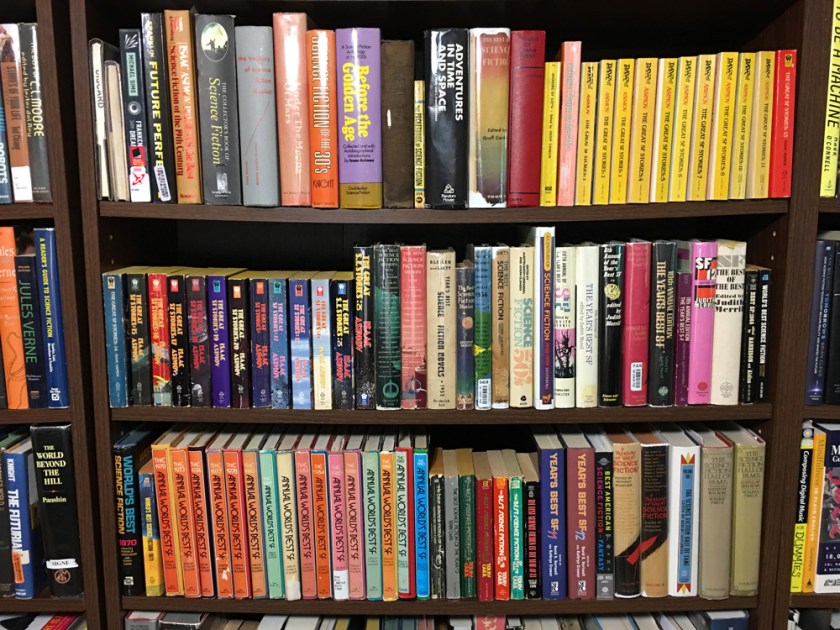
Think about all the interests and hobbies that only you love. Above is a photo of what currently separates me from other people. My fascination with reading old science fiction short stories and studying their history culls me off from the rest of humanity. By Brooks’ distinction, I’m defined by both print and digital technologies, but I also love hearing these stories read by professional narrators, so that connects me with an oral tradition too. But when I listen, I’m wearing headphones that shut me off from the rest of reality, although I’d love to know someone who’d like to listen to the stories with me.

When Susan, my wife comes home from work we sometimes eat together, and sometimes not. We faithfully watch the NBC Nightly News and Jeopardy that we recorded on our TiVo, and then she goes to the living room to watch her shows and I stay in the den to watch mine. We got married in 1978, and through 2008, we had one television set, and we’d watched the same shows together every night.

In 2008 Susan took a job out of town, and for ten years we watched television separately and we learned exactly the kind of TV that resonated with our personalities. I developed a number of friends who came over to watch TV with me, and I learned that friendship was a VENN diagram of shared TV shows. No two people have exact tastes. When Susan moved back permanently last year she brought her own TV, so we had two. We also had two Rokus, and subscriptions to several streaming TV services that allowed us to watch exactly what we want to watch when we wanted to watch. We had also learned to binge-watch different kinds of shows. Taste in TV now separates us.

We do find other ways to share. We’ve been doing game nights with friends. Last night was a game night, and the four of us all talked about the TV shows we watched. It was kind of funny because our tastes overlapped in various combinations. If I wanted companionship to watch my TV shows, I might need to call a dozen different people, and some nights I’d still be watching TV alone.

When TV was broadcast, most of my friends watched the same shows. Now with over 500 scripted TV shows being produced every year, friends connect by the few unique shows we each share a love to watch. And I often feel I disappoint people when I tell them I don’t like the shows they love. It was damn surprising how much The Game of Thrones united people.

I really enjoy having friends over to watch shows together, but that seldom happens anymore. For ten years my TV buddy Janis and I shared a love of several shows and we’d get together and watch them 3-4 times a week. But Janis has moved to Mexico, and most of my other friends don’t want to come over to watch TV that regularly.

I have a handful of internet friends who also love the old science fiction anthologies, and we have a group email address we use to discuss them. I’m also in two online book clubs where we discuss books daily by email. I guess these replace my water cooler friends from my work days.

Facebook is constantly attacked in the news nowadays, but it’s a very useful tool for keeping up with family and friends. Knowing that someone else likes the same cat videos as I do is nice. Not much of a bond, but at least it’s a shared affinity. What really bonds people is raising a family or a career that forces you to work intimately with other people. Susan and I never had kids, and my work days are over. My friend Mike and I work on a computer/web project together, and that’s a great way to connect.

It’s funny, but I think the single thing that brings me and my friends together now is our collective worry about getting old, and our constant talk of bodily functions. Nothing bonds aging baby boomers like a conversation about constipation.

Lately, I’ve wondered about retirement villages. Would moving to a 55+ community would create new kinds of social bonds? I’ve wondered if it would create the social structures I had back in my K-12 years. Would playing Pickleball and Four Square everyday undo all the specialized isolation that TV and computers created? Who knows, maybe I could find other people to watch Perry Mason, or even share a love of 1950s science fiction like these guys:

JWH

Abortion and Democracy

by James Wallace Harris, Friday, May 31, 2019

[The above graph is borrowed without permission from this webpage.]

This essay is not about a woman’s decision to terminate her pregnancy but the impact of passing laws on abortion on our democracy. Right now, many states are passing restrictive laws limiting abortion or even trying to ban it outright. According to the latest Gallup polls, 29% of Americans want abortion legal under any circumstances, 50% legal under conditions, and 18% want abortion made illegal under all circumstances. That means 79% of the nation want women to have the right to choose to some degree, and 18% want to take that right away completely. It also means 68% of the country want to limit abortions in some way. And it also means 47% of the population occupy both extreme ends of the spectrum.

We’re living in times where politically active special interest groups can get laws changed, often against the majority’s will. Is that fair? Shouldn’t the laws in a democracy reflect the will of the majority?

We often teeter between extreme positions rather than compromises. Shouldn’t a law that demand absolutes be suspect? Having laws that demand no abortions under any conditions or laws that say abortions are legal under any conditions only make extremists happy. The same religious people who demand that there should be no exceptions to Thou Shalt Not Kill regarding abortions often make exceptions with the murder of adults – self-defense, war, capital punishment, law enforcement, etc. And if we asked the 29% of the population that believe abortion should always be legal about specific instances wouldn’t they make exceptions too?

It’s doubtful we can make laws that 100% of the population accept. But what percentage of the population should we aim to please to create a stable society? A simple majority leaves half the country unhappy. Even a two-thirds majority (66%) leaves one-third dissatisfied. A three-fourths majority (75%) to four-fifths majority (80%) should be our goal, but it’s doubtful Americans will ever agree that much.

I believe we should always work to have a minimum of a two-thirds majority. Right now, 68% of the population want some limits on abortion and 79% want women to have the right to choose. That suggests we could find a compromise that satisfies a large portion of the population.

Passing laws that only 29% or 18% want seems unethical, undemocratic, and oppressive.

Many believe that men should have no say whatsoever regarding abortion. But like I said, this essay isn’t about abortion, but democracy. Could we have voting by one gender only for a special issue, or restrict voting to a subset of the voters for unique voting situations? Should men have any say in women’s issues after hundreds of thousands of years of enslaving women? Or should democracy always be by all the people all the time?

The reason why we can have minority rule on certain legal issues is that special interest groups have played the representative political system to their advantage. It’s possible for millions to game the system when only dozens or hundreds pass the laws, even when those millions are a small minority of voters. I’m not sure that would be possible if we made decisions by referendums.

And even if we did decide by referendum, is a simple majority enough to maintain a stable democracy? I believe controversial laws should be based on a two-thirds rule. Although shouldn’t we really should strive for three-fourths compromises?

Is there a date after conception that 66-75% of the population would agree on where abortions could be restricted? We know that 18% percent of the population want conception as the cutoff. Ensoulment is a controversial issue, and religion and philosophers have been speculating about it since pre-history.

People who want the date of ensoulment to be at conception is base it on the idea that the soul exists, and there’s never been a shred of evidence that souls do exist, or that they come into existence at conception. This means a belief in a myth from ancient times by a small minority is being imposed on a much larger modern majority. Is that constitutional, democratic, or ethical? Our democracy is based on freedom of religion, but what happens when a religious belief demands that the entire population follows its beliefs?

The social conflict is between the rights of women to control both their bodies and their fate, and the freedom to hold religious beliefs. The extreme religious voters will not allow women to make their own moral decision as to when to have an abortion. This minority demands that 100% of the population follow their beliefs. This begs the question: When does a minority in a democracy have the right to decide for the majority?

Right now, because we have a representative democracy, an extremely tiny fraction of the population decides for the whole. We assume our political representatives are voting on laws based on what their constituents want. However, corruption has distorted representative democracy. Would a referendum system remove that corruption?

If the United States had a referendum on abortion how would it work? Up till now, referendums pass with a simple majority. But they often leave half the voters unhappy. Wouldn’t it be better to create referendums where we all try to find a compromise? Could we find a compromise on abortion that satisfies 66% of the voters, or even 75%? For example, would 75% of Americans agree on unlimited abortions for the first 12 weeks? (I’m not taking a position here, just an example.)

Too many voters are all or nothing with their opinions. Is it even possible to create a large consensus? Since the voters who want no abortions and the voters who want no restrictions on abortion are adamant and won’t compromise, and their totals equal 47%, that means there’s no way to reach a 66-75% compromise. Would some of them change their minds if they knew the 53% wanted a larger consensus? What if the laws of referendums demanded a two-thirds majority to pass a law? Are we to be held hostage by voters with extreme positions?

Representative democracy works well when our political leaders are wiser than the population. If you look at the history of our laws, it’s obvious on every issue the goalpost is always moving. We’re never satisfied with our final decisions. If we had a referendum democracy, we’d probably need to revote on laws periodically. Maybe once a decade, or generation. Could over time we learn how to compromise as a whole? To make group decisions that make a significant majority of voters satisfied.

Our current system has distilled into a political stalemate, resulting in a contentious polarized population. We need to work together to make each other happy. We need to let go of our extreme positions. We need to learn to compromise in the middle. There will always be extremists who think in black and white terms. We can’t let them rule us. I’m assuming 66-75% of the population aren’t extreme thinkers. That’s just a guess. If it’s true, we should find ways to work together.

JWH