I’m reading a rather disturbing book, LikeWar: The Weaponization of Social Media by P. W. Singer and Emerson T. Brooking. It’s disturbing for a number of reasons. First, it shows how completely out of touch I am. Second, it’s very relevant about today’s politics, problems, and conflicts, but makes me realize that I don’t have the tech skills I thought I had – and I’ve been working with computers since 1971. And it’s about a new stage in human communications that I might not be able to join or want to join. I might need to accept I’m too old and let a new stage of human consciousness pass me by.
It’s very difficult to explain why people need to read this book. But here’s a setup that might help. It’s my take on things but relates to what I learn from the book. It’s about the different stages of communications.
Language. This gave us a tremendous boost compared to the other animals, and it’s probably why we’re sentient.
Writing. Let us store knowledge and communicate at a distance.
Printing. Let us mass-produce knowledge.
Telegraph. Let us communicate over distances very fast. This was a tremendous boom for business, war, and journalism.
Telephone. Faster two-way communication without codes.
Radio. The beginning of mass communication. For example, LikeWar quotes Joseph Goebbels saying the Nazis couldn’t have gained power without radio.
Television. More effective mass communication. Truly transformed society.
Computers. They magnified our thinking power and speed.
Networks. Created a world-wide digital nervous system.
Social media. Mass communication with mass participation, or two-way mass communication. LikeWar is about how social media is transforming politics, crime, business, and war. One example LikeWar uses is ISIS, which used social media to overpower traditional national powers.
If you don’t have social media skills you’ll be left behind. Most people’s reactions will be, “Too bad, I don’t care about Facebook.” LikeWar provides significant evidence that all future political power will come from the people who can master social media. LikeWar showed how Trump gained his power with Twitter. Don’t dismiss that out of hand. Singer and Brooking make a powerful case for it being true.
I’m 67 and barely use social media. I blog, I keep up with family, friends, fellow hobbyists on Facebook, I use Twitter to keep up with news about science fiction. That’s essentially nothing. Here’s an example of what I’m talking about. When I was growing up I watched the CBS News every night to follow the Vietnam War. The news was about 24-48 hours old. Some people today keep up with wars in real-time, watching people conduct war using the internet to outmaneuver people conducting war at television and print journalism speeds. LikeWar showed how ISIS used social media users worldwide as recruits in their local battles.
In other words, in any field of endeavor, any conflict, if you’re using print, radio, or television to keep up you’re way behind. We really are developing a global hive mind, and it involves new skills. I can use the excuse that I’m too old to chase that bus. But younger people or older folks who want to compete can’t. And I think that’s stressful. I think a lot of stress in our society is because we’re stratifying by the speed in which we can compete.
I’ll predict there will be a new class of Luddites, those people who choose not to race at social media speeds. But it means giving up power. We’ve had wealth inequality forever, and education inequality for hundreds of years, but what LikeWar envisions is a new kind of inequality. I’m not sure what percentage of the population will be able to keep up.
I first encountered Dolly Levi in The Matchmaker a 1958 film starring Shirley Booth. There was no singing and dancing. This was back in the sixties and I was still in my teens. I identified with Barnaby and Minnie and felt Cornelius and Irene were older, in their twenties. Dolly and Horace were very old, like my mom and dad. I could imagine myself as the youngest romantic couple and assumed I’d be in Cornelius second stage of getting married romance soon enough. But at that age, it was quite disturbing to imagine Shirley Booth and Paul Ford in bed together, to imagine later life-stages of romances. I didn’t sympathize with Dolly then. I didn’t understand she was an older woman making a romantic comeback. I didn’t realize the story was about the other end of a lifetime looking back towards my end.
I’ve never seen a Broadway play. And over my lifetime, I’ve seen less than ten musicals performed in a theater. I have seen quite a few famous film musicals but it took me years to acquire the taste for them. I didn’t see Hello Dolly! with Barbra Steisand when it came out in 1969. Maybe the first musical I saw was the film On a Clear Day You Can See Forever in 1970, which also starred Streisand. I went because of the story but ended up liking the singing. That led to seeing Funny Girl and Hello Dolly! All-in-all I probably saw five musicals on film in the 1970s. At the time I equated them with music for the elderly. Old people’s music featured big bands with trumpets and trombones, while young people’s music was made by a group of four or five with guitars and saxes.
I hadn’t known it at the time, but my first real encounter with Dolly Levi was in 1964 when I heard Louis Armstrong sing “Hello Dolly!” but I didn’t recognize what the song was about then. I loved Armstrong’s voice, and he was a cool old black guy, which in some ways made him more acceptable to my twelve-year-old self. My parents hated my music, rock ‘n’ roll, so I hated their music, even though it didn’t have a name. Frank Sinatra, Dean Martin, Doris Day, Nat King Cole, Peggy Lee were all oldster crooners to me from way back when. Somewhere from being young to growing old, I learn to love their music too.
I’ve been listening to as many versions of “Hello Dolly” I can find on Spotify. I’ve reached an age where I love to hear how music is interpreted by different arrangements. When I was growing up peer-pressure convinced me to shun music that wasn’t written and composed by the performer. Back in the sixties, at the beginning of the singer-songwriter era, we felt it was inauthentic for an artist to sing other people’s songs. That was silly. All the great rock ‘n’ roll I loved in the 1950s and early 1960s was usually written by lyricists working with composers and performed by solo artists and groups. Even The Beatles and The Rolling Stones started out doing covers.
One of the best features of Spotify is to search on song titles to find all the cover versions of a song. A great song can have over a hundred different recordings. I’ve had two versions of “Hello Dolly” in my “Top 1000” playlist for years – the one by Louis Armstrong and the other by Bobby Darin. For some reason this weekend I played over a dozen versions of “Hello Dolly!” I never got tired of it and was constantly delighted by the different arrangements, instruments, and singers. Thinking about why I enjoyed this song so much was very revealing in so many ways, both about the song and it’s many arrangements, and about myself. The whole listening experience was enlightening about growing older. And, as I listened to the lyrics over and over Dolly Levi came to life.
Dolly Levi existed before the song, Broadway musical and Hollywood movie. Thornton Wilder created Dolly Gallagher Levi for The Merchant of Yonkers in 1938, but it was inspired by earlier plays. Wilder revised the play and retitled it The Matchmaker which premiered in London in 1954 and New York in 1955. Ruth Gordon played Dolly first on Broadway before Shirley Booth played her on film in 1958.
Then on January 16, 1964, a Broadway musical, Hello Dolly! was created from the play with Carol Channing as the original singing Dolly Levi. This is where the songs I keep playing originated. However, there are two original versions, one sung by Dolly in the play with a chorus of waiters. It runs for about six minutes. In late 1963 at the producers request Louis Armstrong recorded a different version of the stage “Hello Dolly!” from the male point of view as if one of the waiters got a solo. Armstrong’s version was released on January 1964 and eventually breaking The Beatles three-song streak of holding the #1 position of Billboard Hot 100. This was his most successful hit song, and it stayed at the top of the charts for nine weeks.
After Carol Channing, many famous singers and actresses have played Dolly Levi. There’s a long thread on Broadway World about Dolly Levi’s age. The Barbra Streisand fans rationalize Dolly should be in her twenties because Streisand was 26 when she played Dolly, but they seem to naively miss the point of the play and lyrics. Dolly is a woman of a certain age, one who wants to hear her favorite songs from way back when, one who went away into her personal haze, one who has come back hoping tomorrow will be brighter than the good old days. The role was written for Ethel Merman, who would have been 56 in 1964. She turned it down but accepted it when she was 62. It turns out Bette Midler is the oldest Dolly Levi, at 71. Carol Channing was 43 when she began the role, but 74 the last time she played it.
I think Dolly Levi’s story is supposed to be about being older and looking back, and that’s how I feel about why I like the song so much. I supposed for realism sake, Dolly should be in her forties, maybe fifties, an age I’m well past, but like Dolly, I love to hear old songs from way back when. I still want tomorrow to be brighter than today. In other words, I’ve finally reached an age where the song’s meaning is at it’s most significant perspective.
But it’s not just the words that make me contemplate the perspectives of age. The various Broadway recordings of the play and its revivals have one kind of sound. A 1960s Broadway orchestra sound that took me a lifetime to appreciate. I first got into jazz in the early 1970s, which took me back through the decades until I could enjoy ragtime. Louis Armstrong’s version of “Hello Dolly!” has a banjo and a ragtime/Dixieland feel, also reminding me of Armstrong’s best music of the 1930s. Many versions have the arrangement of Las Vegas acts from the 1950s and 1960s, like those by Frank Sinatra and Bobby Darin. There’s a version by Herb Albert and the Tijuana Brass, a version with strings for the Lawrence Welk state of mind, and there’s even a version sung in French by Petula Clark. Harry Connick Jr. even brings a modern interpretation.
I’ve made a playlist of “Hello Dolly!” covers. I hope you have Spotify to hear it. (You can sign up for the free account if you don’t.) Crank up the volume. The music sounds best played loud over large surround-sound speakers. It still sounds wonderful on headphones but I prefer the aural soundstage created by speakers. The song evokes happiness and is upbeat which explains its enduring popularity. Most of the musical arrangements are for big bands or orchestras, although it works well with small combos. The various arrangements and Broadway recordings show how a good melody and lyrics can be creatively interpreted in endless ways.
The longer versions are how the song is performed by lead actresses on stage with a chorus of waiters. The shorter versions are usually male solo singers, although some female vocalists sing the short version. It also helps to see how the song was choreographed.
I chose this Bette Midler clip because of the quality of the film clip and how well it shows the staging of the song. I wished I could have found a film clip of Carol Channing from 1964.
Most people listen to music as a background filler. I listen to music like I’m intently watching a movie. Most people can’t get into a crazily obsessed state of mind like I can. It takes patience, practice, and concentration. I kid my friends that they have ants in their pants because they can’t just sit and listen to music. I’ve written this essay for them, to try and explain why I can sit absolutely still for an hour mesmerized by one song played twelve times. When you get deep into a song, time slows down and there is so much to discover.
I’ve always known that science fiction was an important aspect of my life, but I didn’t know how important until I read The Way the Future Was by Frederik Pohl, a memoir he wrote back in 1977 about his life in science fiction. This book isn’t in print, you’ll have to order it used, but the first three chapters are available online at Baen Books.
I got to spend a couple hours with Fred Pohl in the early 1970s. I wish I had known everything that was in his book then because I would have pestered him with a thousand questions. At the time I only knew him as the co-author of The Space Merchants with C. M. Kornbluth. I knew he had written several novels with Kornbluth and also with Jack Williamson. This was well before his famous books Man Plus (1976) and Gateway (1977). I think I had read his solo novel The Age of the Pussyfoot and owned a copy of A Plague of Pythons. I probably knew he had once edited Galaxy and If, a couple of my favorite magazines. Back when I met Pohl, along with James Gunn and John Brunner after they appeared at a conference at my university, my college roommate Greg Bridges and I got to sit with them at lunch. I knew Fred Pohl was fairly famous in science fiction, but I had no idea just how famous. I now understand why Brunner and Gunn question Pohl so intently. Years later, I was more impressed with Pohl for Gateway and his later novels, but he was never a big favorite of mine. He is now.
After reading The Way the Future Was I realized he was one of the major figures in the history of science fiction, at least or maybe more important than Heinlein, Clarke, Asimov or even John W. Campbell. Explaining why I now believe that will take some time. I will have to give a quick history of my own relationship with science fiction to connect the dots.
I started reading science fiction in 1962. My father was in the Air Force and I changed schools often. I generally always made a new best friend, but what kept me sane was science fiction. My parents were alcoholics, and I had rejected religion at age 12, so I used science fiction as my guide to life. The fiction part of SF was my mythology, and the genre’s history became my family history. Science fiction writers were the rock stars and founding fathers of my world. Over almost sixty years I’ve put together a rather detail history of science fiction in my head. It’s still constantly growing and expanding. Reading The Way the Future Was showed me that Fred Pohl was intimately active in most of it, almost as if he was a time traveler intentionally trying to experience it all.
Hugo Gernsback began the science fiction genre by publishing Amazing Stories in April 1926, but soon lost control of the magazine, and started another magazine Science Wonder Stories in June 1929. Astounding Stories of Super-Science began it’s run in January 1930. The earliest science fiction fans, sometimes called First Fandom, all began reading science fiction about this time. Fred Pohl discovered science fiction in the Summer 1930 issue of Wonder Stories Quarterly. Pohl wrote, “I opened it up. The irremediable virus entered my veins.”
Over the decades I have read many memoirs and autobiographies of science fiction writers recounting the same experience of discovering science fiction in the 1930s. I discovered the science fiction magazine in the 1960s, and they often included short histories or biographies that recounted this knowledge. For almost sixty years I’ve been reading these chronicles, and The Way the Future Was is one of the best. Pohl begins with his discovery of science fiction and goes on to explain his adventures in the Science Fiction League (the first effort to organize SF fandom), of publishing fanzines in their earliest days, to starting the legendary science fiction club The Futurians, and the first World Science Fiction convention in 1939.
By the time Pohl was nineteen, he was editing Astonishing Stories and Super-Science Stories, and just before WWII, he became an assistant editor for Popular Publications, the largest publisher of pulp magazines. After the war, Pohl became a literary agent for most of the famous science fiction writers of the early 1950s. He was also one of the co-founders of the Hydra Club, another legendary SF club. His third wife was Judith Merril. That chapter also tells about his connections all the early book publishers of science fiction, including Doubleday, Gnome Press, and Ballantine Books. The in 1960 he became the editor of Galaxy, If, Worlds of Tomorrow, and International Science Fiction until 1969, buying some of the best science fiction of the decade and discovering many new writers that have since become famous. I don’t know why John W. Campbell gets all the attention as the great SF magazine editor of the genre, someone needs to write Pohl’s biography.
The Way the Future Was explores many territories, but actually stops before Pohl became really successful as an SF novelist. It’s a shame he didn’t update it before he died in 2013. However, Pohl was close friends and good friends with all the major and minor writers of science fiction and has tons of wonderful anecdotes to tell. He was also a successful lecturer and often appeared on TV and radio, which provided other great stories. All-in-all, Frederik Pohl was very close to most of the significant events and people in science fiction from 1930-1977.
One reason I liked The Way the Future Was is because I have met many of the people Pohl wrote about. Of course, just barely. In nearly all cases I saw these people at science fiction conventions. Sometimes I’d get to chat a few words with them and shake their hands after a lecture. One time I was selling books at a convention and Donald Wollheim stopped to look over my dealer’s table, even bought a book, and we chatted. I forgot what book he bought. I was always on the distant periphery of science fiction, but I still felt a kinship with these people. They were the clan I identified with most, and Pohl’s book reminded me how I felt about that kinship. I always daydreamed of becoming a science fiction writer and getting closer to the clan. I never did. The Way the Future Was has reminded me of what I missed. It made me sad but in a wistful kind of way.
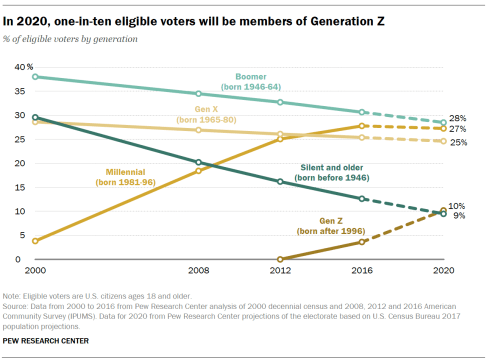
I’m using statistics from Pew Research Center’s “An early look at the 2020 electorate.” I’ve graphed them so blue is older voters, light green the younger voters, and middle-age voters are dark green. There is a certain symmetry to this graph. I’m going to “borrow” a PEW graph that shows the change vectors of each generation.
It’s obvious that Baby Boomer and Silent generations are in decline, but if you look closer, Millennial and Gen X generations have already started their decline. You’d think the 2020 election should reflect a generation shift.
If you look at PEW’s other graph in that article,
you’ll see the shift that Republicans fear. Why do Republicans keep alienating minorities? Haven’t they even considered embracing diversity?
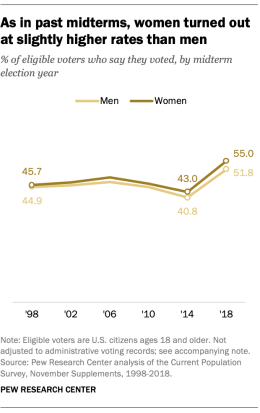
Finally, if we consider gender,
where we see that woman voters are also increasing.
I have no way to predict how the U.S. 2020 presidential election will go. There are too many factors. But if population demographics are good indicators, then youth, minorities, and women should play a bigger role. But are they a large enough factor for Democrats to shun running another old white guy? Which side of the graph should the Democrats bet on?
Trump won in 2016 by finding the right dissatisfaction in America. I think that same dissatisfied voting block still exists, but are they satisfied with Trump? Many independent voters voted for Obama and then Trump because they hoped for significant change. Should the Democrats pick someone promising to make big changes? What do younger voters – liberals, conservatives, independents – really want?
We never seem to know the deciding issue in a U.S. presidential election until after its over. The face-palm slap factor is always a black swan that surprises us. You’d think with all the artificial intelligence out there that data scientists could tell us ahead of time. But I doubt they will.
As of now, I’m going to bet that the 2020 election will be about youth. I’ve been reading articles lately about climate change depression. Young people are bummed out about the future, and who can blame them? I’m guessing they might be the reactionaries in the 2020 election. Maybe I feel this because I don’t want to see the young giving up on the future. Climate change isn’t the end of the world, but voters who don’t vote about the future could be.
From all the studies I’ve read, I’d be a much healthier person if I ate a plant-based diet, and regularly lifted weights and did aerobic exercises. So, why don’t I?
I’ve never been a very disciplined person even though I know from limited experience that being disciplined has its rewards. If I eat right and exercise I feel better than when I don’t. Now that I’m getting older, the importance of health is becoming much too obvious. Yet, I do less to help myself. Why?
Popular wisdom now nags us that inactivity is as bad as smoking. I was disciplined enough to not smoke, so why can’t I make myself stay active? I’ve been a rather inactive bookworm my whole life. It’s hard to believe that my Walter Mitty ways are killing me. Laying around daydreaming feels perfectly natural to me. But I must admit that my energy levels are dwindling as the years go by. Not only do want to do less as I get older, but my muscle strength and overall stamina are fading too. But isn’t that plain old getting old? Can diet and exercise equal rejuvenation?
I tell myself to exercise more. I do. And I feel pretty good. However, naps are more alluring than ever. My doctor says all my blood work numbers are good. She says trying using the exercise bike twenty minutes a day. I do. Maybe I feel a tiny bit better, but I still love naps and daydreaming, and I can’t lift furniture or untwist jar tops like I used to. Is that because I’m racing towards 70? Or because I’m not moving enough?
I wonder if lifting weights or going to the gym would give me back my strength and stamina?. But it’s so much nicer to just read. I ask myself if going to the gym is the solution, why isn’t every oldster not in tip-top shape?
I have my best luck sticking with physical therapy exercises, doing Miranda Esmonde-White exercises, and walking. I gave my exercycle to my wife. I got rid of my big Bowflex machine because it was just too damn big. And I’m thinking about giving away my little Bowflex machine because I’ve found the back pains it cures are also cured by the Miranda Esmonde-White exercises.
Since I hate going to the gym and I’m getting annoyed exercise equipment, I’ve been telling myself to embrace body-weight exercises. I’ve been collecting how-to articles, but I haven’t put them into practice yet. I know it would be good for me, but I can’t make myself start.
I’ve reached a state of equilibrium with my diet. I no longer pursue the plant-based diet that I did after I got my stent. I eat cheese, eggs, and yogurt. I eat some sweats, but not much. I’m still a vegetarian – I have been since 1969. This is my 50th anniversary. But I just can’t make myself go vegan even though I think I’d be healthier and live longer.
In other words, I’ll eat and exercise moderately, but I won’t make a big effort to become healthier. Why? I spend between 20-60 minutes a day exercising. If I spent another 30 minutes I might have more strength, stamina, and longevity, but I won’t go that distance. Why?
I know people who are physical fitness fanatics, spending hours each day exercising, and I know people who are epic couch potatoes, who never exercise or even try to eat right. I’m not sure if there’s any consistency in who is healthier. Both groups are more energetic than me, and both groups suffer from various random health crises. I know exercise nuts who have gotten heart attacks, strokes, and cancer, and I know do-nothings living into their nineties still cramming down the junk food nightly.
I think the illusion is we want to control our fates. I hate that I’m losing my stamina, strength, and energy, but maybe that’s the fate of this particular body.
My new diet is to stop eating anything that makes me feel bad within 24-hours. I have a whole list of foods and drinks that my body doesn’t like. I also exercise just enough to avoid aches and pains. I can tell when my body needs some stretching or activity. After that, I can’t make myself do things on the assumption that I’ll live longer. There’s just no feedback.
Before I got the stent in my heart I couldn’t breathe. It felt like I was dying. That was a wonderful incentive to do something. But that was back in 2013. I now avoid fatty foods. If I eat too much fat I can feel a lack of oxygen. That inspires me. Feeling pain in my back or numbness in my legs inspires me. But the pleasantness of a nice nap while listening to music, or the contentment of sitting and reading doesn’t inspire me to move.



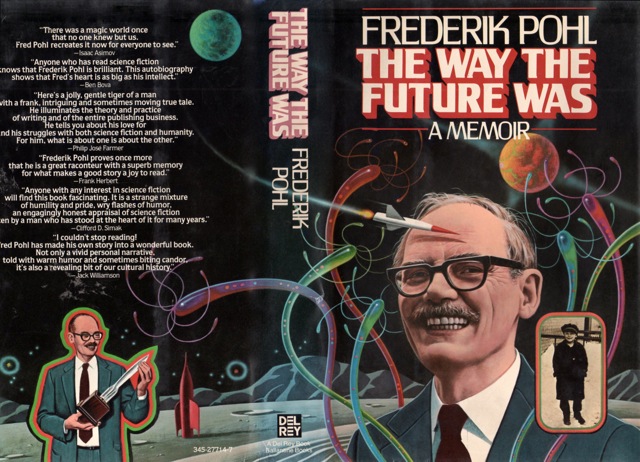
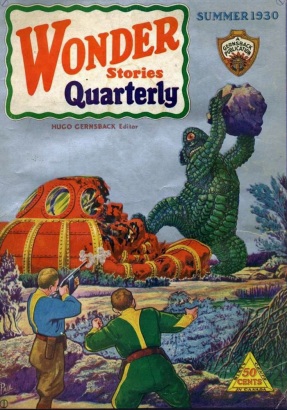 Hugo Gernsback began the science fiction genre by publishing Amazing Stories in April 1926, but soon lost control of the magazine, and started another magazine Science Wonder Stories in June 1929. Astounding Stories of Super-Science began it’s run in January 1930. The earliest science fiction fans, sometimes called First Fandom, all began reading science fiction about this time. Fred Pohl discovered science fiction in the Summer 1930 issue of Wonder Stories Quarterly. Pohl wrote, “I opened it up. The irremediable virus entered my veins.”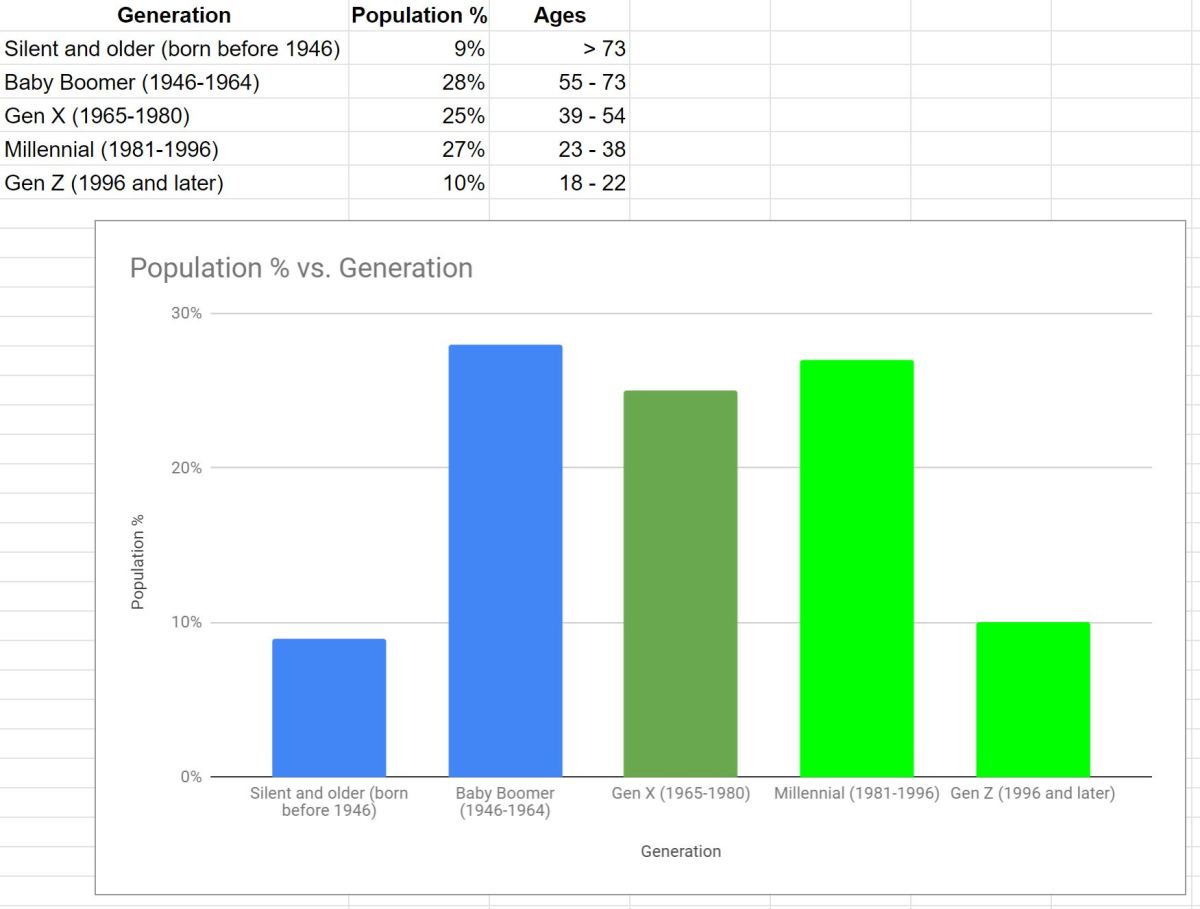


 Auxiliary Memory