Is The Internet Bad For The Economy?

Since the earliest days of Amazon.com I have been buying shelf loads of books from this innovate Internet business every year.  Then I stopped going to record shops and bought my CDs from them too.  Later on I bought running shoes, electronic gadgets, printer ink, and anything else that was convenient.  I buy a lot more books because of Amazon.com’s heavily discounted prices, no state sales tax and free shipping on orders over $25.  Now that the economy has taken a fall, I’ve got to wonder if my buying habits helped in knocking it out?

None of my favorite bookstores have gone under, but they’re struggling.  All my old record stores are dead.  So is the place where I bought my running shoes.  And all the small computer shops I used to visit have disappeared.  My state is hurting from low revenue, mostly gotten from sales tax rather than an income tax.

I buy a lot of audio books.  Audio books used to be $25-150 on cassettes and CDs, but I get them for $9.54 each at Audible.com as a digital download.  I never would have bought many titles if I had to pay the old prices, but if retailers now sold them for $15-25 a book, and Audible.com didn’t exist, I would buy 3-4 titles a month.

I used to buy 2-4 CDs a week.  Now I buy none because I pay $120 a year for unlimited listening on Rhapsody.com.  I used to buy a lot of software, but most of the programs I use today are free.  My wife and I used to collect DVDs, but now we have Netflix.  We used to pay for photo prints to give to people, but now we email copies.

I’ve got to ask:  Is the Internet hurting our capitalistic system?  I love the Internet.  I would never want to give it up.  But survival in this world depends on economic activity.  And comfort and security depends on everyone having a job and the economy doing well.  A 2% rise in unemployment, which we’ve recently experienced, has brought fear and misery.  What will 10% do to our sense of well being?  Do you remember the early 1980s?  People are talking about this financial crisis being the worse since the Great Depression.  1932 had a peak of 25% unemployed.  I have no way of imagining that level of bad times, and I don’t think anyone under 95 can really remember what it was like either.  We really don’t want to go there, and need to consider doing almost anything not to.

We all need to be conscious of our economic impact.  Spending frugally, staying out of debt, making careful purchasing decisions, and all those lessons financial advisors taught us might not be the right thing to do right now.  Would spending a few dollars more for each book and paying the sales tax be a better choice for my local economy than ordering from Amazon?

This afternoon my wife and I wanted to watch a movie together, but there was nothing on at the theater we wanted to see.  So we thought we’d go by Target and buy Kung Fu Panda.  It was $19.99 plus almost $2 in tax.  I could get it from Amazon for $15.99, a savings of almost $6.  But we decided to wait a couple of days for when it comes in via Netflix.  The rental cost would be less than the tax, thus saving over $20.

We didn’t buy Kung Fu Panda.  We just didn’t feel like spending $22 for something so trivial in these economic times.  If Kung Fu Panda would have been on sale for $12.99 we would have come home with a new DVD.  I wanted to help the economy, and considered a 4 DVD set of Dexter Season One for $17.99 plus tax or a 6 DVD set of Northern Exposure Season 6 for $14.99, both of which seemed like excellent buys, but I’ve been spoiled by Netflix.  Why buy something to own when I only expect to watch those shows one time?

See, the Internet has turned me into a bad consumer.  It’s saved me a lot of money, plus it’s more efficient because I don’t have to maintain a physical copy of something that would clutter up my house.  But I’ve deprived a local business of income, took jobs away from the local economy, and reduced the tax revenue of Tennessee.  My gain is a loss for my community.

Either we have to design an economic system with the efficiency of the Internet in mind, or we need to go back to our old ways.  I’m reminded of an old science fiction story.  I can’t remember the title, but it was about a future where the poor had to consume on schedule, while the rich were free to consume as needed.  An example, the poor had to change their shirts several times a day to keep production up in shirt factories. 

Do we really want an economy where people need to buy DVDs rather than rent so more people will have jobs?  Or buy a new gas-guzzling SUV every three years.  I’m sure you get my drift.

Well, the answer might be yes.  If we want to keep the old economy going.  And we might until they invent a new economy.  This is all very hard.  What if you could buy a car that would last 300,000 miles, and used little or no gas, being mainly powered by solar panels on your garage’s roof.  What does that do to GM or Exxon?  If environmental technology, ET, becomes just as efficient as information technology, IT, what does that do to the economy?

What if I took the money I saved by using the Internet and spent it on renovating my house with local labor, buying from local suppliers, but with the goal of making my home more energy efficient?  Will that help the new economy, or just delay the death of the old economy?  I already bought a new SEER 16 HVAC that’s saving me hundreds of dollars a month on energy.  That’s $9300 that went into the local economy, but now my monthly nut to the utility company is smaller.  I could start spending money on insulation, better windows, better appliances, and all of that will add to the economy.

Eventually, I’ll have a very energy efficient house, and I’ll start putting much less into the economic system.  It’s like switching from buying DVDs to renting them.  At some point being efficient leads to less economic activity.

Yes, I think the Internet is bad for my old local economy, and bad for our old national economy.  What’s needed is a new economy.  It’s called a steady-state economy, one that’s not based on growth.  Is the financial crisis that has come down on us going to be the metamorphosis that we must endure before becoming butterflies in a new economic world?  Will Barack Obama return to old tricks to solve our new problems?  Or can he be Copernicus seeing the Ptolemaic economic solar system with new vision?

We can always go back to a wood-chopping, horse and buggy world.  We could turn off the Internet.  This financial crisis may force many to give up cell phones, Internet and cable TV.  Without the Internet, most people will have little need of a personal computer.  Going backwards is possible and may happen.  We may have to prop up the old economy, but is that what we want?

It’s very important that we all pay attention.  In the next few years, a lot of decisions are going to be made.  Where are you going to throw your support?  Every dollar spent is a vote.

JWH – 11/15/8

We Need A Number

Go do a Google search on this phrase – “Target Atmospheric CO2” – and include the quotation marks, and you will find 2,400 links.  The links point to essays discussing a scientific paper by James Hansen and other scientists called “Target Atmospheric CO2: Where Should Humanity Aim?”  The gist of the story:  The likely safe high range for CO2 in the atmosphere is 350ppm, and we’re beyond that at 385ppm.  Hansen is the NASA scientist that first alerted Congress to the global warming problem back in 1988.  Randomly read some of those essays reacting to the paper and you’ll save me the time paraphrasing it.  The paper itself is perfectly readable, if you’re patient, but it’s bumpy with scientific speak, so it might be easier to read the commentaries.

Many of the writers act like 350 is the magic number we need, and in some ways that’s true.  It gives humanity a very specific goal.  It tells everyone that if we want weather like the nice weather we grew up with, then everybody needs to go on a carbon diet and get the atmospheric CO2 below 350 again.  However, that does not convey the sacrifice needed to achieve the goal.

I think we need another number.  Scientists need to decide what is the fair share target number we all need to stay under personally to get the job done.  Recycling paper and buying compact florescent lights are not going to do the trick.  I think until we have a personal number to target, along with proper labeling on everything we buy, people won’t understand how much CO2 they need to cut out of their lives.

How much sacrifice do we need to make?  If the nations of the world had a crash program to switch to 100% solar, wind, geothermal, nuclear and other sources of clean energy, would that solve the problem?  Would that be one way to solve the problem without asking individuals to think about the details?  Or should governments just kill off some of the most polluting industries?  Do we need to give up the beef industry?  Or the paper industry?  Or the airline industry?  Or all of them plus more?  Or would it be better to ask the citizens themselves to take on their own share of global warming responsibility and let them make their own decisions on how to clean up their share of personal waste?

If we had a number to measure our personal use against, we could all decide the sacrifices we’d like to make.  Some people might be willing to dry their clothes on the line outside for a year to budget flying to New York City for a vacation.  Other people might buy high tech cars that put little CO2 in the atmosphere so they can enjoy living in a larger house.  Others might choose to walk to work so eating steaks wouldn’t break their personal greenhouse gas consumption budget.

Many people have suggested having a carbon tax to help fund a Manhattan style project to convert to clean energy power plants.  This would discourage waste and finance change.  Having a tax would be one way to quantify for the public their duty to humanity.  It could also simplify the decisions people make.  If gasoline with a carbon tax was $12 a gallon, then you’d think long and hard about wasting it.  If the price of electricity from coal went to 4x with a carbon tax, it would give utility companies income to build new plants and customers incentives to make their houses energy efficient.

This would be the easy route.  What if in the next ten years we screwed around and didn’t do anything and it became frighteningly obvious we need to do something drastic?   Would we make bigger sacrifices then?  What if we had to outlaw the gasoline powered car?  Or outlaw airplanes?  Or ration electricity?

There are thousands and thousands of things we can do now by freely making the choices ourselves before the governments of the world have to get heavy.  If we knew what our carbon allotment was, it would be easier to make those choices.

Take for instance paper.  I have no idea how much paper contributes to the problem of global warming, but I have seen one number that says that junk mail adds 114 billion pounds of CO2 annually.  My reaction is to give up paper completely.  I’m phasing out my magazine and newspaper subscriptions, I’m doing my best to never print computer documents, I’m working to reduce junk mail, and I’m finding ways to shop for products with less packaging.

If everyone thought this way, paper magazines would disappear from society and everyone would read electronic periodicals.  Is this good or bad?  That’s a lot of jobs lost.  Potentially, it could mean a lot of businesses would go under.  I’d hate to see that, but on the other hand, paper really isn’t needed in our computer networked society.  My local newspaper just started offering a weekly electronic edition that looks just like the print edition, but costs less than the Sunday only paper subscription.  I’m moving to a paperless lifestyle, but even though it’s logical to me, is it what everyone else should be doing too?

I draw the line at magazines and newspapers, but feel that books are worth their environmental costs because we preserve them and consider newspapers and mags disposable.  What if that’s wrong.  What if there’s a way to have environmental safe magazines?  Unless scientists tell us the values associated with all our consumption we won’t know how to make enlightened decisions.  If a National Geographic subscription form came with a number – 24 – for 24 pounds of CO2 added to the atmosphere per 1 year subscription then that would be a big step in understanding the problem.

However, unless I know my allotment number, say 1,000 pounds per year, I wouldn’t be able to practically use the 24 figure I got from National Geographic.  So Mr. Hansen, it you and your science buddies would be so kind, give us another number.  350 is cool for the world to know, but we all need another number, a number that would tell us how to live by so all 7 billion people riding on spaceship Earth pulls that 385ppm figure down to 350ppm.  That number is the maximum amount in pounds of greenhouse gases we can each safely add to the atmosphere in a year.

President Elect Obama, you could help with this too.  Instead of offering another general economic incentive package, offer us tax breaks on buying specific clean energy products and services.  That would be another way to quantify a solution.  Tax what’s bad for the environment, and subsidized what’s good.  Get the U.S. to do more than it’s fair share to get the world below that 350ppm number.  We owe the rest of the world.

JWH 11-9-8

Restless

I’m listening to “Everybody Wants to Rule The World” by Tears for Fear, but that just finished and Todd Rundgren begins singing “Change Myself.”  That’s a better song for my mood, and it’s a nice transition from Tears from Fear because Todd sings,

I want to change the world
I want to make it well
How can I change the world
When I can’t change myself
Try again tomorrow

But then I go back to Tears for Fear and listen to,

It’s my own design
It’s my own remorse
Help me to decide
Help me make the most
Of freedom and of pleasure
Nothing ever lasts forever

Every day I wake up knowing what I want to do.  I have been struggling for months to work on a short story that I have tried off and on for years to finish writing.  I tell myself that’s the one thing in life that I want to complete, yet I can’t, no matter how I apply myself.  I guess it’s writer’s block, but since I’m not a real writer I think it’s something else.  I can write essays until the all the bovines get back to the barn, but writing fiction is like pushing the molecules of my body through a concrete block.

This leaves me in a state of continual restlessness that I can only fight by occupying my mind with other diversions, such as watching “The Big Bang Theory” or flipping through my 18k of mp3 songs looking for mental stimulation.  My restless is often soothed by words, such as Bob Dylan’s,

You will search, babe,
At any cost.
But how long, babe,
Can you search for what is not lost?
Everybody will help you,
Some people are very kind.
But if I,
Can save you any time,
Come on, give it to me,
I’ll keep it with mine.

I can’t help it
If you might think I am odd,
If I say I’m loving you not for what you are
But what you’re not.
Everybody will help you
Discover what you set out to find.
But if I can save you any time,
Come on, give it to me,
I’ll keep it with mine.

The train leaves
At half past ten,
But it will be back
In the same old spot again
The conductor
He’s still stuck on the line
And if I, can save you any time,
Come on, give it to me,
I’ll keep it with mine.

Every evening I am back at this word processor at half past ten.  When I can’t paint my own words I stare at words others wrote.  I should give up and shoot up some TV.  I’m so restless that it eats away at me, but writing about it doesn’t really help.  I wish I was a machine so I could program myself to do exactly what I want.

JWH 11-3-8

Plan B 3.0 by Lester R. Brown

Plan B 3.0: Mobilizing to Save Civilization can be downloaded for free, but I recommend buying a copy and making it your personal Bible.  Lester R. Brown, from the Earth Policy Institute, continues to monitor the Earth’s economic and ecological health and analyze what needs to be done to build a sustainable future.  We’ve all boarded the Titanic, and Lester Brown knows about the iceberg, but few people listen to him.  Studying this book gives me so much to contemplate.  Just glancing at the subjects in the table of contents will tell you what’s this book is about, and you can read every chapter online, or download a .pdf of each chapter or the whole book, and even download an Excel spreadsheet of the data too, if you like studying numbers.

Just look how he has divided the problems we face:

  • Deteriorating Oil and Food Security
  • Rising Temperatures and Rising Seas
  • Emerging Water Shortages
  • Natural Systems under Stress
  • Early Signs of Decline
  • Eradicating Poverty, Stabilizing Population
  • Restoring the Earth
  • Feeding Eight Billion Well
  • Designing Cities for People
  • Raising Energy Efficiency
  • Turning to Renewable Energy
  • The Great Mobilization

What is My Fair Share?

To ask if God exists, is philosophical speculation.  No on knows, and we have debated the question for centuries and will continue to do so.  To ask if there is a limit to economic growth is not imaginary speculation.  We will soon know the answer, one way or the other.  Most people believe there is unlimited economic potential for growth.  The economic foundation of our society is based on this belief, just like the builders of the Titanic believed they had built an unsinkable ship.

There are new economists that now see that any model of economics that does not include the ecology of the Earth is doomed to fail.  Lester Brown says that any product that doesn’t factor in its complete costs from all sources is doomed to bankruptcy in the market, like Enron failed as a company because it cooked the books and hid part of its true operating costs.

What this means is economics is really a subset of ecology.

If you accept this, then you come to understand that the Earth has limits, and realize that growth based economics means we’re all cells consuming the Earth like a cancer spreading in a host.  The idea of steady-state economics is a theory that suggests we can all be healthy cells that live symbiotically within our planetary organism.

Once you realize this, your primary ethical question of existence is:  How much can I consume without being cancerous?  This is more than just worrying about carbon dioxide and global warming.  That’s only one of many cancerous growths attacking the Earth.  The answer has to be more than:  As little as possible.  Economists and ecologists need to set goals for individuals to aim for in their daily lives.

If you could buy a piece of land and live there in a totally sustainable manner, without using resources outside of your property, that might be one answer, but not a practical one.  Scientists are just beginning to explore this issue.  Think of the parable about the fishes and the loaves, but this time divide them between 7 billion people and then factor in that the supply of wheat and fish should never end.

Another way to think about it would be to let scientists determine how much carbon dioxide can safely go into the atmosphere each year and then divide that number by 7 billion and let us each figure out how we’re going to budget our CO2 use.  A recent issue of the New Scientist suggests that might only be 1 ton per person, which means living like someone from Yemen or in the Republic of Congo today.

Since I’m probably using 10-20 times that, I’m quite cancerous.  About the only way to get myself down to using 1 ton of carbon per year would be to ride a bike and make my house perfectly energy efficient.  A possibility, but not a likely one.  The 1 ton per person is a global fair share estimate and much more restrictive than those 50% and 80% reduction goals for American peak usage.

What Happens If We Don’t Change?

Even if we don’t concern ourselves with various forms of pollution, there’s a good chance we’re still heading for economic collapse.  If unlimited economic growth is truly unsustainable, then it will also fail for other reasons, other than too much poisonous output.  We can also fail for not having enough input.  The economy can also crash and burn by not jogging faster than debt, something that’s been dominating the news lately.  Other canaries falling dead are stories about shortages.  Just before the liquidity scare, it looked like we were about to start running short of oil.  Luckily a cure for high oil demand is a slow economy, or is that lucky?  What if we ran out of oil but didn’t have renewable energy.  What if we ran out of fresh water before we ran out of oil?  We could easily face critical shortages of commodities long before we faced surpluses of rising oceans.  Reading Plan B 3.0 illustrates the enormity of all the problems we’ll be facing.

Human nature tends to ignore looming icebergs or melting glaciers.  We like to focus on what we want, and not people shouting that the sky is falling.  However, we have seen great positive social transformations happen quickly – just look at the switch to electricity or going from horse power to horsepower.  And isn’t it amazing how fast we all became geeks with our computers, video games and cell phones?  I think we’ll all change over and over again, whether changing for good or bad, whether we move into an ecological paradise, or a depression that makes the Great Depression seem like the good ole days.

We can’t avoid change.  The real question is whether we can surf change or will change flow over us like a tsunami.

Change is Happening Now

Everything Lester Brown writes about in Plan B 3.0 can be seen on your high definition television right now, if you’re willing to tune in to the right shows.  If you only watch Pushing Daisies and Heroes you can delay learning about the iceberg until after it hits.  A good way to set up your early warning system is to watch PBS Frontline each week.  Keep adding PBS shows, and then documentaries from National Geographic and the various Discovery channels.  Watch between the scenes.  Count how many references to drought you’ve seen in one week, or how many continents and countries are losing their glaciers.  You don’t need a supercomputer or Al Gore to spot trends in global weather patterns.

How Smart Are People?

All the problems mentioned in Plan B 3.0 can be managed.  Theoretically, if humans can cause the problems, humans can fix the problems, but that may not be how things play out.  What everyone really wants to know is whether they are going to be one of those people at the Superdome after Katrina, or will they be the kind of person who had the resources to get out safely on their own.  Being prepared helps.  Sometimes luck is merely a coin toss, and other times luck favors those who plan ahead.  But how do you prepare for global recession?

Plan B 3.0 is a look at what the people in power need to be doing to solve the transition from the economics of growth to a steady-state economy at the macro level.  What we need now are Plan B handbooks for us little guys, advising us what we should be doing to make the same adjustments at the micro levels.  This could be books about careers for college students, to how-to books about starting businesses in a steady-state economy.  I doubt the plumbing industry will be shaken up, but is there much of a future for jet airline pilots?

JWH – 11-2-8

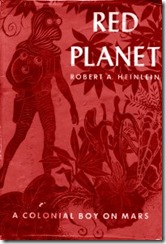
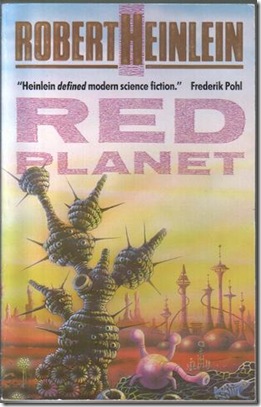
Red Planet by Robert A. Heinlein

Red Planet was the first Robert A. Heinlein novel I discovered back in 1964, and with the first reading of that book I turned into a life-long fan of Heinlein’s work.  From 1964 through 1966 I read Heinlein’s backlog of books, some several times, so after a four year dry spell of no new books I was mentally demolished when in 1970 I read I Will Fear No Evil and hated it.  Somehow my literary hero wrote a clinker, at least in my eyes.  After The Moon is a Harsh Mistress Heinlein (1966), Heinlein never wrote another book I liked.

I still love rereading Heinlein, and usually reread a few of his novels every year.  In the last decade I’ve been listening to audio book editions of his books.  Red Planet just came out on unabridged audio from Full Cast Audio, a company that publishes audio books for young people.  Full cast audio means each character gets their own actor performing the lines.  This works extremely well for young adult novels, and Red Planet comes off wonderful in this format, making each character dramatically stand out.  I’m not sure what authors think about this technique, because the actors get to emotively interpret their character.  In this edition I think they all stay well within the cues Heinlein gave his readers.

This edition of Red Planet from Full Cast Audio uses the restored unedited edition from Del Rey published after Heinlein’s death.  For more information on that, read “Red Planet – Blue Pencil.”
Red-planet-cover

Over the years I’ve struggled with why I don’t like the Heinlein books that came out after 1969.  Why was that such a turning point?  As I got older, I also discovered that his novels after 1959 were different, and they had many elements I didn’t like too.  Before 1969, most of the novels I read were science fiction, but after that my reading tastes broaden.  I was constantly changing from 1969 through 2008, so it’s understandable that my reaction to the books would change too.

Listening to Red Planet gave me an interesting new insight.  Up till now I thought Heinlein became a different person sometime in the 1960s, but in his 1949 story, Red Planet, I found all the elements of later Heinlein hidden away.  The reality is, no matter how much we all feel like we’ve changed and matured, we’re still the same person all our lives.  I’ve long figured that editors influenced what Heinlein wrote, especially before his move to Putnam in 1959 with Starship Troopers.
redplanet2

There’s a strong dichotomy of opinion about Heinlein.  Most of his fans are extremely loyal, if not rabid. There are many people who try to read Heinlein and can’t stand him.  I’m in this middle zone, both loving his work, and despising it, and it’s a very weird position to hold.  I often piss-off other Heinlein fans when I express my doubts, but I seldom meet people who read, reread and study his work like I do.  If I had the time, I’d love to write an analysis of his writing, which I think might end up being a psychological study of myself.

But back to Red Planet.  I’m quite confident that this time was at least my fourth time through the book, and I was amazed by parts I didn’t remember.  It wasn’t until after I finished the story that I discovered I had listened to the revised edition.  Memory is such a fascinating subject.  At one level, I only remembered the book vaguely.  If I had tried to write down what the book was about before I listened to it, I would have given a skimpy plot outline, and then a general impression of several cherished scenes.  When I started listening to the book much of it came back to me, so I could predict just before it happened what would happen.  I call that movie déjà vu because I often feel that when seeing a movie I had watched decades earlier and forgotten.   It’s the weird feeling of knowing what will happen just before the event unfolds.

The revealing part on listening to Red Planet this time, was all the stuff I had completely forgotten since my last reading in 1989.  You’d think after four reading there would be very little I wouldn’t remember at some level.  That wasn’t true.  What’s even more revealing, and I imagine astute readers of this essay will guess, the unfamiliar parts were more like the Heinlein I disliked.  But I hadn’t forgotten.  I was tricked by the new restored edition.

Heinlein had even written Alice Dalgleish, his 1949 Scribner’s editor, “I have made great effort to remove my viewpoint from the book and to incorporate yours, convincingly – but in so doing I have been writing from reasons of economic necessity something that I do not believe.”  I have long theorized that Heinlein’s personal opinions ruined his later stories, and that the reason why I liked the earlier books better were due to editorial censorship.

Story elements that Heinlein would later fixate on are now here in Red Planet, but in shorter, and still restrained form.  Listening to Red Planet showed me I could probably build a list of Heinlein themes that probably exist to some degree in all of his books, either subtly hidden away by editors, revealed by restored editions, or just blaring in later books.

Heinlein explored a wide range of science fictional frontiers, but in the end he often repeated himself thematically.  There is a quality in art that I call the “Beatles Effect.”  I believe a large part of the Beatles success in the 1960s was due to the Fab Four working hard to make every song different.  Mediocre artists tend to create work that has a sameness to it.  Heinlein’s most distinctive individualistic work was all done before 1969, and in particular, before 1959.  During the 1950s, Robert A. Heinlein was The Beatles of science fiction.  Those books are still in print half a century later.  Red Planet has its 60th anniversary next year.

1949 was the year that Red Planet and “Gulf” came out, two stories that anticipated Stranger in a Strange Land, Heinlein’s breakout novel from 1961, that first revealed the true Heinlein, even though Putnam forced him to cut out 60,000 words of that novel.   (Those words were later restored in an uncut edition decades later.)  Listening to the uncut version of Red Planet made it very clear that Heinlein hadn’t changed at different points in his career, but merely, more of his personality had been revealed.

There are two Heinlein aspects that we’re dealing with here.  The first, is a fascinating man that was very opinionated.  The second is a story teller.  As a kid, I imprinted on the storytelling aspect.  As an adult I rebelled against the author’s personality poking through the illusion of the storytelling.

Even in the restored edition, Red Planet is a very slight novel.  It’s overwhelming charm is due to the mysterious Martians and Willis, an engaging talking Martian animal.  What captured me as a 12-year-old was the sense of wonder of humans colonizing Mars, something that would fuel my personal fantasies for decades.  I was also charmed and amused by the antics of Willis.  Heinlein’s juvenile novels often had wondrous alien creatures in them.  And the book was fast paced, and full of adventure for boys.

Red Planet is a good book, but it doesn’t compare well with the dazzling creativity of Heinlein’s later juveniles, Have Space Suit-Will Travel and Tunnel in the Sky.  The ancient culture of the Martians, used in both Red Planet and Stranger in a Strange Land, is an impressive creative achievement on first encounter, but doesn’t hold up to long term scrutiny.  The old Martians are like Australian aborigines.  Their culture is exotic, mysterious and mystic, but after the initial wow, few people would want to follow their lifestyle.   We’re a high-tech species, a species that likes to build and expand.

The super-wise Martians that Heinlein created do not wear clothes or even appear to use tools and they do wonders with thoughts alone.  This appears to conflict with Heinlein’s blaster-toting, rocket-riding humans out to colonize every piece of rock in the universe.  And this is further complicated by Heinlein’s constant promotion of revolution, where bold exploring characters sneer at the corruption of law and order stay-put stick-in-the-mud characters.

Now that the revised version of Red Planet is fresh in my mind, I can easily see how its author will come to write Stranger in a Strange Land in the following decade, and eventually evolve into the man who writes The Cat Who Walks Through Walls.  The disturbing thing is to contemplate which themes will come to dominate.  From 1949 to 1985 Heinlein seems mostly concerned with who deserves to die, and nudity.  This is grossly unfair to the stories, but I think it’s true.

In the restored edition of Red Planet, 1949 Heinlein portrays his colonists of Mars as wearing little clothes when not needing their pressure suits for outside excursions.  In 1961, one focus of Stranger in Strange Land is shedding of clothes.  And in 1985, Heinlein has all his former favorite characters getting naked together.

Even more disturbing is the theme of who deserves to die.  Heinlein’s characters are often preoccupied with who to kill.  Sometimes, it’s individuals, sometimes it’s groups of people, and sometimes it’s whole planets.  As a kid, this motive for story action was no different from the westerns I loved to watch on TV, but now as a person in late middle age, I find very disturbing.

The hated headmaster Howe is “disappeared” by the Martians, but his only real offense was being a strict school administrator and taking a strange pet away from a student.  Heinlein revered his time at the Navy academy, an institution known for strict rules and administrators, so why make such a straw man of boy’s school principal?  Beecher, a colonial administrator is also a man executed by the Martians whose crime was trying to force the colonists to winter in a harsh climate to save the company money.  Not exactly a capital crime in our capitalistic society.  For being known as a conservative, Heinlein seems to love mob rule when it appears to be revolutionary and led by a pseudo-Patrick Henry.  But not every rebellious horde of unhappy armed men equal the American revolution.

The restored political parts of Red Planet make the story more offensive to me, at least as an adult.  As a kid, I would have just skimmed over the boring bits, and all the exotic Mars life and adventure of skating down Martian canals would made me forget them.  So which is the better edition?  I think Heinlein’s original unedited story is better because of the way he handles what happens to Willis.  Ditto for Podkayne of Mars.  Heinlein’s harsher more realistic endings are better, even for kids.  And I have to accept Heinlein as a whole person, even though I don’t like parts of that whole.

It would be interesting if I could read Red Planet at 56 and not be influenced by over forty years of nostalgia.  If I could, I would savage it.  And not just because we know there’s no life on Mars now, but because so much of the story isn’t logical at all.  Jim and Frank wear plastic pressure suits with only jockey shorts underneath and then skate all day on the canals.  Logic tells me the legs of their suits would have pooled up with sweat, and their skin would have been rubbed raw.  And there was no mention of oxygen bottles, or any kind of consumables to power their suits.

Furthermore, there is no, and I mean none, discussion of adapting to living on Mars.  It’s really like living on Earth, but with less oxygen and air pressure.  They have to kill the Mars equivalent of rattle snakes with blasters instead of six-guns.   The boys attend a boarding school, and the only difference is they wear minimal clothes while inside the pressurized areas.  That isn’t about Mars so much as it’s about Heinlein picturing a future where people don’t wear clothes.

What we need is a boys book as exciting as Heinlein’s juvenile novels about what realistic life would be like for future colonists on Mars.  Heinlein was enchanted with the concept but didn’t want to explore the details.  I can’t blame him for wanting to create exotic intelligent life on Mars back in 1949.  That’s what I admired when I first read the story just about the time the first Mariner space missions flew past Mars and showed that Mars was a dead world like the Moon.  Red Planet remains a simple story about a boy and his pet Martian, and it is charming and entertaining.  Time has hurt the speculation, but not the story.

I tend to think twelve year-olds today discovering this story might still be well entertained, but I hope they would be savvy enough about our knowledge of Mars to know that it’s all a fantasy.  I’d bet that they would ignore the silly trumped-up revolutionary politics, and not even think about whether the rest of the story is realistic.  Only the kids who love to read about real space exploration would have an inkling about how complex a pressure suit would have to be, and silly it would be to live on cold Mars and only wear shorts while inside.  Or how silly it would be to have a revolution with Earth that supplies and pays for all the necessities of life.

Like I said, reading Heinlein for me, is more about studying myself.  As a kid I wanted to run away and live on Mars.  It was my Never-Never Land.  What us fans of classic science fiction must ask ourselves is:  Was science fiction just the fairy tales for 20th century children, or was science fiction meant to be more than that?  Heinlein always said he wrote to pay the mortgage.  Were his Scribner’s books just entertaining stories for mid-century boys that helped him pay his liquor bill?

I took his stories as inspiration about exploring space.  So did a lot of other people.  The red planet is still up there, waiting for us.  There are ancient alien life forms waiting for us to discover them.  To me, the real critical question is:  Will humans ever live on Mars.  Heinlein returned to Mars in story after story.  I study what NASA finds with its robots on Mars, but I keep rereading Heinlein.  Why?

JWH – 11/1/8