by James Wallace Harris, Wednesday, September 20, 2017
Do you read books about the past, or about now, or the future?
 This morning I started work on an essay about African-American fiction in the 19th century. It began with a question that had popped into my head: “Who was the first black novelist in our country?” This kind of fun sleuthing on the internet inspires me to write essays. I quickly came across articles about how Henry Louis Gates, Jr. had discovered a long forgotten book in the early 1980s called Our Nig; or, Sketches From the Life of a Free Black (1859) by Harriet Wilson. That made me want to research a number of other things. Have earlier novels been uncovered since? What were the second, third, fourth, fifth novels? What about short stories? Were any bestsellers in their day. Before long I realized I could spend weeks on this project.
 I usually think of several ideas a day for researching and writing. I start work on just a fraction of these ideas, and complete work on damn few. Another idea I got yesterday was to write about Men Into Space, a one-season TV show of 38-episodes (1959-60) that worked to be very realistic about space flight. A lady in my online book club mentioned it and I was surprised I hadn’t known about it before now. It’s not available on DVD except as DVD-R sales through places like eBay (because it’s in the public domain). It is available to watch online at YouTube. However, I did find a book, Men Into Space by John C. Fredriksen that extensively writes about the series. I’d love to write a book like this – if I could focus my mind for a year or two.
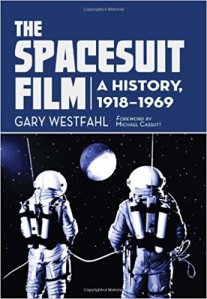 While researching Men Into Space I came across another book The Spacesuit Film: A History 1918-1969 by Gary Westfahl that covered Men Into Space as well as other movies and television shows that prefigured the space age. Hell, this exactly the kind of book I’d love to write too. But can you imagine the time it would take? But wouldn’t it be fun to watch all those old movies and television shows analyzing them for how they imagined the future? However, how many people read such books? I want to, but the $39.95 price for the paperback stops me. Even the $19.99 price for the Kindle edition is making me think long and hard.
This suggests another idea for researching. How many people buy and read these esoteric kinds of history books? How many people love to study tiny segments of forgotten history? I have this nagging desire to write something longer than blog essays. This month was supposed to be the month I began a book-length project. And I did start on an idea, but once again got side-tracked by too many distractions. But I’m back to focusing my mind on the project.
I have to ask myself, who is going to read what I write and why? Why spend a year, or several, writing something few people will want to read? It occurred to me this morning I could divide books into three categories: about the past, about the present, about the future. This is true for both fiction and nonfiction.
 I’ve always loved science fiction, which is future-oriented. But when I think about writing about science fiction, that’s past-oriented. Because I write for Book Riot, I can also write about contemporary publishing. I even think about writing books like To Be A Machine: Adventures Among Cyborgs, Utopians, Hackers, and the Futurists Solving the Modest Problem of Death by Mark O’Connell, which is essentially about how science fiction is affecting our world today.
I also came across this pledge drive for Farah Mendlesohn yesterday. She is writing a book about Robert A. Heinlein and is looking for backers. She’s gotten 143 supportors so far. This is also exactly the kind of book I’d love to write – but is that the rough number of people who would be interested in reading it?
I’m now worrying that I’m spending too much time thinking about the past. Is that because I’m getting older and it’s natural for aging folks to analyze yesterday? I assume that many people who like my blog do so because they are somewhat like me – they are older and thinking about when they grew up, and we all loved some of the same things.
I believe my less popular essays at Book Riot are due to writing about topics that bore their demographic readership, which tilts young and female. This makes me wonder if I should accept that I like to write about things that appeal to a subset of aging baby boomers, or if I should work to write about topics that have a wider appeal across different age groups.
My guess is writing about contemporary subjects or about the future has more universal appeal. I wonder if writing about today or tomorrow isn’t more psychologically positive for both me and readers. But I’m so fascinated by the past, especially esoteric subjects.
I’m currently reading The Man Who Loved Only Numbers by Paul Hoffman about Paul Erdős, a brilliant mathematician, and The Five Gospels, about the Jesus Seminar, a group of scholars who work to figure out what the historical Jesus actually said. Both of these books are intensely fascinating. Both of these books are about the past and have little relevance to today or tomorrow.
I have to wonder if I’ve given up on tomorrow because I don’t have much hope for the future, either for myself, or the planet, and I’m finding pleasure and meaning by exploring the past.
I’ve always loved science fiction but when I read science fiction today I’m usually very critical of works that are based on unrealistic ideas. I don’t believe in all those far out futures like I used to. As a writing challenge maybe I should work to write about positive futures that could be realistic, ones we can hope to find. Yet, my most popular essay ever is, “50 Reasons Why Humans Are Too Stupid To Survive.” Gloom and doom does sell. Hell, the TV shows my friends and I binge-watch focus on awful people and horrible events.
Writing is about focus. Writing a book is about intense focus over a great time span. I’m wondering if choosing to write about the past isn’t a way of escaping the present or future? I also wonder if writing about the future isn’t a way to give myself hope for tomorrow?
Maybe you can’t relate to this topic because it’s about writing. Think of it this way. Do you love watching old movies and television shows, or new ones? Do you listen to old music or new music? If you’re mentally young, no matter what your age is, you’ll be enjoying whatever is new.
I’m being more and more drawn into the past. 1950s movie westerns, mid-20th-century written science fiction, 1960s romantic movie comedies, 19th-century novels, 1950s jazz, 1940s film noir, 1920s modernistic literature, Victorian scientific romances, etc. Growing up, I always thought about the future…
JWH


 Puerto Rico is the canary in the coal mine. Those folks down there are Americans even though we treat them like red-headed stepchildren. Congress is driven by greed, so I doubt those bastards will change their stripes, but maybe, just maybe, a disaster of this size will crack open their greedy little hearts just enough to let in a ray of compassion. I don’t think our rich folks need tax relief as bad as 3.6 million Americans without power, water, food, internet, and cell phone coverage.

 Auxiliary Memory