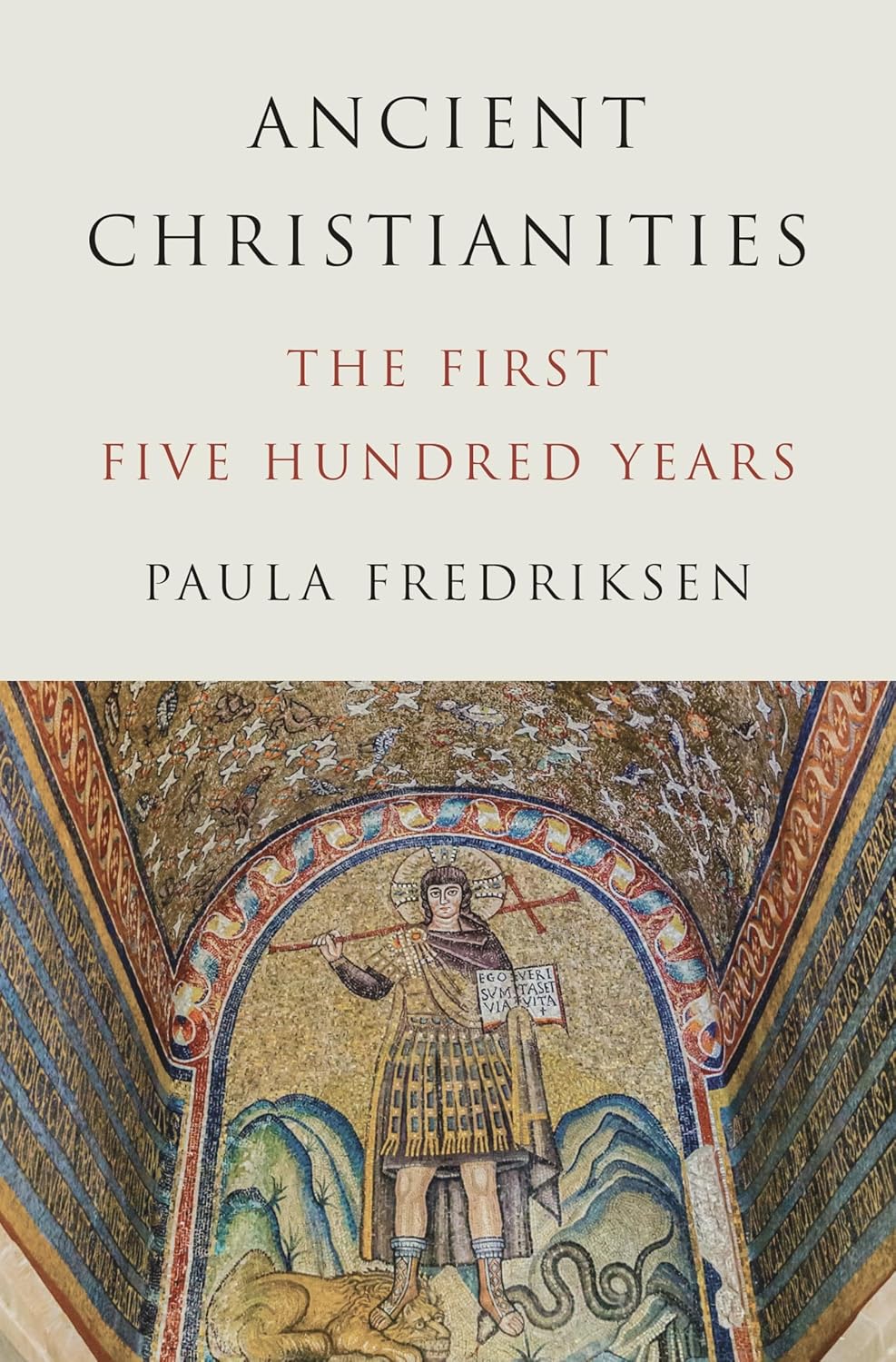
Ancient Christianities: The First Five Hundred Years by Paula Fredriksen

by James Wallace Harris, 12/39/25

Ancient Christianities by Paula Fredriksen is a scholarly work that chronicles the evolution of Christian theology over its first half millennium. I would say this book is not for the faithful, but for readers who enjoy studying history. Paula Fredriksen is an American historian and scholar of early Christianity. She held the position of William Goodwin Aurelio Professor of Scripture at Boston University from 1990 to 2010. If you are considering reading Ancient Christianities, I highly recommend following the link to her name. Fredriksen has published several books on Jesus, Paul, early Christianity, and St. Augustine that I want to read.

I will not review Ancient Christianities; for that, I recommend reading Joseph Foltz’s review in Ancient Jew Review (May 14, 2025). Instead, I’m going to describe why I read this book.

I believe we are all brainwashed as children by our parents, family, teachers, peers, and churches. We can’t recall how we acquired our foundational beliefs because they were imprinted at a time when we understood little about reality. These beliefs are recorded so deeply in our minds that we seldom examine them. The amount of work it takes to explore this area of our personality is too great for most people.

There is a fascinating parallel between dredging up personal memories from our early minds and studying the history of the early formation of Christian theology. It’s impossible to know anything for sure about either. However, working with memory and history can be enlightening.

I gave up religion back in the mid-1960s, but I’ve never been able to erase everything that going to church as a child put in my head. However, I’ve always felt kindly towards the person we call Jesus. I assumed he discovered a new way of seeing the world that was more compassionate than was common over two thousand years ago.

Over the years, I’ve read many books by historians trying to discover who Jesus was and what he taught. I’ve concluded it is impossible to know what Jesus believed or preached, and Ancient Christianities only confirms this conclusion.

If you study all the various sects of Christianity and all its theologians, you will not find one common denominator. Whatever Jesus believed, it’s been obscured by thousands of new opinions. Some scholars claim that Jesus might not have existed at all, but was created to promote specific concepts. But we can’t even identify the first creator of Jesus, because the idea of Jesus has been recreated countless times over the last two thousand years.

Because Jesus didn’t write down his philosophy, we can’t say for sure what it was. The earliest writings about Jesus come from Paul, but we can’t trust them because Paul didn’t know Jesus. Paul wrote letters about Jesus twenty years after Jesus died. He says very little about Jesus the man. But that’s like you writing about someone you heard about who died in 2005.

The authors of Matthew, Mark, and Luke wrote decades later and told different stories about Jesus that don’t always match up. That’s like writing about someone you heard about who died in 1980.

The author of the Gospel of John wrote even later and went full gonzo on the story of Jesus.

Paul Fredriksen recounts how many other men wrote stories about Jesus in the following four hundred years. Everyone made something new up. And some of their ideas involve concepts as far out as those imagined by science fiction writers.

Ancient Christianities is about endlessly reinventing Jesus over five hundred years. Those ideas are so ancient, so deep in our collective unconsciousness, that they are like ideas that we acquired when we were four, and dwell in the darkness of our unconscious minds.

Every theologian and every historian has their own theory about Jesus’ identity. All we can do is pick the one we like the best, but we can never know.

I’ve always wanted to believe Jesus was the guy who came up with the ideas in the Sermon on the Mount. I’m not so sure anymore. I’m currently leaning towards the idea that Jesus was a radical who wanted to overthrow the system. It’s not hard to picture him talking like the hotheads on the internet with big ideas. And that the Sermon on the Mount came from a later storyteller.

There’s a wonderful book, The Five Gospels: The Search for the Authentic Words of Jesus. It’s based on the Jesus Seminar, where, over a decade, theologians and historians debated which passages in red in the New Testament were said by the historical Jesus. The Five Gospels is based on voting, and the results are color-coded. Even among experts, there is no complete agreement. We tend to advocate for what we want to believe. Confirmation bias is powerful.

Books like Ancient Christianities help us understand how commonly believed concepts evolved from specific people. (By the way, it’s all men.)

If you read enough history books about religion, you realize there is no divinity anywhere to be found. It’s all concepts created by men. Like the famous story by Carl Sagan, it’s turtles all the way down.

JWH
Avoiding Mirages in Reality Created By Words

by James Wallace Harris, 10/12/25

Humanity is plagued by delusions generated by words. We struggle to distinguish between words that point to aspects of reality and words that point to fictional mirages. In other words, we can’t differentiate between what is real and shit we make up.

I’m partial to an unverified quote attributed to James Michener, “The trick to life is to make it to 65 without being either a drunk or insane.” Sanity is notoriously hard to define. Many of us can stay sober until 65, but do any of us stay sane till then? Don’t we all end up seeing things that aren’t there? Don’t we all embrace cherished delusions to cope with life?

Of course, you will disagree with me. We all know what we believe is real.

Language allows us to be self-aware and manipulate reality, but don’t many of our words point to theoretical concepts that don’t actually exist in reality?

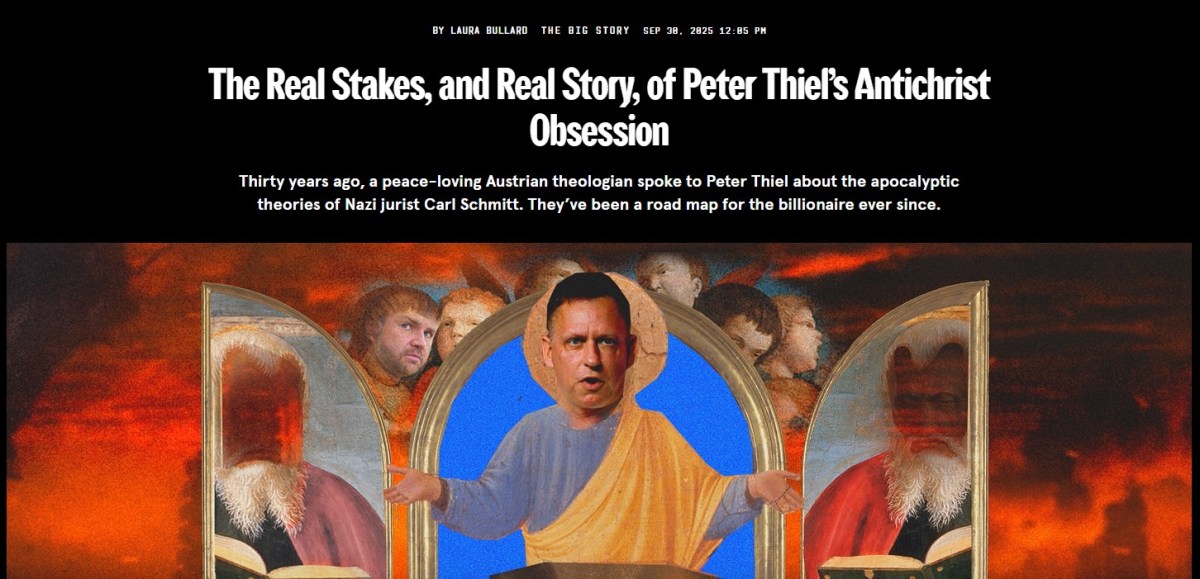
I recently read “The Real Stakes, and Real Story, of Peter Thiel’s Antichrist Obsession” in Wired Magazine. [Nearly everything I read is behind a paywall. I use Apple News+ to access hundreds of magazines and newspapers that exist behind a paywall. Wired shows the entire article for a few seconds. If you immediately right-click and select Print, a copy of this article can be read in your printer preview window. If you don’t catch it the first time, refresh the page. Or read other articles about this.]

Recently, Peter Thiel gave a four-part lecture on the Antichrist and the Apocalypse. In her Wired article, Laura Bullard attempts to decipher what Thiel is preaching.

By Thiel’s telling, the modern world is scared, way too scared, of its own technology. Our “listless” and “zombie” age, he said, is marked by a growing hostility to innovation, plummeting fertility rates, too much yoga, and a culture mired in the “endless Groundhog Day of the worldwide web.” But in its neurotic desperation to avoid technological Armageddon—the real threats of nuclear war, environmental catastrophe, runaway Al—modern civilization has become susceptible to something even more dangerous: the Antichrist.


According to some Christian traditions, the Antichrist is a figure that will unify humanity under one rule before delivering us to the apocalypse. For Thiel, its evil is pretty much synonymous with any attempt to unite the world. “How might such an Antichrist rise to power?” Thiel asked. “By playing on our fears of technology and seducing us into decadence with the Antichrist’s slogan: peace and safety.” In other words: It would yoke together a terrified species by promising to rescue it from the apocalypse.


By way of illustration, Thiel suggested that the Antichrist might appear in the form of someone like the philosopher Nick Bostrom—an Al doomer who wrote a paper in 2019 proposing to erect an emergency system of global governance, predictive policing, and restrictions on technology. But it wasn’t just Bostrom. Thiel saw potential Antichrists in a whole Zeitgeist of people and institutions “focused single- mindedly on saving us from progress, at any cost.”

So humanity is doubly screwed: It has to avoid both technological calamity and the reign of the Antichrist. But the latter was far more terrifying for the billionaire at the podium. For reasons grounded in Girardian theory, Thiel believed that such a regime could only—after decades of sickly, pent-up energy—set off an all-out explosion of vicious, civilization-ending violence. And he wasn’t sure whether any katechons could hold it off.

Thiel draws theology from the Bible, philosophy from studying with René Girard, and apparently combines them with ideas from Carl Schmitt, a political theorist from Nazi Germany, to create a rather bizarre warning about our future.

Because Thiel is a billionaire, he’s able to spread his beliefs widely. And because our society is overpopulated with people searching for meaning, we have a problem.

I’ve been collecting news stories and sorting them into two categories. The first deals with delusions that affect individuals. The second collects reports showing how we’re failing as a species. I could have filed this Wired article under both.

Whether as individuals or as a species, we act on false assumptions about reality. We often assume things to exist that don’t. Such as the Antichrist, or for that matter, The Christ. There may or may not have been a historical person we call Jesus. That may or may not have been his name. The concept of Christ was created over several generations of his followers. It has no real existence in reality. And neither does the Biblical Apocalypse or Antichrist. Those concepts have been redefined repeatedly over twenty centuries.

Among the thousands of Christian denominations that have existed over the past two millennia, there is no consensus on what Jesus preached or what is meant by the term Christ. In other words, there is no common denominator between Christians. This is because their beliefs are imaginary concepts that each individual redefines for their own use in words.

Religious beliefs are fine as long as they remain private to an individual, but when they are used to shape reality, they become dangerous. I often read about people who want to use their beliefs to make others conform to their illusions. That disturbs me.

But I’m only now realizing why. It represents a failure of language. Language is useful as long as words point to aspects of reality. The closer words stay to nouns and verbs that have a one-to-one relationship with things or actions within reality, the safer we are. It’s the words we fight over their definitions. That’s when things get dangerous.

Peter Thiel’s bizarre philosophy becomes dangerous when he can get others to accept his definitions. As I read news stories, I see this validated time and again. How many Russians and Ukrainians would be alive today who died because of Putin’s mirage of words? Look at any war, political conflict, or personal argument, and you can often trace it back to the ideas of one person.

Even my words here will incite some people.

As my last years fade away, I struggle to comprehend the years living in this reality. I’m starting to see that most of the confusion comes from interpreting words. The more I approach my experiences with the Zen-like acceptance of what is, the calmer things get. Eastern religions took a different approach to reality. In the West, we work to shape reality to our desires. Eastern philosophers teach that we should accept reality as it is. There are also dangers to that approach.

The reality is that humans create climate change. Many people can’t accept that reality. They use language that creates a mirage that many want to believe. That is one form of action. It’s a way of manipulating the perception of reality. That will actually work for those people, for a short while.

The weakness of our species is that we manipulate the perception of reality instead of actually making real changes in reality.

That’s how I now judge the news. A plane crash is a real event, not a mirage. But how often are men seeking power describing something real?

JWH

How Christianity Was Created

by James Wallace Harris, 2/26/20

I am a lifelong atheist, but I’m not the kind of atheist who goes around trying to convince folks that God does not exist. Religion serves an important function for many people, giving them belief, community, morality, and solace. For some strange reason, I’m an atheist that enjoys reading about the history of Christianity, The Bible, and Jesus. Countless books have been written on these subjects, but most have been theological. I have no interest in those books. What I like to read are books by historians trying to figure out what actually happened two thousand years ago. It’s a magnificent cold case, a tremendous scholarly puzzle.

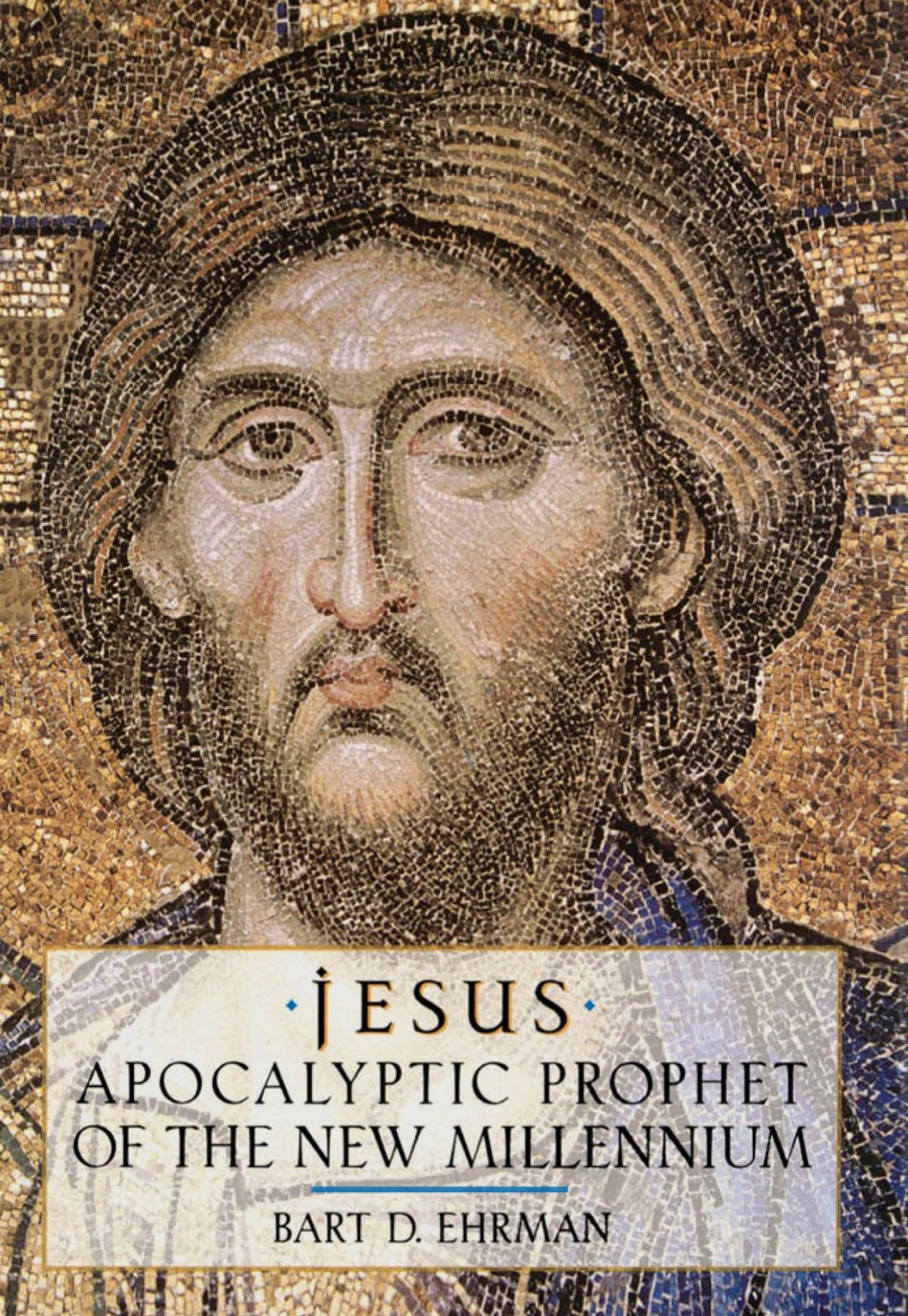
One of my favorite authors writing about this history is Bart D. Ehrman. I’m currently listening to Jesus: Apocalyptic Prophet of the New Millennium, one of his older books from 1999, but it recently came out on audio. Next month I’m looking forward to reading Ehrman’s new book Heaven and Hell: A History of the Afterlife when it comes out (3/31/20). But as of now, I’ve read:

For a historical figure that we know practically nothing about, Ehrman has found a great deal to write about. The fun of all this historical sleuthing is putting the clues together in various ways hoping for new insights. Most believers assume we know a whole lot about Jesus but from a scholar’s point of view, most of the common beliefs about Jesus are made up.

What Ehrman and other historical scholars are trying to do is figure out who Jesus was before he died. What we have are writings that began appearing decades after his death. The goal of all the research is to examine various written memories of Jesus to determine if anything remembered might be true of the actual person. People have been making up stuff about Jesus for two thousand years. The assumption is the oldest documents might have the best clues. That’s what Ehrman’s books are about, going over the old documents, again and again, comparing them against each other. Reading Ehrman also teaches us about the methodologies of historians and the limitations of memory and writing.

Ehrman mostly focuses on first-century documents, the writings of Paul, the Gospels, a few other documents, and their possible ur-texts we don’t have. For a period of about 20-30 years after Jesus died his followers collected his sayings. We assume they were only passed down orally at first. Eventually, they were written down, but we don’t have copies of those sayings. Later on, the gospel writers used those collections of sayings to create the four Gospels. However, the information in each varies. And the newest Gospel, John, reports a great deal of information not reported in Matthew, Mark, and Luke. I tend to agree with many historians that ideas about Jesus first appearing in the Gospel of John were made up.

In the second and third centuries, many more gospels were written and scholars tend to discredit them for various reasons, but they do offer interesting clues. The assemblers of the New Testament also favored the oldest gospels as authentic and considered the newer gospels as heretical. But if we examine all the gospels, there are reasons to doubt all of them because we see that various followers had different agendas in composing their gospels, and none of their reasons seem related to the historical Jesus. Every gospel was written claiming who Jesus was and what he taught. They are all interpretations with a purpose that fit the times in which they were written.

Thus historians are left trying to figure out what Jesus actually said from things he didn’t write down himself, but was written down by many different people decades later. This is why we have so many different conceptions about Jesus. It’s like saying there are 1,000 different biographies of Jesus and one of them could be right. But there’s also a good chance they might all be wrong.

Ehrman and other historians assume it’s possible to deduce the truth. I’m not sure it is.

The Jesus Seminar took a different approach. It asked theologians and scholars to vote on every saying by Jesus hoping some kind of consensus might reveal the truth. But after 2,000 years, can we really expect to find the truth? If you want to know more of their results read The Five Gospels.

What is revealed from all this study is how Christianity began. Jesus’ followers made him divine and determined the scope of his divinity. Ideas about the afterlife, God, and Heaven were all invented long after Jesus died. There is no evidence that Jesus believed any of it. Christ and Christianity are what his followers invented.

What I wish Ehrman (or some other historian) would write is a chronology of how various Christian dogmas emerged, when, and if possible who created the idea first.

I tend to accept Ehrman’s theories about who the historical Jesus was and what he preached, but I think there’s still room to doubt we can even know that much. And I don’t know if it matters. I think we might be giving Jesus too much credit. Both believers and atheists like me want Jesus to be someone wonderful. And believers want Jesus to be someone who validates the truths they want to prove true. I guess I just want to know what the guy really said and how it got distorted.

There’s a good chance that almost everything we call Christianity was invented between 50-350 CE. We don’t really know when Jesus actually died, probably 30-36 CE. Paul started preaching in the 50s. He got to meet some of the disciples that knew Jesus, but we’re not sure how much he learned from them. Paul’s writings actually say very little about Jesus the man. They are about forming Christian communities.

We know the followers from about 33 CE to 60 CE collected the sayings of Jesus. Paul probably saw some of these collection of says, but maybe not, because he rarely quoted them. We have to assume some of these sayings might have accurately recorded Jesus’ speeches, but we can’t be sure. Probably for many years, they were only passed around via word-of-mouth, and we know how poorly that works. And we know how people love to embellish a good story.

What we do have are the four Gospels that were probably written around 66 CD to 110 CE. Mark is assumed to be the oldest (66-70 CD). Matthew and Luke next (85-90 CE) and finally John (90-110 CE). We don’t really know who their writers were. Scholars assume they were not any of the disciples. Each of the four claims to tell the story of Jesus, but they each tell a somewhat different story, sometimes with conflicting details and beliefs. Think of how many books or movies you’ve encountered about famous modern people. Even the most serious biographies, with mountains of hard evidence, are always challenged on some facts. We can’t create perfect biographies even when we have voice recordings and videotape.

Paul essentially created Christianity in the 50s CE. What he preached was often disputed by Peter and the other disciples, but because Paul was so good at spreading his version of the word explains how he got the Christianity snowball rolling. Whoever wrote the Gospel of John created many now cherished beliefs for the emerging religion. Starting in the second and third centuries new theology was added by other writers who we know their names and have some of their writings.

I feel I have read enough on Jesus. I’ve given up on ever knowing who he was and what he taught. There’s just too much speculation. My rough idea after reading all these books is Jesus was probably a very interesting guy who taught something, probably something very unorthodox, probably utopian, and he got himself killed for it. His followers, who passionately believed in him were thrown into despair because they didn’t want to give up on his wonderful vision of how things could be. They came up with the resurrection as a way to keep the dream alive. All the stories about the post-crucifixion were invented to put a positive spin on the inconvenient truth that Jesus was wrong about the Kingdom of Heaven appearing on Earth in his lifetime. They used his memory to preach what they wanted. To sell their ideas they promised potential believers they would gain everlasting life. To gain converts, they made Jesus into a divine being. Then people who had never known Jesus, the gospel writers, started making up even better stories. The stories became so good, so convincing, that it converted most of the Roman world in a few hundred years.

I expect Ehrman’s new book, Heaven and Hell will cover that development. I also assume all the core beliefs of the various forms of Christianity in the last two thousand years are really driven about hopes of an afterlife. Donald Trump has clearly proved that Christianity is not about specific moral beliefs or spiritual discipline. What Christians believe today is too diverse to define them by a specific list of creeds. Basically, what ties modern Christians together is a vague belief in vague God and a hope of an existence after death.

The real Jesus apparently didn’t think of himself as the Son of God, but the Son of Man. He advocated that followers share their belongings, to even live together communally until God created the Kingdom of Heaven on Earth, which would happen in his lifetime. He apparently preached about compassion and how people should treat each other. It appears Jesus had very liberal views. Modern Christians are mostly conservative, so it’s hard to reconcile their beliefs with anything Jesus actually taught. Modern Christians are really disciples of Paul and the writer of The Gospel of John, and second-century theologians.

What I learned from reading all these books on Jesus is whatever he taught can only be discerned from those collections of sayings that existed before the gospels were written, unfortunately we don’t have copies. Some of those sayings are mixed in with the gospels, but we don’t know which. Even then, there are plenty of reasons to doubt anything attributed to Jesus after his death. Can you prove anything anyone said to you twenty years ago was verbatim and what they did was exactly how you say it happened?

JWH


Aren’t Republicans the True Disciples of Darwin?

by James Wallace Harris, Friday, October 12, 2018

I’m beginning to see my liberal hopes for social justice are naïve and conservatives are survivalists acting on animal instinct and not theology.

In “Notes from the Fifth Year” from We Were Eight Years in Power by Ta-Nehisi Coates, he describes why he does not believe in cosmic justice or God. As a kid, Coates got beat up and learned he could only rely on himself for help. He saw that in society too. Our hunger for justice is the desire to be protected, but Darwinian laws of red tooth and claw overrule theology and legal systems. As a liberal, I want society to be just and protective, but I’m realizing that counters my own atheistic and scientific beliefs. What I find ironic is Republicans who claim to be Christian, a belief in cosmic justice, want laws and government that affirm Darwin. That I, an atheist, an avowed disciple of Darwin, really want a Christian society. It’s it hilarious when Christians act evolutionary and atheists yearn for grace?

I thought “Notes from the Fifth Year” both brilliant and depressing. It reminds me of a film I saw on the internet of a big green snake coming out of a woodpecker’s hole while the woodpecker frantically fights to pull the snake out to save its nest. I knew people were on the ground filming and watching this struggle. I wanted the woodpecker to win. It kept pecking the snake, and the snake would grab it by the wing, and the bird would struggle free, fly away, but then immediately return to attack the snake again. Its only hope was itself. I wanted the bird to win. I wanted the people on the ground to find a way to pull the snake down. But like Coates, I realized there is no help for the woodpecker except its own efforts to survive.

More and more I see Republicans as survivalists fighting with all their might to save their way of life. They don’t want to pay taxes to help other people because they want that money to protect themselves. They don’t want laws to help other people, only laws that to protect themselves. They’re against minorities, immigrants, and poor people because they threatened their survival. They offer no alternative to Obamacare because they believe in the survival of the fittest. They don’t really disbelieve climate change but deny the expense of global warming because it threatens their pocketbooks. They’d rather have dollars in their paychecks than a clean environment or a just and equal society.

The Republicans are the snake in the tree, not the valiant woodpecker because they are strong and can take what they want. Coates is right, we live in an atheist reality where the powerful prevail. And the strong won’t help the weak. It’s against their nature.

I find it hard to believe Republicans claim to be Christians. They don’t believe in the fishes and the loaves. They don’t believe in turning the other cheek. They don’t believe loving thy neighbor. They don’t believe the meek shall inherit the Earth. But they’re positive camels can go through the eyes of needles.

I now assume Republicans are Darwinians on Earth but Christians after death. They believe in easy Christianity, where merely saying “I believe in Jesus” is a ticket to heaven. But what happens if Dietrich Bonhoeffer’s The Cost of Discipleship is right, and true Christianity is far more expensive?

I’m an atheist that wants humans to create a society that overcomes the laws of Darwin. Even though I’m not a Christian, I felt Jesus wanted to create a heaven on Earth where everyone is treated equally and just. Am I naïve and the Republicans realistic? Conservatives believe the City of God lies beyond death, whereas liberals want humanism to construct it on Earth.

We can now see that Republicans have given up any pretense of ethics. With them, the end justifies the means, and their means are Darwinian, not Christian. Back in the early days of the Environmental movement, the idea of Lifeboat Earth emerged. It’s a great analogy. There’re always people in lifeboats who feel they deserve the rations than the others, and that the weak should be put off the boat. That’s very Darwinian. Aren’t Republicans acting like the ruthless in a lifeboat?

JWH

The Impact of Atheism on Well-Manicured Lawns

When I think of good Christians I think of close-knit families with spotless houses and beautiful lawns.  The most successful people I know, those whose lives are full of love and happiness, are my Christian friends, because I equate big loving families with social success.  These same people have great houses and yards.  Most of my non-believing friends tend to be childless, and like myself, self-centered, and our homes and yards show a difference.  Its odd, but I think our philosophical differences are reflected how our lawns compare.  My neighbors with the best lawns seem to be family oriented and Christian, whereas my own lawn is weedy and chaotic.  And the lawns of my Christian friends who don’t have children seem to fall in between.

The history of western civilization and Christianity has been one long war with nature.  Christians believe they have dominion over the Earth and wish to subdue nature.  That’s reflected in their lawns and gardens.  A well ordered yard reflects a well ordered mind, or so we thought.

lawn2 

The faithful think atheists are amoral, but most ardent nonbelievers I know tend to be liberal with strong beliefs about improving society, helping the needy and living ethical lives, but sometimes our personal habits reflect disorder.  Atheists I would contend, lean towards embracing nature, rather than ruling over it.  If I had my druthers I’d let my yard run wild and encourage more wildlife to settle in it.  We use to have a fox that lived in my neighborhood that would run through my backyard, but sadly it was killed by a car.  I’m not totally crazy—I don’t want nature coming in my house, but as long as fellow creatures don’t attack me, I don’t mind sharing my yard with as many plants, animals and insects as the natural ecology allows.

I want a Darwinian lawn.  I also want a lawn that helps the Earth and our species.  I want to lawn to helps other species from going extinct.  I want to coexist with nature and not dominate it.

I’ve often wondered about landscaping my yard so it would be perfectly adaptable to our changing climate.  I’d like the plants and other living things to adapt to the emerging weather patterns so I wouldn’t have to fertilize and water anything.  I’m not sure my neighbors and zoning czars would think about that though.  However, as soon as the perils of climate change are accepted by good Christians and they realize they must be stewards of the Earth and not conquerors, they might change their minds too.

For all their talk of heaven, Christians embrace life on Earth.  Deep down they aren’t the kind of people who commit suicide or pull the plug when the going gets tough.  They fight for life to the bitter end—and when it becomes all too obvious that they are committing species-cide they might change their minds.   We atheists accept personal extinction, but we hate the thought of humans dying off.  One day, both sides of the spiritual divide might agree on a new approach to lawn care.

For every gallon of gas you burn the warmer you make it for your descendants.  For every pesticide you add to the environment the more you poison your children, their children, and their children’s children, and so on until the Earth is cleaned up.  Denying manmade climate change is denying your own sins against the Earth, and the crimes you are committing  today will burden far more than three generations.  Easy Christianity has convinced millions to shirk their debts, because isn’t sin incurring debts to others? 

Okay, I’m an atheist, so I can’t expect you to speak my language, so let me try to speak yours.  One Christian book that impressed me was The Cost of Discipleship by Dietrich Bonhoeffer.   Modern Christianity has made the pardon of sins way too easy.  There has to be more to grace than just claiming belief.  What humanity has done to planet Earth is one giant cross that we must all bear.   You can’t escape your sins by denying they exist anymore than running away from them by believing.  We live by our actions, and any grace you seek must be earned by how you live and not how you think.

JWH – 5/12/14