
To The Bearers of False Witness Against Our Democracy

by James Wallace Harris, 2/23/21

When I was in school back in the 1950s and 1960s we were taught that America was the best example of democracy, and it was our most valuable export. The history I was taught, also claimed we inspired a slow worldwide conversion to democracy since the founding of America. Those lessons were something we took very seriously, and for most Americans it was politically sacred. We looked down on those corrupt government and leaders in other countries that undermined democracy as barbarians. And most of all, we believed America was impervious to any such corruption.

Well, we were wrong. Conservatives have taken up the weapon of denialism, first wielding it against science, then journalism, and now democracy. Denialism is a weapon of mass destruction. Donald Trump spent months carpet bombing America with denialism against democracy, claiming our system of voting is corrupt and full of fraud. It was Trump’s backup plan in case he lost the election, and his followers embraced that plan wholeheartedly. Even now the Republican party is doing everything it can to undermine democracy so they can win back power in 2022.

There was no significant voter fraud in 2020, even the conservative judges Donald Trump appointed affirmed that. Anyone who knows anything about our voting systems knows it’s well monitored. But even more important armies of Americans volunteer to support our voting system each election, and to claim it is corrupt and fraudulent is to insult their dedication. That’s goes beyond anything I can imagine to undermine our national unity.

Donald Trump shat all over American democracy and his followers have embraced his acts as the way to get what they want. The only systemic fraud in American democracy are the efforts by Republicans to disenfranchise people of color and immigrants, and to undermine our voting systems. This is down to Earth evil. If you follow the news, it is quite obvious that the Republicans have decided their #1 tool for winning elections in the future is by controlling them.

I just read this quote in 21 Lessons for the 21st Century by Yuval Noah Harari:

Joseph Goebbels, the Nazi propaganda maestro and perhaps the most accomplished media-wizard of the modern age, allegedly explained his method succinctly: “A lie told once remains a lie, but a lie told a thousand times becomes the truth.”

Donald Trump told his lie about election fraud so many times that it has become true to millions of people. Those lies are bearing false witness against democracy. By Republicans playing this one trump card over and over is causing their party members to believe it too. Harari went on to say:

In Mein Kampf Hitler wrote, “The most brilliant propagandist technique will yield no success unless one fundamental principle is borne in mind constantly — it must confine itself to a few points and repeat them over and over.” Can any present-day fake-news peddler improve on that?

I definitely do not mean to imply any connection between Trump and the Nazis. It’s just that the Nazis wrote the manual on public manipulation. Anybody who manipulates other people use a fraction of the techniques the Nazis perfected. We all need to study those techniques to become aware of how we’re being manipulated, either by politicians, corporations, or even by our coworkers, family, and friends.

Harari in an earlier chapter worked to understand why people believe what they do. He said as a species we’re not rational, but depend on myths and group thinking to understand reality. Most Americans don’t understand our democracy and voting systems so it’s easier to sway their opinion with disinformation. Trump treats his followers not as individuals but as a group mind. This comes from from the same book:

Not only rationality, but individuality too is a myth. Humans rarely think for themselves. Rather, we think in groups. Just as it takes a tribe to raise a child, it also takes a tribe to invent a tool, solve a conflict, or cure a disease. No individual knows everything it takes to build a cathedral, an atom bomb, or an aircraft. What gave Homo sapiens an edge over all other animals and turned us into the masters of the planet was not our individual rationality but our unparalleled ability to think together in large groups.

The Republican Party has learned the power of group thinking. That’s why they are so passionate about party loyalty. Unity consistently achieves success and they know it. The trouble is people who do think for themselves can break up groups, and the group is all important to Republicans. What’s amusing is individual Republicans who do think for themselves are always jockeying for control of the party, but it seems that it was Trump who rolled out the attack on democracy and the others had to fall in line. It’s another reason why so many Republicans want to retain Trump as a leader, his successes worked, so why rock the boat.

Harari went on to say:

Yet like many other human traits that made sense in past ages but cause trouble in the modern age, the knowledge illusion has its downside. The world is becoming ever more complex, and people fail to realize just how ignorant they are of what’s going on. Consequently, some people who know next to nothing about meteorology or biology nevertheless propose policies regarding climate change and genetically modified crops, while others hold extremely strong views about what should be done in Iraq or Ukraine without being able to locate these countries on a map. People rarely appreciate their ignorance, because they lock themselves inside an echo chamber of like-minded friends and self-confirming news feeds, where their beliefs are constantly reinforced and seldom challenged.

Conservatives, like any group seeking power, have used techniques and insights into how people form opinions to shape party member’s opinions. It’s how they get their coalition to do their bidding. Harari also noted that once people form opinions they seldom change them. Once the denialism of democracy bomb was dropped there was no going back. The rank and file had to follow. This is destroying our democracy with lies and even false witnessing in courts of law and the courts of public opinion.

Even some Republicans realized this is going too far. It’s like dismantling a passenger jet in flight. We all depend on our democracy for security and happiness, even the people who no longer believe in it. I plead with all rational Republicans to stop denying democracy. Stop undermining our way of life.

I have never believed in hell because I could never imagine any compassionate God would condemn any human soul to it for eternity. Christianity teaches forgiveness, and I can forgive the people who can’t think for themselves and spread lies about democracy. They don’t know any better. But I don’t have enough forgiveness to forgive those who are capable of thinking, who know what they are doing, and who bear false witness against democracy. They can go to hell – forever.

JWH
Book vs. Movie

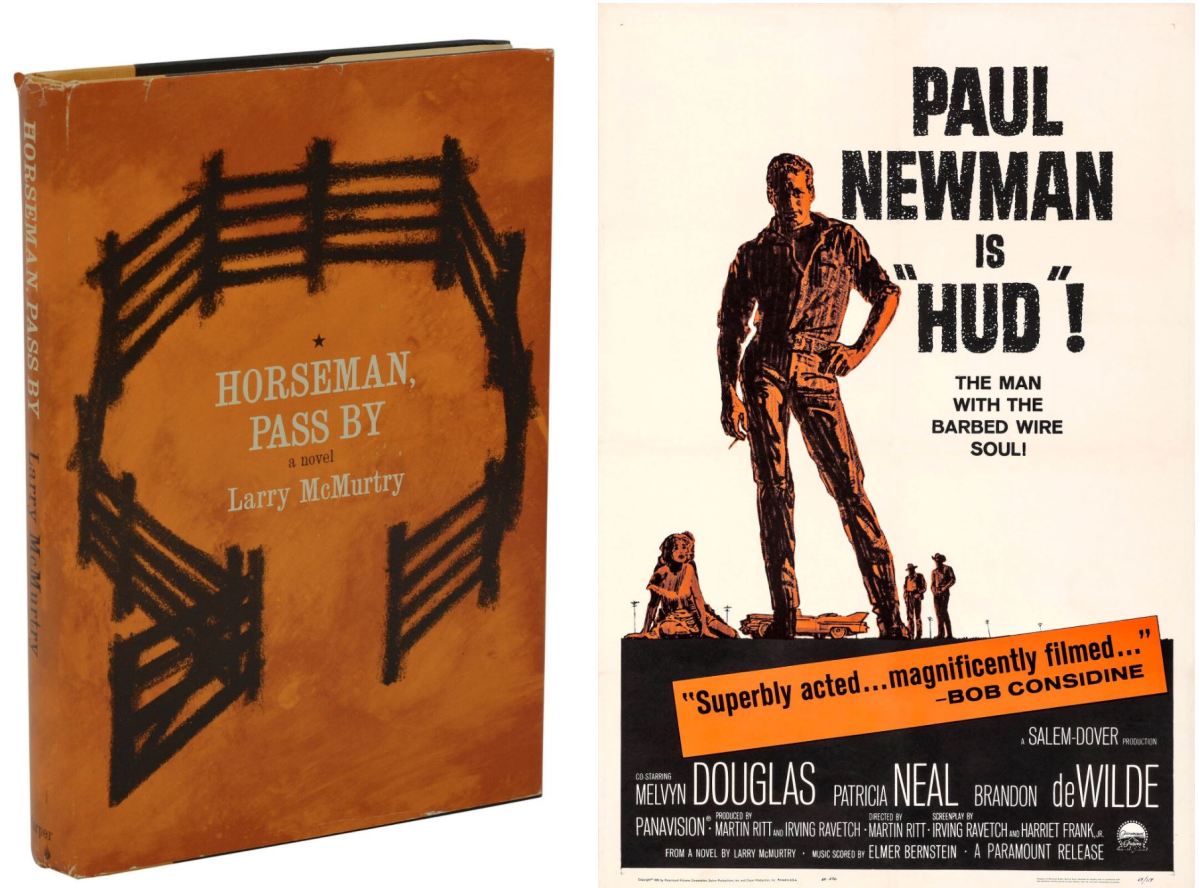
Horseman, Pass By, a beautiful coming-of-age first novel by Larry McMurtry was immediately made into a big Hollywood film starring Paul Newman and renamed Hud. The film was huge validation for a freshman novelist, and got Larry McMurtry’s writing career going with a bang, but I wondered how McMurtry felt having his sensitive literary hero pushed aside to focus on the novel’s most insensitive, and rather minor character. Horseman, Pass By made me think of a rural version of The Catcher in the Rye. Hud feels more akin to Midnight Cowboy. Don’t get me wrong, Hud is a good movie, it’s just not Horseman, Pass By even though they keep much of the basic plot.

The novel is about 17-year-old Lonnie Bannon’s emotional life in the summer of 1954 where he lives on his grandfather’s east Texas ranch with several other significant people. One of those people is Scott “Hud” Bannon, his uncle. In the book we seldom see Hud, and usually only when he’s at his nastiest. For the movie, Hud is elevated to the main character, and Lonnie’s story becomes secondary to Hud’s. Instead of being an empathetic story about a boy learning about life through relationships, the movie gives us sympathetic story about the nastiness of an asshole. Unfortunately, that asshole is so well played by charming Paul Newman, that he becomes an anti-hero, and upstages all the other characters. In the book, Hud deserved to put down with a 30-30 like one of the hoof and mouth infected heffers, in the film he’s not quite as bad, but still deserves some jail time. In both stories he gets off scott free.

Actually, we know what McMurtry thought about Hud since he wrote Hollywood: A Third Memoir about his books being turned into film. He was overjoyed to get the money because it freed him from a life in academia. His only disappoints were he didn’t get to meet Patricia Neal on the set and the screenwriters didn’t fix the ending, the scene with Homer Bannon dying. McMurtry thought it was weak, and one forced on him by his publishers. McMurtry’s general attitude toward Hollywood was take the money. Oddly, though, the pictured Hollywood made from his second novel, Leaving Cheyenne, retitled Lovin’ Molly so outraged him that he wrote a protest article for New York magazine. So, I guess he really didn’t care about the changes made to his first novel with Hud.

But I did. I cared a lot. Horseman, Pass By is a great novel. It deserves more attention, and it deserves not to be remembered as Hud. Besides not focusing on Lonnie, the movie leaves out one great character, and chickenshitly changes another.

The Halmea character played by white Patricia Neal in the film was an African-American woman in the novel. She is a sympathetic and fully realized black character in a 1961 southern novel, making her very important indeed. Hollywood just couldn’t handle that. If 1961 Horseman, Pass By had been filmed as it was, it would have been very close to 1960’s To Kill a Mockingbird in sentiment. And to say a sensitive inner-voice novel can’t be put on screen is to ignore the 1962 movie version of To Kill a Mockingbird. Horton Foote did the screenplay for that book, so I wonder what he could have done for Horseman, Pass By.

Hud also leaves out Jesse, an aging cowboy who Lonnie admires. Jesse is a far more important character than Hud. The real story is Lonnie’s relationships with Homer, his grandfather, Halmea who mothers him, but who Lonnie is sexual attracted, and Jesse, who is a kind of cowboy Socrates to the boy. In the novel, Lonnie is trying to figure out how to live through the people he admires. Hud is not one of them.

Hud is an excellent film if you ignore the book it’s based on. I’ve watched it three times over my lifetime. I just wished they had filmed Horseman, Pass By as it was written. This is my second reading of Horseman, Pass By, and that’s what I want to stick with me.

JWH

Cracks in My Comfort Zone

James Wallace Harris, 2/18/21

I can’t believe it’s been a whole week since we lost power for 32 hours in the ice storm last week. We lost power three times during that week and I’ve been living with constant anxiety we’d lose it again, especially when it got down to one degree and some of our pipes began to freeze. The inside temp got down to 44 degree during the ice storm outage when it was still in the upper twenties outside. It scares me to think what living in this house would be like if it was near zero outside. That was before the snow, when I was thinking of draining the pipes, putting the cats in carriers, and convincing Susan we need to drive to a hotel. She didn’t want to abandon ship though. Her parents survived a week in this house without power back in the big ice storm of 1994. We bought this house in 2008 after they died. They had used the gas fireplace to stay warm then. Susan was afraid it might blow up if I tried to light it this week since it probably hasn’t been used since that 1994 ice storm.

Looking over the top of my monitor through the big window behind it I see our backyard covered with snow, and giant icicles hanging from the roof. It’s now a much warmer outside today, 24 degrees, but I’m still anxious. (And I’m overjoyed it’s going to get to 27 degrees today.) I’m so looking forward to next week when promised temps rise above freezing. All this frigid weather and power outages have made me very contemplative about the future. I turn 70 this year. This little neighborhood blackout has shown me how dependent we are on certain needs and comforts.

If you don’t feel like you’re getting old, or worried about being set in your ways, you probably don’t need to read this essay. Even though the power has been back on for days, I’m still chilled to the bone, still wearing three layers of clothes. Growing old means growing wimpier. Living in a rich technological society has made us addicted to utilities, and without them I go through terrible withdrawal. At least I’m not living in Texas at the moment or North Dakota.

Susan and I were able to survive by bundling up but it made me fussy and grumpy. I know that’s sounding weak and whiny because folks all over the world live without the environmental control us luckier Earthlings take for granted. We live in an old neighborhood with millions of trees and zillions of squirrels and the power goes out fairly often. Susan and I once went without power in the middle of summer for thirteen days in our previous old neighborhood, and I’ve been without power in the winter two times for three days in this house when Susan was working in Birmingham. So 32 hours wasn’t that much, but it was the coldest, when I was the oldest, and that got to me. Age matters.

I don’t want to do it again. So while I hunkered down in the dark trying to stay warm I fantasized about all the ways we could protect ourselves in the future. My first thought was to move to Florida. Isn’t Florida where old people go to die like the legendary elephant’s graveyard in Tarzan movies? However, Susan nixed that idea. Since we bought her parents house Susan assumes we’ll die here too. I just don’t want it to be by freezing to death – or by overheating in August.

I figure after we get our Covid shots we’ll get someone to check out the gas fireplace. Maybe even see if there’s a superior way to get heat from the living room fireplace. Susan’s parents survived a week closed up in that room with that gas fireplace during the 1994 ice storm power outage. I might also see about adding a gas heater in the master bedroom.

The funny thing is, beside warmth, we missed the internet the next most, even more than hot food. Our phones quickly ran out of juice. We had to recharge them by sitting in the car. So I’m going to buy a Jackery portable power station. A small model claims it can recharge a phone 24 times.

Susan thinks my next idea is going overboard, but I want to research getting a natural gas generator. We have lots of neighbors with gasoline generators. When the power goes off we can hear them all around us. I don’t like their noise, or messing with extension cables, or constantly filling up the tank. A natural gas generator is quiet, turns on as soon as the power fails, and feeds off the house’s natural gas line. I’ve done a bit of research and found a Generac for $4000 with an estimated installation of $2000. But I need to do more research. I’m scared of using natural gas, plus it contributes to global warming, and I need to find out how long such a device will last and what kind of maintenance it needs before committing to the idea.

I also need to research getting a camping stove or gas grill. Susan wishes we’d retrofit the kitchen for gas stove and over. The first night we ordered pizza to have something warm to eat, but once we were snowed in I doubt take-out delivery will be practical. I need to think about the right kind of food to have on hand for when the power goes out. By the way, I put our frozen food in my truck.

Because of previous outages I already own a bunch of battery power LED lanterns, but I need to get more. I want to research all the little gadgets to have that will make surviving power failures better.

When the water line to one of the toilets froze I took several old cat litter jugs and filled them with water. One jug could do one flush. Then I heard in Texas they were telling people to boil their water, so I thought I should also get up a supply of clean drinking water. That was the first thing my friend Mike did when his pipe burst and he had to shut off the water to the house – he drove off in the snow to get bottled water.

I’m sure in the weeks to come I’ll think of more things. Another idea I’ve had is to hire a house inspector, the kind people use when selling and buying a house, to give this place a check over to see how we can retrofit it for reliability, durability, and energy conservation. I need to learn what to do when the power goes off in the winter for a long time, especially to keep the pipes from freezing. I do have a T-wrench to shut off the water, and I could drain the water from the house, but what do I do about the hot water heater? It’s gas powered and keeps running without electricity. We could have taken hot showers if we were willing to shuck off all those layers of clothing.

I feel I need to adapt to adapting. As I’ve aged I’ve become rigid in my ways, and I’ve learned to control the crap out of my life by making everything perfectly comfortable. I’ve spent decades learning how to weed out all the little annoyances, so I’m poorly conditioned for abrupt changes to my habits. That means when things derail I get thrown out of my comfort zone. I believe I adapted fairly well to losing power this time, at least being stoic, but I could have handled it much better. We didn’t do much but play on our phones and slept a lot under lots of covers.

We’re usually unaware of our true selves until we’re forced out of our routines, and then we realize who we are by what we miss. My comfort zone totally depends on controlled temperature, electricity, and the internet. As I laid under blankets dressed in multiple layers of clothes trying to enjoy life at 44 degrees F, I just gave up to inactivity. I need to find ways to stay active and enjoy life without power.

I did do a lot of contemplating. I thought about Louisa May Alcott. I imagined she and her sisters spending long New England winters living in much colder rooms. I bet they found plenty to do to occupy themselves during the day. I wondered if I could adapt to reading physical books and writing with pen and paper in very cold rooms? People in the 19th century kept active in extreme cold and heat. Hell, so do most people around this 21st century world who live with HVACs?

The photo above was taken just before the power returned around 3pm Friday. It was 44 degrees inside and 29 outside. Luckily the power came back before it went down to 1 degree. My two cats were sleeping between my legs, but ran off before they could get photographed. You should have seen us at night lit only by flashlight. At least I didn’t have to go outside to an outhouse.

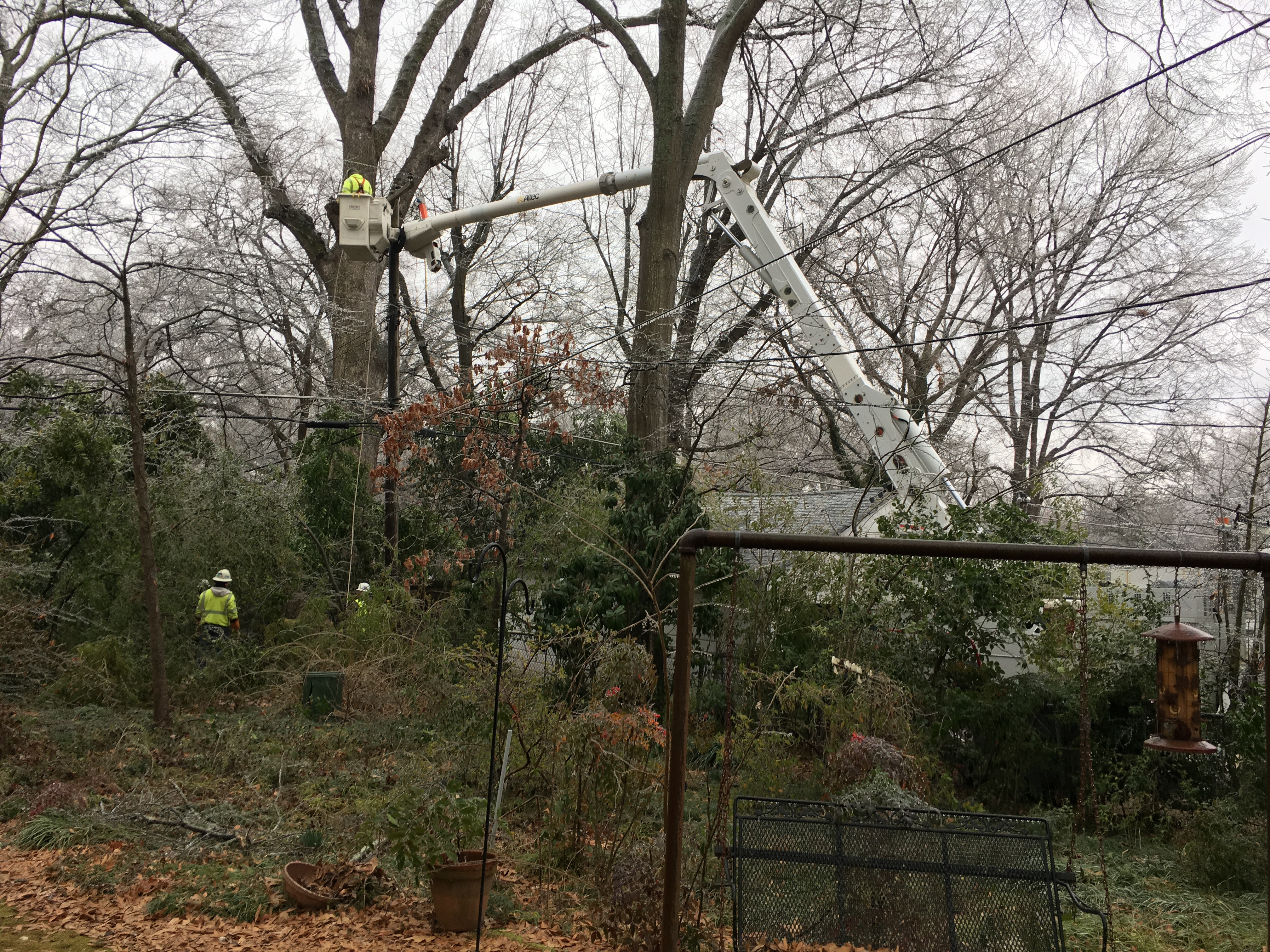
Here’s our rescuers working on a power pole in our backyard with their truck in my neighbor’s yard. It’s hard to see, but everything is covered with ice. That was last Friday. The power went off again for a few hours on Saturday when a tree branch fell on a powerline around the corner.

Now I understand why my mother would do anything to go stay with my sister in Florida during the wintertime. She was driving down there by herself even in her eighties. Boy, I wish I was living in Florida right now.

JWH

Hopes, Dreams, and Bullshit

by James Wallace Harris, 2/2/21

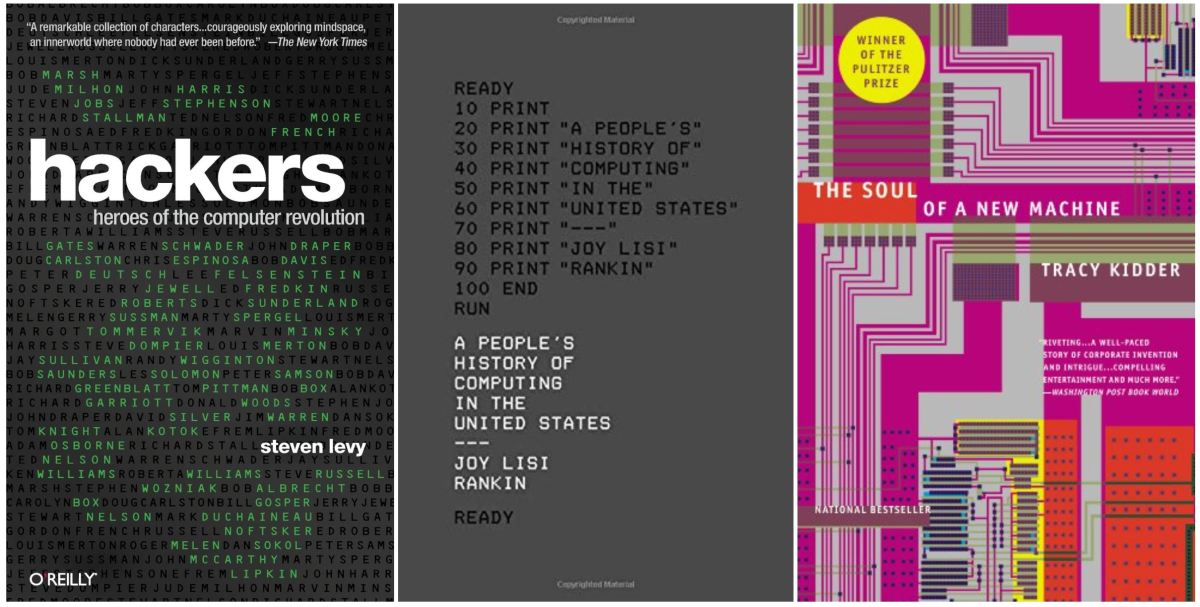
Rereading the 1984 book Hackers: Heroes of the Computer Revolution by Steven Levy unearthed long suppressed feelings and ambitions that first emerged in my personality back in the 1960s and 1970s. When I first read Hackers in 1985 it rekindled those formative emotions and desires then as well. I’ll start my seventies this year and I have to wonder when do hopes that I formed in my teens finally fade away? When can I just give up and be here now? When do I stop trying to constantly be who I was? Why don’t hopes have expirations dates? Why are these books so exciting after all these years?

I remember four years ago triggering these same emotions and ambitions when I reread The Soul of a New Machine by Tracy Kidder. I tried to write about what I felt, but those words don’t capture what I’m trying to say now. One thing about growing older, at least for me, is seeking clarity about my time in reality. Before I die, or my mind fades away, I want eliminate all the bullshit barnacles that encrusts my soul.

My current theory is we acquire our personal dreams and desires from pop culture and subcultures. During my lifetime I’ve belonged to many subcultures, but the two I loved most are science fiction and computers. Both current forms of those subcultures have long past me by, but their initial seduction have left subprograms running within my mind that never stop. Why was I able to deprogram myself of childhood religious programming, but I’ve never been able to escape that cultural programming acquired from age 12-22?

You’d think we’d forget old beliefs as we acquired new insights. Of course, I’m generalizing, assuming all people are the same. Maybe other people do that, but I don’t. Why can’t we emotionally be like historians who rewrite history with new discovers. For example, after rereading Hackers I read A People’s History of Computing in the United States (2018) by Joy Lisi Rankin. Basically, Rankin is saying, hold on there Steven Levy, your history of computer pioneers from MIT and Silicon Valley leave out a lot of middle America computer pioneers. Her book is reshaping my sense of computer history I got from Hackers. Why don’t I do the same things with my personal history?

This is not the book review I sat down to write. I might try again, but let’s go with the flow. These books hit the bullseye of my old computer ambitions. Over the past year I’ve been watching a lot of YouTube videos about 8-bit computers, especially those from The 8-Bit Guy. David Murray essentially has traveled back in time to work on computers at the point where Hackers ends in 1984. Many other YouTubers have done this too. I’ve wondered if the solution to my problem with all these old hopes and desires is to return to a past point in time and start over. I realize at this moment, that’s exactly what I’ve done with science fiction. I’m reading and collecting what I loved best from 1965-1975. That’s kind of weird when you think about it. But maybe it’s a natural aspect of aging too.

However, I also tell myself I should jettison my past like they were my first and second rocket stages and seek orbit for what I could be in 2021. But could that be me bullshitting myself that I’m not too old to learn new tricks. Of course, maybe one way not to stir up old emotions and desires is to stop consuming old pop culture. Does my library of old books, magazines, movies, and TV shows keep those old subprograms going? Actually, yes.

I have a friend, Anne, who lives so in the present that she hates the past, and even throws away old photographs and mementos when she finds them. I also live in the present by reading books published in 2020 and magazines that are February 2021 current. If I tossed out my old library and read only new books and magazines I would become a different person. I could become a fast nimble speedboat. But because I loved old pop culture, and can’t let go of old ambitions, magazines, and books, I feel the past I carry around has grown to the size of the Titanic. (I wish I had a photo of a guy in a rowboat towing the Titanic on a rope to put right here.)

The current nonfiction books and science fiction magazines I’m reading are about politics, climate change, and all the other dark clouds the horizon of this century. (No wonder I want to return to last century.) If I only read new books and magazines I’d completely reshape my present personality. Reading these three computer histories rekindles the futures I wanted back in the 1970s and 1980s, and they were tremendously more appealing than the futures I envision now. The people profiled in those books had such wonderful dreams about what computers would bring to the 21st century. And their dreams came true beyond anything they imagined or hoped. Yet, I wonder if they could see the downside of their creations, would they have done anything different? And isn’t that what I’m doing now by rereading these old books, second guessing my past decisions?

One of the reasons I can’t let the past go is it feels unfinished. I didn’t get to consume all the pop culture I wanted back then, satisfy all my wants, or achieve all my ambitions. But having lived in the future, it also feels like we took so many wrong turns. I can’t help but want to go back and finish what I started and even try different paths.

There is a whole lot more I want to say about Hackers, but this essay has already gotten too long for chiseling on this stone. Hopefully to be continued on another rock.

JWH

How to Save The World by Reading Science Fiction

by James Wallace Harris, 1/26/21

Many people have the inner confidence that the world will always muddle through. That we’ll solve our problems naturally through the unfolding of uncontrolled events. Other people believe as the population of humans grow, we’ll eventually reach a breaking point and things will fall apart. If you read Jared Diamond’s Collapse, you know the history of the world is a history of failed civilizations. Whatever goes up must come down, and if you’re the kind of person that uses numbers and graphs to anticipate the future, it doesn’t look good.

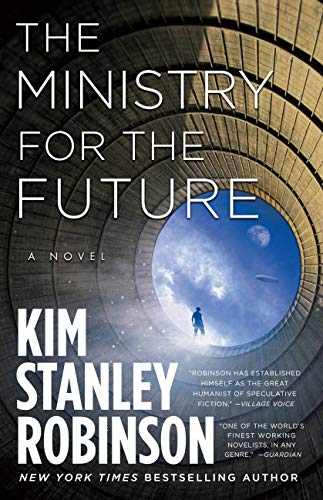
Kim Stanley Robinson has written a science fiction “novel” where he imagines humanity intentionally solving our big problems. The book is called The Ministry for the Future. It’s hard to recommend this book because people who expect a novel to work in a certain way could have difficulty reading it. I’ve already written about how The Ministry for the Future isn’t structured like a typical novel so you might want to read that essay before buying it.

The Ministry for the Future imagines how humanity could save itself. It’s just one possible scenario, but it does offer more hope than I’ve seen elsewhere. Now, it’s not entirely Pollyannaish, because it also assumes a massive economic depression and worldwide acts of terrorism will force us to change at times too, warning us there are no easy solutions, and to expect a bumpy ride.

The chief task to saving our planet is reducing CO2 in the atmosphere. Robinson suggests this can mainly be done by inventing a new worldwide currency he calls the carbon coin. Like the gold standard, this currency will be based on carbon kept out of the atmosphere. Once worldwide financial institutions back the carbon coin, and people and corporations realize future wealth depends on it, there will be an incentive to keep CO2 out of the atmosphere. At one point, Robinson says we’ll pay Saudi Arabia to keep its oil in the ground and that will create more worldwide wealth. That’s hard to believe, especially if you watch this film. (Really, watch this film.)

Robinson also imagines many giant geoengineering projects, including pumping water out from under glaciers to slow their pace into the oceans. He also assumes we’ll pursue different kinds of carbon sequestering combined with switching to renewable energy sources. These are all technical solutions that we’re considering today, but Robinson also has several chapters about why many of our current big ideas will fail.

The whole goal is to get CO2 back down to 350 ppm. Near the end of the novel, which spans many decades, CO2 peaks at 475 ppm. Robinson promotes the success of the real 350.org movement in the book. Last month we were averaging 413.95 ppm of CO2, so we’re currently about half-way to Robinson’s future in real life. To get back to 350 ppm we’ll have to stop using all fossil fuels and retrieve a lot of CO2 already in the atmosphere and put it away somewhere safe. Generally, that’s into trees, or sequestered. So, Robinson imagines the world reforesting on a vast level. But can you really imagine that we’ll stop taking oil, gas, and coal out of the ground? That’s trillions of dollars in wealth that people have invested trillions of dollars to own.

Concurrent with the CO2 problem is the extinction problem. Robinson also embraces Half-Earth Project to give half the Earth back to wildlife based on E. O. Wilson’s book Half-Earth: Our Planet’s Fight for Life. Within Robinson’s novel, huge tracts land are purchased to create wildlife corridors to connect the larger national parks around the world. This is a beautiful vision that I hope comes true. But to achieve it would require buying up small towns and destroying roads on a vast scale. That adds another giant expenditure for saving the world. Robinson claims this will add jobs and eventually grow the economy, but will people see saving animals as an investment?

Robinson foresees two horrible sources of good for the earth that are evils for people. A giant worldwide depression will slow the release of CO2, and he imagines vast networks of ecoterrorists that will stop air and sea travel by any machines that run on fossil fuel. Robinson pictures us returning to clipper ships and dirigibles, as well as new kinds of electric planes and ships that use renewable resources.

In this book Robinson doesn’t dwell on rising seas and other natural disasters like he has in her earlier novels, but he does focus on the refugee problems. He imagines we’ll eventually develop a global citizenship status that will allow us to fairly resettle the millions of refugees. Will we be that wise and kind?

All of this is just a tip of the iceberg among Robinson’s speculations. Overall, The Ministry for the Future is a very hopeful story, but you must read between the lines to account for all the horrors. However, his first chapter is an extremely dramatic scene of one terrifying ecocatastrophe, and I can’t recommend reading it highly enough. It’s available online to read.

After finishing The Ministry for the Future, I keep asking myself: Will we really save ourselves? Robinson believes we’ll more than muddle through, and even find triumph in our achievements. Robinson is almost gung-ho for the future. Americans can’t even pull together in a crisis like the Covid-19 pandemic, so why expect us to pull together at far greater challenges? Will we muddle through despite ourselves? I don’t think so. Humans have always muddled through in the past because there were always been an abundance of options and resources. Solving climate change is where the Ponzi scheme of Capitalism finally comes due. Saving ourselves will require moving to a new paradigm for the politicaleconomy. I’m not sure that will happen. In fact, I seriously doubt it. Why? Because it will require humans to work together at a level of cooperation that we’ve never shown in the past.

Kim Stanley Robinson is an optimist. I’m a pessimist looking for hope. I believe it’s important to read science fiction novels like The Ministry for the Future because we need to all ask ourselves if such dreams are possible. Are we capable of making these kinds of changes in our lives? My hope says its theoretically possible. My pessimism says no.

If you haven’t really thought about how we’ll save ourselves in the future, then you might want to read The Ministry for the Future. It’s not a fun page turner, but I believe it covers most of what you’ll need to consider.

JWH