Our Window On Reality

By James Wallace Harris, Saturday, October 18, 2014

Humans have five senses, but we experience them as a gestalt.  I call that sensation of perceiving everything around us as our window on reality.  A mouse or cockroach would have a much smaller window on reality.  I doubt a bacteria or virus have a window, but if they did, it would be incredible tiny. Humans naturally think they have the largest window on reality because of our egocentric belief we are the crown of creation. We’re not.

And can you imagine the window on reality that God has, if such a being existed? For all our glory we are limited beings, neither angels nor devils, but just a creature of random evolution, one among an unknown many, that use self-awareness to view reality out the window of their limited senses.

Humans that are deaf or blind, or have lost their sense of smell or taste do have smaller windows, and if you close your eyes, you can shut your window to a fraction of perception, but not completely. When you are asleep or unconscious, your window does shut to your conscious mind, but your unconscious mind still peeps out. Only when the brain dies does your window shut completely.

milky-way

The astounding thing about reality is it’s indifferent to the self-aware beings that view it. Reality existed before we were born, and will continue to exist after we die. Our life is merely a short time span when we wake up and look out our window on reality and then we die, and our windows closes forever. Human brains have a tendency to explain what they see out their window by making up stories. Because most of these stories have no relationship with the truth of reality, this tendency is called the narrative fallacy. The human mind has evolved through three stages so far: faith, reason and science. Faith and reason only created delusions about what we see out our windows. Our collaborative efforts at science gives us the hope that we’re all measuring the same reality.

Our window on reality distorts our perception to the size of reality. We assume we’re seeing 100% but we don’t. The visual spectrum is a tiny fragment of the electro-magnetic spectrum. Our range of hearing is also a tiny fragment of sound frequencies. We’ve all heard stories about the fantastic senses of various animals and imagined what that would be like. And then there’s the matter of perspective. The window on reality an eagle peers from at thousands of feet above Earth is much different from ours as we walk along the sidewalk.  And imagine how reality would appear if we had three eyes spaced equally distant around our head giving us a 360 degree view.

If you are familiar with cosmology you’ll know our view on reality is extremely microscopic compared to the true size of reality. Imagine being an atom and how much you’d know about the Earth from your tiny viewpoint of reality.  Compared to the known universe, you’d be smaller than an atom. The same logic holds true for the sub-atomic worlds that are invisible to us, because the ultra small can be truly large from the right perspective.

animals-ants-head-insects-microscopic-1018944-3000x2121

What would our window on reality feel like if we had eyes that could focus from what a scanning electron microscope can see to what the Hubble telescope can take in? We’re building robot bodies now that will eventually have artificial minds. We could give them all kind of powerful senses we don’t have. Their window on reality will make ours feel like a peephole.

We expand our window on reality using our imagination to give us virtual windows on reality. If you look up at the night sky you can imagine what you can’t see with your knowledge of astronomy. When we walk through forests, or along tidal bays, we can annotate what we see from knowledge of biology, botany, chemistry and geology.

It is tragic that our narrative fallacies have distorted what we see out our window on reality. We kill each other over disagreements about what we think we see. To kill someone is to close their window forever. That doesn’t change reality. Nor does it confirm your narrative fallacy. We can believe anything, but only science, with consistent observations, reveal what we might be seeing.

JWH
Making Sense of a Zillion Pieces of Advice

By James Wallace Harris, Friday, October 17, 2014

Have you ever notice how much advice the Internet offers?  The web probably has more advice articles than the complete history of women’s magazines.  From how to organize your life, to the most healthy foods to eat, to the best cities to live in, the quickest meals to fix, to how to fight memory loss, or meet the love of your life,  or which smartphones to buy, and so on, and so on. Some of the advice is based on scientific studies, but most of it is from personal experience, and probably a good deal is just some blogger making shit up.

What if we could consolidate all that advice into meta-lists so we could discover what the most common tips reveal? If one dietician says eating broccoli is great for your health, would you start eating it three times a week?  What if 2,000 different scientific studies proclaimed the virtues of broccoli? What if they said broccoli increases your sexual stamina, reduces cavities, clears your skin and conquers constipation?  At what point are we willing to take notice and act on advice? We’re all failures at keeping New Year’s resolutions, so is all this advice wasted on the undisciplined? Or are we all slowly evolving and improving from all these studies?  It’s taken about fifty years for most people to stop smoking.  And even with a Mt. Everest pile of evidence, many people still light up. When and how does advice become overwhelmingly convincing?

memory-loss

Memory Loss

The 800-pound gorilla squatting in my generation’s living room is memory loss. I don’t know how scary dementia is to people under 55, but for us folks over 55, it’s scarier than a serial killer with an idling chain saw. “Memory Loss From Alzheimer’s Disease Reversed For the First Time With Lifestyle Changes” is one article that grabbed my attention.  It’s based on this press report from the Buck Institute on a very small trial of ten patients.  Nine patients with varying degrees of dementia improved after 3-6 months following a specific 36-point  lifestyle guideline.  The tenth person with late stage Alzheimer’s didn’t improve.  The full report in PDF was published in AGING, September 2014, Vol. 6 No. 9.  Scroll down to Table 1. Therapeutic System 1.0.  The entire system is not easy to describe, but here’s a summary.  How many of these pieces of advice are you willing to follow to save your mind?

  • Give up all simple carbohydrates and gluten
  • Give up processed food
  • Eat more vegetables and fruits
  • Eat wild-caught fish
  • Meditate twice a day
  • Do yoga
  • Sleep at least 7-8 hours a night
  • Take CoQ-10, fish oil, melatonin, methylcobaliamin and vitamin D3 supplements?
  • Use electric toothbrush and flossing tool
  • Take hormone replacement therapies
  • Fast at last 12 hours between dinner and breakfast
  • Don’t eat 3 hours before bedtime
  • Exercise 30 minutes a day, 6 days a week

How many articles have you read in your life that recommended some of these lifestyle changes?  Over the years I’ve seen some of these recommendations hundreds of times. Why didn’t I start following them in my twenties, thirties or forties?  Why did I wait until my sixties to get down to business? Even though this report in AGING came out in September, 2014, its advice is quite common.  Just read these other articles.

This is just a half dozen articles out of whole libraries devoted to the subject. Yet, if you take the time to read them, you’ll see consistent pieces of advice show up time and again, and even interesting contrasting advice.  Such as sleep at least 7-8 hours, but it’s bad to sleep more than 9 hours.

It’s key in evaluating articles on the Internet to understand where the knowledge comes from. First check if it’s based on a scientific study, and see if you can track down the original study. Popular articles summarize scientific studies, and sometimes they slant their summaries.  See if there are other articles from other sites that take a different slant. Great essays will cover multiple studies, and even explain conflicting studies.

Most articles aren’t based on scientific studies. In those cases you have to evaluate the expertise of the person giving the advice. If you’re reading dating advice, what experience does the romance guru have? Is it just personal, or do they have a relevant degree, or work for Match.com? Plain old personal advice can be valuable, especially if that person’s insights are savvy and practical, and they fit your own observations and experience.

My point here is not to write specifically about memory loss prevention, but to show that there’s a tremendous amount of knowledge, and maybe even wisdom to found on any subject.  How do we evaluate the wealth of information?  Most people find it confusing that on so many topics there’s lots of contradictory advice.  So, how do we decide which recommendations are valid? Wisdom doesn’t come easy.

That’s what I’m wishing for here, a web site that collects and contrasts all the studies and averages them out for every issue we want to consider. I want a Meta-Advice site, a one-stop-shop for evaluating advice, organized like Wikipedia, that has an army of specialists hammering out summaries and comparisons of all the research for any specific subject people want advice on. Google is great, but if you use Wikipedia a lot, you’ll understand why it’s structural approach is better for organizing advice information.

Imagine going to this Meta-Advice site and looking up memory loss and CoQ-10.  Let’s say it evaluates 57 different research studies. The summary might not be conclusive – science rarely is – but it would give us the best current answer, even if it’s only a statistic like in 63% of cases using 23,204 subjects, memory retention was improved when CoQ-10 was used in trials varying between 6 months and three years.  I’m making up these numbers, but you should get what I mean.

When research scientists or PhD candidates want to explore new territory they do a literature review of all the previous studies. They need to find the boundaries of what’s known and not known. This Meta-Advice site should do the same thing, and make it understandable to the layman where the boundary of knowledge is, and what they can learn from it.

It is possible for an individual to go to Google Scholar and do a search on “Alzheimer’s and Dementia Prevention.”  But the results are overwhelming. Only the truly dedicated will wade through the massive number of articles available. That’s why a site like Wikipedia, where knowledgeable editors can predigest the information for the average reader would be a huge help. The Internet is coming up with all kinds of new ways of doing things. We have no idea what cognitive tools will be invented soon. If you think of the effective nature of what Wikipedia, Facebook, Twitter, IMDB, Flickr, etc., they all make managing information easier. I believe advice management is in need of an Internet makeover.  

JWH

The Job of Blogging

By James Wallace Harris, Thursday, October 16, 2014

Blogging is an interesting hobby, but strange in some ways.  Most blogs are like diaries, yet before the Internet most folks would be horrified to have their diaries read before they died.  Blogging is a bit like writing papers for school, and most students absolutely hated writing research papers and book reports. Blogging has an element of journalism, so maybe its popularity reflects a strong desire for bloggers to be reporters. However, there’s tens of millions of blogs, most going unread, as are most daily newspapers. If I really wanted to be read I should try and write stuff for popular web sites, that’s where the readers are going. Writing for professional sites should be my ambition, but its easier to just to be my own editor.

In some ways blogging is confessional, and that doesn’t require readers. Writing is therapeutic. But I don’t think I’d take all this time to write if I didn’t think I had readers. The urge to write encompasses the urge to inform and entertain. I’m not sure how entertaining and informative I am, but I keep trying. Before I changed my domain name, I was getting 200-400 hits a day, with occasional spikes.  My best day ever was 4,521. Evidently switching names has screwed up things with Google, because now I only get 100-150 hits a day. Most of those lost hits were for product review pages. And that tells me something – web surfers mostly want information from the Internet. And that’s reasonable. Most of the pages I still get hits on deal with science fiction. When I write about me I get no hits.

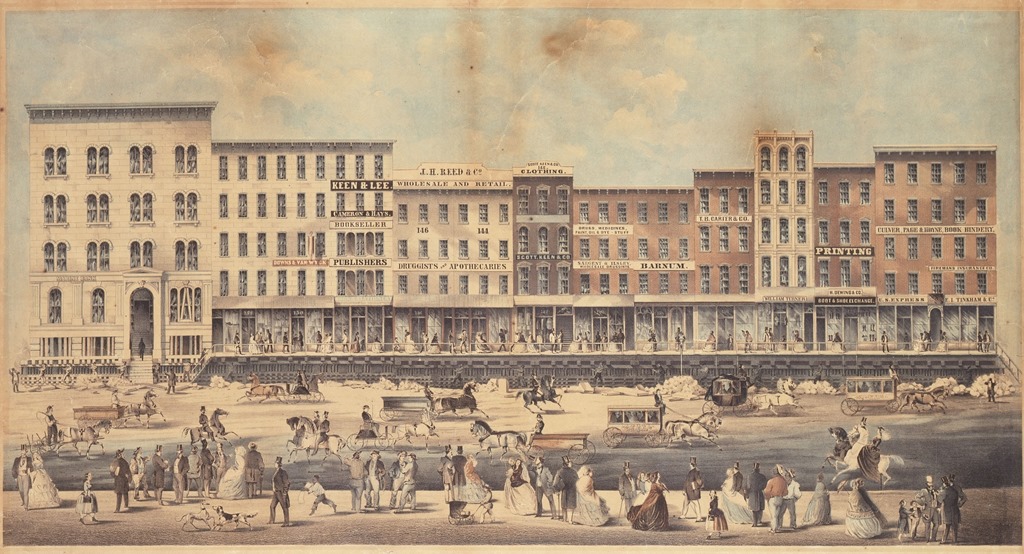
The common advice to bloggers from successful bloggers is to publish regularly.  At least once a week. That means writing 52 read-worthy essays a year. Most popular bloggers publish several times a week, but often, they are the subject of their writing. My life is not as entertaining as The Bloggess. Even if I was more fascinating, I doubt I could handle the stress of making myself more interesting. Besides I love writing about interesting things that aren’t me.  For instance, last night on PBS I started watching a new series, How We Got to Now.  The first episode was called “Clean” and it was about how America started cleaning up its act. It featured a fascinating segment about how Chicago first built sewers.  They actually raised up the buildings to make space. Now that grabbed my attention!

Street_Raising_on_Lake_Street

[Click to enlarge]

If I could, I’d want to write nonfiction books on science and history, but I’m not that disciplined and dedicated. Thus, blogging for me is a way to write tiny reports about the books I read, the documentaries I see, and the web pages I discover, that are worthy of wider attention. People do the exact same thing on Facebook and Twitter.  Blogging is just more verbose. Blogging gives me more time to make my case.

Few writers write original content. They report on people, places and events. Most journalism is a kind of history. Reviewers report on other content creators. For example, the raising of Chicago’s buildings is something I could research and write about, but why should I compete with what Wikipedia has published, or PBS? Blogging is more liked linked lists in computer programming. If you read other web sites about the topic, for instance Gizmodo, you’ll see no one writes much on the Internet about any particular subject, and they often share the same facts, links and images. The image above is at every site I visited. If you follow the links, you will get more information, but not much. Following several links give a bigger picture. If you want true in-depth reporting, you have to read books.

A great blogger will consolidate a greater amount of information, closer to magazine pieces in size. Open Culture and Brain Pickings are my favorite examples. Open Culture just provided me with a wonderful piece about Alice Guy-Blaché, a women director also mentioned in last week’s Makers on PBS that I wanted to research. I wonder if Jonathan Crow was inspired to write his piece because of Makers? Or was it an interesting coincidence.

As a bookworm and documentary junky, I’m constantly finding new facts that startle me. For example, the other night I watched The Galapagos Affair, about a tiny historical incidence from the 1930s, involving a German couple moving to an uninhabited island in the Galapagos. Their letters home made them world famous as a modern day Adam and Eve. Eventually five more people join them, and two were murdered, leaving an interesting mystery. I found this bizarre history riveting, and highly recommend the documentary that’s available on Netflix Streaming.

eve and adam

If I was a better journalist, say up to Maria Popova’s standards, I’d go research to see if more people in history have tried to play Adam and Eve. If Dore Strauch and Friedrich Ritter got the idea, so must have others. As a kid I was always fascinated with Swiss Family Robinson type stories. As a blogger, that should be my job, to track down more information. But to be honest, that requires a lot of work, and I don’t know if I’m up to it. I’m now working in a space beyond Twitter and Facebook, but not yet a full article.

That’s what this essay is about. Even though I’m not being paid, I feel blogging is a kind of job, and comes with responsibilities. While I have been nattering about blogging, I hope I’ve provided some useful information, and maybe turned you onto some interesting reading. Is that enough though?  How much information do I have to provide to make it worth your time to read what I write?

JWH

Classifying Science Fictional Ideas

By James Wallace Harris, Saturday, October 11, 2014

We like to think that science fiction has no limits. We love to believe that science fiction writers can imagine anything.  But is that true?  Reading your first few hundred science fiction stories, it does feel like the genre has unlimited avenues of exploration.  However, after a lifetime of reading, over a thousand science fiction novels, and countless science fiction short stories, I’ve started feeling the genre is limited, and limited patterns are emerging.  Even if there’s the potential for an infinite number of science fiction stories, there’s always the limitation of demarcation.  We can divide things into what is science fiction, and what is not science fiction.

biological classfication

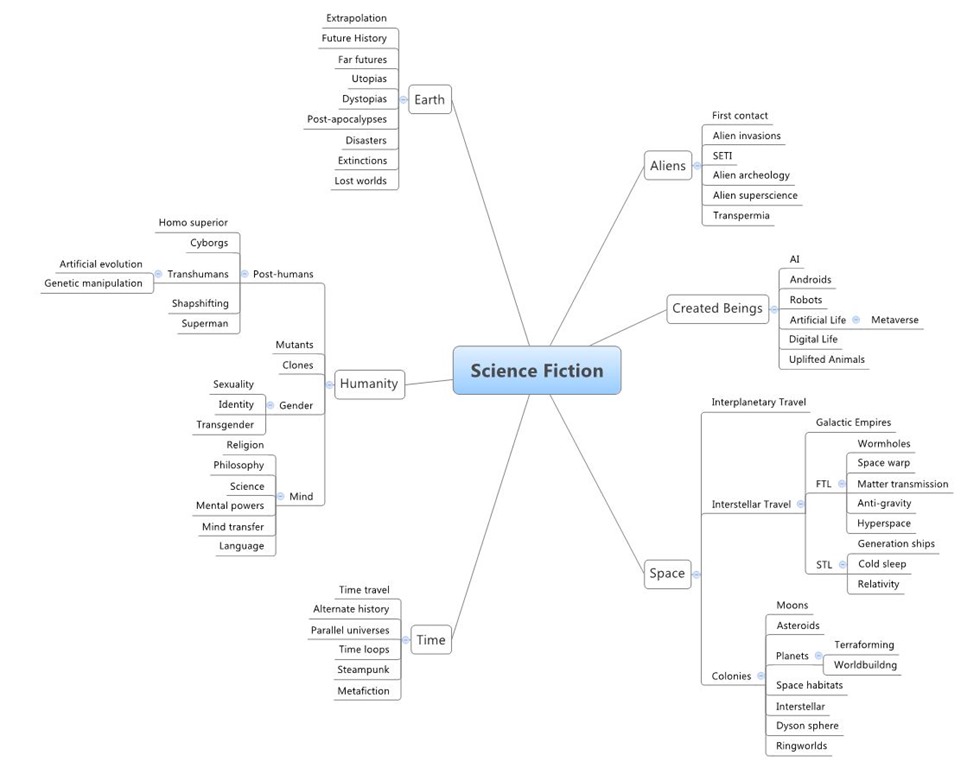
What if we classified science fictional ideas like biological classification where science fiction would be compared to how we classify life.  What would be the domain, kingdom, phylum, class, order, family, genus and species of science fictional ideas?  How would we organize novels into a hierarchy?  Has science fictional ideas evolved out of each other to present an evolutionary taxonomy?  Or are there other structures that we can all agree on?  I’m just opening this idea up for discussion and will present a test classification for consideration.  I’d like to see other classification systems suggested, and amendments to mine.  So post links and suggestions in the comments section.  For instance, Wikipedia offers two classifications:  lists and themes.  Other ideas can be found in their outline of science fiction.

Here’s my first test classification.  [Click to enlarge.]

Classfication of science fiction

I wanted to create the smallest number of domains possible, and I was hoping to find a single highly descriptive word for each.  I flubbed on “Created Beings.”  I’m not really fond of “Humanity” either.  My system mainly thinks of science fiction as stories about the future – future Earth, future humans, meeting aliens, creating new life forms, and traveling through the universe.  Most of the main themes of science fiction would be equal to biological kingdoms – robots, alien invasions, interplanetary travel, post-humans, etc.

Making the classification of science fiction be a perfect analogy to the biological classification of life would be a kluge, but it would be neat if we could map specific novels to be the equivalent of a species.  If we could come up with a successful classification system it should be possible to select any science fiction novel or short story and put it into the structure – assuming we could classify SF stories as being about one topic.

Science fiction novels are usually about many ideas.  For example. The Naked Sun by Isaac Asimov.  It could be classified under robots or galactic empires.  However, it’s mostly about robots.  Then again, some people might claim it’s mostly about agoraphobia and space colonies.  And where would we put such a bizarre novel as Stranger in a Strange Land by Robert A. Heinlein?  Under my system I’d file it under Humanity, Mind and Philosophy, although Religion might work too.

If you wrote a novel about how intelligent robots create an Earthly utopia, would it be classified under Earth or Created Beings?  There are animals that give biologists trouble when classifying, so we should expect problem novels too.  On the other hand, we could think of a different way of looking at classification.  Think of classifying books for library card catalog systems.  These systems allow for multiple subject entries, but even in libraries, books are shelved under single subject groups.  And I tend to think most writers ultimately think of their books as having a major theme.

Classifying science fictional ideas is an idle amusement, yet it’s a revealing way to think about science fiction.  A way to give a big picture overview of the genre.  Like having the mental ability to instantly distinguish between cats and dogs, such a classification system would define science fiction.  For example, I would never file traditional vampire and werewolves stories into my classification of science fiction.  Even though many people casually dump stories of the undead into the genre because they think science fiction is a dumping ground for anything weird, I believe we need to think of the genre in more precise terms.

We can also think of classifying fiction in general, so that fiction is the highest level, and the genres – literary, mystery, western, science fiction, romance, etc. – are the domains.  This would make Science Fiction one branch off of Fiction.  But if genre is Kingdom, do we need five layers of classification between it and the specific work which would be the Species?  Is Fiction, Genre, Theme, Work enough?  That makes me think of using Fiction, Genre, Theme, Time, Setting, Topic, Work.  That way The Naked Sun would be classified as Fiction, Science Fiction, Robots, Future, Colony World, Conflicting Cultures, The Naked Sun.

Many themes from classifying general fiction can be applied to any of the specific themes of science fiction.  Thus you could add romance or war to almost any of my SF categories.

As you can see, this could lead to all kinds of possibilities.  A classification system really helped understand the organization of biological life.  Would such a classification system help in the understanding of fiction?

[I use Xmind to create the mind map above.  You can get this free program that runs under Windows, OS X and Linux if you want to create your own classification system.]

JWH

Are We Becoming Cyborgs?

By James Wallace Harris, Thursday, October 9, 2014

Because of a pinched nerve I’m having difficulty typing.  Because I want to write, I’m seeking alternatives to a keyboard and computer screen.  This failure to type is revealing something about my current state of being.  My mind and body have adapted to the computer.  When I can’t use the computer, or the Internet is down, I’m anxious, and feel physical withdrawal.  I hate this feeling.  Even though my arm hurts more as I type, I keep typing.  Sort of crazy, isn’t it?

handwriting

I’ve tried dictating, and I’ve tried hand writing, and I’ve discovered I’m lousy at both.  When I was young I could write longhand for hours.  Now I can barely scratch out a few minutes of a childish looking print.  Fifty years of typewriters and word processors have ruined me for that ancient tool – the pen. 

The net is full of stories about the death of penmanship.  I used to think, “So what, we’ve got computers.”  Now I regret those thoughtless words.  My left arm burns, throbs and stings as I type, and I feel like banging on it like  Dr. Strangelove.  

I’ve become a cyborg.  The transformation has snuck up me.  If you think you’re still 100% human, try going without your smartphone for a week.

I realize now I shouldn’t have let myself become so adapted to one way of writing.  My body has integrated with cyberspace, and now I feel handicapped when when I can jack in.  Yet, I know fully well that writers were immensely productive before the 20th century with just pen and paper.  Helen Keller wrote inspiringly without seeing or hearing.

Even if I can get my doctors to fix my neck and arm, I think I need to relearn handwriting and pick up the skill of dictation.  I’ve read about a number of authors who write by talking and they claim its immensely productive.  My ability to speak is better than my handwriting, but not by much. Both are so linear.  My thinking depends on word processing features, spelling checkers, and referencing Wikipedia and Google. I now need the Internet to complete my sentences.

Because I’ve thoroughly aggravated my arm, I need to go rest it a couple hours.

JWH