Other Recent Essays

by James Wallace Harris, Friday, March 24, 2017

5_facts_about_essaywrite_-_essay-write-net

I thought I’d link to recent essays I’ve been writing for Book Riot and Worlds Without End – two sites I like to plug.

Book Riot:

Worlds Without End:

I guess I’m neglecting my duties at WWEnd. I’ve started several essays for them that I haven’t finished. In recent months I’m starting a lot more essays for all my writing outlets than I finish. I worry that it might be age related. That I’m not focusing on work as well as before.

I worry that unfinished essays are a sign I’m getting older because I’m not focusing as well as before. But I’m also pursuing more hobbies and I’m enjoying more social activities so it might be I’m just having too much fun. Then again, isn’t focusing on creative pursuits all about ignoring time-wasting fun?

I usually get at least one idea every morning in the shower, and often I get two or three. Completing them is a matter of making myself stick to the task. That means sitting at the computer, writing and rewriting, until the essay is finished. I’m afraid I’ve been more indulgent at playing lately. I am retired. I tell myself it’s okay to do anything I want. Yet, I have a sense of guilt about doing things that don’t produce results. If I go a day without writing it feels like I wasted that day. On the other hand, I might have filled that day with many other wonderful pursuits that are rewarding in other ways.

Just before midnight, I go to sleep wishing I had more time in that day. I can’t comprehend how I ever scheduled a full-time at a job into my life.

JWH


What If Science Fiction Is Wrong About Space Travel?

Science fiction is about speculation and the topic it has speculated on most is space travel. What if science fiction is wrong? What if it turns out that humans aren’t suited for living in space or colonizing other worlds? What if homo sapiens need to live on Earth? How will such knowledge affect your philosophy?

Decades ago I realized that science fiction was my substitute for religion. I didn’t believe in God, heaven, or an afterlife, but I did believe in humanity spreading across the galaxy. I don’t know why that brought meaning to my life, but it did. I grew up reading and watching science fiction during the Project Mercury, Gemini and Apollo year of the 1960s. As I covered in my last essay at Worlds Without End, “A Distance Too Far,” new research is showing the biological limitations of humans living in space. Space scientists hope to overcome those limitations but what if they can’t? What if humanity is condemned to living on Earth until we go extinct? What if we have to watch robots and AI machines live out our Star Trek dreams?

I assume most science fiction fans will react the same way the faithful react when they encounter an atheist. It’s really hard to give up a core value which gives our minds meaning. I have no idea how adaptable humans are to space but I’m wondering what it will mean if we can’t. If you’re a hardcore science fiction fan could you give up your faith in the final frontier?

What happens to us when we no longer believe in getting to heaven or other planets? Will we find meaning living vicariously through the eyes of our robots who leave Earth and become immortal among the stars? What kind of science fiction will be written in fifty years if we have tried to colonize Mars and failed? If we discover galactic radiation fries our brains and it requires 1-G to reproduce normally – will we give up on human space travel?

Or think about this. What if we do colonize Mars and adapt but discover everyone hates living there? There are thousands of people who would volunteer for a one-way mission to Mars. Have you ever wondered why? What motivates people to want to live on a barren rock, that’s bathed in solar and galactic radiation, that’s colder than anyplace on Earth, and its atmosphere is unbreathable? Is it a powerful fantasy implanted in childhood like theology? Is it a deep drive to spread our genes to new worlds? Or is it a psychological desire to escape an unhappy life here?

What if we discover that many of the hopes of science fiction won’t come true for us? Think a moment about our other science fiction dreams. What if we can only push our bodies so far before longevity research peters out and we realize immortality is impossible? What if we can’t download our minds into machines or clones? What happens when we discover that being homo sapiens comes with limits that can’t be surpassed? I’m sure we’re far from discovering those limits but what if someday we know those limits with certainty?

Science fiction has always given us hope for unlimited potential. Yet, reality suggests we’ll eventually bang into the glass walls of our aquarium. I wonder what science fiction will speculate on then.

JWH

Have We Accepted Rising Oceans as Inevitable?

by James Wallace Harris, Thursday, March 16, 2017

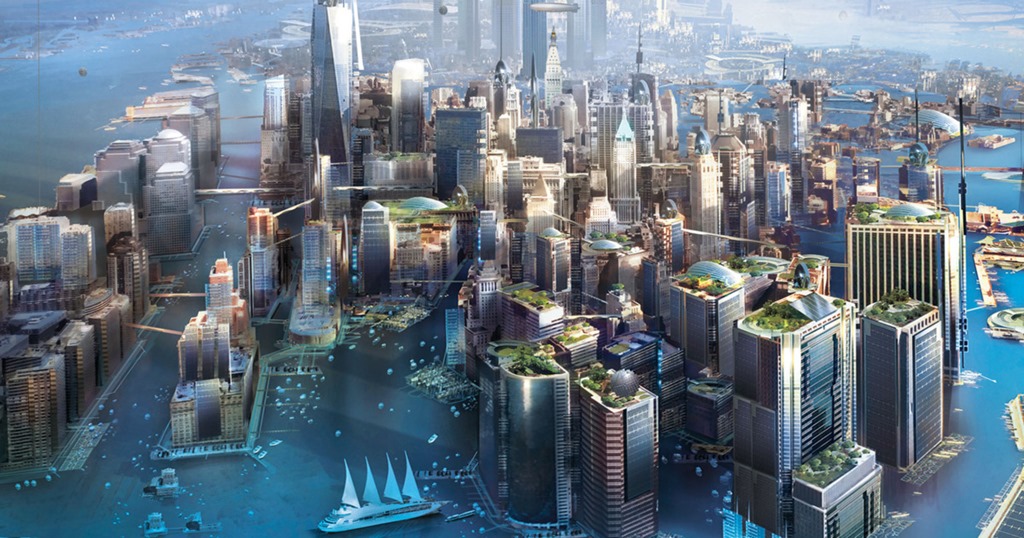
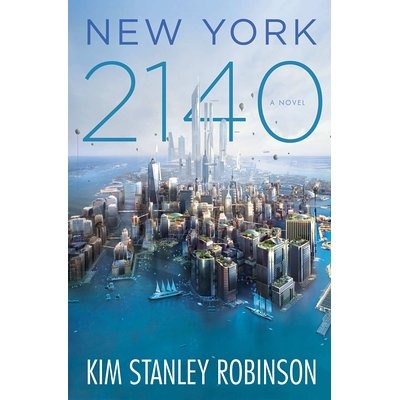
I’m reading Kim Stanley Robinson’s latest science fiction novel, New York 2140. The story depicts a future New York City through the eyes of a wide cast of characters, reminding me somewhat of Stand on Zanzibar by John Brunner. Robinson’s characters are survivors of a massive rise in sea levels. And even though they face horrible problems, their problems don’t seem any worse than those we face. The message is we always have problems, and we always solve them in a muddling way.

New York 2140

I’ve felt until now that climate change fiction warned us to avoid environmental doom. Have we already given up the battle? Are we now accepting rising seas and mass extinctions as inevitable? Donald Trump’s budget came out today, and it’s all too obvious he’s not going to fight climate change. Has everyone else given up too, including science fiction writers, of returning CO2 levels to below 350 ppm?

It is quite clear that conservatives have chosen lower taxes over action to stop global warming. Their greed knows no bounds, just look at their health care proposal. They prefer a tax cut for the rich over any Sermon on the Mount compassion. They pretend to believe climate change is not real, but I can’t believe they’re that stupid. I wonder if they haven’t psychologically accepted rising oceans in exchanged for lowering taxes and deregulation windfalls?

New York 2140 is a very entertaining novel, but I’m wondering if Robinson isn’t taking a Pollyanna view of the future. His New York City of 2140 is vibrant and alive, even after the oceans have turned it into a new world Venice. If I wrote science fiction my 2140 NYC would look a hundred times worse than New Orleans right after Katrina. My novel of a doomed city would be closer to Samuel R. Delany’s Dhalgren. Robinson makes 2140 NYC horrible but exciting, even attractive.

New York 2140 cover

KSM is considered a very realistic science fiction writer, but isn’t he also overly optimistic? Red Mars, Green Mars, Blue Mars, and 2312 reveal a lot of hope for the future. Is Robinson being too hopeful? We have to ask ourselves if civilization can survive runaway climate change? Robinson’s book suggests we’ll adapt and survive like our species always has in the past. But can we really bank on that trend? I’m not so sure.

I don’t think humanity will become extinct if we don’t reverse rising CO2 levels. We are adaptable. I do think we risk devastating billions of lives, and jeopardizing civilization as we know it. Our current successful civilization depends on relentless economic growth. I don’t think that’s sustainable. The real challenge of climate change is mutating our current civilization from free market capitalism to steady-state capitalism. The neo-nationalism we’re experiencing today suggests humans aren’t adaptable to such a change.

In that sense, I’m not sure Kim Stanley Robinson is right in thinking we’ll continue to succeed like we’ve had in the past. I worry we’re approaching a breaking point. That might happen yet in his novel, I haven’t finished it yet.

I’m listening to the audio version of New York 2140, but I admire it so much, I’ve decided to get the book version and read it too. I don’t think one reading will be enough.

JWH

Technology & Education

by James Wallace Harris, Tuesday, March 14, 2017

Does technology improve education? Are people in the 21st century better educated than those from the 19th century? If we use current politics as a metric I’d have to say no. We have a president who constantly makes absurd claims and is backed by a majority in congress. Those wealthy, “well-educated” leaders are currently claiming that the loss of healthcare is a gain in freedom. Evidently, they’re depending on Americans being poorly educated to get their treasured tax breaks. The Republicans have made a political movement out of anti-education in era when technology brings us tremendous amounts of information. Obviously, all that availability of knowledge hasn’t helped the average citizen see the con.

Technology has apparently improved all walks of life except education. If schools reflected the productivity we see in agriculture, medicine, manufacturing, and communication, we’d all be Einsteins. Why hasn’t that happened? When I sat down to write this piece I assumed technology was an overwhelmingly obvious benefit to education – but the little devil on my left shoulder started muttering snarky observations. She might be right.

students-at-computers-in-a-lab

The world wide web has made living on Earth feel much smaller. We can Skype folks from any country in the world, so why aren’t foreign languages skills booming? Anyone can study free lectures from ivy league universities on science and mathematics, yet STEM scores aren’t improving.

We have access to more news, information, knowledge, data, experiments, statistics, scientific studies than ever before in history, yet America elected a human whose grasp of reality is so slight that his observations are the daily butt of comedians. We have more data but not more wisdom. We’re unable process the daily tsunami of information that our tech tools gives us.

This leads me to theorize that being well educated comes from inner motivation and not external tools.

JWH