I Finally Finished All 271 Episodes of Perry Mason

by James Wallace Harris, 2/18/24

Back in 2018 I wrote “Why Am I Binge Watching Perry Mason?” I started out watching the series on MeTV, but decided I wanted to watch the series from the first to the last episode. After printing a listing of all the episodes to act as a checklist, I then subscribed to CBS All Access to stream the episodes in order. I soon discovered they skipped some episodes. That annoyed me, so I got on eBay and found a bargain on a used copy of the complete series on DVD. I watched Perry Mason at a steady pace through the seventh season, when I completely burned out on the show. This year, I went back and with my wife’s help, finished the series.

Last night we watched season 9, episode 30, “The Case of the Final Fade-Out.” It was a fun way to end the series because that story was about a murder on the set of a television show. That episode used the Perry Mason crew as actors portraying a television crew, plus Erle Stanley Gardner played the judge. And there was one in-joke I particularly loved. We overhear an actress telling someone, “Who wants to be on a show that goes up against Bonanza.” Perry Mason was being canceled partly because it couldn’t compete with that popular western.

Even though I enjoyed watching episode after episode of Perry Mason, I can’t say it’s a great show. My love for the series was mainly due to nostalgia. My favorite aspect of each episode was seeing the guest stars, the sets, cars, and costumes. Perry Mason was filmed in black and white, except for one episode. I love black and white movies and television shows but seeing that one episode of Perry Mason in color made me wish the entire series had been filmed in color. The guest stars, old cars, and sets looked great in that one episode. It shows why color TVs became so popular. I can remember our family getting one in 1965.

I loved the characters Perry Mason (Raymond Burr), Della Street (Barbara Hale), Paul Drake (William Hopper) and Hamilton Burger (William Talman). However, they seldom ventured from their one-dimensional characterizations. In one episode Raymond Burr got to play an old English seadog who looked like Perry Mason. That revealed Burr’s missing acting potential. I’ve read that Burr got a big kick out of playing that crusty old sailor with an accent. It’s a shame that Burr played Perry Mason so woodenly so damn consistently.

We never got to see the private lives of Perry, Della, and Paul. The show followed a rigid formula. I’ve read that in the books that Perry and Della were a couple, but I can’t even say that’s even hinted at in the TV show. It would have been great having Della being involved with both Perry and Paul over the nine seasons. That would have added so many character dimensions and plots to the show.

Another missed potential the show should have added, was having Perry Mason lose a case now and then. Poor old Hamilton Burger must lose all his. Having Perry always win, always right, always infallible, made his character cardboard.

It sounds like I’m complaining, but I’m not. For television shows coming out from 1957 to 1966, Perry Mason‘s formula was on par. I wrote an essay, “Does Merry mason Follow the Rules for Detective Fiction?” that dealt with its mystery plots. When you watch 271 of them, it gets painful that every client of Perry Mason saw the victim just before they were killed. Sometimes, just minutes or seconds from the murder event. You’d think the writers would have been more creative in producing plots.

Yet, even with such a rigid formula, it was hard to guess whodunit. I seldom did. Often the plots were so confusing that even when we’re told what happened, it’s hard to understand what happened. I know HBO has a new Perry Mason that addresses my complaints, and I’ve seen the first season of that series. It’s excellent, but it’s not the same Perry Mason. The HBO series might be closer to the original books, and it’s set when the original books were written, making it more authentic to them, but still, I’d like a better Raymond Burr Perry Mason.

I know this is a bizarre and an impossible wish to grant, but I wish someone would remake the 1957-1966 television series set in the 1950s and 1960s, with actors much like Burr, Hale, Hopper, and Talman, but with 2024 television production values. Like Once Upon a Time in Hollywood (2019) recreates 1969.

The old Perry Mason sometimes plotted stories based on current news events. One episode was obviously inspired by the Kitty Genovese case. It’s a shame they bungled that episode. Having one of the bystanders who didn’t want to get involved be the murderer detracts from the moral lesson of the real-life murder.

Another episode was about computer dating. I assume that the 1965 episode was inspired by Operation Match, which was in the news in 1965. Wikipedia has an interesting history of computer dating, and the idea goes back further than I imagined. Again, I thought the writers mangled the inspiration. Because they shoehorned it into their formula, the implications of matching couples by computer was just a novel idea they threw out but didn’t explore.

I’d love to see a new Perry Mason series that explores the reality of Ameria from 1957 through 1966. We changed so much in those years. It’s a shame that an artistic artifact from that period reveals so little about the times, mostly giving a false impression of the past. We humans prefer consuming fantasy over reality.

I know all of this sounds like I’m complaining, but I did enjoy watching the series. It’s just knowing what’s happened to the world in the last sixty years, and knowing the potential of what television can be that makes me fantasize about watching a much better Perry Mason based on the old series. It had so much potential.

Given the times could Perry Mason have been better? I thought Route 66 (1960-1964) proved Perry Mason could have taken more chances and been truer to the times. I must assume that the writers and producers of Perry Mason calculated what American TV watchers wanted to see at the time, and that’s what they gave them.

Could 1950s America have accepted Perry Mason if he lost cases, made mistakes, had personal flaws, was screwing Della, was jealous that sometimes Della might have been screwing Paul, and had to deal with the real years of 1957 through 1966?

I love watching old TV shows, shows from the years I was growing up. That’s mostly because of nostalgia, but it’s also because I like analyzing the past. I can remember the real, edgier, darker, 1950s, even though I was a kid. I wonder why television was so unreal. I often think that back then, we wanted real life to be like television. Now that I’m older, I’m wishing that old television had been more like real life. What does that say about me?

Perry Mason witnessed at least 271 dead bodies, murdered in all kinds of ways. Why didn’t that have a cumulative effect on his psyche? You’d think Perry would have become cynical and bitter as the show progressed over nine years. I think that’s the substantial difference between old television and new. The characters grow and change.

America changed dramatically from 1957 to 1966, but we don’t see that in Perry Mason, except for cars. Watching Perry Mason is escaping into a fantasy we all had a lifetime ago.

But I’ve got to wonder, will people growing up now believe television accurately captures life during their adolescent years when they rewatch their old favorite shows in retirement while looking back over their life?

Even with these complaints, I’m already thinking about starting the series over.

JWH
Reading at the End of Existence

by James Wallace Harris, 12/19/23

I don’t plan to die anytime soon, but the end of my existence looms ahead. That leaves me with a growing anxiety to read all the books I haven’t read but want to. Another growing anxiety is realizing I’m reading less every year. Those problems are acutely revealing that I’ve bought far more books for my retirement years than I could read in several lifetimes. I need either the lifespan of Lazarus, or the ability to reincarnate, or to triage my library.

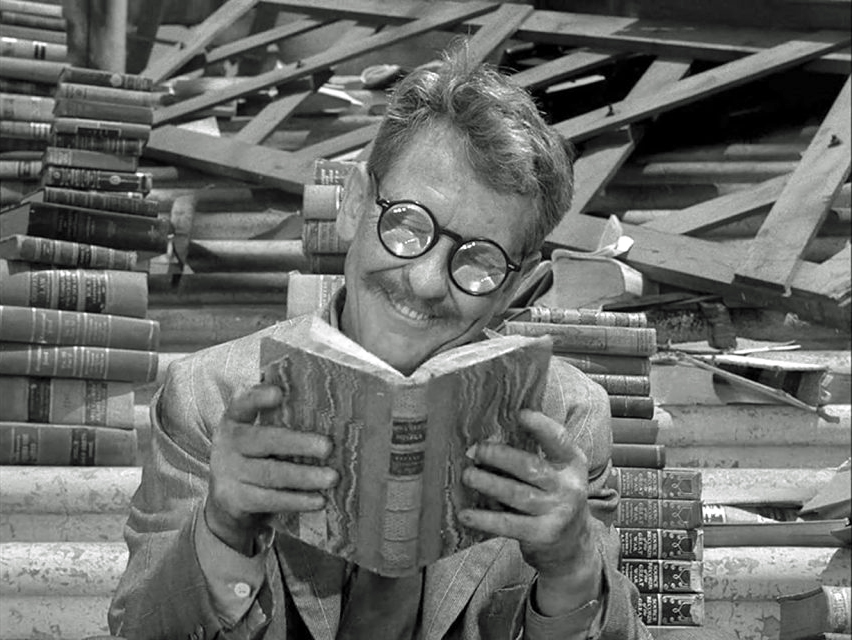
I would feel better if I could only read those books I’m dying to read before I die. There’s that word I’m trying not to say, “dying,” but it does seem literal in this situation. Which books do I want to read the most before I reach a Henry Bemis tragic ending?

The euphemism “dying to read” sounds like I’ll die if I don’t get to read certain books, or it could suggest books I’m so engrossed in reading that I’m dying while I’m not reading them. What I’m really saying is the possibility of dying is pushing me to get down to some deadly serious reading. It would help if I hadn’t developed a YouTube video addiction.

Some people might see retirement years as a time of waiting to die. On the contrary, every day in retirement feels like I’ve got all the time in the world, so I don’t feel the need to hurry. That’s why I’m probably reading less. When I worked, I read more because I had so little free time and it gave me a desperation to read.

However, the problem at hand is I have nine tall bookshelves filled with books waiting to be read. And that’s not counting all the invisible Kindle and Audible books in my digital cloud library. I might read one bookshelf a decade, and I don’t think I have nine decades left. (I kind of think I might have one or two.)

I need to stop wasting time and start reading my ass off.

Unfortunately, it’s not a matter of picking the first book and turning pages. With the sense that my days give me all the time in the world, but my years are running out, it causes anxiety over what to read. If I’m in day mode I can read anything and not feel like it’s a waste of time. If I’m in year mode though, it’s like “Holy Cow, I’ve got to read something great, it might be my last book!”

Lately, I’ve started a lot of books that I want to read and even enjoy reading them but quickly switch to another book I’m also anxious to read. I then forget about the previous book — for a while. This creates a daisy-chain of unfinished books that I’m constantly trying to finish. Here’s a list of unfinished books I’m currently cycling through in my reading:

  • The Science Fiction Century edited by David G. Hartwell
  • Aye, and Gomorrah and Other Stories by Samuel R. Delany
  • Man in His Time: The Best of Brian W. Aldiss
  • The Steps of the Sun by Walter Tevis
  • Davy by Edgar Pangborn
  • Lives of the Stoics by Ryan Holiday and Stephen Hanselman
  • Anthony Powell by Hilary Sperling
  • Songbook by Nick Hornby
  • Lila: An Inquiry into Morals by Robert M. Pirsig
  • The Magic Mountain by Thomas Mann
  • Determined by Robert M. Sapolsky
  • The Simulacra by Philip K. Dick
  • The Rise of Democracy by Sean Wilentz

And these are just the ones lying nearby that tick my memory.

Of course, I rushed through and speedily finished Lessons in Chemistry by Bonnie Garmus and Democracy Awakening by Heather Cox Richardson. Why do I read some books without stopping but not others? Well, some books you really can’t put down. However, I worry my television affliction is carrying over to my reading. That worries me. For the past several years, I have had a tough time watching TV by myself. If I’m watching with other people I can sit through an entire show or movie, but when I’m alone, I end up clicking around every few minutes. I think the internet has ruined my attention span.

Last year I read 52 books, which is about average. That’s about one book a week. This year, with two weeks left to go, I’ve only finished 32 books. If I read books as fast as I read Lessons in Chemistry and Democracy Awakening, I would have finished 75-100 books this year. That 1.5 to 2 books a week.

When I really love a book, I can finish it in 2-5 days depending on length. Since I’m worried about running out of reading time, I should try to read those kinds of books all the time. But I have trouble finding such addictive titles.

If I had a Genie that granted me wishes, I’d wish that he/she would put all my unread books in order of how passionately I’d want to read each of them. But would I start with the most potent? That would put me on a downhill slope of reading enjoyment. Maybe a good procedure would be to pick #52 and read toward #1, so the year would be one reading pinnacle after another. Then take a long break and do it again. But in the second year, would I really want to read 52 books that were less enjoyable than all the books I read the previous year?

Whoops! I wasted my first wish.

Books often complement each other. Reading a history book, along with a biography and historical novel often creates a synergistic reading high. I still want to read the best books first, but I’d also want them blended by subject so that the highs came in waves as I wander from topic to topic. Right now, I’m reading about democracy in America in the 19th century. Susan and I are watching The Gilded Age on television. Supplementing those with some novels and additional nonfiction books about 19th century art and science would make for a very educational month or two.

However, I know I’ll get burned out on America history soon enough. Not only do I not stick to books, but I flit from subject to subject. While I have that Genie, I wish I knew which subjects I wanted to study the most before I die. Not only do I need to abandon some books in my collection, but I also need to abandon some subject areas.

I keep standing in front of my bookcases thinking the sight of so many books is paralyzing me from deciding what to read and sticking to it. My two all-time favorite periods of reading in my life were when I was a teen and could barely afford any books, so I cherished each as I bought and read them. And when I first joined Audible and had two credits a month, that made me incredibly careful to pick what I wanted to listen to and finish. In both cases, I’d finish what I owned, and spend days anticipating what I could buy and read next.

I know I can’t make an end of the world reading plan because I never stick to my plans. Over the years I’m slowly getting a handle on my book buying addiction. Although, I might have slowed on book purchasing because it’s finally hitting me that I’ve already bought far more books than I’ve got time to read. That reality has gotten to feel very real, so I no longer buy books like I used to. But it’s also adding to the anxiety that I need to read as much as I can over the time I’ve got left.

What I need now is a sense of what I will read and what I won’t. Over the coming years I’d like to read more and get rid of books I know I can’t or won’t read until I end up on my deathbed with just one book. But this desire isn’t really about numbers. It’s about the topic of the last book I will be reading. Not only do I have too many books to read, but I’m trying to cover too many subjects.

More than ever, I know my mind can only hold so much. And after a lifetime of reading, I get the feeling I’m heading towards an ultimate distillation of interests. When I leave this existence, I want to feel tranquil satisfaction that I’ve completed my life’s education. I worry I’ll be like one of those foolish Hindu guys who think of a beautiful stag just before they die and must reincarnate as one. If I leave wanting to read more, I’ll come back as a bookworm again. (Or come back as a book.)

JWH

Do You Plan to Bequeath Any of Your Computer Files in Your Will?

by James Wallace Harris, 11/20/23

I currently have 71,882 files in Dropbox. Will anyone want any of those digital documents after I die?

Let’s say I go on a Döstädning rampage (Swedish death cleaning) of my digital possessions, would there be anything left that I’d want anyone to have?

Most people consider their photographs to be among their most cherished digital possessions. I have 5,368 of those — some of those photos go back to four generations in our families. Susan and I have no children. We made copies of those photos for our relatives one Christmas, although I’m not sure if any of those relatives wanted them. I imagine them groaning at their pile of digital junk growing larger.

Would a genealogical database want old photographs? I know people interested in their ancestry spend a lot of time looking for old documents online. I wonder if I have any photos, letters, or documents that would be of interest to people in the future researching their past?

I have 28,811 digital scans of old science fiction and pulp magazines that took me years to collect. Most of them are easily found online, so I doubt they will be wanted. But what if the Internet Archive servers were shut down for lack of funding? Will there be kids in the future wishing they had a complete run of Astounding Science Fiction? Or will that desire die with the generation that grew up reading the stories that were first published in that magazine?

There are certain documents relating to money that my wife will want, but she will prefer printed copies. When my mother died, and Susan’s folks died, I scanned a bunch of family documents. I haven’t looked at them in years, and Susan has never asked about them. Still, would they be of value to anyone? What will future historians want to know about ordinary people?

I wonder how long my blogs will exist after I die. I’ve known bloggers who have died, and I can still read their blog posts, but some of writers were published at online companies that went under. I know I used a couple of those sites, and I can’t even remember the names of the companies.

I have over a thousand Kindle books, and over a thousand Audible audiobooks in Amazon’s cloud. Is there any way for me to leave those libraries to other people?

And if no one in the future will want my digital files, do I need to hang onto them now? Why do I keep them? Why do I give Dropbox $119 a year? When I retired, I made copies of all the computer programs I wrote. I put them on several drives just to be sure. I put those drives in the closet. Several years later I went to check on them and every one of those hard drives was dead. I have a friend whose computer hard drive died recently. She had always backed everything up with Apple’s Time Machine. However, when she restored her files, many were corrupted. It’s hard to preserve digital files for a long time. Backup programs and online backup services aren’t 100% reliable.

When humanity stored our past on paper, some of it got saved. Not much, but some. I get the feeling that since we switched to storing stuff digitally, even less will survive. I have a handful of paper photographs that my great grandparents, grandparents, and parents took. So does Susan. I wonder who we should give them to?

Every day I spend a few minutes going around the house looking for things to throw away or give away. I need to start doing that with my computer files. I spent a lifetime gathering stuff, both physical stuff, and digital stuff. It’s funny now that I’m trying to reverse that progression of acquisitions.

I wonder when I was young if I had somehow known for sure that my older self would be getting rid of all the stuff I was buying back then, would I have bought so much stuff in the first place? How much stuff have I bought or saved because of FOMO (fear of missing out)? And how much did I really miss out?

JWH

Looking Back at My First 10 Years of Retirement

by James Wallace Harris, 10/15/23

Friday was my 10th anniversary of retiring. I started work at Memphis State University in 1977 and retired from The University of Memphis in 2013. I hadn’t moved, they changed the name. Those 36 years represents half of my 72 years. The second largest chunk of time in my life was K-12 schooling. It’s interesting to see retirement has become the third largest segment of this pie chart.

These ten years of retirement were the same number of years as third grade through twelfth, but they certainly didn’t feel the same. For some reason, 1963-1969 were the longest seven years of my life, way longer than the last ten years of retirement. Isn’t that weird? Why have they sped by so fast?

When I look back, I can see a lot has happened. Three presidents. A pandemic. Several wars. Quite a bit of economic ups and downs. In the past ten years we’ve all seen society transformed by smartphones. The worst political polarization of my lifetime has happened in this last decade. There were lots of marriages and babies in our family, and several deaths. I entered my socialist years with social security and Medicare. I’ve had several surgeries and lots of MRIs, CT scans, a couple ER visits, and endless medical tests. Yet, I’m basically healthy.

I have lived in the same house since I retired. Those seven years I mentioned, I lived in nine different houses in three different states. Maybe that’s why those were the longest years of my life. These past ten years have been the most stable of my entire lifetime, and I’m not bored.

I thought when I retired I would do so much with all the free time I would have, but that hasn’t happened. The past ten years has been a slow decline into inactivity. I guess that’s what getting old means. And I accept that decline.

When I first retired, I didn’t watch TV until about eight o’clock at night. I tried to stay active all day. Susan worked out of town, and I spent a lot of time socializing.

Now my daily routine starts with an hour of YouTube videos after I do my physical therapy exercises. Then I putter around doing chores, eating lunch (breakfast since I’m intermittent fasting), writing blogs, listening to music. Then another hour of TV with Jeopardy and NBC Nightly News at 5:30 with Susan. After dinner I wash dishes and try to watch TV by myself while Susan watches her shows. I usually fail and switch to blogging, reading, or listening to music. I finish the evening at nine with two hours of TV watching with Susan, shows we both like.

In 2013 I probably watched 1-2 hours of TV a day, and not every day. Susan was working out of town, and I’d only watch TV when I had friends over in the evening. Now, I’m logging 4-5 hours a day. Television has become an addiction in retirement. I’ve been thinking about breaking it, but I’m not sure I can be more active anymore.

In 2013 I would go out several times a week with friends. I’d go to the movies once or twice a week, eat out several times, and I’d go to museums, parks, shopping, or just walks. Now I go out once a week to the used bookstore, and every other week to the grocery store. Susan and I take turns grocery shopping since we both hate doing it. The pandemic really changed my habits, but also my spinal stenosis limits my walking. However, staying home more does not bother me at all. In fact, I love it. My mother was that way when she got old too. A lot of people do that as they age. Like most of the old people I’ve known, I want to die at home, in this house.

What I’ve really gotten into these past ten years is reading. I read about fifty books a year, so I’d guess I’ve read about five hundred books since I’ve retired.

And several years ago, I joined with a guy from Britain and another from South Africa on Facebook to moderate a science fiction short story reading group. We discuss one story a day, and I’ve slowly developed several online friends from this activity. I’ve been focusing on reading short stories for the last five years and I’d guess I’ve read at least two thousand since then.

I also write essays for two different personal blogs. For a few years I wrote for three web sites, Book Riot, SF Signal, and Worlds Without End. I’d guess in my ten years of retirement I’ve written at least 1,500 essays.

I don’t keep records, but I’d guess I’ve watched a hundred TV series in my retirement. When Susan worked out of town, I’d watch them with my friend Janis. And since Susan retired, I watch them with her. I don’t really like watching TV by myself, so I tend to watch what other people like. My favorite series with Janis was Breaking Bad. My favorite series with Susan was Call the Midwife. Lately, my friend Annie has been coming over and we’re going through the films of Alfred Hitchcock. Ann and Tony come over to watch various shows, we’re currently finishing Ted Lasso. Our friends Mike and Betsy used to come over for TV or movies but since the pandemic that’s stopped. Watching TV series and movies with other people has been a major social activity for me during my retirement years.

Another recent activity is having people over for games and cards.

Our cats Nick and Nora died during the early years of my retirement, and now we have Ozzy and Lily. They are a big part of our retirement life since Susan and I have no children.

We bought this house; the one Susan grew up in when her parents died. That was 2007, I think. We had Susan’s brothers, wives, and their children over for Thanksgiving and Christmas for several years to continue the tradition of her parents. But by the time I retired, the nephews and nieces were grown up and had families of their own, and we stopped hosting the holidays. In terms of family life, the past ten years have been noticeably quiet. My mother, aunts, and uncles all died off before I retired. Since then, about half my first cousins have died. Our generation is fading away.

My retirement years have been mostly about maintaining friendships. I spend a lot of time on the phone keeping up with people. Some of my friends still come over to the house, but that’s slowing down too. Many of our friends no longer travel or drive at night. My sister still visits. And a few old friends that have moved away come to Memphis now and then. Getting old is weird that way.

Retirement goes hand in hand with aging. I didn’t foresee that before I retired. I thought I wouldn’t feel old for many years, and my first decade of retirement would be more active. When I first retired, I fantasized about moving to New York City for a year. Later, I thought about moving to The Villages in Florida. But NYC was impractical, and the pandemic and health problems killed off Florida. I no longer think about traveling, and the only way I imagine moving is if we need to move into a retirement community or assisted living.

My goals have become less ambitious. I’m reading self-help books about developing good habits. I want to do more reading and writing but be more organized and focused. I’m researching ways to take notes and remember what I read because I’m starting to forget more.

I think the next ten years of retirement will be more streamlined. I want to get rid of stuff and focus on accomplishing small quiet creative projects. I know I’m physically running down. I feel wiser than ever, but I’m losing mental horsepower. I need to become more efficient in my use of mental and physical energy.

These ten years of retirement have been nothing I planned. But then, long ago, even when I was still young, I had learned the future is everything we never imagined. My friend Linda and I are studying Stoicism. I think it’s the perfect time for that philosophy, both in our lives, and in this moment of civilization.

JWH

Hitting a Cognitive Barrier

by James W. Harris, 9/24/23

I crashed into a cognitive barrier trying to write my reactions to The Trouble with Harry and To Catch a Thief, two Alfred Hitchcock movies from 1955. After two drafts I realized I wasn’t getting where I wanted to go. I know I don’t want to write movie reviews — the perfect place to find them is Rotten Tomatoes. Nor did I want to describe a film — just go to Wikipedia or IMDB. I wanted to write an essay that captured what I got out of watching those films at age 71.

Time is running out, so I need to make the most of every experience. That involves understanding myself at a deeper cognitive level. One I’m finding harder to reach as I age. On the other hand, aging is giving me more wisdom. The cognitive barrier is being able to express what I’m learning by getting older. But aging is also wearing down my brain. What one hand giveth, another takes away.

Writing is thinking outside of the head. Thoughts are generated inside the head from emotional reactions. Thoughts are fleeting. Thoughts are like cream stirred into coffee, creating little patterns that quickly dissipate. Writing is about capturing that initial pattern and making sense of it by showing how it relates to the memories of millions of past patterns.

Very few people can describe exactly how they feel, and few of those people can explain why they feel the way they do. There are rare individuals that can compose their thoughts inside their heads and eloquently convey the results in speech. Most of us need to think outside our minds via writing and editing.

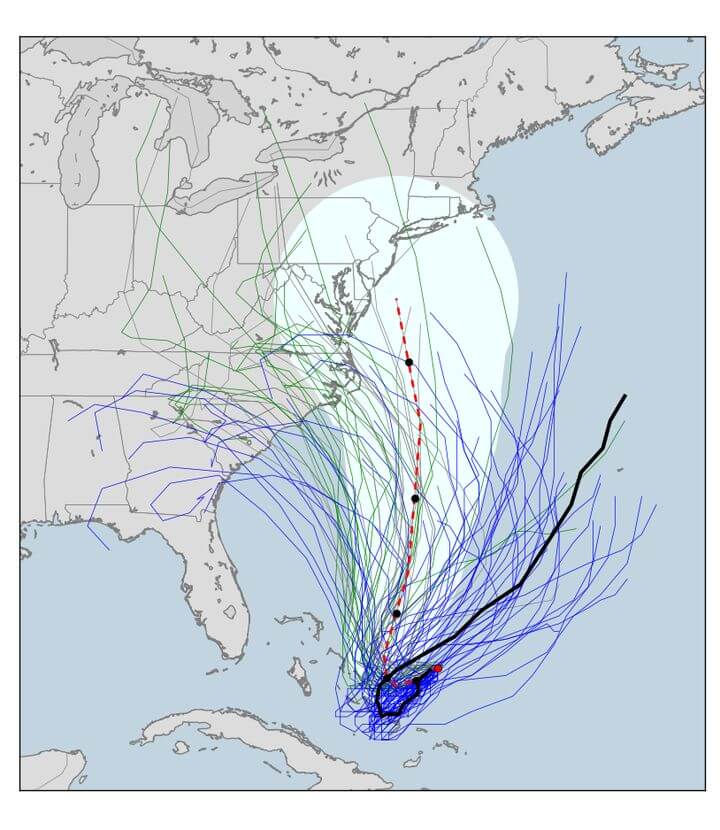
Even when we feel our written words are clear, readers seldom find clarity. Communicating with words is difficult at best and often impossible. What we think we’re expressing can often take a different path to each reader like those spaghetti strings we see in hurricane reports. I might believe I’m writing about Jacksonville, while some readers think I’m writing about Bermuda while others Miami and Charleston.

I enjoyed The Trouble with Harry better than all the other Hitchcock films we’ve watched this month, including Rebecca, Notorious, To Catch a Thief, and Strangers on a Train, films most critics admire a great deal more. However, I thought The Trouble with Harry had many flaws, but then Hitchcock is a flawed filmmaker.

How can I admire a movie that doesn’t measure well against the best movies I’ve seen over a lifetime? This gets into complexity and even multiplexity. I need to relate several reactions that contradict each other. The three films I admired and enjoyed the most this month have been The Trouble with Harry, Twelve O’Clock High, and Mr. Belvedere Rings the Bell. All three were feel-good movies to me, but they each made me feel good in a unique way. Is the word “feel-good” even useful? Many moviegoers might interpret the term “feel-good” so differently that these three movies would not fit their definition.

Should I even use the term? Shouldn’t I just describe exactly what I felt? Will that be clearer?

In my second draft I had a breakthrough. I realized to understand how I react to films I’d need to understand what I expected from them. But my expectations have changed widely over the years. And will my readers have the same expectations? It was then I realized that what I’m expecting from movies at 71 is different from my younger self. Even describing my own emotional experiences is a moving target. But explaining why that’s so hits another cognitive barrier.

I need to think about that.

Putting everything into words precisely is so difficult. Should I even try? I believe most people don’t because all they value is personal experience. Why tell anyone about our perceptions when they have their own?

Do you see why writing that essay became such a black hole?

JWH