What Books Do You Speak?

by James Wallace Harris, 8/8/22

Most of our ideas are borrowed since few people have original thoughts. The other day I was wondering why conservatives and liberals think so differently. I decided one reason is that they read different books. Of course, not everyone reads books. Ideas are also passed around from person to person, or by newspapers, magazines, journals, advertisements, political rallies, television shows, the internet, etc. We dwell in a sea of ideas.

Ideas do originate with original thinkers, and often they are first published in books. Journalism and other forms of mass media then propagate those ideas, which in turn are spread by word of mouth. So, for now, let’s think of the basic unit for storing and spreading ideas are books.

My theory is conservatives and liberals think differently because the foundation of their beliefs comes from different books. I’m not suggesting that all conservatives and liberals read the same set of books, but the ideas for their thoughts and speech originated in a subset of books.

I was thinking along these lines because I wondered if conservatives and liberals each had a core set of twenty books, what would happen if the conservatives read the liberal’s books, and the liberals read the conservative’s books? Would our polarized political opinions begin to homogenize?

Then I wondered about fundamentalist religious people who put their faith in one book. What would happen if all the fundamentalists around the world all read each other’s holy book?

Thinking about that brought up an obvious stumbling block. Most people’s beliefs are based on what they first learned as children. If you are raised Christian and conservative you’re most likely to stay Christian and conservative. That suggests ideas acquired in youth are stickier than ideas acquired later in life. For my test, we’d have to raise children with The Bible, The Quran, The Tanakh, The Talmud, The Vedas, The Upanishads, The Tipitaka, The Tao Te Ching, The Yasna, etc.

We know minds are open and plastic at birth. If you took a child from a Christian family and gave it to a Muslim family to raise, it will grow up Muslim. But for some reason, after a certain age, minds close and lose their plasticity.

On the other hand, fads arise and spread ideas/memes all the time. Adults will embrace new ideas. Fox News, the Internet, to Tik-Tok can spread new ideas like a California forest fire. This suggests that people can acquire new ideas that they put on top of the foundational ideas that were programmed in their youth.

And ideas don’t have to come from nonfiction books. If all you read are romance novels and watch romance TV shows and movies, your ideas about relationships will be different than if you only consumed mysteries.

I’m in a book club that was reading Developmental Politics by Steve McIntosh, a book about our polarized politics. McIntosh hoped his insights would help solve that problem but most of the readers in the book club doubted it. One of our members did believe in McIntosh’s ideas and thought they could work. I felt McIntosh’s ideas were insightful but figured for them to be persuasive, would require everyone to read many other books first. McIntosh’s book was complex enough to require reading dozens of other books to fully understand it.

That’s when I realized we speak in books. When we express ourselves, we pass on fragments of books, but we don’t pass on enough information to let other people fully understand the foundation of the original ideas. Generally, we pass on tiny fragments of the original idea that are barely impressions. And we seldom communicate ideas but express ourselves emotionally.

If you want to understand a person, you have to consume the same books they did, or at least the same secondary sources. If a friend is passionate about a belief you’ll never understand your friend until you understand the foundations of their beliefs.

Few people understand the sources of their beliefs. Few people can point to a set of books and say here’s where my ideas originated. The origin of a classical education came from the study of foundational books, but that idea broke down in modern times when we were overwhelmed with significant books.

Yet, even when there was only one book for most people, The Bible, Christianity spent centuries arguing over its meaning. If you study all the people who claim to be Christian today you’d find very little commonality. The Bible is too big and too diverse. If we took The U. S. Constitution instead, which is tiny in comparison, we still get endless disagreement.

Ideas are slippery and inexact. Even if we read the same books and speak about the same ideas we don’t interpret them in the same way. Humans aren’t computers. We filter ideas through our emotions. Books might sow ideas but they don’t plant them evenly, and they grow inconsistently.

It appears that humans latch onto vague concepts and use them for ammunition to get what they emotionally want. Even if we read the same books we’ll still be a long way from finding agreements.

What we have here is a failure to communicate. What we need is a better approach to understanding each other’s wants. It might start with reading the same books, but it would only be a start. We’d also need to start studying each other’s emotions, and emotions are even harder to communicate than ideas. That’s what McIntosh was getting into with Developmental Politics, building on developmental psychology.

JWH
Getting Too Close to Helpless

by James Wallace Harris, July 14, 2022

For this essay, I’m defining helpless as being in a situation where we can’t help ourselves or get help from someone else. As I get older I worry that someday my wife Susan or I will find ourselves in a completely helpless situation. This weekend it almost happened. Our hot water heater in the attic broke and water was pooling on the sheetrock of the ceiling above my computer room. A seam then spread open and water was draining onto the floor. Susan and I had to find a solution fast and several times I wasn’t sure we would.

First, we were lucky I discovered it so soon. I have an overactive bladder so I’m frequently going back to the bathroom which is annoying. But in this one instance, it put me Johnny-on-the-spot as I went down the hall to the bathroom. The pool of water was only in the middle of the floor.

I yelled to Susan and ran into the kitchen and pulled the filled garbage bag out of the tall kitchen trash can and ran back and put that under the water flow. I saw that it would fill pretty fast so I ran back to the kitchen and got the recycle bin and dumped the contents out on the floor and took it back to the room. By then Susan was there with a pile of towels.

I then went out into the hall, pulled down the attic stairs, and rushed up into the attic. The hot water tank is right next to the stairs and I could see the overflow pan was full and not draining. Damn. I went back down the stairs and ran outside and unscrewed the hose from the outside faucet and dragged it back into the house and up the stairs and connected it to the flush drain. It didn’t have a faucet handle but a slot so I yelled for Susan to get me a large screwdriver. I tried to turn off the hot water heater but it would only let me shut it down to pilot light. For some reason, I couldn’t make the button turn to the off position. I looked at the pipes and saw a red handle so I turned it all the way to what I hoped was an off position. When I had the screwdriver I opened the flush faucet and water started spraying everywhere from a leak in the hose connection. I turned it off.

Two weeks ago my back was hurting so much, that I could barely walk, so I was thankful I was able to be going up and down the stairs. I was moving at a frantic pace but I was calm. I wondered what would have happened if I couldn’t go up the stairs. I don’t trust Susan on the attic stairs. It was then I realized I could be helpless. If I couldn’t fix this problem I had to get someone else. Help means either doing it yourself or finding someone who could. I was suddenly scared I couldn’t, and we’d be helpless. I know this is a minor emergency, but it was enlightening.

Then I went back down the stairs and called our regular plumber. I told them immediately I had an emergency of running water but they made me give me my information first before they told me they couldn’t have someone out until Monday. It was Saturday afternoon, but I thought it was Friday. So I called another plumber thinking I might catch someone still there. The same thing happened. Wanted my information before telling me the soonest would be Monday.

I got some duck tape and went back upstairs and wrapped the hose. I turned on the drain again. It didn’t shoot water. I went outside and saw that water was coming out of the hose. I then went back to the computer room and dragged the first bucket to the front door and emptied it on the front porch. I took the empty bucket and swapped it for the full and emptied it.

I felt I had a bit of breathing room. Then Susan said she still heard running water.

I went to the computer and looked up emergency plumbers. I found one that claimed 24/7 service and called them. Same thing. Can’t come until Monday. I then ran to the hall closet and got my T-wrench and went outside to the street to turn off the water to the house. However, I couldn’t get the valve to budge. I figured I had to call MLG&W to come shut off the water. I didn’t want to do that because I didn’t know how long they would take to get here, and I didn’t want to go days without water.

I went back upstairs and realized that I had shut off the gas, not the water. I started looking around. This time I looked at the top of the water tank, which almost goes to the ceiling of the attic. There I saw water spraying from around the intake pipe, but I also saw another turn-off handle. I gave it a quarter turn and the water stopped running.

That gave me a sense of release. The flow of water from the computer room ceiling slowed, and in about fifteen minutes it stopped. I called the plumber and made an appointment for Monday.

However, I kept wondering what would have happened if I hadn’t been able to shut off the water. What would we have done? What would Susan have done if I wasn’t home? She probably would have called a neighbor, her brother, or MLG&W. I pictured us taking turns swapping filled buckets all weekend, even taking sleeping shifts at night.

It’s incidents like this when I want more control. I should have been prepared. I should have known where the water shut-off to the tank was located. I thought I was prepared by buying the tool to shut off the water at the street. When the plumber came Monday I ordered a new tank and ordered an automatic shut-off device that works with a water sensor in the overflow pan. I also ordered a new overflow pan and all new drainage pipes. But is that enough? I prefer not to deal with another computer room flood. This was the second. Years ago the HVAC installers made the mistake of putting in the condensation pan at a tilt – a tilt away from the drainage outlet.

We don’t have complete control of our lives. On the news that night there were stories about flooding in the east that ruined entire homes. Our flooding was nothing, so I was thankful. However, knowing we can’t control everything doesn’t stop me from worrying about becoming helpless. One sight that always scares me when I see it on the news is when first responders have to rescue old helpless people.

I know I’m worrying about the inevitable, but that doesn’t stop me from worrying. It doesn’t stop me from thinking of ways to be prepared. If I designed houses I wouldn’t put the HVAC and hot water heater in the attic. Every house should have a little machine room on the ground floor, with a floor drain and sensors for flooding. This house has had a hot water heater in the attic since 1952 and things have been mostly good 99.9999% of the time.

Getting old has made me worry about my body breaking down or my house breaking down. I realize there are things I can do to help myself. I also realize there are things I depend on Susan to help me do. And I know there will be other things I will have to depend on friends or hired help. This flooding incident has made me think about the times I might not find any kind of help. Generally, that’s never a problem because we have each other. But it’s a thought.

JWH

How Game of Thrones Reflects History Like Two Opposing Mirrors

by James Wallace Harris, 6/15/22

My friends Linda, Connell, and I are rewatching HBO’s Game of Thrones, and this time around I can’t help but compare it to current politics and the books on ancient history I’m reading. When I saw the series years ago I only thought of it as an epic fantasy. This time I feel George R. R. Martin distilled millennia of human history into one fictional story.

I’ve lost count of the times a real game of thrones has played out in my study of history. By now I’ve read dozens and dozens of accounts of power plays for a throne. One example from ancient Egypt deals with an assassination attempt on Rameses III from The History of the Ancient World by Susan Wise Baurer:

THE FAULT LINE running through Egypt, temporarily plastered over by victory reliefs and building projects, was still liable to crack open at any point. Rameses III held the throne by right of his father’s coup, and he was not immune to power plays.

Towards the end of his reign, one of his lesser wives hatched a plot to assassinate the king by mob violence. Scribes who recorded the affair during the reign of Rameses’s successor say that she began a campaign to “stir up the people and incite enmity, in order to make rebellion against their lord.”10 Apparently she hoped that the mob would not only remove Rameses III, but also his appointed successor—his son by another wife—so that her own son would become king.

A harem plot to kill the pharaoh was hardly unknown, but this one was remarkable for the number of people involved. The court recorder lists, among others, the two royal standard-bearers, the butler, and the chief scribe. The overseer of the herds was accused of making wax figures of the king, apparently for use in an Egyptian form of voodoo;11 the chief steward was convicted of spreading dissension. The conspiracy apparently stretched all the way down into Nubia: “Benemwese, formerly captain of archers in Nubia…was brought in because of the letter which his sister, who was in the harem, had written to him, saying, ‘Incite the people to hostility!’”12

The records of the conspiratorial accusations end, in monotonous regularity, with either “He took his own life” or “The punishments of death were executed upon him.” The exceptions were three conspirators who merely had their noses and ears cut off, and a single acquittal: a standard-bearer named Hori, who undoubtedly lived the rest of his years in disbelief that he alone had survived the purge.13

By the time the trials dragged to a close, the intended victim was offstage. Rameses III himself had died of old age.

That trial reminds me of the current Jan 6th hearings. I wonder how people will study January 6th in future history books?

Donald Trump’s campaigns to stay in political power remind me of Game of Thrones too. Trump wants the 2024 presidency like the Game of Throne characters wants the Iron Throne. I imagine Trump pictures himself as Tywin Lannister, rich and powerful, but he’s actually more like Robert Baratheon, a leader in name only who shirks his kingly duties to wench and hunt. All of Trump’s would-be advisors remind me of the treacherous advisors in King’s Landing. People like Steve Bannon obviously want to be a puppetmaster to the powerful in the same way Littlefinger and Varys pulled the strings on those who would rule Westeros.

This year I’m on my fourth book about ancient history and there is one obvious lesson that stands out above all others: Beware of rulers. There are always people, usually men, who believe they should rule, and they think nothing of getting thousands or even millions of innocent people killed to fulfill their ambitions.

The alpha humans always want more. The betas connive to be alphas. And the rest of humanity, the omegas, are the pawns in the game of thrones. To the ruthless, the 99.99% of humanity are the Star Trek red shirts in their personal fantasies. We see that with Putin in Ukraine right now. I’ve started another book, Bloodlands by Timothy Synder, that focuses on Hitler and Stalin’s roles in killing 14 million people from 1933 to 1945. Why do we let our rulers have so much power?

Until humanity can rule itself without ambitious psychopaths we’re going to repeat the same loop forever. In the history books, there have only been a couple of minor incidents where the ordinary citizens protested their role as cannon fodder. Most of history is about one ruler after another waging war. When will this infinitely repeated story horrify us enough to break free of the cycle? Since Game of Thrones was such a huge hit, maybe we love things just the way they are?

Eight seasons of Game of Thrones is about endless warring and the remembrances of wars. The story ends and we think there will be peace, but history tells us that won’t be true. Why don’t we get other stories in history and literature? Why not the stories of those people who built the beautiful cities we see in Westeros and Essos? Why is it always conflict and destruction?

Why do we mainly remember the monsters of history and literature? None of the major characters in Game of Thrones are good people. Is this why Trump and Putin are so well-loved in their respective countries? Are the rest of us just fans, taking sides while watching the game play out? Is that our only role, to pick a team to follow? Go Starks! Go Lannisters! Go Trump! Go Putin!

Below is one of my favorite and telling passages in The History of the Ancient World. In chapter 52, history intersects with the Old Testament and 19th-century literature. It’s not that I endorse what’s being reported, but I think it reveals something deeply psychological in the human race, especially when you compare these events of almost three thousand years ago to today. This passage reminds me of the destruction of cities in Ukraine and King’s Landing in season eight.

JWH

Why Do We Keep Repeating History When We Know We’re Repeating History?

by James Wallace Harris, 5/16/22

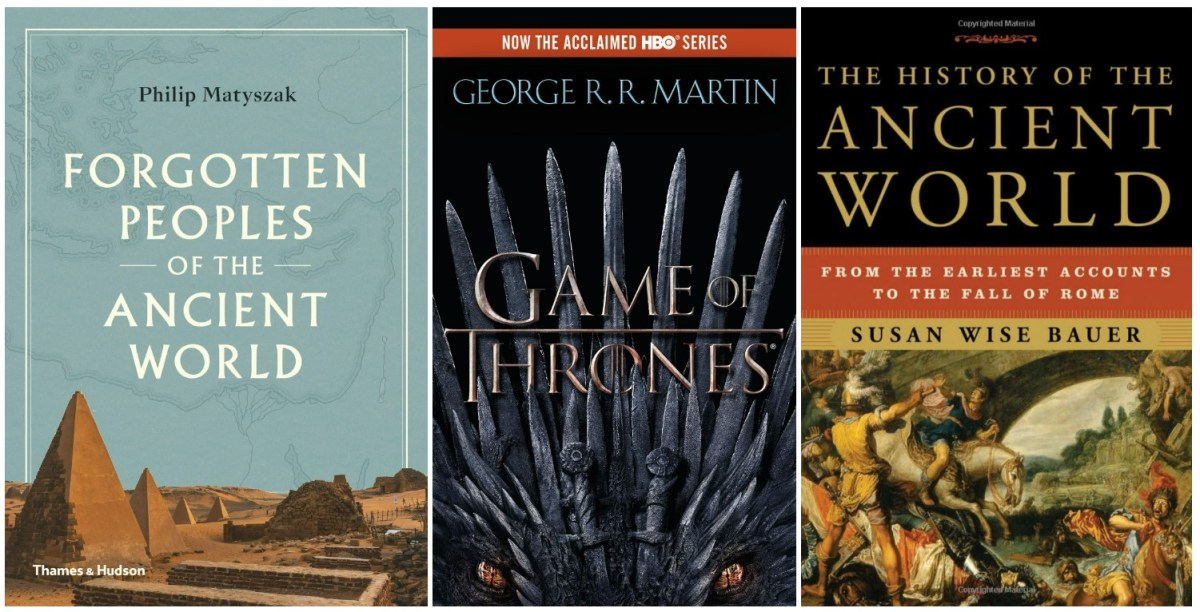
I’m listening to and reading Forgotten Peoples of the Ancient World by Philip Maryazak. It’s a quick overview of 40 civilizations of early history beginning with the Akkadians and ending with the Hephthalites. To be honest, I had only heard of less than half of these civilizations, mostly because of references in the Bible or from Greek and Roman history.

I’ve never studied ancient history much but I’ve recently gotten hooked on it, especially after reading The Horse The Wheel and Language by David W. Anthony, The Dawn of Everything by David Graeber and David Wengrow, and The Writing of the Gods by Edward Dolnick. The first two were a slog to get through but I still admired them. The Writing of the Gods was sheer fun and would probably appeal to many readers. Forgotten People of the Ancient World is a breezy summary, which I’m thoroughly enjoying, but it doesn’t go too deep. Perfect for me right now, but I’ll want to know more later. Actually, the entries on Wikipedia cover more for each civilization than Matyszak’s chapters, but his book integrates a digestible narrative with inspiring photos and maps making it easier to read.

When you read/listen to one summary of a civilization after another, it’s pretty damn obvious that humankind is on repeat mode. Humanity is Phil Connors in Groundhog Day, but we never learn how to break the cycle. You’d think with all this history we’d figure it out the secret.

Some cycles are obvious, like the rise of powerful leaders. Why do we call Alexander III of Macedon the Great? Sure, he conquered a lot of territories but he also killed, destroyed, and plundered. We hate Putin today for what he’s doing in Ukraine, but how was Alexander III of Macedon any different? We really should call Alexander, Napoleon, Hitler, Putin, and every other empire builder the monsters of history.

That’s the number one cycle we keep doing over and over, which is to allow egomaniacs to become rulers. We’ve tried to avoid that by creating democracy, but as you can see from recent times that doesn’t always succeed at controlling men who want more. And even then democracies sometimes go around and destroy other countries too, just like would-be emperors. Humans have this thing about destroying their enemies and expanding their territory. Like Rodney King, I must ask, “Can’t we all just get along?”

A less obvious cycle we repeat is the reverberation between big government and small government. All the successful civilizations grew, needing central control to keep things organized. The central government of the Akkadians had to build vast irrigation systems which required taxes and governmental infrastructure. There are always people who resent that. They rebel and undermine the central government and civilization erodes and eventually collapses. Why can’t we find a balance between secure political structures and personal freedoms?

We fail to be good stewards of the Earth and overtax Mother Nature with our endless growth and consumption. Nor do we save for the future to withstand random destructive acts of nature. Humanity is no Boy Scout, it’s never prepared.

Another hit on the Top Repeat list is ignoring reality. We feed our hatreds and greed with crazy ideas and justifications. We’re always our own worst enemy.

I feel like we’re living in end-of-civilization times. Reading about history is somewhat soothing but for a strange reason. It promotes stoical thinking.

Here’s a neat video on YouTube about how chaos theory predictions patterns of disorder in ordered systems. We live with entropy, and civilization is anti-entropic. It helps to understand both chaos and complexity theory. It won’t help the world to know this, but at least it explains some things.

JWH

How Do You Label Your Existence?

by James Wallace Harris, 5/3/22

Now that I’ve been retired for eight years, I realize I can no longer call myself a programmer, which is the way I identified myself during my middle years. Because Susan and I never had children, I’ve never been a parent, and thus can’t be a grandparent in my waning years, which is a label some of my retired friends proudly embrace.

My new identity is a retired person, but that’s not much of an identity and I’m not sure I like using that label, but I do. I spend most of my time reading and writing about science fiction short stories, which gives me a little bit of a purpose. I can’t call myself a scholar, but I do study that subject in depth. It’s just a tiny subject that’s not very relevant but does give my existence a purpose. I’m not sure I can justify my existence by calling myself a science fiction fan.

I guess I could call myself a blogger but don’t know how satisfying a label it would be to use. I’ve always wanted to be a scientist or philosopher but I’ve never come close to actually being either.

I look around and see people defining their existence in various smaller ways. One prominent label that is often in the news is Republican. Some of these people treat being a Republican almost like a religious identification and evidently find great identity with it. They even take great satisfaction in calling themselves a Republican or a Conservative. I’m a liberal but don’t get off on calling myself one. I think that’s one of the big differences between the two parties. Conservatives are a lot more organized, and they seem to get a lot of satisfaction out of being part of their group. I think being young and liberal is more of an identity thing. It was for me.

I observe people finding meaning in their existence in all kinds of ways. I know many people who are ardent travelers. They use the term traveler to define themselves. Many of them act like their purpose on Earth is to travel. They find self-worth by recalling the places they’ve been. I’ve noticed there are a lot of travelers with YouTube channels. I wonder if they feel like prophets of traveling?

I’m on the fringe of many subcultures. Take audiophiles for example. They find meaning in their never-ending question to achieve higher fidelity playback, I’m too cheap to go all the way with that group. I’m not a sports fan, but they are quite common around here, and they seem to find great happiness in identifying with their teams. There seems to be an overlap between sports fans, Christians, and Republicans, in that they all love their group identity and get immense satisfaction when their group wins or converts folks to the team.

I relate to many of my friends through the kinds of entertainment we share. Much of the conversations I have with my friends, deal with discussing shows and movies on television. I’m also a bookworm and find kinship with other bookworms. I’m not a foodie, but I know a lot of people who find dining out an important aspect of existence.

I believe people get more existential meaning from their pursuits when they have a strong label for themselves. The average person might love dining out, but someone who calls themselves a foodie obviously gets more meaning from it than those of us who just enjoy chowing down. And if people call themselves a gourmet, they feel even more important about themselves, like they were philosophers of the tablecloth.

That’s my trouble. I no longer have any good labels to define myself. I guess the best is Bookworm. It’s the one I’ve embraced since childhood. I’ve never been one for nice cars or clothes. I spend my money on books. I don’t travel because I prefer to read.

However, I have to wonder, when I lay dying in my La-Z-Boy, will I look back and feel my existence was well spent with all those books?

JWH