I turn 71 this month, and getting older is getting harder. Being old is nothing like I imagined. That’s a problem for me because I like to be prepared, and being prepared requires anticipating the possibilities.
Last year I read The Art of Dying Well: A Practical Guide to a Good End of Life by Katy Butler. It’s a useful handbook giving tips about healthcare for the elderly, plus Butler relates plenty of stories about people she met who were going through a variety of issues as they approached death. I learned a lot from her book. People tend to decide between two paths toward the end of life. Some want to take advantage of everything medicine has to offer, and others prefer to take a gentler path, choosing less aggressive medical procedures, or even refusing treatment. One of the best lessons of the book is doctors will go to extremes to keep you alive unless you learn to say no. And for me, the important part of The Art of Dying Well is learning when to say no, and how to decide what you want before you lose control of your situation.
When I read Olive Kitteridge by Elizabeth Strout this week, I was surprised by how it inadvertently taught many of the same lessons. Although it’s called a novel, it’s a collection of thirteen interrelated short stories, and often those fictional stories were like the case studies in Butler’s book. Olive is in her late sixties at the beginning of the book, and seventy-four at the end. I was particularly horrified by the final accounts of Olive’s husband, Henry.
Olive Kitteridge is a book that offers a series of intense emotional impacts. And most of them made me think about how I will deal with a particular issue if it should happen to me. Henry’s fate is the hardest to contemplate. One day he and Olive are going to the grocery store and when he steps out of the car, he falls to the ground. He’s had a sudden stroke that leaves him blind, unable to walk or talk, and probably has left him deaf. He’s put in a nursing home where he needs to be cared for like a small child. To me, that’s scarier than anything Stephen King ever imagined. And how do you prepare for something like that?
It would help to have all the proper legal paperwork ready. And it would help if others knew your wants. That’s covered in the Butler book, but it’s covered in more detail in Elderhood: Redefining Aging, Transforming Medicine, Reimagining Life by Louise Aronson. Aronson is a doctor who eventually got into geriatric medicine. Her book is heavier than The Art of Dying Well, with more clinical details. It has a tremendous wealth of information, but I found Aronson’s structure for her book somewhat disappointing. Elderhood has a clearly laid out structure but Aronson doesn’t always stick to it.
Both nonfiction books are excellent handbooks for anticipating getting older, especially for the medical and legal details. But the novel, Olive Kitteridge, was also excellent for the same purpose, but in a different way. I guess it’s a handbook for philosophically preparing for our last years. Some of its most important lessons were about communication, or more precisely, the lack of communication.
Much of the novel is about waiting until it’s too late to express our true selves. One of the strongest reasons why people want an afterlife is so they can meet up with dead loved ones. Is that because we really want to tell them something? Or that we really want to ask them something? I know that’s true for me.
I loved reading Olive Kitteridge enough that I’m going to read more Elizabeth Strout books and have already started on Olive, Again – a sequel with additional short stories about Olive Kitteridge and the people she knew. I’m also keeping The Art of Dying Well and Elderhood to reread again and again as I get older.
Ken Burns’s new documentary, The U.S. and the Holocaust, punched me in the soul. No documentary has ever moved me as much, and I’ve seen a lot of them. And it’s not because it’s about the Holocaust. I’ve even read about most of the painful facts it presents before. No, the gestalt of this film, which is well over six hours, is to set off an epiphany about our relationship with history.
At the highest level, the documentary asks: What did Americans know about the treatment of the Jews under the Nazis from 1932 to 1945 and when and how did they learn it? But to answer that question Ken Burns and company have to describe what Americans were like during those years. The U.S. and the Holocaust give a different history of America for those years from any I’ve ever encountered from people, in school, reading, at the movies, or on television.
Maybe the best way I can describe it is to say: Everything that has horrified me about living through the years 2016 to 2022 existed in the 1920s, 1930s, and 1940s. The documentary cements a theory that I’ve been developing in recent decades – that people don’t change and even the percentages of the population that hold specific opinions don’t really change either.
The documentary set off this existential conundrum: Why didn’t I already know what the documentary revealed? Or did I just filter it out? Republicans are in an uproar over Critical Race Theory and other curricula that they’re afraid will upset their children. I imagine they will be just as upset at The U.S. and the Holocaust. I knew about the wide popularity of the KKK and eugenics in the 1920s. I knew Americans were mostly isolationists and anti-immigration in the late 1930s. But the documentary gives us a different take on history than what I was taught.
I have to wonder since FDR was president from 1932-1935, have we always gotten the Democratic party’s view of that history? I wonder if Ken Burns has rounded out the historical period by adding the Republican party’s take on those years? I do know the documentary feels very synergistic with today’s politics.
I love old movies from the 1930s and 1940s, and none of the hundreds of movies I’ve seen from that era convey what I learned from The U.S. and the Holocaust. My grandparents, parents, aunts, and uncles, all lived through those years, and none of them ever described the mood of the country revealed in the documentary. I’m a bookworm that has read countless works of both fiction and nonfiction about America in those decades, giving me some of the details from in the documentary, but not in the same gestalt. Two books that come to mind are One Summer: America, 1927 by Bill Bryson and In the Garden of Beasts by Erik Larson.
After I watched the Ken Burns documentary I read The Plot Against America by Philip Roth. It’s a kind of science fiction novel, an alternative history where Charles Lindbergh wins the 1938 presidential election and for many of the reasons described in the documentary. Roth was born in 1933, and he makes himself the point-of-view character in his novel. Young Phil is only 8 when it begins and 10 when it ends, but his viewpoint is mature. It’s about the anti-Semitism of those years.
I thought The Plot Against America was a well-told story about Jewish life in Newark, New Jersey 1938-1942. I thought Roth’s alternate history speculation was well done, deriving from the kind of knowledge I got watching The U.S. and the Holocaust. But the story is mainly a personal one, and its gestalt is different from the documentary.
Last night Susan and I watched Radio Days for the umpteenth time. It’s Woody Allen’s nostalgic look back at those same years. It completely ignores all the political history of The U.S. and the Holocaust. Radio Days is like both movies from that period and later films that worked to recall that era. They all filter out the nastiness of racism and xenophobia that existed in America back then. Although some of it came through in the film The Way We Were, and the book version of Breakfast at Tiffany’s.
And just before I watched the three episodes of The U.S. and the Holocaust I read Revolt in 2100 which contains a 1940 short novel by Robert A. Heinlein called “If This Goes On….” Heinlein imagined America would go through decades of The Crazy Years, before undergoing a second American revolution that created an American theocracy. I was disappointed that Heinlein didn’t do more world-building for his novel, but after seeing the Ken Burns documentary I understand his inspiration for writing it. It’s obvious that many Americans back then wanted a Protestant theocracy. Consisting of only white people from England, Germany, and some Scandanavian countries.
I think it’s important to distinguish fascism as a political philosophy from the Nazis, who were also fascists. What many Americans wanted then and now is basic fascism, and the Philip Roth novel shows how America could have turned fascist.
The other day I saw a quote on Facebook that went something like this: If you get warm and fuzzy feelings reading history then you’re not studying history. I’m on the third volume of world history by Susan Wise Bauer, and it’s brutal. Most people want to romanticize history, which is what we get from novels and movies. The Republicans don’t want CRT taught because they want their kids to feel all warm and fuzzy studying American History. The new Ken Burns documentary will not leave you feeling warm and fuzzy.
My current theory is humans can’t handle reality. That we develop all kinds of psychological delusions to filter reality out. We prefer our fantasies. And popular history along with pop culture gives us nice takes on the past that allows us to cope. It’s also why most people’s theory of how reality works is no more complex than a comic book. It’s why we’ve always clung to religion. It’s why I have a life-long love of science fiction.
We just can’t handle complexity. There are plenty of real history books that document the reality of the times they cover, but they aren’t widely read. Maybe the Republicans are right, and history is too brutal for children. But maybe we keep repeating history because we’re all too wimpy to handle history.
I’m getting so I can’t stomach the historical lies of Hollywood, but I don’t know if I can handle all that much real history either. I used to think that maybe four percent of the population was mentally ill. In recent years, I’ve upped that to forty percent. But lately, I’m thinking there’s an entry for all of us in the DSM-5.
Most of our ideas are borrowed since few people have original thoughts. The other day I was wondering why conservatives and liberals think so differently. I decided one reason is that they read different books. Of course, not everyone reads books. Ideas are also passed around from person to person, or by newspapers, magazines, journals, advertisements, political rallies, television shows, the internet, etc. We dwell in a sea of ideas.
Ideas do originate with original thinkers, and often they are first published in books. Journalism and other forms of mass media then propagate those ideas, which in turn are spread by word of mouth. So, for now, let’s think of the basic unit for storing and spreading ideas are books.
My theory is conservatives and liberals think differently because the foundation of their beliefs comes from different books. I’m not suggesting that all conservatives and liberals read the same set of books, but the ideas for their thoughts and speech originated in a subset of books.
I was thinking along these lines because I wondered if conservatives and liberals each had a core set of twenty books, what would happen if the conservatives read the liberal’s books, and the liberals read the conservative’s books? Would our polarized political opinions begin to homogenize?
Then I wondered about fundamentalist religious people who put their faith in one book. What would happen if all the fundamentalists around the world all read each other’s holy book?
Thinking about that brought up an obvious stumbling block. Most people’s beliefs are based on what they first learned as children. If you are raised Christian and conservative you’re most likely to stay Christian and conservative. That suggests ideas acquired in youth are stickier than ideas acquired later in life. For my test, we’d have to raise children with The Bible, The Quran, The Tanakh, The Talmud, The Vedas, The Upanishads, The Tipitaka, The Tao Te Ching, The Yasna, etc.
We know minds are open and plastic at birth. If you took a child from a Christian family and gave it to a Muslim family to raise, it will grow up Muslim. But for some reason, after a certain age, minds close and lose their plasticity.
On the other hand, fads arise and spread ideas/memes all the time. Adults will embrace new ideas. Fox News, the Internet, to Tik-Tok can spread new ideas like a California forest fire. This suggests that people can acquire new ideas that they put on top of the foundational ideas that were programmed in their youth.
And ideas don’t have to come from nonfiction books. If all you read are romance novels and watch romance TV shows and movies, your ideas about relationships will be different than if you only consumed mysteries.
I’m in a book club that was reading Developmental Politics by Steve McIntosh, a book about our polarized politics. McIntosh hoped his insights would help solve that problem but most of the readers in the book club doubted it. One of our members did believe in McIntosh’s ideas and thought they could work. I felt McIntosh’s ideas were insightful but figured for them to be persuasive, would require everyone to read many other books first. McIntosh’s book was complex enough to require reading dozens of other books to fully understand it.
That’s when I realized we speak in books. When we express ourselves, we pass on fragments of books, but we don’t pass on enough information to let other people fully understand the foundation of the original ideas. Generally, we pass on tiny fragments of the original idea that are barely impressions. And we seldom communicate ideas but express ourselves emotionally.
If you want to understand a person, you have to consume the same books they did, or at least the same secondary sources. If a friend is passionate about a belief you’ll never understand your friend until you understand the foundations of their beliefs.
Few people understand the sources of their beliefs. Few people can point to a set of books and say here’s where my ideas originated. The origin of a classical education came from the study of foundational books, but that idea broke down in modern times when we were overwhelmed with significant books.
Yet, even when there was only one book for most people, The Bible, Christianity spent centuries arguing over its meaning. If you study all the people who claim to be Christian today you’d find very little commonality. The Bible is too big and too diverse. If we took The U. S. Constitution instead, which is tiny in comparison, we still get endless disagreement.
Ideas are slippery and inexact. Even if we read the same books and speak about the same ideas we don’t interpret them in the same way. Humans aren’t computers. We filter ideas through our emotions. Books might sow ideas but they don’t plant them evenly, and they grow inconsistently.
It appears that humans latch onto vague concepts and use them for ammunition to get what they emotionally want. Even if we read the same books we’ll still be a long way from finding agreements.
What we have here is a failure to communicate. What we need is a better approach to understanding each other’s wants. It might start with reading the same books, but it would only be a start. We’d also need to start studying each other’s emotions, and emotions are even harder to communicate than ideas. That’s what McIntosh was getting into with Developmental Politics, building on developmental psychology.
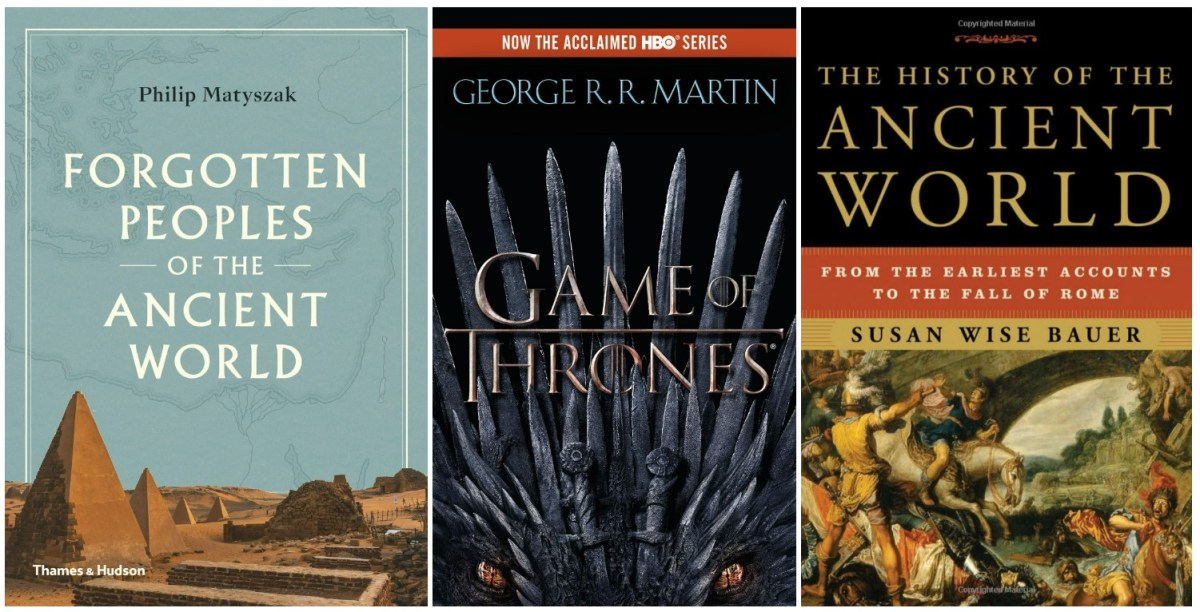
My friends Linda, Connell, and I are rewatching HBO’s Game of Thrones, and this time around I can’t help but compare it to current politics and the books on ancient history I’m reading. When I saw the series years ago I only thought of it as an epic fantasy. This time I feel George R. R. Martin distilled millennia of human history into one fictional story.
I’ve lost count of the times a real game of thrones has played out in my study of history. By now I’ve read dozens and dozens of accounts of power plays for a throne. One example from ancient Egypt deals with an assassination attempt on Rameses III from The History of the Ancient World by Susan Wise Baurer:
THE FAULT LINE running through Egypt, temporarily plastered over by victory reliefs and building projects, was still liable to crack open at any point. Rameses III held the throne by right of his father’s coup, and he was not immune to power plays.

Towards the end of his reign, one of his lesser wives hatched a plot to assassinate the king by mob violence. Scribes who recorded the affair during the reign of Rameses’s successor say that she began a campaign to “stir up the people and incite enmity, in order to make rebellion against their lord.”10 Apparently she hoped that the mob would not only remove Rameses III, but also his appointed successor—his son by another wife—so that her own son would become king.

A harem plot to kill the pharaoh was hardly unknown, but this one was remarkable for the number of people involved. The court recorder lists, among others, the two royal standard-bearers, the butler, and the chief scribe. The overseer of the herds was accused of making wax figures of the king, apparently for use in an Egyptian form of voodoo;11 the chief steward was convicted of spreading dissension. The conspiracy apparently stretched all the way down into Nubia: “Benemwese, formerly captain of archers in Nubia…was brought in because of the letter which his sister, who was in the harem, had written to him, saying, ‘Incite the people to hostility!’”12

The records of the conspiratorial accusations end, in monotonous regularity, with either “He took his own life” or “The punishments of death were executed upon him.” The exceptions were three conspirators who merely had their noses and ears cut off, and a single acquittal: a standard-bearer named Hori, who undoubtedly lived the rest of his years in disbelief that he alone had survived the purge.13

By the time the trials dragged to a close, the intended victim was offstage. Rameses III himself had died of old age.
That trial reminds me of the current Jan 6th hearings. I wonder how people will study January 6th in future history books?
Donald Trump’s campaigns to stay in political power remind me of Game of Thrones too. Trump wants the 2024 presidency like the Game of Throne characters wants the Iron Throne. I imagine Trump pictures himself as Tywin Lannister, rich and powerful, but he’s actually more like Robert Baratheon, a leader in name only who shirks his kingly duties to wench and hunt. All of Trump’s would-be advisors remind me of the treacherous advisors in King’s Landing. People like Steve Bannon obviously want to be a puppetmaster to the powerful in the same way Littlefinger and Varys pulled the strings on those who would rule Westeros.
This year I’m on my fourth book about ancient history and there is one obvious lesson that stands out above all others: Beware of rulers. There are always people, usually men, who believe they should rule, and they think nothing of getting thousands or even millions of innocent people killed to fulfill their ambitions.
The alpha humans always want more. The betas connive to be alphas. And the rest of humanity, the omegas, are the pawns in the game of thrones. To the ruthless, the 99.99% of humanity are the Star Trek red shirts in their personal fantasies. We see that with Putin in Ukraine right now. I’ve started another book, Bloodlands by Timothy Synder, that focuses on Hitler and Stalin’s roles in killing 14 million people from 1933 to 1945. Why do we let our rulers have so much power?
Until humanity can rule itself without ambitious psychopaths we’re going to repeat the same loop forever. In the history books, there have only been a couple of minor incidents where the ordinary citizens protested their role as cannon fodder. Most of history is about one ruler after another waging war. When will this infinitely repeated story horrify us enough to break free of the cycle? Since Game of Thrones was such a huge hit, maybe we love things just the way they are?
Eight seasons of Game of Thrones is about endless warring and the remembrances of wars. The story ends and we think there will be peace, but history tells us that won’t be true. Why don’t we get other stories in history and literature? Why not the stories of those people who built the beautiful cities we see in Westeros and Essos? Why is it always conflict and destruction?
Why do we mainly remember the monsters of history and literature? None of the major characters in Game of Thrones are good people. Is this why Trump and Putin are so well-loved in their respective countries? Are the rest of us just fans, taking sides while watching the game play out? Is that our only role, to pick a team to follow? Go Starks! Go Lannisters! Go Trump! Go Putin!
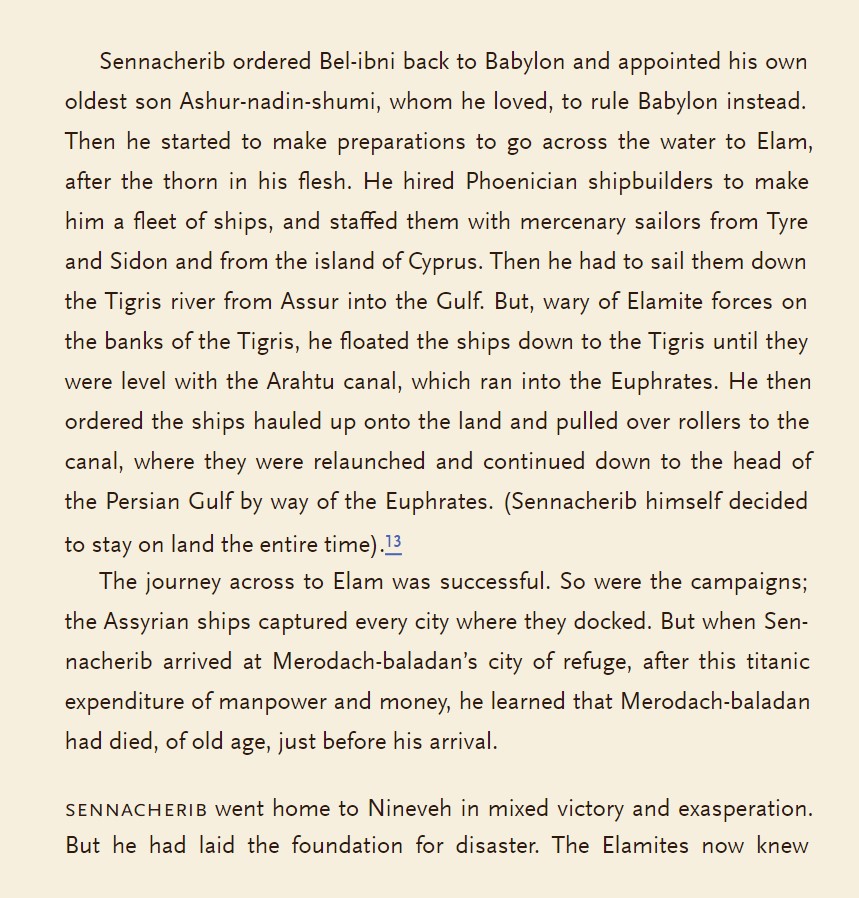
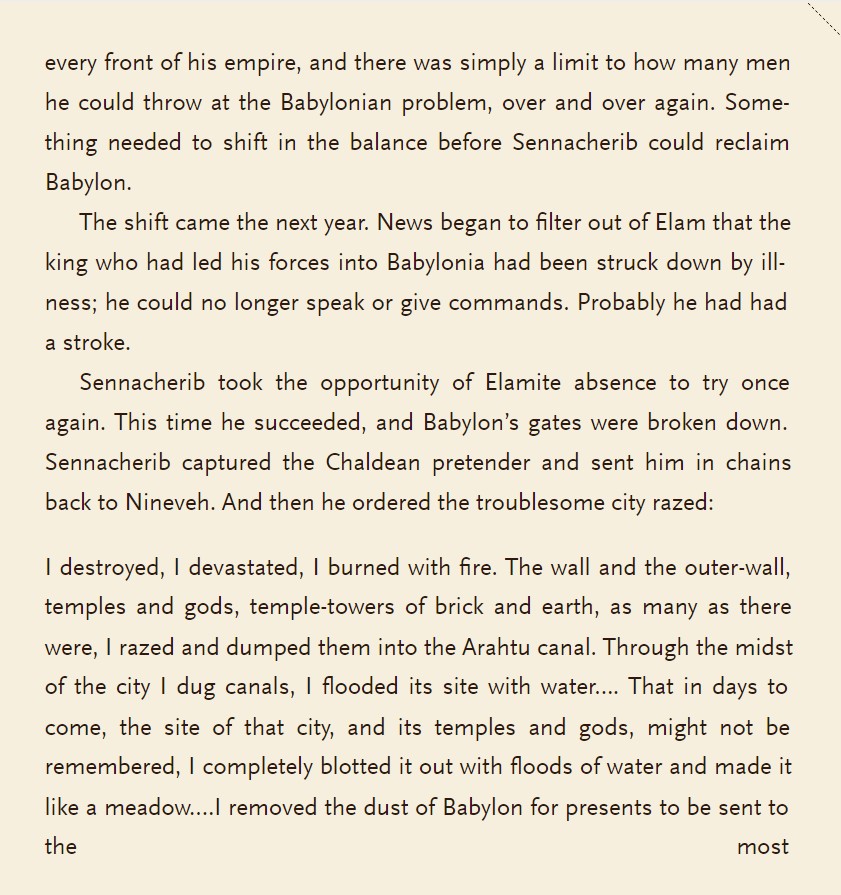
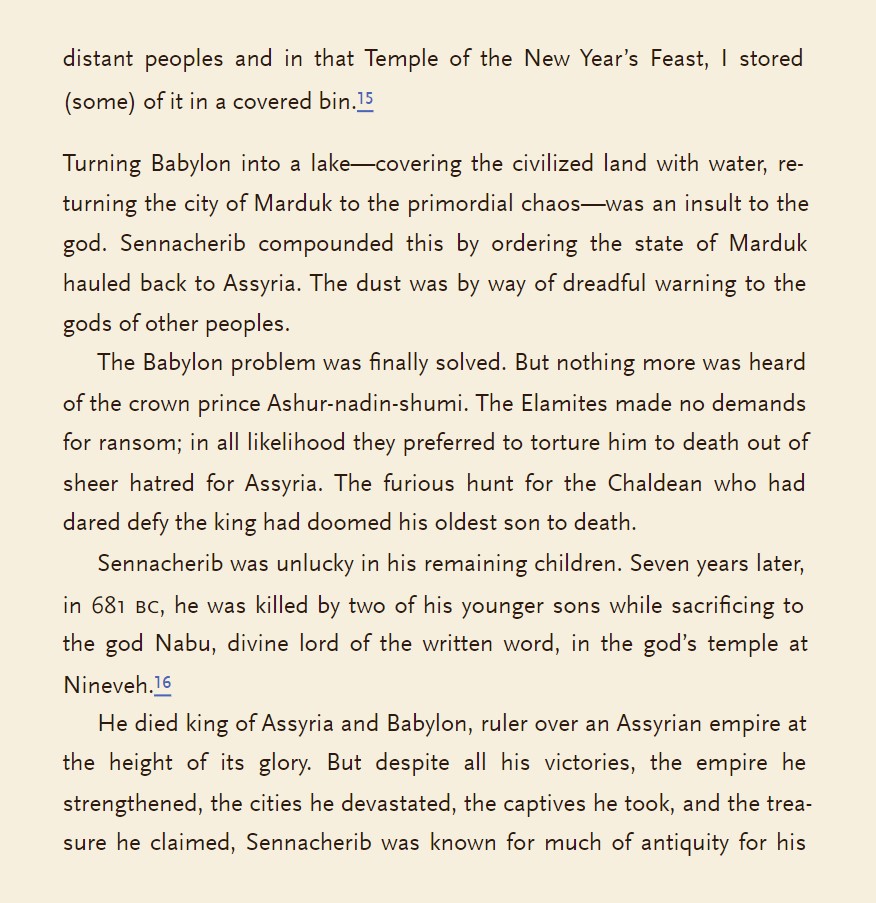
Below is one of my favorite and telling passages in The History of the Ancient World. In chapter 52, history intersects with the Old Testament and 19th-century literature. It’s not that I endorse what’s being reported, but I think it reveals something deeply psychological in the human race, especially when you compare these events of almost three thousand years ago to today. This passage reminds me of the destruction of cities in Ukraine and King’s Landing in season eight.
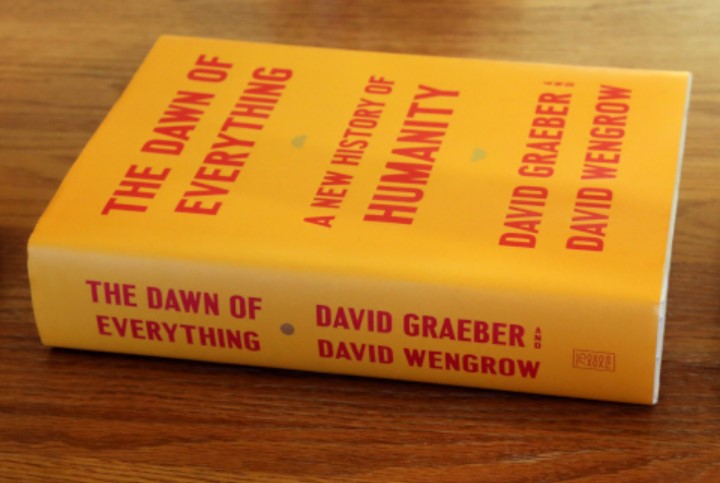
I’m still reading The Dawn of Everything: A New History of Humanity by David Graeber and David Wengrow. I’m a member of an online book club that will be discussing the book all during the month of March, so I’ll be discussing it here piece by piece, whenever a particular topic intrigues me.
Here’s the setup for the book. Humans have been around in their present form for about 200,000 years, but recorded history only covers around the last three thousand years — what were we doing for those other 197,000 years? Anthropology and archeology help answer that question to a degree. The Dawn of Everything works to say to what degree is possible. However, most of what anyone can say about those 197,000 years is speculation, and that can cause controversy.
For most people, prehistory is a mixture of the Garden of Eden imagery and fantasies about cave people. Anthropologists study the evidence provided by archaeologists then speculate about that evidence by comparing it to what we learned from ethnographic research on various indigenous societies from the last few hundred years. Unfortunately, what most Americans know about the pre-20th century indigenous people of North America comes from watching westerns. In other words, unless you read a lot of books on anthropology it’s doubtful you think about prehistory at all, and what you do think you know is pop culture deceptions.
David Graeber and David Wengrow, an anthropologist and an archeologist, have caused some political shit storms by angering some of their readers with their discussion of freedom and inequality while analyzing what we know about prehistory. These brouhahas are caused partly because Graeber was an anarchist and was a leader in the Occupy Wall Street movement, and, partly because they challenge the established Western views that speculate on humans in prehistory, and tie ideas about various forms of inequality and freedom to their speculation. They seem to imply humanity made a wrong turn, but I’m not so sure we did, but don’t care to argue it. Graeber and Wengrow do review a lot of speculation that claimed we made a wrong turn when we switched from hunting and gathering to farming, but I’m not sure they believe that idea either, but merely review it too.
First off, there is no introduction, so the first chapter works as an introduction, but I don’t think it’s a good one. So far, I’ve felt every chapter has been self-contained, so it’s hard to assess the book as a whole. They title their first chapter, “Farewell to Humanity’s Childhood: Or why this is not a book about the origins of inequality.” I don’t think some readers took that to heart and feel The Dawn of Everything is harping about inequality. I wonder if conservatives dislike the book for the same reason they don’t like Critical Race Theory, that it smells of liberal thinking, and it asks them to relearn a history they’ve already embraced and memorized.
Here’s the thing about speculating about prehistory — speculation is only speculation. We’ve found some human bones, lots of animal bones, we have some pots and graves, some old cave paintings, remnants of housing, stone monuments, figurines, lots of rock tools, but not much of anything else. Most speculation about prehistory rests on ethnographic studies of primitive cultures that have survived into historical times. What Graeber and Wengrow challenge are generalized ideas we’ve developed about those cultures over the last couple of centuries.
Most of The Dawn of Everything is about the limits of speculation. What we really want to know is what were the people like? What did they think? How did they relate to each other? What kind of societies did they form? How much did they know about nature and reality? It’s one thing to look at old bones and relics and guess what people did, it’s entirely another thing to extrapolate what they thought and believed.
Here’s what I want to ask: Can ideal concepts exist before they are defined? Take inequality? That’s a concept that’s been emerging for a few centuries and a concept that modern society is working on. Even something like freedom is a concept been around for a long time, but has it always existed? What about science? Graeber and Wengrow have a whole chapter dealing with the origin of scientific thinking. Our ancestors might have observed nature and put two and two together but was that really science? I believe a concept like fairness might be very ancient, but I don’t know about inequality. I believe inequality is an emerging concept. There might have been societies in history and prehistory that had more equality but I don’t think they thought about it as a concept.
I think it’s completely insane to suggest humanity took a wrong turn because we don’t like aspects of our present society. The old saying, “the only constant is change” applies here. The variety of ways humans can organize their societies is infinite, and that comes across in this book. I think Graeber and Wengrow are right to say we can’t generalize about the past like Rousseau or Hobbes.
The best we can do is study all the ethnographic studies, examine all the archeological evidence and review all the speculation, and then create our own inner map of what prehistory was like with the jigsaw pieces we have. We also must be willing to constantly update that map as we gather new puzzle pieces.
We must resist philosophers and psychologists who try to characterize humans now or in the past in broad general terms. I believe what Graeber and Wengrow are telling us is not to lump together various stages of human development or societies into convenient pigeonholes. For example, there was no one shift from hunting and gathering to agriculture. Nor was there one type of nomads or hunting and gatherers. For example, North America had hundreds of different types of Native American cultures, so there is no way to generalize about what they thought about gender or money, or politics.
The trouble is there are places in the first chapter of this book (and I’m only on chapter six) that seem to imply that Graeber and Wengrow are advocating that we should be working towards all the various forms of equality. We can judge modern societies on inequality and even ethnographic studies of primitive societies we have studied, but I believe speculation on inequality in prehistory societies will be based only on our biases, and I think Graeber and Wengrow make that clear even though they keep trying.
Personally, I wonder if Graeber and Wengrow haven’t spoiled the rest of their book with chapter one. Most of the reviews I’ve seen focus on that first chapter. That might be due to the reviewers only reading that chapter, or it might be because it’s the one that pushes buttons. The other chapters I’ve read deal more with what we know, and I’m finding them quite fascinating. It makes me want to read more ethnographic studies — although, as Graeber and Wengrow show, those studies are often colored by their observer’s speculations. If anything, this book shows us time and again how we distort the evidence.
For me, the key to enjoying learning about prehistory is to avoid speculation and focus just on the evidence. The trouble is a certain amount of speculation is good. Nowadays generalizations are considered evil. But we make useful generalizations all the time — it’s called pattern recognition. We just can’t go overboard. Every archeological dig is like a crime scene. You only find so much evidence. Science never knows anything for sure, but works with statistics, looking for a preponderance of convincing evidence.
Most people don’t spend time studying history, much less prehistory. And it’s hard to make a case to get people to care about history and prehistory. For most people, it’s about as useful as studying geometry, cosmology, or particle physics. But consider this. All of us are deluded. We constantly fool ourselves in countless ways that make us see reality distorted by our cultural upbringing. Studying other societies that adapted to our shared external reality in different ways can break us out of the brainwashing of that upbringing. If the book is doing its job it should be stirring things up.
It’s not about whether or not we made a wrong turn, but knowing about all the possible turns we took and could have taken. I think this is scary for some people. If you want to believe the Bible is literally true, then learning about all the societies that existed at the same time as the Bible was being written could be disturbing. If you’re a scholar of Western culture that backed a particular view of history and prehistory, considering what Graeber and Wengrow are saying could also be disturbing. But aren’t all paradigm shifts uncomfortable?
Humans think we’re the crown of creation. And people raised in western culture believe we’re the pinnacle of human intellectual development. Maybe Graeber and Wengrow believe we took a wrong turn because our global society is sailing into an iceberg and they want us to change course. Personally, I don’t think our species has any control over its evolution. It’s not a matter of choice, but playing out all the anti-entropic possibilities. I believe studying history and prehistory shows us some of the many things we’ve already tried.
Knowing where we’ve been might help us know how we can adapt to climate change. Here’s one example. Graeber and Wengrow consider that prehistory societies made the choice between being hunting and gatherers and settling down and that they often chose to stay on the move because it offered more advantages. This video, it shows one modern reason why nomadic people choose to settle down and pursue year-round agriculture. It allows them to build wealth and stability in their lives. This is a very inspiring video.








 Auxiliary Memory