Can Meditation Overwrite the Unconscious Mind?

by James Wallace Harris, Friday, November 9, 2018

My friend Linda has been getting into meditation. That made me think I should give it another go. I’ve tried meditation many times since the New Age of the 1970’s, but never stuck with it. I currently face two obstacles I want to overcome and wondered if meditation could help. I see at least one article a week show up on Flipboard touting the successes of meditators. They claim science supports the claims of meditation, but I’d want to verify that before I claim it too. I’ve written before about how I feel there are two wills occupying this body – the conscious me, and my unconscious mind whose will seems much stronger than my conscious mind.

older-adult-meditating

The two of us fight over health and creativity. My unconscious mind wants to follow my biological urges. The conscious me wants to become disciplined and be more creative. The conscious me wants to control or eliminate my biological urges and apply all my energy to achieving my goals. My unconscious mind loves to go with the flow and puppet-mastering me into doing whatever it feels like.

This morning I sat erect in an upholstered straight chair, put 20 minutes on my iPhone timer, sat on my hands, and closed my eyes. Meditation usually involves following your breath or focusing on a mantra. I decided to pay attention to my senses and always bring my mind back to one thought: I want to write a short story. I already know which story. I’ve written several drafts but left it unfinished several years ago.

I have two barriers I face every day. My declining health and my declining ability to focus on work. As I sat, and let my mind quiet I noticed the regular tick of the clock on the wall. I observed that tick which was more of a quiet thump, thump, thump…

Then I noticed the faint wail of a train whistle far to the east. I told myself to think about writing. I worked to just empty my mind of words and hold just the urge to write. Time and again my thoughts would flare up. They’d be about writing, but I tell myself to stop thinking words and just observe.

Then I noticed the sound of the HVAC in the attic starting the furnace. My mind went back to the clock and then wail of the train that was getting closer. I had three sounds to follow. My mind felt like it was in a golden sphere of nothingness. My mind began to chatter again, thinking about the details of writing. I brought it back to just the three sounds and the urge to write.

I have no idea how meditation is supposed to do its wonders. Does merely learning to slow and stop thoughts alter the unconscious mind into new programming?

My mind drifted to other thoughts not related to writing. I reigned it in again. I observe the sound of the thump, thump, thump of the clock, the concurrent sound of the approaching train, the sound of the HVAC now blowing air through the vents, and a new sound, the little crashes of the occasional acorn hitting the roof and then rolling off. Then I noticed constant Tinnitus sound in my ears. My ears were singing louder than all the other sounds.

It came to me I should write a thousand words today. Then it came to me I should write about meditation. Then it came to me I should write the fiction first. Then it came to me I should write 1,000 words of fiction the first thing every day. Then I stopped my thoughts and went back to observing the sounds outside the golden glow of my mind.

After a while, my mind got away, and it gave me the first sentence of the story. I thought up more sentences but told my mind to stop. I focused on quieting the mind and observing the sounds.

It kept doing this until the alarm went off.

I got up immediately, went to the computer and wrote 1,039 words of new fiction. The first in a very long time. Is that success due to meditation? I don’t know. Let’s see what I do tomorrow and the following days.

I doubt the success of today’s writing is due to twenty minutes of meditation. I felt good today, after a string of feeling poorly days. I got up and did a Miranda Esmonde-White classical stretch workout, and then 30 minutes on the exercise bike. I then took a nice warm shower. I was feeling pretty damn good when I meditated, so maybe just the momentum of following some positive endeavors help me write fiction. I’ve been wanting to get back into writing fiction for years but just couldn’t make myself try. Mainly, because all my efforts ended in disappointment.

Most creative efforts are achieved by folks when they are young. A few creative endeavors have late-blooming exceptions, and writing is one of them. But I think I’m already older than that oldest late-blooming author I know about. My hope to succeed at something is strictly against all odds. And I understand why. The older we get, the less mental and physical health we have, the harder it is to make ourselves work at disciplined tasks.

I was feeling pretty good today. Except for a pesky hemorrhoid, I’m feeling really good this morning. That’s rare. My back and heart aren’t nagging me at the moment. My mind is a good deal more alert than usual. I have been on this intermittent fast for almost 40 days. I haven’t lost weight, but it seems to be making me feel better and give me more energy. I’m napping less. So one session of meditation probably didn’t get me to write today, but maybe feeling like meditation is another good sign. I hope to do it twice a day from now on. Let’s see if my unconscious mind will stop me, or if I can reprogram it.

I know I’m battling an uphill mental fight while in a physical decline, but I keep hoping there are things I can do to keep the fight going longer. I know at some point declining health and aging will crush my spirit. And even when I can’t actively be creative, I hope for some years of mass-consumption of books, music, movies, and television will keep me happy. I’ve talked to many old people that gave up on everything. I know what the future holds. I’m just fighting a delaying action. But I consider that a positive.

JWH

Three Friends Start Over at 67

by James Wallace Harris, Friday, October 5, 2018

Have you dreamed of starting over – maybe in another career, city, country or even continent? Do you crave new surroundings, conversations, activities, friendships, romances, routines, or even commitments? Do you hunger for something new, something different, something even exotic? Or do you just want the freedom to be yourself, to make all your own choices, to schedule every moment doing exactly what you want?

Three of my friends amazed me recently by rebooting their lives at age 67. Janis after years of planning moved to Guanajuato Mexico, Linda after a lifetime of dedication to husbands and children moved to Denver, and Peggy who thought for a decade she’d be the happiest living on a lake near her brother finally found she was right. Seeing these three women start over by themselves in a new place amazed and inspired me. I’ve been living in the same city for 48 years, married for 40, worked at the same university for 36 years, lived in the same house for 12. (Janis, Linda, and Peggy must think I’m boring!)

I’ve often wondered if I shouldn’t do something different with my life before I die. Up until I got married at 26, I had never lived in one place longer than 18 months, with the average closer to 12. Marriage, work, and getting older settled me down. In my late forties, I started having a heart arrhythmia which eventually gave me a touch of agoraphobia. My ticker was eventually surgically fixed, but I’ve kept the slight agoraphobia. Then my wife Susan started working out of town, and for eleven years I lived mostly alone (she came home Saturday afternoon to Sunday afternoon 2-3 times a month). For the last five years since retiring, I’ve been holed up in the house spending my days pursuing hobbies, and evening socializing with friends. But most of the time I was alone and I got to like that.

Janis, Linda, and Peggy were three women I’ve gotten to know in recent decades. I’ve often listened to them talk about their hopes for happiness. All three have gone through many changes, each different, but including buying and selling houses, retiring, losing or leaving husbands, dealing with children and grandchildren, traveling as much as possible, but ultimately, each thinking about where they could go to be exactly the person they wanted to be.

I am reminded of what I’ve read about women finding themselves in their post-menopausal years when they realize that men and children have dominated their lives, and it was time to put themselves first. I believe Janis learned that in her twenties after a brief marriage, but Peggy and Linda were devoted wives and mothers most of their lives. My wife Susan found a lot of independence when her career blossomed in her fifties and she moved out of town to follow it. And I also discovered being alone strengthened my soul. However, Peggy, Susan and I never learned to live completely alone, like Janis always has and how Linda is experimenting.

JanisThen there is moving to a new location. Janis living in Mexico blows me away. She is a life-long tourist. Her true love is travel. She was a flight attendant for Eastern before it failed, then became a lawyer, and briefly returned to work as a flight attendant in 2001 but that was nipped in the bud by 9/11. She’s been studying Spanish since I’ve known her and finished a B.A. in the language last year. She moved to Guanajuato to immerse herself in conversation and culture. The idea of living in alone another country astounds me. I’m much too chicken to ever do that.

Linda decided she wanted a life where she could make all her own choices and moved to Denver. She’s also a frequent traveler and wanted to live somewhere where people were progressive and liberal. That’s been my dream too, but I’m even too chicken to move to another town in this country.

LindaLinda wrote to me, “First, we’re all so different and so I don’t think what any of us have done would work for you. We’re very different people. What Janis and Peggy have done sound great—but wouldn’t be something I would want to do. I hadn’t really thought about it but 2 of my 5 or 6 best friends have done exactly what Janis and Peggy and I have done—Decided they didn’t like where they were and picked up and moved across the country. I think where we find ourselves when we retire just isn’t necessarily where we want to be and we’re more likely to be financially able to do what we want to do. For me, Denver is so comfortable. The people I’m meeting are well-educated, well-read, welcoming and just nice!  I’ve never had so many people go out of their way to get to know me. And the opportunities for learning and for meeting like-minded people seem way more than I’ve ever noticed in other cities. Maybe it’s just because my head is in a different place. Anyway—this was a great move for me and I am completely content with my decision!

Peggy recently moved to Denver to be near her daughter and grandson but found that Denver was not a good fit for her. Ultimately, she decided to move back south to fulfill a longtime dream of living on a lake. She has been talking about living on a lake ever since her husband died when she was in her fifties. It’s just taken her this long to get free of the distractions of children, jobs, and boyfriends.

PeggyPeggy wrote to me, “After 27 years of marriage, I have spent the time since my husband’s death in 2006 trying to find my new place in the universe.  I have read many times that life is a journey and not a destination.  I’ve learned through my own experiences, both good and bad, that there is probably not just one place for me. So, I believe that if I am not happy in a place or relationship, it is reasonable to move on to another.  However, each time I move on I hope for a longer stay where I can find happiness and someone to share it.  To have the courage to do this, I remind myself that the final destination is Death and that we are not promised tomorrow. Jim thinks I’m brave, I think I’m just following the life I was destined to lead. So, I expect to continue my journey wherever it takes me (maybe with someone special) until I reach that final destination.

Maybe I’m awed by my brave lady friends because of my agoraphobia, but I don’t think most people make such big moves late in life, especially by themselves. However, I can think of several women bloggers who have. Are women more willing to start over later in life? Maybe I don’t travel because I’m too content where I am, even though I know there might be better places to live elsewhere.

I assumed I would grow old and decay in place in my current house. Before Janis moved to Mexico, she had said life here was getting stale. That got me to thinking. Was I not making enough effort to get more out of life? Am I going stale? For years Janis was my TV buddy and we watched television together several nights a week. We have many overlapping interests, but we’re also very different. I’m sure our TV life was part of the staleness. However, Janis also said without the challenge of being a lawyer or going back to college, just being retired can be boring. I’ve often wondered if my life shouldn’t have more varied stimulation than books, music, movies, and television, but they give me such great pleasure that so I don’t feel retirement is boring. Susan has always resented that I didn’t love to travel and even asked me to try Zoloft hoping it would make me less anxious about taking trips. Maybe I don’t travel because I like what I’m doing more.

I told my oldest friend Connell about writing this essay and he immediately replied I was deluding myself if I thought I could travel. He knows me extremely well. Yet, I still felt guilty for not trying harder to see more of this world. My goal for retirement was to teach myself to write. I could live anywhere as long as it had few distractions.

Before I retired at age 62, I saved for years so I could reach my dream destination of free time. Maybe it’s my tiny touch of agoraphobia because I’ve always wanted to stay home and worked at my hobbies. Yet, is my reclusiveness hurting me? Should I push myself to be braver before I get too old? Or am I already too old? I’ve had more physical problems than Janis, Linda, and Peggy — or is that just a rationalization. Stephen Hawking traveled often despite his severe handicaps.

These women wowed me. They decided what they wanted and made it happen. They had to take risks and sell houses, leave family and friends, and essentially start over, almost from scratch. I wonder if there’s any place on Earth I’d give up everything to go live?

Being married is security. Owning a house is security. Having old friends is a security. Having a familiar infrastructure of shopping, doctors, support services, entertainment is security. Because Susan moved away to work for eleven years, I feel I could move away to do something on my own for a while too. One place I thought about is New York City, on the Upper East side near Central Park. I want to live somewhere where I won’t need a car, in a rented apartment building several floors up, but near lots of cultural events that were within walking distance or a quick rideshare. Or cities would work too. I’d still need a place to hold up in that comforts my agoraphobia but makes it easy to take excursions two or three times a week. (Ha-ha, I don’t expect to transform that much.)

Linda wrote to me, “But I do think you might regret not living in New York at some point. Why don’t you find a place to rent for 3 months and just get the experience of living somewhere else without a long-term commitment? I’m pretty sure I’ve suggested this before. I think you would really enjoy it and it would be an adventure. Without moving everything you own.” I’ve already been thinking about that and I’m encouraged by her advice, but I just don’t know if I have the balls to do that. I am going to do some extensive research and planning. That helps me overcome my anxieties.

I wish I was a brave traveler like Janis. I feel guilty for not ever traveling outside this country. I have lived in far more places in the U.S. than Janis, but that was all before I got married. I’m even chickenshit with my foreign travel fantasies because I’ve only ever been tempted by London, Paris, and Tokyo. I’m just too conditioned by always traveling in books, not reality. Janis sends me photos, videos, and stories that make me feel there’s more to this reality than the United States.

I’m most impressed with Janis’ travel bravery, but I’m the most envious of Linda’s location and activities. She immediately volunteered to work for the Democratic party, joined a thriving Unitarian church, and found many fascinating people who are pursuing a variety of creative activities to befriend. And she lives in an apartment several floors up overlooking beautiful scenery, another fantasy of mine. Linda shows me I don’t have to live in the conservative heartland. I could go and live somewhere that isn’t so politically depressing.

Peggy’s new life is the most opposite of my psychology. She’s out in nature every day, doing lots of physical and social activities. Peggy likes being with groups, which I don’t. But this represents bravery on her part because after her husband died, she spent years barely getting out. In a way, Peggy has returned to her high school age, hanging out with people who love social activities, sports, dating, eating out, and doing things in gangs. Susan is like that and wishes I was too. I’ve never been that way though. I love people but prefer them one at a time. However, Peggy shows me I should make more of an effort to get out into nature and to socialize more. This week she’s at Cruizin’ the Coast which attracts folks in antique cars. That’s something I would love to see.

These women are making me rethink my own life choices. I assumed I made my choice when I retired, but now I’m thinking I still have time to make other choices. I worry that I’ve let security and anxiety keep me from doing more – but can a leopard change its spots?

I turn 67 next month.

JWH



Breaking the Cognitive Decline Barrier

by James Wallace Harris, Sunday, September 16, 2018

2008-2018

The above two drawings by Grace Murray were taken from “20+ Artists Challenge Themselves To Redraw Their Old ‘Crappy’ Drawings, Prove That Practice Makes Perfect.” They are an example of cognitive increase. Murray’s mind/body skills have progressed over time by an amazing degree. We seldom see such perfect proofs of cognitive progress. I highly recommend everyone visit this site and look at all the before and after drawings – there are now 14 pages of them. Parents and teachers should use this site to show their kids and students.

What I want to talk about is cognitive decline. I am not a scientist, and I am not using this term in a scientific way. I’m appropriating the phrase “cognitive decline” temporarily for this essay. For my purposes, it means both the mental and physical decline in our countless abilities. I believe our mind and body are a single unit. How well our mind works is dependent on the well-being of its integration with our body.

I have a friend that is worried about cognitive decline and wanted a baseline to measure against. I thought that was a fantastic idea. I’m not sure doctors can easily provide medical diagnostics to do such a job, nor do I think we can easily invent one on our own. My theory is we each need to keep an eye on ourselves and develop a series of baselines to follow over time. We have to become our own psychologists.

The baseline I want to describe is the ability to apply myself to a task and improve. It’s exactly what Grace Murray is doing with her drawing skills. I would like to believe that at age 66 I can still learn a new skill and show improvement over time. However, I struggle to do this. There is a barrier that I can’t break through. But I don’t believe it’s age-related per se. I’ve always had trouble applying myself to a task. I give up too easily. The baseline is not the skill, but the willingness to work at a skill.

Persistence pays off. That’s what the article about how artists show improvement over time reveals. They keep practicing and improving. The first cognitive decline barrier benchmark I want to observe in myself is that quality that makes me keep working to improve. That’s a very slippery target. My theory, as we age, we give up trying. We fall back on comfortable routines, rationalize the enjoyment of our indulgences, tell ourselves we can’t do it anymore.

This is not the only baseline I want to track. I’m noticing plenty of problems with myself, but this benchmark is a critical one to me. Most of my friends tell me they struggle to remember words, especially names. And again, we laugh about how those names pop up hours later. It’s like we haven’t forgotten but just can’t find our memories right away. Could we also improve our recall ability with persistent effort?

And it’s not just memory. We make fun of ourselves for not being able to do physical things that we once found easy to do. And we compare the times we’ve fallen or left the car keys in the refrigerator. Getting old is loads of fun when you can laugh at yourself, but it can be mentally wearing. We can even give up on fighting the good fight.

The worst thing about my cognitive decline to me is giving up. It’s so easy to just let things slide, or tell myself I can’t do that anymore, or accept I’d rather take a nap than do something on my To Do list. Most telling to me is not finishing what I aim to write.

I’ve been thinking about the nature of cognitive decline. I’m not sure, but I think we’ve always experienced it our whole lives, at least at times. I remember being young and tossing in the towel when things got hard, or struggling to recall words for a test, or being mentally impaired on dope or drink. I remember days when I could convince myself to jog five miles instead of my standard two but on other days set out to run five miles and only make two.

Cognitive ability depends on a lot of factors. When we were young, healthy, rested, well fed, we felt like we could do anything. As we age, and our body wears out the cognitive decline barrier changes. Stress is a huge factor. Like the sound barrier varying with altitude and temperature, cognitive decline varies with health and stress.

I’d like to believe I’m not too old of a dog to learn new tricks. I feel by writing this essay I’ve discovered something I can track and work at. Will I make the effort? That’s the cognitive decline barrier I have to break through.

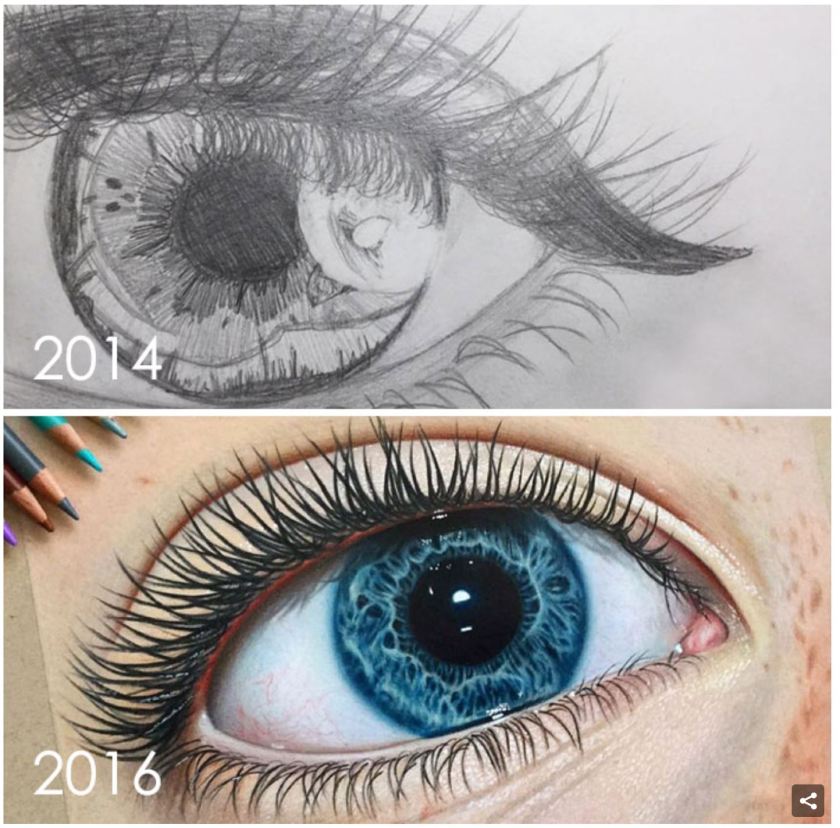
Just look at these amazing next drawings. It tells me people can learn a lot in two years. Could I do the same thing from 66 to 68?

2014-2016

Art by DVO

What made this woman stick with drawing eyes until they are so vividly real looking? I’m only guessing here, but here’s what I think. She’s willing to work at the task for hours on end. She’s willing to study tutorials and acquire a large library of techniques that she’s programmed into her mind/body with that practice. I’d also guess she works with tutors or teachers that can critique her work. She’s also willing to forego other pursuits and interests and focus on this task as her primary ambition. Being young is probably a significant factor, but I’m not sure how critical it is. Can older folks learn to draw this well if they make the same effort?

The difference with being older is having the energy and stamina to work at anything for hours. But there’s also a difference between giving up completely, and working an hour at a time.

Since high school, I’ve dreamed of writing science fiction stories. I’ve taken a number of writing classes and even spent six-weeks at Clarion West. I’ve finished dozens of unpolished, unsold, stories, and a couple crude novel drafts. I have not succeeded in my dream because I haven’t stuck to the work. I haven’t taken my stories from 2014 to 2016 like the drawings above.

I wonder if I worked at writing short stories again could I make myself persist? Could I show improvement over time like this artist? Am I just too old? Or is the cognitive decline barrier too great to break through at 66?

Saying one of my baselines is the failure to finish is rather vague. If I can return to churning out 12,000-word stories of the same quality as before, then I haven’t declined. If I can’t, I have. What I’m really interested in, is if I can actually improve like DVO. Not just write a better story, but improve my baseline on trying, on being persistent?

(Writing this essay took more persistence than usual. That’s a good sign.)

JWH

We Need a New Frontier Because the Final Frontier is a Bust

by James Wallace Harris, Monday, September 10, 2018

Are you jaded with science fiction on television? Have you stopped seeing every new Sci-Fi flick at the theater? I have. On Wall Street, investors always assume a bull market won’t last. I’m wondering when the current science fiction bubble will burst?

During the pulp era, there were more western titles than any other genre. In the 1950s, there were more westerns on television than other types of shows. Then the genre all but disappeared. Could that happen to science fiction?

Westerns disappeared as western frontiers faded, and science fiction replaced westerns in popularity because it offered new frontiers.

Mars

If this observation is true, then science fiction won’t go away until a new genre offers an alternative frontier. Today, science fiction is often dystopian. The final frontier is tarnished by the reality of science. A few million still hope to run off to Mars to escape the looming apocalypses on Earth, but most know the Martian frontier is a destination only robots could love.

Science fiction has failed at convincing Earthlings to colonize other worlds. Instead, we stayed home and trashed the only sustainable planet for our species. Are there any frontiers left to offer new hope? Back when the Space Age was dawning, science fiction also envisioned colonizing the oceans. That idea never caught on and we’ve only sent our plastics to dwell there instead.

Oceans

Are there any frontiers left for our dreams? We need a new genre that inspires us to clean up the Earth. We need stories where a sustainable ecology/economy is the new frontier. We need fiction that depicts healing of the Earth. We need optimistic tales that aren’t fantasy. We need practical utopias.

And, this is very important, we need to stop using fiction to escape. Hasn’t fiction become the frontier that’s replaced science fiction? Aren’t we all trying to live in the imaginary worlds of books, movies, television shows, comics, computer games, and virtual reality? I have to wonder if we don’t all believe we’re passengers on the Titanic and fiction is our heroin.

JWH

Losing the Battle of My Bulge

by James Wallace Harris, Wednesday, August 22, 2018

I believe we all have multiple personalities. The person writing this is my thinking mind. There are two others beings sharing this body, maybe more. Neither of them speaks English, so I can only guess at their mindsets. The other two are my animal body and my unconscious mind.

Puzzled-Pug-Dog

People are deluded by assuming their thinking mind is the whole shebang. Their egos falsely assume they’re the master of their domain. Well, ask yourself, “Who ate that whole carton of Ben & Jerry’s?” when you trying to lose weight. Anyone who had struggled with hunger, lust, addiction, compulsion, fear, depression, anxiety knows their thinking mind isn’t the boss of me.

After I had a heart stent put in back in 2013, I took up a plant-based diet and lost weight. Dropping from 242 to 208. I believe even my body was afraid then. When I got to 208 I thought for sure I’d get below 200 soon. Something happened. My body rebelled, claiming it felt better, and I lost the battle of my bulge. I went up to 222. My doctor scolded me to lose 10 pounds. I got down to 211. Then she insisted I lose 10 more pounds. My body threw a tantrum and began binging on ice cream, peanut butter & jelly, chocolate and all its other favorite yummy foods, We’re back up to 231. My body is happy and doesn’t care. My unconscious mind isn’t sending any signals. And I’m in a panic.

Why do I let my body have its way when I know better? Why can’t my body understand the concepts of health? Sometimes I believe I can get my unconscious mind to help out. Of course, I might be nuttier than a Payday candy bar. Normally I can eat almost anything and my stomach is fine. Other times, my stomach suffers painfully from what I eat. My thinking mind has recently concluded that ice cream and chocolate hurt my stomach. Since I’ve stopped eating them my stomach has gotten better. My intellectual mind wonders if my unconscious mind has decided to trick my body. The unconscious mind is a wonder, but hard to understand.

By the way, my body might be an unthinking clod, but I have to admit my thinking body is easily deluded, confused and shanghaied. My body is very stupid. It will eat anything it wants. It’s only after it’s conditioned lots of pain will it stop eating a certain food.

I really need to lose weight. This extra weight is an obvious burden. Somehow I need to come up with a new battle plan that will conquer my body and make it surrender. There are zillions of articles on the internet about losing weight. Some people seem to win their battles, but I often wonder for how long. No matter how well I do or for how long, sooner or later my body grabs control again. How can I stop that?

It’s going to take a maximum effort to win this war. Somehow I’ve got to put everything I learned into my battle tactics. It would help if Purina made People Chow, and all I had to do was eat three bowls a day that left me feeling satisfied.

Here’s what I’ve learned and hope I can apply again:

  • Don’t keep tempting food in the house!
  • Plan all meals ahead of time!
  • Never eat out!
  • Don’t run out of healthy foods to eat because I’ll eat unhealthy foods to satisfy my hunger!!!
  • Go back to a plant-based diet.
  • Go back to intermediate fasting (eat between 10-6).
  • Solve the protein problem.
  • Make a list of acceptable foods and only eat from that list.
  • Remember, I can’t make exceptions!!
  • Eating holidays never work!!!!

JWH