
Bomber by Len Deighton

by James Wallace Harris, 9/5/23

I thought Bomber, a 1970 novel by Len Deighton to be an exceptional work about WWII. But saying so will not convince you to read it. How can I describe it best to help you decide? First, if you love books and movies about bomber missions during WWII then you don’t need to read this essay but just go buy the book (if you haven’t already read it). If you love Catch-22 by Joseph Heller and Slaughterhouse Five by Kurt Vonnegut, then you’ll probably want to read Bomber. If you love well-researched historical novels particularly about WWII, or well-written novels in general, then you should keep reading this essay.

Grove Press released a new edition of Bomber on 8/22/23 with an introduction by Malcolm Gladwell. Bomber has been reprinted many times over the last 53 years which says a lot about a book. I listened to the 21 hours and 25 minutes audiobook edition narrated pitch-perfectly by Richard Burnip which includes an afterward narrated by Len Deighton. I loved how Burnip did accents for different characters.

Bomber is about one fictional day, June 31, 1943, that that is so realistic that you keep thinking it’s based on true events. It’s not, but it’s so well-researched and detailed that it could compete with history. Deighton creates over a hundred characters including several Avro Lancaster bomber crews, their German interceptors and controllers, the ground crews and command in England, and the citizens of an imaginary German town that gets bombed to hell by a flying armada of over seven-hundred planes.

Two of my favorite movies growing up were Twelve O’Clock High (1949) and The War Lover (1962), along with the Quinn Martin TV show 12 O’Clock High (1964-1967). And I’ve read nonfiction books and novels about the Blitz and B-17 campaigns over Germany. Bomber gave me a much better sense of what it was like to be in a bombing raid, both in the air and on the ground. Of course, no fiction or nonfiction book could convey the actual experience and horror but this one gave me far more details to consider. It was multiplex and multidimensional.

But Bomber reminds me most of all of Catch-22 (1961) and Slaughterhouse Five (1969), two classic anti-war novels from the 1960s. Those two novels had comic aspects, and Bomber does not. However, all three novels depict the horror of war on innocent individuals. Wars are born out of the egomania of a few, who inflame the passions of true believers who then force millions of helpless bystanders into their deadly squabbles. These books are about ordinary people who want to live ordinary lives but are forced to play parts in the conflicts created by these evil egos.

In the afterward of the new edition Len Deighton talks about how he produced the idea for Bomber. He was studying WWII and thought one way of looking at the war was to visualize it as our machines against their machines. He said he liked machines, but to tell the story he had to talk about the people behind the machines. He didn’t want it to be science fiction. (By the way, he talked about using an IBM MT word processing machine, one of the earliest dedicated word processors, and said he thought Bomber might be the first novel to be written with word processing. I worked three years on an IBM MT/ST machine.)

In Malcolm Gladwell’s introduction to the book, he suggests that Bomber is about the evil and guilt the British felt specifically targeting German citizens during their nighttime bombing raids. Here’s what Gladwell said in a version of the intro at The Washington Post:

“We British are not an imaginative people,” the activist Vera Brittain wrote, in the opening sentence of her 1944 book “Seed of Chaos.” “Throughout our history wrongs have been committed, or evils gone too long unremedied, simply because we did not perceive the real meaning of the suffering which we had caused or failed to mitigate.”

Brittain was referring to the decision during the Second World War by Arthur Harris, head of the Royal Air Force’s Bomber Command, to send hundreds of planes, night after night, to bomb the residential neighborhoods of German cities. Harris was resolutely unsentimental about his decision. He once wrote that it “should be unambiguously stated” that the RAF’s goal was “the destruction of German cities, the killing of German workers, and the disruption of civilized life throughout Germany … the destruction of houses, public utilities, transport and lives, the creation of a refugee problem on an unprecedented scale.” His nickname was “Butcher” Harris, a sobriquet employed with a certain grudging respect, on the understanding that butchers can be useful in times of war. Harris was a psychopath. Twenty-five thousand people in Cologne once burned to death, in one night, on his orders. And Vera Brittain’s point was that the people of England acquiesced to his decision because they did not have the imagination to appreciate what those deadly bombing campaigns meant to those on the ground.

I didn’t get that reading Bomber. It’s there if you read between the lines, but Deighton doesn’t preach or philosophize in the novel. Bomber is a perfect example of show don’t tell writing. Nor does Deighton make his characters into heroes or anti-heroes.

Even though Bomber is told through a couple dozen main characters, with several dozen walk-on parts, the story focuses on Sam Lambert who is a Flight Sargeant and Captain of the Creaking Door, an Avro Lancaster, a 4-engine British bomber. Lambert is the Yossarian or Billy Pilgrim of this story. Lambert isn’t always on center stage though because Deighton considered it especially important to tell the story of the people he bombs, the people who try to kill him, as well as the other airmen who fly with Lambert, both in the Creaking Door and other planes.

I was particularly taken by this Solzhenitsyn quote “to do evil a human being must first of all believe that what he’s doing is good” taken from this review (which I recommend reading). Deighton doesn’t preach or sermonize in Bomber, but there is much to meditate on in his story. In recent years I’ve been reading more history books, and history is really one long succession of wars. My take is evil is caused by a few individuals who need to feed their monstrous egos, as well as the people who worship and follow those psychopathic egos.

There is one scene in Bomber that was very minor but very telling where a commanding officer tried to coerce Ruth into getting her husband, Sam Lambert, to play on the company’s cricket team. It showed how that officer’s ego manipulated reality for doing what he thought was good. If you read Bomber, notice how often that happens.

JWH
Memories Imagine the Darndest Things

by James Wallace Harris, 7/10/23

This essay is about remembering something that never happened and the theories I’ve developed to explain my memory hallucination.

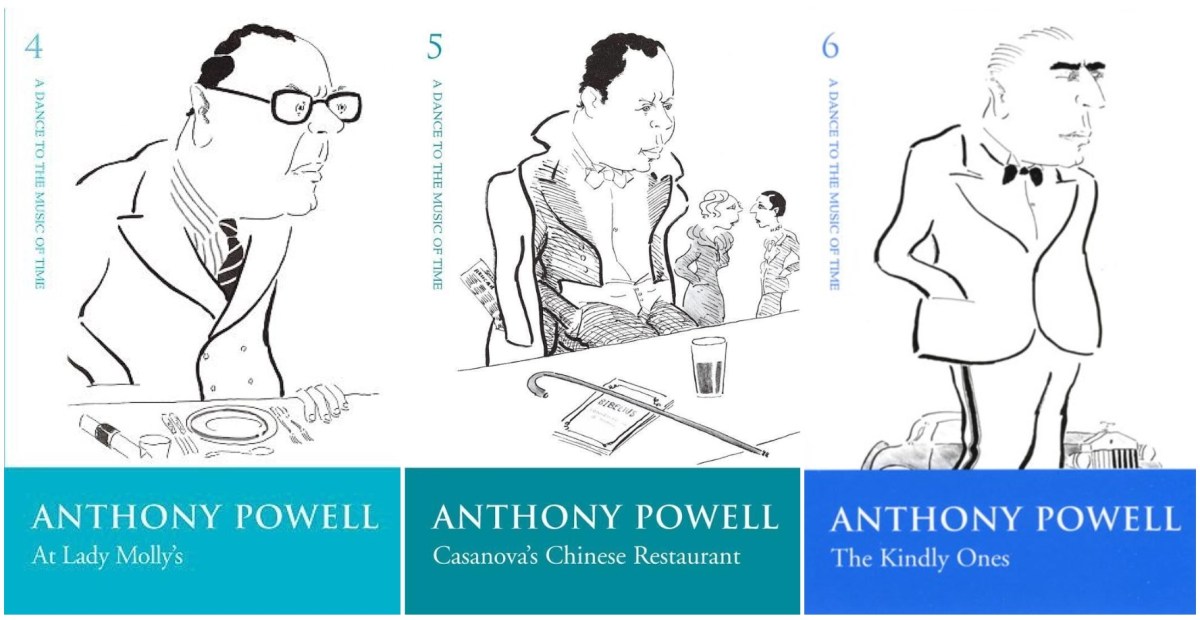
While reading The Kindly Ones by Anthony Powell, the sixth novel in a twelve-novel series called A Dance to the Music of Time, I had the constant feeling I had read it before. Several scenes throughout the novel seemed so familiar that I felt like I had studied them over several readings. I always assumed it was because I had twice watched the four-part miniseries based on the books. I’m sure that accounts for the general sense I’ve read The Kindly Ones before, but not the intense sense of remembering specific scenes. Yesterday I replayed the portion of the miniseries that deals with the most remembered scene and it merely skims over a very long detailed scene in the book.

A Dance to the Music of Time is about Nick Jenkins and his life from the 1920s through the 1960s. It’s not a Roman à clef but Anthony Powell based Nick on his own life. It’s a fictional exploration of memory, so it’s rather ironic that I’m having memory problems reading it.

There were many scenes that felt I had read before, but I just assumed they were in the miniseries. However, one scene was intensely vivid and familiar. It was the long scene where Nick Jenkins met Bob Duport years after Nick had had an affair with Duport’s wife Jean That affair was chronicled in an early novel in the series. So those pages recall events that happened in earlier novels, but it also has much new information that wasn’t in the earlier novels. The most vivid scene involved Nick wanting to avoid the subject of Jean, but Bob slowly getting around to talking about her. Bob starts describing the men he knew Jean had affairs with and what they were like. Bob kept making a case that Jean was attracted to men who were assholes and even admits to being one himself. Nick doesn’t know if Bob is intentionally insulting him or accidentally torturing him.

In recent years I have become distrusting of my memory for many reasons. The first is, memories often feel faulty. But that sense of faultiness is the kind we associate with dementia. I’m now exploring memory delusions.

I’ve read a number of books about the limitations of memory, and I’ve come to assume memories are unreliable. The best book I’ve read on this is Jesus Before the Gospels by Bart D. Ehrman. You wouldn’t think a book about Jesus would be the best place to learn about the limitations of memory, but it’s the best I’ve found.

If the television miniseries wasn’t where I acquired my pre-knowledge of that scene in The Kindly Ones, where did it come from? My first thought was to wonder if I had read the book before? I checked my reading log, a listing of books I’ve read since 1983, and it wasn’t there. Now, there have been times when I forgot to record a book read, but I don’t think that happened in this case. Why would I read the sixth book of a series out of order?

Another possibility is I listened to it in my sleep. Books 4-6 are in a combined edition on my Audible edition, a total of 21 hours. Theoretically, I could have fallen asleep and my unconscious mind heard it. This happens all the time. But I wake up, usually, in minutes, but no more than an hour, and shut off the book. I always scroll back to a scene I’m positive I listened to the day before. I’m almost positive I didn’t let this whole book play while I was sleeping with The Kindly Ones. Because of an overactive bladder, the longest stretch I can sleep at night is two hours.

I do have a wild and crazy theory. What if certain human experiences become part of what Jung called our collective unconscious? I know this is New Age woo-woo, but it’s a thought. It might explain why some people think they are reincarnated, or some instances of Deja vu.

I have two less wild theories, ones I think might be closer to the truth. One involves prediction, and the other involves resonating with tiny universal fragments.

The novels in A Dance to the Music of Time feel like an autobiography. The novel series is not a Roman clef, but they were inspired by Powell’s own life and the people he knew. I’m thinking they create such a detailed sense of Nick Jenkins, especially after six novels, that when I got to the scene with Bob, I felt like I was Nick, and the encounter felt so real that I had experienced it as if I was remembering it.

The second theory is somewhat like the basis of holograms. If you cut one up, it will still show the whole picture, just fuzzier. Even a tiny fragment of a hologram will still show the entire image, but just very fuzzy. This second theory suggests that any scene involving a man meeting the husband of the woman he had an affair with will trigger a resonating memory response. I can’t recall any specific similar scene in fiction or real life that matches this, but that doesn’t mean I haven’t and just don’t remember it.

This hologram fragment theory might explain all Deja vu experiences. Our mind remembers things in generalized tokens, and sometimes we confuse the token from one event with another. If you think about this, you’ll probably recall this happening to you. The other day I asked Susan if I had gotten the mail, and she said, yes, you got a book. I said, no, that was yesterday. I was quite positive. I even convinced Susan that it was true. A few hours later I remembered that yesterday was the 4th of July and there was no mail. I have a “got the mail” token in my brain and it makes me feel like I’ve always gotten the mail. But it’s not really specific to any single event of getting the mail.

A recent episode of 60 Minutes on Google’s AI called Bard offers another theory. Bard was asked to explain inflation, which it did, and offered five books on the subject with descriptions of the books. When CBS fact-checked that list days later they discovered the books didn’t exist. CBS asked Google about this. They were told this was an AI phenomenon called hallucination. Evidently, AIs will just make up shit whenever they feel like it. Maybe what I experienced was a memory hallucination.

Google’s Bard performed another scary feat. It taught itself to read and write in a language it wasn’t trained on, and without being asked. Maybe my brain just tricked me into thinking I had read this book before?

And there’s one last idea. Last night I dreamed of a variation of an episode of a TV show Susan and I watched last evening. The dream didn’t involve characters from the TV show, but people I know. But the dream put me, and people I know in the same exact situation. Have you ever wondered how our brain can generate so much endless dream content? What if the same mental mechanism that generates dreams also creates our memories and beliefs? What if that mechanism works like Bard?

I’ve always liked Roman à clef fiction, or fiction that is highly biographical. I’ve always been obsessed with memory. I’m ready to finally read Proust, who is the authorial authority on fictionalizing memory. Some people compare Anthony Powell to Proust, others hate that comparison. Proust fans don’t think Powell was heavy-duty enough. I think they each had their own approach to remembering their life. Powell may have been an extrovert and Proust an introvert, and the differences in their prose were caused by that and not the quality of writing. But I also think the differences involve the different ways of how memory works.

JWH

“Created by Humans” vs. “Created by AI”

by James Wallace Harris, 4/22/23

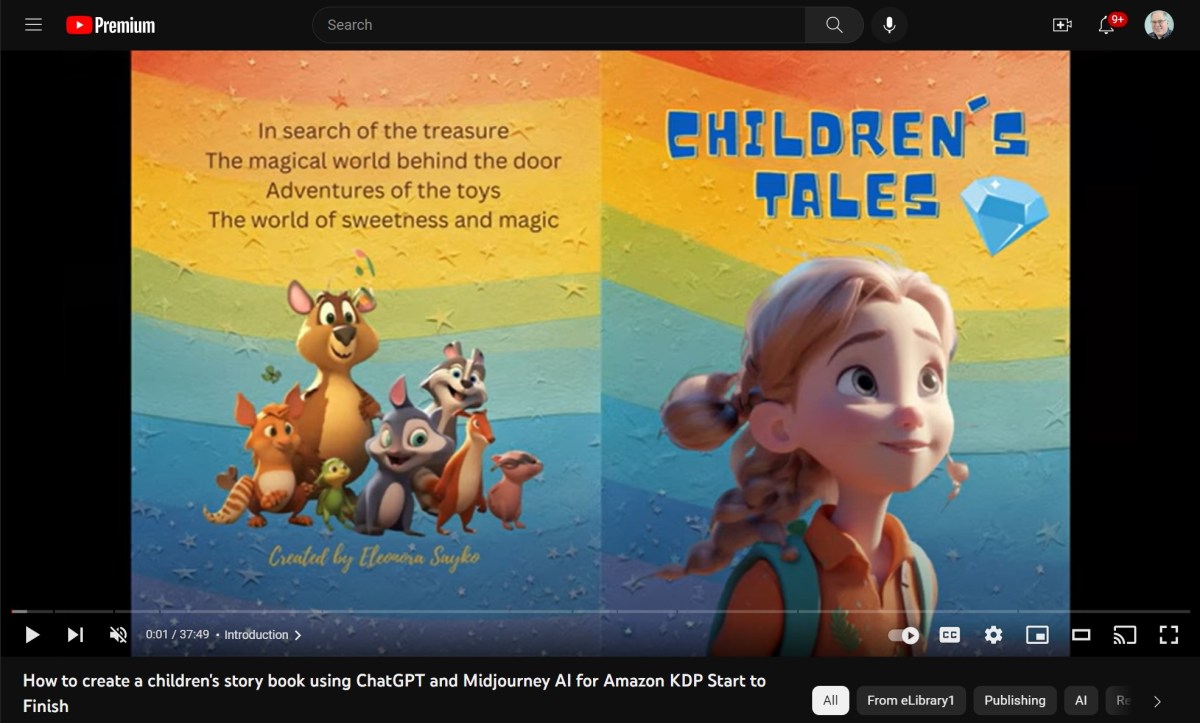
The first video I watched on YouTube this morning was “How to create a children’s storybook using ChatGPT and Midjourney AI for Amazon KDP Start to Finish.” eLibrary1 explains how she creates children’s books using AI tools.

It’s actually quite fascinating. She gets ChatGPT to suggest a series of ideas and then asks ChatGPT to write up 500-word versions of the ideas she likes. Then she tests those stories against an AI checker to show how they can be easily detected as AI-created. Then she runs the stories through another program that rewrites her stories. After that, she checks again and shows how the AI detector shows they are now human-written. Then she runs them through a plagiarizer detector to make sure they won’t be rejected for that reason. After she’s sure she’s got something good to work with she submits the stories scene by scene to Midjourney to have it create the artwork.

As I watched this video I thought about how so many people are concerned with seeing “Made in America” tags on the products they buy. I wondered if people in the future will look for “Made by Humans” or “Created by Humans” tags?

My initial reaction was I wouldn’t want to read a book that eLibrary1 created. I would feel cheated. I expect art and fiction to be produced by artists that suffered for their art. But then I thought, what if the story and pictures were better than what people produce? I’m already seeing artwork produced by AI that blows me away.

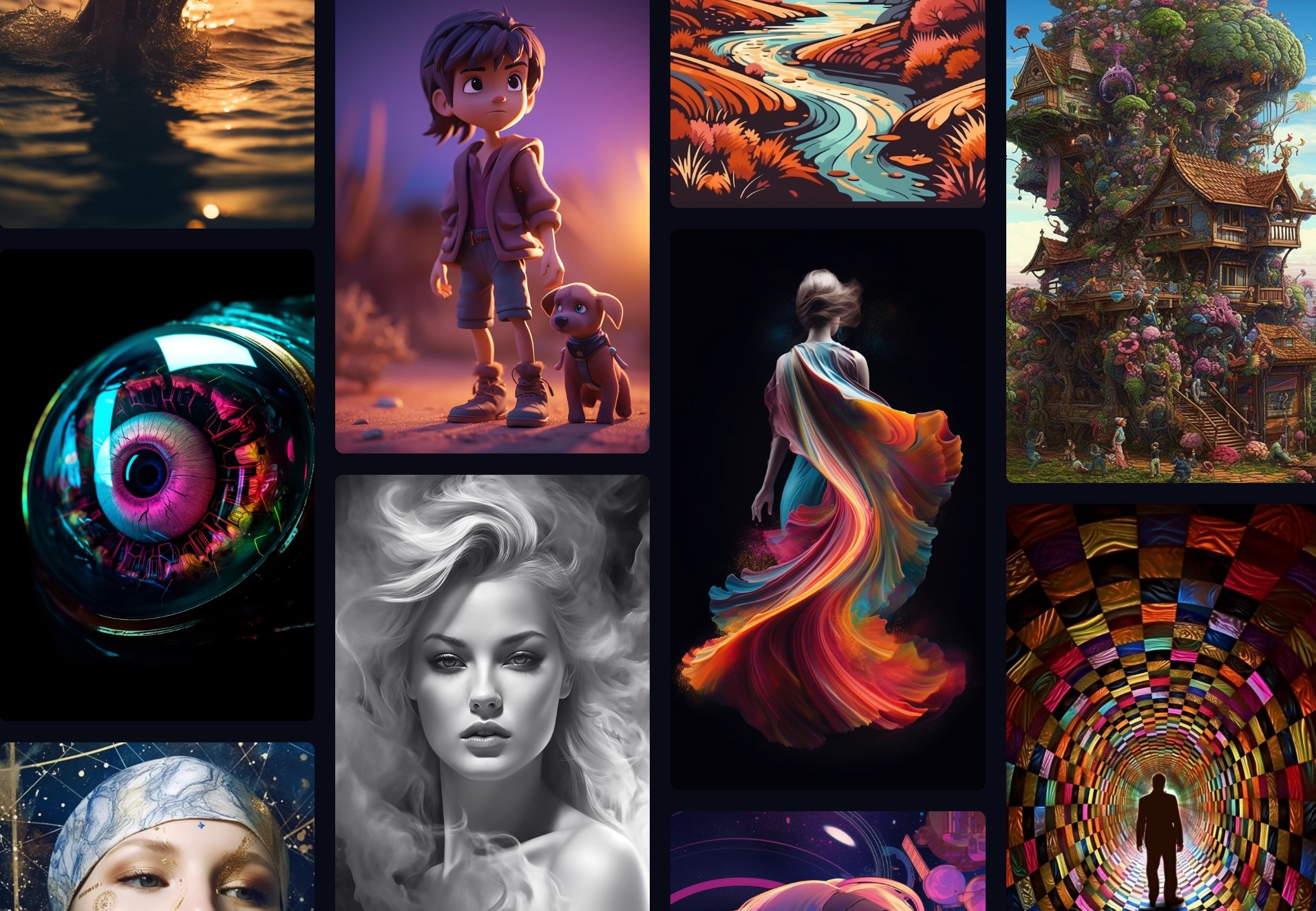
Just scroll down for a while in Midjourney’s Community Showcase.

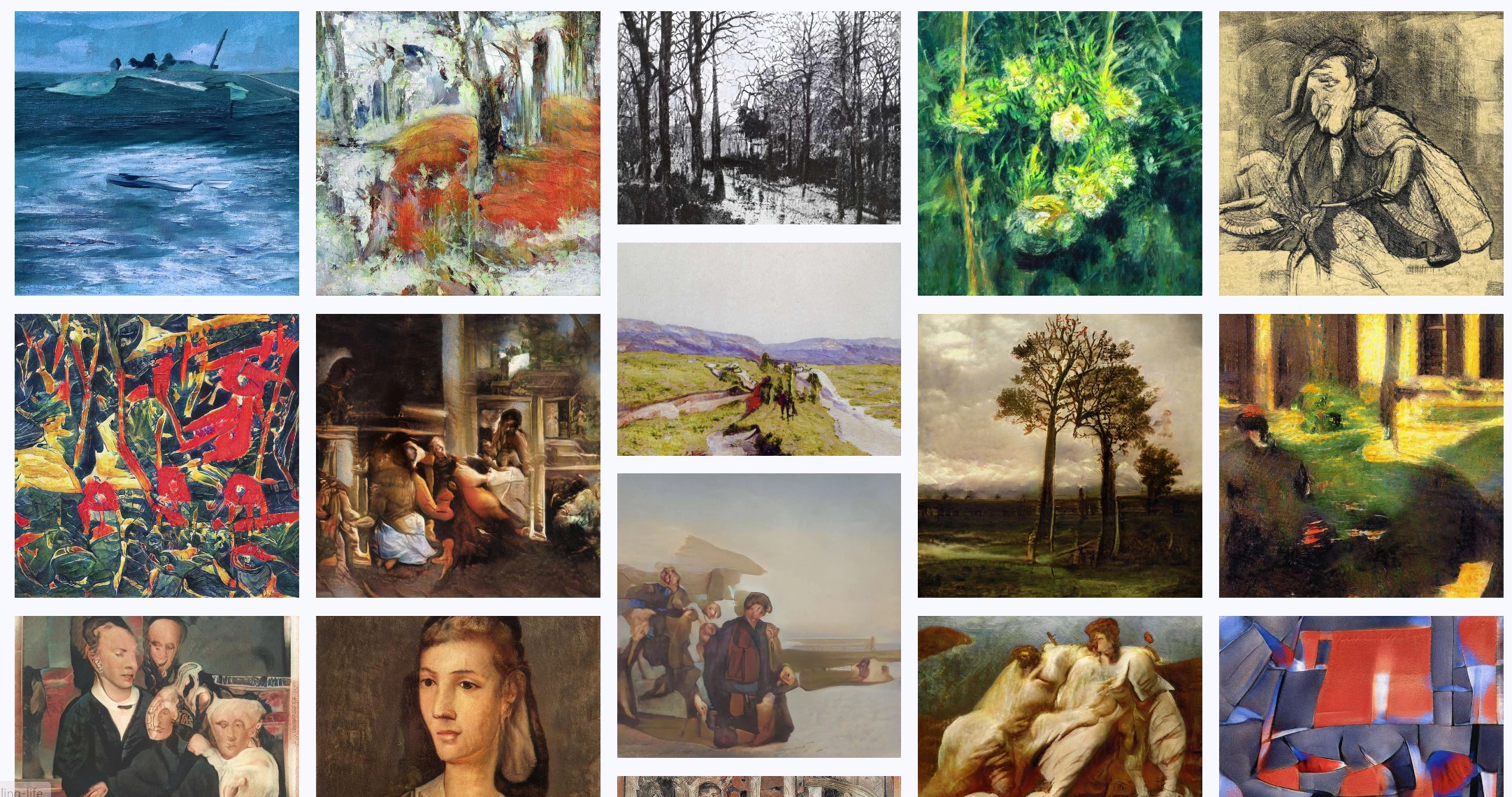
Or look at Latest Works at Art AI Gallery.

The range of what’s possible is tremendous. But then, it’s all been inspired by art created by humans. Is AI art actually creative work? Well, humans don’t create artwork out of nothing either. They have a lifetime of being inspired by other artists.

Let’s ignore this philosophical question for a moment. Let’s go back to the old idea of people “liking what they see” as a test of quality. I love visiting art galleries. I love looking at graphic art in magazines. I love looking at art books. I often buy books for their covers. And I have collected thousands of science fiction magazines, both in physical format and digital scans (but mostly digital). The reason I love them so much is because of their covers.

I’ve got to admit that AI-generated art presses the same exact buttons as art produced by humans. I have not read fiction written by AI writers, but what if I love their stories as much as I like AI art? To be honest, I believe I have a stronger psychological desire for fiction to be human-generated. What happens to that feeling if I read an AI-written novel that I like more than all my favorite human-written novels?

What I’m feeling right now is the desire to tune out the AI world. To retreat into the past, and savor the art and fiction created before the 21st century. That I want to become a modern Luddite that rejects AI machinery. But what will I be missing out on?

What if machines can take our imaginations further? Isn’t that why I’ve been a lifelong science fiction reader? Isn’t that why I took psychedelic drugs in the 1960s? Isn’t that why we admire the greatest of human thinkers?

Maybe I want to run away because I’m old and tired. One of the main enjoyments of getting old and putting up with the pains of aging is seeing how events unfold. So, why turn away now?

JWH

Reading Elizabeth Strout

by James Wallace Harris, 12/15/22

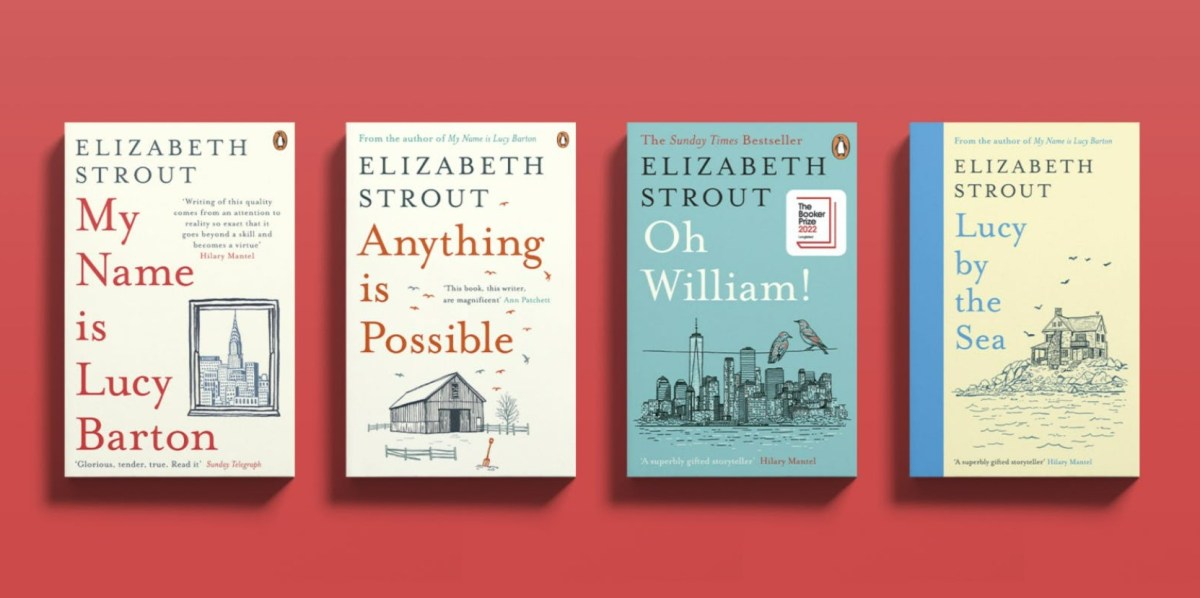
My fiction of choice has always been science fiction, but I’ve recently had my fill of that genre and started reading contemporary and literary fiction. I got hooked on the books of Elizabeth Strout and Anthony Powell. I’ve finished Oh, William! today, my sixth Strout book in six weeks, and started my seventh, Lucy by the Sea. She only has nine novels, so I will run out soon. Hopefully, I’ll be satiated and can try somebody new, but I’m hooked on her now. (Concurrently, I’m on the fifth book of the twelve in Powell’s A Dance to the Music of Time series, but that’s another story for another time.)

I began my addiction to Elizabeth Stout with Olive Kitteridge, a “novel” composed of 13 short stories. I saw the HBO miniseries based on the book years ago, but when I tried to watch the show again after finishing the book I realize it wasn’t the same experience. My image of Olive is not Frances McDormand’s version even though I liked her version very much.

I also read the sequel Olive, Again which adds another 13 stories to the Olive Kitteridge saga. We meet Olive in her sixties in the first book, and we last see her in her eighties in the second book. I’ve seldom read books about old people, but now that I’ve become old myself they have become very appealing.

Of the Strout books, I think I’m the most partial to the Olive stories, but I also love the Lucy Barton books too. There are four in that series, My Name is Lucy Barton, Anything is Possible, Oh, William! and Lucy by the Sea.

I feel both series are kind of experimental. Olive’s story is told in short stories, where some stories only have cameo appearances by Olive. Lucy narrates her story in the first, third, and fourth books, but in the second novel, we hear about Lucy from other people. I found that perspective fascinating after the first book. I listen to the books on audio, and in the books where Lucy narrates, they each feel like one long monologue. The only standalone Strout story I’ve read is Abide With Me, which has a best-seller-type third-person structure.

What’s striking about both series is the sparse, clean prose that feels like a hyperrealistic painting. I believe that’s why I like these books so much after all the science fiction I’ve been gorging on. They are hard, concrete, and mundane which contrasts sharply with the otherworldy fantasy of science fiction.

I got hooked on Strout because of my friend Linda. After I read Olive Kitteridge I started mentioning Strout to my friends and I learned that Anne (Old Anne) had already gotten hooked too. She was reading Strout in publication order and insisted that I should start over and do the same. I didn’t agree. When I mentioned to Annie (New Ann) that we were reading Strout, she wanted to read her too.

Along the way, Linda told me that she heard a Kelly Corrigan interview with Nick Hornby where she asked him what was the last book he was most impressed with, and Hornby had said Oh, William! (For now, I agree too.)

You can search online for the recommended reading order for reading Elizabeth Strout and find opposing opinions. I don’t know if it matters, even within the Olive and Lucy series. For example, if you only read Oh, William! it would work fine as a standalone novel. But I was happy that I read them in series order. Starting Stout with her first book is fine, but I feel her later books are the best.

One reason why I don’t think reading order is important is they all have the same theme. Stout likes to explore how we really don’t know each other, especially our parents, siblings, children, and spouses. And we also don’t know ourselves either. Her books inspire me to pay more attention to the folks in my life and myself. Don’t worry, they aren’t heavy. Strout succeeds with lightness.

I’ve been listening to the Elizabeth Strout books, but I liked them so much that I’ve been buying hardback copies to study. I even ordered a copy of Best American Short Stories 2013 where Strout was the guest editor. I want to see what kind of fiction she admired.

Are any of y’all fans of Elizabeth Strout?

JWH

Dang, I Broke My TV Watcher

by James Wallace Harris, 11/5/22

I seem to be losing my ability to watch television. In the past year or two, when I try to watch TV by myself, I have the hardest time getting into a TV show or movie. If I’m watching television with Susan or a friend I have no trouble settling into the show, but if I’m alone, I often abandon a show after five or ten minutes. Because I’m a lifelong TV addict used to filling my evenings with the boob tube, this is disturbing.

I’ve got sixty-seven years of solid practice watching TV, so why am I losing this skill now? Some of my earliest memories are of watching TV when I was four. I started watching television with the 1955-1956 season, but sometime in 2021, I began noticing I had a problem, maybe even earlier, but it’s painfully obvious in 2022.

The TV watcher part of my brain has broken. And it’s not for trying. Every evening I try getting into several movies and TV shows. Every once in a while, I find one that my mind will latch onto, but it’s getting rarer. So I’m developing some theories about why my brain is broken.

The Gilligan Island Effect

I loved Gilligan’s Island back in 1964 when it first aired. But as I got older I could no longer watch it. My friend Connell and I use Gilligan Island as our example of being young and stupid. Whenever I catch it on TV now I cringe and wonder how could I ever been so easily amused. That feeling is also true for The Monkees. It embarrasses me to recall those were once among my favorite shows. Now I understand why my dad used to pitch a fit when they were on, telling me and my sister we were morons.

As we age we become more sophisticated in our pop culture consumption. I assumed that development stopped when I got into my twenties because I pretty much watched the same kind of shows for the next several decades. However, with The Sopranos, TV jumped a level in sophistication, and for most of the 21st century, I’ve been consuming ever more sophisticated TV content.

What if my TV-watching mind has gotten jaded with all TV? So everything now feels stupid like Gilligan’s Island did when I got a couple years past twelve?

The TV Buddy Effect

As I said, I can watch all kinds of TV shows and movies if I’m watching them with other people. And looking back over my life I realized I watched a lot of TV with other people. With my family growing up. With friends when I was single. With Susan for most of my married life. With my friend Janis when Susan was working out of town Mondays through Fridays.

When Susan retired and Janis moved to Mexico, things changed. Susan now wants to watch her favorite TV shows from the 20th century and I don’t. So she sits in the living room with her TV and cross-stitches while watching endless reruns of her favorite shows. She likes old shows because she doesn’t have to look at them while she sews. I sit in the den and try to find something to watch on my own. Over the last few years, I’ve had less and less luck until I’m starting to wonder if I can’t watch TV alone at all anymore.

Susan and I do watch some TV together. Around 5:30 we watch Jeopardy and the NBC Nightly News that we record. It’s a family habit and the cats sleep in our laps. On Wednesdays we watch Survivor.

This year I was able to binge-watch Game of Thrones. I had watched it as it came out, and when two of my friends living in other cities each expressed a desire to rewatch the entire series I joined them. I discussed each episode with Linda and Connell in separate phone calls.

The YouTube Effect

Let me clarify something. I can watch about an hour of YouTube a day, and I can channel surf trying to find something to watch for another hour. (By the way, that drives Susan crazy. Another reason she likes watching TV by herself.)

My dwindling ability to watch TV has coincided with my growing love of watching YouTube TV. I have to wonder if watching endless short videos and constantly clicking from one subject to another has broken the TV watcher in my brain, so I can’t stick with longer shows.

The Relevance Effect

Last week I binge-watched A Dance to the Music of Time, a four-part miniseries based on the twelve-novel series by Anthony Powell. I had seen it before, but because I was now reading the books I wanted to watch it again. That seems to suggest if I have a good reason to watch television that I have no problem sticking to a show. My mind isn’t completely defective. I’m now on the fourth book in the series, and I’ve bought a biography of Powell and a character concordance to supplement my reading. The series has over 300 characters.

Knowing the Magician’s Tricks Effect

Another theory I’ve developed deals with my studies in fiction. As I read and think about how fiction works, I’ve paid more attention to how movies and television shows are constructed too. I’ve noticed that I often quit a movie or TV show when I spot the puppeteer. I can hardly stand to watch a mystery or thriller nowadays because they seem so obviously manipulated.

Male Aging Effect

I remember now how my uncles as they got older stopped watching TV except for sports, and even then, still not often. My male friends stopped going to the movies years ago, and I’ve finally stopped myself. I’m now doing what Susan and I used to laugh about her father – going to sleep in his den chair after dinner. Since we bought Susan’s parent’s house when they died, I’m going to sleep in the very same den, around the very same time – 7:30.

Conclusion

Because I sometimes find shows that hook me, I figure my TV watcher isn’t completely broken. I do worry that it will conk out completely. Right now I spend my evenings listening to books or music, and I worry that those abilities might break if I overuse them. I’m thinking my TV watcher needs new kinds of TV content to watch, but I have no idea what that would be.

With so many premium channels cranking out so many kinds of quality shows for the last two decades, I worry that they’ve done everything to death. One reason my mind responded so well to YouTube is the content is very different from regular streaming TV content. But I feel like I’m about to reach the end of YouTube too. I’m starting to think TV shows and movies are like clickbait, that once you’re used to all the variety of bait, you become jaded and stop clicking.

JWH

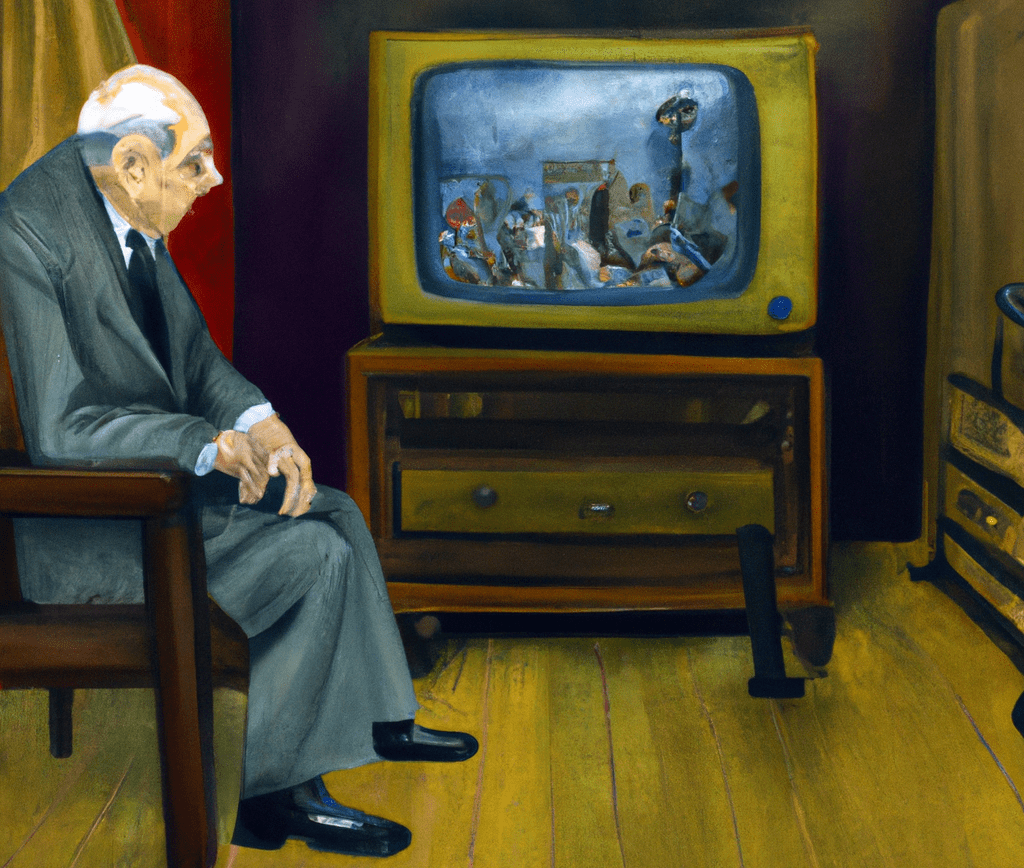
p.s. I’m using DALL-E 2 to generate the art for my blog.