What Would Have Made Me Want To Study as a Schoolkid?

by James Wallace Harris, Friday, August 23, 2019

I considered my K-12 education a 13-year prison sentence. I did my mediocre best getting mostly Cs and Bs, with rare As and Ds. My good grades didn’t reflect my ability but showed what I was actually interested in. I had a lot of great teachers that tried hard to get me to learn, but I didn’t cooperate. I wish to apologize to all of them now, especially my 12th-grade math teacher. I just didn’t want to pay attention, study, or do homework. Life was full of fun diversions and I found no incentive to make the most of my school years.

I regret that now and it’s really pointless to worry about it now, but it is an interesting problem to think about solving. How do you get kids to want to study? A certain percentage of children respond well to traditional classroom learning, but most don’t. When I’m shopping in used bookstores I look at K-12 textbooks and I’m horrified by how much crap they want to stuff in a young person’s head.

Part of the problem is society wants kids to acquire proficiency in a specific set of subjects before they’re 18. Then they up the ante by a couple of magnitudes for higher education. Before you can start life you have to be programmed with 400,000 facts. We’re told we need that many factoids to succeed in life but I doubt many believe it. I always considered it cruel and unusual punishment. I never knew what crime I committed to deserve such torture.

And it’s not like I didn’t enjoy learning as a child. I was a bookworm from the 4th-grade on, reading several hundred books while serving my K-12 time. I just didn’t want to read the books teachers wanted me to read.

I don’t know if I was a typical child. But I’d guess most kids didn’t like the system either. I’ve often thought about what if I could have designed my own pedagogy. It’s a fun thing to fantasize about. Try it and post a comment. I have come to some conclusions for me only, not a general system.

  1. The most important thing I should have been taught as a kid is about the world of work and how I’d spend forty years doing something that I could either like or dislike. I needed to learn as early as possible if I didn’t find my right vocation I’d spend those years in quiet desperation at best and crushing resentment at worse.
  2. I needed to have been shown by experience that there are many kinds of tasks and work environments. After high school, it took me several jobs to realize I preferred working inside rather than outside. I eventually learned I rather work with machines than people, but I liked an environment with well-educated people, and tasks that produced something useful to humanity rather than the bottom line. And I didn’t need to be the boss. I’m pretty sure I could have learned all of that in grade school.
  3. I learned too late in life that I loved science and technology. Again, I can imagine ways to get kids to learn subjects they like while they are still in grade school. It might require spending some classroom time in real work environments.
  4. What I sorely missed was a real incentive to study. I was told an education led to a good job but I never knew what a good job meant. I think study incentives need to be more immediate. I think the goal of being freed from classes would have been the incentive that would have worked for me. In other words, tell me the week’s goal. If I can finish by Thursday I could have Friday off. If I could finish in four weeks of a six weeks period, I could have two weeks off. If I could finish the year in March, I could have a long summer. Or even, if I could finish at 14 I could bum around for a few years before college. That would have inspired me to study harder. (I know that K-12 schools also serve as babysitters, so being freed from classes might mean more library days, or sports, or clubs, or other school activities. Although I wanted to be out on the streets or at home.)
  5. For such a finish-early system to work we’d need to carefully define and quantify what needs to be learned. Right now schools are one-size-fits-all. Not every kid wants to learn everything every other kid learns. Society needs to decide what subjects form a basic education, and what should be electives. We should find creative ways to test everything. Educators have gone nuts with cultural literacy.
  6. Society is discovering all kinds of learning and teaching methods. They didn’t have personal computers when I was little. But I think if they did I would have learned best in the classroom and taking quizzes at night on the computer for homework. If testing had been more like computer games and trivia contests they would have been fun. Competing for high scores would have pushed me, but grades never did in the least. If every subject had a rating like in chess, that would have been fun.

I’m curious if anything could have motivated me to study as a kid. It’s too bad we don’t have time machines. It would be a fun challenge to go back in time and see if could motivate my younger self.

Uh, maybe that’s an idea for a science fiction novel.

JWH


I Haven’t Studied Biology in a Classroom Since 1967

by James Wallace Harris, Friday, January 5, 2019

How old is your knowledge? That question can be taken in two ways. The years since the last time you studied a subject, which for me and biology is 52. Or, the age of the subject itself. For example, Euclidean geometry is two thousand years old. And dating the ages for either isn’t precise. I’m sure when I studied biology in the tenth grade (1966/67) my textbooks were not up-to-date, and far from chronicling the current discoveries in biology. Thus, my simple-minded memories of cell structure might be about two hundred years old.

In the first third of life, we go to school and college to prepare ourselves to be functional adults for our middle third of life, but how much do we need to know for our last third of life? What is a useful education for our retirement years? I certainly could sneak by without knowing any more biology, but should I?

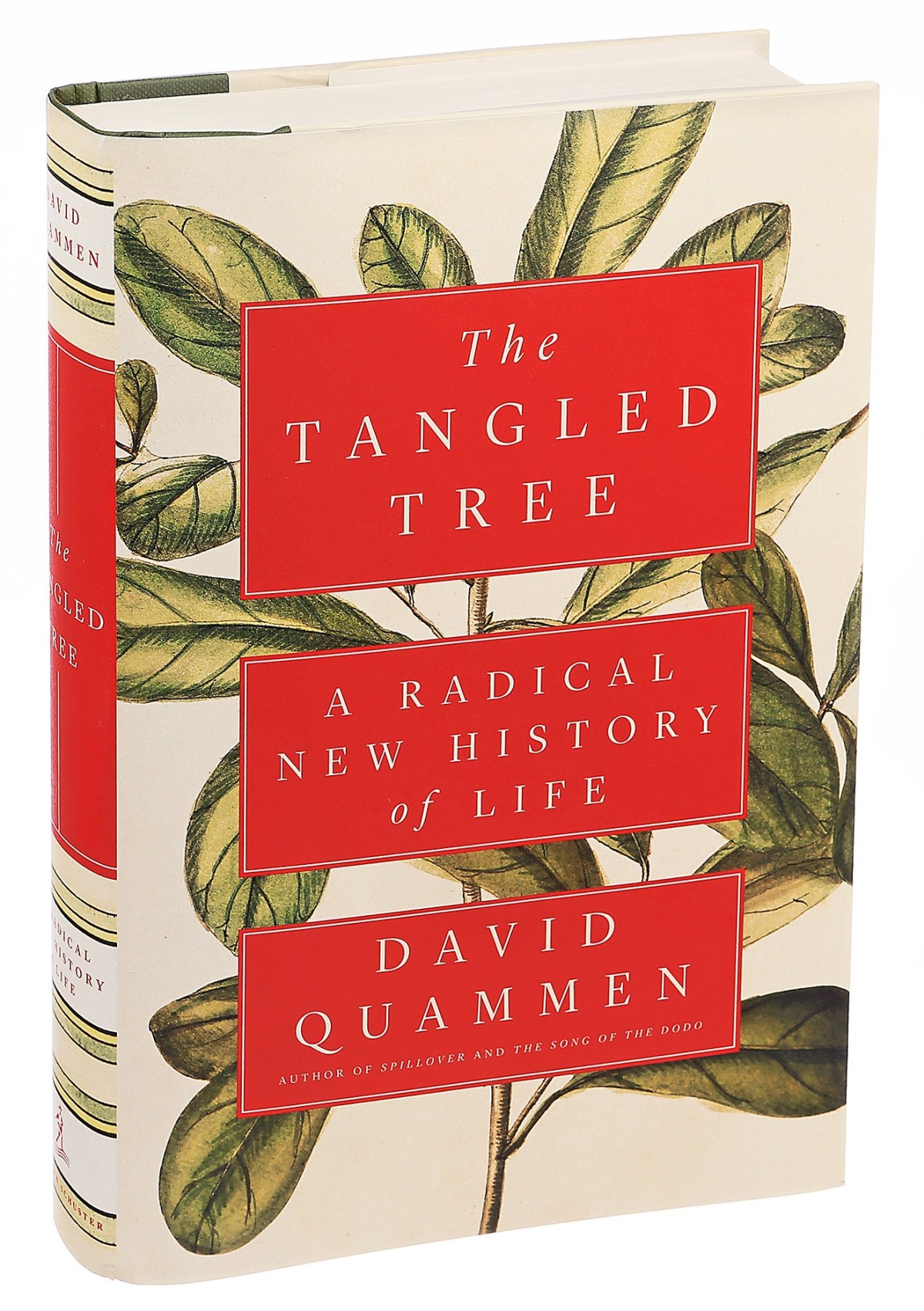
I’m reading The Tangled Tree: A Radical New History of Life by David Quammen for a book club. Reading it makes me feel ashamed of how little I know about biology while blowing my mind with new information. It makes me wonder just how current my knowledge should be in various important subjects, subjects that help me understand my place in reality. Just because I might be leaving this reality soon, doesn’t mean I should fall into oblivion knowing so little.

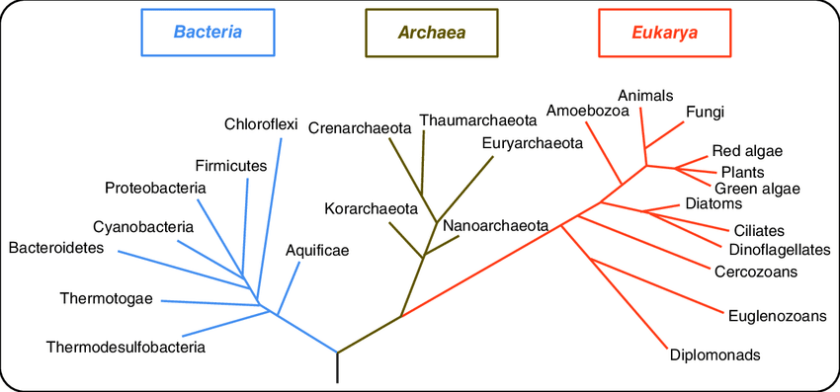
universal-phylogenetic-tree-showing-relationships-between-major-lineages-of-the-three

The Tangled Tree starts out by announcing “recent” discoveries in biology, such as horizontal gene transfer (HGT) and the third domain of life called archaea and how they are disrupting our old image of an evolutionary tree structure, thus the title of his book. Both discoveries occurred after my last biology class. I had heard of archaea since and seen the graph above. I’ve read about prokaryotes (bacteria) and eukaryotes (plants, animals) but I couldn’t remember those labels. They say to really learn a subject you should be able to teach it, but I could only confuse small children with the vague ideas about biology.

Of course, I’m not totally ignorant of later biological developments. I regular watch PBS Nova and Nature, and over the decades read books like The Double Helix, The Selfish Gene, and a few popular books about the history of evolutionary theory, but they don’t require the same kind of learning that taking a class does. To really know a subject, even at a fundamental level requires knowing the words that describe it. As an adult, I’ve read many books about physics and astronomy, so I know some of their vocabularies, but I know very little of the terminology of biology. Quammen describes many fields within biology that are new to me, like molecular phylogenetics. I’m savvy enough to know what molecules and genetics are, and I could guess that ‘phylo’ concerns their taxonomy, but I’m totally clueless about how scientists could go about classifying these wee bits of proto-life.

Before jumping into the work of Carl Woese, Quammen succinctly describes the history of how the idea of evolution emerged in the 19th-century with various scientists using the tree metaphor to illustrate life emerging out of an orderly process. And he gives passing references to those scientists that developed taxonomy systems to categorize all living things. This lays the groundwork for understanding why Carl Woese wanted to develop a tree model and taxonomy of bacterial life.

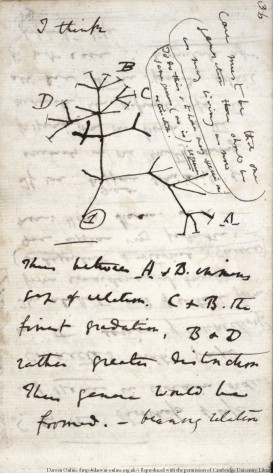
1837_notebookb_cul-dar121.-_040Quammen grabbed my interest by describing how 19th-century scientists first started drawing trees to describe their theories. He even describes a page from Darwin’s notebook saying his first tree was rather simple. I was shocked when I saw it though, it was too simple looking, but the basic idea is there. I’ve vaguely remembered seeing this before, but to be honest, I’ve never tried to learn all of this information in a way that I’d memorize and use it. I put my faith in science, in evolution, but I know very little of the actual science. What I know probably compares to what the average Christian knows about this history of Christianity.

This got me to thinking. Should I study biology before I die? I doubt I’ll need it after death since I’m an atheist. So, what should my educational aspirations be in my retirement years? I’d like to pass from this world knowing as much about reality as possible. Why leave in ignorance? Why live in ignorance? There’s no meaning to our existence, but why not try to understand our situation to the fullest extent possible?

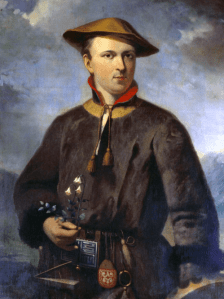
linnaeusWe’re a bubble of consciousness that has accidentally formed in reality. That’s pretty far out. Most of the matter in this reality is unconscious stuff like subatomic particles, atoms, molecules, and a smidgeon of biological living things. Reading The Tangle Tree makes me want to do more than reading over the subject and forgetting it again. Like Linnaeus, I want to organize what I should know into categories, into a Tree of Knowledge I Should Know. But I realize I am limited by time and energy – the time I have remaining to live and the dwindling personal energy I have each day.

How would I even go about studying the subjects I deem time worthy? I do have access to free university courses. And there are countless online courses, and I already subscribe to The Great Courses on my Amazon Fire TV. I could pick out some standardized tests for my goals, and thus limit the scope of what I want to learn. Or I could start studying and then try to teach what I learn by writing essays for this blog. That sounds more doable.

Other than the history science fiction, I don’t think there’s a single topic I could teach. I’m not even sure how many other topics I’d like to study — at any level. I do feel a sense of challenge that I should work on biology. At least for a while. Maybe read a few books on the subject this year. Maybe take a Great Course.

That makes me think I could choose a topic each year to study. I can’t promise much, but I think I should try.

Thus I declare:  2019 is the year to learn about biology.

JWH


Breaking the Cognitive Decline Barrier

by James Wallace Harris, Sunday, September 16, 2018

2008-2018

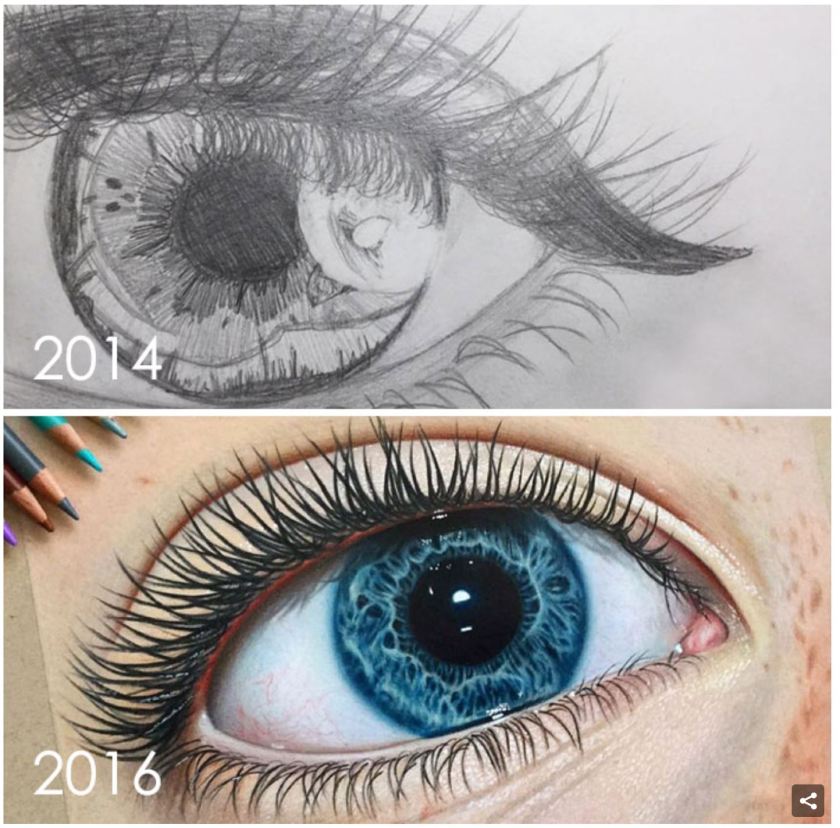
The above two drawings by Grace Murray were taken from “20+ Artists Challenge Themselves To Redraw Their Old ‘Crappy’ Drawings, Prove That Practice Makes Perfect.” They are an example of cognitive increase. Murray’s mind/body skills have progressed over time by an amazing degree. We seldom see such perfect proofs of cognitive progress. I highly recommend everyone visit this site and look at all the before and after drawings – there are now 14 pages of them. Parents and teachers should use this site to show their kids and students.

What I want to talk about is cognitive decline. I am not a scientist, and I am not using this term in a scientific way. I’m appropriating the phrase “cognitive decline” temporarily for this essay. For my purposes, it means both the mental and physical decline in our countless abilities. I believe our mind and body are a single unit. How well our mind works is dependent on the well-being of its integration with our body.

I have a friend that is worried about cognitive decline and wanted a baseline to measure against. I thought that was a fantastic idea. I’m not sure doctors can easily provide medical diagnostics to do such a job, nor do I think we can easily invent one on our own. My theory is we each need to keep an eye on ourselves and develop a series of baselines to follow over time. We have to become our own psychologists.

The baseline I want to describe is the ability to apply myself to a task and improve. It’s exactly what Grace Murray is doing with her drawing skills. I would like to believe that at age 66 I can still learn a new skill and show improvement over time. However, I struggle to do this. There is a barrier that I can’t break through. But I don’t believe it’s age-related per se. I’ve always had trouble applying myself to a task. I give up too easily. The baseline is not the skill, but the willingness to work at a skill.

Persistence pays off. That’s what the article about how artists show improvement over time reveals. They keep practicing and improving. The first cognitive decline barrier benchmark I want to observe in myself is that quality that makes me keep working to improve. That’s a very slippery target. My theory, as we age, we give up trying. We fall back on comfortable routines, rationalize the enjoyment of our indulgences, tell ourselves we can’t do it anymore.

This is not the only baseline I want to track. I’m noticing plenty of problems with myself, but this benchmark is a critical one to me. Most of my friends tell me they struggle to remember words, especially names. And again, we laugh about how those names pop up hours later. It’s like we haven’t forgotten but just can’t find our memories right away. Could we also improve our recall ability with persistent effort?

And it’s not just memory. We make fun of ourselves for not being able to do physical things that we once found easy to do. And we compare the times we’ve fallen or left the car keys in the refrigerator. Getting old is loads of fun when you can laugh at yourself, but it can be mentally wearing. We can even give up on fighting the good fight.

The worst thing about my cognitive decline to me is giving up. It’s so easy to just let things slide, or tell myself I can’t do that anymore, or accept I’d rather take a nap than do something on my To Do list. Most telling to me is not finishing what I aim to write.

I’ve been thinking about the nature of cognitive decline. I’m not sure, but I think we’ve always experienced it our whole lives, at least at times. I remember being young and tossing in the towel when things got hard, or struggling to recall words for a test, or being mentally impaired on dope or drink. I remember days when I could convince myself to jog five miles instead of my standard two but on other days set out to run five miles and only make two.

Cognitive ability depends on a lot of factors. When we were young, healthy, rested, well fed, we felt like we could do anything. As we age, and our body wears out the cognitive decline barrier changes. Stress is a huge factor. Like the sound barrier varying with altitude and temperature, cognitive decline varies with health and stress.

I’d like to believe I’m not too old of a dog to learn new tricks. I feel by writing this essay I’ve discovered something I can track and work at. Will I make the effort? That’s the cognitive decline barrier I have to break through.

Just look at these amazing next drawings. It tells me people can learn a lot in two years. Could I do the same thing from 66 to 68?

2014-2016

Art by DVO

What made this woman stick with drawing eyes until they are so vividly real looking? I’m only guessing here, but here’s what I think. She’s willing to work at the task for hours on end. She’s willing to study tutorials and acquire a large library of techniques that she’s programmed into her mind/body with that practice. I’d also guess she works with tutors or teachers that can critique her work. She’s also willing to forego other pursuits and interests and focus on this task as her primary ambition. Being young is probably a significant factor, but I’m not sure how critical it is. Can older folks learn to draw this well if they make the same effort?

The difference with being older is having the energy and stamina to work at anything for hours. But there’s also a difference between giving up completely, and working an hour at a time.

Since high school, I’ve dreamed of writing science fiction stories. I’ve taken a number of writing classes and even spent six-weeks at Clarion West. I’ve finished dozens of unpolished, unsold, stories, and a couple crude novel drafts. I have not succeeded in my dream because I haven’t stuck to the work. I haven’t taken my stories from 2014 to 2016 like the drawings above.

I wonder if I worked at writing short stories again could I make myself persist? Could I show improvement over time like this artist? Am I just too old? Or is the cognitive decline barrier too great to break through at 66?

Saying one of my baselines is the failure to finish is rather vague. If I can return to churning out 12,000-word stories of the same quality as before, then I haven’t declined. If I can’t, I have. What I’m really interested in, is if I can actually improve like DVO. Not just write a better story, but improve my baseline on trying, on being persistent?

(Writing this essay took more persistence than usual. That’s a good sign.)

JWH

Creative Blogging

by James Wallace Harris, Sunday, January 7, 2018

Events in my life are leading to a perfect storm for writing about blogging. I’ve been discussing blogging with my friend Laurie who is a professor of reading. She plans to include blogging in a course she’ll teach this spring. Laurie introduced me to the idea of multi-genre research papers, which is an alternative to the five-paragraph essay used in high schools. She was asking me about blogging because she wanted her students to use a blog for their progress reports. When I heard the concept of multi-genre writing I immediately thought of blogging because blogging is at heart multi-genre, or at least in the way these academics are defining the term. Blogging is both multi-media and multi-genre. I’ve been trying to convince Laurie that her students’ multi-genre research papers should be blogged.

Michel_de_Montaigne

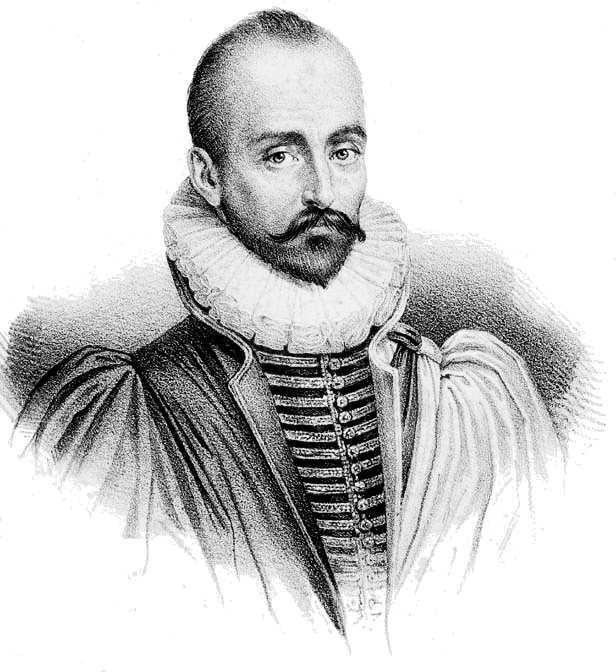
Concurrent with this I’m reading for my nonfiction book club How to Live: Or A Life of Montaigne in One Question and Twenty Attempts at an Answer by Sarah Bakewell. Michel de Montaigne is legendary for developing the personal essay, and he has inspired countless readers and writers for centuries. Montaigne should be considered the Patron Saint of Bloggers. Montaigne retired early and became a contemplative, developing a personal philosophy by writing about his experiences. [Here’s an excellent essay, “Translating Montaigne” to help you find a copy of his work to read.]

And I just got The Sense of Style: The Thinking Person’s Guide to Writing in the 21st Century by Steven Pinker. Pinker is a cognitive scientist and approaches writing and grammar through studying how the brain works at communication. Pinker realizes that we all read and write differently since we’ve all moved online. I’m anxious to dive into this book because I want to scientifically and systematically improve my blog writing.

Then there’s the book I read last year, The Art of Memoir by Mary Karr. She combines teaching writing with understanding memory. Writing the personal essay is all about recalling details when our brains are very poor at remembering. We constantly trick, lie, and delude ourselves, and learning why is both psychologically rewarding and artistically challenging. Contemplating the limits of memory is a fantastic tool for understanding how to write.

I’ve written two essays recently about blogging, “Blogging in the Classroom” and “Using Blogging to Accelerate Learning.” What I’m advocating is we start requiring children to blog their school work to teach them about reading, writing, memory, thinking, and history. Essentially what I’m asking is everyone become a Michel de Montaigne to write their personal history. I also expect them to be historians, teachers, preachers, scientists, philosophers, naturalists, and so on, to write about the world at large too. For example, here is Peter Webscott’s “Reading the world – visiting Montaigne’s Tower.” It is an example of a multi-genre essay about visiting Montaigne’s house. This kind of writing is how we should explore our personal experiences and thoughts, and blogging is how we can save those insights for a lifetime.

Creative blogging should be our tool to write our autobiography, one that is preserved, even after we die. Creative blogging is how we should communicate our deepest thoughts to our family and friends. Only the closest people to you will ever take the time to read your blog. Learning who they are is revealing. Blogging has the beautiful side-effect of showing which of our interests bores other people. That will probably scare you. Learning to know what you care about most and how much your friends and family care about what’s important to you is quite enlightening. It teaches how you are unique. It also teaches you how you overlap with other people, and that’s the key to friendships.

I also wrote this a couple years ago, “77 Things I Learned From Writing 1,000 Blog Essays.” Strangely, painful truths are wonderfully educational. I could probably come up with 177 things I’ve learned from blogging today. It keeps growing.

JWH

Reading Mentors

by James Wallace Harris, Wednesday, January 3, 2018

Years ago, after reading Outliers by Malcolm Gladwell I contemplated how my life had been shaped by not having a mentor growing up. Looking back now, I see I had mentor-like encounters. My reading was guided by random external influences and that worked as a kind of mentorship. We expect teachers to be mentors, but they can’t, not really, not with so many students.

This is going to be a long essay to explain how I select books today to read and why. I feel compelled to jump back and write a history of my evolution of discovering what to read. Looking back, I wish I had known right from the first that some books are significantly better than others — that I should seek out the best. I also wish I had read from a wider range of subjects — that I could have had far more favorite subjects. And I wished I had learned at an early age that some books can be like junk food — making me addictive to empty calories.

Society expects schools to pick the best books for children, but I always rebelled against their choices. How can we raise kids to be better book selectors?

Bookstore reading

Can teachers ever select books perfectly customized for the individual student? How can teachers avoid turning off students by promoting the reading of unrelatable classics? How can parents and teachers overcome the urge to make kids read the books they loved so passionately but might not be relevant to their children’s lives? If only one book is taught in any given class period what are the odds that all the students will respond to it? Is the goal to teach reading – the ability to decipher fiction and nonfiction – or to teach kids how to find the right book that will provide them cognitive maps to reality? Are kids ever taught the dangers of reading? Are they ever warned that books can become a crippling addiction? Are they ever taught that books can spread dangerous beliefs, delusions, prejudices, hate, and lies? I wished I had learned those things early on.

It has occurred to me that how I found books have always influenced what I read. And what I read has always determined the direction of my life. Thus, I need to be more careful with how I find books. If you are not a bookworm you probably won’t understand this insight. Back in 1971 when I first took a computer course they taught us this acronym: GIGO (garbage in, garbage out). Before that, I remember hippies preaching, “You are what you eat.” From this, you might assume I’m about to write an essay on “You are what you read.” However, I’m going to take one step back and write, “You are what you find to read.”

The first book I can remember is Treasure Island by Robert Louis Stevenson. My mother read it to me in the third grade (1959/60) after I had seen the film version with Wallace Beery. If my mother had chosen a different book for me I would have followed a different path as a bookworm? Both my parents were readers of tattered paperbacks. I remember mother reading Perry Mason and my father reading Mickey Spillane. Neither encouraged me and my sister to read. I guess they assumed our teachers would do that.

Evidently, at the end of the third grade, my teacher told my parents I had a reading problem and should attend summer school for reading. I vaguely remember going to a small, wedged shape room, probably a large closet rather than a classroom. The teacher told me to find a book and start reading. I went over to a twirling wire rack and found a small paperback titled Up Periscope. I started reading. It turns out I could read just fine. I don’t remember the summer school teacher ever giving lessons or even talking to him again. I was just bored by what they made us read in class. That twirling rack was an important book mentor and changed the direction of my life. The lesson I learned was I could pick my own books.

Starting in the 4th, 5th and 6th grades what I chose to read was determined by the school libraries and the physical locations where I came to browse. I was my own reading mentor. I remember always going to the beginning of the A’s of the kid’s section at Homestead Air Force Base Library in the 5th grade (1961/62). That got me reading Tom Swift (Appleton) and Oz books (Baum). Eventually, I worked up to the Hardy Boys (Dixon). I would have tried a greater variety of books if I hadn’t gotten hooked on series.

My sixth-grade (1962/63) teacher, Mrs. Saunders was the first teacher to be a book mentor. She’d read us books after lunch. I remember her starting A Wrinkle in Time by Madeleine L’Engle and me rushing to the library after school and checking out a copy to finish on my own.

When I started the 7th grade (1963/64) at another school I found When Worlds Collide (Edwin Balmer and Philip Wylie) again by browsing the beginning of a range. That simple routine was a reading mentor of sorts. By then I’d range up and down the alphabet looking for the kind of book I liked. I’d read a lot of so-so books. Books were like television or cookies, I consumed them as fast as I could. They were a commodity. I didn’t know there were great books. That’s when I could have used a reading mentor most. If only someone had only shown me how to find purpose in reading, rather than using reading for cheap thrills. If only a wise reader had shown me how to compare books to reality, or taught me about the quality of writing.

At this time I was fixated on space travel and biographies. I read for vicarious adventure. I found a numbered series that published cut-down biographies for children. I remember reading books about Ben Franklin, Aaron Burr, PT-109 and John Kennedy, and Blackjack Pershing. The numbered series acted like a mentor to me because I wanted to read them all. It also showed me that some people are more interesting than others, worthy of being written about. I wish I had had a reading mentor that that taught me that living is better than reading. On my own, I decided reading life was superior to real life.

In the 6th and 7th grade, my schools gave us order forms for Scholastic Books. I still didn’t know there was a genre called science fiction but I was drawn to science fiction books. Because of Scholastic Books, I discovered Jules Verne and H. G. Wells (too far down the alphabet to discover on my own I guess). These were the first books I bought after begging my mother to write a check. This was my first taste of owning and keeping books. I wish I had had some way of knowing what the other books were like on the Scholastic list. This was my first time I encountered a book list or publisher’s catalog. In a way, the Scholastic sales flyer was a kind of reading mentor.

Scholastic Order Form 1963

If I had found different books in the As and Bs at Homestead Air Force Base Library I could have taken a different path. I picked the Oz books because of the annual showing of The Wizard of Oz on television. Now that I am older I sometimes wish I had not started down the path of fantasy stories. I can see now that I didn’t pick what I chose to read. My tastes had already been shaped by television, which makes it another kind of mentor.

The first person to truly influence my reading was my 8th grade (1964/65) teacher. I’m sad I can’t remember her name because she was very important. She had an approved reading list. To keep the grade we earned from tests during each six week period we had to read three books, three magazine articles, and three newspaper articles — otherwise, our grade was dropped one letter. We could raise our grade each period if we read five of each. Eighth grade was the year I struggled with grammar, so I was able to turn my Cs into Bs by reading. This teacher is memorable for two reasons. She introduced me to Robert A. Heinlein and got me to read books other than science fiction. She also taught me library research and how to make bibliographic lists. This teacher couldn’t be a personalized reading mentor to all her class sections, so she worked out a method of inspiring reading and allowing us to choose our own books from an approved list.

Because I asked a librarian about Heinlein, I was shown the adult science fiction section at the Homestead Air Force Base Library. It was small, only two half-height bookcases of four shelves each. Those shelves shaped my reading for a year. Again, a limited set of books becomes a reading mentor.

In the 9th grade (1965/66) I started earning money mowing lawns and babysitting. This got me into buying albums and books. Having money and a bike let me ride to used bookstores. Because I was a science fiction fan I mainly bought books from the science fiction section. I could only afford cheap books. I mainly bought ten-cent used paperbacks that were very old. That limitation was a kind of reading mentor. I mass-consumed science fiction paperbacks from the 1950s. Even today I realize that shaped my personality more than anything else.

It’s a shame I didn’t know better. I should have read more widely. In junior high, I did branch into nonfiction reading books about science, nature, space travel, exploration, history, maps, sailing, etc., but it was still a limited focus.

In the 10th grade (1966/67) I joined the Science Fiction Book Club. This defined my reading for years. Also in the 10th grade, while going to school in Mississippi that only required 16 credits to graduate, I had two library study halls in a six-period day. Science fiction was rare in Charleston, Mississippi, so I began reading more nonfiction.

In the 11th and 12th grade I worked and went to school so I stopped watching television and got little reading done. (This also became true after I got married and worked full time.) Being a bookworm requires the luxury of time.

In the 1970s while in college, I joined the Book of the Month Club and The Quality Paperback Book Club. This broadened my reading somewhat. So these book clubs became reading mentors. Book clubs allowed me to acquire hardbacks at a discount, but the two monthly selections also became a reading mentor too.

By this time I was regularly reading the science fiction magazines, F&SF, Analog, Galaxy, If, Amazing, and Fantastic. These periodicals had book reviews, and they became another reading mentor. In the late 1960s or early 1970s, I read a review of Heinlein in Dimension by Alexei Panshin. That started me reading books about books. However, I seldom branched out of science fiction. It wasn’t until I became an English major in the later 1970s that I began studying books outside the genre. But even then I rebelled against what my professors wanted me to read. For every required classic I was forced to read to pass a test, I read ten or twenty books of my own choosing.

Unfortunately, most of the books I chose were science fiction, with a smattering of popular science and biographies. Now let’s jump ahead about thirty years. Amazon.com changed my reading habits a lot. But what really changed my reading habits was Audible.com. From listening to books read by wonderful narrators I learned I was a very poor reader myself. I also discovered my poor reading habits caused me to read too fast and love books that could be read fast. Once I started listening to books I tried all kinds of novels and nonfiction I would never have enjoyed before. Suddenly, I loved 19th-century novels. Ones that previously had turned me off by all the slow tedious descriptive bits. I also got into long rambling nonfiction books.

I have to say audiobooks have been my best reading mentor. I was reading around 12-20 books a year during the 1980s and 1990s. Mainly because of work and being married. From 1963-1973 I probably read several books a week. From 2002-2017 I read one book a week, or about 52 a year, mostly because of Audible.com. Not only did I read (listen) to more books, my range of reading topics exploded like a nova.

Then around ten years ago, I started blogging and writing about books. I began to think more about what reading meant. I read more book reviews. The internet gave me access to book commentary from all over the globe. I read blogs by other bookworms and discovered whole reading vistas I had missed. Sites devoted to books and reading maniacs showed me countless paths other bookworms had taken.

Since the 1980s I’ve been fascinated by meta-lists. I created one for science fiction, first for a fanzine, and then for the internet. Since then I’ve found others creating general fiction meta-lists, like The Greatest Books, or even collections of meta-lists like Worlds Without End. These are another kind of reading mentor.

Then there is Goodreads and Listopia where millions of readers gather to discuss books. I can even browse what books family, friends, strangers, and famous people read. That’s another kind of mentor.

Finally, in recent years I’ve been greatly influenced by Best-Books-of-the-Year lists, and especially meta-lists that collect them all together. For example, here is “The Ultimate Best Books of 2017 List,” a meta-list created by Emily Temple, where she combined 35 lists covering 520 different recommended books. These annual lists have been getting me to read 6-10 books each year I never would have tried before, and often they turn out to be the very best books I read in the year.

In conjunction with the Best-of-the-Year meta-lists is ebook bargain sales. I subscribe to a half-dozen email newsletters that tell me what books are on sale each day as ebooks. I’ve already bought three books from Temple’s 2017 list. It’s hard to resist trying a book that is on ten or more Best-Books-of-the-Year lists for only $1.99. That makes for a powerful reading mentor.

It turns out the wisdom of crowds is true. It might make the best reading mentor of all I believe. I would think if kids in school had access to meta-lists of books kids like themselves were recommending it might be an excellent mentor to aid teachers.

It would be great to have had a human reading mentor growing up. To be honest, I was never trustful of grownups as a kid. I was a know-it-all little schmuck who wanted to make my own decisions, even if they were bad. I was greatly inspired by my peers, but let’s be truthful here too, my peers were not that wise. We were all too influenced by trends. Plus, I became addicted to science fiction at an early age, which made me ignore most everything else to read.

A while back I wrote, “What 12 Books Would You Give Your 12-Year-Old Self.” Even if I had a time machine I doubt I could have been much of a mentor to my younger self. We all wish we had known what we know now back then, but we forget that most of us are hard of hearing when it comes to taking advice. Today’s kids seem more connected to their parents than kids of my generation. Maybe today parents can be mentors. Rich folks have always been great mentors to their children. I do believe Malcolm Gladwell was right in Outliers that the kids who succeed in life start early and have mentors.

We try to design education curriculums that has the wisdom of mentors, but I’m not sure if such one-size teaches all plans can ever succeed. We know the internet inspires both good and bad in children but will we ever be able to channel its chaos? I wonder if kids can find other kids on the internet who could act as their reading mentors and provide the kind of wisdom I missed growing up. Teachers might try to catalog the best young adult bloggers to show their students. And I assume the internet allows teachers to be far more in tune with their students than teachers of my era.

JWH