
Uncanny Valley by Anna Wiener

by James Wallace Harris, Friday, December 4, 2020

I have never been to San Francisco but over my lifetime I’ve read many books about social movements that city produced. They include the Beats (1950s), Rock (1960s), Gay Liberation (1970s), and Silicon Valley (1970s, 1980s). Anna Wiener’s 2020 book Uncanny Valley is about San Francisco of the 2010s, although I’d say mainly about from 2013 to 2016 when Trump is elected president with a bit of updating to 2018. Anna Wiener was on the peripheral of several interesting news events of the decade, so even though this is a personal memoir, she had a stadium seat to some significant social upheavals that affected more than just San Francisco. This is probably why The New York Times chose Uncanny Valley as one of the “Ten Best Books of 2020.” It was also on these best of the year lists from Esquire, NPR, and Parade. Bookmarks which tracks links to reviews found mostly rave reviews.

Describing what Uncanny Valley is about will be hard. Wiener, graduated from college in 2009 and went to work for publishers in New York, and then at age 25 moved to San Francisco to work at a succession of three internet startups, the most famous of which was GitHub. I’m a computer guy who loves books about the history of computers and computing. I was hoping Uncanny Valley would be another The Soul of a New Machine by Tracy Kidder. It wasn’t. Anna Wiener wasn’t a programmer or computer engineer, and her memoir is not really about computers even though it focuses on people who passionately are.

Wiener’s role in her story was much like Nick Carraway in The Great Gatsby, as a commentator on the main characters, or like Tom Wolfe in The Electric Kool-Aid Acid Test. Wiener was an observer of a social revolution, not a revolutionary herself. Wiener gets to know the revolutionaries, their causes, their ambitions, their faults, their crimes, their successes and anguishes. Wiener tries to understand the philosophical implications of this revolution but it’s too complex.

The young millenials who become millionaires and billionaires creating tech startups in San Francisco have a lot of overlap with the counterculture revolutionaries of the 1960s. They imagine reshaping society with similar utopian ideals, justifying their hubris with similar sounding pop philosophies, they indulge in drugs, alternative lifestyles, leftover New Age faiths, wild conspiracy theories, and silly science fictional schemes that have echos in previous cultural revolutions. They even contemplate engineering cities from scratch like hippies use to dream about communes. But this time around they are capitalists and they all want to get mega rich.

Silicon Valley and San Francisco are not everyday America, but they impact it in a way we can’t escape. Most of us live at least part-time on the net, joining the hivemind subculture Silicon Valley created. Anna Wiener lived in the eye of the hurricane collecting data readings she hoped would reveal meaning. I’m not sure anyone can make sense of that era. She felt bad and blamed herself for failing, but that’s silly. What she has done is taken excellent notes about her experiences and impressions.

Uncanny Valley could be a textbook supplement for a graduate course on current issues in business and business ethics. It could also be a meditation guide for young people who contemplate their own participation in society. Like the Beats in the 1950s, and the Hippies in the 1960s, and the New Agers in the 1970s, the millenials are struggling to make sense of life and find a righteous path for living in a corrupt world of commerce. Like every generation, they’re looking for meaning in a meaningless reality. In some ways, Uncanny Valley reminds me of The Making of a Counter Culture by Theodore Roszaks – but who remembers that 1969 book?

Throughout this memoir I kept feeling the people Wiener described were going through many of the same psychological struggles I did in the 1960s and 1970s. It’s a chronicle of typical youth angst. Of course, that left me wondering if we can ever solve the problems we all rail against early in life, but which we eventually forget when we co-opt ordinariness.

The only thing unique about Wiener’s generation is how some of them got so damn rich. Part of Uncanny Valley deals with the problems of chasing those billions, and soul changing of catching mountains of money, or the agony of failing to become wealthy.

Even though this is a short book, there’s a great deal to it, really too much to digest, including many ethical issues created by the business models of these new tech industries. Often Wiener would be working on software that got into the news for its evil side effects. Or that same software would empower legions of formerly powerless people to do evil. She often worried about the degree of guilt that belong to her.

Ultimately, Uncanny Valley becomes a must read book because Anna Wiener just happened to be in the right place at the right time to glimpse at generation changing events. Nearly everything she writes about has been well documented in news stories over the last decade. If you’ve been paying attention, a lot of it will be familiar. Weiner got closer than most reporters. However, she obscures the names of everything. I found this very annoying, but finally accepted it as a quirky writing affectation. In one review I read, it was suggested she Wiener had to sign so many non-disclosure agreements she’s become shy of using real names for anything. Of course, Wiener might have thought it funny to make us guess.

I don’t know how often I convince blog readers here to read what I review. Uncanny Valley could bore the crap out of most of my friends, or it could dazzle them. If you like nonfiction and memoirs, and interested in issues dealing with current events, profiles of younger generations, sexism, privilege, technological change, politics, economic equality, ecology, homelessness, gentrification, capitalism, and contemporary ethical issues, then this book might be for you. If reality overwhelms you, you should avoid it like the Covid.

Additional Reading:

JWH

Devs – Turn On, Tune In, Psyche Out

Devs is a new eight-part science fiction miniseries on FX on Hulu. Physics and philosophy dominate this story but in a bogus way. Quantum computers are used to do things quantum computer will never do. The plot is driven by cliché thriller violence, while the characters are motivated by emotional reactions taken to absurd lengths. I should have hated this TV show, but I loved it. I’m even thinking about watching it again already.

Why, if the parts are so bad, can the whole be so good? The Matrix also abused physics, philosophy, computers, and succeeded in being wildly entertaining too. I’m trying very hard not to tell anything specific about Devs — I don’t want to spoil anyone’s fun. Reading the reviews, my guess is about 20-30% of viewers won’t like this show, but the rest might. Especially, if you love science fiction. If you’ve ever said, “Far fucking out, this is blowing my mind, man” (or its Millennial equivalent) while stoned then this show is for you.

Science fiction often tortures science to convey a sense of wonder — and some of the best science fiction goes beyond science to remind us of the limits of reality. Devs has the kind of physics and philosophy that potheads and science fiction nerds love to use to mess with each other’s heads. We should be reading Plato and Penrose but it’s more amusing to psych ourselves out by watching philosophy-fiction. (Phi-Fic?)

Quantum physics has become the LSD of science fiction. Einstein hated its spooky strangeness.  In the absence of a general theory of everything its possible to imply anything, and Devs takes us to some gnarly places. I wish Devs hadn’t felt the need for building its plot on a murder — and instead based it on philosophical concepts duking it out on a peaceful personal level.

The show seems to have paid off free-will to throw the fight in favor of determinism. I’m grateful they didn’t bring in good and evil, although in such a knockdown brawl of ontologies, tag-teaming the theory of God for a few rounds could have been even more consciousness-expanding.

I don’t believe in any of the theories or inventions Devs proposes, but I can’t mention them without spoiling your potential fun. What Alex Garland does is take some fascinating speculations and extrapolate them to their limits, creating some groovy PKDian science fiction.

Worth Reading:

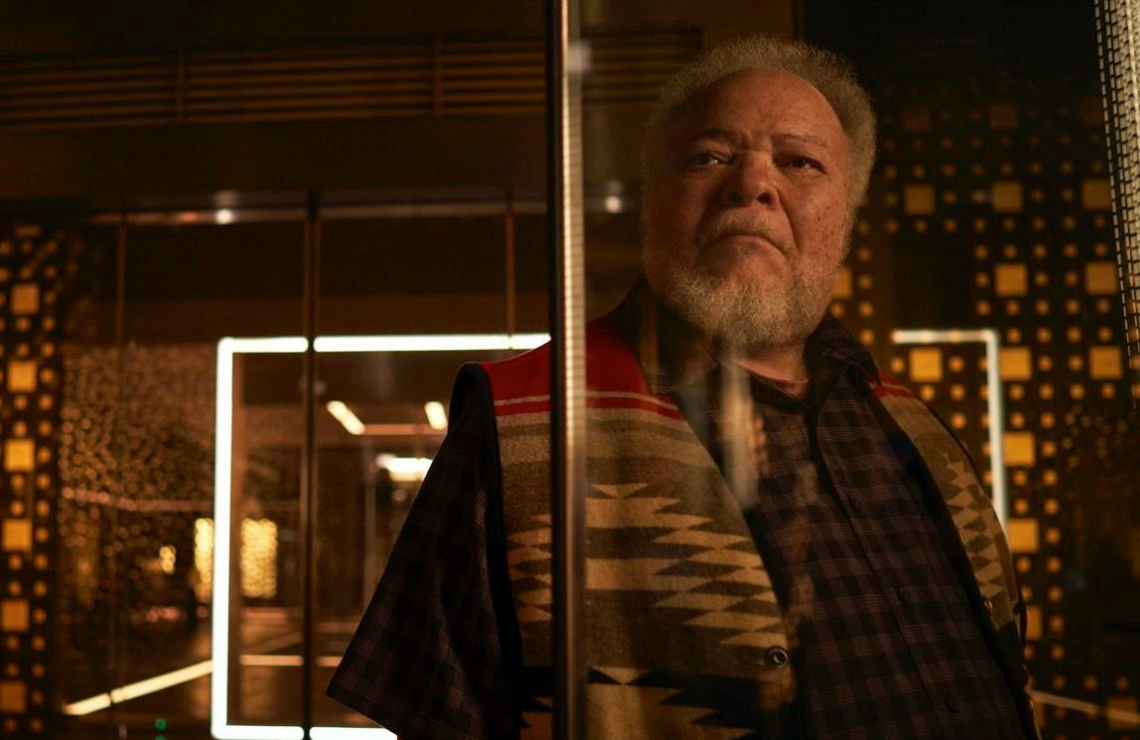
devs-stewart

JWH

Alleviating My 8-Bit Nostalgia

by James Wallace Harris, Tuesday, October 15, 2019

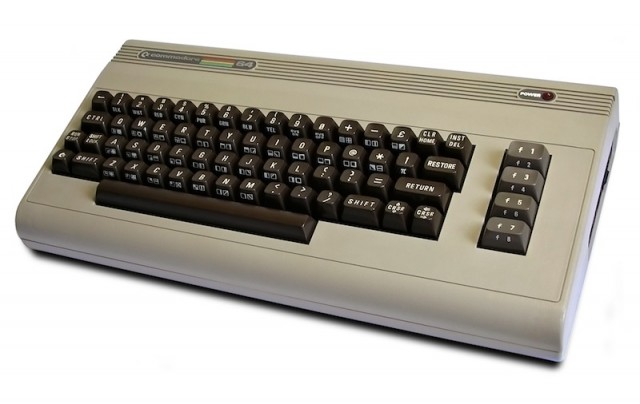
For the past couple of weeks, I’ve become obsessed with watching YouTube videos about old 8-bit computers. I’ve even been shopping on eBay looking for old machines in good condition to buy. But I think I’ve cured my 8-bit nostalgia.

October 13th was the 6th anniversary of my retirement. My dream before retiring was to use my work-free years to become a science fiction writer. That hasn’t happened. Instead, I’ve chased the siren call of nostalgia. The other day I read an article about why people stop listening to new music and it gave me a clue about the nature of nostalgia. We keep listening to the music we imprinted on as a teenager because we gave that music a lot of our time. Once we got older we didn’t have that kind of time to devote to new music.

I’m wondering if nostalgia isn’t an attraction for anything we’ve already spent the time learning to love?  Now that I have a lot of free time it’s much easier to pursue old hobbies than learn new ones. This has given me an insight into my affliction. I both delight, relish and resent nostalgia. Nostalgia feels good to indulge in but it makes me also feel guilty that I’m not learning to love new stuff.

I’m nostalgic for two kinds of things. Stuff I once loved that I bought, and stuff I once wanted to do. Writing science fiction is something I’ve wanted to do my whole life. But it is much easier to love stuff that we can buy than it is to learn to love to do new things. That article didn’t realize it was saying two things. It was much easier to buy LPs than learn to play the guitar.

That article rings true because I stopped spending time with new music after the 1980s. I believe the new songs I do love are because they sound like old songs. Nostalgia is spending time enjoying things we’ve already spent the time learning to love. And the reason nostalgia was originally considered a psychological defect is because we stop learning to love something new. Over the centuries we’ve stopped considering it a flaw and turned nostalgia into a positive trait. Especially if we’re old.

However, that fits right in with our belief that you can’t teach old dogs new tricks. If you indulge in nostalgia you aren’t learning new tricks. Maybe we can learn new stuff when we’re young because we don’t already have a backlog of things we already love to distract us with nostalgia. Of course, kids today seem to put thousands of hours into fun pursuits even before they start school. I now see nostalgia in people in their twenties.

I realize that in the past six years I’ve been cycling through the various periods of my life escaping into my past. Each period has something different I learned to love. I imprinted on TV watching in the 1950s and early 1960s before I became a bookworm. That’s how I got hooked on TV shows and old movies that I now collect. Starting around 1962 I got hooked on science fiction and rock and roll. I write about both. At the beginning of the 1970s, I got into SF fandom and fanzines, which eventually morphed into blogging. I started computer school in 1971 and got my first microcomputer in 1978. The 1980s were the time when I owned several 8-bit and 16-bit computers, and ran a BBS. I also got a job with computers and worked at it for 35 years.

From 1968 to 2013 I tried writing science fiction several times but I never put the needed hours into it. I wrote about thirty short stories, a couple novel first drafts, and attended a bunch of classes, including Clarion West. But it was just a few hundred hours, and for most of that time, I was in my fifties. Was I too old to learn a new trick, or was it because I didn’t put in my 10,000 hours?

So, why haven’t I bought an old 8-bit machine? It’s because I’ve watched dozens of videos by The 8-Bit Guy. Watching him demo all these old machines vicariously gave me all I needed. It reminded me why I owned so many 8-bit and 16-bit machines in the first place. I was always looking for a machine that could do more. My current machine, an Intel NUC with an i7 processor, 16GB of memory, 1TB SSD, and 4K monitor is completely satisfying. It does everything I want. The 8-Bit Guy inflames my nostalgia for old machines but also reminds me why I gave them all to Goodwill.

However, The 8-Bit Guy has also taught me something else, something about nostalgia that I have written here. There is nothing wrong with returning to retro tech, but I do have a choice. I could put those hours into doing something new. Or put them into an old ambition I never achieved. (Is that another kind of nostalgia? Pursuing old dreams.)

For the past six years, I’ve been mass consuming old hobbies. The question is, will I continue to consume nostalgia or learn a new trick? It’s so easy to stick with what we know, and it’s so hard to learn something new. There’s a reason why we have that saying about failing to train old dogs. And there’s something else I’ve learned in my six years of retirement. My energy is draining away. I’m guessing old dogs can learn new tricks but it’s ten times harder than when they were young. Maybe even a hundred.

I could say I’m expending all my dwindling energy on enjoying my old loves. That’s kind of nice (and normal). And maybe that’s what we’re supposed to do when we’re old. But theoretically, I wonder if we can break the nostalgic habit. Instead of watching The 8-Bit Guy before I go to bed I could be watching YouTube videos on the techniques of writing fiction and get up in the morning and apply them.

JWH

Unraveling a Loose Thread of History Found in a 1956 Issue of Galaxy Science Fiction

by James Wallace Harris, Monday, September 16, 2019

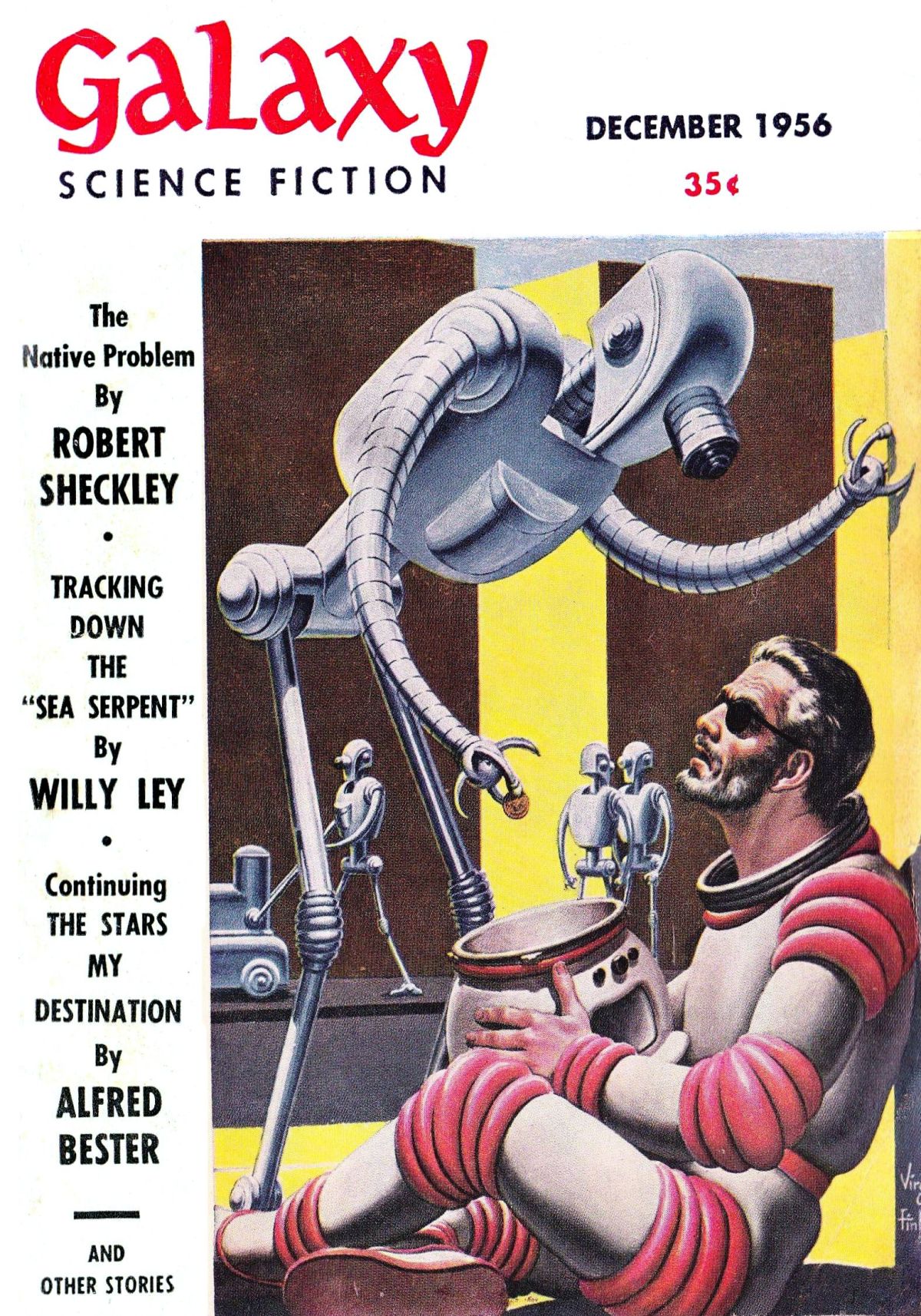
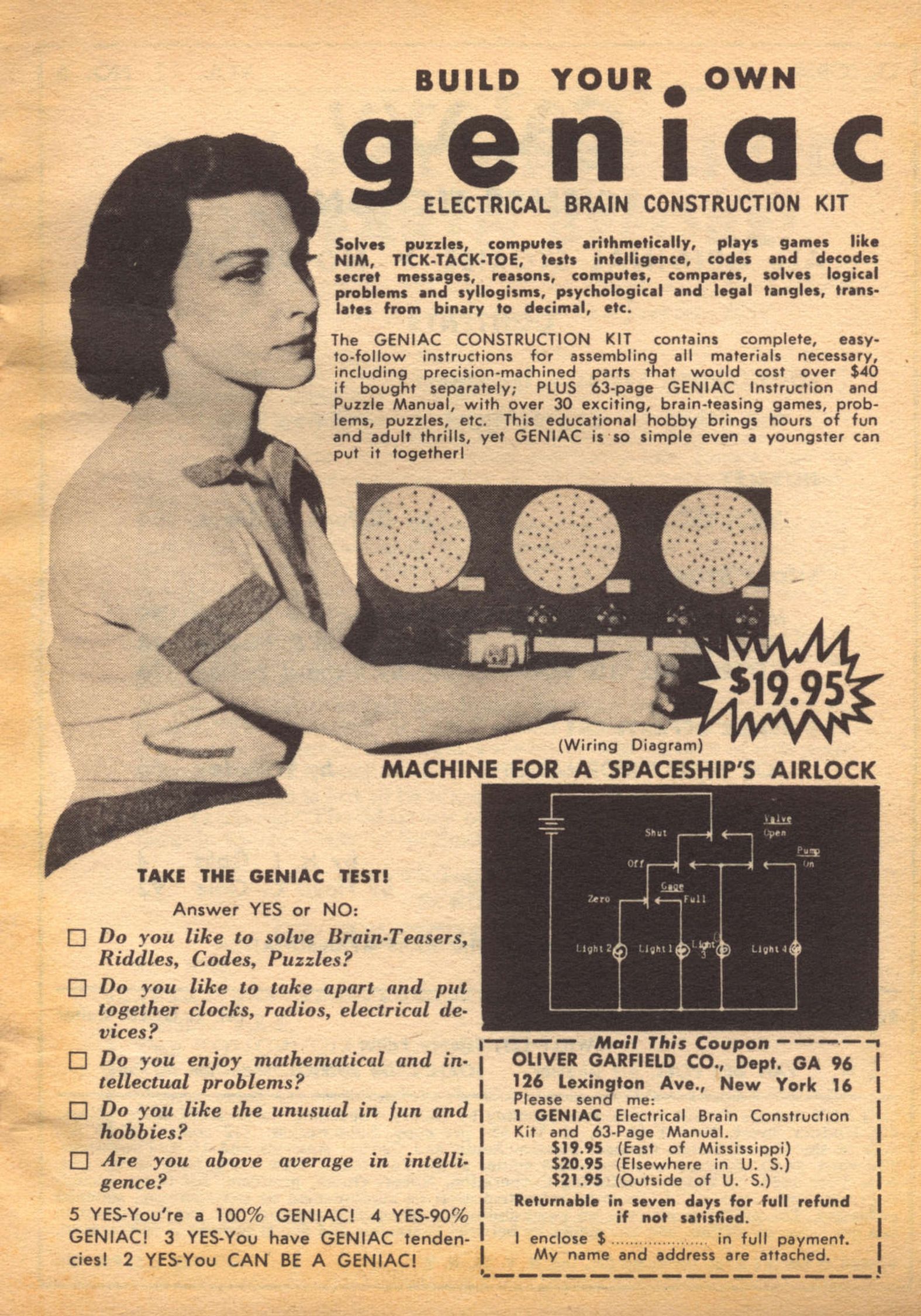
This morning I was flipping through some old issues of Galaxy Science Fiction I had bought on eBay and ran across this ad in the October 1956 issue:

Geniac - Galaxy 1956-10

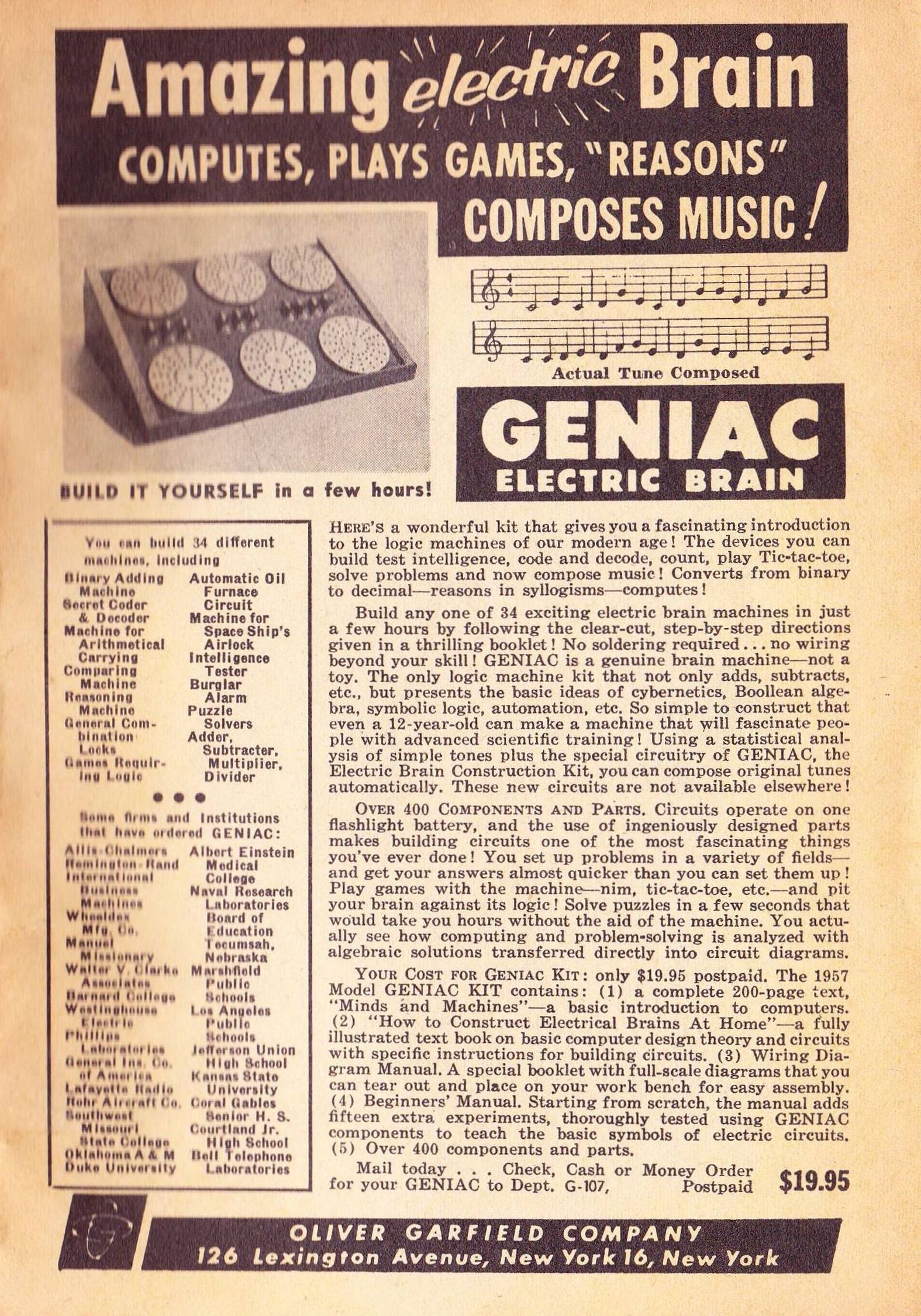
At first, I flipped right by it. Then in the next issue I picked up, the December 1956 issue, I found this ad:

Geniac - Galaxy 1956-12

This one promised a whole lot more. Could this be for real? Computes, plays games, composes music? I don’t ever remember reading about home computers existing this early. I thought computer kits were something from the 1970s. This December ad promised a new improved 1957 model, and for only $19.95. In 1956, $19.95 was some serious money for a kid. It would probably be hundreds of dollars in today’s money. And was this a genuine computer, or was it some kind of trick, like those X-Ray glasses advertised in the back of comic books?

First stop: Wikipedia.

Geniac was an educational toy billed as a "computer" designed and marketed by Edmund Berkeley, with Oliver Garfield from 1955 to 1958, but with Garfield continuing without Berkeley through the 1960s. The name stood for "Genius Almost-automatic Computer" but suggests a portmanteau of genius and ENIAC (the first fully electronic general-purpose computer).

Operation
Basically a rotary switch construction set, the Geniac contained six perforated masonite disks, into the back of which brass jumpers could be inserted. The jumpers made electrical connections between slotted brass bolt heads sitting out from the similarly perforated masonite back panel. To the bolts were attached wires behind the panel. The circuit comprised a battery, such wires from it to, and between, switch positions, wires from the switches to indicator flashlight bulbs set along the panel's middle, and return wires to the battery to complete the circuit.

With this basic setup, Geniac could use combinational logic only, its outputs depending entirely on inputs manually set. It had no active elements at all – no relays, tubes, or transistors – to allow a machine state to automatically influence subsequent states. Thus, Geniac didn't have memory and couldn't solve problems using sequential logic. All sequencing was performed manually by the operator, sometimes following fairly complicated printed directions (turn this wheel in this direction if this light lights, etc.)

The main instruction book, as well as a supplementary book of wiring diagrams, gave jumper positions and wiring diagrams for building a number of "machines," which could realize fairly complicated Boolean equations. A copy of Claude Shannon's groundbreaking thesis in the subject, A Symbolic Analysis of Relay and Switching Circuits, was also included.

Okay, so it was real! But in 1956? In the mid-fifties, commercial computers were just beginning to be rolled out to businesses. In 1957 American audiences got to see a humorous look at computers in the film Desk Set with Spencer Tracy and Katherine Hepburn. Rumors of computers produced a fear that the librarians would lose their jobs, but ultimately humans prevailed. I expect most Americans in 1957 had never seen a computer and only knew about them from funny cartoons in magazines and newspapers. Geniac came out before Sputnik which ignited a fear that American youths weren’t being educated in science. Was there a desire by kids that early in the 1950s to know about computers?

Here is a History of Computer timeline that shows the Geniac for 1955. And here’s an article about the history of computers that played NIM games, which includes the Geniac.

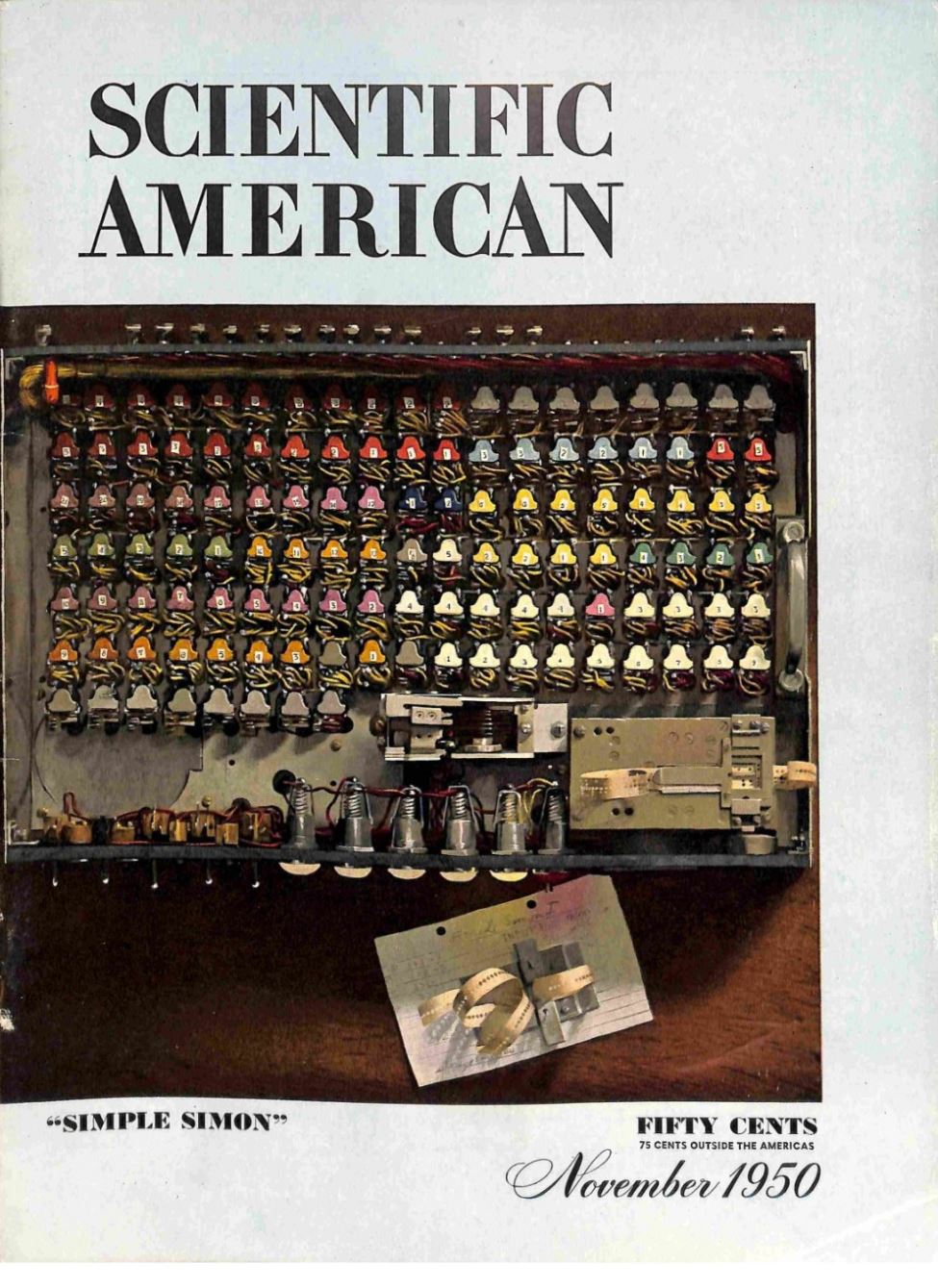
Scientific American 1950-11The main designer of Geniac appears to be Edmund Berkeley. He wrote an early book about computers in 1949, Giant Brains, or Machines That Think. Berkeley was also written about in Edmund Berkeley and the Social Responsibility of Computer Professionals by Bernedette Long. If you follow that link she writes about his influence with Geniac. I’m awful tempted to buy the Kindle edition. He also designed what some people call the first personal computer, Simon. Simon appeared as 13 how-to articles that began running in Radio-Electronics magazine in October 1950. (All 13 parts can be read online here.) It would have cost around $600 to build and had very limited features with only 2-bits of memory. Berkeley wrote the article “Simple Simon” for the November 1950 issues of Scientific American.

Electronics was a big tech hobby back then and had been since the early days of the radio in the 1910s. Looking at the Geniac ad carefully though showed it wasn’t an electronics kit, but merely electrical. It might contain 400 parts, but they were wires, light bulbs, batteries, nuts, and little contacts. It seems designed to set up simple logic programs. How much could a kid do with one? YouTube to the rescue:

And this film, which features a later model from the 1960s called a Brainiac:

This brings up even more questions. Did kids really play with them? Where they inspired to study computers and become computer programmers and engineers? Were there any famous computer pioneers that started with a Geniac or Brainiac? Could Steve Wozniak or Bill Gates have played with one? Of course, those two might have been too young for this era.

The kit seemed aimed at kids, but it would have required a great deal of work and patience to produce any results. Actually putting one together and doing any of the example projects would have been very educational.

David Vanderschel describes his Geniac computer from 1956. He says an IBM 1620 was the first real computer he encountered in 1962. That was the first computer I programmed on in 1971 at computer school using FORTRAN.

Hackaday had a post last month about the Geniac claiming that Mike Gardi credits his professional success in software development to educational logic games like the Geniac. Gardi created a replica of a Geniac and has links to the original documentation. This 1955 manual had instructions for a couple dozen projects. Gardi said:

Technically GENIAC was a collection of configurable N-pole by N-throw rotary switches, which could be set up to cascaded and thus perform logical functions. As a result GENIAC could use combinational logic only, its outputs depending entirely on inputs manually set. However, projects outlined in the manual, which started with basic logic circuits, ultimately progressed to such things as a NIM machine and TIC-TAC-TOE machine.

I did find a Geniac on eBay that has a $99.99 buy it now price. There’s a Brainiac for sale for $349! That’s more than I’d want to spend. The Brainiac is in great shape though. It’s probably the one from the film above.

The more I Googled, the more intrigued I became about the impact of the Geniac computer. Is this how historians get sucked into writing books? I checked a couple books on the history of personal computers I own, but neither mention Geniac or Edmund Berkeley. If you search Google for the first personal computer you usually get the MITS Altair 8800. Maybe that’s not true. Maybe I could write a whole history book about home computers before 1975.

Additional Reading:

Update:

I went to my public library and looked through the books about the history of computing. I found no mentions of Geniac or Edmund Berkeley. I then checked The Reader’s Guide to Periodical Literature for the years 1950-1960. I found no references to Geniac and only a handful of articles by Berkeley. His articles did sound interesting:

  • “Robots for Fun” Life, 173-74+, March 19, 1956
  • “Relations Between Symbolic Logic and Large-Scale Calculating Machines” Science, 395-399, October 6, 1950
  • “Simple Simon” Scientific American, 40-43, November 1950
  • “Tomorrow’s Thinking Machines” Science Digest, 52-57, January 1950
  • “2150 A.D. Preview of the Robotic Age” New York Times, 19, November 19, 1950
  • “Robot Psychoanalyst” Newsweek, 58, December 12, 1949
  • “Algebra and States and Events” Science Monthly, 332-342, April 1954
  • “We Are Safer Than We Think” New York Times, 11, July 29, 1951

An amusing thing happened at the library. I kept asking the librarians where the Reader’s Guide to Periodical Literature was located. They didn’t know. Finally, they asked a very old librarian and she found it for me. She then came back with the younger librarians, they wanted to see it too. I had told them when I was young every kid was taught to begin their library research with that classic index.

JWH


Why We Can’t Trust Digital to Remember

In The Map of Knowledge Violet Moller describes how the works of Euclid, Galen, and Ptolemy were collected, translated, transcribed, and preserved over over the centuries. Most of the works from the ancient world have been lost. We have the Arab civilization to thank for preserving much of what we have from ancient Greece after the fall of Rome, and before the emergence of the modern western civilizations.

When humans first develop writing we wrote on stone, wood, clay, wax, and metal, but eventually invented the more convenient papyrus and paper for scrolls and books. We’re still finding ancient works of papyrus like the Dead Sea Scrolls, and we’re still translating steles from antiquity that archaeologists unearth. In other words, our data can potentially last for thousands of years.

On the other hand, it’s surprising how quickly it can disappear. Since the dawn of the internet age how many digital content providers have gone bust leaving their customers without access to the works they bought? Remember Microsoft’s Zune player? Microsoft phased it out which is okay, but they also turned off the servers handling the digital rights, meaning owners of that content were locked out of their digital libraries. Over the years I’ve bought books, movies, television shows, songs, albums, etc. from various online sellers that have disappeared. Much of it was without DRM, but I didn’t back it up. Since then most of that content has been lost between all my computer upgrades.

Today I only buy digital content from Amazon because that company is so big I hope it will never go out of business. But it if did, I’d lose thousands of ebooks, audiobooks, movies, television shows, songs, and albums. So far it appears that Amazon (and their company Audible) have saved everything I bought, even when the work went out of print. But sometimes I think I owned something I can’t find in my Amazon library. So far I think it’s me because in the early years I bought so much from other companies that I now misremember what I bought from Amazon. But I never can be sure.

Many years ago I decided to go paperless and scanned my files to .pdf documents. My mother had saved all my report cards and I scanned those too, throwing away the originals away. I can no longer find those files. I thought they were on DropBox. When you have hundreds of thousands of digital files it’s hard to know when a few thousand disappear. I’ve been putting everything on Dropbox for years, and they’ve always seemed very reliable. Again, I can’t tell if I could have accidentally deleted those files, or something in their system ate them.

I recently discovered my Yahoo email has all disappeared. I used Yahoo to save backups of important emails, but I seldom went to the site to look at these old emails. I just discovered Yahoo deletes your content if you haven’t access your account for one year. Dang. Also, I used to have access to all my oldest emails at Outlook. But now Outlook only shows recent years. If you get to the bottom of a folder you can request Outlook to show more, but I’m not sure if they save everything anymore.

What’s needed is a program that catalogs all my files and tells me when some go missing. I don’t do backups because I assume I have my files locally and on Dropbox and that’s good enough. I used to save backups to external hard drives, but keeping up with such backups is a pain. I recently threw out six hard drives. They had been sitting in my closet for years, but when I checked them they no longer worked.

I also worry about all my financial records. All the companies I do business with begged to stop sending me paper copies so they could go digital. Now I wonder about the wisdom of that. I realize if I died I’m not sure if my wife would know where all my 401K savings are located. But if I only saved on paper and my house burned down, where would we be too?

I’ve read a few articles in the news lately saying if you read the fine print we don’t own our digital content. We can’t resale it or lend it, but what about accessing our purchased content forever? What if a publisher goes out of business? What if a publisher selling through Amazon goes out of business, is Amazon responsible for maintaining that digital content forever for its customers?

And what happens to my 1,400+ essays if WordPress shuts down? One of my blogs, Lady Dorothy Mills, is about a woman writer from the 1920s whose work is almost completely forgotten. I started a website about her decades ago, and I used to get 1-2 emails a year asking about her. It’s been years since I’ve had a query. Only a handful of her books come up for sale every year. Even printed books have no guarantee of surviving. If I really wanted to save my essays I should print them out. I don’t though. I hate saving paperwork.

We are becoming completely reliant on saving data digitally. After our civilization collapses, and they all do, how will future scholars like Violet Moller write about us? A book from this century could last a thousand years. But even if a hard drive could last a thousand years, would people in 3019 have a PC to run it?

Or will future civilizations carefully preserve our digital data someway? For years I tried to save the files I created on my Commodore 64 or Atari ST to my early PC programs like WordPress. Even as late as 2013 when I was still working I’d get requests to convert 1980s Apple II discs so the files could be read on Macs. It was seldom possible.

We talk about plastics surviving for thousands of years. I wonder if it’s possible to produce a new kind of paper that’s nearly indestructible, including fire and water proof? That way, anything we really wanted to save we’d print on the new DuroPrint format. Or can we design solid-state drives that can hold their bit positions forever?

I’m at an odd point in my life. I have a lifetime of books I’ve collected that run in the thousands. They included printed books, ebooks, and digital audiobooks. I’ve actually saved too many books. I figure I might live another 10-20 years and I want to thin out my collection to just what I need as I fade away. I also want to start deleting digital files and paper files of things I no longer need. What a huge task. I’ll probably delete 99 out of a 100 items, but for that one, I’ll want it to survive no matter what, and be discoverable by someone after I die.

I feel like I’m moving towards an Omega Point where I will die with just the exact books and documents I need. It’s the opposite of building a library or filing system. I’m not sure I need to leave any of my books or papers to anyone. I’ll give away my books before I die, and my wife will need only a few papers. But I do worry about a few rare objects I own, like the Lady Dorothy Mills books, or rare science fiction fanzines. I’ve been scanning the fanzines for the Internet Archive. I should probably scan the Mills books too.

The Map of Knowledge by Violet Moller

JWH