Our Fantasy For Interstellar Travel is Dying

For over 50 years I’ve been reading science fiction hoping humanity will someday travel to the stars and settle other planets. Obvious other people do too, just witness the frenzy behind the new Star Wars movie, which opens on the 18th. Galactic empire stories are the new locale for big sword and sorcery epics. (Isn’t it bizarre that both are enamored with aristocracy?) What deep rooted drive makes us want to colonize distant lands? Why are we enchanted by alien landscapes, strange superior beings and their surreal cultures?

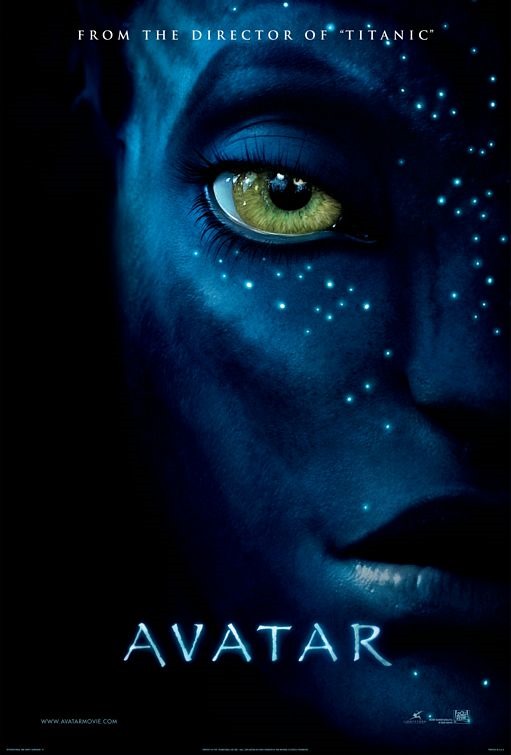
Of course, the film Avatar probably reveals our true intentions. We’d do to other worlds, what we’ve done to ours.

A Heritage of Stars - Clifford Simakavatar

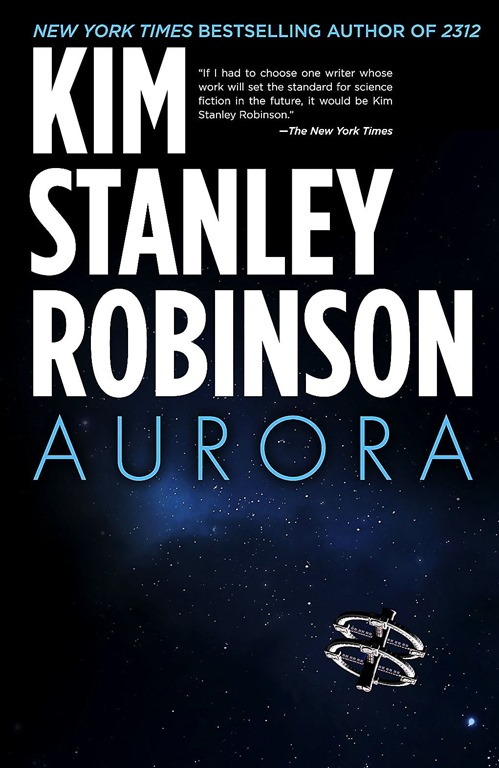
I just finished A Heritage of Stars by Clifford D. Simak, which questioned our desire for interstellar travel. It was published back in 1977. A Heritage of Stars is a quaint little book, not particularly good, unless you relish 1950s style science fiction, where Simak, in his seventies, questions many of the tropes of our genre. This same questioning was evident in Aurora, Kim Stanley Robinson’s latest novel. Both Simak and Robinson wonder at the wisdom of traveling to the stars. The distances are beyond fantastic, almost beyond comprehension. Characters in Star Wars zoom between planetary systems quicker than we travel between cities on Earth in our jet airliners. The absurdity of that strains the boundaries of absurdity. It’s only slightly less delusional than thinking we can travel to other worlds by dying.
Aurora KSMCity - Clifford Simak

Simak covers many of the most famous themes of science fiction in A Heritage of Stars. The setting is in the far future Earth, a thousand years after the collapse of a great technological civilization that went to the stars, and built intelligent robots. In some ways, it’s a variation of Simak’s classic City. America is now a post-apocalyptic landscape of roving tribes who collect the heads of robots for ceremonial voodoo. They are primitive people who can’t conceive of space travel or intelligent machines. The story is about a young man named Cushing who takes shelter in a closed-wall town, built around a former university. Cushing learns to read, discovering that humans used to be great. Cushing eventually finds mysterious references to “Place of Going to the Stars” and sets out on a quest to find it. Much like a L. Frank Baum Oz book, Cushing gathers along the way a motley assortment of strange characters to take up his quest too. A witch, a surviving robot, a horse, a man who talks to trees and a autistic like girl who can commune with the transcendental.

Along the way, Simak’s characters discover what happened to mankind, and allows Simak to philosophize about why we wanted to go to the stars. Simak also wonders if mankind is smart enough to survive his addiction to technology. Even forty year ago Simak realized that interstellar travel isn’t very practical, questioning his science fictional roots. Had Simak given up on the Final Frontier dream because he was getting old? He was in his mid-seventies at the time. I’m in a my mid-sixties and I too have given up on colonizing distant worlds. Does getting older make us realize our childhood fantasies have no foundation in reality?
Earth Abides - George R. StewartThe World Without Us - Alan Weisman

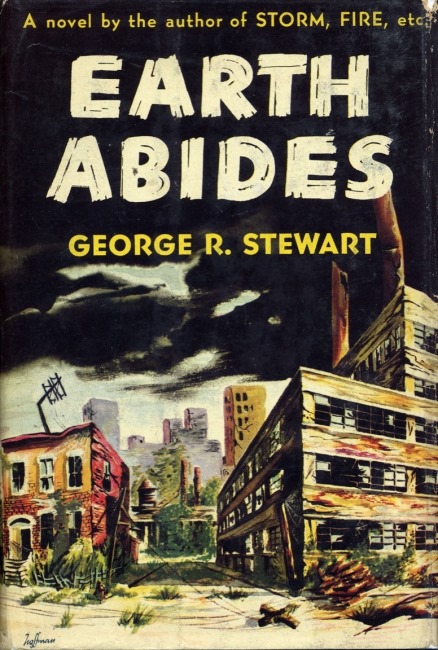
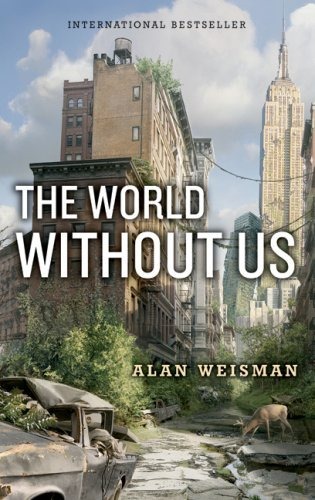
Science fiction is mostly high tech fantasy that reveals the same impulses humans have always shown. This world and life doesn’t seem to be enough for us. We want more. But the reality appears that this life and planet is all we’ll ever have. Like many other science fiction stories Simak wonders if the future of humanity will be one where we give up technology and live nomadic lives much like how Homo sapiens lived its first two hundred thousand years of existence. I can’t help but believe Simak was greatly influenced by Earth Abides by George R. Stewart. And I believe Simak would have been blown away by Alan Weisman’s The World Without Us, a philosophical thought experiment that wonders what Earth would be like if humans just disappeared.

Shouldn’t we psychoanalyze why science fictions two strongest themes are space travel and the post-apocalypse? Why are galactic empires always suffering collapse and revolutions? Isn’t it rather telling that our favorite fantasies feature feudal governments and primitive weapons? The heroes of Star Wars fight with swords made of light. Is the reason why conservatives want smaller governments is because they don’t have the genes to imagine large ones?

Childhoods End - Arthur C ClarkeMore Than Human - Theodore Sturgeon

Strangely, Simak reveals a problem that NASA wouldn’t discover until years later. Mainly, we can collect the data, even store the data, but we won’t always be able to access the data. One of the conundrums that Cushing and his crew face is humans went to the stars but what they discovered is locked up in technology that their post-apocalyptic world can’t access. I felt let down by Simak’s solution. Let’s just say that Simak’s hope for humanities failures is to discover supernatural powers. That was a common theme in 1950s science fiction, especially Arthur C. Clarke’s Childhood’s End and its 1960s retelling, 2001: A Space Odyssey. Theodore Sturgeon was never much of a technological science fiction writer, and went right for the ESP solution in More Than Human. Even the hard science Heinlein had hopes humans would discover magical powers. I guess they all grew up reading Oz books.

I feel let down by Simak, although I enjoyed A Heritage of Stars well enough. I believe he ends his story with false hope. Simak believes humanity can keep trying until it gets it right. Yet, he doesn’t attempt to describe what is getting it right might be. Not long ago I read a passage about Neanderthals that shook me up. It stated for the entire length of its long species’ lifetime, Neanderthals never showed any progress after achieving a certain level of development with their stone tools. For hundreds of thousands of years they made the same tools. We Homo sapiens feel superior because we’re quite dazzling with our technological innovation. However, I’m not sure we’re not like the Neanderthals in that we’ve continued to follow the same emotional and psychological patterns that we have for the last two hundred thousand years. We can’t get away from our Old Testament mindset, and without technology, we’d all live pretty much like North American tribal people before the advent of Western invaders, or the people who lived on the Russian Steppes and spoke the language that inspired all the Indo-European languages.

Kim Stanley Robinson has a much more sophisticated lesson about why we won’t be colonizing planets orbiting distant suns in his book Aurora. We are adapted to our biosphere. It’s extremely complex and interrelated. It’s extremely doubtful. even if we could travel the distance to another stellar system, we could integrate into another biosphere. Humans were made for this planet and biological landscape. We could probably export our biosphere to other barren planets if the conditions were right, but even that is doubtful.

Simak doesn’t give much focus to the intelligent machines of his story, but I’m guessing artificial intelligence has more potential validity than any other theme that science fiction explores. Simak points out that robots are the true species for interstellar travel. If Star Wars was realistic, galactic empires would be governed and populated by C3POs and R2D2s. Biological creatures would always stay on the planet of their origins, comfortably bound to their biospheres.

Simak wrote A Heritage of Stars near the end of his life, probably speculating about what will happen to humanity after his death, and revealing a certain level of age related pessimism about the future. I don’t know if he was aware of environmental catastrophes—he seemed to fear our mishandling of technology. Forty years later, our race doesn’t seem any wiser, but it does seem more suicidal.

More and more, I’m becoming an atheist to the religion I grew up with, science fiction. It’s not that I’m going to stop reading science fiction, but I no longer believe it. I study science fiction like many former believers still study The Bible. Both The Bible and science fiction reveal our deepest inner hopes. For some reason humans want to go to Heaven or Alpha Centauri. We need to understand why, and also need to understand why we’re turning our own biosphere into Hell.

Essay #984 – Table of Contents
Searching For Hope Thanksgiving 2015

By James Wallace Harris, Thursday, November 26, 2015

Yesterday was my 64th birthday. I had planned to publish “100 Signs of Hope for the Future” in reaction to my 63rd birthday post, “50 Reasons Why The Human Race Is Too Stupid To Survive.” That essay, the most popular one I wrote this year, still gets 20-50 hits a day. This year I felt challenged to discover twice as many signs of hope for my 64th birthday. I’ve been working for weeks, but alas I have failed. Not because I couldn’t find that many signs of hope, but because the essay just got too big to finish on time. I’ve decided to break it into several essays.

Thanksgiving 2015 

I’ve switched to searching for hope because pursuing pessimism is pointless. Even if we know we’re going to lose, we have to bet to win. Signs of despair are everywhere, so it’s too easy to find roads to apocalypses. The real existential challenge is to find  routes out of our maze of problems. Deciding what we want is the first step on the journey. I want an Earth friendly society, where everyone is equal, who follow universally accepted standards of ethics, with lifestyles that are sustainable over millions of years, that leads to opportunity for all Homo sapiens while still fairly sharing this planet with the rest of our fellow species.

When we are young we have great hope for the future, but as we age, little by little, that hope fades. I grew up with a tremendous sense of wonder for this amazing reality around us, but as I’ve grown old, I’ve become increasing pessimistic about the future of our species. Most people on this planet hide from reality in childish beliefs about God and Heaven, but as an atheist, I have to live with the scientific assessment of our existence. The future looks bleak. But I want to fight the natural tendency of becoming cynical while growing wrinkles. I desperately want to the human race to get its shit together and make the most out of this astonishing piece of ontological luck.

Finding hope for the future is a Mt. Everest size challenge. News reporting makes us all want to stick our heads in the sand. How can we overcome our sense of powerlessness? Why does being spectators on the sidelines of history feel so soul destroying? When will weathervanes stop pointing to countless hurricanes bearing down on us from all the directions of the compass? I actually believe there are ways to solve our collective problems. The trouble is we are our own worst enemies.

It would have been much easier to find a 1,000 signs of despair than 100 signs of hope. We all cope by ignoring what we don’t want to see, and rationalize things will magically get better. It’s impossible for one person to even comprehend the holographic information behind one half-hour news program. Having access to the internet overwhelms our minds with infinite data. We can’t even tell the facts from misinformation. We all maintain an ever shifting illusion about the future. The easier path is to ignore what might be, and focus on our personal needs and wants. I see hope in just defining our problems, which is what I want to do in future essays.

The other night I found an especially important sign of hope in a very strange place, the documentary Pandora’s Promise. This film is about environmentalists who were once passionately against nuclear power that have changed their minds. The hope I find, is not in the promise of cleaner energy, but in the fact that fervent true believers can admit they were wrong. To survive all the ill winds that blow our way, will require open minds with a strong willingness to study new information. We’re currently being bombarded by politicians who regurgitate the same brainwashed propaganda of their parties. This gives us little reason for hope. We need more Sauls who become Pauls, transformed by the light of reality. And before all you conservative Christians gloat with glee over my metaphor, let me tell you that you’ve still got your own Road to Damascus to travel.

For all of us to find hope for the future will require each of us to transform ourselves. Last year I was pessimistic because I doubted we could change. Recently I decided to bet on hope than spend my waning years becoming bitter about the human race, like the aging Mark Twain. What I need, and I think every else needs too, are signs of hope. I’ve spent a lifetime reading science fiction, so thinking about the future comes easy to me. If this essay seems more worried over despair that’s because it illustrates two significant points. One, finding hope is Sisyphean task. Two, recognizing that we have a problem is the beginning of transcendence.

Our problem as ordinary citizens, is we feel powerless at controlling our own fates. We think leaders should enact policies that will change the way we live. That passivity is dangerous. It is our individual decisions to change ourselves that is the solution. The key issue is sustainability. The ways we live our lives are not sustainable. For me to find 100 true signs of hope will require finding signs we are all choosing sustainable ways live.

People seldom change without being forced to change. Few people will unilaterally sacrifice what they have to help others, or even help themselves. It’s one thing to have a lot, and share some extra. It’s a whole other thing to give up what you have. This past year I’ve chosen to go on a plant-based diet for health reasons. I’m constantly tormented by what I can’t have. It’s not easy doing without. I know so many people who have far more serious health issues, yet they say they won’t change how they live to save themselves. They pray for magical solutions. Such false hope will destroy us.

I agree we won’t change without technological help. We’re more likely to survive if clever engineers invent technology that bypass our human failings. But technology can’t be our only salvation. Anyone who has been on a diet knows how hard it is to change the momentum of habits. Anyone who has succeeded at losing weight and transforming their health, knows how empowering new habits can be. No civilization of the past has survived a major disruption, so we have a perfect record of losing. On the other hand, our species has been mutating and transforming at a hyper-rate since The Enlightenment. Scientific knowledge has transformed our cognitive abilities dramatically, and with technology we’ve transformed human society, the face of the Earth, and the biosphere. So far this knowledge has allowed us to become a cancer upon the planet.

The reason why I wrote that pessimistic essay last year was because I felt people are incapable of change, but a year of reflection tells me the human race constantly changes. Recent research shows the brain is very plastic, capable of rewiring, even late in life. Another good sign of hope. However, humans tend to change because of powerful outside forces rather than by personal choice. We evolve through survival. And now it’s time to evolve like we never evolved before. Is it possible to intentionally guide our evolution? Can we choose to do what’s hard instead of what’s easy? Will the seven deadly sins always rule our habits?

There seems to be little reason to expect a political solution. A U.S. president from either party will never be bold enough to defy political self interest. In fact, their self interest thrives on our weaknesses. Does that mean we should just give up and wait for the apocalypse? I’d like to believe when the going gets tough, the tough get going, and we’re all tough enough.

Everything is interrelated. Solving any of our major problems requires solving our other major problems. Finding hope also involves recognizing the problem—we cannot solve problems we refuse to see. We cannot solve our problems without becoming different people from who we are now. Learning what we need to do will require reeducation, and that means a lot of reading and watching of documentaries. We need to learn how reality works. We need to stop pursing mindless forms of escapism. We’ve spent thousands of years praying to God, and we know that doesn’t work. Waiting for a Zoroaster, Moses, Jesus, Mohammed, Buddha, isn’t practical either.

To stop acting like lemmings rushing to the cliffs of oblivion requires thinking for ourselves.

Essay #982 – Table of Contents

How To Save The Planet–Without Detailed Instructions

By James Wallace Harris, Tuesday, November 3, 2015

Humans are destroying the biosphere of planet Earth. Homo sapiens have overpopulated the planet, crowding out all the other species, and has initiated a self-destruct countdown. To solve this crisis requires creating a sustainable way of life, one that will ethically accommodate 13 billion people, allow other species to thrive, create a stable weather system, and not poison the biosphere with pollution. This is an immense challenge. There are countless books, studies, organizations, documentaries and pundits claiming they have solutions, but few people agree on anything. (I use the number 13 billion because most people today will see the Earth’s population grow to that number before it starts to shrink.)

The real responsibility falls on us individually. We each have to decide how to live and justify that lifestyle’s sustainability. In other words, any rational for survival you choose must be judged by what impact that lifestyle would have if 13 billion people also followed it. The Lifeboat Earth metaphor applies here. Ethically, we all have a justification to claim one thirteenth billionth of the planet’s resources, excluding the ethical share we first deem is due to all the other species. Our current philosophy is “everyone for themselves” – grab all you can get, and fuck all other humans and all the animals. It is this philosophy that will lead us to self-destruction, and why there is so much hate, violence and stress in the world.

Earthe-Europe1413

Finding an ethical way of living that is equitable to our fellow humans and to all the animals is hard. You will have to do a lot of research, read a lot of books, watch a lot of documentaries, and listen to countless thousands of talking heads argue and argue. One recent documentary I feel is very persuasive is Cowspiracy, a film by Kip Andersen and Keegan Kuhn. I shall use it as an example. At it’s core, the film is trying to do what I’m talking about regarding sustainability. However, I don’t trust it’s numbers, and I’m guessing it’s motivations aren’t entirely honest and straight forward. But understanding these problems I have with the film are exactly the skills we need in evaluating any solution to save the planet.

There is no reason to want or expect us all to decided on the same path. We can each develop our own consumption plan so long as it integrates into the whole, and we each use only our fair share. Before we can begin inventing our individual solutions we need to understand what is our fair share of consumables and pollution. The mathematics of such an undertaking is way beyond my ability. So I never trust other people who claim to have that ability.

I find documentaries that use lots of facts, figures and infographics to be more persuasive than documentaries that don’t. The watchers of these film must deal with is whether or not the film’s figures are accurate. Even cheap, crudely made films can have great impact, such as Cowspiracy. I was far more moved by Cowspiracy than I was the more famous and better made, An Inconvenient Truth. Both appear to be about climate change and environmentalism, but I suspect the underlying motivation by Cowspiracy is animal rights. Andersen and Kuhn contend that raising farm animals has more impact on the environment than all burdens the various transportation industries place on the planet.

Do their numbers add up? Is their basic assumption correct? They are offering a reasonable solution to save the planet. Are they right? They offer a very simplistic path to solving the sustainability problem. First, watch the film Cowspiracy (free on Netflix streaming, $4.95 digital download, $19.95 DVD). Their solution, stop eating meat, poultry, fish and dairy. We must evaluate their plan. Would choosing a plant based diet make a sustainable lifestyle? Cowspiracy defines the sustainability issue properly, but I doubt their numbers justifying their solution, even though I’m personally pursing a vegan lifestyle and I’m for animal rights. I’m willing to consider that there might be ethical ways to eat meat that is sustainable.

Whether or not to eat meat, and whether or not raising food animals has a massive impact on the environment are a highly contentious issues. You can can find people on both sides of the argument claiming they know the truth and throwing out tons of facts and figures. I wish to set the ethical issues of killing animals aside for a moment, and just consider Andersen and Kuhn’s assertion that raising animals for food has a greater impact on the environment than all of the transportation industries combined. Does giving up meat help the environment significantly? More than going to mass transit and switching to a renewable energy based economy?

My guess is we could greatly improve meat and dairy production to make it sustainable, but it might require that people eat a lot less animal products than they do now. And even then, we’d still have to bring back the issue of animal cruelty. Andersen and Kuhn do define many of the issues we have to consider in creating a personal sustainable lifestyle.

  • We all have a fair share of fresh water this is sustainable, but will vary by location.
  • That a sustainable lifestyle will impact specific area of land.
  • That land set aside for humans should leave plenty of natural areas for animals.
  • That the impact of our land requirements not impact the weather, pollution or the biosphere.
  • That our personal energy use must be sustainable.
  • That we shouldn’t let people starve while we feed animals to produce meat.
  • Can we raise animals so they have quality lives before we kill them?
  • Are there humane ways to kill animals?
  • Is it ethical to kill animals?
  • Should you eat any animal that you didn’t personal kill?
  • Should we give land to food animals when wild animals have so little?
  • That factory animal raising is not sustainable.
  • That free range animal raising is less sustainable than factory animal raising.
  • That industrial fishing isn’t sustainable.

I’ve been a vegetarian since the 1960s, and in the last couple years I’ve been veering towards veganism to reduced the clogs in my arteries, so Andersen’s and Kuhn’s solution would be no sacrifice for me. It would demand a tremendous change for most people, and a drastic transformation of society. Can you imagine if all restaurants were vegan and all grocery stores health food stores? I’m going to assume Cowspiracy plays fast and loose with its numbers simply because the film is on the amateur side. On the other hand, I’m going to assume they might be right and explore their solution.

We often admire members of The Greatest Generation because they survived The Depression and WWII. We admire their determination and sacrifice. We admire first responders and soldiers for their dedication and heroism. Often I meet people who wished they had done more good in their lives, or even lament they hadn’t done something extraordinary like their heroes. Some even feel their life has been without meaning. I don’t believe you need to be Pope Francis or Martin Luther King to help other people and make a great sacrifice. Just being decent, law abiding and nonviolent adds a lot to our society. Choosing not to act like an asshole and controlling your temper goes a long way toward bringing peace on Earth. Of course, I think many folks reading this will say they’d prefer to work inside burning buildings or go to war in Afghanistan than give up eating meat. However, from now on out, the best thing we can do for our fellow humans and our descendants is live a sustainable lifestyle. Are we willing to make that sacrifice and dedicate ourselves to meeting the challenge?

You need to see the film to be convinced that animal farming is having a greater impact on the Earth than all forms of transportation combined. Cowspiracy asks why all the major environmental groups are not focusing on the biggest problem the planet faces. If Andersen and Kuhn are right, then the single quickest way to fight climate change, the current mass extinction of animals, the destruction of the oceans, the collapse of civilization and create a sustainable society is to give up eating animals. The documentary points out that a plant based diet is sustainable, and it’s healthy. My own research into healthy diets is uncovering more and more doctors advocating a plant based diet. Giving up meat is better for the planet and better for you, and gives us hope for our descendants. However, I don’t know if Andersen and Kuhn’s numbers are anywhere near accurate.

Will people give up eating meat? I doubt it. Republicans are taking the brunt the responsibility for not doing anything about climate change because they refuse to give up fossil fuels. What if giving up meat could actually solve climate change without waiting on new renewable energy technologies? I doubt even liberals would embrace that solution. Why are bacon and eggs, milk and cheese, beef, chicken, pork and fish so important to us? What if the facts and figures in Cowspiracy are right?

Are there any sustainable sources of animals products? If people raised chickens and rabbits in their backyards, feeding them with yard grown food, would that be sustainable? What about hunters culling deer populations every year, or other animals that could live abundantly in the woods without human support? What if all fishing was from hook and lines? Andersen and Kuhn make it obvious that neither factory animal farms, or free range animal farming are sustainable. But what if everyone hunted their own meat? What if you really wanted to eat meat and were willing to hunt down an animal, kill it and butcher it, you could eat it and be sustainability justified? Andersen and Kuhn assumes all the land that went into grazing or raising food for livestock would be returned to the wild. Would that be true?

We all ignore the fact that we’re consuming more than the Earth can give. Humans are increasing in numbers while everything else is decreasing. We’ve been laughing at The Limits of Growth for forty years because the book hasn’t come true. We always assumed science and technology would continually solve the problems of exponential growth. The Club of Rome didn’t anticipate disruptive technology, but their basic premises were still correct. The Earth’s resources are finite and consumption can’t increase forever.

Table of Contents

Can We Build Nature Proof Houses?

By James Wallace Harris, Monday, August 10, 2015

Is it a possible to design houses that can withstand hurricanes, tornadoes, ice storms, fires and even earthquakes? Is it possible to design homes like the internet where each node is protected from failures in other nodes? Is it possible to design dwellings that last thousands of years that can be continuously modernized?

tornado proof house

Every evening on the nightly news we see natural disasters destroying homes, towns and even cities. It’s completely obvious to all but a few that climate change is happening. Is it possible to create a way of life that is hardened against most of what mother nature can throw at us?

When I grew up in Miami back in the 1950s and 1960s we lived in concrete block houses built on top of poured terrazzo foundations, with roofs made with another poured material that had pebbles embedded in it. No wolf could blow it down. After a hurricane we’d go outside and see knocked down trees, small manufactured stuff blown about, and some houses might have a window bashed in, but the little concrete block houses stood like bunkers.

disaster-proof-arch-dome-house-florida

Is it time to stop building wood frame homes? Is it time to stop building roofs that need to be replaced every twenty years or blow off in a big wind? Isn’t it time we build electrical power grids with independent home energy systems with backups? Last week 67,842 homes lost power here from a so-so storm system. My power was off for a few hours, but I knew people who lost it for a day or two, and read about others having to wait 4-5 days.

If houses had battery systems like Tesla is designing, they could handle short power outages. Throw in generators that can kick in based on natural gas, and homes can withstand long outages. But the real long-term solution is to build homes with solar/wind generators so every dwelling is part of the energy grid. If we put all power lines under ground that would further secure the power system. Can you imagine cities without power poles? For years new neighborhoods have done this, but we should retrofit older subdivisions. The reason most of those homes lost power here last week was because of downed lines from falling branches and trees.

pyramid2-1024x629

What if we designed homes to be continuously in-place upgradable? Could we design a house that can withstand anything nature can throw at it, be useable for a thousand years, and still be adaptable to new technology as its invented? Are single homes on small plots the most efficient design for maximum human happiness? What if four homes were push together but the families shared one big yard? Homes that can withstand natural disasters can also be very soundproof. They can also be made burglar proof too. If they shared some infrastructure such designs could save on building costs. If land use was optimized, shared gardens, swimming pools, and playgrounds would be more practical.

tornado proof school

We could design dwellings that could withstand extreme temperatures that used little central power, and could survive for time periods without taking power from the grid.

For some reason post-apocalyptic stories are very popular today at the movies, on television and in books. We could design energy self-sufficient housing that can withstand nature and the collapse of civilization. With better land utilization, and advanced techniques for gardening and animal husbandry, it would also be possible to make for self-sufficient neighborhoods. If we combined the philosophy of Mother Earth News, Make Magazine and Wired Magazine, we could reinvent the subdivision to combine the past and future into a more secure way of life.

In recent times many people have become preppers, hoarding food, water and AR-15s to prepare for the collapse of civilization. In all their scenarios the strong kill the weak to survive. We know what happens when civilization disappears—just watch the news covering Syria, Iraq, Afghanistan and Yemen. Survivors tend to be refuges, not preppers. Wouldn’t it be better if we design a more sturdy civilization. Does anyone want live under rule by AR-15/AK-47 owners?

If you search the internet on this topic you’ll find lots of sites describing people already working on inventing what I’m speculating. During the 2016 presidential elections we need to stop dwelling on how to return to the past, but think about how to design the future. Demanding a smaller government, less taxes and an every man for themselves way of life isn’t very imaginative—or positive.

JWH

This Changes Everything: Capitalism vs Climate Change by Naomi Klein

By James Wallace Harris, Monday, March 2, 2015

The most political perceptive woman of our times is not Hilary Clinton, Angela Merkel or Elizabeth Warren, it’s Naomi Klein. Klein is a journalist, but her new book This Changes Everything synthesizes economics, environmentalism and politics into a holistic statement that should define the 2016 U.S. Presidential election. It probably won’t, but it should. Many reviewers have compared This Changes Everything to Rachel Carson’s Silent Spring. The environmental insight is only part of this book, Klein’s observations on capitalism are as large as those made by Adam Smith, Karl Marx and Thomas Piketty.

This-Changes-Everything-Capitalism-vs.-The-Climate 

Klein has set forth the hypothesis that free market capitalism is the driving force of climate change, and she provides plenty of evidence for her case. But the scope of her book goes well beyond environmentalism, capitalism and politics, into a deep existential and spiritual challenge. This Changes Everything can be seen as a holy book defining a new moral paradigm.

This Changes Everything in thirteen chapters describes the dynamic scope of the problem. We admire The Greatest Generation for their response to the Depression and World War II. Solving climate change is a greater task than solving a worldwide economic meltdown and will cause more suffering than a war that killed sixty million people. Our generation needs to be greater than the Greatest Generation, and we’re shirking the job. To avoid environmental, social and economic catastrophes that climate change will bring, all seven billion of us must transform our lives. We need leaders far more inspiring than Franklin Roosevelt and Winston Churchill, and tragically we’re not finding them. Instead we have people who are fighting with all their might to maintain the status quo. Climate change will change everything, whether we solve the problem, or not. All of humanity is jumping off a cliff, and to deal with climate change is to learn how to make a parachute in free fall – pretending it’s not happening is pretending hitting the ground isn’t in your future.

Climate change is already happening and has been since the beginning of the industrial revolution. We can’t stop its current momentum, at best, we can only put on the brakes, and slow things down. Climate change is only the tip of the iceberg! The impact of free market capitalism fuel by industrialization and technology, is transforming the entire biosphere, destroying the atmosphere, oceans and land, causing the sixth great extinction event.

Naomi Klein spent five years writing This Changes Everything and covers a staggering amount of data and issues. It has over sixty pages of fine print notes. It’s not an easy book to digest, except that each of the thirteen chapters coalesces around a single important concept. Even then, each chapter has evidence to weigh that stretched my mind beyond what I can comprehend. Klein writes clearly, and works hard to help us digest the facts, but reading this book is a commitment. It took me weeks to read. I’d do a chapter at a time, and sometimes I’d go days just thinking about ideas from that one chapter. The problems she presented are like Zen Koans.

The first five chapters describes the economic problems of climate change. The next three covers the failures of the current solutions. The final five chapters explores new solutions that are struggling to emerge. There are many surprises along the way. I feel Klein has convinced me why conservatives have chosen to deny climate change. And she convinced me that the extractive industries for gas, oil and coal have no intention of leaving trillions of dollars in the ground. She also proves why politicians have been no help, and probably won’t be, but even more depressing, she explains how many environmental groups have been coopted, and are failing to meet the challenge.

The first eight chapters are bleak. After reading them I thought the best solution was to go find a quiet retirement community away from all the action, move there, and turn off the news. It’s the last five chapters that offer hope, where Klein offers new paths to explore, but none of those paths will be easy to hike. Essentially, we all need to go through a metamorphosis of how we look at living on this planet. It will be a transformation like moving from hunting and gathering life, to agrarian life, or agrarian living to industrial living. There’s a reason why this book is called This Changes Everything.

Ultimately it comes down to: Do you stay and fight, or run and hide. Klein proves that it’s not just the conservatives that are climate change deniers.

JWH