How Quickly Do Ideas Spread?

by James Wallace Harris, Saturday, December 2, 2017

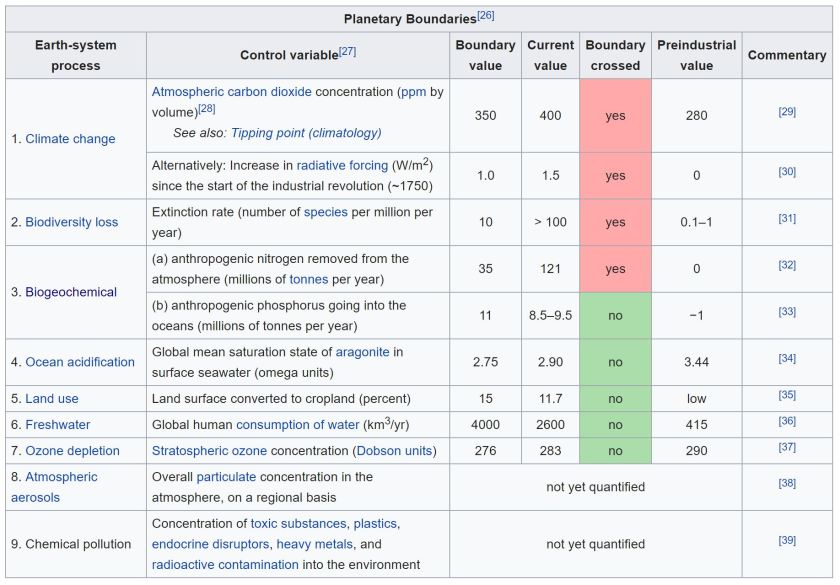
In 2009 group of environmental scientists led by Johan Rockström and Will Steffen proposed the idea of planetary boundaries. They defined nine indicators to monitor Earth’s environmental stability. In 2009 we had not crossed any of the nine boundaries, but by 2017 we had crossed four. Everyone knows about boundary number one – climate change – but do you know the other eight? I may have heard of planetary boundaries before in the popular science books I read, but it feels like I just discovered this concept when I read Thank You For Being Late by Thomas Friedman. So, it took me eight years to encounter this concept since it was first created. That’s not too bad. How long will it take this idea to spread to everyone? Have you heard of planetary boundaries?

book-big-world-small-planet (1)Johan Rockström came out with a textbook, Bankrupting Nature: Denying Our Planetary Boundaries in 2012, but I rarely buy textbooks (the Kindle edition is $45!), but even if I did, I’m not sure I’d find them readable because of my knowledge level. Rockström did come out with a popular science level book, Big World, Small Planet in 2015, which I do wish I had discovered. How often do we buy new books with new ideas when they first come out? (I ordered it today, even though I’m two years late.)

The first laser was built in 1960. I read about it in Popular Science sometime in the mid-60s. I got to see one in 1967 at a science museum in Miami. In the 1980s I finally got to own one when I bought my first CD player. So it took about a quarter century to spread laser technology to the masses.

On the other hand, it took algebra thousands of years to finally get to me in 1963. In fact, most of what I know is pretty damn old. I finally learn about calculus in the early 1970s, when its concepts were only as old as Newton and Leibnitz. I guess astronomy is the science I’m most up-to-date with, and I’m sure I’m years behind and only know its discoveries in the most rudimentary of ways.

The concept of climate change has taken decades to spread through society and it’s often rejected. How long will it take other planetary boundaries to become universally known and affect political action? Even with the speed of the internet we just don’t seem to learn new ideas quickly enough. Most people are stuck on religious ideas proposed thousands of years ago which have been completely invalidated by later knowledge.

And, we forget so much knowledge! My awareness of mathematical concepts has de-evolved to a time before the classical Greeks. To make matters worse, Republicans seem hellbent on rejecting science. Even if knowledge flows freely and fast around the internet there are barriers to absorbing it.

The concept of planetary boundaries is essential to our survival. And I bet there are way more the nine boundaries – that’s just the number scientists are working with now. (Of course, there might already be a new number and I won’t acquire it for a few more years.)

I’m looking for the best popular science books on the nine boundaries. Read about them at Wikipedia but here’s the table they use to define them. (Hope it’s okay to copy.) If you’ve read good popular science books on each that you’d highly recommend, let me know. I consider This Changes Everything by Naomi Klein to be the best book for boundary #1, and The Sixth Extinction by Elizabeth Kolbert for boundary #2. But I’m having trouble finding bestsellers that focus on boundaries 3-9.

9-planetary-boundaries

JWH

Should I Abandon My Bible Study?

by James Wallace Harris, Monday, November 6, 2017

I’m an atheist, so I don’t study the Bible in the same way as people of faith. I have two goals for Bible study. First, I consider Christianity, or any religion for that matter, like a language. To talk to Christians requires understanding their language. The Bible is an integral part of western civilization, and to understand our history requires understanding the Bible. This is still akin to learning a language. The details of history are often idiomatically based on biblical references.

The Bible

The second reason why I study the Bible is to understand how information is transmitted over space and time. Think of my interest like the game of telephone kids play – also known as “Chinese whispers.” Jesus said many things two thousand years ago, and now we hear what he said repeated through thousands of distortions. Is there any way to backtrack and try to filter out two millennia of noise?

I’ve always felt both approaches to this kind of Bible study are practical and intellectually rewarding. However, I’m beginning to fear both goals are pointless. I’m starting to doubt I can ever communicate with a religious person, nor can we ever know what Jesus actually said. One proof of my doubt is all the faithful firmly believe they actually know what Jesus said even though they each have a unique interpretation. In my reading of the gospels, I would say it’s impossible to follow the teachings of Jesus and own a gun or pursue wealth, but millions of Christians would vehemently disagree. Where’s the truth?

This issue came up today when I saw How Jesus Became God by Bart D. Ehrman was on sale from Amazon in November for $1.99 for the Kindle version. I thought about buying and rereading that book. Ehrman is my favorite teacher for explaining how Christian memes evolved over time, and consider this book the best explanation how Christians believe Jesus, a man, is now God. My personal assumption from studying the Bible is Jesus never claimed to be God but was made God by his followers. Ehrman backs this up with historical analysis. I feel these six books by Bart D. Ehrman are the best explanation I’ve found that removes the distortion of playing telephone with Jesus’ original sayings 2000 years ago.

Ehrman’s approach is to study Jesus as history, not theology. Each book takes a different tack in solving a historical puzzle. I believe many of the problems we face in society today are caused by irrational beliefs about Jesus. However, I’m not sure Ehrman’s results can ever be used to logical dispel such beliefs when talking to a person of faith.

Fantasyland by Kurt Andersen has convinced me that irrational thinking is so entrenched in American society that logical discourse will never work. In fact, Andersen makes a good case that two-thirds of Americans embrace a “believing makes truth” philosophy.  They feel rational thinking is out to get them, that scientific knowledge is oppressive, and freedom is being allowed to believe what they want.

Thus, why I wonder if it’s even worthwhile to continue my Bible study.

Because there are billions of interpretations of who Jesus was and what he said it’s impossible to ever know what he actually said and meant. This allows believers to believe anything they want and still claim they are following his teachings. The only logical way I can think of disproving their belief logic is to analyze the words of Jesus by doing what the theologians of the Jesus Seminar did. This was a group of Bible scholars who voted on probable accuracy of every saying we have of Jesus (the ones printed in red in some Bibles). They color-coded the results to statistically reveal which sayings the historical Jesus might have said, with red being the most likely. This is a wisdom of crowds approach.

Thus, if you take just the red, and maybe the pink quotes from The Five Gospels, we might assume that’s what the historical Jesus taught. The trouble is, the results do not match what most people believe today. And since believers believe belief trumps everything, this logical approach will be no proof to them.

I’m wondering if I shouldn’t tune out all discussion of religion completely. Don’t try to understand or explain it. Just write religion off as complete irrational thinking. I was hoping the scientific and faithful could meet halfway, but after reading Fantasyland I’ve given up on that idea.

When I read science or technical books I feel I’m living in a rational reality. I have hope for the future. When I read books written by true believers I feel despair. Their irrational thoughts convince me society is crashing.

JWH

Cozy Science Fiction: Chocky by John Wyndham

by James Wallace Harris, Friday, October 27, 2017

What makes for good storytelling? How is a science fiction story different from other kinds of stories? Chocky, John Wyndham’s last novel published in 1968 is a story about a David and Mary Gore and their two children Matthew and Polly, living in England in what appears to be the quainter side of the 1960s. I imagine its time and setting looking somewhat like the Father Brown mysteries on PBS. The story is told by David. It’s rather prosaic, with a light literary touch. David relates how he met Mary. How she came from a big family and the pressure they felt to have a big family too. When they apparently can’t they adopted Matthew. Then, Polly, a girl is born. The story jumps ahead a few years to give the history Polly’s imaginary friend when she was four, and how that problem was resolved. Then the story jumps again to the present when Matthew is twelve, much too old for imaginary friends, and how he acquires one anyway. Most of the novel is about the family difficulties caused by Chocky, Matthew’s mysterious invisible companion.

Chocky by John Wyndham

Wyndham’s novel Chocky could be considered a mainstream literary novel, a nice quiet little story about family life in mid-century England. What makes it science fiction is who we think Chocky might be. The mystery genre has a sub-genre called cozy mysteries. Chocky could be a cozy science fiction novel. But what does that mean? There’s already a sub-genre in science fiction called cozy catastrophes. Many of them are by English writers by the way, and I believe many cozy mysteries are set in England too, but an Anglophile appeal is not a defining attribute of a cozy novel.

I’m sure there is no international standard for cozy novels but for me, the size of the setting, number of characters, and scope of the plot are important factors. So a story about a single alien invader impacting one family makes it a cozy tale. I guess that also makes E. T. the Extra-Terrestrial a cozy, but Chocky is much smaller and quieter than that story. The story loudness knob for science fiction movies is usually cranked to 11. Gattaca and Her being level 3 exceptions. Chocky is about a 1 or 2, and I found that exceedingly pleasant.

I’m not sure if science fiction fans even crave cozy science fiction novels. Science fiction plots are inherently big, thundering, and exciting. Mostly mystery fans who love cozy mysteries love them because they are quiet, with simple murders usually solved by ordinary folks, with tame storytelling for sex, violence, and crude language. Chocky fits that bill nicely. Chocky is currently in print from NYRB Classics, the prestigious paperback line from New York Review of Books. As of today, NYRB Classics only publishes 13 science fiction novels, most of which are on the quiet side, and many from England. Maybe the NYRB editors admire cozy science fiction too.

I doubt Wyndham intended Chocky to have an ambiguous ending, but if you were skeptical and tried hard, the science fiction could be removed the story. I imagine if there were a sub-genre cozy science fiction, that would be one of the defining characteristics, the science fictional element would be painted lightly onto a story of ordinary life. Examples might be The Age of Miracles by Karen Thompson Walker or Station Eleven by Emily St. John Mandel, both gentle post-apocalyptic tales that are a far cry from Mad Max rip-roaring tales of civilization’s collapse where it’s kosher to blast away anyone you want with your modified AK-15.

When I was younger I loved loud science fiction. Now I’m drawn to the cozier side of its storytelling. I think loud storytelling, both in books and movies became popular in the 1960s. I love westerns and constantly seek out old ones, and I’ve discovered the kind I like best were made in the late forties into the middle fifties. Westerns are a genre that depends on violence, but starting in the late 1950s they began cranking up the violence too until they became a kind of gun-porn by the 1960s. Special effects, relentless action, and comic book violence have ruined movie science fiction for me. I guess that’s why I enjoyed discovering Chocky so much.

Be sure and read Margaret Atwood’s introduction to the new edition of Chocky, “Chocky, the Kindly Body Snatcher.”

JWH


The Church of Reality

by James Wallace Harris, Friday, October 27, 2017

PKD“Reality is that which, when you stop believing in it, doesn’t go away.”

― Philip K. Dick, I Hope I Shall Arrive Soon


We need to declutter the world of bullshit memes. It’s time to apply Marie Kondo’s techniques for getting rid of unnecessary things to unnecessary beliefs. We all live in a fantasyland of lies, myths, untruths, and endless other forms of bogus thoughts. There is too much truthiness in the world and not enough truth.

Yesterday I started writing an essay about all the bullshit beliefs that pollute our minds. As I began tallying those crazy concepts I realized I’d need to write a whole book to cover the topic. This morning I discovered that book has already been written, Fantasyland: How American Went Haywire: A 500-Year History by Kurt Anderson. Here is a portion of chapter 1, “Now Entering Fantasyland,” but I highly recommend following the link to Amazon and reading the whole chapter.

HOW WIDESPREAD IS this promiscuous devotion to the untrue? How many Americans now inhabit alternate realities? Any given survey of people’s beliefs is only a sketch of what people in general really think, but from reams of research, drilling down and cross-checking and distilling data from the last twenty years, a rough, useful census of American belief, credulity, and delusion does emerge.
By my reckoning, the more or less solidly reality-based are a minority, maybe a third of us but almost certainly fewer than half. Only a third of us, for instance, believe with some certainty that CO2 emissions from cars and factories are the main cause of Earth’s warming. Only a third are sure the tale of creation in Genesis isn’t a literal, factual account. Only a third strongly disbelieve in telepathy and ghosts.
Two-thirds of Americans believe that “angels and demons are active in the world.” At least half are absolutely certain Heaven exists, ruled over by a personal God—not some vague force or universal spirit but a guy. More than a third of us believe not only that global warming is no big deal but that it’s a hoax perpetrated by a conspiracy of scientists, government, and journalists.
A third believe that our earliest ancestors were humans just like humans today; that the government has, in league with the pharmaceutical industry, hidden evidence of “natural” cancer cures; that extraterrestrials have recently visited (or now reside on) Earth.
A quarter believe vaccines cause autism and that Donald Trump won the popular vote in the 2016 general election. A quarter believe that our previous president was (or is?) the Antichrist. A quarter believe in witches. Remarkably, no more than one in five Americans believe the Bible consists mainly of legends and fables—around the same number who believe that “the media or the government adds secret mind-controlling technology to television broadcast signals” and that U.S. officials were complicit in the 9/11 attacks.

What we need is a movement to zap unreality whenever we encounter it. We need a Church of Reality where the ten commandments work to clear the collective consciousness of delusion. Of course, that’s Zen Buddhism, which has never caught on big. Too bad we can’t all walk around with bamboo sticks and give each other a politic whack if we hear something attacking reality.

If John Kelly had a keisaku, swatting Donald Trump every time he said something foolish, I wonder if the President could be conditioned into seeing reality more clearly? Would it help any or all of us if we got a little sting when we said something unreal? Maybe Apple and Google could develop apps for our phones that listen to us like Alexa and honks rudely when hearing silly remarks. Think of it as an AI friend like Mr. Spock or Data from Star Trek who would be cool and logical.

Anderson, in Fantasyland, goes into the history of how we’ve become such a looney nation. It used to be crackpots were loners seldom seen, but the internet has turned them into preachers gathering huge flocks of crazy followers. To compound the problem our country is creating an anti-authority establishment. Politicians and businessmen have learned that two-thirds of the population will believe anything they tell them so they greedily take whatever they want by lying. Currently, they are pulling off the biggest con in history with their tax-cuts using tired old lies that have been disproven for decades, yet they continue to succeed.

There is one external reality in which we all reside, unfortunately, the human mind creates its own subjective reality that each mind prefers to believe. Science is the only cognitive tool that tells us statistically which aspects of the external reality are probably real. Any Church of Reality we create needs to teach people how to tell shit from Shinola. I don’t know if that’s possible, but it’s lessons need to come from an external source. I can picture us each having a robot that follows us around and routinely says in the voice of Jeeves, “I’m sorry sir, what you just said is incorrect” or maybe in the voice of Marvin the Robot, “Damn human, you certainly are full of crapola today!”

JWH


Is There Any Hope for the Future?

by James Wallace Harris, Tuesday, October 24, 2017

A friend of mine recently posted to her Facebook that her world was rocked when she attended a lecture by Rev. Dr. William Barber who is leading a moral movement to repair the breaches in our society. I assume Laurie found hope in the idea we can save ourselves by creating a new moral order. Even though I’m an atheist, I’m all for this. The trouble is our society is too fractured. Is it even possible to put it back together again? I’ve recently wondered if there is any kind of movement that everyone could embrace and find agreement? I figured it would have to be as powerful as Christianity was in its first four centuries — and yet work with non-Christians and non-believers.

How can we find common ground? Everyone talks about America being politically polarized into conservatives and liberals, but I believe there are far more divisions than that cracking up our society. If every group identity is going to demand society conform to their narrow vision we are doomed. How can we find common ground when so many different viewpoints want to dominate making the rules? Instead of seeking cooperative compromises they all fight to impose their view while demeaning everyone else’s.

In small, homogenous societies, social coherence is found with shared morality. We live in a vast, heterogeneous society with countless ethical/moral visions which makes having shared values almost impossible. In the past, we all tried to agree on some social conventions such as etiquette, acceptable public behaviors, and abiding the laws. Such efforts are almost universally ignored now.

Our greatest obstacle to finding social consensus is defining reality. “I will destroy the wisdom of the wise” is how the apostle Paul began the divide between religion and science by attacking what he called the “empty logic of the philosophers.” Several hundred years later, St. Augustine continued with “There is another form of temptation, even more fraught with danger. This is the disease of curiosity . . . It is this which drives us to try and discover the secrets of nature, those secrets which are beyond our understanding, which can avail us nothing and which man should not wish to learn.”

The-Closing-of-the-Western-Mind-by-Charles-Freeman

I got these quotes from The Closing of the Western Mind: The Rise of Faith and the Fall of Reason by Charles Freeman. They explain perfectly how and why modern believers deny science. The faithful intuitively understand faith is threatened by science. It’s why Christianity embraced Plato and not Aristotle when they discovered the Greeks. It’s why conservatives have a never-ending guerrilla war with education working to undermine K-12 and higher education. They deny the results of science by denying science.

Is it even possible to find a common morality sharable by the sacred and the secular? We can’t even agree murder is evil. How can Christians embrace stand-your-ground laws, gun carrying permits, and AR-15s in light of the Sermon on the Mount? It’s strange that godless liberals support diversity, a concept that St. Paul brought to Christianity when many modern Christians reject it today. Not only is our secular society fractured into countless pieces, but so is Christianity. If believers in a single divine authority can’t agree how can secular society?

The old saying claims money is the root of all evil. I think it’s truer than ever. Money promotes self-interest, and self-interest promotes justifying the acquisition of money by any means. Our plutocratic society has escalated lying to the supreme tool of the greedy. Wealthy people and corporations have learned that lying pays big dividends. A great book that makes that point is The Merchants of Doubt by Naomi Oreskes & Erik M. Conway.

There is a war on science, knowledge, expertise, and intellectualism. The greedy have aligned themselves with the faithful to attack science, and they are winning the war. We can never achieve a universal morality if half the population believes the end justifies the means, thus rationalizing lying. The age of fake news and endless assaults on journalism will never stop before society collapses. I sometimes wonder if the goals of the radical right are to destroy society so they can start over fresh.

There is no hope for any moral movements if we all can’t agree to stop lying. We all need to accept that science is the only tool we have for verifying reality. Science was invented to work across cultures and weed out subjective bias. It is an extremely effective tool for explaining the objective reality we all live in. We must accept that any subjective religion, philosophy, or opinion can’t be a basis for defining what is true. Religion has two choices. It can embrace science or reject it. Religion will strengthen itself if it accepts science, even if science denies it’s metaphysical assumptions. The real value of religion is creating shared values and stable communities — heaven on Earth rather than silly promises in exchange of silly declarations of beliefs.

The greedy are currently using religion to attack science to protect their wealth. The greedy have aligned with the faithful who are also attacking science to defend ancient memes created by primitive folks thousands of years ago. There is a logical synergy to their union but if it succeeds it will destroy our current civilization. Thus, greed is corrupting modern Christianity. I find it hard to accept the faithful who claim the moral high ground when Mammon is their ally.

I don’t know how they can assert America is a Christian nation when our society isn’t even close to resembling the sayings printed in red in their bibles. I believe Jesus tried to teach social action that has more in common with the Democratic party than the Republican. To me, the only valid analysis of Christian philosophy comes from what Jesus said. Everything else said in his name or about him is corrupt. Read The Five Gospels by the Jesus Seminar to understand what I mean, or the books of Bart D. Ehrman.

I believe our only hope is to get the faithful and faithless to agree on common secular morality. This is what the Founding Fathers intended when they created freedom of religion. Because religious beliefs are infinite in variety they need to stay out of politics and remain personal. We need laws and common morals that protect everyone equally. We need to ignore the politics of special interest groups that want special treatment for the few.

We need to agree that science is the only arbiter of explaining reality, promote universal quality education, develop a set of ethics that all agree on which protects both people, animals, the plant world, the environment, that develops a sustainable society. What we need is worldwide Constitution and Bill of Rights for everyone in the 21st century. We need to protect the poor and helpless, but allow the ambitious to succeed without collectively destroying the planet.

The Death of Expertise by Tom Nichols

I’ve read two articles this week that suggests this won’t happen. Both are about the war on science and knowledge. The first is Bill Moyers dialog with Joan Scott at Salon, “In the Trump age, an embolden attack on intellectuals.” And this older article at The Federalist by Tom Nichols, “The Death of Expertise” which later became the book, The Death of Expertise.

Hope involves believing people can change. Since we haven’t for two hundred thousand years, why expect the human race to get its shit together at the last moment to avoid an apocalypse of our own making? We could save ourselves if we weren’t so greedy. Unfortunately, we live in a civilization where greed is the foundation.

JWH