Young vs. Old Voters

by James Wallace Harris, Saturday, July 13, 2019

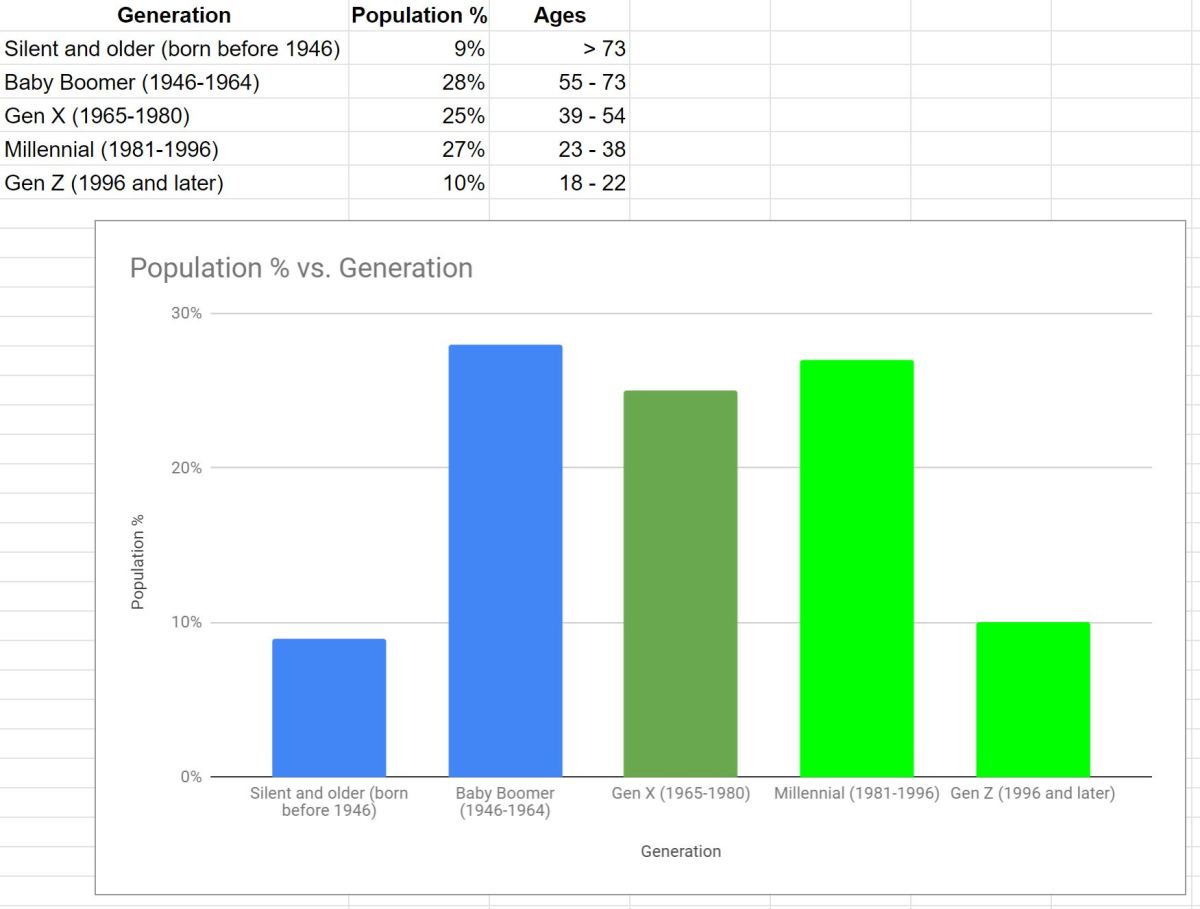
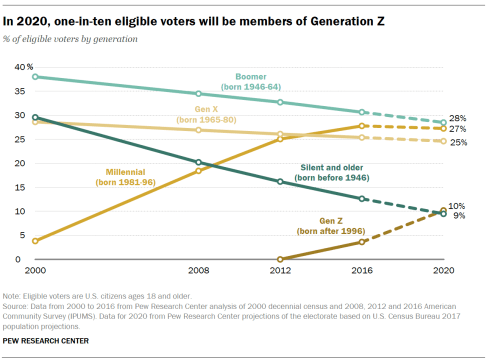
I’m using statistics from Pew Research Center’sAn early look at the 2020 electorate.” I’ve graphed them so blue is older voters, light green the younger voters, and middle-age voters are dark green. There is a certain symmetry to this graph. I’m going to “borrow” a PEW graph that shows the change vectors of each generation.

population trends

It’s obvious that Baby Boomer and Silent generations are in decline, but if you look closer, Millennial and Gen X generations have already started their decline. You’d think the 2020 election should reflect a generation shift.

If you look at PEW’s other graph in that article,

Voters by ethnic groups

you’ll see the shift that Republicans fear. Why do Republicans keep alienating minorities? Haven’t they even considered embracing diversity?

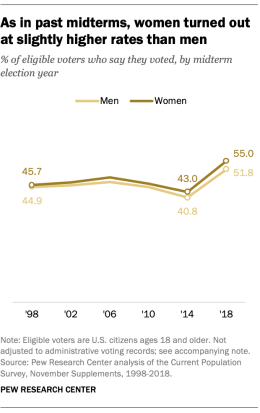
Finally, if we consider gender,

Voters by gender

where we see that woman voters are also increasing.

I have no way to predict how the U.S. 2020 presidential election will go. There are too many factors. But if population demographics are good indicators, then youth, minorities, and women should play a bigger role. But are they a large enough factor for Democrats to shun running another old white guy? Which side of the graph should the Democrats bet on?

Trump won in 2016 by finding the right dissatisfaction in America. I think that same dissatisfied voting block still exists, but are they satisfied with Trump? Many independent voters voted for Obama and then Trump because they hoped for significant change. Should the Democrats pick someone promising to make big changes? What do younger voters – liberals, conservatives, independents – really want?

We never seem to know the deciding issue in a U.S. presidential election until after its over. The face-palm slap factor is always a black swan that surprises us. You’d think with all the artificial intelligence out there that data scientists could tell us ahead of time. But I doubt they will.

As of now, I’m going to bet that the 2020 election will be about youth. I’ve been reading articles lately about climate change depression. Young people are bummed out about the future, and who can blame them? I’m guessing they might be the reactionaries in the 2020 election. Maybe I feel this because I don’t want to see the young giving up on the future. Climate change isn’t the end of the world, but voters who don’t vote about the future could be.

JWH

Why Don’t I Do What I Know Is Good For Me?

by James Wallace Harris, Friday, July 12, 2019

From all the studies I’ve read, I’d be a much healthier person if I ate a plant-based diet, and regularly lifted weights and did aerobic exercises. So, why don’t I?

I’ve never been a very disciplined person even though I know from limited experience that being disciplined has its rewards. If I eat right and exercise I feel better than when I don’t. Now that I’m getting older, the importance of health is becoming much too obvious. Yet, I do less to help myself. Why?

Popular wisdom now nags us that inactivity is as bad as smoking. I was disciplined enough to not smoke, so why can’t I make myself stay active? I’ve been a rather inactive bookworm my whole life. It’s hard to believe that my Walter Mitty ways are killing me. Laying around daydreaming feels perfectly natural to me. But I must admit that my energy levels are dwindling as the years go by. Not only do want to do less as I get older, but my muscle strength and overall stamina are fading too. But isn’t that plain old getting old? Can diet and exercise equal rejuvenation?

I tell myself to exercise more. I do. And I feel pretty good. However, naps are more alluring than ever. My doctor says all my blood work numbers are good. She says trying using the exercise bike twenty minutes a day. I do. Maybe I feel a tiny bit better, but I still love naps and daydreaming, and I can’t lift furniture or untwist jar tops like I used to. Is that because I’m racing towards 70? Or because I’m not moving enough?

I wonder if lifting weights or going to the gym would give me back my strength and stamina?. But it’s so much nicer to just read. I ask myself if going to the gym is the solution, why isn’t every oldster not in tip-top shape?

I have my best luck sticking with physical therapy exercises, doing Miranda Esmonde-White exercises, and walking. I gave my exercycle to my wife. I got rid of my big Bowflex machine because it was just too damn big. And I’m thinking about giving away my little Bowflex machine because I’ve found the back pains it cures are also cured by the Miranda Esmonde-White exercises.

Since I hate going to the gym and I’m getting annoyed exercise equipment, I’ve been telling myself to embrace body-weight exercises. I’ve been collecting how-to articles, but I haven’t put them into practice yet. I know it would be good for me, but I can’t make myself start.

I’ve reached a state of equilibrium with my diet. I no longer pursue the plant-based diet that I did after I got my stent. I eat cheese, eggs, and yogurt. I eat some sweats, but not much. I’m still a vegetarian – I have been since 1969. This is my 50th anniversary. But I just can’t make myself go vegan even though I think I’d be healthier and live longer.

In other words, I’ll eat and exercise moderately, but I won’t make a big effort to become healthier. Why? I spend between 20-60 minutes a day exercising. If I spent another 30 minutes I might have more strength, stamina, and longevity, but I won’t go that distance. Why?

I know people who are physical fitness fanatics, spending hours each day exercising, and I know people who are epic couch potatoes, who never exercise or even try to eat right. I’m not sure if there’s any consistency in who is healthier. Both groups are more energetic than me, and both groups suffer from various random health crises.  I know exercise nuts who have gotten heart attacks, strokes, and cancer, and I know do-nothings living into their nineties still cramming down the junk food nightly.

I think the illusion is we want to control our fates. I hate that I’m losing my stamina, strength, and energy, but maybe that’s the fate of this particular body.

My new diet is to stop eating anything that makes me feel bad within 24-hours. I have a whole list of foods and drinks that my body doesn’t like. I also exercise just enough to avoid aches and pains. I can tell when my body needs some stretching or activity. After that, I can’t make myself do things on the assumption that I’ll live longer. There’s just no feedback.

Before I got the stent in my heart I couldn’t breathe. It felt like I was dying. That was a wonderful incentive to do something. But that was back in 2013. I now avoid fatty foods. If I eat too much fat I can feel a lack of oxygen. That inspires me. Feeling pain in my back or numbness in my legs inspires me. But the pleasantness of a nice nap while listening to music, or the contentment of sitting and reading doesn’t inspire me to move.

JWH


What Would Give Us Hope for the Future?

by James Wallace Harris, Saturday, May 25, 2019

I have little hope for the future. I’m not alone, my most popular essay with over 60,000 hits is “50 Reasons Why the Human Race is Too Stupid to Survive.” So I keep asking myself: “What would give us hope for the future?”

If certain changes were made in our laws I might change my mind about the future and be hopeful. However, I seriously doubt they will be made because the current state of corruption is too ingrained. Until we can solve these five problems I don’t think there can be any hope for the future.

  • Greed
  • Corruption
  • Deception
  • Inequality
  • Pollution

Our current system has wired our society for self-destruction. If we don’t do something to alter course our civilization will collapse in the next 50-75 years. Just count the countries that have collapsed around the world in recent years. There are several bald spots on civilization right now. Civilization is thinning around the globe. We need to repair those bald spots and make civilization sustainable economically and ecologically.

I no longer feel electing a new leader every four years is a solution. We need to tweak our political system so that it’s more democratic. We need to redesign capitalism so it’s equitable and ecological. Our current political polarization leaves a majority of the population depressed because we effectively have minority rule. Even we got rid of the Electoral College it will only help a little. We’d also need to get rid of all the corruption in the voting process such as gerrymandering and unfair laws to control who votes.

Even if we overhauled the voting system so that it’s 100% fair and open, we’d still have lethal problems. The most important of which is corruption. People with money control too much. We live in a plutocracy. The solution here is to remove all campaign contributions. The government should pay for all campaigning so every candidate has equal resources and no reason to be beholding to any special interests.

Ending political contributions would not end corruption. We’d also need to overhaul the tax system so businesses couldn’t strive to get a better deal. By allowing tax breaks for certain industries or to lure them to specific locations we create a structure for corruption. The influence of greed needs to be removed from politics.

Some people don’t want a true democracy because they fear it would bring mob rule. I’m not so sure. But we might need to change the definition of majority. Winning with 50% causes polarization. We’ve coalesced around two parties by forming coalitions of special interests. We need to get back to bipartisan compromises. We should change the percentage to win an election to 55%, and maybe eventually larger. We should change the percentage for a law to pass to 66%. And more laws should be based on referendums, rather than politicians.

We need to elect leaders who work for 100% of the people. Every political issue, no matter how divisive needs be base on solid compromises. Right now everyone wants extreme solutions, ban all guns – allow all guns, ban all abortions – allow all abortions, etc. We need to find middle paths that satisfy at least 66% of the country. If two-thirds of the population were satisfied, I feel the country would eventually heal itself.

And we need to stop endlessly arguing. Our polarized politics have made the country into one giant trench warfare where the lines never move. We need to find compromises, and then shut up for a while. We need to make a decision and stick with it for at least a decade before we argue over it again.

Part of our problem is we argue with lies and deception. We need to learn how to validate the information we club each other with. People with power and money know how to deceive. If we had a true democracy, those who want to influence change would have to appeal to everyone, and not just a few corruptible politicians. We need to eliminate lobbyists to politicians shift lobbying to the voters.

Part of the problem is inequality. A powerful minority are born with decisive advantages while too many are born without the opportunity to compete.

Capitalism is the only mechanism we have to create wealth and inspire innovation, but it unfairly creates too many losers. We want a system that rewards effort, but we don’t want a system that allows unjust competition. All of us are born on Lifeboat Earth without our choosing, but some were giving more of the provisions than others at the start. We are a greedy species, so we couldn’t stand a society that divided everything equally. However, for stability, we do need a fairer divvy up of what we have.

I would have hope for the future if everyone had an equal say, had equal opportunity, and the winners of society left the losers with at least a respectable life.

And we have to do all this while preserving the Earth. Seven billion people cause a lot of pollution. Climate change is a byproduct of pollution. Our pollution is destroying the environment for us and all other species. Not only should we seek equality for all humans, but other species deserve a share of equality too.

I think it’s possible to create a fairer sustainable society, but I’m not sure we will. As you consume the news each day, pay attention to these five problems. Are we moving to solve them, or increase them? Keep your own scorecard. How would you bet on the future?

JWH


I’m a Slow Learner of the Big Picture

by James Wallace Harris, Sunday, May 12, 2019

It took me over ten years to graduate college, changing majors several times. I realize now that my problem was seeing the bigger picture of every topic. I never understood why I needed to learn what was required in each course. For example, The Modern Novel, a course I took for the English major I finally completed. Back in the 1970s, I couldn’t fathom why they called novels from the 1920s modern. Well, now in the 2010s, I do. I just read The World Broke in Two by Bill Goldstein. Goldstein chronicles how Virginia Woolf, E. M. Forster, D. H. Lawrence, and T. S. Elliot struggled in their personal lives to finish their most famous works in 1922. Each floundered in their efforts before finding new narrative techniques.

I now see the “modern novel” in a larger context, and I’m sure if I keep reading the history of everything from 1875-1930 I’ll expand that mental map even larger. Since I was an English major in the 1970s I’ve learned about the revolutions in art, music, philosophy, and other subjects in the early 20th century that add to that bigger picture. If I had taken courses in history, science, art, music, literature, engineering, medicine, etc. concurrently that covered the 18th-century one semester, then the 19th the next, and then 20th century, I would have understood how everything came together in the 1920s to be labeled modern. And that would have helped me comprehend the “post-modern.”

Concurrent to reading The World Broke in Two I’m also reading and studying the history of science fiction short stories. I’ve been reading these since the 1960s, and their evolution is finally coming together in multiple related ways. I realize now that I’m quite a slow learner when it comes to constructing the big picture in my head.

I remember back in high school and college feeling jealous how some of my fellow students always knew the answers. I assumed they studied harder than I did because I knew I didn’t study much. But that’s only part of the reason why they did better in school. I’m just now realizing they were also better at connecting the dots.

One of the big regrets in my life is not finding a passion while young to pursue with great effort and concentration. I knew success requires hard work, but the willingness to work hard requires drive and focus, and I never had that. I now understand that seeing the big picture is part of creating that drive and focus.

I’ve always been somewhat smarter than average, but never very smart. I had enough innate skills to get through school without studying much, but not enough cognitive insight to understand why I should study. I always saw school like the smaller image in the larger image above – a fragment of the whole that didn’t make sense.

Evidently, some people have a knack for seeing the synergy of details when they are young. We know this from the early works of successful people. It must be a cognitive skill like a sense of direction, spatial awareness, or conceptualizing in three-dimensions, but with data and ideas.

I know what I’m saying is vague, but then I’m trying to describe something I’m challenged at understanding. I only have a hint of its existence. I wonder if its a skill they can teach young kids? However, I also wonder if the way they teach subjects in school actually works against gaining this skill. Because schools divide up learning into thousands of lessons we’re trained to memorize individual facts, and not how those facts make patterns. Of course, pedagogy might have changed since I went to school a half-century ago.

I’ve often wondered if in each school year they should teach students the history of reality from the Big Bang to now so they see how all areas of knowledge evolved together. Of course, in pre-K years teachers would have to be very vague by telling kids the biggest generalizations, but with each successive year refine those details. I wonder if kids learned to see how knowledge arose from previous knowledge it wouldn’t help reveal bigger pictures of how things work.

JWH


The Case of the Overactive Bladder

by James Wallace Harris, Sunday, April 28, 2019

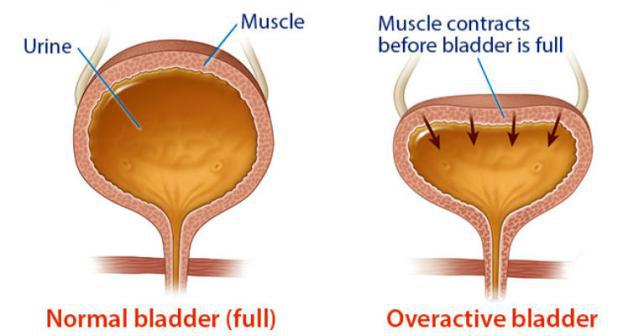
Old men often reach a stage in life where they have to pee frequently because of benign prostatic hyperplasia (BPH). This is caused by our prostates enlarging. Just another annoying aspect of aging. Depending on what I eat and drink, my bladder normally makes me go about every two hours, which means I get up three times in the night, and once during long movies. Not a terrible debilitation, but inconvenient. Yet, on some rare days, when I accidentally do the perfect routine, I only have to get up once in the night. That suggests I could do something to change things.

However, there’s something I also do that give me “pee spells” as I call them. They last about two hours and I have to pee every 10-15 minutes. This is extremely annoying, and I want to figure out what causes these spells. Maybe some of my readers might have this problem too and have already figured it out.

Of course, this case of the overactive bladder might be much too much information for some readers, so I expect most of them to have quit reading by now. But it is an interesting mystery, and I find people like solving mysteries.

My guess is I’m eating or drinking something that annoys my bladder since the condition only lasts a limited time. Figuring out that irritant is the mystery to solve. Sometimes I can go weeks without a pee spell, and other times it’s every afternoon. It’s the most annoying when it comes in the middle of the night. When it happens during the day I feel tired and try to nap. Of course, getting up every ten minutes to pee during a nap bugs-the-crap out of me and pisses off the two kitten who sleeps on my lap.

I had a pee spell yesterday. So here are the current clues. The week before I was on a sugar bender eating ice cream and oatmeal cookies twice a day, but I quit after one week. One theory is going between healthy and unhealthy diets does something to my bladder or hormonal system. I often feel like I have pee spells when I’m losing weight, but it might because I’m eating something healthy that’s triggering it and not the weight loss.

Because I hadn’t been eating much fresh fruits and vegetables last week I gorged on them this week. Another theory is my fruit salad might be the cause. I remember having frequent pee spells in the past, and maybe they were during the times I was eating fruit salads regularly.

I like fruit salads, and vegetable soups and salads because I can cram in many servings of each into one meal. However, that makes figuring out the culprit harder. I get all kinds of weird ideas like maybe I don’t wash my fruits and vegetables well enough and the suspect is a pesticide. Or maybe some fruit or vegetable is a natural diuretic.

I seldom take pain pills because they end up upsetting my stomach. This week I did take one ibuprofen for my back. So now its a suspect. I wonder if their occasional use is my problem and I’ve never noticed it before?

I’ve also wondered since I’m drinking less to pee less if this makes my urine more acid, and thus aggravates the muscles of my bladder. I’ve thought of drinking more, which is counter-intuitive, but I will test it. However, when I have tried drinking more in the middle of a pee spell it only makes it last longer. I wonder if there’s a way to get pH test strips to test my theory?

Another theory I’ve worked up relates to bacteria. Our gut biome is a big topic today, with claims it affects our thinking and personality. Could I be consuming something that alters the balance of warring bacteria in my intestines and that eventually affects my bladder?

When I was in high school and working at a grocery store after class, I’d often drink two 16-ounce Cokes on my commute home at 10 o’clock at night. I don’t remember it affecting my sleep. I also remember a few times of eating two Whoppers, a Coke, a shake with two orders of fries and not feeling stuffed. At 67, such a meal would kill me.

Getting old is so goddamn weird. I don’t want to be a hypochondriac, but my body has gotten hyper-sensitive to everything. I have to think about my health all the time, and I don’t want to. My body has become so sensitive to what I consume that I’ve thought about inventing the perfect bland diet. I wish Purina made People Chow. Or like in some science fiction story, I wish I could transfer my brain into a robot where I didn’t have to eat or eliminate at all. I’m a very happy person if my body didn’t keep nagging me. I’d be in my own Nirvana if I was a robot and could just read, write, watch, listen, and contemplate.

I tend to think the agent of my annoyance is something physical I consume, but I’ve also wondered about it being a psychological problem. I know that I’m weird, but am I that weird? My doctor once suggested trying Zoloft for anxiety and said one positive side effect of it might be to relax my bladder muscles. I did try Zoloft but not for long, it bothered my stomach. But this has gotten me to wonder if anxiety might cause my pee spells? Normally, I’m very happy except for when I have to go somewhere. As I’ve gotten older I just dread going places. This week I was dreading going to the book club last night.

I did ask my doctor about the medicines I see on TV for overactive bladders and she advised against them because of their side-effects. I was happy with that recommendation because I hate taking medicine.

So, there are the clues I have so far. Any health detectives out there that have already solved a similar crime?

JWH