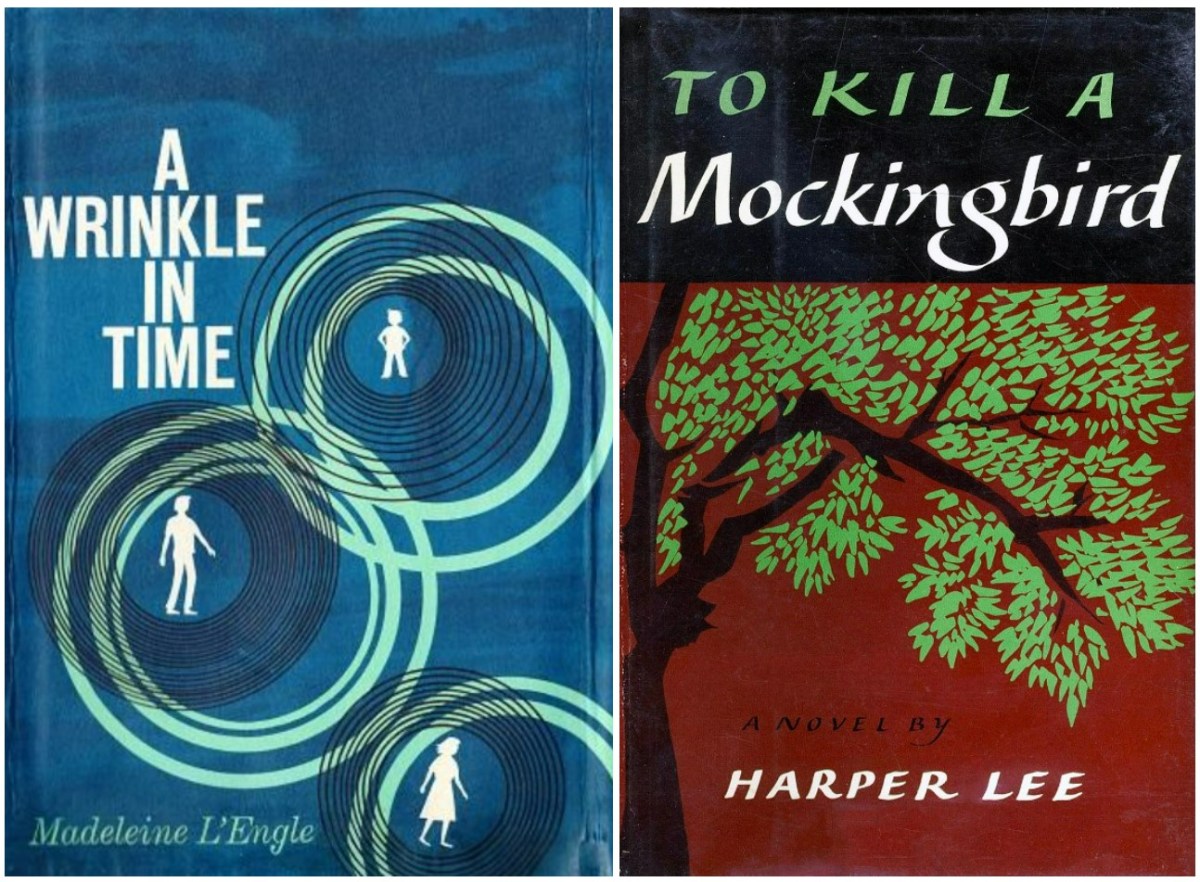
What If Mrs. Saunders Had Read Us To Kill a Mockingbird Instead of A Wrinkle in Time?

by James Wallace Harris, 10/10/22

In 1962, when I was in the 6th grade, my teacher Mrs. Saunders would read to the class after lunch. The book I remember from that year is A Wrinkle in Time by Madeleine L’Engle. I found it so exciting that I went to the school library and checked out a copy so I could read it faster than 30 minutes a day. At the time, I didn’t know the novel was science fiction, or that the story belong in a category of fiction. But looking back, I see Mrs. Saunders had put me on the road to becoming a science fiction fan.

Yesterday, I wondered if Mrs. Saunders’s influence on my life would have been different if she had read To Kill a Mockingbird by Harper Lee instead? Would I have become a different kind of bookworm? Instead of being fascinated with space and time travel, would I have become interested in social justice and equality? I did come to care about those issues later on in the 1960s as the decade progressed, but could I have been made aware of them sooner by reading the right book?

Even though I mostly read science fiction, I do read some serious literature. I was an English major in college. I know when they come out, The Best American Short Stories 2022 will have far deeper, more mature, better-written stories than The Year’s Best Science Fiction Vol. 3: The Saga Anthology of Science Fiction 2022. Yet, the odds are I’ll probably buy and read the science fiction anthology.

In eighth grade, my English teacher required us to read three books each six-week grading period and raised our earned grade by one letter if we read five. She had an approved reading list. That’s how I discovered Heinlein. She gave me the chance to read science fiction and non-fiction, and I took it. What if I had read A Tree Grows in Brooklyn or The Diary of a Young Girl by Anne Frank instead? Would I have matured sooner? Would I have been more conscious of the real world?

What if in 1965 I read The Painted Bird by Jerzy Kosiński instead of Stranger in a Strange Land? Would I have become a different person? Or, did I read what I read because I was an immature kid that could only handle the immaturity of science fiction? I tend to think it’s the latter because I know serious literature is far superior to science fiction now and I still seldom choose to read it.

I believe I read science fiction then and now to escape from the real world. I read nonfiction as a kid and as an adult to learn about the world. However, I do wonder how I would have been different if I had gotten addicted to serious literature as a kid.

If I had a time machine and could go back to talk to my younger self I would tell him to read To Kill a Mockingbird. I’d say, “Kid, stop daydreaming about going to the Moon and Mars. Other people will do it, but not you. And if you could, you wouldn’t like it. Our personality isn’t suited for space travel. Spend more time with people and less time with books, and when you read a book, make sure it helps to know more about people.”

I’m pretty sure my younger self wouldn’t listen. People don’t take advice. Not even from our future selves.

For all I know, Mrs. Saunders may have read To Kill a Mockingbird to us and I just ignored it. She read us several books that year, and A Wrinkle in Time is the only one I remember.

JWH

Fiction v. History

by James Wallace Harris, 9/25/22

Ken Burns’s new documentary, The U.S. and the Holocaust, punched me in the soul. No documentary has ever moved me as much, and I’ve seen a lot of them. And it’s not because it’s about the Holocaust. I’ve even read about most of the painful facts it presents before. No, the gestalt of this film, which is well over six hours, is to set off an epiphany about our relationship with history.

At the highest level, the documentary asks: What did Americans know about the treatment of the Jews under the Nazis from 1932 to 1945 and when and how did they learn it? But to answer that question Ken Burns and company have to describe what Americans were like during those years. The U.S. and the Holocaust give a different history of America for those years from any I’ve ever encountered from people, in school, reading, at the movies, or on television.

Maybe the best way I can describe it is to say: Everything that has horrified me about living through the years 2016 to 2022 existed in the 1920s, 1930s, and 1940s. The documentary cements a theory that I’ve been developing in recent decades – that people don’t change and even the percentages of the population that hold specific opinions don’t really change either.

The documentary set off this existential conundrum: Why didn’t I already know what the documentary revealed? Or did I just filter it out? Republicans are in an uproar over Critical Race Theory and other curricula that they’re afraid will upset their children. I imagine they will be just as upset at The U.S. and the Holocaust. I knew about the wide popularity of the KKK and eugenics in the 1920s. I knew Americans were mostly isolationists and anti-immigration in the late 1930s. But the documentary gives us a different take on history than what I was taught.

I have to wonder since FDR was president from 1932-1935, have we always gotten the Democratic party’s view of that history? I wonder if Ken Burns has rounded out the historical period by adding the Republican party’s take on those years? I do know the documentary feels very synergistic with today’s politics.

I love old movies from the 1930s and 1940s, and none of the hundreds of movies I’ve seen from that era convey what I learned from The U.S. and the Holocaust. My grandparents, parents, aunts, and uncles, all lived through those years, and none of them ever described the mood of the country revealed in the documentary. I’m a bookworm that has read countless works of both fiction and nonfiction about America in those decades, giving me some of the details from in the documentary, but not in the same gestalt. Two books that come to mind are One Summer: America, 1927 by Bill Bryson and In the Garden of Beasts by Erik Larson.

After I watched the Ken Burns documentary I read The Plot Against America by Philip Roth. It’s a kind of science fiction novel, an alternative history where Charles Lindbergh wins the 1938 presidential election and for many of the reasons described in the documentary. Roth was born in 1933, and he makes himself the point-of-view character in his novel. Young Phil is only 8 when it begins and 10 when it ends, but his viewpoint is mature. It’s about the anti-Semitism of those years.

I thought The Plot Against America was a well-told story about Jewish life in Newark, New Jersey 1938-1942. I thought Roth’s alternate history speculation was well done, deriving from the kind of knowledge I got watching The U.S. and the Holocaust. But the story is mainly a personal one, and its gestalt is different from the documentary.

Last night Susan and I watched Radio Days for the umpteenth time. It’s Woody Allen’s nostalgic look back at those same years. It completely ignores all the political history of The U.S. and the Holocaust. Radio Days is like both movies from that period and later films that worked to recall that era. They all filter out the nastiness of racism and xenophobia that existed in America back then. Although some of it came through in the film The Way We Were, and the book version of Breakfast at Tiffany’s.

And just before I watched the three episodes of The U.S. and the Holocaust I read Revolt in 2100 which contains a 1940 short novel by Robert A. Heinlein called “If This Goes On….” Heinlein imagined America would go through decades of The Crazy Years, before undergoing a second American revolution that created an American theocracy. I was disappointed that Heinlein didn’t do more world-building for his novel, but after seeing the Ken Burns documentary I understand his inspiration for writing it. It’s obvious that many Americans back then wanted a Protestant theocracy. Consisting of only white people from England, Germany, and some Scandanavian countries.

I think it’s important to distinguish fascism as a political philosophy from the Nazis, who were also fascists. What many Americans wanted then and now is basic fascism, and the Philip Roth novel shows how America could have turned fascist.

The other day I saw a quote on Facebook that went something like this: If you get warm and fuzzy feelings reading history then you’re not studying history. I’m on the third volume of world history by Susan Wise Bauer, and it’s brutal. Most people want to romanticize history, which is what we get from novels and movies. The Republicans don’t want CRT taught because they want their kids to feel all warm and fuzzy studying American History. The new Ken Burns documentary will not leave you feeling warm and fuzzy.

My current theory is humans can’t handle reality. That we develop all kinds of psychological delusions to filter reality out. We prefer our fantasies. And popular history along with pop culture gives us nice takes on the past that allows us to cope. It’s also why most people’s theory of how reality works is no more complex than a comic book. It’s why we’ve always clung to religion. It’s why I have a life-long love of science fiction.

We just can’t handle complexity. There are plenty of real history books that document the reality of the times they cover, but they aren’t widely read. Maybe the Republicans are right, and history is too brutal for children. But maybe we keep repeating history because we’re all too wimpy to handle history.

I’m getting so I can’t stomach the historical lies of Hollywood, but I don’t know if I can handle all that much real history either. I used to think that maybe four percent of the population was mentally ill. In recent years, I’ve upped that to forty percent. But lately, I’m thinking there’s an entry for all of us in the DSM-5.

JWH

What If I Didn’t Come Back From The Dead?

by James Wallace Harris, 9/3/22

Last Monday I had hernia surgery and was under general anesthesia for over two hours. Being anesthetized is maybe the closest thing to being dead. Our conscious self is turned off so completely that it feels like we’re gone for good.

Interestingly, my book club book this month is Being You by Anil Seth and he introduces the study of consciousness with the discussion of general anesthesia. This was the fifth time I was put under so beforehand I was contemplating being gone. And I kept asking myself: “What if I don’t come back?” I thought it was philosophical fun to imagine nonexistence.

Mostly I thought about people I would miss but if I didn’t exist I wouldn’t feel anything. I think of death being like how things felt before I was born. I feel the only existence we know is this one. But my atheist beliefs could be wrong. I wondered how it would feel if I came to, but in another existence. I’ve always hoped if that happened I would be given all the answers to my questions about this existence.

My hunch is this existence is our only one. That reality is filled with many infinities but infinite existence isn’t one of them. Mostly I thought if I wasn’t coming back I should do a lot of paperwork before I might die to help Susan out. But I didn’t do that for two reasons. First, I assumed I was coming back. Second, because I’m lazy.

Still, it felt very weird and fascinating trying to imagine not existing.

Before my surgery, I had a long talk with my surgeon and he agreed to do everything I wanted. I was worried about two things. I was afraid lying on the surgical table for hours would inflame my spinal stenosis. I worried that I couldn’t hold my pee for that length of time because of my overactive bladder. I told him of these fears weeks before the surgery. He said he would try to arrange my back on the table like I needed and would give me a catheter but I would have to wear it for a few days at home. So I practiced lying flat each day before the surgery. Then on the day of the surgery, I told him to not worry about positioning me for my back but do whatever was best for his work. I also asked for the catheter to be removed before I came to and if I couldn’t pee on my own in recovery they could put it back in.

He seemed glad I practiced lying flat and agreed to my method with the catheter. This made me very happy and cleared all my worries. My surgeon then said he wanted to pray for me. I said sure. I’m not the kind of atheist that’s against religion or religious rituals. I am actually grateful for any prayers I receive.

I was impressed by the length of his prayer. He carefully went over all my problems and concerns and then covered all his goals in great detail while asking God for help. It was reassuring on several levels. First, it let me know how closely he listened to me, and second, it carefully laid out his working plans. But it fits in with my contemplations on nonexistence. And his prayer set the right mood for the occasion.

I felt that we each used a different language for understanding our shared existence. I use the word Reality for what he calls God. He believes in a personal relationship with God whereas I think I’m interacting with infinity and randomness. What he calls God’s will I call the unfolding of evolving randomness. Prayer assumes we can ask for blessings. I assume I will get what will be but I’m on one long lucky anti-entropic run of fabulous luck. The big difference is my surgeon believes there’s an existence after this one and I think death is oblivion. I’ve always been exceedingly grateful for this existence.

Well, I did come back. I’m writing this on my iPhone with one finger. The surgery went very well but it was more involved than my surgeon expected. I had no back pain after the surgery. And for 24 hours my back felt limber and young. Even after the drugs wore off it hasn’t been bad at all. And I peed right away when they rolled me back to my room after recovery. And in the days since I haven’t had much pain. I did without drugs except for a couple Tylenol and later, a couple of ibuprofen. However, I am suffering from a swollen scrotum which is typical of this operation and why I’m not sitting at the computer.

I’m quite glad to be back but I’ve learned that God’s will or reality wasn’t finished with me regarding this surgery. We never get what we picture, and my surgeon’s prayer didn’t cover post surgical complications. I thought going under inspired a lot of philosophical musings, but it turns out dealing with an expanding scrotum, generates even more existential thoughts.

One side effect of this experience is to feel sorry for women and their boobs. I imagine my affliction feels somewhat like getting a breast implant. My package is so much bigger it’s freaking me out. Having a sensitive globular appendage is not convenient. It gets in the way, making sitting and walking weird. So I imagine having two would be more than twice as inconvenient. And the size of my burden is still smaller that what most women have to deal with. I now regret every time I ever wished a woman had bigger breasts.

Yes, I came back, but to something I never imagined. But then, the future has always been what I never imagined.

If there is a God and he/she/they willed these big balls on me then I hope it’s God’s sense of humor and not punishment. So I will close with a prayer: “Dear God, please make my scrotum normal again. And if you intended a philosophical lesson help me learn it quickly. Amen.”

JWH

Reading With My Eyes and Ears At The Same Time

by James Wallace Harris, 8/26/22

I’ve recently learned why it’s best to read with my eyes and ears concurrently.

When I joined Audible.com in 2002 it changed my reading life in several ways. First, it made me discover several things about my reading abilities. I always thought I was a great reader. I thought that because I was a bookworm. Listening showed me that was a delusion. I was really skimming books because I was reading too fast. Listening revealed that my inner reading voice was crappy at best. Listening made it all too obvious that there were nuances to fiction and nonfiction that I was completely missing.

When you listen to a professional narrator read a book you often get to experience the book at its best. Usually, the words are pronounced correctly, and the dialog comes across naturally, at a speed at which you’d hear it in real life. This enhances the dramatic effects of fiction, but it also has a cognitive impact on nonfiction.

I suppose good readers do all this in their heads, but I didn’t. I read to find out what happens. I did not savor the words or the writing. As a reader growing up I conditioned myself to read books with fast action prose. Either for fiction or nonfiction. I mainly stuck to science fiction and popular science books.

When I started listening I quickly learned I could handle other kinds of prose – especially longer, and denser books. For example, I listened to Moby Dick, not an easy novel. Listening opened up the 19th century to me. I never had the patience for old classics, but once I started listening I got into Dickens, Austen, Trollope, Elliot, and even Henry James. I also got into all kinds of nonfiction, including dry academic works, because hearing made them more interesting and accessible.

Over time listening helped me to read better with my eyes. Listening taught me to read slowly, and that made a big difference. I would switch back and forth depending on what format was the cheapest to buy.

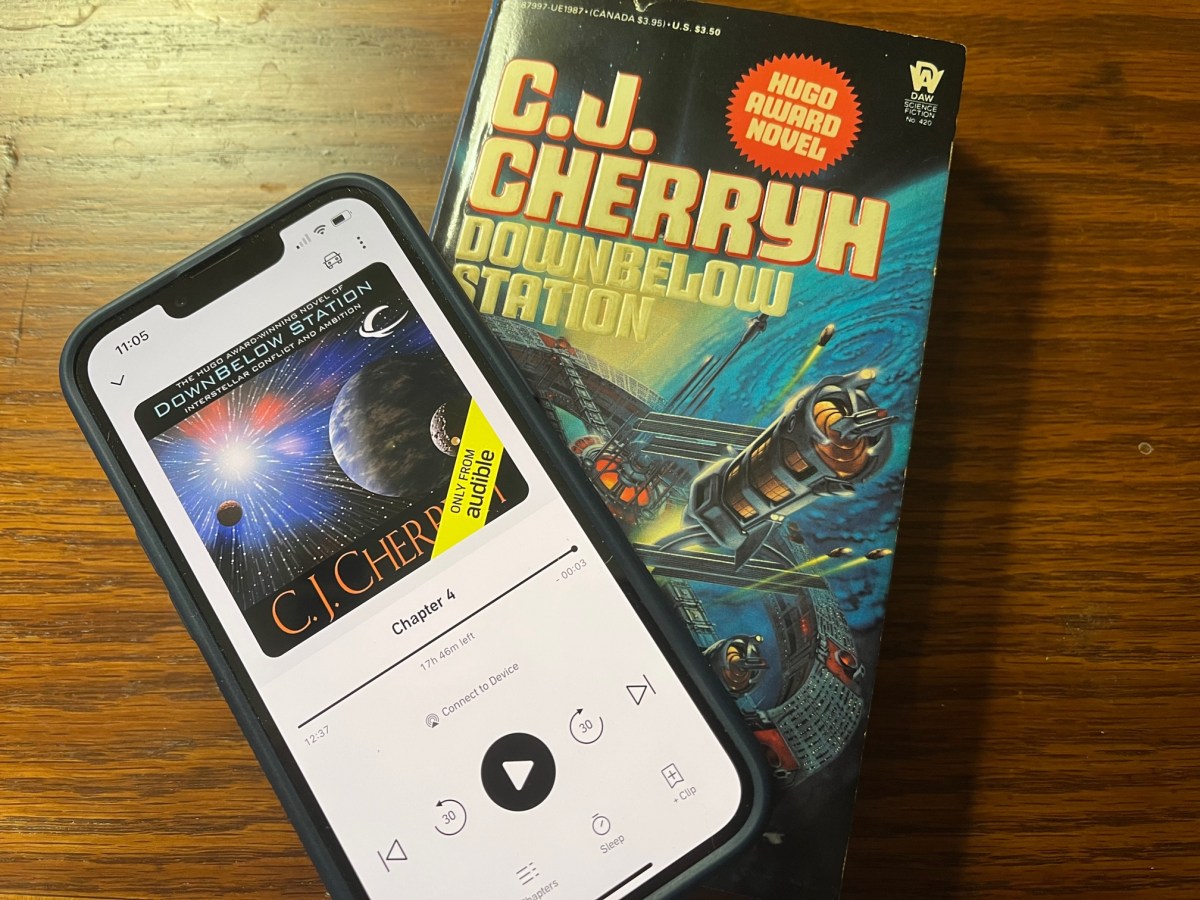
However, there are still books I couldn’t get into – like Downbelow Station by C. J. Cherry. Her dense prose makes my eyes glaze over when I try to read that novel, and my ears tune out when listening. Because it’s one of a handful of novels I haven’t read on the Classics of Science Fiction list, I’ve been pushing myself to finish it. And I’ve learned a trick that will help me.

I can only listen to books if I’m doing something else, like walking, doing the dishes, eating, exercising, etc. I had to give up walking, and because of my back problems, I’ve been exercising less. That’s cut into my listening time. If I try to listen while just sitting I fall asleep.

However, I’ve found a trick to beat that. I listen to an audiobook while reading the book with my eyes. Not only do I stay awake, but I retain what I read better. That’s always been one of the drawbacks of listening to books. I don’t retain them as well when I read with my ears. I don’t get into them as well when I read with my eyes.

When I read with my eyes and ears at the same time I get into the most and retain the most. And it turns out, it lets me read some books like Downbelow Station that I previously couldn’t read with just my eyes or just my ears.

Isn’t that weird?

The trick is to follow along with the words as I hear them – and don’t let myself get distracted.

I listened to Susan Wise Bauer’s The History of the Ancient World and The History of the Medieval World but started listening and reading The History of the Renaissance World. I’m getting so much more out of this dual-reading method, especially retention, that I’m thinking about rereading the first two volumes with the new method.

There is a major drawback to dual reading – cost. I do subscribe to Scribd.com and they sometimes have both the ebook and the audiobook. They had the recent biography on Buckminister Fuller that I listened to on audiobook so I just had to buy the Kindle edition. With Downbelow Station I had the paperback I’ve been meaning to read for years, and I’ve had the audiobook I’ve been meaning to listen to for years. And sometimes Amazon will give you a deal on the audiobook if you buy the Kindle edition first. Sometimes I get the Kindle on sale for $1.99 from Bookbub announcements and then buy the audiobook. Or I buy a used copy of the book or get it from the library.

I’m not going to read every book with my eyes and ears. But for books that I want to study, or total grok, or can’t get into, I will try the dual reading method.

JWH

To Go, or Not to Go — To the Bookstore?

by James Wallace Harris, 7/21/22

Each morning before I get out of bed I plan to do something with my day. It’s never very ambitious because of health problems, lack of discipline, and laziness. And things seldom go according to plan. Today I decided to donate ten books to the library bookstore. That impulse came from getting a new toy. I feel like Jerry Pournelle in his old columns for Byte magazine called “Chaos Manor.” In those columns, Jerry would get a new computer which would cause a cascading series of problems. I got a new little tube amp, a cheap one, to set up a better stereo system in my bedroom. That single act has caused a domino-falling cascade of problems to fix.

The only place I have to put a stereo in my bedroom is on top of two bookcases. That’s okay if I don’t care about sound quality, but this new little tube amp sounds great — if the speakers are at ear level — but sounds like crap next to the ceiling. For me to solve this problem, will require moving two Ikea Billy bookcases and replacing them with a piece of furniture 72 inches wide and roughly 24-30 inches high.

“Ah-ha!” you might be thinking. “He’s finally getting to the part about going to the bookstore.”

Well, not quite. This is going to be a long story about getting old and how my aging mind and body affect my decision-making at seventy.

The quick and easy solution to my problem was to go into the dining room which we’ve converted into a gym and take the TV credenza and put it in the bedroom in front of the bookcases. That left the TV on the floor for now, but I had to give up exercising when my back went out a few weeks ago, so I can worry about it later. Since I’ve become semi-invalid the easiest solutions are the ones that work with the least effort.

If Susan and I had had the foresight to have children we could have gotten them to move the bookcases into the dining room, left the TV on the credenza, and then sent those kids to Ikea to get a cabinet for the stereo. Unfortunately, back in the early 1980s, we didn’t anticipate this need.

My back has gotten somewhat better. I can do a little lifting. I don’t want to do too much because I might screw it up again. I figured I could unload a shelf or two each day in stacks on the floor. There are two cases with six shelves each. You do the math. I could put slides under the cases and push them into the dining room, and then reverse the process of loading them back up. Ikea also offers delivery and assembly for a fee. Thus, without offspring, and if I’m patient, I can get the job done in a week or two depending if Ikea can deliver that quickly.

But is this the best long-term solution? Susan has long complained that she doesn’t want to deal with all my books after I depart this world — whenever that might be. I keep telling her she can just call Salvation Army or a book buyer, but maybe all those books are my responsibility?

This morning I decided I would start going through my books and weed out enough to empty two bookcases. I figured I could carry ten or twelve books to the library bookstore each week and eventually, I’ll donate two bookcases worth of books. So after doing my spinal stenosis physical therapy exercises I pulled the first book off the shelf I thought might be the first of ten I would part with today. It was The Long-Winded Lady by Maeve Brennan.

I opened it up to a random page and started reading. Whoops. There went my plan. Maeve wrote lovely little essays about living in New York City for The New Yorker. The first one I read was about seeing a young woman collapse on the street outside her restaurant window. The next was about an evening walk to see a farmhouse that had been moved from downtown to Greenwich Village. I bought this book after seeing a documentary, I think on HBO, about another writer who met Brennan before she died. That writer had discovered Maeve on the street after she had become homeless. I’d like to see that documentary again, but I can’t remember its title.

I’m afraid every book I pulled off the shelf had a story behind it, one that made me want to keep it. I have more books than I could read in another dozen lifetimes. It might take me years to find and decide which books I could give away that would free up two bookcases full of books.

That left me so despondent that I went to the library bookstore and bought five more books.

JWH

p.s.

The other night Janis and I were jabbering on the phone about all the hoarders we know. We felt horror at what has befallen our friends. Now I need to worry if that affliction needs to be added to my recognized list of afflictions.