Jesus and Christ

by James Wallace Harris

For decades I’ve wondered how Christianity could be so closely associated with Republicans. It seems that Democrats are more concerned with feeding the poor, healing the sick, and welcoming the stranger, all issues generally linked with the teachings of Jesus. But recently, I had a revelation – not from God, because I’m an atheist, but just an ordinary light bulb going off in the head kind.

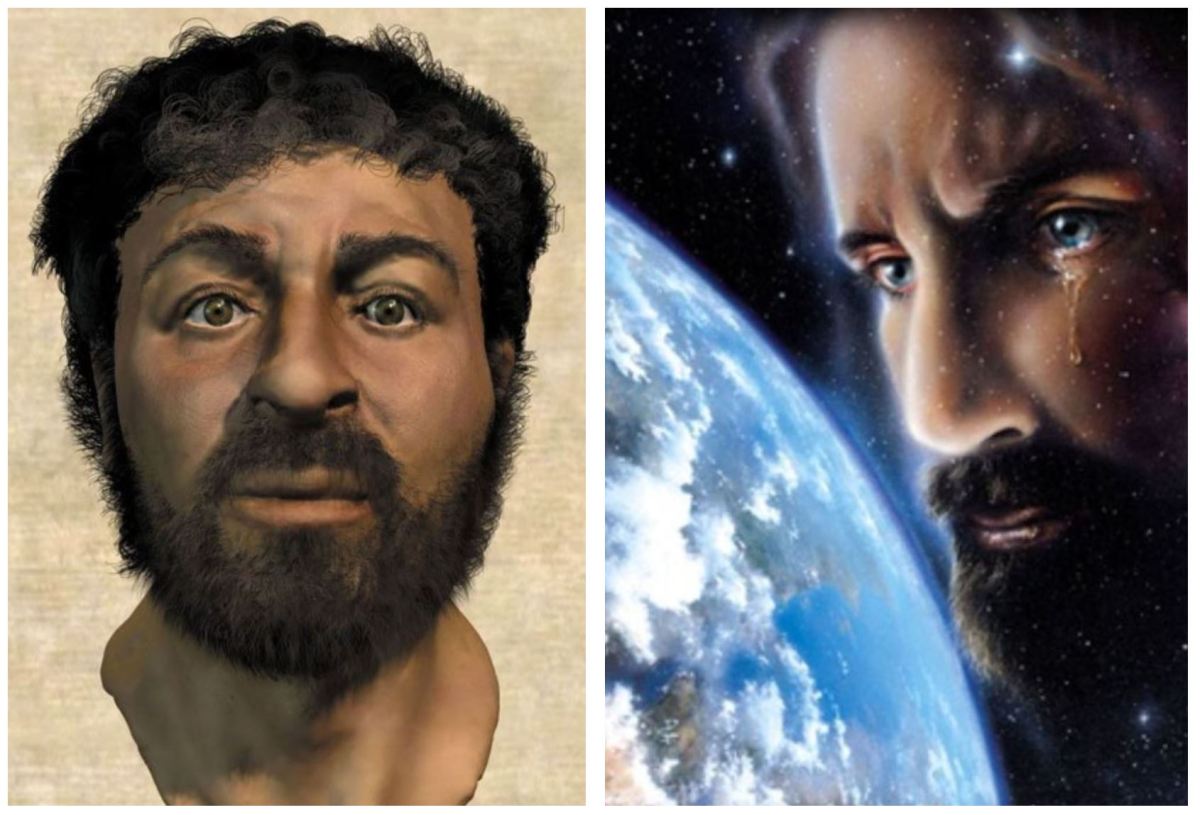
Republicans worship Christ and not Jesus. Of course, most people are going to claim that Jesus and Christ are the same, but I don’t. And maybe at an unconscious level neither do Democrats and Republicans. I consider Jesus a man, a human being, a member of the Homo sapiens, whereas believers in Christ believe Jesus was and is a God. Because I’m an atheist, I don’t see Christ, but I do see Jesus. Jesus was a man who had philosophical ideas about a compassionate society. I see Jesus like Socrates, and Paul was his Plato. Unfortunately, Paul was tainted by a lot of magical thinking – to put it kindly – so it’s hard to know how much magical thinking Jesus the man also believed.

I’m going to make a lot of generalizations in this essay that have no scientific basis, but I do think they have some rough validity. It’s like going outside at night and seeing a mercury-vapor streetlamp and a yellow incandescent houselight and noticing that each attracts different kinds of bugs. Developing a theory that bugs are attracted to different wavelengths of light isn’t farfetched, but it isn’t scientific proof either. I’m saying that Christians, who should have a consistent moral philosophy, are attracted to both the Democratic and Republican parties, which seems to me to have opposing moral philosophies. Is it so strange to ask why? Here are my guesses.

Republicans see Christ. They like father figures. They like authority and power. They also like patriarchy. Jesus was meek, kind of wimpy, a hippie preaching peace, love, and happiness with socialistic leanings, who hung out with the poor, the losers, the powerless. After he died, his image was made over, giving him superpowers, eventually elevating him to equality with God. I never understood the Trinity business but that’s what it appears to rationalize. But the PR experts of the early church needed their guy to compete with other so-called gods of their day, and they gave Jesus more and more superpowers. That whole died for your sins and immortal life in heaven was just brilliant marketing. No wonder it became the dominant religion.

It makes sense to me that Republicans consider their party the party of Christians. Then what are the Democrats? I guess I’ll call them Jesuits. I know that the label has been trademarked by the Society of Jesus, but it works well for my purpose. If you look at history, I feel I can trace liberal philosophy and humanism back to Jesus, but not to Christ. Christ the God is just a repackaged Jehovah. Conservative philosophy goes way back, well before Jesus. See, that’s another insight I had. The Old Testament is all about nation-building. It’s us vs. them. The Old Testament is dominated by following the rules, about might makes right, the end justifies the means. It’s a very Republican kind of book. The New Testament is all about love and forgiveness, the Golden Rule, power-to-the-people, all about embracing diversity. Paul worked to bring globalization to the teachings of Jesus.

Christ is really a transformation of Jesus the man into the Old Testament God. The early Christians, the ones that became the orthodox Christians competed with the traditional Hebrew religion, and they owned the copyright on God because they had invented the monotheistic God. At first, the Christians just claimed their guy was the son of God, but eventually, they had to make him equal to God, otherwise. how could their movement succeed?

I believe Jesus was a man, a philosopher, and died. Because I’m a liberal I’m somewhat of a Jesuit, even though I’m also an atheist. I believe his philosophy continued on, but not him. Christ is an idea created by the early followers of Jesus. I believe Jesus would have been shocked by all these miracles and superpowers given to him. But it’s hard to know. Paul really created Jesus for us, and like I said, Paul had a lot of magical thinking ideas.

All we have of Jesus is the red letter text in the New Testament. Many Biblical scholars have expressed doubt that all the sayings of Jesus were really spoken by him. We have to assume Jesus was illiterate. He didn’t write his philosophy down like Plato, he was like Socrates and went around speaking to people. His friends and followers appeared to have remembered his sayings and passed them down by word of mouth in the early years after he died. Eventually, they were collected by followers who could write. And those collections of sayings were used by the writers of Matthew, Mark, Luke, and John, written decades later in another language to compose the gospels. Time filters and alters all memory. Each gospel was written years apart and show a changing, evolving, Christ. Jesus is most human in Matthew and most God-like in John.

Paul’s writing is the oldest we have about Jesus, and he wrote his epistles a couple decades after Jesus’ death. You can see the earliest ideas about Christ forming in Paul’s writings, but far from all. They were added with each gospel. By the time we get to the Gospel of John, Christ has amazing god-like powers. But it wasn’t until a couple centuries later, by several generations of church theologians did Christ become completely God. During those hundreds of years, the early church, the church we now call the Catholic Church, had theological wars with other sects or branches of Christianity and Jesuits.

To me, Christianity became Judaism 2.0 because it carefully incorporated the Old Testament into its philosophy. But that was common back then when one religion supplanted another. Christianity became orthodox. It became a conservative philosophy. It decided the hierarchy. It decided the role of men and women. It was patriarchal. God was the father, the church was next in power, and ordinary people were the children. The family was very important because it was designed to mirror the structure of the church, with the husband being the God/father of the family. Christ is a God who is easy to understand because he looked like us, but he also had all the powers of the supreme creator in the Book of Genesis. Any man wanting ruling power on Earth had to align their quest with the orthodox Christian church.

If you think about this, it all makes sense why Republicans hang on so tightly to Christianity. But it also explains Democrats. Their political platform follows the Sermon on the Mount, the Beatitudes, the commandment to love each other. It also explains why there has always been a polarized split between liberals and conservatives. Some people naturally are Jesuits, while others are Christians. If you look at the Apocrypha and Gnostic Gospels you can see that other followers of Jesus tried to form opposing religions to orthodox Christianity. At one level that same conflict is still going on between Democrats and Republicans.

Democrats are still trying to divide the fishes and loaves. Democrats believe everyone should have a healer. Democrats believe everyone should have shelter, and strangers should be welcomed. Democrats believe we should help each other. Republicans believe its God’s duty to decide what to do with the poor, the sick, and the homeless. If God sends a hurricane to Puerto Rico then why should we pay to rebuild it?

The followers of the human Jesus, the philosopher, see building the Kingdom of Heaven is our job, not God’s, and we’re to build it here on Earth. Jesuits feel we are responsible for Earth, not God. That’s why Republicans hate the idea that climate change is caused by human activity. By their way of thinking, the power of weather belongs to God. If they admit that climate change is our fault, it means it’s within our power. It destroys their sense of hierarchy. It undermines the conservative philosophy. It lets the Jesuits win a battle, and they can’t let that happen.

Christianity has a subservient role for women, one that’s part of the hierarchical structure. Making women equal to men devalues the hierarchy. Many of the apocryphal gospels had Jesus giving power to women followers. The power structure is very important to Republicans. If Jesus was just another philosopher, he has no power. If he has no power, he has no authority. Democracy came later, and I think Jesus would have been a big believer in true democracy. Republicans don’t want a true democracy. They want a power structure, and they want to be part of the power structure. They don’t want equality because if everyone was equal no one would have power. If God is on your side you have the power. If a philosopher is on your side, all you got is a wordy guy.

Before democracy, the practical thing for the average citizen to do was to align themselves with the most powerful person around. Conservatives still have that urge. With democracy people are the power and leaders should only be the administrators of our power. That goes against the natural Darwinian reality of the strong taking control. In our world, the rich are the strongest. Now that’s quite amusing because Republicans are generally against Darwin. They want to believe power is top-down from God, whereas Darwin claims it’s a bottom-up thing from nothing.

That might explain another reason why the orthodox made Jesus the man into God. They don’t like bottom-up power paths. That would mean any mere mortal human could start a revolution and disrupt the harmony of the hierarchy.

I know all of this is a bunch of weird ideas, but I do think it’s an interesting way to explain our political polarization. I don’t think it changes anything. I’m not sure we can change. I think some people are naturally drawn towards conservative philosophy and others towards liberal ideas. Genetics might explain it, but it would involve too many different genes and other variables. It’s sort of like gender identity. Some folks identify as male and others as female and some people with all kinds of combinations in between. It’s a spectrum. I assume some people are liberal, others are conservative, and lots of people with different variations. There is a certain percentage of the population that are Yellow Dog Democrats, and another percentage that always votes the straight Republican ticket. While there a bunch of people who swing back and forth. I doubt logical persuasion changes the way they think politically. I’m not sure we have free will when it comes to our political and religious choices any more than people have with their gender identity.

All I’m suggesting is the word Christian isn’t exact enough. Of course, Christians split into a zillion different sects. For my purposes, I’m going to label them Jesuits and Christians, for followers of Jesus and followers of Christ. I know most of my readers will think I’m pursuing painful hairsplitting. But for me, it’s helped me understand Republicans who embrace Trump and claim he’s the best President ever for helping Christians. Using the above perspectives let me understand how they could think that, and I now believe them. But maybe they will understand why I believe Trump is the worst president ever for Jesuits.

JWH



Wanted: Purina People Chow (Formulated for the Aging Geezer)

by James Wallace Harris, Wednesday, September 26, 2019

Abstract: Seeking a 100% nutritionally balanced meal plan for my aging body that involves the fewest possible standard meals that can be easily prepared. These meals should never cause gas, acid reflux, constipation, stomach pains, bloating, lethargy,  diarrhea, or any other bodily discomfort.

Trigger Warning: Do not read if you are unsettled by descriptions of bodily functions or euphemistic words that describe them. Do not read if you are depressed about getting older. Do not read if you want to keep all your geriatric surprises until they happen to you personally.

My friend Linda recently asked me why they didn’t warn us about all the weird things that would happen to our body as we got old. Not long after that I was at my doctor and asked her that question. She replied with a twinkle in her eyes, “You don’t want us to spoil the surprise, do you?” I thought, maybe she doesn’t want to depress her patients. I gave her an example to see what she would say. I told her my dick was shrinking. I lamented that my dick had never been big, and now it was beginning to whither. I might have also said WTF? She gave a little knowing laugh. Maybe that was a common complaint from men that she found funny, but I worried that maybe other changes for my little wonder worm were in my future and she didn’t want to tell me.

The other day I saw an article on Flipboard about vagina atrophy. Maybe such secrets of aging are out there and I just haven’t been paying attention. If penises and vaginas can atrophy, what about other organs? Am I peeing so much because my bladder is atrophying? Is constipation a new problem in my life because my intestines are shrinking away? Is all my stomach problems due to my stomach wimping out? WTF? I bet this is TMI, isn’t it?

When I was a kid I could eat anything and it never bothered me. Growing up I don’t really remember shitting much. I can’t ever remember taking a dump at school. And I think I only went to the boys’ room once a day to piss, and maybe some days not pissing at all. Hell, if I was in school today I’d be waving my hand to go to the restroom every hour – at least. And that lunchroom food would give me a stomach ache, heartburn, and gas that would last the rest of the day. In fact, I can’t remember spending much time in the bathroom when I was young, other than those adolescent years of jerking off while pretending to need to take a long leisurely crap, but now I practically live next to the toilet. And it’s no longer because of one-handed reading.

I’ve decided what I need is to study nutrition and create a small repertoire of meals that don’t offend my fussy body. In the last decade, I’ve slowly learned through painful lessons I refuse to accept, that my stomach, intestines, and bladder just don’t like my favorite foods anymore. For example, eating peanut butter now makes me feel like I have a bleeding ulcer. Drinking iced tea or soda pop makes me piss every fifteen minutes. Oatmeal creates enough gas that I could pressurize a natural gas tanker. Fatty foods give me painful acid reflux that feels like I’m having a heart attack. And the list of humiliations goes on and on.

I understand that my bladder is being crushed by an enlarging prostate and I have to pee more often, but if I get constipated or pressurized enough for farting I have to pee 2-3 times an hour. That’s very annoying. I hate to leave the house anymore because I have to piss so goddamn much. My wife is annoyed I won’t go on trips, but the logistics of finding that many bathrooms on the road put travel plans out of the question.

And I don’t mean to be whining. I know people with cancer, dementia, chronic pain, strokes, debilitating diseases, and other depressing conditions, so I consider myself very lucky to only have the puny physical problems I do have. But I figure if I’m going to live another 10, 20, or god forbid 30 years, I need to adapt to a long-term strategy of surviving with the minimum of discomfort. And since much of my discomforts come from eating, I need to buckle down and find out just exactly what my body wants. I feel hostage to my digestive system and I’m ready to pay the ransom.

If Purina offered People Chow that provided everything I needed for optimal nutrition, bright eyes, and a shiny chromedome, I’d eat it three meals a day. I’d forego all eating pleasure just to make turds that slid smoothly out, to be free of gas and bloating, to need to pee as infrequently as possible and especially to have a nice peaceful stomach.

I know I sound like all those old folks who talk endlessly about their bowel movements. But I figured something out last night. If young people had our bowels they’d be talking about their shits and pisses all the time too. Take care of your body because if you don’t it will get its revenge. (No, I’m glad I drank a trainload of  Cokes and chocolate shakes and ate those thirty-three tons of M&Ms.)

What I want to find are meals that satisfy my body’s need for nutrition and causes no physical complaints. I figure I need to eat two healthy meals a day with one snack in between. The problem I face is finding a selection of meals and snacks that are nutritionally balanced. I don’t even need culinary variety.

I know such meals exist because I sometimes go days without my body complaining. Then I’ll eat something and my pleasant digestive detente will be shattered for a week. Being vegetarian complicates things because foods with enough protein are limited. For fifty years I did fine with dairy products, beans, and peanut butter, but now those cause constipation, gas, and stomach pain.

I wish that my healthy diet could be based on ice cream, pie, cake, cookies, chocolate, Coke, and ice tea. Actually, my digestive system loves pie and ice cream, but they make me gain weight. Come to think about it, everything that makes me lose weight annoys my insides. Is just getting fatter the answer?

It’s such an insanely hard puzzle to figure out the right combination of foods that are ideal. If anyone knows of cookbooks for geezers or meal plans for sissy stomachs, post them below.

JWH


The Uneducated Unkindness of Youth Censoring the Past

by James Wallace Harris, Wednesday, September 25, 2019

Yesterday I read, “The Cult Books That Have Lost Their Cool” by Hephzibah Anderson at the BBC online. Anderson snidely dismisses several novels that were considered classics by my generation. Of course, when I was young I was just as quick to dismiss the works my parents loved. History has shown us that revolutionaries tend to eliminate people and art that don’t meet the standards of the new zeal. As an old person, and evidently part of an old guard, I’m seeing more of my history dismissed, causing artists and artists to disappear from pop-culture consciousness. It feels like agism censorship.

I can accept that the young have judged us harshly and found us morally wanting. What annoys me is they don’t have any sympathy for human frailty, and quite often I feel their social media kangaroo courts are conducted without examining the actual evidence. Take for example Anderson’s assessment of Jack Kerouac’s On the Road:

Based on a road trip from New York to Mexico with Beat muse Neal Cassady, Kerouac wrote what would become the Beatnik’s bible in just three weeks. It took six years to get published and more than half a century later, it exudes tiresome stoner machismo. Kerouac pokes fun at gay people, and isn’t much better where women and black people are concerned. A few years back, a spate of books and films inspired only a flicker of revived interest in his legacy. Boorish egotist or inspired prophet? The jury isn’t just out, it left the building long ago, dancing after the hippies who supplanted the Beats.

I can’t believe Anderson has even read the book. She says Kerouac pokes fun at gay people, but of the three main characters, Kerouac is straight, Ginsberg is gay, and Cassady is happy to have sex with almost anyone. And these men practically worship black jazz musicians. Kerouac hardly takes a machismo stance. He portrays himself with endless faults and emotional weaknesses. Kerouac was like Proust, he struggled to make sense of his life by fictionalizing it. The term beat deals with Kerouac’s existential angst over living in the 1940s and early 1950s. On the Road is about seeking freedom from an oppressive materialistic society. Anderson assumes it is some kind of bro road epic. If anything, Kerouac portrays the beats as Quixotic figures tilting at windmills. It’s a realistic portrait of the times, of men, women, gays, minorities, Mexicans, ethnic groups, and so on. It’s a sad, beat story about looking for kicks and being kicked down. It’s not pretty, but it is honest. Anderson has no sympathy for Kerouac’s suffering and struggle.

Nor is Anderson sympathetic to The Catcher in the Rye by J. D. Salinger:

Poor Holden Caulfield. Mired in a funk for more than half a century, the angst-ridden ‘everyteen’ is now regarded by the cool kids as being a bit – well, self-indulgent. His ennui is, if not exclusively a rich-white-boy problem, then certainly nothing compared with looming climate collapse and other woes weighing on the minds of his 21st-Century peers. Plus, in the era of helicopter parenting and geo-tagging, not to mention hyper-vigilant mental-health awareness, the idea that a depressed teen could simply go Awol in New York City for a couple of days is increasingly hard to indulge.

Just because Kerouac and Holden Caulfield don’t meet modern moral standards of 21st-century young people they are shunned and ridiculed. But here’s the thing, every generation is different. Should we erase the past because it’s different? Sure these people are morally and ethically wanting by today’s higher consciousness, but they are still human beings trying to make sense of life by what they knew at the time. The point of reading old books is to understand the past, to see it for what it was, not what we want it to be.

Dismissing Kerouac or Sallinger is cold and callous. Dismissing these writers is a kind of censoring the past. You can’t perfect the present by erasing the past. The ironic thing is Kerouac and Sallinger were revolutionaries like Anderson, wanting young readers to know that the times were changing. Of course, they did their own rejecting of the past too. That’s how it goes. But it’s better to see the bigger picture.

I wonder how Anderson will feel when she’s my age and someone her age now dismisses the cherished art and artists that shaped her generation?

I don’t really expect things to change. I always felt sorry for Kerouac. Kerouac and my father lived about the same years and died young from alcoholism. I wrote an essay years ago called “The Ghosts That Haunt Me” about Mark Twain, Jack Kerouac, Louisa May Alcott, and Philip K. Dick. These writers had painful lives, but they were outstanding in their soulful writing trying to make sense of those lives. It pisses me off that someone would blithely dismiss them for being uncool. I’m also sensitive about forgotten authors – see my page for Lady Dorothy Mills who has practically disappeared. It just seems hurtful to me that any writer would encourage readers to stop reading any author.

To be honest, I was like Anderson when I first read Kerouac when I was young. I thought it was a novel about thrills. But with every decade of life On the Road changes. I’ve been on the road for more years than Kerouac ever got to live. It takes a long time to really understand what beat means. Hephzibah, don’t be so quick to dismiss On the Road. Read it again when you’re older.

JWH


Ken Burns Chronologically – The History of the United States

by James Wallace Harris, Tuesday, September 24, 2019

While watching the new Ken Burns documentary, Country Music, I realized that his documentaries often cover the same time periods but through different subjects. For example, in this new series, I was enamored with how country music was spread in the early days of the radio in the 1920s and 1930s. Burns had also covered radio tangentially in his series Jazz, specifically in the film Empire of the Air, and to a lesser extent in such series as The Dust Bowl, Baseball, The Roosevelts, and other shows. We forget, and I guess for the young, they never imagined, that radio had the society changing impact of the smartphone.

This got me to thinking. Instead of watching Ken Burns films by subject, what if I watched them by time periods? I then made a Google Spreadsheet of all of Ken Burns’ films and sorted the episodes by date. (This is a crude start I hope to refine over time. I “borrowed” the descriptions from Wikipedia and Ken Burn’s websites.)

Let’s say I wanted to focus on the 1920s and get a multi-dimensional view of that decade, I could watch these episodes and films:

  • Empire of the Air
  • Jazz – “The Gift” – episode 2
  • Country Music – “The Rub” – episode 1
  • The Roosevelts – “The Storm” – episode 4
  • Baseball – “4th Inning: A National Heirloom” – episode 4
  • The National Parks – “Going Home” – episode 4
  • Jazz – “Our Language” – episode 3
  • Jazz – “The True Welcome” – episode 4 (first part)
  • The Dust Bowl – “The Great Plow-Up” – episode 1 (second part)

And then supplement those with parts of:

  • Frank Lloyd Wright
  • The Rise and Fall of Jack Johnson
  • The Mayo Clinic
  • Jackie Robinson
  • Thomas Hart Benton

Now I’m thinking about all the everyday history Burns hasn’t covered. I wish he would do documentary series on:

  • Feminism – especially the first and second-wave feminists. He’s got a start with Not For Ourselves Alone about Elizabeth Cady Stanton and Susan B. Anthony. I wish Burns would film the book Other Powers by Barbara Goldsmith which is about the rise of feminism, abolitionists, the temperance movement, and spiritualism in America from 1848-1900. Goldsmith also covered Stanton and Anthony.
  • Science Fiction in America – how did the genre evolve. Nathaniel Hawthorne, Edgar Allan Poe, and Mark Twain wrote science fiction, as did many other Americans in the 19th century. Did cowboys discuss Frankenstein and Jules Verne out on the prairie? Show how science fiction developed in the dime novel, pulp magazines, on the radio, in movie serials, newspaper comic strips,  comic books, hardbacks, paperbacks, movies, television, and video games.
  • Books, Magazines, Newspapers, and Bookstores in America. How did we become a nation of readers?
  • Rock and roll – give it the same treatment as country music and jazz.
  • The History of High Fidelity in America. About how recorded music technologically evolved.
  • The Transcendentalists. Include Eden’s Outcasts by John Matteson.

There’s an unlimited supply of everyday history I’d love to see. That’s what I love most about Ken Burns’ films, they are so visual.

JWH


Book Shopping in the 21st Century

by James Wallace Harris, September 22, 2019

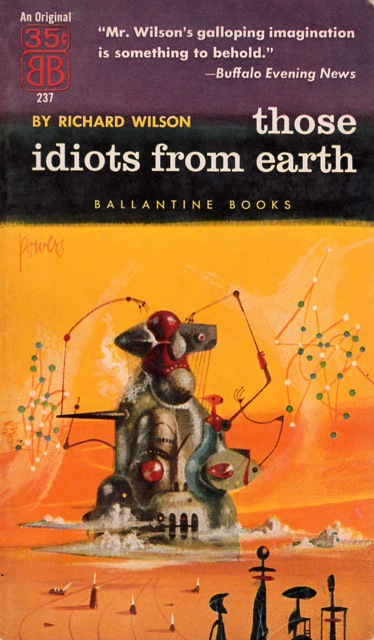
It’s early Sunday morning. My wife isn’t up. The stores are closed. And I’m book shopping. I just bought Those Idiots From Earth by Richard Wilson, an author I don’t even remember. I just loved the cover and title. Book shopping is so different from how it was back in the ancient times of the 20th century.

In the 21st century, I perused thousands of booksellers from around the globe in a fraction of a second. From the time I decided I wanted this book till the time I pressed the order button was about 25 seconds. Of course, I’ll have to wait several days for Mr. Wilson’s collection of SF stories to show up in my mailbox.

Maybe I should jump back before I even knew about Those Idiots From Earth. I’m in a Facebook group The Best Science Fiction and Fantasy Short Fiction of the Year created by Paul Fraser. It’s devoted to collections and anthologies of science fiction short stories. I hadn’t posted in a while, so I wanted to find a unique old science fiction anthology that had a cool cover. I was using the Internet Science Fiction Database and searching on anthologies edited by Groff Conklin. Several of his paperbacks had cover art by Richard Powers, a favorite artist of mine. I then clicked over to look at books with covers by Powers. That’s when I noticed Those Idiots From Earth. Checking Richard Wilson’s entry showed a few novels and a lot of short stories. He was a writer I don’t remember at all. If you follow those links you’ll see just how truly useful ISFDB.org is for book shoppers.

Once I saw that cover and title I was intrigued. I’ve owned hundreds of science fiction magazines, so I’m sure I’ve seen the name before, and maybe even read a story of Wilson’s. I just didn’t recall anything this morning. So I got on Google and found a review of the collection by Joe. He gave four stories 5-stars, and the rest either 4-stars or 4.5-stars. I’ve never read any reviews by Joe before, but he did make Wilson’s stories sound like something I wanted to read. I love finding new SF authors with a different slant.

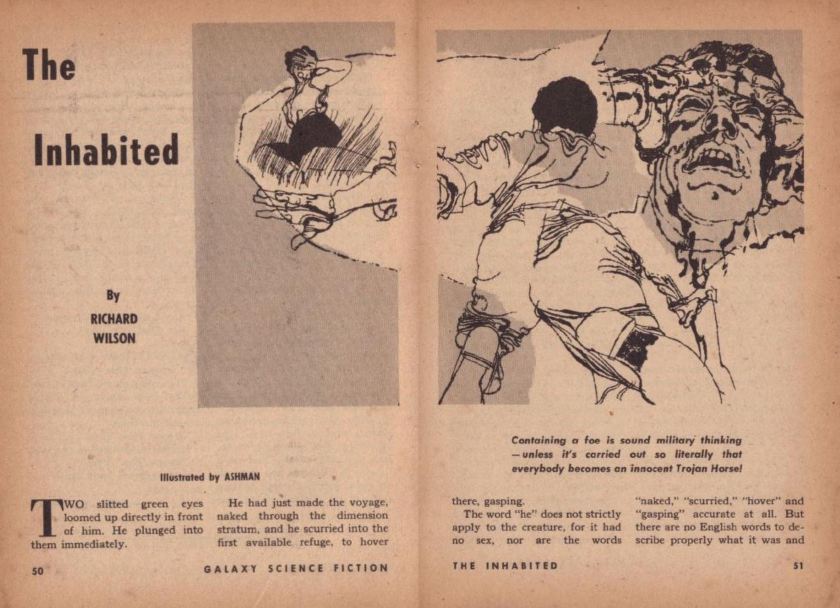
I wanted to test read the title story, but it was never published in a magazine. Luckily, the first 5-star story, “The Inhabited” was in the January 1953 issue of Galaxy Science Fiction. I checked my collection of Galaxy but didn’t have that copy. But I do have a complete run of the magazine on digital scans. You can read the story on the Internet Archive.

The Inhabited by Richard Wilson

“The Inhabited” is about an alien mind coming to Earth to scout out our planet. Are we worth invading? The alien mind occupies a cat, two men, a boy, and a pregnant woman before ending up in the mind of an insane man. The alien ends up confessing to a psychiatrist. It’s a neat little story. I decided I wanted Those Idiots From Earth and went to ABEbooks.com and ordered a copy. The original paperback was in fine condition and cost $4 (plus $4 shipping).

It took me a pleasurable ten minutes to find out about the book, but only about 25 seconds to find and buy it on ABEbooks. I’m hoping you’re getting the power of the internet for 21st-century book shoppers. ABEbooks claims it has thousands of booksellers in 50 countries selling millions of books. There were three copies available from all those locations. Now that’s efficient book browsing!

I remember the first bookstore I went to back in 1964. It was a little hole-in-the-wall shop in a strip mall in Perrine, Florida. The shop was dark and dusty. I was twelve. It was before I earned my own money. Back then a used paperback was a nickel or a dime – candy money. I had no idea what I was buying, but it was exciting. I knew I loved science fiction, and I’d buy books based on how cool their covers looked.

As I got older I would go all over town looking through old book shops. Whenever I visited another town, I’d look up their used bookstores. There were books I searched for years in several states and cities before finding them. The hunt for a book used to be quite thrilling. Then in my late teens, I learned how to use mailorder rare book dealers, which had its own kind of fun. I could almost always get my book, but sometimes it took years. There were some books I never found until the internet and ABEbooks.

In the 21st-century it’s much easier to track down a used book, but not quite as fun. Without the internet though, I would never have heard of Those Idiots From Earth. I often surprise my friends when they mention a book they’ve been searching for years and I find it in minutes.

I sometimes wish the internet had never been invented. I’m not sure if living in the hive mind of social media is healthy. Nor do I love keeping up with data overload. It does let me find the few people that share my exact interests. But then I have those highly specialized interests because of the internet. I remember when there were only three TV channels, Top 40 radio, and the science fiction section was two shelves of books at the new bookstore. At school, we all talked about the same movies, television shows, and songs. Nowadays every friend seems to have their own favorite show, so there’s less sharing, even though on social media what we do is called sharing.

The internet lets me get up on a Sunday morning and search through millions of books in thousands of booksellers from around the planet in a matter of seconds. That’s pretty damn far out. It’s not the same as riding my bike down to an old shop and spending an hour looking through stacks of unordered SF titles trying to find just the right books to get the most for my quarter.

The times keep changing. I can’t imagine how we can go any faster. Maybe I should wonder how to go slower?

JWH