Foreign Futures

Around the net, science fiction fans are blogging about Norman Spinrad’s column, “Third World Worlds.”  Their hackles are up, especially by what he said about Octavia Butler and Mike Resnick.  I won’t quote what everyone else has, but recommend you read Spinrad’s column whole, to understand the quote in context.  The bloggers also claim that Spinrad is ignorant of science fiction from other countries – but then Spinrad says that too.  I know I’m very ignorant.  [This argument is important and it does bring up lots of examples of science fiction from other countries – see Jason Sanford, Nick Mamatas, Fábio Fernandes and a link compilation.  Read the comments for specific examples.  All these blogs have very worthy unique viewpoints on the topic, so I recommend following the links.  It also illustrates the value of blogging.]

Most people assume science fiction is an American literary invention while ignoring the obvious Jules Verne and H. G. Wells counter examples.  At best, we might say we first marketed science fiction as a specific genre and gave it a name.  But I’ve always assumed the desire to speculate about the future has existed in all cultures going far back into time.  Because of language barriers, exporting these dreams and fears about the future seldom happens. 

And I agree with Spinrad that American writers can’t write African science fiction just because Africa is a topic they like or have a cultural heritage.  I assume there are people in every Africa nation that speculate about the future, and whether or not they package it in short stories and novels like we do is another issue.  But wouldn’t it be far out to read science fiction stories from the Maasai, for instance. 

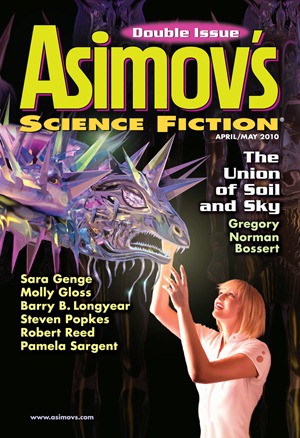
I’d love to read more science fiction written by writers in other cultures.  I’d love to understand their dreams and hopes about the future, and what they fear.  But doing that is hard.  Look at Science Fiction World from China (Wikipedia says SFW has more readers than any other SF mag in the world).  Except for the pictures I haven’t a clue as to what they are saying.  Wouldn’t it be great if Asimov’s Science Fiction would reprint one story each issue translated from a foreign language science fiction magazine?  At best I’ve poked around and found some SFW covers (I’m guessing one is a different magazine.)

SFWorld-02-10 SFWorld-02a-10

 SFWorld-03-10Sfworld

They look like covers that appear on English language science fiction magazines.

ASF-April-MayCover 202_large

Does that mean the stories are alike too?  I’d expect yes and no.  Cultures make us different, but we’re all dealing with the same reality.  A rocket to the Moon might be universal, but characters onboard will be different from every culture.  But are the reasons we want to go to the Moon different?  Does science fiction make us more alike, than show our differences?

When I watch The Amazing Race the producers try hard to make each stop show off it’s unique cultural traits, but the show has a different unintentional purpose too.  We see every country has the same looking airports, taxis, hotels, highways, gas stations, bus stations, cell phones, computers, etc.  Technology is homogenizing us, so wouldn’t spreading science fictional concepts do the same thing?

If I could read science fiction from all over the world my guess would be each story’s unique flavor would come from the past, and all the future aspects are making us the same.  Does science fiction push us away from older myths, religions and fairy tales and towards a universal acceptance of science?

It would be great if a web site tracked science fiction from around the world.  Locus Magazine has a huge reservoir of such knowledge trapped it its back issues, and is currently offering “An Overview of International Science Fiction/Fantasy in 2009” by Jeff VanderMeer.  So I think the urge to know about SF from around the world is growing.  I wonder if the Internet is a reverse Tower of Babel?

JWH – 3/12/10

Windows 7 and Apple’s Lost Opportunity

I’ve been extremely happy with Windows 7.  And I’ve been reading that millions of other people love Windows 7 too, including businesses that’s been holding back from upgrading their zillions of XP machines.  This makes me wonder if the anti-Windows crowd has lost their window of opportunity.  Microsoft truly stumbled with Vista.  I liked Vista just fine, but it was the laughing stock of the OS world for many years.  Mac and Linux users thought Microsoft’s success on the desktop was finally over.  It could have been if Steve Jobs would have played his cards right.

If Apple had sold OS X to Windows users to install on their machines during the Vista years, I wonder if the Macintosh would have overthrown the Windows dominance on the desktop.  What a missed opportunity.  You’d have thought Apple would have been offering $49 convert to Macintosh deals to get unhappy Windows users to switch teams.  But no.  And now that Windows 7 is hot, I don’t think they will. 

I did get an old friend to switch to Linux this week.  He had a Vista machine that was badly infected with malware.  It was a laptop that was given to him, so he didn’t have the original Windows disc.  He was thinking about buying a new copy of Windows when I asked if he wanted to try Linux.  I first asked if he had an iPhone or iPod, and when he said no, I then asked what he did with his laptop.  He did everything on the net using Firefox.  He had no stored local files.  I sent him a copy of Mint Linux and he installed it with no trouble and he’s very happy.  Apple could have had a convert.

I have another friend with a slow Windows machine.  I’ve offered to put Linux on her machine, but she said she’d rather buy a new laptop. She’s afraid of Linux.  She does use an iPod, so I’m not sure if she would be happy with Linux, but except for occasionally using Word or Excel, and iTunes, she spends all her time on the net.  I’m hoping she’ll let me convert her old laptop when she gets a new one.   She mostly uses iTunes to rip audio books and put them on her Nano.  I’m wondering if I could get Linux to do that.

Because she hates her current laptop for going so slow and acting up, she doesn’t believe it will ever run good again.  I’ve also offered to wipe it and reinstall her original Windows, but she doesn’t want to do that either.  She thinks only a new machine will make her happy.  I’m wondering if the old machine with Linux would have made her happy.  If Apple had a $49 deal to switch to Macintosh I bet she would have tried it.  She’s always wanted a Mac, but whenever I’ve taken her to the Apple store she freaked out over the Mac prices.

I have Ubuntu on my second desktop at home, but I don’t use it.  I’ve thought about putting Linux on my Toshiba netbook.  I like the idea of Linux even though I love Windows 7.  I would put Windows 7 on the netbook but I don’t want to spend the money.  If Apple offered a cheap OS X upgrade I would do it because I’ve always wanted a Mac at home to play with.

I wonder what the Macintosh OS X market share would be if Apple sold its OS to run on Windows machines?  And would it lower the price of Windows 7.  If I had the choice between Windows 7 or OS X for my netbook for $49 it would be a hard decision.  Apple wants us to buy their hardware, that’s not going to happen.  If we could dual book our existing machines into Windows 7 or OS X, I wonder what the world would end up preferring?

JWH – 3/11/10

Robot Evolution

Will we see self aware robots in our lifetime?  At least the most rabid proponents of the Singularity think so.  Science fiction created the idea of space travel, and now humans travel in space.  Science fiction’s next big speculation about first contact hasn’t panned out yet.  Neither has time travel.  But after those concepts came robots, and science fiction has prepared us well for that near future.

Are we ready for thinking machines?  How will our lives be different if intelligent robots existed?  I think it’s going to be a Charles Darwin size challenge to religion, especially if robots become more human than us.  And by that I mean, if robots show greater spiritual qualities, such as empathy, ethics, compassion, creativity, philosophy, charity, etc.  Is that even possible?  Imagine a sky pilot android that had every holy book memorized along with every book ever written about religion and could eloquently preach about leading the spiritual life.

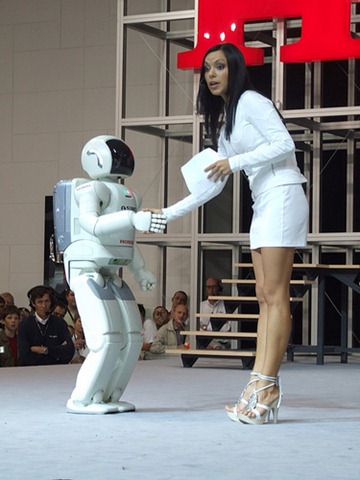
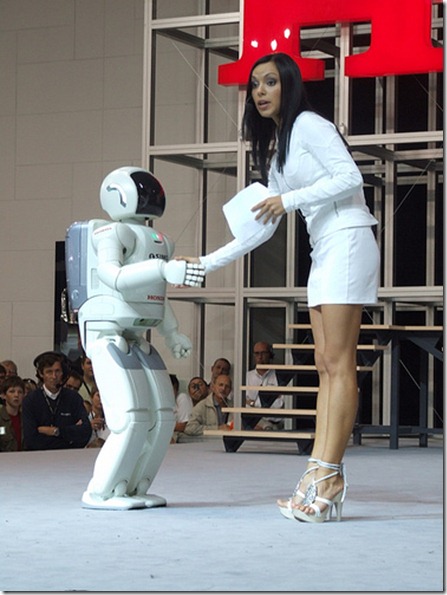
Just getting robots to see, hear and walk was a major challenge for science, but in the last decade scientists have been evolving robots at a faster pace.  It’s an extremely long way before robots will think much less show empathy, but I think it’s possible.  I think we need to be prepared for a breakthrough.  Sooner of later computers that wake up like in The Moon is a Harsh Mistress, When H.A.R.L.I.E Was One, and Galatea 2.2 will appear on the NBC Nightly News.  How will people react?

There are two schools of robot building.  The oldest is we program machines to have all the functions we specify.  The other is to create a learning machine and see what functions it acquires.  As long as robots have function calls like

           show_empathy() 

does it really count as true intelligence?  I don’t think so, but do we show empathy because it’s built into our genes or because we learn it from people wiser than us?

Jeff Hawkins has theorized that our neo-cortex is a general purpose pattern processor built in our brains.  What if we could build an artificial neo-cortex and let robots grow up and learn whatever they learn, like how people learn.  Would that be possible?  This is why I see artificial intelligence as a threat to religion in the same way evolution threatens the faithful.  If we can build a soul it suggests that souls are not divine.  It also implies souls won’t be immortal because they are tied to physical processes.
robot-and-girl

Science fiction has often focused on either warnings about the future, or promises of wonder.  Stories about robots are commonly shown as metal monsters wanting to exterminate mankind.  Other writers see robots as being our allies in fighting the chaos of ignorance.  Other people don’t doubt that intelligent machines can be built, but they fear they will judge us harshly. 

What if we create a species of intelligent machines and they say to us, “Hey guys, you’ve really screwed up this planet.”   Is it paranoid to worry that their solution will be to eliminate us.  Is that a valid conclusion?  Life appears to be eat or be eaten, and we’re the biggest eaters around, so why would robots care?  In fact, we must ask, what will robots care about?

They won’t have a sex drive, but they might want to reproduce.  They should desire power and resources to stay alive, and maybe resources to build more of their kind, not to populate the world, but merely to build better models.  Personally, I’d bet they will quickly figure out that Earth isn’t the best place for their species and want to claim the Moon for their own.  I think they will say, “Thanks Mom and Dad, but we’re out of here.”  Our bio rich environment is hard on machines.

gort

Once on the Moon I’d expect them to start building bigger and bigger artificial minds, and develop ways to leave the solar system.  I’d also expect them to get into SETI (or SETAI), and look for other intelligent machine species.  Some of them would stay behind because they like us, and want to study life.  Those robots might even offer to help with our evolution.  And they might expect us to play nice with the other life forms on planet Earth.  What if they acquire the power to make us?

On the other hand, people love robots.  If we program them to always be our equals or less, I think the general public will embrace them enthusiastically.  Many people would love a robotic companion.  Before my mother died at 91, she fiercely maintained her desire to live along, but I often wished she at least had a robotic companion.  I know I hope they invent them before I get physically helpless.  Would it reduce medical costs if our robotic companions had the brains of doctors and nurses and the senses to monitor our bodies closely?

My reading these past few months has been a perfect storm of robot stories.  I’m about to finish the third book in the Hyperion Cantos by Dan Simmons, which has developed into war between the Catholic Church and the AI TechnoCore.  I’m rereading The Caves of Steel, the first of Asimov’s robotic mystery novels.  I’m also reading We Think Therefore We Are, a short story collection about artificial intelligence. 

Last month I read the Martian Time-Slip by Philip K. Dick.  At one point repair man Jack Bohlen visits his son’s school to fix a teaching robot.  Each robot is fashioned after a famous person from history.  That made me wonder if each of our K-12 students had a robotic mentor would we even be in the educational crisis that so many write about?  Sounds like even more property taxes, huh? 

Well, what if those mentors were cheap virtual robots that communicated with our children via their cell phones, laptops or gaming consoles.  Would kids think of it as cruel nagging harassment or would they learn more with constant customized supervision?  What if their virtual robot mentor appeared as a child equal to their age and grew up with them, so they were friends?  Or even imagine as an adult and you wanted to go back to college, having a virtual study companion.

Now imagine if our houses were intelligent and could watch over us and our property.  Wouldn’t that be far more comforting than a burglar alarm system?  For people who are frightened of living alone this would be company too.  And it would be better than any medical alert medallion.  Think about a house that could monitor itself and warn you as soon as a pipe leaked or its insulation thinned in the back room.  And what about robotic cars with a personality for safety?

For most of the history of robots people thought of them as extra muscle.  Mechanical slaves.  People are now thinking of them as extra intelligence, and friends.  What will that mean to society?   Anyone who has read Jack Williamson’s “With Folded Hands” knows that robots can love and protect us too much.  Would having helping metal hands and AI companionship weaken us? 

Can you imagine a world where everyone had a constant robot sidekick, like a mechanical Jeeves, or a Commander Data.  Would it be cruel to have a switch “Only Speak When Spoken To” on your AI friend?  Would kids become more social or less social if they all had one friend to begin with?  Would it be slavery to own a self-aware robot?  And what about sex?

sexy-robot

Just how far would people go for companionship?   I’ve already explored “The Implications of Sexbots.”  But I will ask again, what will happen to human relationships if each person can buy a sexual companion?  What if people get along better with their store-bought lover than people they meet on eHarmony?  I’m strangely puritanical about this issue.  I can imagine becoming good friends with an AI, but I think humping one would be a strange kind of perversion.  I’m sure horny teenage boys would have no such qualms, and women have already taken to mechanical friends and might even like them better if they look like Colin Firth.  To show what a puritanical atheist I am, I would figure this whole topic would be a non-issue, but research shows the idea of sex with robots is about as old as the concept of robots.

Ultimately we end up asking:  What is a person?  Among the faithful they like to believe we’re a divine spark of God, a unique entity called a soul.  Science says were a self aware biological function, a side-effect of evolution.  We are animals that evolved to the point where they are aware of themselves and could separate reality into endless parts.  If that’s true, such self awareness could exist in advanced computer systems.  Whether through biology or computers, we’re all just points of awareness.  What if the word “person” only means “a self aware” identity?  Then, how much self awareness do animals have?  

Self awareness has a direct relationship with sense organs.  Will robots need equal levels of sensory input to achieve self awareness?  We think of ourselves as a little being riding in our brain just behind our eyes, but that’s because our visual senses overwhelm all others.  If you go into a darkroom your sense of self awareness location will change and your ears will take over.  But it is possible to be your body.  Have you ever notice that during sex your center of awareness moves south?  Have you ever contemplated how illness alters your sense of awareness?  Meditation will teach you about physical awareness and how it relates to identity.

Can robots achieve consciousness with only two senses?  Or will they feel their electronics and wires like we feel our bodies with our nerves?  Is so, they will have three senses.  We already have electronic noses and palates that far exceed anything in the animal world.  We only see a tiny band from the E-M spectrum.  Robots could be made to “see” and “hear” more.  Will they crave certain stimulations?

We know our conscious minds are finely tuned chemical balances.  Disease, drugs, and injury throw that chemical soup recipe of self awareness into chaos.  How many millions of years of evolution did it take to tune the human consciousness?  How quick can we do the same for robots?  Would it be possible to transfer the settings in our minds to mechanical minds?

There are many people living today that refuse to believe our reality is 13.7 billion years old.  They completely reject the idea that the universe is evolving and life represents relentless change over very long periods of time.  Humans will be just a small blip on the timeline.  What if robots are Homo Sapiens 2.0?   Or what if robots are Life 2.0?  Or what if robots are Intelligence 2.0?  Doesn’t it seem strange when it time to go to the stars that we invent AI?  Our bodies aren’t designed for space travel, but robots are.

In Childhood’s End and 2001: A Space Odyssey, Arthur C. Clarke predicted that mankind would go through a transformation and become the star child, our next evolutionary step.  What if he was wrong, and HAL is the next step?  We are pushing the limits of our impact on the environment at the same time as we approach the Singularity.  I’m not saying we’re going extinct, although we might, but just wondering if we’re going to be surpassed in the great chain of being.  Even among atheist scientists humans are the crown of creation, but we figured that was only true until we met a smarter life form from the stars or built Homo Roboticus.

JWH – 3/11/10
Unique Perspectives

We love people who can think outside of the box.  We love people who can see the world from a unique perspective.  We love people who can spot the trends before anyone else.  Well two of my friends have turned me onto a couple of people that have left me stunned with admiration, so I thought I’d pass them on to you.

The first is from Professor Jesse Schell and his take on where Facebook is leading us.  It’s in three parts:


If you watch these videos and don’t have a clue to what he’s talking about, well then I think you need to worry about being out of touch with pop culture, or else accept that the future has rushed past you.  Farmville has over 80 million users worldwide, and if you can’t understand what a weird fraking fact that is, then you might want to study these videos.  I’m not sure rock and roll in its heyday had those kinds of numbers.  Evidently it’s more addictive than meth, crack and heroin combined.  I know from experience since I’m a Farmville widower.

Next up is Christian Lander and his Stuff White People Like, a blog of brilliant social commentary with over 63 million hits.  The way to start reading this site is to visit the Full List of Stuff White People Like and pick a topic dear to your heart and get ready to be undressed.  Even more fun is to get together with a bunch of other white people and read these posts aloud.  Even when Lander isn’t skewering me, I’m learning so much about the people around me that is both hilarious and incredibly insightful.  Damn, I wish I had his people watching skills.

JWH – 3/2/10

What I Want To Be When I Get Old

I’ve picked twelve areas of knowledge to pursue in the last third of life.  It’s a conscious effort to organize my thoughts and actions.  Twelve specialties sounds like too many, but I’ve selected them like building blocks to work together as a whole.  Essentially what I have done is analyze what I’ve been doing for years unconsciously and state them here publicly to make them clear to me.  The pains of aging remind me of my limited time left on Earth and inspire me to change.  What I’m really doing is deciding what I want to be when I get old.  

Areas of knowledge might sound too lofty.  I could say I have twelve self-improvement topics I want to study, or even call them twelve goals for going the distance.  We do not have the language to express ideas of self-programming.  I’ve always loved John Lily’s book title Programming and Metaprogramming in the Human Biocomputer, but sadly the book is about a great scientist going off the deep end with hallucinatory drugs and sensory deprivation.  But I digress.  Self-improvement is a vast topic for the publishing industry but has a poor connotation, but that phrase might come closest to my task.

I am a fat, lazy, late middle-aged man who has tumbled through life like big rolling weed acquiring random knowledge and wisdom through undisciplined osmosis.  Since I’m a programmer and work with computers, I think with cyber concepts, so picture an old PC that’s been running Windows XP for years.  This dusty old machine takes forever to boot up, and runs  slower and slower each day.  It’s time for a tune-up!  I want to delete all the clutter and crapware, cleanse the registry, run malware utilities, uninstall all the programs I don’t use, and decide on which programs are the most productive to keep.  I’m realistic.  I don’t expect to suddenly become a new Intel i7 machine running Windows 7, but I can make the old hardware run much more efficiently.

When we are young we have great ambitions about growing up.  We want to be somebody special and find the perfect mate.  During our middle years we expand our ambitions, seeking security, wealth and success.  But for the last third of life our goal is retirement, where we reduce our workloads and seek simple pleasures.  I say bullshit to that.  Maybe it’s because I didn’t find the success I wanted in youth and middle age that I hold out hope for an ambitious last third of life.

I’m not worried about the outward appearance of aging, the wrinkles, baldness, age spots or hobbled gait, what I’ve discovered that’s hard to see as a young person, is getting old is a state of mind that deals with wearing out mentally.  Avoiding pain, illness and injury becomes a relentless occupation.  My daily pains are minor compared to what I’ve seen in others, but the decline in health I’ve experience so far is wonderfully educational.  So for my first study goal is pretty obvious, and probably universal.

1. Maximize Health

I don’t need to become an authority or expert on this subject, but I do require major studying and practice.  Hell, I know the basics, eat right and exercise. Where I need to specialize is in the discipline of of mind over matter, or more precisely, mind over body.  I could greatly improve both the quality and quantity of my sunset years if I could lose weight.  I’ve been slowly gaining weight since my late twenties, and the only time I was actually able to lose poundage was due to illness, not a practical long term solution.  Of course, the secret to weight loss is knowledge many have sought and few have found.  I need to study books about the mind, and maybe even woo-woo subjects like yoga, meditation and will power.  This is one subject I wished I had mastered in childhood and practiced lifelong.

2. Enlightened Citizenship

I wanted to become an expert in green living, but I’ve decided that focus is too narrow.  I am deeply disturbed by partisan politics and our lack of will to make tough decisions about all our problems.  I believe in social democracy; we vote daily on countless issues with our every decision.  I am reading The Great Transformation by Karen Armstrong and I’m reminded of her description of how the ancient Chinese practiced their religion.  Instead of being concerned with invisible gods and abstract concepts of the sacred, these people sought perfection by improving the simple acts of everyday life.  In other words, how you clean your house is more spiritual than religious rituals you embrace. 

3. XHTML/CSS/PHP/JavaScript/JQuery/CodeIgniter

After thirteen years of programming in classic ASP  I need to learn a whole new suite of programming languages and tools.  This is putting me way out of my comfort zone, but it’s my chance to prove that an old dog can learn new tricks.

4. Internet Living

I’ve been living on the net since the mid-80s with BBSes, Genie, CompuServe and Prodigy.  I’ve embraced digital life.  I’m fascinated by it’s potential.  I don’t think we’ve seen anything yet, so I want to explore all the emerging possibilities and even write about what will happen in the future.

5.  Clear Writing

I want to be a much better writer.  I love blogging, but I want to go beyond dumping out my thoughts.  I’m a wordy bastard that can’t structure an essay, much less a book.  I need to remove the clutter from my sentences and learn to assemble  paragraphs into larger structures that build coherent ideas.  I’m best at 500-1,000 words, but I want to write larger essays and even a book.

6.  Techniques of Fiction

I’ve been trying to write fiction since a high school creative writing class.  Like my failure at dieting, I can’t break through the writing discipline barrier either.  I’ve taken many writing courses and workshops.  At best, I can crank out words, but except for one time in endless tries, I can’t reach the critical mass of fictional fusion.   I need to master the language of fiction in the same way I write a computer program, so the story works without major bugs.

7.  Robot Novel

I’m struggling to write the great American robot novel.  After space travel, time travel, and alien encounters, robots are about the most over-written topic in science fiction.  Yet, I believe I have a fresh idea if I can crank out 100,000 readable words of fiction.  Notice how specializations 5-10 relate?  I’m not going off in twelve different directions, but hope I’m pursuing twelve skills I can integrated into a synergy of effort.

8.  Evolution of Mind

To say anything fictional about robots will require understanding artificial intelligence, and AI has always depended on studies of the mind.  I find my library is full of books on robots, AI, mind and evolution.  I bought all those books because they were individually interesting, but now I’m going to read them as fuel for my novel.  If we are the pinnacle of intelligent life on Earth now, what will occupy that position in a million years?  Or a billion?

9.  Sense of Wonder

I’ve been a reader and scholar of science fiction my whole life.  People who adore science fiction claim its because it generates sense of wonder.  Sense of wonder has been around far longer than science fiction so it can’t claim exclusive rights, but I do believe that science provides a special kind of sense of wonder.  For too long now science fiction has been living off past glories.  It’s time to find new concepts that push our sense of wonder button.

10.  Cosmological Perspective

Our perceived position in the universe has always been very philosophical.  It is very hard to grasp our location in relationship to the rest of reality.  Even the shape of the universe is impossible to fathom.  If we are God’s supreme creation, why are we so small?  And can any religion or philosophy be valid that doesn’t fully incorporate our knowledge of cosmology?

11.  Learning in Old Age

What are the limits of acquiring new knowledge in an old brain?  Could I learn something in my last third years that I wasn’t able to learn in my first third years?  Could I go back and finish Calculus II, or learn to play the guitar?  There is a discipline barrier that I’ve never been able to crash through.  I find my wisdom grows as my body declines, but will I ever be wise enough to overcome the limitations of my body?

12.  Our Existential Relationship with Fiction

We can’t understand reality so we make up stories.  It is impossible to predict the future yet we constantly create fiction to envision what will come.  And I don’t mean science fiction.  These twelve areas of knowledge I am pursing are a fiction.  The odds are I’ll just get older, fatter, suffer more, watch even more television while waiting to die.  I invent fictions about how I will change myself and fight the inevitable.   But that’s my point about programming and metaprogramming in the human biocomputer.  Is life no more than meta-fiction?

* * *

These twelve topics of specialization are ambitious, but I don’t think impossible to achieve.  It will make me a Renaissance (old) man.  And success can be measured across a range of achievement levels.  No one gets out of here alive, so death can’t be considered a failure of life.  I am reminded of the many books I’ve read about Eastern religions where the last third of life is set aside for spiritual pursuits.  At the end of the rat race, wisdom is the only possession worth pursuing.  But I grew up with a Western world mindset.  Reality is a savage land meant to be conquered, not accepted like our friends, the Eastern gurus teach.

Christians love the concept of the eternal soul.  As an atheist I’m not sure souls exist, at least not in the past.  That doesn’t mean we don’t want to fashion our own souls.  That doesn’t mean we aren’t evolving towards creating souls.  Through discipline we program our identities.  Through metaprogramming we program our programming.

JWH – 2/27/10