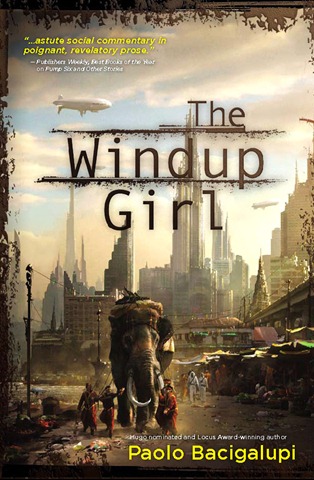
The Windup Girl by Paolo Bacigalupi

The Windup Girl by Paolo Bacigalupi just won the Nebula Award, and is one of the finalists for the Hugo Award to be announced at the end of summer.  Time, in their Top 10 Everything in 2009, called The Windup Girl the #9 novel of 2009.  Jason Sanford gave The Windup Girl five stars at SF Signal in his insightful review.  In fact, The Windup Girl gets so much great press I don’t think I should try to review it.  When I read Wake by Robert J. Sawyer, also up for this year’s Hugo award, it was so good I couldn’t imagine another novel beating it.  Well, The Windup Girl is such a tour de force that now I can’t imagine anything beating it.  I’ve got four more novels to read before September, including Julian Comstock: A Story of 22nd Century America by Robert Charles Wilson, that like The Windup Girl is another view of our world gone mad next century.

Look at the cover of The Windup Girl to see the future:

the-windup-girl-by-paolo-bacigalupi

Paolo Bacigalupi pictures the future without oil,  powered by weird clockwork “kink-spring” devices that stores kinetic energy, plagued by relentless blights on genetically engineered food crops, a future that struggles against the rising oceans and global warming, while enduring complex political intrigues.  But the most interesting aspect of this future is the new people, called windups, designed by gene splicing, who are outlawed and despised.  The title of the novel refers to an abandoned Japanese new person struggling to survive in Thailand as a sex slave.

As one of my reading friends told me, “The Windup Girl is dark.”  One reviewer even called it a dystopian novel, but I don’t think that’s correct.  Let’s just say it’s a very gritty future.  I suppose every century is full of hardships, so this future might not be any more bleak than the next.  If 19th century people could have read about a fictionalized but true version of the 20th century, they would think we lived through hell.  But the overall quality of life now is better than any time in the past, even though we might have millions complaining about how our present time sucks.

I really admire Bacigalupi’s creative vision of the future, but I don’t expect the 22nd century to be like The Windup Girl.  Our current problems, can be seen as evolving into the world of The Windup Girl, but on the other hand, I think by then we will have solved those problems and the 22nd century will have new problems we can’t imagine today.

No one can predict the future, but I’d like to believe in a future where we get smarter and solve our present problems.  But our world is diverse beyond any measure.  How would the past judge 2010 if they saw two films:  It’s Complicated and The Girl with the Dragon Tattoo?  One film shows the world as light-hearted and cheery, and the other as brutal and perverse.

If we read dozens of science fiction novels about the 22nd century, will they all be bleak?  I want life to be like Wake, where the problems are mathematical and scientific, which is why I liked that book so much.  I loved Wake, but I have to admire the creative writing of The Windup Girl.

JWH – 5/20/10

Netbooks: Windows 7 versus Linux

I’ve been playing with Linux since 1994, but it always disappoints me in use, even though I love the concept of Linux.  Recently, I thought Linux for the desktop was going to make it on netbooks.  My Toshiba netbook came with XP, and it was okay.  Because I didn’t depend on my netbook I felt like experimenting, and tried several netbook specific versions of Linux, including Ubuntu Netbook Remix, Jolicloud and Moblin.

They were cool, especially Jolicloud which tries to control it’s environment like the iPhone/iPad with HTML5 apps, but ultimately I discovered that Windows 7 was by far the best netbook OS for me.  I’m sure the Linux people will have technical reasons to argue that I’m wrong, but for me the aesthetics of how Windows 7 looked on the small screen, it’s speed of booting up, running and shutting down, and it’s battery life just seemed overwhelmingly obvious.  It’s a shame that XP still comes on some netbooks.

However, I’d gladly trade my Toshiba netbook for an iPad.  The small size of the netbook makes it useful for on-the-go computing, but ultimately, various needs will determine whether or not a user wants a netbook or tablet.  If I was a student taking a computer to class, I’d probably want a netbook, but I’m not a student.  Nor a traveling salesman.  I now wished I hadn’t bought a netbook because I think a iPad would better suit my portable at home needs.  And I might even be wrong about that too. I might be better served by a smartphone, like an iPhone or Android.

I’ve read that Windows 7 is too big and power hungry to run on tablet computers and compete with the iPad, and that’s a shame.  I’m very happy with Windows 7.  If I could afford to own a Mac OS machine it might compete, but I’m so happy with Windows 7 that I’m not sure I’d switch if the prices came down on Macs.  Having Windows 7 on my desktop, HTPC and netbook works so well it makes me not want more.  I’m OS satisfied with Windows 7.

After having Jolicloud and Windows 7 on the same machine for awhile, I realized that Windows 7 has won the OS war for me.  I removed Jolicloud, and I gave my second desktop I kept for Ubuntu away.  I now just have three machines: desktop, HTPC, netbook.  All run Windows 7 and they all talk to each other easily.

JWH – 5/14/10

Get Rid of Textbooks!

Every year I acquire a few K-12 textbooks that are given away where I work.  I am amazed at the quality of these textbooks as compared to those I studied 40-50 years ago.  Mine were much smaller, plainer, and simpler.   Modern textbooks are marvels of knowledge presented in beautiful full color multimedia layouts.  And they are HUGE.  If children are studying these books this generation should be the most well educated generation ever.  Then why all the bad press about failing schools and under achieving kids?  Could the textbooks be part of the problem?

At first glance modern K-12 textbooks look more comprehensive than my general education textbooks in college.  If high school students mastered these books they should be much smarter than college students from the baby boom era.  But then I got to thinking, maybe these giant tomes provide too much content for young people.  Could academic apathy just be a rejection of being over programmed?  Are we trying to stuff too much into growing minds?

I picked up these textbooks for reference works.  I can’t imagine being in the 11th grade and having to master five of them in nine months.  Three of the volumes I picked up this year where American Literature (10th), British Literature (11th) and World Literature (12th).  I got the teacher’s editions and each volume has hundreds, if not thousands of teaching suggestions, questions, quizzes, activities, etc.  This is a lot to learn and to teach.

The goal is the systematic injection of facts, more facts, and endless concepts.  On the surface, the desire to educate is motivated by wanting children to have a deep and wide knowledge of the world and history.  This is great in concept, but I’m wondering is its wrong.

I can imagine an interesting experiment for some school systems to try.  Take 11th graders, and instead of giving them a textbook on British Literature at the beginning of the year, start the year by telling them they are required to each edit and produce a textbook on British Literature to be handed in at the end of the year.  All great literature before the 1930s is available on the Internet in public domain versions, and even selections of copyrighted material after that is available.  Students could collect the content, write an introduction for each piece, and an analysis afterward.  They could do the layout and graphics, and if they wanted, have a hard copy printed-on-demand for less than the cost of buying a professional textbook.

Wouldn’t students learn more by doing?  Wouldn’t learning about British Literature be more fun as a treasure hunt than rote memorization?  Teachers could still guide the students lesson by lesson by discussing a required reading list, but they could also expect students to find their own supplemental reading.

Teachers could lecture on authors, assign a standard poem, story or essay for all to read, and then require students to collect additional works from the author’s output that they felt an affinity for, to add to their personal textbook/anthology.  Lesson plans could be built around students sharing their experiences.  Competition would arise to who could find the coolest works to collect.

And why not let the students collect art work, photos, letters, diaries, and other content to supplement their poems, stories and essays.  Encourage them to study history, science, social studies, economics, etc. to help explain their selections.

It we had students create their own textbooks they’d have a book for life they could keep, revise and expand, and it might be more memorable and meaningful than being forced to study a book for one year that they turned in when school was over.  Also, they would have something to show their kids and grandkids.

What if college acceptance was based on the textbooks they created in high school?  I know this is a bizarre, radical idea, but the Internet is changing our society in all kinds of ways.  With computers, software and the Internet, students shouldn’t have too much trouble creating their own textbooks, and imagine what kind of textbooks they could create for the iPad, which adds the dimensions of sound and video.

Instead of buying students hundreds of dollars worth of textbooks, buy them Adobe Creative Suite and require them to be creative.  Expect them to work instead of memorize, I believe they will learn more that way.  Can you imagine a K-12 system that was based on productivity instead of passive learning?  And students would learn so many practical skills as a byproduct of this kind of schooling.  And the same concept could be applied to all other courses. 

We might have more scientists, engineers and mathematicians if students spent their time doing productive work rather than memorizing.  K-12 students in the course of their academic careers should make a telescope and microscope, design a house, assemble a car, build reproductions of all the classic science experiments, reinvent mathematics century by century, put together a radio, television and computer, and so on.

Every school year in a student’s K-12 life is really trying to learn about reality from the Big Bang to the present.   We weave the language skills with math skills and then start studying the history of reality over and over again, with each school year expanding on the previous one.  That’s a lot of knowledge to catch up on.  Maybe kids would learn better by recreating how it was discovered rather than being forced to memorize the facts.

I remember my elementary, junior high and senior high years, they were like a 12 year prison sentence that I had to endure by sitting and being forced fed a curriculum not of my choosing.  Study, memorize, test, study, memorize, test.  It was all so painful.

JWH – 5/14/10   

Wake by Robert J. Sawyer

Wake by Robert J. Sawyer is the first novel of a trilogy, it came out in 2009, Watch, the second book, came out this year, and Wonder will come out in 2011.  Sawyer calls them the WWW Trilogy, and it has a rather slick web site, with the best production values I’ve ever seen promoting a SF novel.  Personally, I found Wake as exciting as when I first discovered science fiction back in the 1960s, when I was a kid.  And it’s up for the Hugo this year, so I figure Penguin knows it has a great story and its hitting warp ten to promote it.

wake-for-blog

Wake is not marketed as a YA novel, but it could have been.  The main character is Caitlin Decter, a fifteen year old blind girl, who is a math wiz, computer geek, engaging blog writer, and extremely precocious.  This reminds me tremendously of the Heinlein juveniles from the 1950s, and in particular Holly from “The Menace From Earth.”  Like the Heinlein juveniles, Wake is chock full of educational tidbits.  And Wake is the kind of novel you don’t want to put down. 

Classic SF Theme:  Intelligent Computers

It’s getting harder and harder for science fiction writers to come up with completely new science fictional ideas, so what we often see is a writer taking on a classic theme and having a go at evolving past ideas.  Wake follows in the tradition of many fictional computers, but in particular ones about a computer becoming conscious in front of one person.  These are the just the ones I’ve read, there are many others.

  • 1966 – The Moon is a Harsh Mistress by Robert A. Heinlein
  • 1972 – When H.A.R.L.I.E. Was One by David Gerrold
  • 1995 – Galatea 2.2 – Richard Powers
  • 2009 – Wake by Robert J. Sawyer

Sawyer goes further then earlier writers in trying to imagine how an artificial mind would evolve and what it would perceive as it came into being.  Sawyer weaves blindness and Helen Keller, autism, apes that do sign language, Julian Jaynes’ the bicameral mind, and other explorers of consciousness into the story in a very effective way. 

One reason why I love this novel so much is because I’ve been writing a novel in my head about this subject for years.  It’s not likely I’ll ever become a real novelist, but if I do, I’ll have to take the concept further than Sawyer, and that’s a good challenge.

Go read Wake.  End of review.

Spoiler Alert

Now I want to discuss what Sawyer is really writing about.  Sawyer supposes that the Internet could evolve into a self-aware mind.  That idea isn’t new, but what Sawyer does with Wake is make his case for it with series of suppositions that are wrapped in a page turning novel.  In other words, he has a bunch of wild theories that he gets readers to think about one at a time. 

What I’d like to do is discuss these ideas but hopefully without hurting anyone’s enjoyment of the story, but I recommend you not read beyond this point if you haven’t read Wake yet and want to get the full impact of its excitement. 

Sawyer’s first theory is the emerging web mind will go through a stage much like what Helen Keller went through before she discovered language.  Sawyer indirectly explores this stage in a number of ways, including quotes and references to Helen Keller, a subplot about signing apes, and references to the book The Origins of Consciousness in the Breakdown of the Bicameral Mind by Julian Jaynes, a book I found very exciting when it came out back in 1976.

But I think Sawyer is missing a piece of the puzzle, one I got from On Intelligence by Jeff Hawkins.  Hawkins thinks our consciousness emerged out of a pattern recognition processor that we call the neocortex.  Sawyer uses cellular automata as his theoretical model, but I’m not sure that will work.  Cellular automata create patterns, but do they recognize them?  I’m not sure the Internet can generate a consciousness in its current design.  Oh, the Internet will make a fine nervous system for such a web being, or beings, but I think another type of device will need to be built first, and that’s a multilayer pattern recognizer that’s as good or better than our neocortex.

So far, all the writers exploring this theme have assume that when computers reach a critical mass a consciousness will spontaneously arise out of the complexity.  I doubt that completely.  I think at least three components are needed for self-aware consciousness: pattern recognition, mind and language.  I don’t think any of these exist in the internet, or supercomputers.   I think mind evolves out of pattern recognition, and self-awareness evolves out of mind, with the development of language.

Atoms and molecules have early stages of pattern recognition, but as life arises out of non-life, sense organs develop that seek out patterns in reality.  Most organisms are so highly adapted to specific patterns that they will die off if they can’t find them.  Evolutionary adaptation is the ability of organisms to explore and take advantage of new patterns.  I believe the mind grows out of this process, and there are different kinds of minds.  A dog, cat, dolphin and chimp all have minds.  We aren’t sure how much they perceive, or if they have much self-awareness, but they do have minds.  Language studies in dolphins and chimps hint that maybe these animals are self-aware and have identities, maybe far more than our egos want to believe, but I think their consciousnesses are limited by the state of their language abilities.  I think signing will add consciousness to apes.

For an AI computer to develop a mind, I think it needs to have a focus on reality that is processed through a pattern recognition device, and then a language needs to be linked to the patterns.  At first, I thought Sawyer was going to have the web mind see out of Caitlin’s artificial eye, so as the device taught her mind to see, the web mind would also learn to see, and with another fictional piece of technology, learn a language.  Instead Sawyer imagines an inner world where the web is visible.  I don’t buy that at all.  It’s leftover fluff from cyberpunk novels.  Why invent a new reality to observe, when the internet mind has millions of eyes on our reality?

Now this brings up some interesting questions about AI minds.  If a web mind has millions of web cameras at its disposal, will it think think like it has millions of eyes?  Or will it’s  consciousness move from camera to camera and peer out at single points of reality?  Omniscient life would be tough, don’t you think?  I tend to believe, and I only have limited knowledge to think otherwise, that an AI mind will emerge from a limited environment.  Some scientist will raise up an AI mind by teaching it to see and hear while learning a language.

But what will a hive AI mind be like?  Let’s say anyone in the future can go down to Radio Shack and buy an artificial neocortex to add to their computer system and bring up an AI child.  If all of these AI minds are connected by the Internet it will be like a race of telepathic beings.  Now, wouldn’t that be a far out science fiction story?  I still haven’t read Watch, so who knows what will happen.

JWH – 5/13/10 

Update: The Classics of Science Fiction

I’ve had a web site devoted to identifying the classics of science fiction since the early days of the world wide web.  It is based on an article I wrote for Lan’s Lantern, a fanzine, back in the 1980s.  Well, for the last week I’ve been updating this web site to look more modern, and to use validated XHTML and CSS.  It’s still not that fancy looking, but it no longer looks like a 1994 web site.

I also rewrote the introduction.  I reread the original introduction today and was depressed by how long and boring it was.  I’m a wordy bastard.  The new intro is about one fifth as long, but is still probably too verbose.  At least I hope the new menu makes getting around easier.

If I was a young person, one career I’d like to pursue is web design.  I wish I was more artistic and had graphic design skills.  At least my Classics of Science Fiction site gives me a chance to have web design as a hobby.

JWH – 5/12/10