by James Wallace Harris, Monday, September 11, 2017
How should we act after learning something deeply important? If we read about evil, what should we do? Just start reading our next book? Should books change the way we live? Books teach us about reality, but what can we do with that knowledge?
I was emotionally shaken by reading In the Darkroom by Susan Faludi. The book had a tremendous impact on me because I read it just after the violence in Charlottesville and much of In the Darkroom deals with the history of the extreme right in Hungary before WWII and the resurgence of extreme right nationalism in modern day Hungary. Like Charlottesville, In the Darkroom reveals extremely ugly aspects of reality.
On the surface, this book is about a daughter learning that her estranged father has become a woman. Her father, Steven, a Jew from Hungary barely escaped being exterminated by Nazis as a teen, returns to his childhood homeland, just as anti-Jewish fervor was again reshaping Hungarian politics. The parallels to our current political landscape are horrifying.
I often find when finishing a great book I want to know more. I want to use what I’ve learned. I even wrote an essay about this craving for Book Riot, “Researched Rereading.” In the Darkroom left me with many unanswered questions. So, this essay will try to illustrate what I do after reading a specific book. Usually, it’s little more than read about the same topic, recommend the book to friends, or review it here on my blog.
In the Darkroom is so complex and rich that this is my fifth new draft attempting to capture my exact feelings. None of the earlier versions succeeded. I’m not sure this one will either. I believe In the Darkroom may require writing a book length reply to do it justice. Sadly, I don’t think it’s getting the attention it deserves, even though it was on many of the best-book-lists of 2016.
I keep wishing I could list all the important themes in the book but I don’t know how to phrase each for a bullet point. To say it’s about a man becoming a woman is misleading, although that’s part of the book. Faludi’s story is deeply psychological. It’s about identity and survival. Faludi’s Jewish father survived the Nazis sometimes by pretending to be a Nazi. Many times in his long life he pretended to be someone else to survive.
How do we survive our mundane lives, do we pretend too?
After reading In the Darkroom I wasn’t sure if Stefánie Faludi was a woman or pretending to be a woman to survive the final decade of his/her life. Steven became Stefánie, but her story is not like the typical transgender people I’ve met or read about. Susan Faludi’s father is a unique person that defies analysis. In the Darkroom is a case history of a psychological condition that is endlessly revealing but impossible to define.
Most reviewers focused on In the Darkroom being about a woman discovering her father having gender reassignment surgery at 76, and then writing a book about her dad’s life. And, In the Darkroom is part memoir and part biography. But that’s just the tip of the iceberg.
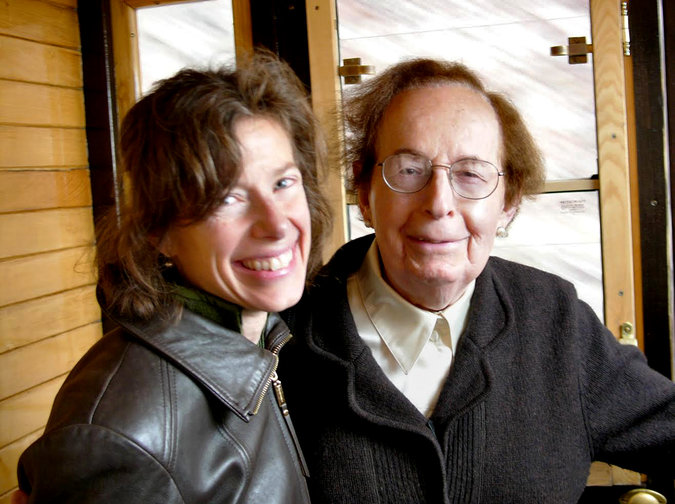
Because both the father and daughter are named Faludi, I’m going to sometimes use their first names to reference the two. Because her father had three names and two genders in his/her lifetime, I’ll use the name from the period being discussed. Susan’s father was born István Károly Friedman on November 1, 1927, in Budapest, Hungary. Susan’s father died Stefánie Faludi at 87, in Budapest in 2015. Susan was born in Queens, New York in 1959, and knew her father as Steven. Susan’s parents divorced in 1977 and she saw little of her father after that until 7/7/2004 when she got an email from her father saying he was now a she and living back in Budapest. In the Darkroom is about Susan’s many trips to Budapest between 2004-2015 getting to know her father, an enigmatic person who did everything possible to hide his/her identity.
Susan grew up knowing Steven, a highly competitive very masculine man. She did not know of István, or his Jewish heritage and extended family. So her book is about Hungarian family history in the 1930s and 1940s, and 21st-century Hungarian history and culture.
As I read In the Darkroom I wondered if Susan’s father was a psychopath, but Susan doesn’t explore that issue. I did find this paragraph from Psychology Today that fits István/Steven/Stefánie quite well:
Psychopaths, on the other hand, are unable to form emotional attachments or feel real empathy with others, although they often have disarming or even charming personalities. Psychopaths are very manipulative and can easily gain people’s trust. They learn to mimic emotions, despite their inability to actually feel them and will appear normal to unsuspecting people. Psychopaths are often well educated and hold steady jobs. Some are so good at manipulation and mimicry that they have families and other long-term relationships without those around them ever suspecting their true nature.
But István/Steven/Stefánie defies any singular labeling. Susan’s detective story to unravel her father’s secrets is far more than just a story of having a transgender parent. Susan’s father had a profoundly complicated and fascinating life that perfectly illustrates that fact is indeed stranger than fiction. In the Darkroom contains countless seeds for novels and nonfiction books if other writers wish to spout them, as well as a goldmine for grad students wanting Ph.D. dissertation ideas.
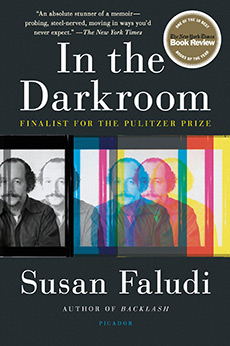 The hardback edition does not include photographs. The photograph shown above is widely used on the internet, and I assumed it was released for the publication of the book and safe to copy. Faludi writes for the NY Times “In My World, Photographs Lie,” which includes a slideshow of photos that are now in the paperback edition. They are not enough! And they do lie. But words deceive too. Susan constantly describes photographs throughout the book which I’m sure most readers crave to see too. When I finally saw some of those photographs they weren’t like I imagined. Steven was a photographer and cinematographer, so it seems odd to leave out photographs in a book about that part of his life. And the book uses the word “darkroom” from the title as a multidimensional metaphor. However, no amount of Googling has provided enough photographs to fill my desire to see what Susan wrote about.
Ultimately, In the Darkroom is about identity and not just transgender identity. István/Steven/Stefánie never says she felt female from childhood like other transgender female memoirs I’ve read. And most of the book is really about István/Steven/Stefánie conflict between being Jewish and wanting to be Hungarian, even Magyar Hungarian. Magyars persecuted the Jews before and during WWII, and again today. Read Susan Faludi’s “Hungary’s sharp rightward turn is a warning to America” in The Guardian. Jobbik is an extreme right political party in Hungary whose success should scare Americans, especially after what we saw in Charlottesville.
In the Darkroom could be a supplemental text for any graduate course about current day fascism or how racial and nationalistic hatred overwhelmed Hungary in WWII. I could imagine a professor asking students to list similarities between German and Hungarian nationalism in the 1930s and 1940s, and what we see with the Alt-Right today. Just read Susan Faludi’s piece in The Baffler, “Pity, O God, the Republican.”
One of the constant ironies in the book is Susan’s feminism in conflict with her father’s concept of being female. Joy Ladin at Lilith, a Jewish feminist publication, wrote, “What’s Wrong Here? One Daughter’s Rendering of Her Dad’s Gender Transition,” and felt Faludi might be misleading readers about transgender psychology because Susan doesn’t warn readers her father is atypical. Ladin worries Faludi is presenting anti-trans stereotypes. Faludi does profile a transgender woman that cared for her father after surgery, and who had doubts of about choices she made. Faludi also includes research on transgender people who end up being unhappy. However, Faludi is very careful to explain how her father did an end-run around all the psychological guidelines used for people electing gender reassignment surgery. Stefánie is so unique that nothing should be generalized about her story.
Even though In the Darkroom is a masterpiece, it left me wanting to know more. Of all the family Susan interviews and profiles, why did she leave out her mother and brother? Faludi chronicles her encounters with her father like a journalist carefully documenting evidence and sources, yet I don’t feel we get Susan’s reactions and feelings. And why is she maintaining dual citizenship with a country that was so horrible to her family? We get hints that Susan is like her father, and like her father, she hides her identity too. And like her father, I wonder about the inner identity that Susan hides from us readers.
István/Steven/Stefánie is a master manipulator of people, (the reason I wonder if he/she was a psychopath). Susan constantly shows the reader how her father tried to manipulate her and everyone else. I believe Ladin’s worries are unfair. Susan Faludi does an excellent job separating her father from the typical person, be it male, female, Jew, American, Hungarian, etc.
The real question is whether István/Steven/Stefánie Faludi knew himself/herself. István/Steven/Stefánie was so obsessive-compulsive his/her whole life about secrecy that it’s hard to accept what we do know. Somehow István/Steven/Stefánie was able to drag a lifetime of possessions with her over three continents. When Susan visited Budapest she found rooms recreated that she had seen in America as a child, as if István/Steven/Stefánie was the curator of a museum devoted to his/herself. I wished Faludi had included photographs of all these rooms and possessions, and from the time Steven was a photographer in Brazil in the 1940s.
The hardest part of the story to grasp is István/Steven/Stefánie feelings about being Jewish. At one point, Stefánie describes herself as an “overdressed shiksa.” She has chosen to be a woman and appears to identify as a Magyar. Both identities that have persecuted István/Steven/Stefánie over a lifetime. This is rather amazing because Stefánie has overcome two physical barriers – gender and ethnicity – to create an outward appearing identity of her own making. In the dark room of her mind, she invents what she wants people to see, even her daughter.
It’s a shame István/Steven/Stefánie didn’t keep a journal, but then, that would have been too revealing.
Reading In the Darkroom makes me wonder about my own identity. I don’t think about gender, race, nationality, religion, or ethnicity when it comes to my identity. I side with scientific and liberal thought. I might tell people I’m a liberal or atheist, but what does that mean? I’d guess the best one-word description for myself is bookworm.
Books have to stand on their own, and In the Darkroom does. However, any great book should introduce the reader to a new path into reality to explore. And In the Darkroom does that too. My craving to know more really boils down to wanting to ask all the people involved my own questions. But I can’t. The best I can do is look for interviews other people have done.
All of these are polite interviews which are typical for authors while doing book promotion. Faludi is famous for writing controversial books on complicated subjects, including Backlash and Stiffed. In the Darkroom has fathoms of depth to it. I’d love to read an academic anthology collecting essays that dissect it, but it’s unlikely such a book will ever be assembled.
But I still haven’t answered my title question. A great book should change us so we act differently. The reason I was so upset at reading In the Darkroom is the same reason why millions got upset over the news from Charlottesville. What can we do about people who hate? Susan Faludi’s book is about what her father did. He survived where many in his family didn’t. I don’t want to survive the Alt-Right by his method. The tragedy of In the Darkroom is Stefánie is not a likable person even though she is incredibly remarkable. I don’t want to change myself, I want the people that hate to change. Is that even possible?
JWH
 I’m reading An American Sickness: How Healthcare Became Big Business and How You Can Take It Back by Elisabeth Rosenthal. Rosenthal carefully chronicles how medical costs have risen since the advent of health insurance. Most people won’t read this book because they don’t worry about the future. They won’t start worrying until a certified summons arrives via FedEx from a collection agency lawyer notifying them of their court date.

 We Are Legion (We Are Bob) came out 9/20/16 on Audible. As of 9/8/17 has 36,360 ratings, with an average score of 4.7 out of 5 stars. It’s sequel,
