
31 Lessons to Save the World

James Wallace Harris, 3/4/21

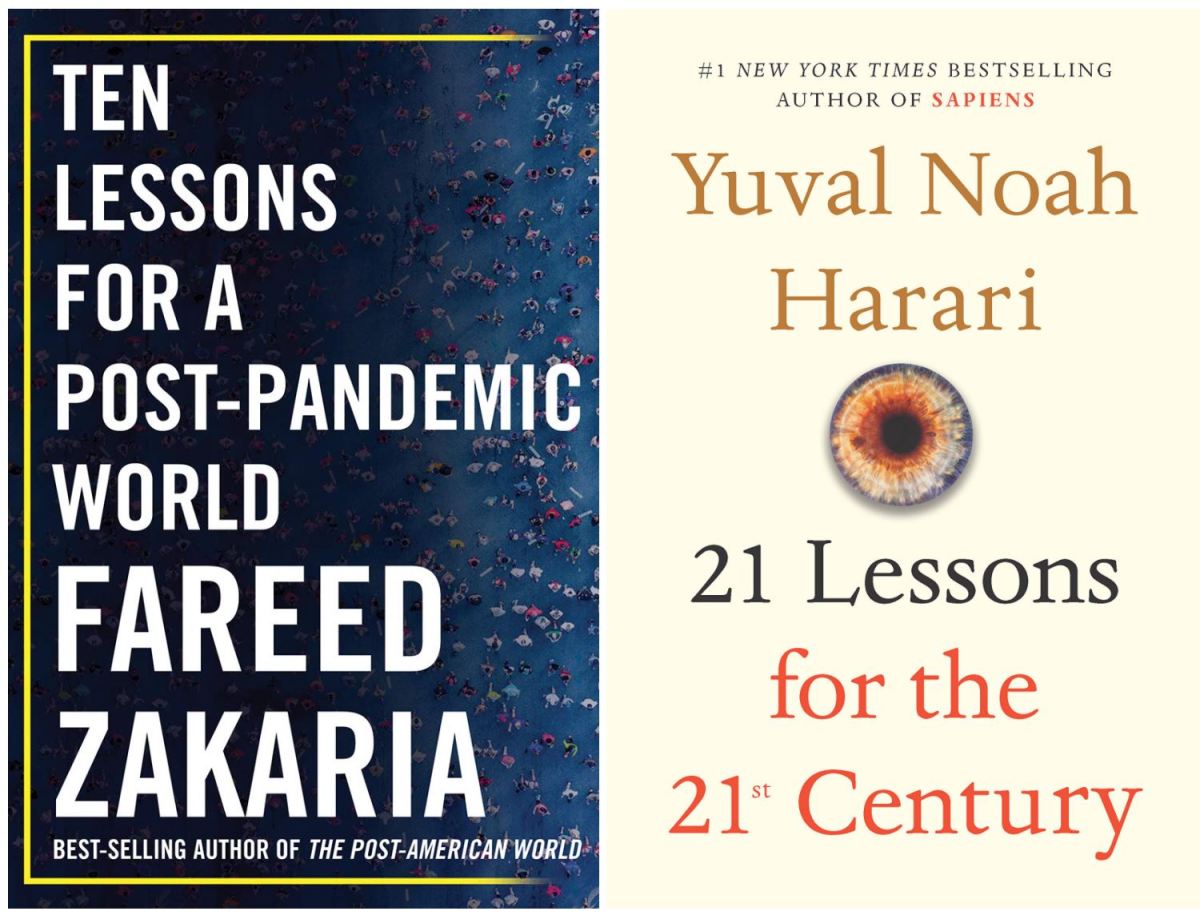
Reading 21 Lessons for the 21st Century (2018) by Yuval Noah Harari and Ten Lessons for a Post-Pandemic World (2020) by Fareed Zakaria made it all too obvious that everyone needs to get to work together to save the world. But will we? Harari and Zakaria are two tiptop brains who have been thinking mighty hard on what needs to be done and have come up with a total of 31 useful insights. However, while reading these books I kept wondering if humanity will do what it takes to save itself.

Of course, both books carefully assess the major governments around the world and generalize on the psychological abilities of their citizens. Harari focuses more on people, while Zakaria deals more with governments. Harari is an international philosopher from Israel, while Zakaria is a savvy political commentator on CNN. Harari’s lessons focus on how people think and his main advice advocates freeing oneself from all the bullshit that confuse our thinking. Because our modern world lays a lot of crap on us, Harari offers a great number of lessons to free ourselves. Zakaria asks us to focus on what is good government and how can we build them. Since the United States has been sinking deeper and deeper into bad governmental practices for decades Zakaria suggests a lot of changes too.

Can individuals and humanity as a whole make all the needed transformations before our problems reach a perfect storm of self-destruction? One of the lessons Harari covers is how people live by the stories they tell themselves. He makes a case that people generally don’t think for themselves, but buy into group thinking. Psychologically, it’s beneficial and easier to accept a story from a group than invent your own. That’s why people embrace religion, nationalism, and political parties – they give meaning to their lives, a satisfying sense of purpose and understanding, and a story to embrace and share.

At first, you’d think Yuval Noah Harari is a liberal, but as he recounts the history of various philosophies, dismissing each, he comes to liberalism and says its dead too, and keeps on going. That made me question my own stories I got from hanging with the liberals. It made me ask: What story do I live by? Well, here’s my story abbreviated as much as possible:

I don't use the word universe to mean everything anymore after science started speculating about multiverses. I use the word reality. From all my studying of science there appears to be no limits to be discovered from exploring larger and larger realms, or by delving into smaller and smaller pieces. Evidently reality is infinite in all directions in both time, space, and any other possible dimension or existence. Earth is an insignificant portion of reality. But in the domain of human life, this planet is all that matters because it sustains our existence. I am an accidental byproduct of reality churning through all the infinities of infinite possibilities. I am a bubble of consciousness that has a beginning and end. I coexist on a planet with other similar consciousnesses, as well as a spectrum of other living beings with their own versions consciousness. Life on planet Earth has the potential to exist here for billions of years, but it appears our species is about to destroy its current level of civilization, if not commit species suicide, or even wipe out all life. We can all continue to live pursuing our own stories ignoring their cumulative effect on the planet, or we can collectively decide to protect the planet.

You can see why these books appeal to me.

To cooperate means everyone working from the same pages. I’m not sure that’s possible, but these two books describe what some of those pages should look like. As long as we selfishly pursue the individual stories we currently live by, cooperation can not happen.

I cannot bet we’ll cooperate because the odds are so impossible. But I am quite confident that we’re quickly approaching an endpoint to our current civilization. All the odds are just too high for that. If you haven’t read Collapsed by Jared Diamond, you might consider doing so. It’s about all the civilizations before our current ones, they all failed. But just pay attention to all the trends you encounter. They all seem to be aiming at a near future omega endpoint bullseye.

To solve our problems requires everyone becoming a global citizen. We must all put the security of the Earth before our own goals. That involves learning a new story. But as Harari points out, most people don’t switch stories once they’ve found one that gives their life meaning, even if it has no connection to reality whatsoever.

We live in a era where people are embracing nationalism over globalism. This is Zakaria’s territory. Not only must individuals must change, but nations need to change too. Zakaria covers how some nations are succeeding and others are not.

In the story I live by as described above, I know my place and limitations. I’m a single consciousness that will endure for a few more years. Basically, I putter about in my tiny portion of this planet, pursuing things that interest me. I enjoy what I can, and try to limit my suffering as much as possible. I am quite thankful for having this experience of existing in reality. Maybe it is too much to hope that we could collectively control our environment and the fate of our species. Reality is all about creation and destruction, roiling through all the Yin-Yang possibilities. Maybe in some locations in reality the inhabitants do work together to shape their existence, and theoretically this could be such a location, but I doubt it.

I told my friend Linda the other day, to save the world will require everyone reading a certain number of books to understand what needs to be done. I’m not sure how many books would be required, but I’m pretty sure they won’t get the readers needed. That’s why my most popular essay is “50 Reasons Why The Human Race Is Too Stupid To Survive,” getting tens of thousands of hits. And most of the people who leave comments are quite cynical about our odds too. I really need to update that essay with current examples, but I could call this essay reason #51.

JWH
REWATCHING: The Graduate (1967)

James Wallace Harris, 3/3/21

I’ve heard older folks often say, “I’m the same person I was at 19 on the inside.” My wife has a family story about an uncle in his eighties who said, “I feel just like I did at 19, but something is terribly wrong with my body.” I’ve always taken it for granted I’ve been the same person my whole life, but is that true? The other night while watching The Graduate, a film I hadn’t seen since I was sixteen back in 1967, I began to doubt that. The movie was exactly the same, but who I was at sixteen and who I am at sixty-nine are two different people.

I’ve decided to watch and review a series of films I’ve seen before to help me remember who I was at different times in my life. We all experience the illusion that we’re the center of the universe and find it hard to empathize with all the people around us. We forget they see reality from an entirely different perspective, one where we aren’t the center, but they are.

There is a word, “sonder” in The Dictionary of Obscure Sorrows that I find most useful right now, so much so I believe I should quote it’s definition here:

sonder
n. the realization that each random passerby is living a life as vivid and complex as your own—populated with their own ambitions, friends, routines, worries and inherited craziness—an epic story that continues invisibly around you like an anthill sprawling deep underground, with elaborate passageways to thousands of other lives that you’ll never know existed, in which you might appear only once, as an extra sipping coffee in the background, as a blur of traffic passing on the highway, as a lighted window at dusk.

Most folks at a certain age have the revelation of sonder, where they realize the human beings around them live in their own fully realized universe that doesn’t include us. Our own lives are so complicated that we struggle to imagine the complications that others endure. It helps to stop and contemplate what people around you are feeling, seeing, thinking, and all the background details that went into developing their unique perspective. Watching The Graduate I sondered my younger self. I also sondered that every character in the film should have a fully developed backstory if their characterization was to be realistic.

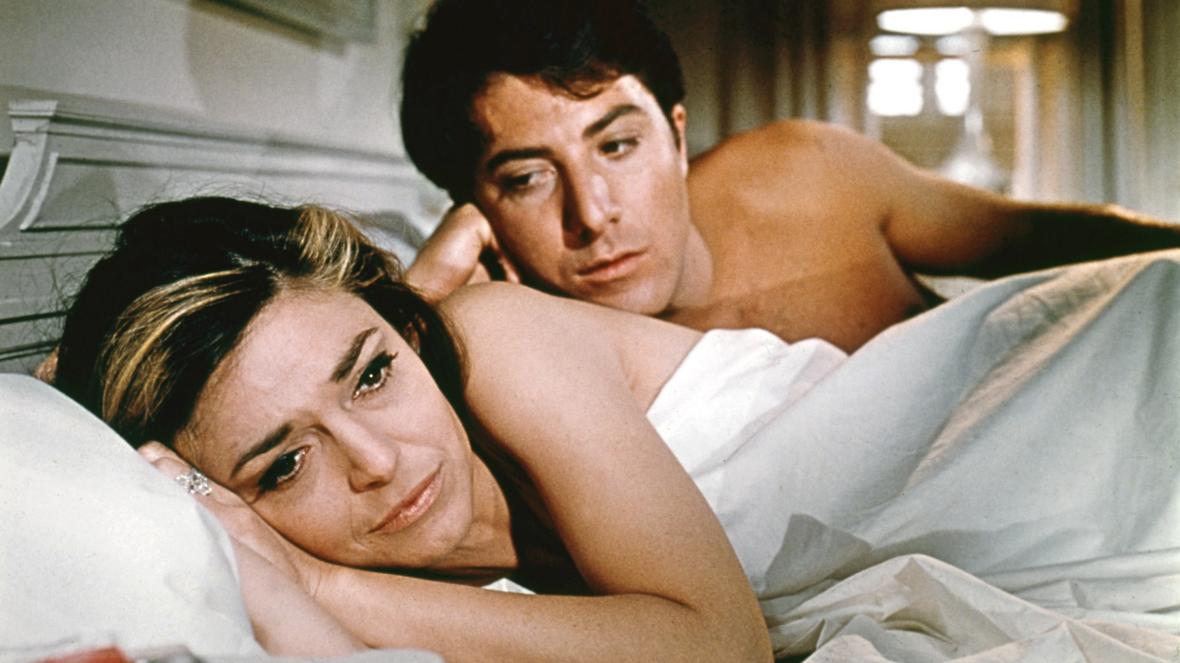
Here’s the thing, who I was at sixteen was a different Jim Harris, or a subset of who I am at sixty-nine, because those intervening fifty-three years changed me drastically. However, the characters Benjamin Braddock (Dustin Hoffman), Mrs. Robinson (Anne Bancroft) and Elaine Robinson (Katherine Ross) should be exactly the same. Because I reacted to them differently at sixteen and sixty-nine reveals I’m different. Partly, that’s due to how I sondered those characters at sixteen and sixty-nine. We can never know what it’s like to be another person because telepathy doesn’t exist. Our best effort is to always extrapolate and speculate on what other people are like from our own experiences, which may never be equal to what others experience.

I still have vivid memories of the first time I saw The Graduate back in 1967 when I was in the eleventh grade. Debbie Hall, a cute dark-haired girl who was my chemistry lab partner, had told me all about the movie with such excitement that I felt I had to go see it. And I wanted to impress her. I attended Coral Gables High School, but I wasn’t like most of the students there who were from rich families like the Braddocks and Robinsons. We lived in a poorer section of Coconut Grove, before it became chic. I went to the school library and read about The Graduate in Time Magazine. The article treated the film as some kind of phenomenon. That really made me want to see it. The buzz was the The Graduate was the first movie aimed at the Baby Boomer generation

Even though I was sixteen and could drive, and worked at a grocery store making my own money, I didn’t have a car yet. This was a particularly poor time for my family, and we only had one old car, a beat up old clunker from the previous decade. I was embarrassed to be seen in that old car. I told my dad I had to see The Graduate for school and he drove me over to the Miracle Mile in Coral Gables and dropped me off at a theater there. I was glad then he didn’t want to come in. I was also embarrassed to be seen with my dad too. But now I wish he had because I’ve spend most of my life since he died when I was eighteen trying to figure out who he was. But dad drove off to go to the Grove VFW Club to drink.

Over a half-century later I watched The Graduate again, this time on a 65 inch 4K TV that I couldn’t have imagined back in 1967 even though science fiction was all I read. In the 21st century, the experience of watching The Graduate was much different from when I first saw it as a high school kid in the 20th century.

Back then I thought Benjamin Braddock’s parents (William Daniels, Elizabeth Wilson) were pushy, smothering, meddling, and oppressive – the bad guys of the show who wanted to convert Benjamin into a sellout robot. This time, I saw them as good natured folks who wanted their son to get on with his life and make something of himself. Young people today probably won’t understand this, but a common phrase from back in the 1960s was “The Generation Gap.” We told ourselves never trust anyone over thirty, and we felt the older generations wanted us to conform to their way of thinking. We feared that as much as they feared communism. To my generation, our parents kept trying to get us to sleep with a pod (see Invasion of the Body Snatchers for the reference.)

Benjamin was like my snooty Coral Gables High School classmates who lorded their fancy clothes and new cars over my poor attire and carless condition. One of the reasons I liked Debbie Hall so much is because she defended me from Bruce, a rich kid who sat behind us in chemistry. Bruce berated me for not wearing the right clothes. Obviously, he was trying to impress Debbie and I was a zero in his universe. But I liked how Debbie was aware of the class distinctions and put him down. Bruce had obviously already fallen asleep with a pod in his room.

Benjamin, a recent college graduate, was right on the cusp of becoming adultified. That was why he was so surly and angry. Being seduced by Mrs. Robinson meant more than just getting laid. At the time I had only been on a handful of dates and had been too shy to even try to kiss a girl, so sex with any female, even an older mom thrilled me to the bone.

But that’s the thing I realized at sixty-nine about myself at sixteen. I didn’t try to sonder Benjamin, Mrs. Robinson, or Elaine in that Coral Gables theater over a half-century ago. I didn’t try to imagine their backstories or perspectives on reality.

In 1967 The Graduate was tremendously exciting, but my younger self was only unconsciously reacting to various elements in the movie. The sex excited him. The beautiful Katharine Ross excited him. The red Alfa Romeo 1600 Spider excited him. The Simon and Garfunkel songs excited him. The abundance of jokes made him happy. And I left the theater pumped with a sense of rebellion. Even though Benjamin didn’t have long hair, The Graduate felt like it was counter-culture anthem, giving the finger to the over thirty generations.

In 2021 I saw The Graduate as a very different person. The whole time I was watching the movie I kept trying to sonder the characters, but all I could extrapolate was insane contradictions. Good fiction is due to writers creating fully realized characters that are believable. It’s as if they sondered real people and used enough details from their lives to let the audience also imagine being those fictional people.

In 2021 I could see that Benjamin and Elaine were from well-to-do families that had controlled their lives. That both of them had little experience thinking for themselves and as new adults were confused by what they should do. However, beyond that, there were few clues about them in which to speculate.

There is nothing about Mrs. Robinson that makes sense. There is no reason to believe she’d want to have sex with Benjamin. Both dads were little more than comic pawns in the plot. And once Elaine knows that Benjamin has been sleeping with her mom, there’s little reason to believe she’d want to have anything to do with him. Even without knowing Benjamin had been humping her mom, I never saw any reason for Elaine to be attracted to Ben. And when Benjamin tells his parents he’s going to marry Elaine and then admits that Elaine knows nothing of his plans and that she hates him, we know Benjamin is a clueless unrealistic fool. As an adult viewer, The Graduate falls apart. I now see it as a series of unrelated gags that don’t make a coherent whole.

Except for the ending. After Benjamin and Elaine find their seat on the back of the bus and we look into their eyes for many moments, I saw something I don’t remember seeing at sixteen. In their eyes we could hear them think: “What the fuck have I done! What am I supposed to do now?” It’s obvious why I didn’t see that doubt in their expressions in 1967 when I was sixteen – I didn’t want to. I wanted to believe there was an escape from growing up.

In 2021, at age sixty-nine, seeing that last scene, I suddenly sonder the writers of The Graduate. They wanted a hit movie, to capitalize on the Baby Boomer generation, but they knew their revolutionary rhetoric was just to make a buck, so they gave us wink-wink at the end, saying, you can rebel against the status quo kid, but you’re ain’t going to get away with it.

We didn’t, did we?

JWH