Which Came First – the Emotion or the Hormone?

by James Wallace Harris, 3/26/21

This essay began when I asked myself: Do emotional states stimulate hormone production or do hormones flowing first cause us to experience an emotional state? Does happiness increase energy, or does energy increase happiness? Our mental, emotional, and physical states are all interconnected. As I get older I’m trying to figure out how to increase all three even though aging seems to be reducing them equally. I’m wondering if working on any of the three will cause a corresponding increase in the others.

Eventually, we all go looking for the Fountain of Youth. Some want to look younger, others like myself, want to feel younger. I quit believing in magic when I was a kid, so whatever is the source of vitality it should be discoverable by scientific observation. My current amateur theory is youth and vitality come from chemistry, but I also assume aging affects the efficiency of the chemical processes in our bodies.

Most people want to believe in mind over matter, but is there any evidence to support that belief? Can positive thinking overcome entropy? Or do positive thoughts come from robust chemistry? We all know hyperactive oldsters, but does their energy come from force of will or thriving endocrinology? If we’re low energy beings because of our wimpy hormonal system, can we fertilize them with right thinking, positive emotions, or good eating?

I’m pushing myself to write this essay. The whole time while I’m writing part me is begging to be allowed to go eat and watch television. But I’m still writing. Is that because willpower has empowered by want, or is it because I stoked my chemical furnace with good food and a nap this afternoon?

Does our state of mind set hormones in action that create our feelings, or do hormones generate our feelings which dictate our state of minds? Lately, I’ve been trying to observe my feelings and mental states. I’ve even wondered if changes in my brain chemistry in the past year is making me more aware of my feelings and thoughts. Other reasons for increased contemplation is I’m feeling old, tired, and worn out, so I’m spending more time just relaxing, and that’s leading to increase cogitation and self awareness, but not productivity.

What I want is to be more active. I can’t tell if that’s wishful thinking since I’m turning seventy this year and decrease activity is natural with aging, or if I could be more active if I thought the right thoughts, or felt the right emotions.

Has the stress of living a year in pandemic isolation drained my vitality or is my diminished energy just coinciding with normal aging? Life is complicated. There are no quick and easy answers. However, I’m not ready to give up. I’ve been retired from work since 2013 and easy living might also be a factor in my decline. Of course, we do have to be logical. How many aging people gain youthful vitality as they progress in years? How many retired people start doing more?

I’ve never thought of myself as an emotional person. Whenever I’ve seen people getting wildly excited at parties, sporting events, and rock concerts I wondered why I wasn’t jumping up and down and yelling too. I’ve always considered myself a happy person because I don’t get depressed. But then I don’t get exuberant either. If I was more emotional would that give me more energy?

I can energize myself somewhat by artificial means. I gave up drugs a half century ago. I’m slightly tempted again because old age seems like the perfect time for uppers and cocaine, but I know that would only accelerate my decline. I also gave up caffeine decades ago for mental clarity. And in recent months I’ve given up refined sugar, which might explain my current low mental states. But I’m also feeling better physically since I gave up sugar, and I’m losing weight, so I hope in the long run eating healthier will translate into more mental energy.

When I said I could energize myself artificially, I meant with music, books, movies, and television shows. Sometimes a nap and some good music leads to gung-ho thinking that inspires actual activity. Or has my lunch digested while I slept stimulating hormone flow leading to roused thoughts and finally feeling inspired to get up and do something? It’s a subtle distinction.

Whatever refuels my tank doesn’t do it for long.

For example, when I play “Here Comes the Dawn Again” by Billy Vera and the Beaters real loud, I feel physically stimulated. That also turns up the flow of emotions.Then my thinking speeds up. After that I feel like getting up and doing something. Has music increased hormone activity? Or did music increase my thinking which increased hormone activity? Is this a bit of evidence for the power of positive thinking?

Writing this essay is energizing me – to a degree. I can’t quite call it a jolt of youthfulness. I also feel myself draining my battery as I write. I wish drugs weren’t so self-destructive because I feel like doing a Kerouac and chewing benzedrine cotton from a broken inhaler to write more.

Now that I’m older I feel more emotional, but still not highly exaggerated emotions like I see in other people. We all have different levels of energy and emotions. Are highly emotional people more active people? I have observed that some of the most emotional people I know are also the most active.

Instead of mind over matter, could it be emotions over matter? Or is there a direct relationship, more emotions means more mental activity? If that’s so I’ll have to find a way to increase both. However, I’m still trying to decide if more mental activity increases emotions, or if more emotions increase mental activity.

JWH
Imagine Living Only in the Real World and Rejecting All Screens

by James Wallace Harris, 3/18/21

I grew up in the 1950s with the television screen. In the 1980s I became addicted to the computer screen. In the 2010s I started looking at the smartphone screen all the time. After having someone impersonate me with a fake Instagram account on Facebook last night I got disgusted with the internet I wondered if I shouldn’t abandon the online world. Then I thought, what would it be like to live just in the real world, without any screens, not even the TV screen? Much of what I find disturbing about the world comes through screens.

That’s a scary thought, giving up screens. I spend hours every day staring at them. My favorite past time right now is discussing science fiction short stories with folks on Facebook. If I didn’t use screens I could still read books but I couldn’t connect with the other people who love to read the same kind of things I do. Of course, what if we considered book pages to be like screens and abandoned them too?

Before screens there were books, newspapers, and magazines. I can imagine giving up screens, even giving up watching television, but I can’t imagine giving up the printed page. Isn’t that weird?

I’m trying to imagine life without screens or pages. It kind of blows my mind. My world would get very small. I’d probably keep up the house and yard way better than I do now. I’d probably get into gardening, cooking, and making things. I’d want to spend more time with people face-to-face. I assume life would slow way down. I guess I’d crave hearing about the world beyond my little place in it by talking to people and listening to their stories about events beyond my sight.

Without pages from books, magazines, and newspapers I’d be a lot more ignorant. Pages and screens inform us, connect us to the wider world. I can see now thinking about this, that screens really are an extension of pages. Screens add movement to the static type, illustrations and photos in printed matter.

When I watch YouTube videos created by amateurs I realize they are sending a highly constructed recorded speech with visuals which is more evolved than the printed essay, and an essay is more evolved than a lecture, and a lecture is more evolved than conversation.

The real world is nature. Plants and animals, earth and sky. Pages and screens are our way of communicating about nature. But hasn’t the abstraction of our communication moved us away from nature?

As much as I find nature beautiful and fascinating, I’m far more wrapped up in pages and screens, which if you think about it, is our way of reacting to nature. So what if we gave up abstraction and just dwelled in the natural world? (It might feel like living in a Ursula K. Le Guin novel. Even her futuristic human societies dwelling on far away worlds seem like medieval times on Earth.)

To be honest, it’s too late for me. I’m far too addicted to abstraction. I much prefer the fantasy of fiction on the page or screen to living actively in the real world. I much prefer the abstraction of nonfiction, news programs, and documentaries to studying reality first hand.

Should I feel guilty about that?

JWH

Another Literary Novel About Androids Passing for Human

James Wallace Harris, 3/13/21

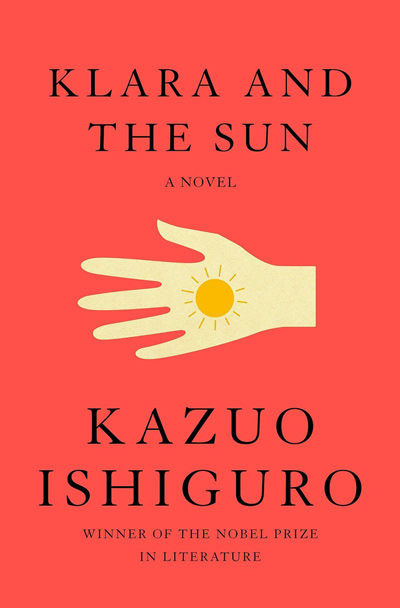
Androids that can pass for humans have become very popular characters in books, movies, and television shows. Klara and the Sun by Kazuo Ishiguro is the second novel I’ve read by a literary writer to explore this theme, the first being Machines Like Me by Ian McEwan. I reviewed it back in 2019. I have to admit that literary writers do a better job at characterization than science fiction writers. Klara is a fully realized being that we come to know from a first person perspective.

And I was impressed with Ishiguro’s science fictional speculation. He develops Klara with a distinctive speech pattern and we learn about Klara’s way of perceiving the world through Klara’s narration. Klara is designed to be a girl robot, an artificial friend, and androids like Klara are referred to as AFs in the book. Other than looks, Klara’s personality has little to identify as female. Klara is a being with growing awareness and Klara’s consciousness grows by observations. We never know exactly what Klara looks like, but since Klara is supposed to be a companion for a teenage girl we have to assume it looks like one.

However, one of my greatest objections to stories about androids passing as humans is giving them gender. For some reason creators of such stories believe AI minds will have gender and that’s illogical. AI minds, no matter what their outer casing looks like will not have gender because they will not be based on biology. Nor will they have human emotions. All of our emotions are tied to our biological subsystems. Writers of these stories seem to assume people will want to buy machines just like themselves. That might be true, but it won’t happen.

Klara starts out life in a store waiting to be bought. I imagined an upscale Apple Store. We slowly learn how Klara thinks about things from its observations. Klara’s vision is broken down into a grid system. Sometimes this appears to help Klara with perspective, sometimes with identifying objects, and sometimes with analysis of the details of specific aspects of what’s Klara sees. If you remember Deckard using the machine to analyze a photograph in Blade Runner, that’s how I envisioned Klara’s visual field. I thought this clever of Ishiguro.

Klara is eventually bought to be the companion for Josie, a young teenage girl around fourteen who suffers from an unnamed medical condition. Josie’s sister died from a similar condition. One of the mysteries of the novel is what they suffer from.

Ishiguro fleshes out this story with many other current science fictional speculations. Some kids, like Josie have been genetically altered (think Gattaca) while others haven’t. Josie’s closest childhood friend Rick hasn’t. The society of this world has also put many people out of work while elevated other humans with high status jobs. In this story, Josie’s mom has such a valuable job, but her divorced dad doesn’t.

Another fascinating theme introduced by Ishiguro is theology. Klara is a Sun worshipper, which is logical since Klara runs on solar power. However, Klara’s simple-minded beliefs are hard to accept. Ishiguro makes his AFs childlike in their thinking. If we ever create AI minds with general knowledge, including a chip with all of human knowledge would probably only add a buck to the cost. AI minds will know all human languages, all of mathematics, physics, chemistry, and biology, all of history, literature, and the arts, all of philosophy, religion, and psychology.

But Klara and the Sun is a story, and for this story, Klara has an innocent faith in the Sun. Giving theology to robots is what made Battlestar Galactica great, and has the same effect here.

Klara and the Sun is really about human relationships, and all the plot complications deal with Josie and her family. Without spoiling the story, it’s what the humans want and fear from machines that make the novel philosophically interesting. Ultimately, I believe Ishiguro rejects our sillier desires for androids that pass for humans such as creating them to satisfy our sexual urges, but even the ones he does suggest seem tied to our basic instincts.

Overall, Klara and the Sun is an enjoyable story, but more and more I’m getting disappointed that writers can’t picture realistic AI beings, or imagine such realistic AI beings’ impact on our society. There are no real reasons to create robots that look like us. There’s no reason to think they will think or feel like we do. And they will certainly have immense intelligences that will dwarf ours. We will probably anthropomorphize them even when real AI beings with general intelligence emerge because that’s our hangup.

But how will AI minds see us? Our behaviors will be inscrutable to them. They won’t be able to imagine love, hate, pain, lust, anxiety, humor, greed, jealousy, pride, and all our other emotions. AI minds will understand us like biologists study all nonhuman living organisms. AI minds will see us through their statistical studies of our behavior and by theorizing on how our behavior coincides with our languages. But could you imagine love, hate, or pain if you’ve never felt them?

Klara believes Josie was helped by the theology Klara imagined, but there is no real reason to believe this is true. If you read this novel, pay attention to Klara’s usefulness throughout the story. Does Ishiguro ever suggest that an AF would be an actual useful companion for teenagers? Or is Klara no more than a sentimental toy?

How will humanity be helped or hurt by AI minds? I think such novels are waiting to be written. So far all the ones about computer overlords or humans passing for human are based on our most basic emotions. Writers need to think outside our brain box we can’t seem to escape.

I actually thoroughly enjoyed reading Klara and the Sun despite my nitpicking about how writers want us to believe we can create androids that will pass as humans.

Other Takes:

JWH

REWATCHING: Strange Cargo (1940) and Papillon (1973)

by James Wallace Harris, 3/9/21

Movies often appear to teach us about history, unfortunately, we tend to remember their lies rather than their facts. Why do we prefer movie history over scholarly history? Why do we love glamourize characterizations of real people with fudged biographies? Yet, don’t we also relish that statement “Based on a true story” when the film starts rolling? Are believable lies more entertaining than historical facts? The easy answer is most moviegoers couldn’t care less about real history, they just want to react emotionally to a good story.

Until today, my only source of knowledge about the penal colonies in French Guiana came from fiction. In popular culture the French penal system in Guiana is remembered as Devil’s Island, but from Wikipedia I learned the penal colony of Cayenne was based on three islands off French Guiana and three locations on the mainland. The actual Devil’s Island only held about a dozen prisoners at any time, and maybe no more than 50 over its history according to one source. The Wikipedia entry was far more fascinating than anything I learned from watching any of the films about Devil’s Island I’ve seen.

The evolution of the French prison system would take many books to explain why France created the horrors of its Gulag in the New World. These terrors are painted with impressionistic cliches in movies because what moviegoers want is the thrills of prison escapes. The actual history of injustice is of little interest to mass audiences. Whereas the reasons why an enlightened nation would kill tens of thousands of its citizens with brutal torture should interest us far more than why a few men make an exciting escape.

My knowledge, like most people’s comes from a handful of books and movies. The most famous of which is the 1973 film Papillon based on the 1969 autobiography of Henri Charrière of the same title. Charrière claimed his book was 75% true, but researchers over the years have found more and more evidence to suggest it was mostly fiction, if not all. However, just the merest whiffs of the fading myths from Devil’s Island is enough to inspire writers and screenwriters, while they ignore volumes of meaty history. Aren’t we accepting the smell of the cooking over the meal?

I first watched Papillon as a movie rental in the late 1970s or early 1980s on VHS tape on a TV with a 25″ screen. I was in my late twenties. I regretted then not having caught it at the movies when it came out in 1973 because it was cinematically beautiful. It was also tremendously exciting. I liked both Steve McQueen and Dustin Hoffman performances. I had also loved Steve McQueen in The Great Escape (1963), one of the most exciting movies of my childhood. With both films I read the book based on them immediately after seeing the movie. Both films were about escaping prison. At the time I wondered if Steve McQueen had been typecast as a great escape artist. Papillon, like The Great Escape, impressed me by what the men endured in prison, and the efforts they made to escape. Looking back I realized that in the sixties when watching The Great Escape I wanted to escape my childhood, and fifteen years later when I saw Papillon I wanted to escape my job.

When I watched Papillon this week I wasn’t really interested in the Steve McQueen character at all, but sympathized with Louis Dega (Dustin Hoffman). At 69 I realize there are no escapes from life, but it must be endured to the end. The final scenes with Dega working his gardens and tending his pigs on Devil’s Island was something I could completely understand and relate. I do admit that visually the recreations of the prisons and Devil’s Island in Papillon look very much like the photos I’ve seen of the real places. The film and film locations are stunningly beautiful, and feel historical.

This time while watching Papillon I wondered about why the prison existed, why the cruelty, why the extreme inhumanity? How could they keep men in solitary for five years. How could any human survive that? I wanted to know the reality and history of this penal system. This time I knew the film was a caricature sketch based on a complex lie Henri Charrière sold the world based on his hyper realistic life experiences. Movies goers were only getting a few parts per billion of the real facts.

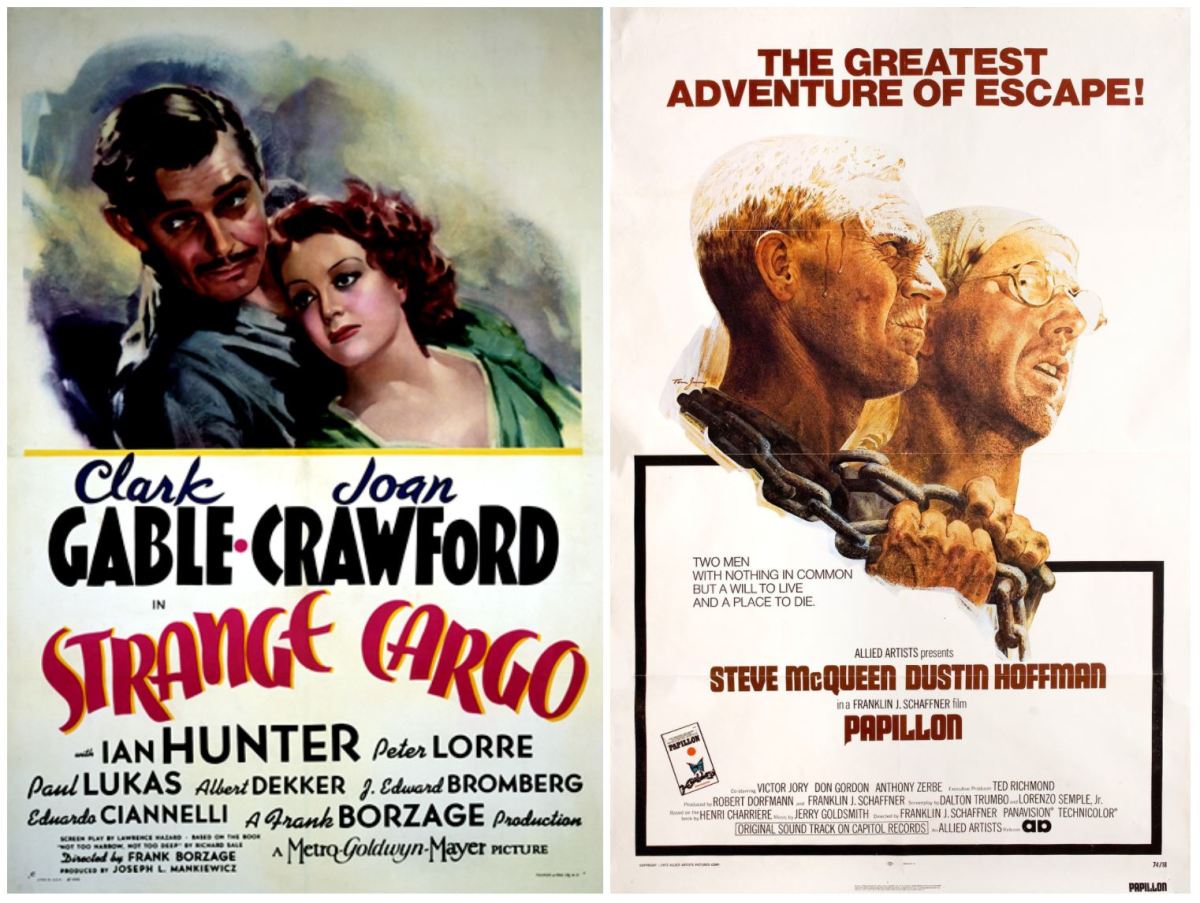
The first time I watched Strange Cargo (1940) was probably in the 1990s on Turner Classic Movies. It made an odd impression on me, but then Strange Cargo was an odd film for its time, an MGM’s take spirituality. The story is about Verne (Clark Gable) who escapes from the French penal system in Guiana with Julie (Joan Crawford), Moll (Albert Dekker) and other hardened criminals along with a strange Christlike figure named Cambreau (Ian Hunter). Cambreau is both mystical and supernatural.

These escapees weren’t on Devil’s Island, but one of the larger prison islands that had a civilian population – which is how a woman is included in party. Like in Papillon, the goal is to acquire a boat via bribery and make for the mainland. Both stories involve treacherous travel through a jungle and then an arduous sea voyage with minor characters dying along the way. In Strange Cargo, Cambreau helps each character who dies with a spiritual awakening. Both Verne and Julie resist Cambreau powers until they very end of the story by being hard independent individuals.

The first time I watch Strange Cargo I was more caught up with the escape story, and felt the mystical side of the tale to be a bit sappy. I was happily married, and worked in a university library. I liked my job and the people I worked with, but still I felt trapped by having to put in my 9-to-5 hours. Again, the theme of escape was the overriding motif that moved the story along.

Decades later, retired and freed from my sentence of work, I am much closer to death, and the mystical angle of Strange Cargo was far more appealing to me this time, even though I’m an atheist. And this time around I was far more sympathetic to M’sieu Pig (Peter Lorre), a pathetic creature so desperate for Julie to love him. Pig is a snitch, small and ugly, completely loathsome to Julie no matter how nice or helpful he is to her. Pig is the only character that Cambreau can’t help.

Strange Cargo doesn’t try to us teach history, and I think it’s a more successful because of it. Yet, Strange Cargo does preach another kind of truth, which I don’t believe, yet admired. Some of the greatest spiritual works of history have come from souls enduring prison and finding enlightenment. Strange Cargo is almost surreal in its black and white beauty.

Papillon gives us a story of survival, but Strange Cargo is about transcendence. Both are classic inspirations for stories, but like I said, when I was young I wanted escape, but at this end of my life I’m more interested in transcendence. As an atheist, I believe transcendence is only found on this side of death, and I could read that in Strange Cargo better than Papillon even though it was simplistic and heavy handed. However, this time I thought the spiritual thread of Strange Cargo was artistic, and moving.

Further Reading:

JWH

REWATCHING: The Birds (1963)

James Wallace Harris

It’s funny, but we rely on our memories for everything, but studying the functionality of our memory system shows they’re completely unreliable. When I started this rewatching project I intended to explore how I was a different person from the first time I saw a movie and who I am now when I just rewatched a film. I figured by comparing my current experience to my memories I could unearth the differences between myself then and now.

Rewatching The Birds has caused a lot of confusion. I only have vague memories of seeing the movie the first time, and I am not even sure when that first time was. Before I started writing this essay I assumed it was in the 1960s, and it may well have been. I thought that because my memory of seeing The Birds the first time are memories of talking about the horrifying bits with my friends at school. All of us were excited by the bird attacks, and none of us talked about the actors or the story.

The Birds came out in 1963. I was in the sixth grade during the first half of the year, and the seventh grade for the second half. However, I also thought I saw it on TV first, but The Birds didn’t have it’s U.S. television premiere until 1968. By then I was in high school and working five nights a week at a grocery store, so I don’t believe it was then. During 1962-1963 we lived on base at Homestead Air Force Base, and I often went to the base theater, even by myself. It was just fifteen cents for kids. I even remember seeing adult films like Town Without Pity (1961), The War Lover (1962), and The Manchurian Candidate (1962). The first two I saw by myself and actually liked them (sex and B-17s), but the third I saw with my mom and sister and was bored (politics). So it’s possible I saw The Birds there. I do know in the 6th and 7th grades it became common to stand around with buddies on the playground and discuss the movies and TV shows we had seen the night or weekend before.

One reason why my memory of The Birds is iffy is because up until very recently I never really liked Alfred Hitchcock films. I liked his TV show back in the 1950s, but the tension and intrigued he developed in his films didn’t appeal to the younger me. My friends and I were thought the bird attacks and their creepy gatherings were uber-cool, but that’s my only lasting impression. When I rewatched The Birds the other night, all the attack scenes felt very familiar, and all the scenes of characters relating to each other didn’t.

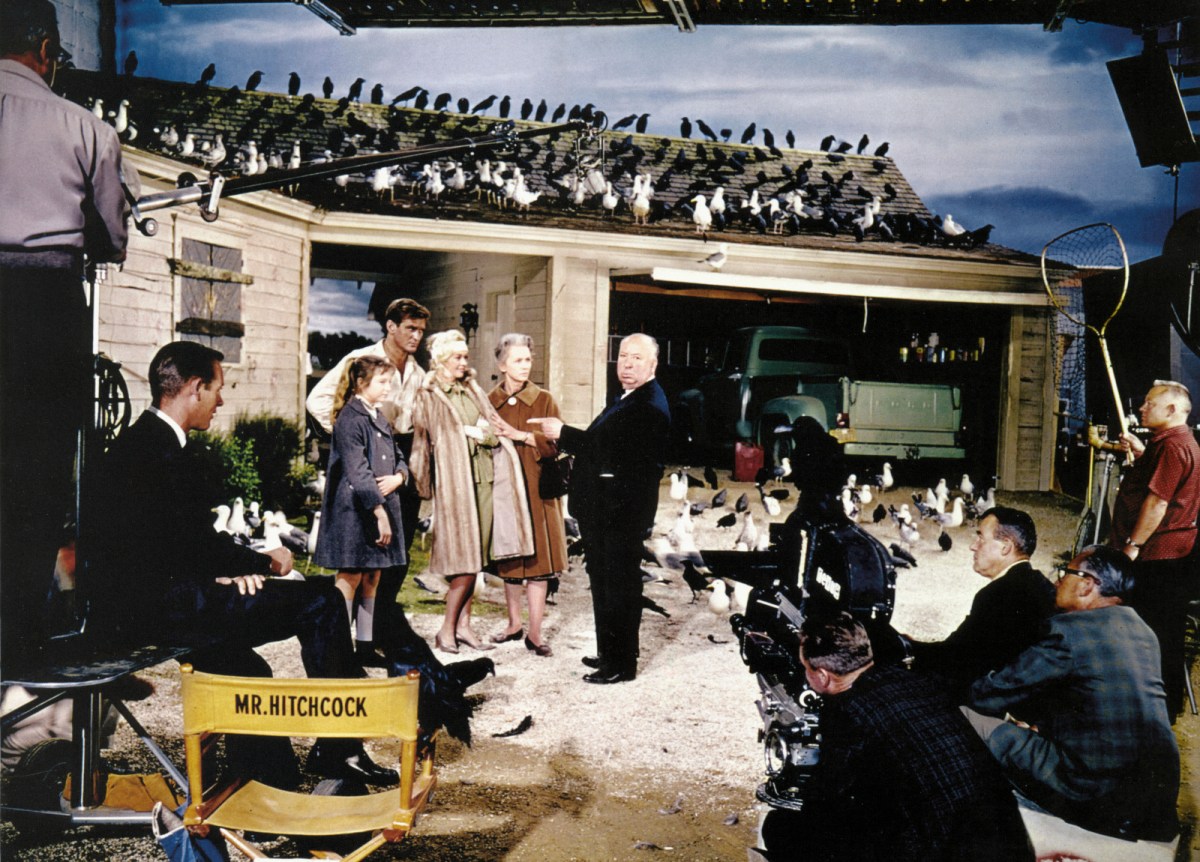
This time I was amazed by how gorgeous the cinematography looked. I also spent a lot of time amused by Melanie (Tippi Hedren) having to wear the same light green suit for most of the flick (she didn’t bring a change of clothes when she went to Bodega Bay and ended up staying the weekend, a weekend from hell). This time around I was caught up in the interplay between Mitch (Rod Taylor) and Melanie, between Melanie and Annie (Suzanne Pleshette), between Melanie and Mitch’s mom Lydia (Jessica Tandy), and between Melanie and Mitch’s sister Cathy (Veronica Cartwright). Melanie had a weird personality, almost off putting, but as she adjusted to each person she met becoming a better person for it. All that personality meshing was something that was invisible to me as a kid.

When I talked to my old buddy Connell about this movie today, he said he spent a lot of time as a kid studying people trying to figure them out. He was mystified by other people’s behaviors and struggled to understand the world by understanding why people did what they did. I don’t remember doing that at all. I was very self centered and mainly concerned with what amused me, and what I wanted. I was closer in age to Veronica Cartwright when I saw the film and probably would have reacted to the bird attacks pretty much like her character did in the movie. She was mostly frightened but did stay focused on her new pet lovebirds. I was mostly frightened of the world around me but ignored unpleasantness by staying focused on pleasures and desires.

In 2021 The Birds was an impressive film. A few weeks ago I watched Vertigo and I’m changing my mind about Hitchcock. I plan to rewatch Rear Window soon. This time around I didn’t find the birds particularly interesting, instead I admired the sets, costumes, cinematography, but most of all the characters. All aspects I ignored as a kid.

The main problem I had with the film this time was with the birds themselves, they had no motive or justification for doing what they did. Hitchcock said later that the birds represented nature turning against us, but even that seems too vague. In Daphne du Maurier’s original short story, “The Birds,” her isolated English village eventually learns the birds were attacking everywhere. I wished Hitchcock had featured that in his version of the story. It would have satisfied my science fictional sense of things.

I now feel like I’m a whole person, although if I live to be ninety, I might disavow that when watching The Birds again. I believe the first time I saw The Birds I was a very incomplete person, even though I smuggly felt like a little knowitall.

When do we become a whole person? I’ve always assumed I was unformed and only vaguely a person before age four and five, which is when my memories start filling in. But I also felt I ran on instinct rather than awareness until about age twelve or thirteen when I started thinking about things. I was probably eleven when I first say The Birds.

I saw a lot of movies from age five to twelve, mostly those made in the 1930s and 1940s, with some 1950s B-features. During the 1950s and 1960s, old movies ran on television during the afternoon after school, on the weekends, and at night after primetime. Becky, my younger sister, and I loved to stay up and watch all-night movies during summer vacations. I think my mom let us because we’d sleep till noon and stay out of her hair, and then play outside until it got dark. Like I said, I started going to the movies on my own when I was ten and in the fifth and sixth grade. The base theater played several a week, it was cheap, and only a bike ride away. I’ve seen thousands of film, and I wonder now just how much they shaped my personality, and my evolving personality judged them.

I know all those old 1930s, 1940s, and 1950s movies imprinted on me, especially the ones most suited for kids, like the Tarzan movies, westerns, and science fiction. But I also loved old 1930s black and white flicks from MGM and Warner Brothers. Maybe those movies from simpler times worked well with my simple mind. Many of my friends my age tell me they can’t watch old movies. Hell, I know a lot of people who think old movies means those from the 1980s and 1990s. I love films all the way back to the 1890s.

Even though I admired The Birds this time, it wasn’t really aimed at who I am at this stage of life. Nor did I particularly enjoy it. I enjoyed watching myself watch it, which is why I’m writing about the experience. Most movies and television shows seemed aimed at a young audience. There’s a fair amount of content suitable for middle-aged folks, but I don’t find much storytelling for young geezers like myself in their last third of life. I can pretend to be a kid again, or remember adult issues from middle life while enjoying movies aimed at those audiences, but they’re starting to get harder to watch, even tedious.

It’s much harder to find shows that I love. Three that come to mind are Black Sails, Belgravia, and The Marvelous Mrs. Maisel. Strangely, all deal with history. Links are to my reviews. I find it odd now that I never wrote about my enchantment with Mrs. Maisel. I’m not sure if there are any overlapping aspects to these show that reveal why they appeal to my late sixties mind. A few months ago I wrote about three film comedies that grabbed my attention (Genevieve, It’s a Mad, Mad, Mad, Mad World, and Bachelor in Paradise). Beside trying to understand who I was when I was younger by the films I watch, I realize I’m also trying to figure out who I am now by what I like to watch.

Cognitively I can analyze what I must have been like as a kid. I was poorly educated. I was sensitive to the suffering of others but I was burdened by prejudices. I feel I spent most of my K-12 and college years deprogramming my original upbringing. At eleven, I hadn’t started watching the news or reading newspapers, so my worldview was based on fiction I saw on television, at the movies, or read in books. Most of that fiction was not very sophisticated. I believe The Birds was a sophisticated horror film that was over my head in 1963.

The Birds is now considered a cinematic masterpiece, and I might have agreed with that during my middle years if I had seen it again then, but now it’s mostly an artistic curiosity, appealing for what it teaches me about time and my changing personality. My favorite character was Annie, who had to watch Mitch, the guy she loved, fall for Melanie. My feelings for her were so much stronger than my feelings for a story about creepy birds.

JWH

p.s. Sorry to be pounding out so many posts so quickly, but I’ve been laid up with a bad leg and I’ve spent a lot of time thinking about what I wanted to write when I felt like sitting at a computer again.