A Tale of Two Screen Generations

by James Wallace Harris, Sunday, October 6, 2019

I believe growing up with the television screen made me different from my parents and grandparents. I wonder if kids growing up with smartphone screens will be even more different?

The education you get before starting school is the bedrock of your soul. For most of human history, kids grew up listening to family stories while acquiring their beliefs in religion, economics, and politics. Books, magazines, and newspapers didn’t affect those early years, but when radio came along, a new source of influence competed to program our early childhood. This escalated with television and accelerated even faster with computers, networks, tablets, and smartphones.

In those early years before we learn to read we acquire all kinds of concepts that become the cognitive bricks to our psychological foundation. For example, I didn’t acquire religion during those years, but a belief in science fiction. Aliens replaced gods and angels, heavens replaced heaven, and space exploration replaced theology. And because kids are learning to read at an earlier age today, more concepts are compressed into those formative years. I assume kids today are smarter than we were in the 1950s.

Isn’t this why traditional religious beliefs and family history is less important to people growing up today? Sociologists have long talked about peer pressure influencing teens, but didn’t television shaped the toddlers of my generation? Doesn’t everyone agree that social media pressure is shaping the early childhood of today?

A more descriptive name for Baby Boomers is The Television Generation. We got our name because so many of us showed up all at once after WWII. But more importantly, we were also the first generation to grow up with the television screen. We were raised with three new network eyes on the world. We’re now seeing a generation growing up with mobile devices such as smartphones and tablets, and these kids have countless extra inputs.

I was born in 1951 and it seemed perfectly natural to suckle at the glass teat. Even now I have a hard time comprehending how my parents’ generation grew up without it. And I can’t conceive of what it’s like growing up today playing with mobile devices in the crib. Mobile devices are so much more intelligent than televisions, especially television programming in the 1950s.

Before radio, children acquired limited mythology from their parents, but also from large extended families that crossed generations, and the church. Whatever creation story you were told you accepted. There wasn’t a lot of skepticism back then. Starting with the radio, it was easy for kids to encounter competing creation myths at an earlier age. But it was television that made a quantum leap in providing alternative explanations about reality.

My earliest extensive memories begin around age four. I don’t remember what my parents told me, or what I heard in church. I do remember the television shows I  watched. I remember exactly where I came from – Romper Room, Captain Kangeroo, The Mickey Mouse Club, Howdy Doody, LassieTopper, Love That Bob, Gunsmoke, The Twilight Zone.  Television ignited my imagination. I remember being four and trying to communicate the ideas I got from television with my parents, but they seemed clueless. It’s like we spoke a different language and lived on different planets. They’d tell me about growing up on farms, or the depression, and I just couldn’t imagine what they were talking about. I’d eventually learned about their upbringing from television.

Once I started school I bonded with other kids over the television shows we loved. Television provided a shared language and mythology. However, I think growing up in the 1950s and 1960s is definitely different from today. We had three television networks, and two Top 40 radio stations, and limited access to a small number of popular movies. Among my generation, everyone pretty much watched and listened to the same shows and music. Sure we arranged our top ten favorites a little differently, but everyone pretty much knew about what everyone else liked.

Growing up today the TV screen now brings kids hundreds of cable channels, and a variety of streaming channels with thousands of different choices, and Spotify lets people listening to tens of millions of different songs. Every week countless new movies show up. But more than that, mobile devices let you choose what feels like an infinity of rabbit holes to fall into. I can understand why social media is so popular, it allows people to share their discoveries and make common connections. And I can see why movie franchises are so popular, it’s another way to bond over a limited selection. We really don’t want more shows, we want more shows we all love the same.

I’m writing this over six decades after I grew up. I wonder what people growing up today will say about their early education sixty years from now? In my generation, it was easy to share because we pretty much shared the same content. Now kids need powerful computers to find friends that like the same stuff they do.

I believe the appeal of the church today is not theology but communion. Not the communion of wine and wafers but being with other people sharing a common experience. However, I do believe television in my generation undermined the hold church had on programming our young minds.

Bible stories no longer provided our ontology. The TV screen widened our epistemology. Mobile devices are the fentanyl of screens. I imagine in another generation or two, cyborg-like devices will inject data into kiddies at an even faster rate. However, I believe there’s a limit to what our brains can handle. I’m not sure if smartphones and tablets aren’t exceeding that limit now. But that might be old fogie thinking, and we’ll have future technology that will match our wildest science fiction.

Yet, I also see signs of a backlash movement. Why are record players and LPs making a comeback? Why are there so many Top Ten lists on the web? Aren’t those signs that people want a smaller selection of inputs, ones that have a commonality with other people? Sure, everyone wants to be famous on YouTube, but 75 million kids can’t all have 75 million followers. What we want are five friends that love the same five shows and songs.

When I was growing up we often watched TV with other people. Our parents, our siblings, our friends, our neighbors. When I was little, I’d have friends over and we’d watch Saturday morning TV under tents built of blankets. As teenagers, we’d get high and watch TV together. At college, we’d watch TV in the student union together. Watching TV on a smartphone or tablet is as solitary as masturbation.

Since around 2000 I’ve stopped keeping up with hit songs and albums. I no longer know what new shows begin in the fall. As a kid, my parents used me as a walking TV guide. When I see the magazines at the grocery store checkout line, I don’t know the famous faces on their covers. Movie stars have to be in their fifties before I can remember their names. There’s a limit to how much pop culture I can absorb. I feel pop music peaked in 1965, although I struggled to keep up with it through the 1980s.

I have to wonder if kids growing up playing with smartphones can handle more data than my generation. Can they drink more from the fire hose of the internet longer? I can only chug so much data before I start spewing. Is that my age showing, or does it reveal my limitations shaped by my training watching television in the 1950s? Are those babies growing up playing with smartphones becoming like that little robot Number Five in the film Short Circuit that kept demanding, “More data, more data!”

Is growing up with a mobile device screen wiring kids differently from how we were wired by our television screens? Does Greta Thunberg represent a new stage of consciousness? I hope so. The Television Generation threw a fit in the 1960s. I feel the Smartphone Generation is about to throw a fit in the 2020s. Good for them. Don’t assume you know more than they do – you don’t!

JWH

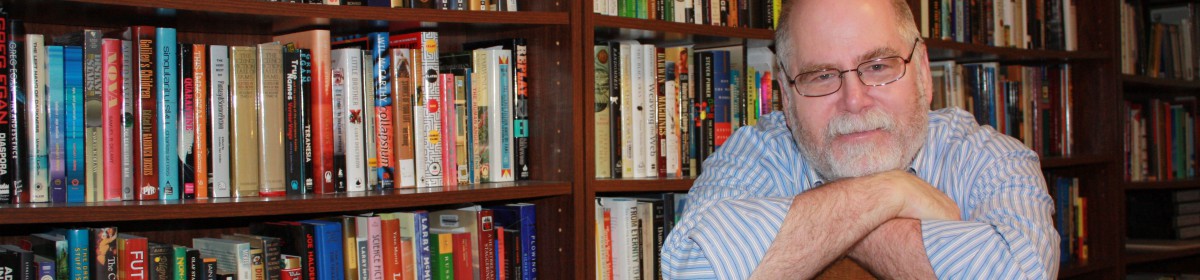
p.s. That’s me above with my mother and sister when I was four, and my cyclopic guru.
Jesus and Christ

by James Wallace Harris

For decades I’ve wondered how Christianity could be so closely associated with Republicans. It seems that Democrats are more concerned with feeding the poor, healing the sick, and welcoming the stranger, all issues generally linked with the teachings of Jesus. But recently, I had a revelation – not from God, because I’m an atheist, but just an ordinary light bulb going off in the head kind.

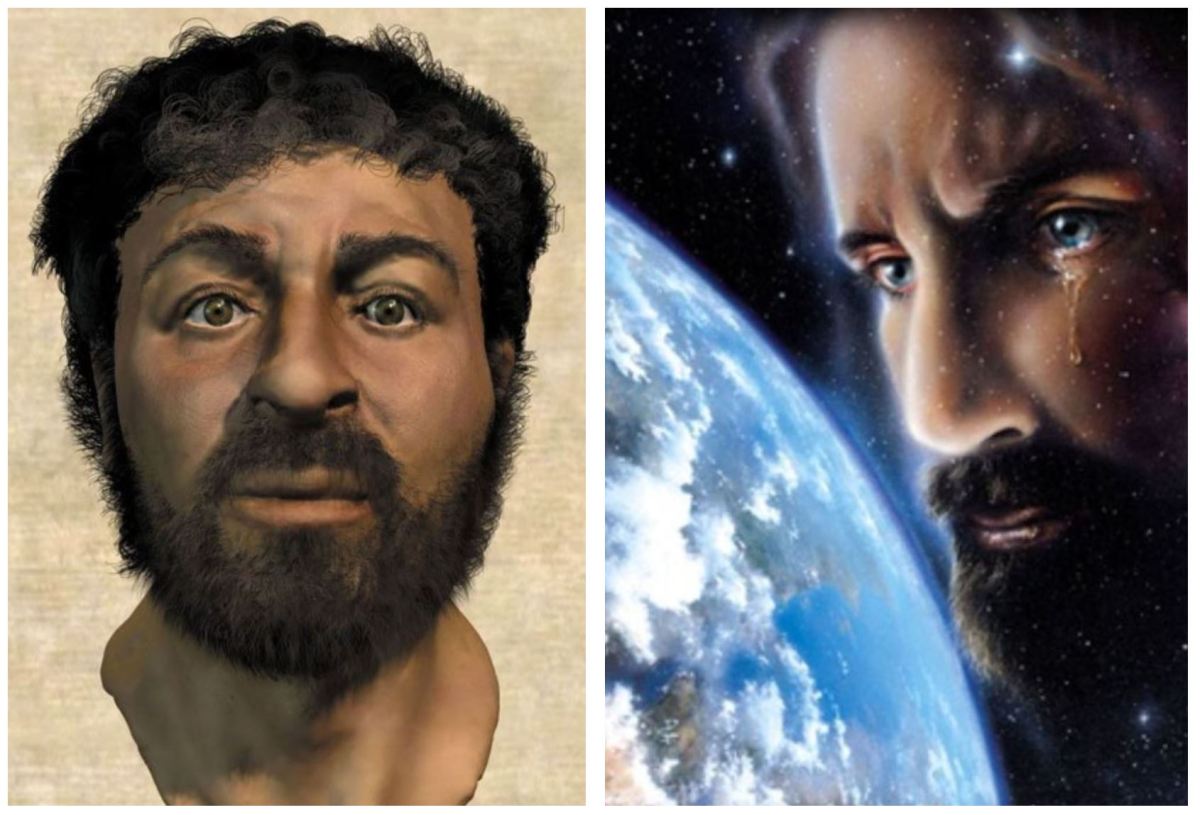
Republicans worship Christ and not Jesus. Of course, most people are going to claim that Jesus and Christ are the same, but I don’t. And maybe at an unconscious level neither do Democrats and Republicans. I consider Jesus a man, a human being, a member of the Homo sapiens, whereas believers in Christ believe Jesus was and is a God. Because I’m an atheist, I don’t see Christ, but I do see Jesus. Jesus was a man who had philosophical ideas about a compassionate society. I see Jesus like Socrates, and Paul was his Plato. Unfortunately, Paul was tainted by a lot of magical thinking – to put it kindly – so it’s hard to know how much magical thinking Jesus the man also believed.

I’m going to make a lot of generalizations in this essay that have no scientific basis, but I do think they have some rough validity. It’s like going outside at night and seeing a mercury-vapor streetlamp and a yellow incandescent houselight and noticing that each attracts different kinds of bugs. Developing a theory that bugs are attracted to different wavelengths of light isn’t farfetched, but it isn’t scientific proof either. I’m saying that Christians, who should have a consistent moral philosophy, are attracted to both the Democratic and Republican parties, which seems to me to have opposing moral philosophies. Is it so strange to ask why? Here are my guesses.

Republicans see Christ. They like father figures. They like authority and power. They also like patriarchy. Jesus was meek, kind of wimpy, a hippie preaching peace, love, and happiness with socialistic leanings, who hung out with the poor, the losers, the powerless. After he died, his image was made over, giving him superpowers, eventually elevating him to equality with God. I never understood the Trinity business but that’s what it appears to rationalize. But the PR experts of the early church needed their guy to compete with other so-called gods of their day, and they gave Jesus more and more superpowers. That whole died for your sins and immortal life in heaven was just brilliant marketing. No wonder it became the dominant religion.

It makes sense to me that Republicans consider their party the party of Christians. Then what are the Democrats? I guess I’ll call them Jesuits. I know that the label has been trademarked by the Society of Jesus, but it works well for my purpose. If you look at history, I feel I can trace liberal philosophy and humanism back to Jesus, but not to Christ. Christ the God is just a repackaged Jehovah. Conservative philosophy goes way back, well before Jesus. See, that’s another insight I had. The Old Testament is all about nation-building. It’s us vs. them. The Old Testament is dominated by following the rules, about might makes right, the end justifies the means. It’s a very Republican kind of book. The New Testament is all about love and forgiveness, the Golden Rule, power-to-the-people, all about embracing diversity. Paul worked to bring globalization to the teachings of Jesus.

Christ is really a transformation of Jesus the man into the Old Testament God. The early Christians, the ones that became the orthodox Christians competed with the traditional Hebrew religion, and they owned the copyright on God because they had invented the monotheistic God. At first, the Christians just claimed their guy was the son of God, but eventually, they had to make him equal to God, otherwise. how could their movement succeed?

I believe Jesus was a man, a philosopher, and died. Because I’m a liberal I’m somewhat of a Jesuit, even though I’m also an atheist. I believe his philosophy continued on, but not him. Christ is an idea created by the early followers of Jesus. I believe Jesus would have been shocked by all these miracles and superpowers given to him. But it’s hard to know. Paul really created Jesus for us, and like I said, Paul had a lot of magical thinking ideas.

All we have of Jesus is the red letter text in the New Testament. Many Biblical scholars have expressed doubt that all the sayings of Jesus were really spoken by him. We have to assume Jesus was illiterate. He didn’t write his philosophy down like Plato, he was like Socrates and went around speaking to people. His friends and followers appeared to have remembered his sayings and passed them down by word of mouth in the early years after he died. Eventually, they were collected by followers who could write. And those collections of sayings were used by the writers of Matthew, Mark, Luke, and John, written decades later in another language to compose the gospels. Time filters and alters all memory. Each gospel was written years apart and show a changing, evolving, Christ. Jesus is most human in Matthew and most God-like in John.

Paul’s writing is the oldest we have about Jesus, and he wrote his epistles a couple decades after Jesus’ death. You can see the earliest ideas about Christ forming in Paul’s writings, but far from all. They were added with each gospel. By the time we get to the Gospel of John, Christ has amazing god-like powers. But it wasn’t until a couple centuries later, by several generations of church theologians did Christ become completely God. During those hundreds of years, the early church, the church we now call the Catholic Church, had theological wars with other sects or branches of Christianity and Jesuits.

To me, Christianity became Judaism 2.0 because it carefully incorporated the Old Testament into its philosophy. But that was common back then when one religion supplanted another. Christianity became orthodox. It became a conservative philosophy. It decided the hierarchy. It decided the role of men and women. It was patriarchal. God was the father, the church was next in power, and ordinary people were the children. The family was very important because it was designed to mirror the structure of the church, with the husband being the God/father of the family. Christ is a God who is easy to understand because he looked like us, but he also had all the powers of the supreme creator in the Book of Genesis. Any man wanting ruling power on Earth had to align their quest with the orthodox Christian church.

If you think about this, it all makes sense why Republicans hang on so tightly to Christianity. But it also explains Democrats. Their political platform follows the Sermon on the Mount, the Beatitudes, the commandment to love each other. It also explains why there has always been a polarized split between liberals and conservatives. Some people naturally are Jesuits, while others are Christians. If you look at the Apocrypha and Gnostic Gospels you can see that other followers of Jesus tried to form opposing religions to orthodox Christianity. At one level that same conflict is still going on between Democrats and Republicans.

Democrats are still trying to divide the fishes and loaves. Democrats believe everyone should have a healer. Democrats believe everyone should have shelter, and strangers should be welcomed. Democrats believe we should help each other. Republicans believe its God’s duty to decide what to do with the poor, the sick, and the homeless. If God sends a hurricane to Puerto Rico then why should we pay to rebuild it?

The followers of the human Jesus, the philosopher, see building the Kingdom of Heaven is our job, not God’s, and we’re to build it here on Earth. Jesuits feel we are responsible for Earth, not God. That’s why Republicans hate the idea that climate change is caused by human activity. By their way of thinking, the power of weather belongs to God. If they admit that climate change is our fault, it means it’s within our power. It destroys their sense of hierarchy. It undermines the conservative philosophy. It lets the Jesuits win a battle, and they can’t let that happen.

Christianity has a subservient role for women, one that’s part of the hierarchical structure. Making women equal to men devalues the hierarchy. Many of the apocryphal gospels had Jesus giving power to women followers. The power structure is very important to Republicans. If Jesus was just another philosopher, he has no power. If he has no power, he has no authority. Democracy came later, and I think Jesus would have been a big believer in true democracy. Republicans don’t want a true democracy. They want a power structure, and they want to be part of the power structure. They don’t want equality because if everyone was equal no one would have power. If God is on your side you have the power. If a philosopher is on your side, all you got is a wordy guy.

Before democracy, the practical thing for the average citizen to do was to align themselves with the most powerful person around. Conservatives still have that urge. With democracy people are the power and leaders should only be the administrators of our power. That goes against the natural Darwinian reality of the strong taking control. In our world, the rich are the strongest. Now that’s quite amusing because Republicans are generally against Darwin. They want to believe power is top-down from God, whereas Darwin claims it’s a bottom-up thing from nothing.

That might explain another reason why the orthodox made Jesus the man into God. They don’t like bottom-up power paths. That would mean any mere mortal human could start a revolution and disrupt the harmony of the hierarchy.

I know all of this is a bunch of weird ideas, but I do think it’s an interesting way to explain our political polarization. I don’t think it changes anything. I’m not sure we can change. I think some people are naturally drawn towards conservative philosophy and others towards liberal ideas. Genetics might explain it, but it would involve too many different genes and other variables. It’s sort of like gender identity. Some folks identify as male and others as female and some people with all kinds of combinations in between. It’s a spectrum. I assume some people are liberal, others are conservative, and lots of people with different variations. There is a certain percentage of the population that are Yellow Dog Democrats, and another percentage that always votes the straight Republican ticket. While there a bunch of people who swing back and forth. I doubt logical persuasion changes the way they think politically. I’m not sure we have free will when it comes to our political and religious choices any more than people have with their gender identity.

All I’m suggesting is the word Christian isn’t exact enough. Of course, Christians split into a zillion different sects. For my purposes, I’m going to label them Jesuits and Christians, for followers of Jesus and followers of Christ. I know most of my readers will think I’m pursuing painful hairsplitting. But for me, it’s helped me understand Republicans who embrace Trump and claim he’s the best President ever for helping Christians. Using the above perspectives let me understand how they could think that, and I now believe them. But maybe they will understand why I believe Trump is the worst president ever for Jesuits.

JWH