What Would Happen To The Economy If Everyone Ate Healthy?

By James Wallace Harris, Wednesday, September 30, 2015

I’ve been eating healthy for my heart, and hopefully unclog my arteries that have been giving me trouble after a lifetime of bad food choices. Eating healthy is a vast readjustment. When I shop for food, 80% of what I buy comes from the produce section. And if I followed the recommendations exactly, it would be 95%. If everyone ate like this, most of what’s sold in grocery stores would stay on the shelves, and all the processed food corporations would go bust.

ways-to-eat-healthier

Eating out while following these healthy diets is extra hard. Most restaurants would go out of business unless they drastically changed their menus. All fast-food and convenience stores would go belly up too. So too, for vending machine owners. Any beverage company selling liquids other than water and wine would be filing for bankruptcy. And very few people in the meat, poultry and fish business would have any business.

Then, there’s the medical establishment. What if it’s true that healthy eating greatly reduces heart disease, diabetes, cancer, and a host of other chronic ailments our society spends billions to heal? Won’t a lot of doctors and hospitals lose all their trade? And all those people who process insurance claims will be out of work too! And what about all the quack doctors, miracle cure salesmen, and vitamin peddlers?

If everyone ate healthy and actually got healthy, tens of millions, maybe even hundreds of millions, would be out of work. Just think of how many people have jobs because we have long lingering deaths from chronic illnesses. What would happen to all the long-term care facilities and their workers?

I’m not sure we’ve thought this healthy eating thing through. Now I understand why so many conservatives don’t want to fix global warming.

JWH

Learning To Love Classical Music

By James Wallace Harris, Sunday, September 27, 2015

I’ve been a big music love all my life, but I’ve never really liked classical music. I keep trying, thinking classical music must be an acquired taste, or I need to be educated to its ways. In recent months I’ve been trying harder, attending a few concerts. Last night I went to hear The Ceruti String Quartet perform Opus 76, No. 4 (“Sunrise”) – Franz Joseph Haydn, Opus 11 – Samuel Barber, and Opus 59, No. 3 – Ludwig van Beethoven. I was emotional moved sometimes by the Barber, mostly because some melodies seemed somewhat familiar, like I might have heard the second movement in a movie soundtrack. I liked the Haydn least, and the Beethoven kind of impressed me, but still didn’t quite work as something I’d want to regularly hear.

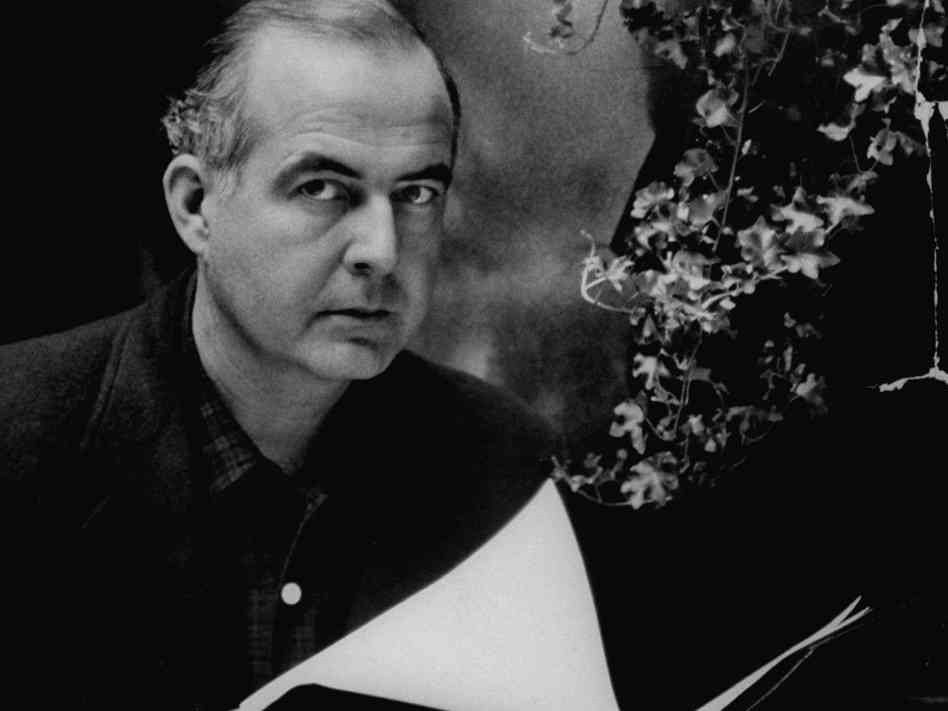
Samuel Barber
Samuel Barber

I’m fascinated by why some people find classical music so moving and powerful and others find it annoying. I’ve learned to like classical music enough, from brief measures here and there within symphonies, that I want to learn to like it more. I believe I have a conceptual barrier to understanding classical music. By understanding I mean being able to listen to it and appreciate its artistic beauty.

One hypothesis I’m working with, is I don’t have the working memory to appreciate classical music. I can’t remember the melody to any song, even popular songs I’ve heard a thousand times. I can’t hum a tune, or remember lyrics. Popular music, which I love, is based on short songs built around a relentless rhythm. Rock, folk, country and to a degree jazz songs are composed around a steady beat, usually provided by drums and bass. Other instruments weave simply melodies within the beat, but they are seldom complex, at least compared to classical music. Pop music is close to a short chant, while classical music is often much longer, far more complex, and might be compared to several long poems all read at the same time, but which still create a coherent whole. To my mind, classical music is a jumble of words and phrases I can’t comprehend, often jarring, usually without resonating with my feelings, but occasionally twinging a sense of beauty.

I came up with my working memory theory because of three recent incidents. First, my friend Janis has listened to two symphonies with me that she remembered from her high school band days. She can still hum/sing them, and remember their ever changing movements. She’d conduct with her hands as she listened, which shows she remember their overall structure.

Then I saw a video of a 3-year-old kid “conducting” the 4th movement of Beethoven’s 5th.

If you watch young Jonathan you can see that he anticipates what’s coming up. He has memorized the piece. Janis has done the same thing with the two pieces we listened to. I don’t know any classical music well enough to anticipate any part of it, even the symphonies I’ve played four or five times. I have no memory for structure. Popular music is so repetitive that you don’t have to remember. Has popular music made me lazy, or do I just have a very poor working memory?

I did play the three pieces I heard last night before the performance on Spotify–so I wasn’t absolutely new to them. I wonder how many times I would have to play them before I would learn to anticipate all the changes?

I remember taking tests where I was asked to remember a series of numbers. I’m miserable at it. Which probably explains why I can’t remember lyrics, poems and melodies. I don’t know if this is a birth defect, laziness, or lack of training. But it also relates to a third clue I discovered when I read “What Makes a Prodigy?” Scientists have discovered that most prodigies have fantastic working memories, either in the 99th percentile, or even in the 99.9th percentile. Most childhood prodigies are good at math, music and chess—all things I’m terrible at.

This probably explains why all my life I’ve wished I could play chess, music and do math—I hunger to do what I can’t. It might also explain why I can’t sing or dance. Don’t worry, I’m not feeling pity for myself, I’m good at other things. We often want what we can’t have. I’m guessing it might take a certain level of working memory ability to appreciate classical music, say 70th percentile or above, and I must be way below that.

Last night as I sat alone in the hall, (none of the three friends I asked to go with me would go). I struggled to make sense of what I was hearing. I was impressed by the performers, and by the creativity of the compositions, but except for some of the Barber, what I heard didn’t feel like what I feel when I listen to music I love. And I have a theory about that too.

If you are born into a family of Baptists it’s most likely you’ll grow up to be Baptist. If a Muslim family adopted a Baptist baby, it would grow up to be Muslim. Or maybe Hindu if it was taken to India. I was never raised with classical music, so it’s a foreign religion, a foreign culture. Because some people can move to a distant land and embrace a new culture, religion and ethics, I assume it’s possible for me to learn to like classical music. I just don’t know how hard that might be, or if my short term memory problem will be a limiting factor.

I tend to think it’s a matter of long term exposure. I used to really hate opera, but in the last year I’ve added a few arias to my Spotify playlist of favorites that I play everyday on random. This playlist are songs I can always hear and always enjoy, no matter when they come up. I’ve learned to love a few opera pieces enough to add them into the group.

Yet, I continue to struggle to conceptualize classical music. It’s funny what a newbie I am. I want to clap at the end of movements, whereas the obvious tradition is to sit quietly until the end of a piece. There’s no whistling, shouting, or stomping when a performer plays a particularly good riff. I was in a mostly empty hall with about sixty people in the audience. I think most of them were music majors, or older folk who love classical music. They all knew when each piece ended and clapped right on clue. I expected most of them were familiar enough with each of the three pieces they could have conducted. Which means they see classical music as a whole, something I can’t fathom yet.

Popular songs are played so often, and last so little time, that most people can grasp their basic structure quickly. A very long time ago I tried learning how to play the guitar and my teacher taught me the chord structure to “Like a Rolling Stone,” a song I’ve heard thousands of times since 1965. For a few weeks, decades ago, I could bang out that song, and had a feeling for its structure. I can’t even hum it now.

I listen to music in a extremely weird way, that might not be typical for most people. I don’t comprehend it’s parts. I can’t comprehend or visualize it’s structure. But holistically music pushes a button in my brain that turns on emotions. Music is a drug to me. Because pop songs are so concisely repetitious, they usually create just one emotion. Because classical music is so complexly varied, so diverse in it’s effects, that most of the time I feel nothing, but every once in a while, a measure, or even half measure of its music will find an emotion button to press. I wonder if I keep trying, I’ll learn how to like classical music so more of it’s riffs hit buttons within me that produce a response? One thing significant about classical music, and why I often compare it to movie soundtracks, is it creates a series of different emotions, sometimes even a rollercoaster ride of feelings.

Finally, I have one other hypothesis. I think I responded better to Barber than Beethoven or Haydn because he’s a 20th century composer. And that I liked Haydn least because he’s the oldest. I’m guessing the music of the 18th and 19th century was different because people’s minds were different, and I can’t tune into those periods—yet. With popular music I’ve learned to enjoy music all the way back to the 1920s, and I’ve even heard songs from the 1910s that are becoming catchy to me. For me to learn to love classical music will require learning to love music from other centuries. What’s fascinating is I started listening to chants from the Middle Ages, and I dug them. And I have a theory about why. Medieval music is more like today’s popular music, very simple. The early melodies were monophonic. Which makes me wonder if the minds of people in the 18th and 19th century were more capable of comprehending complexity than our 21st century minds?

JWH
Are We Going To Mars Because of Science Fiction?

By James Wallace Harris, Thursday, September 24, 2015

The new movie, The Martian, based on Andy Weir’s book of the same name, is generating tremendous buzz, for the movie, for science fiction fans who love books that inspire space travel, and for NASA types who feel Mars is the place to go next. Last year I wrote a review of the novel, “When I Was Martian” where I gushed about the book but wondered if I really wanted to go to Mars. Growing up in the 1950s and 1960s I thought Mars must be a wonderful place from all the science fiction I read. However, over the decades, all those robotic missions have convinced me Mars is only a suitable destination for robots and geologists.

The-Martian-Matt-Damon-Hamilton-Watch-5

Millions of people still want to go to Mars, and NASA recently released gargantuan plans to visit Mars by 2039. On the other hand, yesterday I read three essays questioning our desire to go to Mars. The first, by Ed Regis in the New York Times, “Let’s Not Move to Mars” is probably the most critical. Regis wonders why anyone would be willing to live in a capsule with the living space of a SUV for seven to nine months, only to get to a destination with little atmosphere, the scenery all rocks, and far colder than any place on Earth.

Over at The Guardian, Chris Chambers writes about the psychological impact of travel to Mars. He makes going to prison an appealing alternative to traveling to Mars. And this blogger compares colonizing Mars to going to Hell. I’m not sure how many people have The Right Stuff to get to Mars—to actually enjoy the experience. I doubts its many.

I have to wonder if most people who dream of going to Mars do so because of science fiction. I’ll admit I wanted to go to Mars because I pictured Mars like the novels of Robert A. Heinlein (Red Planet, The Rolling Stones, Podkayne of Mars, Stranger in a Strange Land). I’ve known guys older than myself who dreamed of Barsoom, the Mars of Edgar Rice Burroughs. But is even the Mars of Kim Stanley Robinson and Ben Bova any less romantic? Compared to reports sent back by NASA robots, can any work of fiction convey the true brutality of living on the Red planet without being escapist?

Mars can get as cold as -225F, and the surface air is as thin as being four times the height of Mt. Everest here on Earth. Why would anyone want to live there—or even visit? My best guess is science fiction. How can stories make us so irrational? Fiction is appealing. Fiction is an alternative to reality. If we analyze ourselves, does reading reveal a desire for adventure and travel? Or does reading reveal we’re bored with our lives and just want to go somewhere different? Or even want to be different people? Kids used to want to be astronauts when they were famous and legendary, but now all the people who fly up into space are mostly nameless. If I was young I might still want to go to Mars, even knowing what I know now. It’s appeal is that strong. Why?

Like I said at the beginning of this essay, The Martian is creating a lot of excitement, both for the movie and the desire see manned missions actually go to the Red planet. Since the Hubble Space Telescope, astronomy has been going through a renaissance larger than what it went through in the time of Kepler, Copernicus and Galileo. I think space exploration gives some people a sense that existence has great meaning. Does that sense of purpose come from a love of science, or science fiction?

Aurora KSM

Yet, even science fiction is becoming more realistic about the possibilities of space travel. In his new book Aurora, Kim Stanley Robinson questions the wisdom of leaving Earth. If science fiction is guilty of overselling space travel should it now be responsible for removing the false romanticism its given the final frontier? How many people would remove their names from the Mars One mission if they read Aurora?

I still think it’s possible that some humans will want to colonize the Moon and Mars. Whether they are thrill seekers or final frontier missionaries is another issue. To live on the Moon or Mars will require living mostly underground, in highly controlled environments that are always one technological failure from extinction. All the science fiction stories we now read about cities on the Moon and Mars are 99.99% unrealistic fantasies. Too much of science fiction is about transferring Earth living to space life, and it won’t be like that. Should science fiction be held responsible for false advertising?

I must admit, even my hopes for the realistic possibilities of space travel are still driven by the science fiction I read. My guess is anyone who hasn’t been enchanted by the genre would see that space is only suited for robots. 

JWH

The Zen of Hanging On

By James Wallace Harris, Thursday, September 24, 2015

This essay will be one of those that my friends think I’m going a little squirrelly.  But anytime I point to something that can’t be touched, I do seem a little crazy. I’m actually trying to capture a fleeting feeling—a single emotion I felt when hearing an old song.

The conventional Zen wisdom is one of letting go. We are taught to be one with the moment and learn to quiet our chattering mind. The lesson being that we miss the Now because we’re not there. Our thoughts churn out virtual never-never-lands instead of focusing on the beauty of existence. We live in our heads instead of reality. Our souls are like a drop of water floating down a stream that passes through an ever changing landscape. We hang onto memories of past sceneries or imagine future sights, ignoring the current vista.

Becoming one with Now is a lovely way to exist in reality, but I’m going to be contrary here, and explore the virtues of hanging on. All animals live in the moment. For some reason reality decided to evolve Homo sapiens who are capable of stepping out of the Eternal Now. It’s impossible to paint the Sistine Chapel or the build the Curiosity Mars rover without being able to ignore the moment. It is true we throw most of lives away in mental delusions, but it’s also true that some of those air castles we build in our heads get erected in reality. But I’m not talking about that kind of hanging on.

This morning while I was doing my morning exercises “Be My Baby” by The Ronettes came on the stereo, a song that first imprinted on me fifty-two years ago. By conventional Zen wisdom I should just listen to Ronnie Spector and enjoy the song for what it is in the moment. The powerful feelings I experienced when I was eleven years old and “Be My Baby” was chemically etched in my neural pathways don’t exist anymore. Or do they? Is it possible to exist now and then?

Living in the moment is being a one-dimensional point traveling through a four dimensional reality. The Zen of hanging on is constructing a four dimensional being. Our awareness of reality lives in the moment. Time is an illusion. The past and future don’t exist. We build the past with memories and the future with speculations. One meditation technique is to watch our thoughts, usually with the goal of quieting them. Our thoughts appear to be constant chatter that dribbles out of our brain. But if your soul can step back far enough, that chatter reveals patterns. Our diarrhea of mental babble has it’s own hard reality.

The Zen of hanging on becomes one of seeing ourselves from the fourth dimension. Living in the moment is eternal. We can’t know birth or death. But we are a finite creature with a beginning and end. We can only see that by hanging on to the residue of past moments and the most rational extrapolations of what we might become.

I don’t know if any of this will make any sense, but I felt compelled to write it before I allowed myself breakfast. It’s merely an explanation of why I believe “Be My Baby” keeps something from the past existing in this moment. To hear the song now flicks on a chemical sequence in my head that shapes my sense of the moment. From that view, the past still doesn’t exist, and the song long ago hardwired something that my present self can always experience. On the other hand, does my fourth dimensional sense of self, using all those memories I’ve hung onto, sculpts a bigger view of myself that includes the past?

Another way to ask that: Is our past a complete illusion, or something we continually reconstruct in the moment with artifacts we’ve hung onto?  Yes, one kind of past no longer exists, but don’t we create another kind, that does have a reality in the moment? Aren’t the things we hang onto the colors in which we paint our personality?

JWH

Time Management for Retirement

By James Wallace Harris, Monday, September 21, 2015

My working friends think I have unlimited free time because I’m retired. Hell, before I retired I thought I’d have a time bonanza too. It didn’t work out that way. I’ve got so much I want to do that I fantasize buying Microsoft Project to run my life. Living by impulsive is turning out to be frustrating. It’s low stress, something that my inner-hippy loves, but totally unproductive.

Everything we do takes time. It’s much easier if we only have one passion to single-mindedly chase, because it’s then a snap to know how to apply our free time. But if you chase many goals, that takes juggling. For example, the other day I got an ad in the mail for the local paper. I haven’t taken the paper in years, but the price was so low that I thought maybe I should give it a try. I feel guilty for knowing so little about my city and state, especially the politics and business. This Sunday I bought the paper as a test. I can’t find time to read it. One reason I cancelled the paper all those years ago is because they would pile up unread. Taking on any new activity requires shifting old ones around. That abundance of extra time I thought I’d have after retiring doesn’t exist.

Time Management 

I figure it takes about an hour a day to properly read the paper. Especially if you want to value what it offers. Just quickly flipping the pages and scanning the headlines isn’t worth wasting its carbon footprint. But where would that hour come from? Either I’d have to expand into another activity’s timeslot, or I’d have to read less on the internet, magazines or books. It’s just not practical for me to take the paper right now. I could, but I’d have to become a newspaper reader and give up being an internet addict. That’s like becoming a different person.

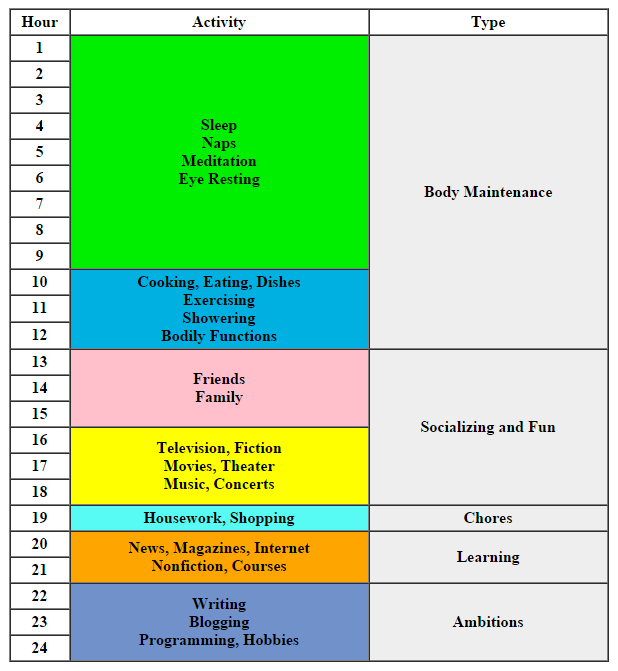
When you’re retired it feels at first like you have all the time in the world, but that’s not true. Half the day is taken up with body maintenance. Another quarter of the day is taking up with socializing and fun. I can’t remember I how squeezed in eight hours of work. Of course the numbers above are rough approximations. I’ve averaged them for the week. I often spend whole weekends in social activities, so I’m spreading activities across a single 24 hour clock as my pie chart.

When I look at this schedule I realize why I’m not getting much writing done. Three hours a day feels about right for how I’m doing things now. I have to work hard to get those three hours. It’s very easy to just fill the day with all the other stuff. I could cut out two hours a day of television and give it to writing, but I’m not sure that would work. Watching two hours of TV before bed every night seems almost a necessity for my body and mind’s upkeep, as valuable as sleep and eating. My mind is shot for the last few hours of each day, so I don’t think I could do anything ambitious.

And the older I get, the more reenergizing my cells need to keep going. All those naps and eye resting moments help recharge my batteries. I’ve recently read that sleep is the time when the brain flushes out toxic byproducts accumulated from mental activity during the day. That sounds true because when I take a nap it erases a mental fog that’s developed from writing.

I’ve been thinking about taking on two new activities – drawing and studying math. I want to push myself to learn something completely new and different. Actually, I get impulses to pursue all kinds of new activities. Writing this essay makes me realize that I’m not devoting enough time to writing, and I shouldn’t take on anything new. But I think I will try learning to draw. I need to find other things to give up, because I think always learning one new thing is essential to mental wellbeing. Thus, I need to make room.

What’s required is performing activity triage. I wonder if drawing is something I can do when I’m intellectually tired? I’m currently taking a Coursera course, “Learning How to Learn” based on A Mind for Numbers by Barbara Oakley. In the book and course she teaches techniques for more efficient learning. And I think her insights points to ways to solve my time management problems. Learning them will make me more efficient at pursuing all my ambitions. I need to stop wishing for more time, to stop hoping to can do more things, and learn to do fewer things, but being better at each, and doing so with greater efficiency.

JWH