Meditating on a Meme

by James Wallace Harris, 11/28/24

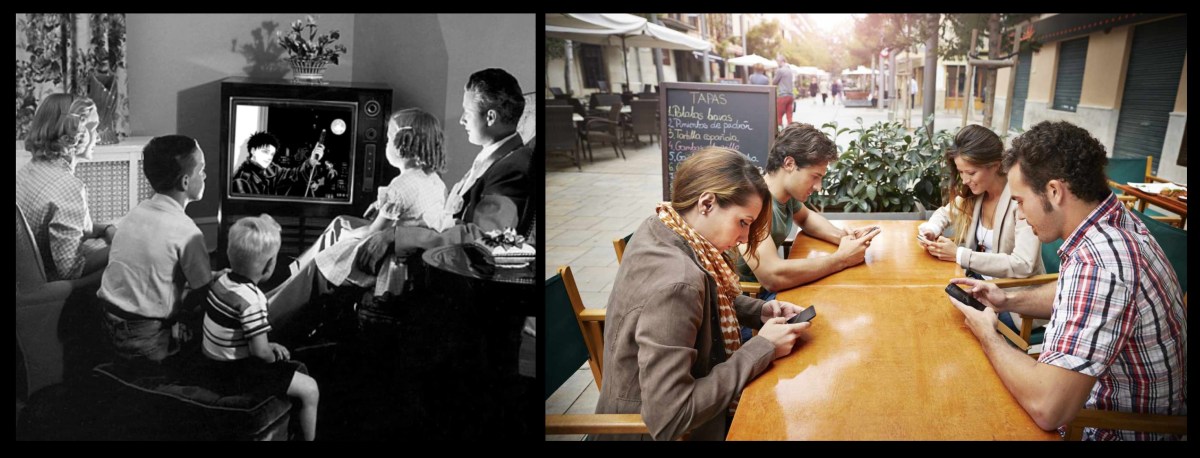
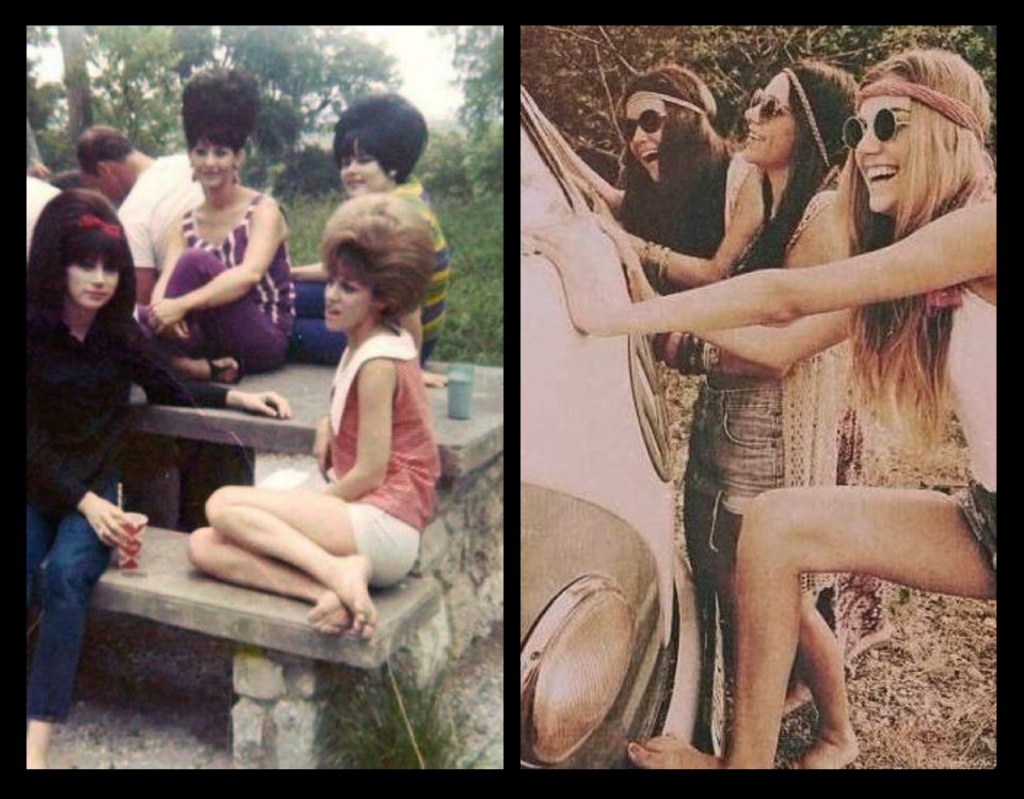
Seeing the above photos as a meme on Facebook made me think about how much people, society, and pop culture changed in the 1960s.

If a picture is worth 1,000 words, then are two pictures only worth 2,000 words? I don’t think so, I think it’s 1,000 words times 1,000 words, or 1,000,000 words. I could easily write that many from all the ideas my mind has generated since I began meditating on those photos.

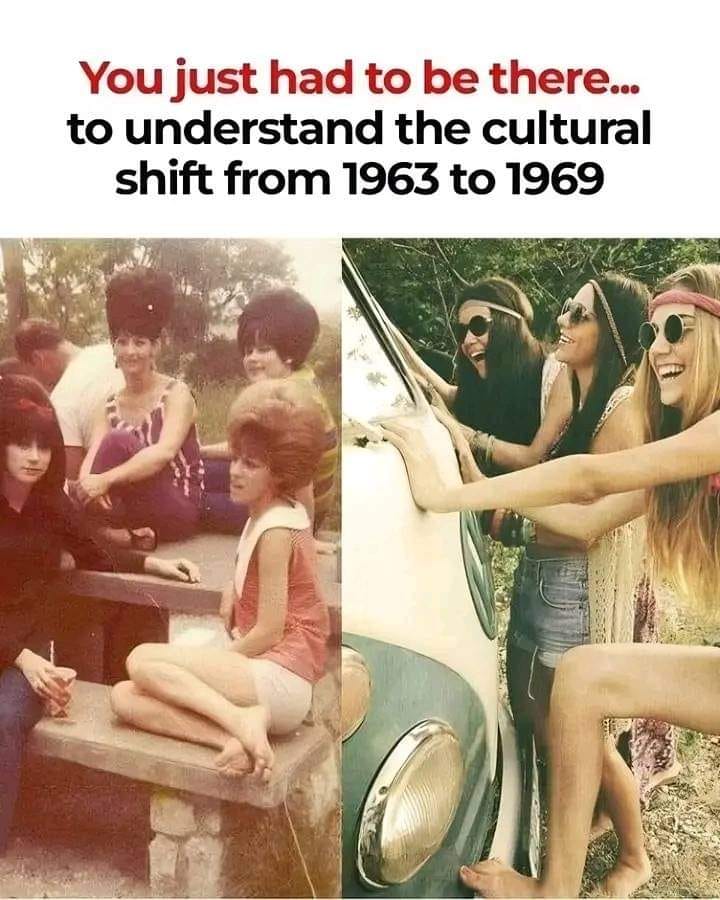
Here’s the original meme from Facebook:

I was eight on 1/1/60 and eighteen on 12/31/69. I have always thought the longest years of my life were from 1963 to 1969 because so much happened to me and the world I lived in during that time. For folks who didn’t grow up in the sixties, it was much more than what you can learn from watching Grease or American Graffiti and contrasting it with Hair or Woodstock.

When I first saw the meme above I instantly thought about how rock and roll music of the 1950s ended up becoming the rock music of Woodstock. I’ve tried several times just to write an essay about that, but after typing over 5,000 words, I realize I’ve barely hinted at what I could say. That’s too long for a blog post.

I recommend that you find two photos that bracket your adolescent years or the decade you identify with the most and meditate on them. Start with remembering every place you lived and what you did each year. Remember your family and friends, your pets, your homes, your schools and workplaces, the clothes you wore, all the activities you pursued, everything you wanted to buy. Then write the shortest essay that makes it all coherent. You will then feel the mental anguish I am feeling right now.

Then branch out in your meditations. The easy and fun things to contemplate are the changes in pop culture — how music, movies, books, TV shows, games, and technology evolved over ten years. But then move on to the political and social changes. That’s when things get heavy. Can you connect your firsthand experiences with all those external events? Have you ever compared the life you lived to what you saw on the TV news every night?

Every one of us has the life experience to write a Proust-size novel and has lived through enough social change to write a series of history books about the formative decade of our lives. If you don’t think so, meditate more on the two photos you have selected.

I turned seventy-three on Monday, and getting old has made me more susceptible to memes about the past. My memories are fading away so I desperately want to cling to them. Emotions gnaw at me to make sense of everything I’ve experienced. The urge is to put it all down in words, but I don’t have what it takes to do the job and do it precisely.

There is an undefinable mental barrier that keeps me from organizing my thoughts into coherent histories. And I’m not talking about writing something worthy of publication for others to read, but just producing a narrative that makes sense of things for myself about myself and what I’ve learned. The older I get, the more I want to understand.

This essay started out about when rock and roll music became rock music. After several drafts and much contemplation, I narrowed it down to the summer of 1965 when I first heard Bob Dylan’s “Like a Rolling Stone” on the radio. As I kept trying to document my theory, I realized I could write a whole book on it.

Then as I was researching the subject, I found that Andrew Grant Jackson had already published the book I wish I had written, 1965: The Most Revolutionary Year in Music. His book is what I wanted to write in this essay when I first saw the meme above.

The Kindle edition is currently $2.99, and it’s a perfect example of what I’m talking about when I suggest we should chronicle our lives. Even if you don’t buy the book, read the sample at Amazon. I feel the format of organizing the narrative around a month-by-month description of what was happening is a great template to use for writing about memories.

JWH

Pandora and Internet Radio

On August 16, 2008, the Washington Post ran the news story, “Giant of Internet Radio Nears Its ‘Last Stand’,” referring to Pandora.com.  Pandora is a standout Internet site that allows users to create custom Internet radio stations based on their favorite songs and artists.  It’s a unique way to discover undiscovered music showcasing technology that gets about a million daily listeners.  The Post quotes Pandora’s founder Tim Westergren, “We’re approaching a pull-the-plug kind of decision.  This is like a last stand for webcasting.”

The problem is one of paying royalties.  Right now there are a number of technologies that broadcast music:  traditional radio, satellite radio, cable TV radio and Internet radio.  Oddly, they each pay different rates to play music, and it looks like the music industry wants Internet radio to pay the most.  If this happens many sites will shut down.  Pandora has yet to make money but anticipated to go into the black in 2009 if the rates were not increased.

There are many articles about the death knell of Internet radio showing up now, with the implication that if the rates these sites have to pay goes up they will close their doors.  I think other things might happen.  Why give up on a new business model so quickly?  Pandora is actually a superior way to listen to random music – it’s superior because it’s less random but still random.

There are two way to listen to music.  You think of a song you want to hear and you play it, or you turn on a broadcasting system to play music for you.  The first method usually involves owning the song, but subscription music is a variation of that.  The second method, random listening, involves finding a source that’s close to your musical mood.  In the old days, a city might have a dozen radio stations and you picked one to play, or if you were in your car, you programmed your five radio buttons and jumped between them.  Satellite music offers more variety by giving you more stations to choose from.  Internet radio ups the variety factor further.

Pandora let’s you pick a seed song and then Pandora plays songs their Music Genome Project software thinks will match your taste.  You can click thumbs up or thumbs down on their picks to help the software zero in on what you like.  It works exceedingly well, but it’s still random music, or broadcast music.

Now I want musicians and music producers to get all the money they can, but I don’t want them to unfairly charge one random music technology more than another, and that appears to be a key issue with Pandora and other Internet radio sites.  Another random site I like is Playa Cofi Jukebox, which allows you to seed your mood by picking a year and it broadcasts random songs that came out in that year.  That’s another triumph of technology in my book.  I want these sites to succeed.

Pandora is thinking of ways to improve its ad revenue and that’s good, but I think they should think of other ways to generate revenue.  I pay for cable TV and a DVR so I see less television ads.  I would be willing to pay a fee to Pandora to not hear ads.  They should run ads, but allow users who want to pay not to listen to them.  Another possibility is to merge with a subscription service like Rhapsody or Napster and be an extra selling point for those companies.  Rhapsody has random radio stations for when I don’t want to pick my songs, but it would be even better if they had the Music Genome Project technology.

I have come to see great value in random music because of shuffle play of my MP3s.  I can even add Music Genome Project like tech to my own MP3 library with MusicIP software.  But Pandora beats my collection of 17,081 songs by light years.  And I can play it on my iPod touch.  I really do not want to see Pandora and other Internet radio stations go out of business.

Another option, rather than increasing royalty rates, could require Pandora to provide links to songs that take users to sites selling the song.  Sites that would also provide a commission to Pandora.  Pandora could offer a variety of online music stores and users could check box their favorite when they register.  Increased sales should offer better revenue than broadcast royalties.

Don’t get me wrong.  I’m not wanting free music.  I believe free is bad.  I want the music industry to make their money and I want Pandora to make money and I’m willing to either listen to ads or pay a subscription to get what I want.  It will be a shame if the industry that collects royalties forces these new sources of random music out of business.  I don’t listen to traditional radio anymore.  I’m not interested in satellite radio.  I have cable TV radio but I don’t use it.  I’m an Internet person.  Why should random music businesses pay more per song for customers like me than the other businesses pay for their customers?

Jim

If you read the Slashdot thread listed below one reader posts the suggestion that Internet radio should just stop using songs that require royalties.  That’s an interesting idea, but I think ultimately it’s a bad idea.  Free is not good.  If this idea succeeded it would kill off a whole industry and destroy legions of jobs.  If the writer’s purpose is to promote new artists and bands, it would be better to use Pandora and help these new musicians gain an economic footing, rather than turn the music industry into all amateurs.  The Music Genome Project would work just as well with unknown artists.

The real virtue of Pandora is when it plays a song for you that you’ve never heard but you love it so much that you buy it.

Related stories

17,081 Songs

I finally finished ripping my CD collection, a task I’ve been meaning to do for years.  I put it off, time and again, but I finally made up my mind that it had to be done, and when I did, it only took a few weeks.  What I did was set up two old computers to be a ripping factory.  The results were 17,081 songs contained in 125 gigabytes.  I immediately copied them to a USB hard drive and took it to work and backed up the library to my office computer.  I figured after that effort I didn’t want to loose my new digital music library to a crashed or stolen computer.  The question now:  How do I maximize the use of my song collection.

As I write this I keep an iTunes window open with a single long listing of my songs sorted by artist.  My collection represents decades of collecting covering centuries of music history.  One lesson from holding every CD I’ve bought while putting them into the burner is learning how many I’ve forgotten I owned.  On CBS Sunday Morning today they profiled Shelby Lynne, and I checked and found I had six of her CDs, but not the one they talked about that I wanted to hear the most – damn!  Just now I noticed I have four CDs of John Lee Hooker and clicked on Chill Out to play as I type.

Other than just random gazing at my list I have no real idea of what’s in my collection.  I can remember my favorites to a degree, but I’ve discovered its easy to find forgotten favorites, albums I played regularly years ago that I’ve since forgotten I even loved, much less owned.  Can you name all the movies you got excited about during the 1980s?  Susan, my wife, told me to go through all 17,081 and rate them.  Sure thing, Susie.  iTunes tells me I have 48.3 days of 24×7 listening.  I wished iTunes, Windows Media Player, or Firefly Media Server would tell me how many albums I owned.

Since I started this project I’ve been playing music a lot more and loving the rediscovery of old friends, but I’ve also been bummed by how many songs I own that I just don’t dig – not in the least.  Some songs were filler to begin with, but in other cases I guess I’ve just changed.

How To Be My Own Disc Jockey

What I need to do is organize the playing of the best songs and musical genres in a way that educates me about my own collection.  The traditional way to organize playing digital music is playlists, but that assumes you know what you want on your list before you build them.

Another option is shuffle play.  The random jumping between 17,081 songs can lead to some weird song combinations, but it does get me to hear songs I would never try from just memory.  And it can be surprisingly surprising.  “Sleeping in the Devil’s Bed” by Daniel Lanois just started playing.  Hell, I didn’t even know I had a Daniel Lanois CD, but it’s from a soundtrack to movie called Until the End of the World, a film I only vaguely remember.  The next song is “Sunflakes Fall, Snowrays Call” by Janis Ian, which is just as good.  I knew I had several Janis Ian CDs, but never remember even hearing this song, but I’ve played the album several times I know.  The next song is “No Surrender” by Bruce Springsteen, from the Live 1975-85 album.  Again, another song I like but didn’t remember.  Either I have a terrible memory or most music is not very memorable.

So far, I can say that random play succeeds the best to teach me about my own record collection.  However, I just discovered I can’t rate the songs as I hear them because I’m using the Firefly Media Server on a separate computer server to feed them through iTunes, and to rate the songs would require my library being in iTunes on my Vista machine.  This brings up another huge problem for having a digital music library.

Where Do I Keep the Master Library?

Right now my collection is on an old Dell server, ripped and stored under Windows Media Player, but distributed throughout the house by the Firefly Media Server.  I can play songs through iTunes on any machine, or I can play songs through my stereo using a Roku SoundBridge M1001.  I can remotely manage the SoundBridge with VisualMR, so I can use my laptop to select which songs to play on my stereo.  Supposedly, I can use Windows Media Connect to share songs between any Windows Media Player on any of my machines, or use Windows Media Center to distribute songs throughout my house with Windows Media extender devices like the Xbox, but I haven’t figured out how to use them yet, and I don’t own an Xbox.  The Roku maybe an extender, but I haven’t explored that angle either.

I could put a copy of the library on each computer I own, and on my iPods, but what if I decide to delete a song, I’d have to go to each machine and delete the file to keep all the libraries in sync.  That would be messy.  Ditto for adding new songs.  I could buy a 160gb iPod and make it my master library, but that means being tied to iTunes.

I’m thinking about buying a larger hard drive for my main Vista machine and putting the library there and installing Firefly Music Server on the same machine and taking down my extra machine.  Why burn watts on two machines with work that could be done by one?  This would also allow me to backup my library with Mozy.com, which I can restore to my work machine occasionally – so work and home will stay in sync.

Now that I have a master library, I want to clean it up and delete all the songs and albums I don’t like.  And with the master library on one machine I can catalog it in both Windows Media Player and iTunes because I have yet to decide which I like best for browsing songs and making playlists.  And if I ever get a Windows Media Center extender I could browse album covers from my HDTV and play songs on my living room stereo.  Both Windows Media Center and iTunes have the nice cover flow browsing feature.  Let’s hope in the future that cover flow can be expanded to include all the CD jacket data and editorial content.

Another advantage of having a single master library is collecting ratings.  If the files are on the same machine I can rate songs in both iTunes and Windows Media Player.  I have no idea how this information is stored, or whether it migrates well to new computers and new operating system upgrades.

Yet, another advantage to saving my music library on my main home computer is when I buy new songs.  They will be added immediately to the master library.

Where To Play Music?

Most people think the iPod is the sole venue for playing digital music but I don’t.  I maybe an old fuddy-duddy because I don’t like separating myself from the world by plugging the white buds into my ears.  I have nice speakers on my computers at work and home, and I also have a nice stereo system in the den with comfy La-Z-Boys for truly devoted music meditation.  Sure I have iPods to carry around, but strangely, I prefer to listen to audio books on the go.  My wife does like playing music in the car on her commutes, but it’s easy to sync songs to her iPod and play them through the car’s stereo.

I share my music collection with my wife.  We can play music in the den that’s heard well in the kitchen and breakfast room, meaning we can do dishes and groove at the same time.  Eventually I think I might like to pipe my music library into my bedroom too.

Ripping music to MP3 has made it easy to play songs anywhere without the hassle of finding CDs and filing them back afterwards.  The key will be maintaining the master library.  It will be annoying if I delete a hated song one day and then be listening to music the next and that deleted song pop up again somewhere else.  Or conversely, if I buy a song at home but can’t find it on my work computer later.

Buying New Music

Now that I have my nice digital music library and my CDs are all filed alphabetically away, how do I add new music?  Over the past few years I have occasionally bought digital songs that are now trapped in ancient DRMs and stuck on the computers on which they were purchased, and in some cases lost on dead computers.  So no more buying DRM shackled music.

If CDs are about the same price as digital downloads, should I get CDs or files?  I’m tempted to get CDs, but digital downloads are a better deal for the environment.  As long as I keep my master library backed up and migrate it from new computer to new computer digital files should be safe.  If my house burns down I have my backup on Mozy and my work computer.

Yet, it depresses me to think that I’m limited to the sonic quality of 256kbps rips.  With CDs I could re-rip my collection to a new standard in the future, or even rip them to a loss-less format when I have enough main storage.  The Shelby Lynne CD I referred to above is $9.49 as a download and $9.97 as a CD at Amazon.  Which would you buy?  Of course I can listen to it for free on Rhapsody.

I am a subscriber to Rhapsody Subscription Music and I don’t have to buy new music for the most part since I rent.  However, if a CD goes out of print it disappears from Rhapsody.  I have Shelby Lynne CDs that Rhapsody doesn’t offer.  Strangely it seems for a service that offers unlimited plays from an almost unlimited library that you’d think once they offer a song it would never be deleted.  But it appears if it isn’t for sale somewhere it gets dropped by Rhapsody.  That’s why I ripped my large CD collection.  I have many out-of-print CDs that aren’t always on Rhapsody.

If Rhapsody offered everything, and promised to be a business that would last forever, I would have just packed away my CDs without ripping them and lived by Rhapsody alone.  It’s easy to play Rhapsody music from any machine attached to the Internet, and I can send Rhapsody music to my stereo via the SoundBridge, and if I owned a certified player, I could carry it around too.  But right now, Rhapsody is only good for new music – the kind you can buy from Amazon.

I’ve been playing 17,081 songs on shuffle play all afternoon and through the evening and I’m delighted by what it brings me.  Taking the time to rip my music is paying off fast, I should have done it long ago.  It’s like having the most eclectic radio station ever.

Jim
Beyond the iPod

Because the iPod and iTunes has had such a fantastic impact on the music industry, I have to wonder if another industry shaking revolution like it is possible?  I’m reading The Post-American World by Fareed Zakaria, where he praises the U.S. for economic innovation, so I assume for us to stay ahead of the pack we’ll have to keep inventing new tech to market.  We’ve seen a lot of technological change in the last 50 years, but does that mean we’ll see constant growth in the next 50 years?

And will other emerging capitalistic markets start beating us at our own game?  Zakaria claims that America is not declining but the rest of the world is rising.  That means both new markets and new competitors.  But will anyone anywhere create another product like the MP3 player to change the marketing of music again?

I remember the days before video recorders – where few people saw the advent of the VHS revolution coming, but once it was underway it was very easy to accept a steady stream of new tech acronyms like CD, PC and DVD.   The MP3 was even more revolutionary and economically disturbing because music moved from physical objects to bits, bytes and electrons.  There was no need for any of these inventions other than convenience, which shoots down that old theory about necessity being the mother of invention.  We’re now into the HD and Blu-Ray upheavals.

I originally started collecting music by buying 45s and LPs.  Then I had to start over with CDs.  And for a short while a few years ago I had started moving to SACDs.  I’m hesitant to make another move, but I’ve finally committed to the MP3 format.  The question is, will I have buy my favorite songs all over again in another format in the future?

But back to my questions about iPods.  Assuming that the iPhone is really an iPod merged with two other revolutionary technologies, a cell phone and a computer, is there theoretically room for a new paradigm shifting music device?  If Steve Jobs sanctioned subscription music there would be a slight bump in the iPod road, but not much.  People would still be listening to music with white plastic buds in their ears.  Once you get rid of the physical media where is there room to invent?   Sure, we could talk science fiction and imagine ESP delivered music, but we have to stay somewhat realistic.

Maybe I’m not imaginative enough, but no matter how much I rack my brains I can’t imagine a new gadget for music.  I can imagine variations on the current iPod, lots of them in fact, but they’re all just improvements:  larger hard drive, larger flash memory, better sounding headphones, tiny built-in Hi-Fi speakers, SACD quality files, better filing systems, but nothing that offers drastic change.  I feel the same about personal computers and televisions.  Once you go beyond the physical medium of DVDs like DVRs, improvements are more of a matter of storage space and video quality.

Gadget junkies are going to need to look elsewhere for big society-changing technology.  Before long I think the geekiest of geeks will be buying home solar power generators.  If you can generate a significant portion of your own power, getting into a plug-in hybrid cars is the next gizmo that’s going to change society.  Now those two technologies are going to be huge game changers.  It will be like the iPod – you won’t need to buy that much gas to run your car – or at least not much compared to how things are now, and the secondary fuel may not even be gasoline.  See the trend – away from the physical.  Think 1950s movie science fiction where all the aliens did everything with glowing balls.

Mechanical evolution is moving towards fewer moving parts (hard drive to flash drive) and away from the physical (CD to MP3).   Electric cars have a lot fewer moving parts, and fewer parts in general.  Solar energy panels, LCD TVs, iPhones don’ have any moving parts.  If computers move to flash memory storage and became completely net oriented, they could even jettison the optical drive, and the only moving parts would be in the keyboard.

There’s a chance that Blu-Ray won’t even catch on because we’ve already gone beyond the physical with online movies and DVRs.  I would buy a Blu-Ray player now if it was $99.95 and get discs from Netflix, but if they don’t bring down the price soon they will have competing products that distribute HD video over the web, or cable companies will figure out a way to distribute HD programs on demand.  Cable companies are already teamed up with Rhapsody and other subscription music services to provide songs on demand.

My guess is the end is near for revolutionary gadgets for music, movies, television, audio books, e-books and other media that can be digitized.  What we will see is refinement in software.  Putting a cell phone, GPS, camera, computer into an iPod styled package isn’t revolutionary, just evolutionary.  What makes the new iPhone 3G so exciting is the software.  Now that the iPhone is opened up to developers it becomes very promising for endless speculation of what it could be, but it’s still the same old gadget.  That’s why Google saw the Android phone as such a big deal – open development – build it and they will come.

If a person could ask his iPod to play the ten most played songs on iPods in America during the last 24 hours, that would effect the music industry.  If she could ask for the top iPod songs from Russia, India or Dubai, that could have a new kind of impact too.  Or if you’re on a road trip and could ask your iPod to play the most popular songs of the towns you are passing, that would be another interesting variation.  The Zune song sharing feature is very cool and Apple and others should copy it.

All those features effect the distribution of music, making music more global and making it more social.  Sheet music was the technology for spreading music in the early days.  The first gadget to change the world of music was the phonograph.  Then came the radio, creating the mass audience.  To understand the impact of radio watch Ken Burn’s Empire of the Air: The Men Who Made Radio, which you can buy from Amazon or rent from Netflix, but if you want even more details, track down the out-of-print book by the same title written by Tom Lewis.   The phonograph went through many refinements including the CD, but ultimately, the ethereal MP3 player replaced it.

At first the MP3 file technology, combined with technology to play the file set music free.  Bad for the industry.  The goal of the music industry is to sell music as widely as possible.  Illegally free MP3 music has a wide distribution, but it’s not necessarily the best way to promote music.  Kid’s pretty much stole what they already liked.  Radio has always been the best medium to educate people about new music, and it’s always been free too, because it came with programming and promotion.

What will be the next big revolution in the music industry won’t be a gadget but software.  The networked computer part of the iPhone and iPod Touch has the ability to promote music in ways never possible before.  Whether you buy songs 99 cents at a time, or subscribe to them at $15 a month, getting you to commit ear time to a song is the dream of all musical artists.  People have complained about the stale rotation of Top 40 music for decades, but with a world of hundreds of countries and thousands of cultures, and all their musical history, there’s a lot of music to discover and play.

Let’s say you want to get into music history, wouldn’t it be fun to tell your iPod to start with 1950 and begin playing the Top 100 Hits of that year and move forward in time, and then use your click wheel to rate the songs.  Or buy a future edition of “How to Listen to and Understand Great Music” from the Teaching Company and have it play full pieces while it instructs you about the history of music?  Or buy a special edition of Richie Unterberger‘s history of folk rock and whenever you hear the narrative mention a song, it pauses to play the song.

Just remember, it’s not about the iPod stupid, it’s about music.  What we want is great music.  What we want is for as many composers, performers, producers and publishers to become wealthy or at least make a good living as possible.  We want music to stimulate the economy.  We want it to be a driving force in culture and art.  Every decade needs their own Beatles, Springsteen, Madonna and Prince.  Modern pop music is produced like candy and not art.  It needs more new waves like Rap and Hip-Hop before they got tired like rock, jazz and country.

I’m willing to call it quits with the development of MP3 music technology.  I don’t need any more convenience.  What I miss is the excitement I got from music back in the 1960s when I was growing up.  What I love is discovering a new song that I’ll play over and over again for two weeks.  It’s been a long time since I’ve found such a song.  Susie and I are watching The Beatles Anthology, an eight part DVD documentary and it’s riveting.  I don’t need or want a new generation of iPods, what I want is the new Beatles.

Jim

What Does the Demise of the CD and DRM Mean?

Yesterday I went to my favorite Borders bookstore and was shocked to see that they had removed their entire music shopping area.  Life is getting mighty hard for record stores and High Fidelity type dudes.  Now, it’s been awhile since I bought any CDs at Borders, so I won’t miss it, but seeing that big gapping space in the back of the store made me realize that the era of the CD is over.

If you go to Google News and search on DRM, you’ll see all the announcements about how Rhapsody Music will now sell DRM-free songs and albums.  I’m in the process of ripping my old CD collection, which is very time consuming.  From now on, whenever I buy a new song or album I’ll just get the digital edition.  The last CDs my wife and I bought were a few Beatles titles we didn’t already have.  Beatles For Sale might have been our last CD purchase.

It’s a whole new world for music fans, that’s been evolving since the advent of the MP3 player, and especially since the iPod.  But what does this paradigm shift mean?

Cover Art

When music albums shifted from LPs to CDs, cover art moved from major galleries to refrigerator art.  Going from CD to MP3 we lose the art altogether.  I think a marketing angle record companies should pursue is adding cover art to sales of digital albums.  I’d recommend setting up a free standard for desktop art gallery software, like I envisioned in Inventions Wanted #4 – The Desktop Art Gallery.  Or at least back existing desktop software like Webshots.  Then if buyers select a whole album to buy, reward them with several desktop scenes of music related pop art.

Liner Notes

Another feature to be missed is liner notes.  I loved the liner notes on the old huge 12″ record jackets, but hated the microscopic booklets that came with CDs.  It’s time to bring back good liner notes with lyrics and band/fan info in elegantly designed Acrobat Reader files that size to the computer screen.  Maybe music lovers don’t buy albums because they aren’t the art form they used to be.  I know aficionados that still buy vinyl records because they miss the whole experience that was once part of buying an album.

Shopping and Listening

Hanging out in records stores used to a great way to waste time and even a prime activity for dates.  No wonder sales are down.  Without the word-of-mouth recommendations gained from social record buying there’s not a lot of incentive to shop for music like there used to be.  See my post, “Why Has Listening to Music Become as Solitary as Masturbation?”  Record companies need to invent software for FaceBook that puts people together for song listening parties.

Also, online record stores like iTunes, Rhapsody and Amazon need to create a virtual store experience that enhances the shopping experience beyond searching a database for new music.  One feature I would like to see is accurate discographies that list which songs are in print and are for sale and which are out of print.  There’s no reason in our digital universe that all an artist’s work should not stay in print.

Peach Crates

In the old days people stored their albums in wooden crates that made it easy to flip through the LPs one by one and easily see the covers.  When you met a new friend you’d go through their LPs to see what kind of person they were.  An album collection, with their beautiful artistic covers, were as revealing as a deck of Tarot cards laid out.  Kids today can give each other their whole collections, but what good is that?  Stolen music is indiscriminate.  And long iTunes Library lists are just rows and rows of black and white words.  No personality.  Record companies should allow music fans to decorate their blogs with songs, cover art and lyrics.

Ownership

The downside of digital music is ownership.  Protecting your digital collection is going to be a hassle.  Sharing is iffy.  Selling used albums on eBay will be weird.  Handing down your fabulous collection to your children probably won’t happen.

Personally, I think MP3s are not the ultimate format for music, and even wrote my opinions in “Are MP3s at the End of Their Lifecycle?”   My prediction, people are going to discover that owning invisible intangible objects will be a pain, lacking in style and glamour.

Unless music is freely traded, it’s going to be hard for songs to become hits.  If songs are freely traded, nobody will want to buy them.  Thus, the value of subscription music.

Playlists

Playlists will be the sharing medium of the future.  Everyone will be their own DJ – creating musical mood experiences, showing off talents for discovery, and defining identity.  Send your favorite playlist creations out to your friends, and if they have a subscription to the songs, they will play.  Or build blog pages and web sites around playlists, so when surfers drop by that are subscribers, they will have instant background music.

Next

I expect music to start disappearing from Targets and Walmarts.  Not everyone has a MP3 player yet, but the tsunami is bearing down on us.  It will be interesting to see what an all digital music world will be like.  Won’t it be strange to live in a world and never to see a LP or CD?

Jim