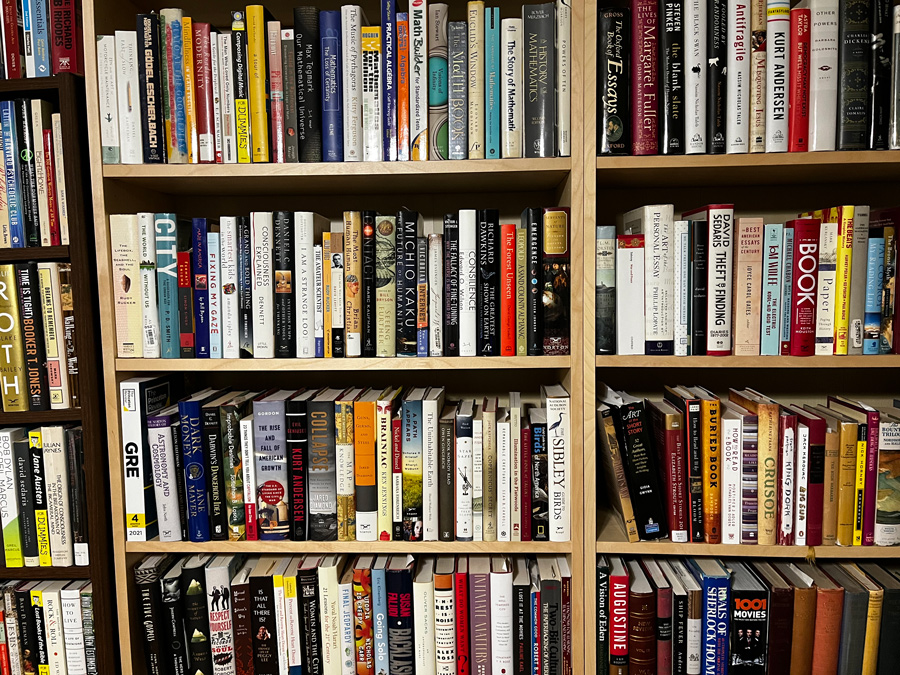
What I Learned Cataloging My Books, Ebooks, and Audiobooks on Goodreads

by James Wallace Harris, 3/21/23

I learned several things this week while entering over fifteen hundred books into my Goodreads database. The books I added were mainly acquired since I retired in 2013. One insight that impressed me the most was I was specializing in a limited number of topics. On one hand, I was disappointed by my narrow range of interests, but on the other hand, I was annoyed at myself for being scattered in my intellectual pursuits. You can’t get good at something if you try to get good at too many things.

If I judged my reading as a leisure activity it wouldn’t matter what I read. However, if I judged my reading as an education, then I was majoring in too many subjects. But here’s the kicker to this revelation. Before I started cataloging my books I assumed I was reading for fun and randomly exploring any subject that caught my fancy. It was only as I entered all the titles into the database did I realize that I have been specializing in several areas. And my immediate impulse was to read deeper into those topics and to go out and buy more books on those subjects.

Why was I chasing so many subjects when I’ve always wanted to be a master of one? Why would I want to do that? Yet, focusing on one would mean ignoring many things I want to know more about. That thought has started me to do a lot of naval gazing this week.

My original goal was to put all my books into my Goodreads database so I’ll know what I own to keep from buying duplicates when I’m at the used bookstore. So far I’ve found a shopping bag of duplicates which I gave to my buddy Mike. I entered all my books into Goodreads many years ago but didn’t update the database when I bought books or gave them away, so my Goodreads database was badly out of date. I had been putting this task off for years because I couldn’t figure out which books to add or delete from the system to catch up again.

My solution was to create a “shelf” called “2023 inventory” and reenter all my books linking them to that shelf. Then delete all the books in the system that wasn’t in the 2023 inventory.

After entering 1,506 books, which were all the physical books in the house, I had 3,159 total books in the database. That implied I could have given away 1,653 books, but then I realized that some of those might be Kindle or Audible books I own. Now I must go down the list of 3,159 books, and if they aren’t in the 2023 inventory, see if they are in my Kindle or Audible libraries. If they aren’t, I can delete them.

Doing all this librarian work has been rewarding in several ways. The work is revealing how my reading has shifted away from physical books to ebooks and audiobooks. This process has also revealed other insights about myself. For certain titles, and subjects I tend to buy both the audiobook and the ebook edition because that’s how I like to study them. And for some titles, I have the ebook, audiobook, and physical book. If I really like the book and subject, or if it’s fiction, and I really enjoy the story, I like getting into the book through all three formats.

I can spot my favorite authors because with some writers I’ve collected their books in all three formats. That also reflects a consolidation of interests, focus, and specialization.

When I used to go to parties I noticed that people tend to talk about things they loved most. The most interesting people were the ones who could expound deeply on a subject. Like most people, I just chatted about what little I knew about a zillion subjects.

I eventually observed that some people like to specialize and that some people even feel they are experts on their favorite subjects. It’s even fun to see two fans of the same subject argue over who knows more. I see from my data entry the subjects I’ve unintentionally tried to master. What’s funny is I seldom meet people interested in the subjects I’m interested in. Which is why I seldom talked much at parties. (This blog is my way of nattering about what I like.)

Thinking about people who know a lot about a little has led me to ask why I’d want to specialize in certain topics anyway? It’s not like I’m at a university trying to pass courses and get a major. I never go to parties anymore. I think it’s like my urge to catalog my books, which is a kind of anal pursuit, I also want to organize what I know.

There is a certain satisfaction in getting the biggest picture on the tiniest of topics. There is also satisfaction in collecting everything of a certain type. For example, I like westerns, so I collected my favorite western movies on DVDs. Then I started buying books about movie westerns. But after that, I started buying books about the history of the American West. I’ve done the same thing for classic rock and jazz music. While cataloging my books I realize I was gathering novels written in England between the wars, and books about their authors. That interest is also reflected in the TV shows I’m watching. Susan and I have recently watched all of Downton Abbey, Upstairs, Downstairs, and we’re currently going through the seven seasons of the first television version of All Creatures Great and Small.

The upshot of all these cataloging revelations is I want to focus more on my best subjects. And abandon some lesser interests to put more time into my majors. After I finish this project I could write my tombstone epitaph – “Here lies Jim Harris, this is what he liked to read:” I mean, isn’t what we focus on one of the best descriptions of our personality?

I only have nine bookcases. And they are all full. I don’t want to buy more bookcases. Nine’s my limit. I feel that’s also an analogy for my brain. It can only hold so much, so if I want to get better at one subject I have to forget about another.

If I want to buy more books I have to get rid of existing books to make room for the new ones on the shelves. This tends to distill my collection even further into specialized subjects. It also means I cull crappy books for better books.

But there is something else to consider. I’m getting older. I’m running out of time. My mental abilities are declining, which limits how much information I can process. And my physical abilities are declining, which also influences my book collecting. I can imagine a future where I can only handle six bookcases, or even three, and maybe down to just one.

I put every book I own onto a Rubbermaid rolling cart one shelf at a time to take them to my computer to enter their data. That physically wore me out. I’m thinking of getting rid of the heavy coffee table books in my collection just because in the near future I won’t be able to handle their weight. And there’s another reason I need to start shrinking my collection. If I should die I don’t want to burden my wife with having to get rid of a couple of tons of books. And if I ever need to move to a retirement apartment or assisted living I wouldn’t want to deal with all of them either.

This week of cataloging my books has reminded me of which subjects I’ve studied over the last forty years, which subjects are my favorite topics, and that I want to thin out my collection.

Currently, Goodreads says I have a total of 3,150 books but I haven’t finished entering all my Kindle and Audible books. Amazon says I have 1,608 Kindle books and 1,544 Audible titles, however, many are already in Goodreads. I’ve just got to figure out which ones aren’t. Luckily, Kindle and Audible books don’t weigh much, or take up much space.

I’ve always wanted to make a list of everything I own because I assume it would tell me a lot about myself. This Goodreads list is a good start toward that.

JWH
Unfocused Reading

by James Wallace Harris, 3/12/23

I love reading best when I’m reading a book that I hate to stop reading and always want to get back to when I’m not reading it. Back in December, I was obsessed with reading Elizabeth Strout’s books. I read seven of her nine novels, practically one right after another. That was delightful. I was in reading heaven.

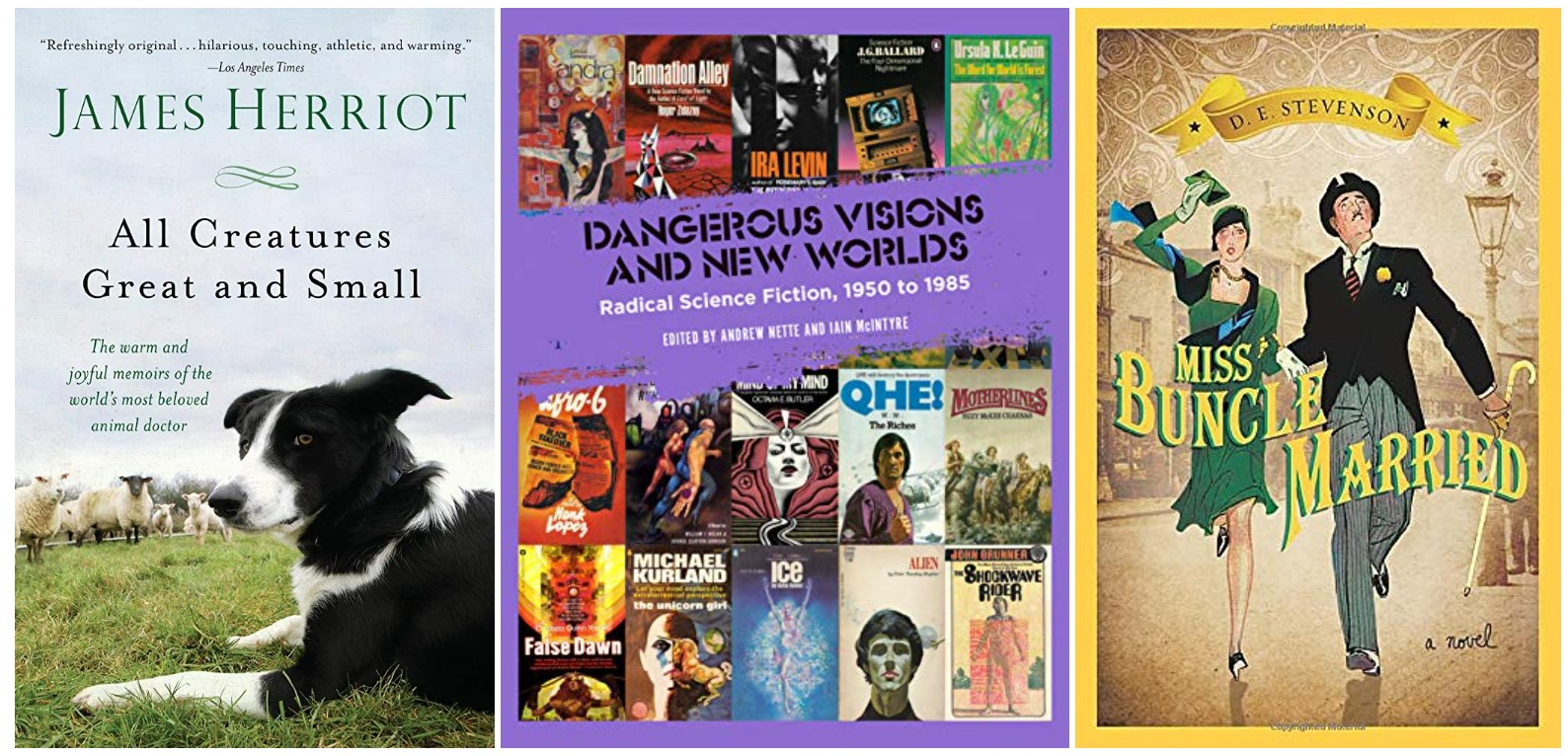
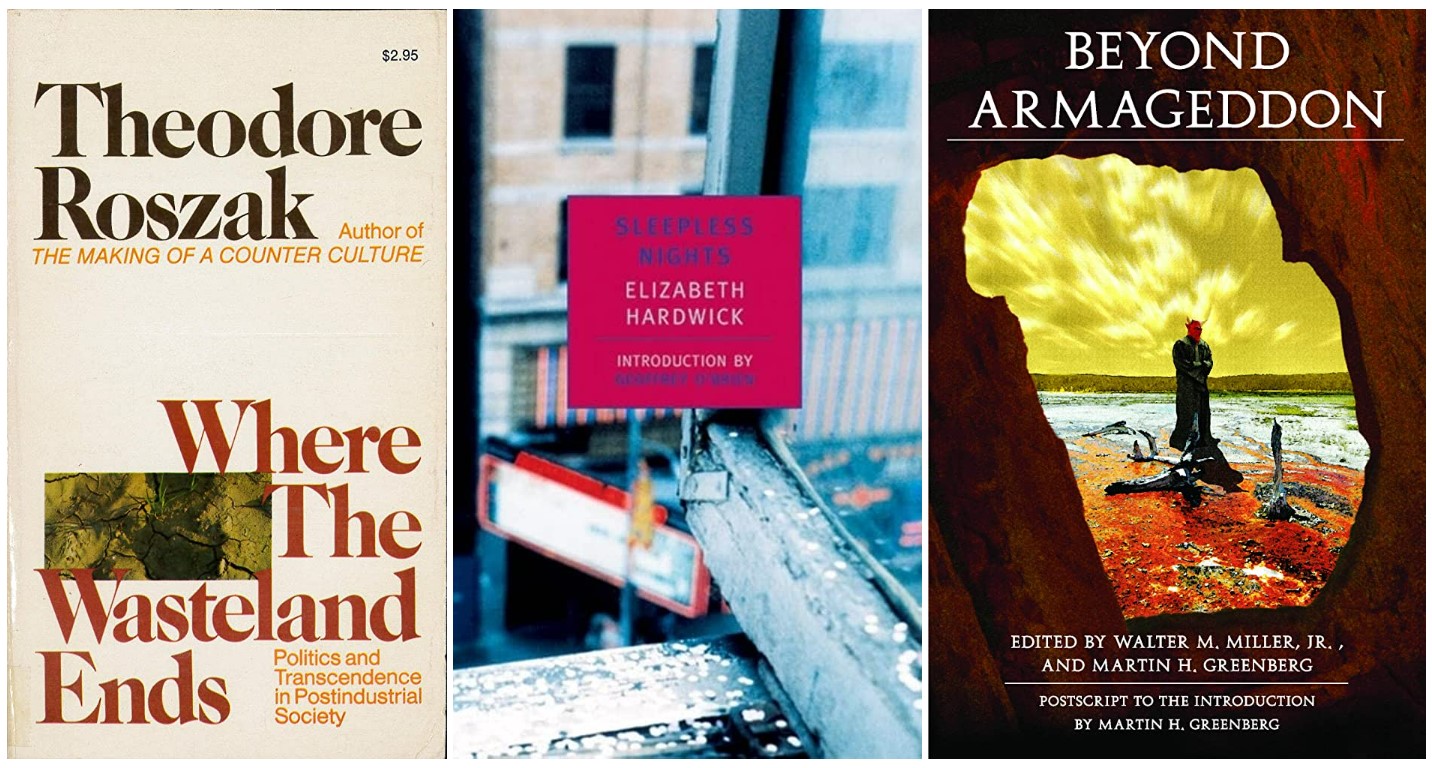
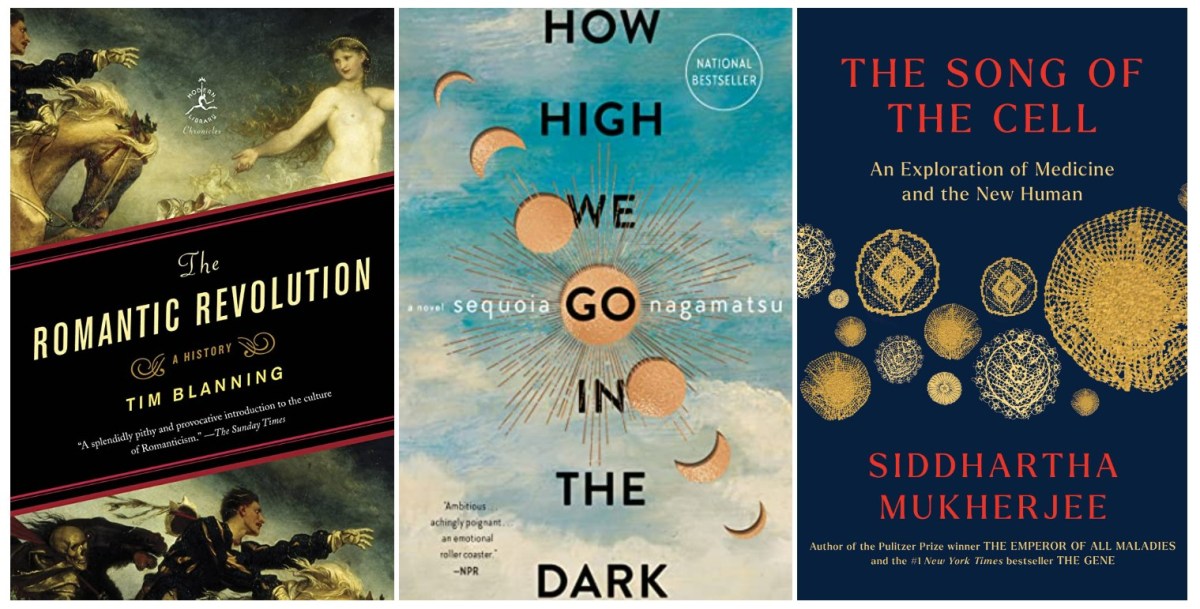
Right now my reading is terribly unfocused. I can’t stick with any book for long. Pictured on this page are all the books I’m currently reading — at least they are the ones that are currently up on my Kindle, Audible, Scribd, and Libby apps, and the books I see lying around. There’s probably more lying next to chairs, or under magazines.

Some of the books I’m reading are because I’m in an online book club for nonfiction books (Come Back in September, Song of the Cell). Or books related to what we read (Jena 1800, Sleepless Nights, The Romantic Revolution).

Others are because I’m in a Facebook group that reads anthologies (The Best of Nancy Kress, Beyond Armageddon, 21st Century Science Fiction). Others are because I’m interested in a particular subject, or they were recommended by a friend (The Good Lord Bird). (It’s great.)

I’m reading All Creatures Great and Small by James Harriot because Susan and I are watching the TV show of the same title. We finished the new series and are into the third season of the old series.

I’m reading Where The Wasteland Ends because I got interested in Romanticism in my online book club. I’m reading Miss Buncle Married because I loved Miss Buncle’s Book. I’m reading Neanderthals and The Great SF Stories 20 because I just love reading science fiction short stories.

I’m reading The Murder of the U.S.A. because I’m writing about the history of science fiction stories that deal with surviving a nuclear war, and it’s an early example of the subject. I’m reading Television’s Greatest Year: 1954 because I found it in a used bookstore and it looked interesting and is interesting. I’m reading Dangerous Visions and New Worlds because I like reading and writing about the history of science fiction. I’m reading How Hight We Go In The Dark because I try to keep up with current science fiction and it was considered one of the best SF novels last year.

I hope this illustrates how scattered my reading and thinking are at the moment. I’d much rather be focused on one subject and one book. When I was growing up and for many years of my working life, I mostly read one book at a time. I miss that simplicity, that focus.

When I joined Audible in 2002 I was on the 2 audiobooks a month plan, and I’d finish one audiobook and carefully study for days how I would use my second credit. Each book was special.

Then Audible started having sales, and now I have hundreds of audiobooks in my TBL to pile. And with all the Kindle books on sale, and all the wonderful buys I find at the Friends of the Library bookstore, I have a couple thousand books on my TBR pile. Life was simpler when I could only afford to buy one book at a time. I just can’t resist a book I think I want to read if it’s priced very low. And I subscribe to Scribd, Kindle Unlimited, and Apple News+ which provide access to hundreds of magazines and countless books and audiobooks. I have too much of a good thing. Less might be a whole lot more.

The book covers shown on this page are only the books I’m trying to read this week. It doesn’t include the books I’m buying or the books I recently gave up trying to read or finished.

I think between all the zillions of albums I can listen to on Spotify, all the zillions of movies and TV shows I can stream, and all the zillions of books, audiobooks, and magazines I could read my mind is running in seven directions at once trying to consume everything. It’s wearing me out.

I hanker for a simpler reading, listening, and watching life. One that is more focused. I think it’s time to cancel some subscriptions and give up buying bargains. I don’t know if I can ever get back to reading just one book at a time, but it should get it down too much less than 21 at a time.

[There is a certain synergy between this essay and the one I just wrote for my science fiction blog, “10 Reasons How I’m Reevaluating My Interest in Science Fiction.”)

JWH

Visualizing My Discontent

by James Wallace Harris, 2/28/23

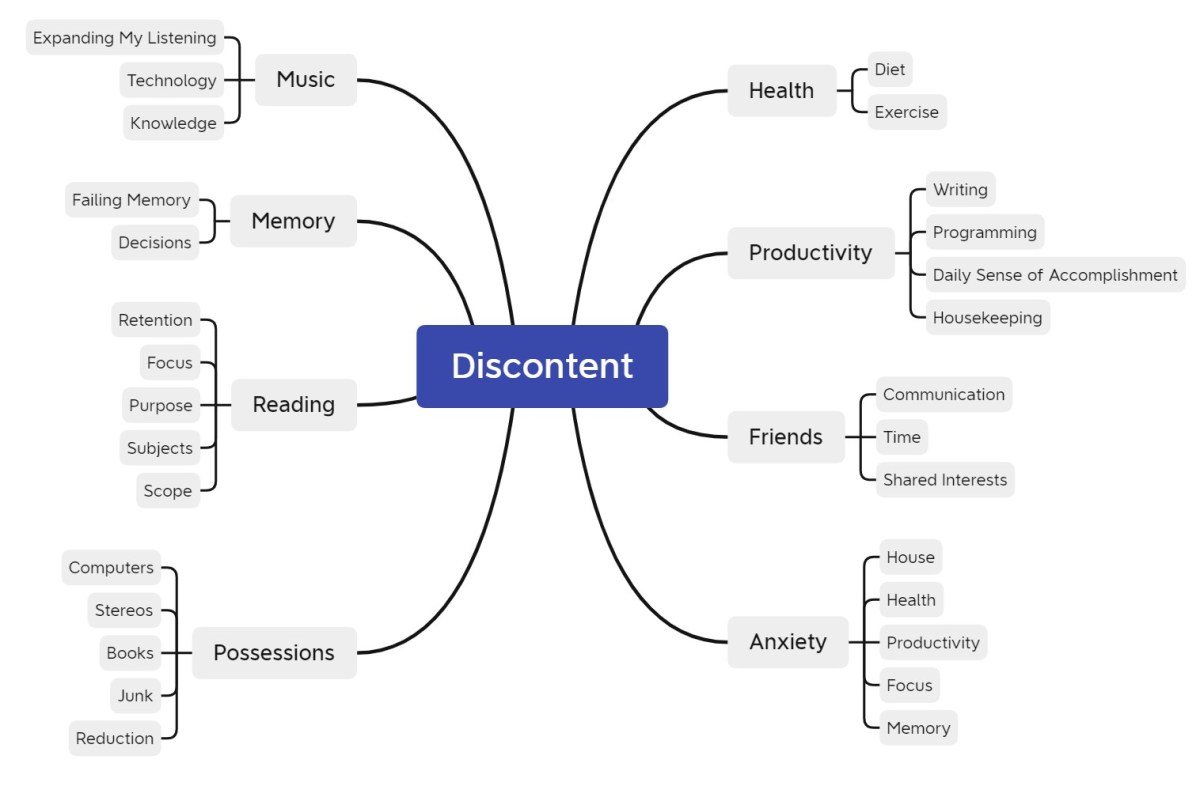
Yesterday I watched a YouTube video about writing morning pages. The idea is to get up and hand-write three pages of stream-of-conscious thoughts. So, I tried it this morning and I realized I have a number of things that make me discontent. And one of the things that make me dissatisfied with my life is not being able to see the big picture of what’s going on with myself. This brings me to this blog. I went to Xmind and created a quick mind map of my discontents hoping to see an overview of what was gnawing at me. You can see the results above.

The seed of discontent that inspired all of this comes from the way I feel each night before I go to bed — about how I spent my day. If I did something that felt productive, I feel satisfied with my day. If I didn’t I feel restless. I like when I have an ongoing project that inspires me to get up and get back to working on it. I haven’t had one of those in a while. My next level of satisfaction comes when I write a blog that I’ve put some good work into creating.

Of course, everything depends on health. Over the past few years, I’ve had to deal with a number of health issues. The walls of my life, my aquarium you might say, are the limitations of my health. When I was younger, that aquarium felt like the ocean itself, but as I grew older it shrank. As an adult, I began to realize my limitations, but the possibilities still felt huge, like I was living in the Atlanta aquarium. In my fifties, it felt more like a fancy 50-gallon deluxe home aquarium. In my sixties an ordinary 20-gallon job. Now when I feel bad it feels like I’m living in one of those bowls people keep goldfish in. When I’m feeling better, I’m back in a basic 10-gallon tank. My health goal is to do as much as I can within the boundaries set by my body. That means a lot of my daily anxiety deals with staying healthy. If I can maintain a certain level of health I feel like it minimizes my discontent. And the more I do, the less discontent I feel.

However, staying healthy juggles so many goddamn variables that it’s stressful to think about what to do to stay healthy. For instance, I watched a video, “7 Foods That Ruin Your Liver” this morning — two of which are among the top ingredients of the protein supplements I eat. Since I have a fatty liver, and sometimes have pains in my liver area, this is another worry. I also have a cyst on my liver. And I have gallstones. Eating carefully has become a very big deal for me.

Luckily, my health problems don’t cause me much discontent, or even anxiety. I’m used to dealing with them. My discontent comes from worrying over what to eat and how to exercise. I want to eat what I like and dislike making myself exercise. What would eliminate that anxiety would be finding a diet that I just stick with all the time, and finding a way to integrate just enough exercise to the minimum needed. Both really come down to discipline, but discipline is a major area of discontent for me.

I’ve been lucky lately, and have been feeling better. Last year wasn’t so good because of health problems and a hernia operation. Because I’m feeling better I feel like I should be doing more. Because I’m not doing more I’m feeling restless and discontent. That’s what came out in my morning pages.

Reducing that discontent and getting back on track will require finding a project to work on. I want something that will take me several days or weeks. Something that will make me feel like getting out of bed in the morning. The one I’ve picked to start on, but I don’t know if I’ll stick with, involves creating a new way to learn, memorize, and visualize a subject. My memory is deteriorating, but it’s never been very good for studying a subject deeply. I read nonfiction books and news articles all the time. But that information goes in and out of my brain almost instantly.

I recently read and reviewed a book about the German romantics. Supposedly, they found a lot of insights that have trickled down to us today. I want to create some kind of visual representation of their ideas and how they connected to other influential people over the last two hundred years. I figure this will kill several birds with one stone. It will touch on four branches of the mind map above: memory, reading, productivity, and anxiety. It might even touch on possessions because I will enjoy using more of my computer equipment, and it might touch on friends because it will give me something to talk about with them.

What I want to do is develop a way to visualize what I read to help me remember the information and convey what I’ve learned to other people.

All of this was inspired by scribbling out three handwritten pages this morning when I got up. Watch the video above, you might find it useful too.

By the way, the level of discontent I feel right now isn’t very high. I have a very contented personality. I find it very easy to just hang out and putter around in life. My greatest discontent has always been not being more ambitious. All I’m doing now is pushing myself to do just a little more.

JWH

Famous Group Friendships

by James Wallace Harris, 2/23/23

The TV show Friends was a huge success for many reasons. However, there is one important reason few people mention that I want to reference for this book review. Group friendships don’t happen often in our lives and they usually don’t last long — yet they are often the ones we miss most when they are gone. Group friendships are usually created for us, by the classroom, churches, sports teams, the military, the office, arts and crafts groups, or hobby clubs. I fondly remember several such friendships and miss them. I even dream about them.

Magnificent Rebels by Andrea Wulf and Jena 1800 by Peter Neumann are about a very special group of friends. Friends who made history. Friends who inspired how we think today. Because they were German and their relationships happened over two hundred years most people won’t know their names. However, those friends influenced people who became famous in the English-speaking world. We remember those friends as the founders of Romanticism. Interestingly, both Magnificent Rebels and Jena 1800 came out in 2022. Magnificent Rebels is longer, and the story is told more like a novel, and Jena 1800 is shorter but focuses more on the concepts, but both tell about the same people. I recommend reading Magnificent Rebels first to see if you like the people, and if you do, you’ll probably want to read Jena 1800.

As a kind of warning I must ask, do you really want to read a book about a bunch of Germans from the 18th century with hard-to-pronounce names? Names that are hard to remember because so many of them began with the letters Sch – Schlegel, Schelling, and Schiller. And there were too many damn Friedrichs. I admit this made the book hard to read but it was worth the effort.

Here’s the thing, I knew practically nothing about these people. I’ve heard of Goethe and Hagel, but haven’t read anything by them. The reason why I read Magnificent Rebels is that I read Andrea Wulf’s book The Invention of Nature: Alexander von Humbolt’s New World and was completely blown away. And I don’t even remember hearing or reading about Alexander von Humbolt before. Wulf opened up a whole new historical territory for me to explore.

For most of my life, I’ve read and studied English literature and science from the perspective of English history. I’ve read very few European novels and haven’t studied their history and culture. I knew about the English Romantics (Wordsworth, Coleridge, Byron, Shelley, Keats), but I didn’t know or had forgotten, they were inspired by the German Romantics. Being introduced to this new knowledge was the first reason I enjoyed Magnificent Rebels.

But the second reason, and by far the more important reason, is I love reading about counter-culture friendship groups that spark a revolution. If you enjoy reading about the Beats, the Lost Generation, the Bloomsbury Group, the Transcendentalists, the Futurians, Ken Kesey and the Merry Pranksters, or even the personal computer pioneers of the 1970s, then adding the German Romantics should be a pleasure.

Both books focus on the German romantics that lived in Jena which is in Germany. But their homeland wasn’t modern Germany. The books mainly cover 1796-1803, after the French Revolution and during the Napoleonic Wars when Europe was in upheaval. At one point in this story, Jena is occupied by Napoleon’s army who sacked the city taking any food, valuables, and wood.

I admire books about a group of people who do something so exciting that biographies are written about the group and the individuals. Magnificent Rebels makes me want to read more books about the German Romantics, but also books by and about all the individuals involved. Here’s a scorecard for the main personalities in the book, and the ones I’d want to study more. There were many other people mentioned in Magnificent Rebels.

The first block list the young people that had all the love affairs. The next block is Geothe and Schiller who were best friends and mentors to the German Romantics. They were older and represented the previous generation. The final group was the philosophers and scientists who were friends of the first group, but who were also successful in other fields.

Caroline Schlegel and Wilhelm Schlegel were married but had a best-friends kind of arrangement. Wilhelm accepted Caroline’s love affair with Fredrich Schelling. Friedrich Schlegel was lovers with Dorothea Veit, who was married. That affair was far less accepted.

To me, both Caroline and Dorothea are the most interesting people in Magnificent Rebels. In a way, because they were women, they had the most to rebel against.

The German Romantics remind me of the 1960s counter-culture. The German Romantics weren’t exactly the hippies of the 1790s, but there are comparisons. They were rebellious, flouting sexual conventions, and excited about everything new. For a while they did everything together, reading poetry, going to plays and concerts, discussing philosophy, attending literary salons, hiking in nature, and defying what was expected of them. They almost had a little commune. The men taught at the university in Jena and promoted new ideas that attracted students from all over Europe. But the women were thinkers and writers in their own right.

However, like with the student revolutionaries of the 1960s, things fell apart, often because of egos. It’s hard for two people to maintain a friendship, and group dynamics are infinitely harder to maintain. When the Jena set broke up, it felt like the Beatles breaking up. What we think of as The Sixties was really only from 1964-1969. The Sixties really began with The Beatles arriving in America in February 1964 and ending with Altamont in December 1969. These two books about Jena cover a similarly short period.

Magnificent Rebels and Jena 1800 both try to capture a certain era of exciting social transformation that happened in a small town with a few colorful people seeding changes that spread across the world. I also compare them with the Beat Movement of the 1950s.

JWH

How To Play Shanghai Rummy

by James Wallace Harris, 2/11/23

[Over the past two years over 37,600 people have visited this page. Evidently, I am not the only one who fondly remembers a card game they learned decades ago and wants to play again.]

We recently decided to play Shanghai when my sister came to visit. It’s a card game I first learned back in the 1960s. However, we couldn’t remember the exact rules so I looked them up on the internet. Several sites gave slightly different rules and they called the game Shanghai Rummy. As we played the game trying out different rules I decided to consolidate on one set of rules. I made a crib sheet to help remember the requirements of each hand (see below). My goal was to blend how we used to play with the rules published on the internet to maximize the fun and challenge of the game.

Each hand or round requires a different combination of cards to make a meld, and I noticed that the complexity of each combination was related to the number of cards required to complete the meld. The game gets harder with each new hand. I settled on the sequence of 10 hands (rounds) based on the rules at Wikipedia and Bar Games 101.

But our family had one last hand that I’m adding as a bonus round. It requires 17 cards to make the meld. With 11 cards dealt, and 6 cards acquired in three buys. This requires making a perfect hand, meaning you go out on all the other players before they can meld. It’s very hard but lots of fun. Because that hand required 17 cards to meld, I thought there should be a 16-card meld, so I created another bonus round. I just liked the symmetry of 12 hands of increasing complexity going from 6 cards in the meld to 17.

Here are the sites I consulted:

Players: 3-5 with 2 decks, 6-8 with 3 decks.

The Deal: 9-11 cards depending on the round. It can always be 11, but fewer card in the early rounds speeds up the whole game.

The Draw Deck: The undealt cards face down.

The Discard Pile: Start by flipping over the top card of the draw deck.

Melds: Composed of a combination of Sets/Books and Runs. A set/book is cards of the same value. Usually, it’s 3 cards. A run is a sequence of cards of the same suit. Usually, it’s 4 cards. Aces can be low or high. Jokers are wildcards. We called sets books when I was growing up, so our family uses the word book, but the internet has settled on set.

Buys: 0 to 3 depending on the round. A buy is a way to acquire cards out-of-turn. See below. Buying is very strategic to the game. Buying cards helps and hurts because they add two cards to your hand in a game where you are trying to get rid of cards. We always played by allowing 3 buys for every hand but limiting the buys in the early rounds makes the round more challenging and speeds up that hand. Be careful buying cards you don’t need, but sometimes strategy requires making a buy to get extra cards to have a discard.

Gameplay: Turns go clockwise. A player draws one card, either from the deck or the discard pile. They must discard one card. Before the next player takes a card, the other players have an opportunity to buy the discard. They must also take one card from the deck. This adds two cards to their hand, and they don’t discard a card while buying. After the buy, the gameplay returns to normal.

The goal is to gather the required meld and lay down. Then get rid of all the other cards in your hand. Generally, the first person to lay down will have extra cards and the gameplay will continue. As other players make their meld and lay down their cards, they can play their extra cards on any sets and runs currently on the table – but only before they discard. Players who have made their meld can lay down on melds only during their turn. Players who haven’t made their meld can’t play on the melds that have been laid down. Each meld can be from Ace to Ace only. Cards cannot be swapped in melds.

Players can not make more than the required number of sets and runs. However, you can make larger sets and runs. So instead of a 3-card set of 3 queens, you could have 5 queens. Or a run of 2-3-4-5-6-7 of the same suit.

Strategy: It’s easy to order your cards and know what you need for the rounds where you only make sets or runs. Rounds, where you make up both sets and runs, are very challenging. How you organize your hand and which cards you seek requires various strategies. How often you buy and when becomes strategic. Sometimes it’s fun to hold your cards until you can lay them all down going out on the other players.

Going Out: The player that can lay down all their cards and have an unplayable discard wins the hand. This rule varies. Some Shanghai rules say going out is when you have no discard. If this method is chosen, the bonus round won’t be perfect and others can still play. Decide ahead of time on which method of going out you prefer. We like requiring a discard.

All other players must add up the values of the cards in their hand and the total is added to their running score. The player with the lowest score wins the game.

Card Values: 2s through 9s = 5 points. 10s through Kings = 10 points. Aces = 15 points. Jokers = 20 points. Other scoring variations include numbered cards = 5, face cards = 10, aces = 20, and jokers = 50. That’s how we scored growing up, but it makes for some brutally large penalties.

Standard Game. To the best of my memory, this is how we used to play the game. To make the game slightly quicker to play nowadays we leave off the two easiest hands.

Expanded Game. I decided to expand the game so each round requires one more card in the meld. To be honest, none of my friends like to play this because it takes too long and it’s too hard to remember.

Speeding Up the Game: Playing all the hands listed can take 2-3 hours. You can speed up a game by skipping certain hands, especially the first two and the bonus rounds. However, the most complex hands are the most fun.

I have many fond memories of playing Shanghai growing up. Whenever our family visited my Aunt Let in Mississippi in the 1960s, we’d play Shanghai. After we grew up, my sister and I would play Shanghai with our cousins, Sonny and Eleanor, who often played it nightly with their kids, and visitors.

Shanghai is a great card game because it’s not just the luck of waiting for a specific card. Various strategies can be used. You try to arrange your hand so that drawing several different cards will improve your odds of winning.

In all my years of playing Shangai, I have only run into one other person that said their family played this game. If you’ve played Shanghai leave a comment. And if you have any problems with the rules or understanding the rules leave a comment. I hope they are clear and precise.

JWH