Understanding Reality

Think about cockroaches.  How much do they know about reality?  They have compound eyes that see the world poorly.  They can sense vibration, and they have a sense of touch.  Do they smell and taste the world around them?  I don’t know.  Cockroaches are little biological machines that eat and replicate.  They survive.  Between roaches and humans is an array of animal life with ever improving senses that understand more of reality.  To get some idea how an animal thinks watch “My Life as a Turkey.”  Humans do not have an exclusive hold on consciousness, but our consciousness lets us explore reality far deeper than any other creature we know.

I tend to doubt animals understand their environment in a conscious way.  They react to it, and even develop rudimentary calls that can be language-like that can relate to others of their kind about locations, events or things in their environment.  But I don’t think they ever ask:  who, what, where, when, how and why?  Maybe some higher forms of animals might pine for who, what and where, but I doubt they cognitively ask.

I believe we have a number of cognitive tools that help us analyze, map and understand reality.

Language

Words let us break down reality into parts.  Grammar lets us describe actions with nouns and verbs.  The origin of language let us work with who, what, where and when.

Theology

Theology introduces abstractions that attempt to answer how.  Theology was our first tool that lets us ask why are we here.  Unfortunately, theology is all based on imaginary concepts.  Theology distorts reality.  Theology lets us think we see things that aren’t there.  Theology has imprisoned humans for tens of thousands of years in a pseudo-reality.

Philosophy

Philosophy introduced rhetoric and logic and attempts to understand reality through deduction.  Sadly, philosophy was tainted by religion and sought to reconcile reality with ideal forms of the mind.  It took philosophy centuries to throw off trying to make reality shoehorn into a preconceived concept.

Mathematics

We started counting with language and commerce, but mathematics came into its own with philosophy.  At first mathematics was used in philosophical interpretations of abstractions and ideal forms, but eventually we applied it to analyzing reality.  It became our first tool where consensus and validation was important.

Science

Science is a system for testing reality.  Answers only count if they are consistent, reproducible and universal.  Mathematics became the cognitive tool of science.

Technology

Technology allowed us to expand our senses.  Telescopes and microscopes see further than our eyes.  Other technology allowed us to look into the reality where our senses can’t perceive.

The first three cognitive tools we developed, language, theology and philosophy often distort reality, or create illusions and fantasies.  Most humans never get beyond those three tools and even though they perceive reality far greater than a cockroach because of their superior senses, language, theology and philosophy often just confuses their minds.  Our brains are so powerful that they let us see what we want to see.  Our minds can override our senses and alter reality.  Theology has always been more powerful than any drug, especially combined with the power of our imagination.

The Limits of the Mind

Math, science and technology have expanded our awareness of reality out to infinity in all directions, including time.  How much of this reality humans can comprehend is yet to be determine.  Most humans on planet Earth cannot get beyond theology which blinds them from seeing true reality.  Most religions have incorporated bits of philosophy to make their religion logical and understandable by rhetoric, but its foundation is based on illusion and quicksand.  In recent years theology has even attempted to incorporate science but its been a pathetic failure.  Those people whose only cognitive tool for understanding reality is theology cannot comprehend how science works, if they did, it would destroy their theology.

There are many other tools for understanding reality, such as art, literature, history, journalism, poetry, drama, etc.  They are all subjective, but they have their pros and cons.

JWH – 3/6/12

Waiting for Linux

In the early 1990s my friend Mike bought a copy of Minix that promised to be a home version of UNIX.  At the time I was into GENIE, CompuServe, Prodigy and BBS systems.  I even ran my own 2-line bulletin board.  I liked the promise of UNIX and how it networked.  Luckily I worked at a university and also had access to USENET and FTP.  This was before the web.  I eventually found my way to a USENET group that talked about Linux, and it was free.  At the time I was hesitant to spend $69 for Minix, so Linux intrigued me.  However, the instructions for getting the code, making the install discs, and installing Linux were daunting.  I’ve forgotten all the details, but it involved a DOS program for making the floppies, and I had to make a bunch of floppies.  This might have been Slackware, but I don’t remember.  It was a long way from Ubuntu 12.04.

ubuntu

After much work with FTPed files,  I finally got Linux going on an old machine, but I was frustrated that it wouldn’t do any of the things I normally did with a computer at the time.  It was neat, but Linux wasn’t ready to be my computer OS.  After that I’d try Linux again and again, as it evolved, hoping it would become something I’d want to use as my full time computer system.  I remember I was so excited when I got Yggrasil and I could install Linux from a CD.  I could install it from the CD, but I couldn’t mount the CD afterwards.  This was before standard IDE drives and each CD device had its own drivers.  I can remember being so happy the first time I finally got Linux to mount a CD.

Then came Redhat and things got much easier.  Over the years Linux distributions got so easy to install that it was almost nothing to throw Linux on a computer, but I always took it off almost as fast.  After Windows 95 came out, and then Windows 98, using Microsoft got addictive and standard.  I got used to all the popular programs and games and it was just painful to try and switch to Linux.

And why did I want to switch?  The whole open source programming movement was so appealing.  The idea of free and DIY made so much sense.  I thought Linux would catch on and everyone would eventually make it their OS of choice.  But that never happened.  Linux has become a standard for servers and supercomputers, but for desktops it’s never been able to compete with Windows and Macs because they have so much commercial software that’s a breeze to install and use.  It’s a breeze now to install Linux, but adding other programs, especially those not prepackaged for a specific distribution, can still be a major headache.

I could switch to Ubuntu or Mint today and do most of what I like to do on a computer, but with programs that are clunky compared to the slick ones I use on my Windows 7 machine.  If I was truly tempted to switch operating systems it would be to Macintosh OS X, but even OS X is a pain to use after being addicted to Windows all these years.

I’ve been waiting for a long time for the Linux desktop to surpass Windows, and KDE and Gnome have come a long way, but desktop Linux just never catches up.  Most of the people reading my blog will not even know what I’m talking about because Linux is so esoteric.  Over the years I’ve talked a few people into trying Linux.  Linux is great for people who only use Firefox or Chrome to do everything they do on a computer.  But I still like Word, Photoshop, Audible Manager, iTunes, Rhapsody, Spotify, Webshots, and many other Windows based programs.  But even if I was totally cloud based in all my apps, I just prefer Chrome on Windows much more than Linux or the Macintosh.

I recently install Kubuntu on my home Linux box so I could play with Amarok on Linux, but I quickly grew disappointed with it.  I loved how Amarok will find lyrics to display as it plays songs, and the program is rather nice overall, but it feels years behind other programs on Windows 7 and Lion.  Spotify also does lyrics now, and they scroll as the songs plays, and the lyric being sung is highlighted.   Spotify is blazingly fast, Amarok is not.

I keep waiting for Linux, like waiting for Godot.  Linux is always on the horizon, close but far.  For awhile Windows XP was having so many problems that I thought I jump over to Linux, but then XP shot ahead and became reasonable stable.  Then Windows 7 came out, and I even prefer it over OS X.  I’m not sure about Windows 8, but I’ll probably get hooked on it too.  Ubuntu is trying hard to leap ahead, to catch up, but by the time it gets where it’s going, Windows and Mac OS X have shot ahead again.

I want Linux to be my desktop operating system because the Linux philosophy is just so much cooler than the commercial alternatives, but I’m hooked on their crack and I just can’t give it up.

It’s sad to admit, but I’m tired of waiting.  Actually, I’m tired of thinking about computer operating systems.  I started using computers in 1971, and I’ve been waiting over forty years for the future to arrive when computers would do everything, and I’d live with the perfect human/machine interface.  I’m tempted to say Windows 7 is it, and I plan to go no further.  I remember working with a guy who retired and bought a computer with latest WordStar and DOS who told me that system would have to last him the rest of his life.  I wonder if he lived long enough to eat those words?

Computers have been the most fascinating invention in my lifetime, and I have put a lot of my life into learning them, but I think I have reached a point where I don’t want to care about them anymore, not as a hobby or topic of interest.  I just want to use them.  I want computers to be invisible and all I see if my work.  I want the Wizard of Oz to stay unseen behind the curtain.  Linux still demands too much working under the hood, getting grease on my hands, and requiring a toolbox of tools to keep things running.  Windows 8 promises to be the operating system so mundane that it’s transparent.

I guess I’m ready for computers to just be magic rather than advanced technology.

The sad thing is technology changes too fast.  What I learned about the IBM 360 forty years ago is all forgotten now, and there’s a long line of other machines and operating systems that came after it that I’ve forgotten too.  I can’t remember how many programming languages and operating systems I’ve forgotten.  Computer technology has been dazzling, mesmerizing, diverting, but what was it all for?  I used to be able to use a slide rule as quick as some people could use a calculator, but that skill is gone too.  Technology knowledge isn’t like scientific knowledge, or history or mathematics.  It’s not cumulative.  Gadgets just keep changing.

I think computers have become good enough that computer literacy is no longer required.  They aren’t idiot proof yet, but they are getting there.  At one time I thought desktop Linux would be the winner, but I think the race is over and Linux never made it to the finish line for the personal desktop OS.  I also believe, sometime in the near future we’ll buy computers and we won’t even care what operating system is on them, or what version.   We probably won’t even think of them as computers.

JWH – 3/4/12

Windows 8 Consumer Preview–Initial Impressions

I had no trouble getting the Windows 8 Consumer Preview on the first day.  I did an in-place upgrade that quickly installed on my i3 test machine.  Booting up into Metro was like falling into a rabbit hole, or playing a new video game, because I had to click here and there just to find all the new menus.  I’m a computer support person, and I know Metro is going to shock my users.  Metro is obviously designed for tablet users.  One of Metro’s app panes is the desktop – which is great for people wanting to escape Wonderland quickly and get back to the real world.

I stayed in Metro and was sliding through its screens and installing apps almost immediately.  Cutting the Rope was a more fun using a mouse, and reading USA Today was easier to deal with on a big screen using a mouse, which goes to show you that poking the screen with a finger might not be the ultimate human computer interface.

I often wish when using my iPad 2 that my apps were on my big monitor, especially Zite.  I use my iPad 2 because I love Zite, Words with Friends and Kindle for the iPad.  And it’s only the Kindle app that I want to use away from the desk.  And even then, my iPad 2 is so dang heavy that it’s a hassle to use.  I have to prop it up with pillows to get comfortable.

I love my iPad 2 and Kindle 3, but to be honest, I’m perfectly adapted to sitting at a desk using a computer with a mouse and 23” monitor with 1920 x 1080 resolution when interacting with programs.  Passive reading is different.  But back to Windows 8, using Metro is like using a big tablet at my desk, and that’s fun.  I wish it had Zite.

I hate that Windows, Mac OS X and Linux are all moving away from the desktop UI that I’ve grown to love so dearly.  Using Metro means living with a different UI.  People will get use to it, but it’s going to be a big move.

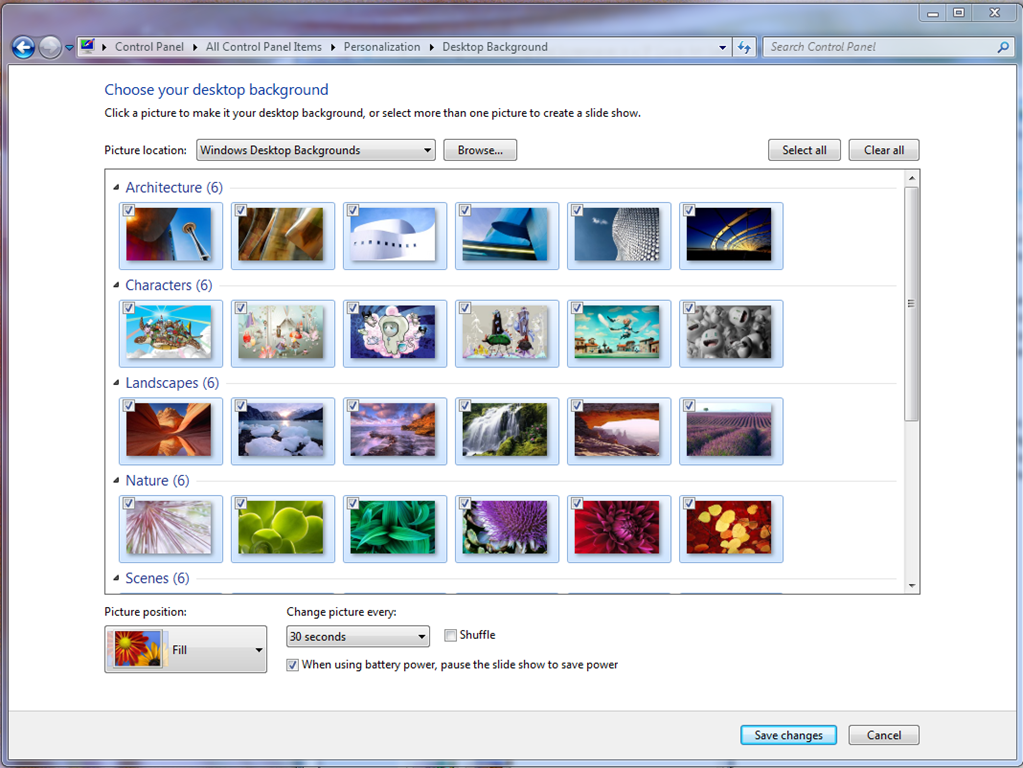
I hate icons on the desktop.  I consider my desktop my picture gallery.  Beautiful photographs from Webshots sooth me all day long at work and all evening long at home.  I want 100% of my screen for art and photos, and that’s possible with Windows 7.  All the new OSes for Windows, Macs and Linux want to clutter up the UI with widgets, and that annoys me.  Luckily Windows 8 lets me drop back into the old UI where I can hide all the icons and make the taskbar auto-hide.

I worry that Windows (and all computers) will evolve away from that classic desktop metaphor.  I remember the world of DOS, and the text based interface, so I know the world of computers can go through major paradigm shifts.  If feel that about to happen again, and I’m already nostalgic for the old user interface.

Windows 8 isn’t Windows 7 even when it looks like Windows 7.  I couldn’t even find the shut down menu.  The old view is there for now, but it’s been altered.

To be honest, I’m not giving Windows 8 a proper test drive because I don’t have a touch screen monitor.  Using the mouse, I have to fumble around trying to figure out what would probably be natural gestures if I was using my fingers on a multi-touch display.  It took me awhile to learn that moving the mouse to the corners brought up the “Charms” – translucent menu options.  The elegance of Windows 8 won’t truly reveal itself until I see it on a tablet or a touchscreen monitor.

Windows 8 comes with apps, like tablet and smartphone apps, and not applications, like in the old days of software programs.  Windows 8 also has an App Store, where it’s easy to find more apps to add to Metro.

Metro is a very busy user interface to me, but it works with its own logic, like iOS, but unlike iOS, apps can interact, making Metro more like a multi-tasking desktop OS.  Metro is a new look and I’m sure I’ll get used to it, but it is jarring.   I have Windows 8 Consumer Preview set up on test machine at work, so I’ll be learning it hit and miss when I get some extra time.  Whether or not I recommend we roll it out in the future is yet to be determine.  My users are very conservative.  Many found moving from XP to Windows 7 upsetting, but Windows 7 has won everyone over.  However, in the past year more professors have been wanting Macs because they have iPhones and iPads.  I’ve yet to have a user bring me a Windows Phone to set up.  Microsoft needs to get Windows 8 tablets out there as soon as possible, or the shift between Windows 7 will be to Mountain Lion instead of Windows 8.

Microsoft Office

I installed Microsoft Office 2010 but since there is no Start Menu with All Programs I couldn’t find the Office apps.  I switched back to Metro and found them as small square panes, and rather ugly ones at that.  I’m surprised Microsoft didn’t make eye candy versions of its flagship products.  When I launched Word, I saw  the desktop background for a second and then a full-screen view of the standard Word app ready for me to start typing – all very normal.  If you minimize the window, you’ll see you’re back in the desktop mode.

User Interface

Strangely, Windows seems to be moving away from windows, and dialog boxes, and other standard interface pop-ups.  Windows 8 tries to stay in full screen mode for each app.  Overall, this feels like Microsoft is trying to simplify all actions to their basic nature.  I imagined their engineers asking at every step, “Do we need this?”  And second guessing them, I think most of the time the answer was “No!”

Windows introduced the vertical and  horizontal scrolling windows.  Windows 8 is trying to simplify the desktop by doing away with overlapping windows and using sliding panes, or screen swapping techniques.  Their engineers have been paying attention to the minimal UI of smart phones and tablets.

Impressions

For the average experienced Windows user switching to Windows 8 will take a little time, but not much.  I’m sure, hidden away will be a lot of new subtle features that will take time to discover.  So far I have found no compelling feature to make me want to switch.  Windows 7 is so good that I prefer it over Mac Lion and Ubuntu machines I have at work.  I now have 4 major OSes to use in my office.  I’ll see how Windows 8 grows on me.

– – –

For more of the nitty-gritty details see this article at Computerworld.

David Pogue raves about Windows 8.

JWH – 2/29/12

How to Debate a Conservative?

My neighbor has a son I discuss politics with from time to time.  He’s conservative and I’m liberal.  He’s anxious for Obama to leave, I’m anxious for him to stay.  My friend, who is my age, is good guy and he doesn’t push his agenda and I try not to push mine.  Conservatives are mighty arguers, and debating them can be difficult because conservatives are often as passionate about their politics as they are about their faith.  One problem with debating conservatives is they often feel the solution to the issue at hand is all too obvious and the facts are all on their side.  And that’s the first quandary with debating conservatives – liberals have to argue against the status quo.  We’re fighting an uphill assault against a well entrenched position.

Today my friend claimed Obama was making a huge political mistake by not siding with the proposed Keystone XL Pipeline.  To ordinary folk, the pipeline sounds like a no-brainer.  It promises jobs for Americans and more oil for America’s long term security, and during an election year where gasoline prices are climbing daily and politicians want to get every vote they can get, it would appear insane for Obama to reject the pipeline.  Why wouldn’t liberals want more jobs?  Why wouldn’t liberals want cheaper gasoline and securer oil supplies?

Obama recent decision to reject the current claim puts the decision off, probably until after the election.  Obama claims he wants a better environmental impact report.

If you aren’t familiar with the Keystone pipeline controversy you’ll need to do some background reading because I don’t want to summarize what is already so well-written elsewhere.

Keystone-pipeline-map-KWD2

I think it’s pretty easy to restate the conservative position.  The pipeline means jobs during times of high unemployment.  The pipeline will be another source of oil that doesn’t come from the Middle East, promising more security against future oil shortages.  It offers hope for lower gasoline prices.  It could be a great economic stimulus, especially for the state of Texas.  Finally, it’s a way to help our friends the Canadians.

How can liberals argue against all of those benefits?  We already have zillions of pipelines crisscrossing the country, why not another one?

If you read the articles you’ll see there are many people fighting the pipeline.  Why?  I don’t mean their specific reasons, but why are some people for something and other people against?  Any project benefits some people and hurts others.  It’s always that way.  A hot issue like the Keystone XL Pipeline is political.  The prime motivation for any big scheme is to make some people wealthy.  There’s nothing wrong with that.  The Canadian company and its American allies are trying to put over a big project and they are doing everything they can to convince America its in their best interests to let them go ahead.  So why stop them?

Like every wish from an Aladdin’s Lamp, something unexpected comes with our wishes.  To some, Obama’s delay is merely one for letting us think harder about what we’re wishing for – to try to foresee the possible unexpected consequences.

There’s been a boom in natural gas production in America and many landowners and towns rushed to embrace drilling and pipelines in their communities only to regret it later.  That’s the first layer of protests against the proposed pipeline.  There are individuals that don’t want it in their backyards.  Eminent domain has always been controversial in our country – it’s always the little guys versus the big guys and the benefits of the many against the sacrifice of the few.  But this is not the major consideration in the Keystone Pipeline now, but it’s growing.

The next level up is the local environmental impact of the project.  President Obama and the EPA and other agencies want to take a longer look at the problem.  What’s the worst thing that could happen?  Could Keystone shell out the billions like BP if there was a major spill?  What if there was an accident that impacted millions of citizens?  I tend to think the current delay by Obama is really about this level of opposition, and sooner or later the pipeline will be built.

But there’s two more layers, that I think are the real issues.  These two issues are at the heart of liberal opposition to the Keystone Project.  The first is oil addiction and the second is global warming.  They are related, and even interconnected, but they are still two separate issues.

Oil is a finite resource that the human race is using up at an exponential rate of consumption.  Americans are oil junkies and the Canadian tar sands offer billions of barrels we greedily want to consume.  We don’t want to give up our SUV and wasteful lifestyles, and the Keystone Pipeline is another drug dealer to rely on for our addiction.  Among our citizens are people that are saying, “Hey, this is enough, we’ve got to get off this drug.”  These people know that through conservation and energy efficiency we could easily live with much less oil.  They know oil is vital to our whole economy and wasting it is huge danger to our long-term survival.  Instead of using all the oil up in the next 50 years, maybe we should make it last 300 years or longer.

To these people, some of who are environmentalists, and others just economists, they know we don’t need more sources of oil, but a lifestyle to live with less.  And they believe we need to change now.  This would be true even if global warming didn’t exist.

Of course global warming does exist, and the Canadian tar sands are a particularly nasty way to get oil.  Conservatives refuse to believe that global warming is happening, or they refuse to believe it’s man-made.  Throughout the history of mankind people have refuse to accept anything that threatened their personal wealth and wellbeing.  Accepting that the pipeline is a bad idea means accepting that our way of life is wrong, and most people can’t go there.  But what if it’s true?

Now this brings me to the title of the essay, “How to Debate a Conservative?”  How do you convince people their way of thinking is wrong?  I’m not sure we can.  That’s why conservatives don’t like liberals.  We’re asking them to make radical changes in their lives.  What gives us the right to ask so many to give up so much?  Of course we know we can substitute an energy efficient lifestyle that would give them everything they have now and more, but it would be disruptive and costly in the transformation.

We can also tell them their children and grandchildren will suffer the consequences of their wastefulness, but that’s never worked in the past.  How effective is that Bible verse about the sins of the father visiting the later generations?  If God couldn’t change the Israelites, why think the liberals can change the conservatives?

We could try and convince them to read hundreds of history and science books, but we spend billions on education and get few to read.

How long has it taken to convince white people that people of color are equal?  How long has it taken to convince men that women are also equal?  Right, the liberals are still hard at work on those issues.  Change comes slowly.  We can take some satisfaction that even the most conservative people today are flaming liberals compared to people of the past.  But is that any consolation?

And how many liberals are driving SUVs and living in 6,000 square foot houses?  I’m afraid all too many.  As long as liberals consume as much oil and live equally energy inefficient lives, we can’t argue well.

Does it come down to which side has the most lawyers, super-PACs and Congressmen in their pockets?  It certainly would help if Obama had the balls to take an environmental stand and marshal the Democrats into action.  I like Obama, and I think he’s a very eloquent guy, but he’s not a visionary leader.  We live in times that needs another Lincoln but all we got was another Kennedy, a charming man with style, beautiful wife and kids, but who is only better than average politically.

Liberals need to organize and become more successful politically.  They need to fight as hard as the conservatives do, but hopefully without the dirty tricks.  Lucky for us, the best the conservatives can find to lead them are greedy buffoons that only think about one thing:  eliminating taxes.  If liberals were as aggressive as conservatives at seeking tax breaks we’d have one healthy environment, but sadly Democrats seem to be just as corrupted by money and power, but they feel just enough guilt to help the poor.

I’m not sure how to debate a conservative.

I tend to think our addiction to oil will not be broken and the Keystone XL Pipeline will be built.

I tend to think the concerns of the little landowners, farmers and ranchers will be pushed aside when the pipeline is built.

I tend to think there will be small and large oil spills and we’ll live with the consequences.

I tend to think we will consume all the oil before we learn to live without it.

And I’m quite confident global warming will destroy our current way of life, and our generation will be cursed for centuries.

JWH – 2/26/12

A Universe From Nothing Lawrence M. Krauss

As far back as I can remember I’ve often contemplated why there is something rather than nothing.  And by nothing, I don’t mean empty space, because even that would be something.  I finally decided that nothing can’t exist.  That it’s impossible for “nothing” to exist, because if it could, we wouldn’t be here, and there would be nothing.  I concluded that reality is all the possible some-things coming into being. 

When I first saw a copy A Universe From Nothing by Lawrence M. Krauss I wondered if he had a scientific theory to explain why nothing cannot exist to support my own philosophical theory.  Sad to say, he doesn’t actual work with the same concept of nothing as I imagined it, but I think he’s getting close.  Theology has always been burdened with the question that intellectual pesky kids eventual ask, “Who created God?”  Smart kids will also ask scientists, “What created the Big Bang?”  Sooner or later the ontological question has to be:  “How did something come from nothing?”

Cosmology has always invaded the territory of theology and Krauss does not shy away from this conflict.  In fact, Christopher Hitchens had promised to write the introduction to A Universe From Nothing, but he died too soon, so Krauss got Richard Dawkins to write the afterward, which uses the science in this book to attack theology rather sharply.

It seems like every popular cosmology book I read has to reiterate all the cosmological discoveries since Edwin Hubble figured out that nebulae are galaxies existing outside of the Milky Way, and they are speeding away from us.  For a short 224 page book, Krauss gets the background covered quickly and moves on to the title topic, but it requires the reader to grasp quite a bit of recent research.  To understand nothing requires understanding a lot of some-things.

Now here is where I wish I had the writing skills of Brian Greene, my current favorite science writer.  Of course, if I had such writing skills I’d end up writing a book much like what Lawrence M. Krauss wrote – however, I’d still like to summarize what I learned from reading A Universe from Nothing.  I’ve lost count of how many books I’ve read on cosmology, or documentaries I’ve seen, but I feel the need to summarize just to get things straight in my head by listing them on paper.

And if Krauss and Dawkins are right, and cosmology deposes theology, then the average person needs to learn a lot to catch up with science.  Cosmology is science’s Book of Genesis.   But unlike the Bible myths, cosmology explains how the universe came about by studying the evidence, a lot of evidence, a whole lot of evidence.  And for some concepts, like the Big Bang, there are multiple paths that prove the theory that makes the scientific research more and more definite.  This is a lot of learn and its no wonder that most people prefer the Bible to answer their origin questions.

Here’s quick and dirty study guide to modern cosmology.  The more you know will make understanding A Universe From Nothing easier to understand and comprehend.  Also, it’s impossible to understand cosmology without understanding particle physics.

Now this is a lot to learn, and even after reading many books I only have a vague layman’s idea of what’s going on, but what’s fascinating is how everything interconnects.  Reading A Universe From Nothing just inspires me to read more, to keep putting more puzzle pieces together to get the big picture. 

Just take what we’ve learned about the cosmic microwave background radiation in my lifetime.  Reading The First Three Minutes by Steven Weinberg and The Very First Light by John C. Mather tells the long story of how the CMB was theorized, discovered, and measured to finer and finer accuracy.  The Very First Light is about building the COBE spacecraft to measure the CMB.  Then I read about the Wilkinson Microwave Anisotropy Probe that studied the CMB with even more accuracy.  Then there was Planck spacecraft that explores even deeper.  If you aren’t familiar with the cosmic microwave background radiation then I beg you to study it.  It’s a near perfect example of how science works.   Just look at the list of the major experiments studying the CMB.  This history shows how experiments are constantly refined and evolved to find more evidence, or how to look for evidence from other sources, or from other approaches.  Science is a beautiful Chinese puzzle where the pieces interlock in elegant ways.

Don’t worry about not knowing mathematics to enjoy reading about cosmology.  Most of the popular science books are about the men who invented the mathematics, and their stories are told by the experimental evidence.  Their numbers are validated by real world experiments and applied engineering.  Did you know that GPS systems in your smartphones depend on mathematics that involve relativity?  Without Einstein’s equations they wouldn’t work.

Back to the book – does Krauss explain how something comes from nothing?  No.  But he does explain the current theories on dark energy, which suggests that powerful forces come from apparently empty space.  Of course, once we understand how dark energy, and dark matter work, they won’t seem like nothing anymore – they will be some-things.

The nothing Krauss is talking about are just some-things that science can’t see right now.  The nothing I say can’t exist is pushed further back into the unknown, into the multiverse.  Like the kid who asked who created God, I’m asking what created the multiverse, but if science could tell me, there would still be another layer of unknown to explore.  It’s still turtles all the way down.

Other Reviews:

JWH – 2/24/12