JWH – 6/26/12
How To Pay for Music?
David Lowery, of Camper Van Beethoven and Cracker wrote “Letter to Emily White at NPR All Thing Songs Consider” last week that got a lot of attention on the net. The post currently has 533 comments, many of which try to justify stealing music with various self-serving excuses, even after Lowry carefully explained why stealing music is hurting musicians. Emily White had written “I Never Owned Any Music To Begin With” at NPR Music, confessing how she has 11,000 songs on her iPod but never bought more than 15 CDs in her life. Emily loves music and wants to work in the music business, but confesses she doesn’t pay for music. There are some fascinating comments for this blog post that’s well worth reading, but basically it comes down to telling hundreds of stories about why people don’t pay for music.
If all these people had their weekly paychecks stolen I wonder if they’d be so willing to admit to stealing other people’s pay?
Is there a solution to this problem?
In another post Lowery shows how it’s quicker to find music at iTunes and Amazon than to find copies to steal, disproving that people steal because it’s convenient. People steal music because they don’t want to pay. Lowery also showed that more music is available for sale than to steal, but that doesn’t seem to sway people either. Most folks just flat out just don’t want to buy music anymore.
Is there anything the record companies can do? Is there such a thing as music that can’t be stolen? Before the Internet LPs and cassettes could be copied, but not easily. The net lets people distribute stolen music easily. Unless we do away with the Internet it’s doubtful the music industry can stop piracy, even with DRM. So is this the end of the music industry?
I’ve bought 4 CDs this past month, but that’s a fluke, and one CD, Our Version of Events by Emeli Sandé, I bought two copies, one to give as a gift. But I primarily listen to Emeli via Rdio ($9.99/month). I could also listen to her by Rhapsody ($9.99/month) which is my backup streaming music service. So I’ve paid 4 times for the rights to listen to this one album. I could also listen to Spotify on my free account. And if I wanted to take the trouble, I’m sure I could track down a stolen copy. My point is Rdio is the absolute easiest way to listen to music. The only reason I bought the CD is because sometimes I want to hear the music played very loud on my big stereo at it’s best sonic version. But it’s a pain to keep up with CD and to play it. So I just use Rdio 99% of the time.

People can pay as little as $4.99 a month to legally listen to most music via Rdio, Rhapsody, Spotify, MOG and other streaming music services on a computer. So why do people choose to be thieves instead? I don’t know. Like Lowery points out, paid for music is far more convenient to use. They aren’t too cheap to pay $80 a month for a smartphone, but they won’t pay $10 a month to play the music they love on it.
I own two copies of all the Beatles CDs, the old ones and the new re-mastered ones, but I don’t play them because they aren’t on Rdio, and Rdio is too convenient. People who work so hard to steal music have no idea how easy it is to use legal music.
But there’s a problem with streaming subscription music – some artists don’t feel they pay enough. And that might be true. In the comments to Lowery’s post, one person wrote in they were paid $.0091 per stream from Rhapsody and $.0008 from Spotify. In other words, Rhapsody pays just under a cent per play and Spotify under one tenth of a cent per play.
For Our Version of Events I paid $8.99 for the CD. That’s just 64.21 cents for my favorite song, “River.” But that’s the whole cost which includes Amazon’s cut, the record company’s take and Emeli’s royalty. I don’t know how accurate these streaming play figures are, but it’s enough to give us an idea.
| “River” by Emeli Sandé | Cost to Buy/Play |
| Amazon CD | 65 cents (whole cost) |
| Amazon MP3 | 99 cents (whole cost) |
| iTunes | 129 cents (whole cost) |
| Rhapsody | .91 cents (royalty) |
| Spotify | .08 cents (royalty) |
For Emeli to make as much money as whole cost of the CD song, I’d have to play the “River” 71.43 times on Rhapsody or 812.5 times on Spotify. No wonder artists think Spotify is a rip-off. If anyone can document the actual payment schemes please post a reply.
I have no idea what Rdio pays per stream, but I’ve been playing the hell out of this song. I’m sure I’m coming close to the 71.43 figure, meaning for people who love a song it can pay as much or more than buying a CD.
The problem with pay per stream method is songs that don’t get played don’t earn money, whereas CDs buyers do pay for them, even if they don’t listen to them. Pay per stream is actually more fair, but it’s a big cut in pay to artists used to the CD sales method. I’ve bought hundreds of CDs I’ve only played once or twice.
I wish all the streaming services would post their stream rates so us music fans could use that knowledge in deciding on which streaming service to use. I’m about to settle on Rdio and abandon Rhapsody, but if I learned Rdio paid so little as Spotify I’d change my mind.
I don’t know how to make everyone pay for music, but I’m more than willing to pay for subscription streaming music. $9.99 a month is little enough to be an honest music fan. I’d be willing to pay more if I knew the artists were getting a better deal. Even though I still buy CDs, they are very inconvenient to use and I prefer the emerging subscription streaming services.
Other sources about earnings:
- How Much Do Music Artists Earn Online (4/13/10) (fantastic graphic!!!)
- Spotiwhy? (10/6/11) – interesting number crunching
- Why artists and indies shouldn’t write Spotify off – at least not yet
- The New Economics of the Music Industry – Rolling Stone 10/25/11
- Spotify, Rdio, and Mog on Artist Payments: Don’t Blame Us (11/22/11)
JWH – 6/24/12
Does Science Fiction Hurt Science?
Science is under attack in America today. There are more anti-science people than scientists. And by scientists I mean anyone who accepts science as the best method for understanding reality, not just working Ph.D. scientists. I just finished a book Merchants of Doubt by Naomi Oreskes and Erik Conway and they carefully chronicle how fraud science is being used in politics to attack real science.
Most people have no idea how real science is conducted and communicated, thus it’s very easy to corrupt the general public about scientific knowledge. Real science is done in peer reviewed journals and is rather plodding. Popular science writing takes real science and tries to explain it. This is the first level where unscientific noise enters the equation. Most people do not read peer reviewed science journals so they must depend on textbook and popular science writers to explain science to them.
The third level down are writers (like me) who take what they’ve read in popular science writing and further spread the ideas or use the ideas in some applied political or practical fashion. This is were a lot of imprecise and unscientific noise gets spread to readers in general.
I’m a life-long science fiction reader. I spend a lot of time writing about science fiction and its history. I grew up thinking science fiction promoted the study of science. Now I’m not so sure.
Anyone can introduce a meme into the social network. And they can claim the meme is scientific. 99% of Ph.D. climate scientists say global warming is happening, and it’s caused by humans, but if one non-science person who is good at communicating can convince a large group of people that global warming is a fraud, it will be believed, even more so than by the Ph.D. scientists. The scientists have billions of dollars of the latest technology systematically researching the problem on a worldwide scale, and one person, with no expertise and equipment, but with good communications skills can destroy all their effort. Ideas are more powerful than science.
We live in a world of seven billion gullible people who’d rather believe what they want than the truth. People are self-delusional.
Science fiction is a powerful art form that generates non-scientific memes. Is that good or bad? Should we worry.

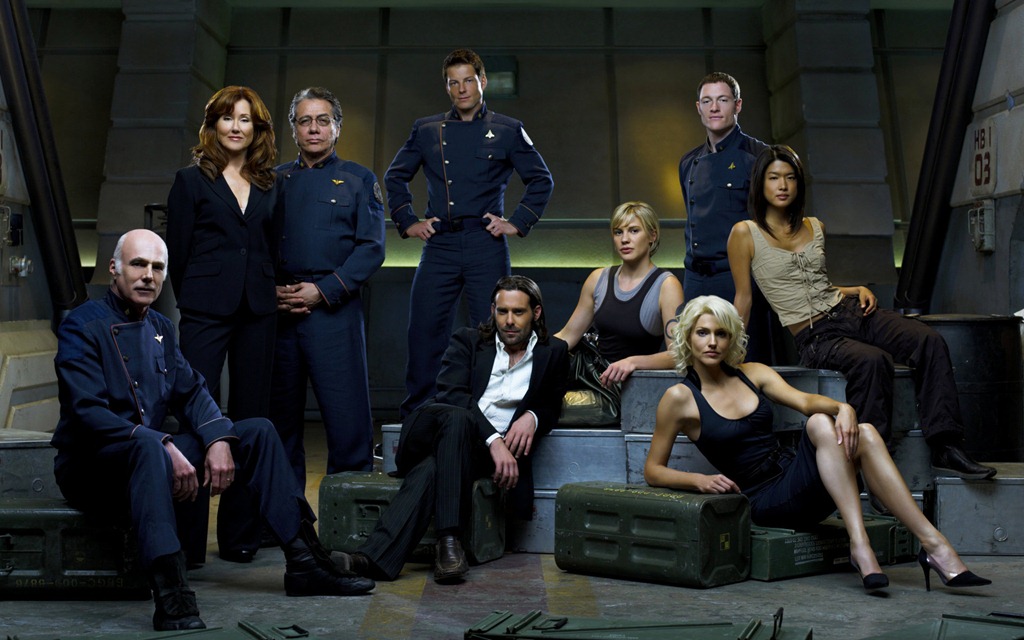
Thousands of years ago some human came up with the idea of angels and the meme has existed ever since. In more recent times science fiction promoted the idea of faster-the-light traveling spaceships. Is a warp drive any more real than an angel? Battlestar Galactica had warp drives and angels. I thought the show was a lot of fun, but I don’t believe in either, but many people do. Create an idea and the believers will come.
The innocence of science fiction corrupting minds with junk science depends on fans knowing that science fiction is just for fun. I’ve argued this point before and some of my friends exclaim that it’s obvious that people know that science fiction books and movies are just for fun. I don’t agree. I think some people want to believe that their favorite science fiction can come true. That the future of mankind includes galactic civilizations, time travel, downloading minds into clones and computers, and so on.
I think great science fiction takes real science and dramatizes it in ways that make readers speculate about the future. The Time Machine by H. G. Wells is a good example. Wells used the idea of evolution to speculate about descendants of Homo Sapiens and the extinction of our race and the Earth. The time machine was merely a gimmick to let the reader visit these speculations, but it’s that gimmick that’s stuck with the popular mind.
Other science fiction throws out far out ideas just to see what people will say. There’s nothing wrong with fun speculation, unless people consider it science. Take for instance the current film Prometheus which I’ve already written about. What’s dangerous is if some people actual start believing that aliens visited the Earth and helped humans develop civilization. Prometheus is only a continuation of 2001: A Space Odyssey back in 1968 and that led to Chariots of the Gods type thinking.
Now this kind of fun pretending is fine as long as you don’t think it’s science. Science has a huge problem in America. Few want to study it, fewer still want to accept it, and many want to corrupt it. I have to ask if my favorite art form is contributing to undermining scientific thinking?
According to this recent Gallop Poll, 46% of Americans believe God created man in the last 10,000 years, according to Bible history. Science is competing with that kind of thinking. Does it help science to have science fiction generating all kinds of nonsense ideas too? If you understand science, science fiction is fun, but if you don’t, how can you tell if the ideas are real or crazy?
Follow the link to the Gallop Poll and read the statistics about Americans and their beliefs. They’re closer to fantasy and science fiction than science. In fact, people who pursue scientific thinking makes up only a tiny fraction of the population. We all depend on science for medicine, cars, airplanes, computers, weather prediction, etc., but few of us study how it works. Scientists are the magicians of our times, and few understand how their magic works.
I’ve read popular books and magazines about science all my life. I think of myself as an advocate for scientific thinking, but I’m far from a disciplined scientific thinker. Science is a very misused word. Our society is full of junk science, fraud science, pseudo science, fake science, and an emerging category I’m calling zombie science.
Some computer viruses take over personal computers and turn them into zombie computers to attack other computers and create massive denial of service attacks. Conservatives waging a war on science and environmentalism have developed fake and fraud science to inject into people’s minds to spread zombie science. They are taking over people’s minds to create a denial of science attack with their anti-science science. This is very diabolical, but impressive. Read Merchants of Doubt for the details.
What I’m asking is in this war on science, is science fiction helping or hurting?
Don’t just toss this idea off. Think about it for awhile. Everybody has a map of reality in their heads. How functional or accurate that map is depends on how well it corresponds to actual reality. That’s what science is about, validating the input of our senses. It’s extremely easy to program humans to believe anything. Not only can we be brainwashed but we all actively promote self-delusion. Scientific thinking is an extremely hard discipline to pursue, much harder than Zen.
Remember Cypher in the film The Matrix, when he sells out to Agent Smith? Cypher is willing to accept a delusional world because it gives him what he wants. Most humans do that. I wonder if our love of science fiction is like steak to Cypher?
People will dismiss this idea. They will say only an idiot will believe the stuff in science fiction, that science fiction is only books you read for fun. Well, how many people believe in the Bible? It’s only a book too. Don’t get infected by zombie science.
JWH – 6/23/12
Clear Explanation of Fast and Furious Scandal
I highly recommend watching this video – it’s enlightening on so many levels.
By the way, I’m all for gun ownership. Maybe if all us liberals joined the NRA they’d feel less paranoid. Obama has done nothing about control and that’s caused immense fear in the NRA community. Fear drives people to desperate thinking and this video explains how. Maybe Obama should join the NRA.
I’ve been hearing about the Fast and Furious scandal in the national news and wondered what the hell was going on. This video makes everything clear.
Thanks to Bill at That’s interesting… for the link.
JWH – 6/23/12
Are You Naïve, Delusional, A Rube, A Chump?–The War On Science
Do you believe everything you read?
Can you verify everything you know?
How much of what you know is wrong?
People believe what they want to believe, and they always think they’ve right. Would you even know when you’re wrong? Does it matter, or would you really like to know the truth?
The reason I ask these question is because we’re in the middle of a war on science. Like the rulers in Nineteen Eighty-Four, there are people who want you to believe what they want to believe and they know what they believe isn’t scientific, so their battle plan is to confuse people by attacking science and making it very hard to know what’s true and what’s not true. Like those rulers in that famous dystopian novel, they’re willing to rewrite history and invent newspeak to fool people into believing their version of the truth.
Why trust what I have to say is the truth? Well, you shouldn’t. Never trust anyone. The important thing is to learn how to verify facts for yourself. It’s also important to learn how information is presented to you. It’s very easy to be persuaded. People are quick to believe anything. It’s surprisingly easy to convince people to believe false information. It’s devilishly hard to be logical. People aren’t rational, even though we believe we are. We’re geniuses at self-delusion. Don’t trust yourself either.
Absolute truth is elusive in this reality. We don’t live in a black and white world, but one with infinite shades of gray. One of the biggest misconceptions about science is its knowledge is one hundred percent certain. We know with absolute certainty that the Earth orbits the Sun. Our knowledge of celestial mechanics is good enough that we can launch a satellite to Saturn and years later and billions of miles traveled, we’ll hit our target perfectly. This is while the Earth, the satellite and Saturn all move independently tens of thousands of miles an hour in different directions, and the gravity of all the bodies in the solar system come into play. This is fantastic knowledge that correlates to many decimal places.
Science is far less sure about the causes of breast cancer or global warming, but scientists know far more about those topics than you think. The trick is, if you are worried about getting cancer or impending global warming, is to understand just how much they do know. Evolution is closer to the fact of the Earth orbiting the Sun than the causes of global warming, and what we know about global warming is massive, but millions of people are fooled otherwise.
Now I can’t prove that in this essay. It would take more words than I have time to write. What you need to learn is how to examine news about science, and to do that I highly recommend reading Merchants of Doubt by Naomi Oreskes and Erik M. Conway. Oreskes and Conway examine several public scientific debates that have occurred since the 1940s and they show how science works and doesn’t work, as well as how anti-science forces are corrupting science in the United States.

After World War II scientists began to tell people that smoking cigarettes was not safe. Now the tobacco industry didn’t want people believing that, even though their own scientists told them it was true. When the tobacco industry realized they couldn’t refute the actual science, they discovered they could confuse the public by attacking science in general and sowing doubt. Oreskes and Convey show a history of how big businesses have refined these techniques to fight one scientific discovery after another that threatened livelihood. And they use the public as their dupes.
Oreskes and Conway examine these battles like a court case carefully weighing all evidence presented by science and the anti-scientists. One thing big business learned quickly was to hire scientists to attack other scientists, and Merchants of Doubt presents several men and women who have made careers of being anti-scientists. Oreskes and Conway try hard not to vilify these individuals, but I can’t help seeing them as evil.
But who is to say I’m right? The point of Merchants of Doubt is to learn how scientific issues are studied and decide for yourself.
We all get email with a political agenda. These emails have carefully crafted stories designed to convince us to believe something specific about reality. It might be that global warming is a myth, or Obama isn’t a natural born American. Why believe what you read? Why be skeptical? Because there’s a war going on and each side is recruiting. One side wants you to be their chump. It’s like computer viruses that convert your computer into zombies used for organized crime – someone wants to use your mind, and they want you to act for them.
Don’t get brainwashed. Learn how to think for yourself. Learn how to think scientifically. Be skeptical. Seek good evidence.
Real science works through peer reviewed journals. A scientist will develop a hypothesis to test. They will set up an experiment. They will report their results in a paper and send it to a peer reviewed journal. Fellow scientists in the same discipline will review the article and judge it for proper methodology. If the article is accepted and published it doesn’t mean the results are facts. Other scientists will read the article and devise new tests and go through the process again. Topics under examination will be thoroughly researched over and over again until a statistical consensus emerges. It takes a long time. All too often one test result will be reported in the national news and causes a big brouhaha. This is one reason why many people find science confusing. They think one test result is suppose to tell the absolute truth and it doesn’t.
To further complicate scientific inquiry, people with a vested interest in a particular topic will make that topic newsworthy. They will do everything they can to try their case in the court of popular journalism. In peer reviewed journals only people who are specialists in the topic deal with the subject, but in regular journalism anybody can say anything. You might get a food processing chemist proclaiming facts about climatology. Or you might get high school dropout that just wants to get their opinion heard.
Don’t believe what you read about scientific concepts unless you thoroughly research them. Few people are going to read peer reviewed science journals. So what can you do? Learn to read popular science books. At least research Wikipedia. Wikipedia can be untrustworthy, but many of its articles are a battleground between many points of view and a consensus often gets hammered out.
Another good realty check is Snopes.com. Snopes often reviews silly topics, but all too often people believe silly crap. When you hear about something new check Snopes. A large percentage of internet gossip is fabricated.
Like I said, I highly recommend reading Merchants of Doubt. Instead of saying anything more about the book please read Global Warming Deniers and Their Proven Strategy of Doubt to get a bit of the flavor of the book.
This isn’t the only book on this subject. Journalists, writers and historians are beginning to see a pattern.
- Doubt is their Project: How Industry’s Assault on Science Threatens Your Health by David Michaels
- Deceit and Denial: The Deadly Politics of Industrial Pollution by Gerald Markowitz
- The Republican War on Science by Chris Mooney
- The Battle Over Climate Science – Popular Science
JWH – 6/21/12
 Auxiliary Memory