by James Wallace Harris, Thursday, November 17, 2016
There’s a book by Clifford D. Simak with a title I love, Time is the Simplest Thing. It’s not. Try to define “time” in words. You can’t. Everyone tries, but has anyone ever succeeded? In Time Travel: A History, James Gleick covers the science fictional subject of time travel, and the scientific subject of time. Thus, if you’re a science fiction fan, you’ll have a wonderful stroll down memory lane of many iconic time travel stories. But it’s the other half of the narrative, the one where Gleick explains the science of time – that tied my mind in knots.
 I don’t believe in time travel. H. G. Wells didn’t believe in time travel. James Gleick does not believe in time travel. So why spend so much time speculating about an impossible subject? That’s what Gleick’s book is about. One big spoiler warning to anyone planning to write a time travel novel – after Gleick described so many time travel stories I wondered if there’s any need for more. Can anyone read this book and think of a new angle on time traveling? Time Travel: A History illustrates just how speculative one idea can be. For me Gleick’s book is a celebration of the concept of time travel, and an eulogy. Time travel stories are fun, especially when young, but other than escapist entertainment, speculation about real time travel feels as valuable as counting the number of angels that can fit on the head of a pin. This book is about speculating on time travel. When we are young we hope concepts like God and Time Travel are real, but when we’re old such thoughts fade, but it’s pleasurable to contemplate old thoughts of fancies. I know I won’t be traveling in time, or outer space, or even to heaven or hell. Now is all I’ve got. Being old makes me want to know the real nature of time. Gleick’s book combines the two.
What’s really rewarding about Time Travel: A History is the respect it gives to science fiction. Gleick uses famous SF stories to illustrate how we struggle to understand time. Of course, it’s also bait and switch. Science fiction fans will buy the book to read about time travel, but Gleick spends a good deal of “time” conveying the thoughts of Newton, Einstein, Feynman, Plato, Augustine, Hobbes, Proust, Bergson, and other heavyweight thinkers about the nature of time.
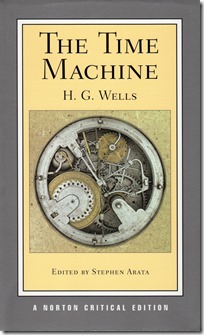 Of course, Gleik covers The Time Machine by H. G. Wells, including some of the serious reactions to that story. I wish he could have gathered a sample of man-on-the-street reactions. How did the average person respond to the idea of time travel in 1895? How did the standup comics of the day, or whatever they were called, poke fun at the idea? Did the story generate 1890s pop culture buzz? In some ways I would have liked this book to have been The Time Machine: A History. Looking at the publication history of The Time Machine at ISFDB, I’m not sure it was an instant hit. I have a copy of the Norton Critical Edition that features early reviews and later scholarly essays, but it doesn’t offer what everyday readers thought. I wonder if such a history could be written? (Or has?)
One of the trickier aspects of reading this book is paying attention to when Gleick uses the phrase “time” or “time travel” because my mind often wanted to switch them. For example, when he quotes Lee Smolin, “I no longer believe that time is unreal” my eyes tried to read it as “I no longer believe that time travel is unreal.” I assume my unconscious mind wanted a scientist to claim time travel is possible. As a species, I believe we all wish to travel in time. Don’t we do this is so many ways: art, history, journalism, fiction, nostalgia, dreams, memories, and so on. Gleick covers all this too.
 It’s when Gleick tries to define time, especially in relation to Einstein’s discoveries, that my head explodes. I want to believe there is one now that exists everywhere, all across this universe, to other universes in the multiverse, down into the atomic world, the subatomic, the quantum, and if they exist, to all the dimensions of strings, and then to what makes up strings, and so forth. But my understanding of Einstein, which is very limited, tells me the observer has their own time. What does that mean? I can understand if that means clock time is different in different locations – depending on the speed of the observer. But is Einstein saying the nature/substance/structure of time is different for each observer? Do they each have a personal now? Many scientists doubt the existence of time, and consider it an illusion.
H. G. Wells confused things when he suggested that time was the 4th dimension, and we can travel through it, like we do through the 3rd. How does that explain Newton’s apple falling from the tree? How does that explain a light beam from a star 1,000 light years away? Is that a 1,000 year yardstick with ticks for all the nows that exist along its path – like counting tree rings? That light beam is a relic of the past, so it confuses us about the nature of time. Even though we think we see a star, what we’re seeing is 1,000 years old light. The star’s now is different. But does our sun and that star also share a same now regardless of the age of the light beams we see? Is there one eternal now everywhere? Is time merely a measure of how far points in the past and future are from the eternal now?
Think of it this way. We measure time on a timeline, and imagine the now moving down the timeline. What if we didn’t use the timeline, and used a constantly changing number for events in the past. For example, instead of saying I was born in 1951, I’d say I was born -65 years in the past, that Columbus discovered America –524 years ago. Of course, every year we’d have to memorize a new number for every event in history. It’s easier to give every event a year to remember, and let now always be an ever changing date. But isn’t that backwards? Isn’t now always the same, and the past an ever expanding number? And the future an ever shrinking number?
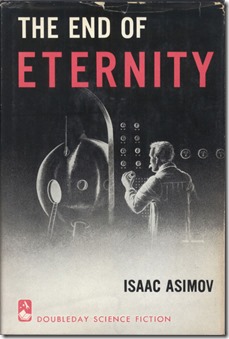 What if we wanted to travel back 542 years to see Columbus. That requires moving our now back all those years. The essence of time travel is moving to another now. That’s why I personally don’t believe in time travel, I believe there is only one now for all of reality. What I want to know, and Gleick didn’t tell me in his book, is whether or not there are other nows, meaning multiple timelines, one for each universe. A great example of this problem is Time for the Stars by Robert A. Heinlein. The premise of this book is some twins have telepathy, and that this telepathy is always instantaneous over any distance, so use them as radios for interstellar flights. The twin that stays home gets older much faster than the twin that travels to the stars. They always share a telepathic now, but they can tell there’s a difference. What the space traveling twin hears in his mind as he travels faster is his twin talking slower.
I can’t remember when I first grasped the idea of time travel. I saw the George Pal movie in the early 1960s, before I read the classic novel by H. G. Wells, but I’m not sure if I hadn’t seen cartoons, television shows or movies that also dealt with the topic. Before H. G. Wells few people thought of time travel, now, I doubt many people haven’t thought about it. Before Wells, writers wrote about people sleeping into the future. Mark Twain wrote A Connecticut Yankee in King Arthur’s Court, but had he invented time travel? Wasn’t Twain really inventing alternative history? Gleick does go into all the philosophical old variations on time travel, such as prophecy, fortune telling, eternal life, and so on. It’s amazing how many ways we play with the idea of time.
That’s the thing about this book – it demands rereading. Is that another form of time travel? Read Maria Popova review of the book. I wish I could think and write like her. And isn’t her essay an example of actual time travel? We constantly revisit the past, to annotate and evaluate. Reading my review, hers, and others, we’re all traveling to the same spot and time – the book Time Travel: A History.
JWH
[I wrote two versions of this essay. Microsoft decided to update Windows when I left the machine unattended, and I lost parts of the first version. Rewriting this essay feels like time traveling itself, and this version is the result of my mind going back and interfering with the timeline of the first version.]







 Auxiliary Memory