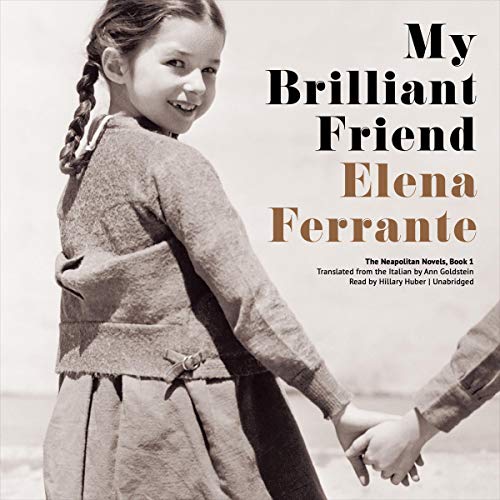
MY BRILLIANT FRIEND by Elena Ferrante

by James Wallace Harris, 10/19/24

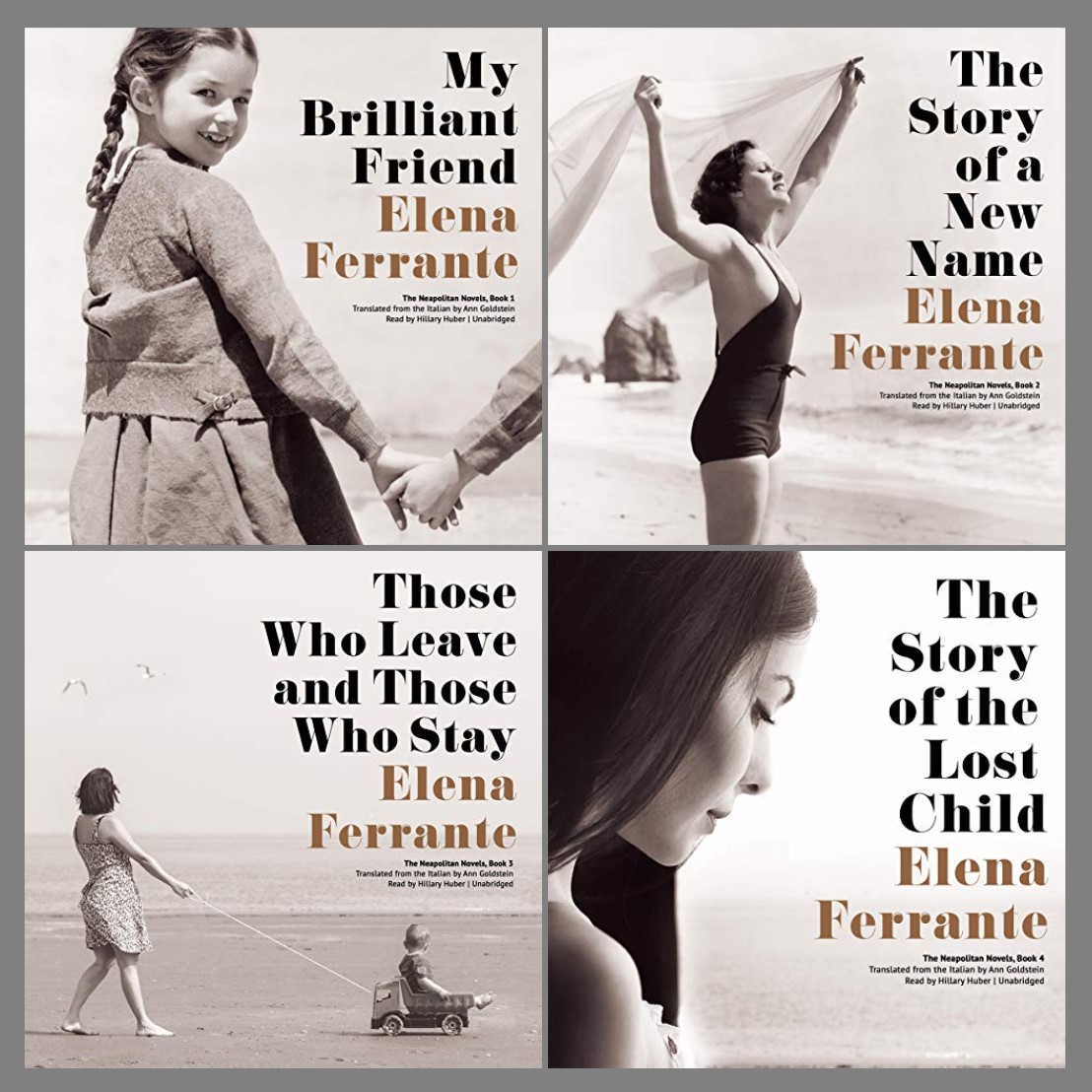
Technically, My Brilliant Friend by Elena Ferrante is the first novel in a four-volume sequence that is collectively referred to as the Neapolitan Novels. Now that I’ve read all four books, I dislike that tagline for the whole story. The four books are really one whole novel, and even though Naples, Italy is very important to the story, it doesn’t properly describe the complete novel. Each volume picks up exactly where the last one stops. If they were published in one volume with no subdivisions, you wouldn’t notice any transitions.

For this review, I’m going to refer to the whole as My Brilliant Friend, and when needed, I’ll point to the individual titles as part of the story. The structure below uses the dates for the English translation. The books were originally published in Italian one year earlier.

  1. My Brilliant Friend (2012)
    • Prologue: Eliminating All the Traces
    • Childhood: The Story of Don Achille
    • Adolescence: The Story of the Shoes
  2. The Story of a New Name (2013)
  3. Those Who Leave and Those Who Stay (2014)
    • Middle Time
  4. The Story of the Lost Child (2015)
    • Maturity
    • Old Age: The Story of Bad Blood
    • Epilogue: Restitution

Circular Plot and Recursion

The complete story begins where it ends. And throughout this long story, it constantly refers to itself. It’s so recursive that it feels like two mirrors aimed at each other. It’s also cyclical because it’s about daughters and their mothers, who eventually become mothers of daughters. In so many ways, this story mirrors its parts.

The novel is about two women, Elena Greco and Raffaella Cerullo, who call each other Lenù and Lila. The story feels like an autobiography, and we have to remember that the author’s name is Elena too. Elena Ferrante hides behind a pseudonym, but this novel feels very autobiographical. Lenù and Lila react and respond to each other so intensely that it’s hard to tell who originates what traits. I even imagined that Elena Greco is writing about two versions of her own identity, the one who writes books, and her ordinary self. And it’s interesting that Ferrante hides behind her pseudonym, claiming she wants to remain anonymous while Lila also wants to remain anonymous throughout the story. So many reflections.

Literary Novels

I’ve always thought the greatest of literary novels feel biographical or autobiographical. They don’t need to be about real people, but they do need to feel like they are, and this novel offers two realistic portraits. Another trait of great literary novel is setting. We often think of London when we think of Dickens, or Russia when we think of Tolstoy, or Ireland when we think of Joyce. Ferrante has made her book about Naples and Italy.

If you’ve only read the first volume, My Brilliant Friend, you should tell yourself that you never finished the novel. The Neapolitan Novels boxed set runs 1,965 pages. On audio the four books run 78 hours and 52 minutes. To give perspective, War and Peace by Leo Tolstoy averages about 60 hours in the various audio editions. Different translations of The Bible run 82-102 hours. The seven volumes of Proust’s Remembrance of Things Past runs 154 hours and 14 minutes. In other words, the whole My Brilliant Friend is a literary heavyweight.

Most novels that come out in a series are never artistically heavier than a single volume. That’s why when I finished reading the single volume entitled My Brilliant Friend, I couldn’t understand why the writers polled by The New York Times considered it the top book of the 21st century so far. It was good, but not that good. That’s because it’s only one-fourth of a whole. Now that I’ve read all four volumes, I can easily see why it was voted the top novel of this century.

Will it Become a Classic?

Whenever I read a highly respective modern novel I’ve wondered if it will someday be considered a classic. I’ve never felt sure about any modern novel to predict one before. However, for the whole of My Brilliant Friend I felt like it was at least an equal to Anna Karenina by Leo Tolstoy. That novel only runs 36-40 hours in audio, so it’s about half the size of the full version of My Brillian Friend. The Ferrante novel is far more ambitious, at least in being a biography of two women, so maybe it needs twice the space that Tolstoy used to tell us about Anna Karenina. However, Anna is never developed in such detail like Lenù and Lila.

We follow Lenù and Lila from being little girls to old women, and that makes a huge difference in storytelling ambition. This novel is primarily about friendship, even though it says almost as much about kinship. Men do not come across well in this story. This novel is feminist at a visceral level. I’d also say this book is an anti-chemistry book in the sexual sense. Time and time again, hormones overwhelm Lenù and Lila into making bad life-changing decisions. The great loves of their lives are the same evil Mr. Right. Nino Sarratore is no Mr. Darcy. Ferrante makes Nino one of the detestable bad guys of literary history. I can’t believe that Lenù and Lila didn’t immediately recognize that he was a clone of his father, Donato, the slimy seducer they knew from childhood.

The Prose

It’s hard to judge the writing of a translated novel. I do know that Ann Goldstein’s translation of Ferrante’s Italian prose is clear and precise, and the writing comes across as vivid and impactful, but the style is plain and unadorned. It lacks the colorful authorial voice of two recent novels where the prose enchanted me, A Gentleman in Moscow by Amor Towles and Lessons in Chemistry by Bonnie Garmus. Nor does it have any the wonderful authorial commentary like old literary writers Dickens or Tolstoy since Ferrante’s story is told in the first person.

A lot of modern bestsellers have the highly refined writing style taught by MFA programs. Readability and clarity are valued over wordy digressions and colorations. This is one reason why I have a hard time predicting if a novel will become a classic a century from now. The classics we’ve crowned from the 19th century all have distinctive writer’s voices. Ferrante’s voice comes across through the characterizations of Lenù and Lila, and it’s confusing to distinguish Elena the author’s voice from Elena the character.

Final Judgment

I liked this story tremendously. It may have ruined me for reading lesser novels, especially for reading science fiction, which seldom achieves any kind of deep character development. The whole story of My Brilliant Friend reminds me of two other multi-novel sequences about characters as they age.

The first is A Dance to the Music of Time, a twelve-volume series by Anthony Powell which he wrote from 1951 to 1975 using his own life and friends for inspiration. I reviewed them here, here, and here.

And the other are books by Elizabeth Strout. Collectively, they follow the growth of two women too, Lucy Barton and Olive Kitteridge. I’ve reviewed them here.

This first reading of the entire My Brilliant Friend story will not be enough to truly appreciate this novel. Even though it’s told in a straightforward manner, it is quite complex in what it has to say. I listened to the books this time. Next time I’ll read them with my eyes. Luckily, I have a one-volume Kindle edition that includes all four books.

Ferrante made me think about my life as a whole. She also makes me think about aging. And she has quite a lot to say about the relationship between men and women. Her novel might be the perfect illustration as to why we don’t have free will. Whether or not it becomes a classic in future centuries, it is worth reading and contemplating now. It gives us lot to meditate on.

JWH

Tell Me Everything by Elizabeth Strout

by James Wallace Harris, 9/24/24

I’m a huge fan of Elizabeth Strout. I just finished her new book that came out just a couple of weeks ago, Tell Me Everything. It was wonderful. Now I could just say to you, “Go out and read it,” but that’s problematic. This is Elizabeth Strout’s tenth book, and it includes characters that have been in eight of her other novels.

Tell Me Everything is mostly about Bob Burgess, and it includes his brother Jim. They were featured in The Burgess Boys (2013). Bob was also in Lucy by the Sea (2022). Lucy Barton’s first book is My Name is Lucy Barton (2016), and her story continued in Anything is Possible (2017), Oh William! (2021) and Lucy by the Sea, and she’s one of the main characters in Tell Me Everything. Elizabeth Strout’s most famous character is Olive Kitteridge who first appeared in Olive Kitteridge (2008), and her story continued in Olive, Again (2019), but she’s also a minor character in Lucy by the Sea and Tell Me Everything.

One of the exciting things about reading Tell Me Everything is Lucy and Olive meet and become friends. Olive is 90 when the story starts and 91 at the end, but we’ve known her since she was in her fifties, working as a teacher. She’s now in assistant living facility. We’ve followed Lucy for most of her life, and she’s now in her mid-sixities in Tell Me Everything.

I believe the title of the new novel comes from Lucy’s and Olive’s relationship where they tell each other stories about people who have unrecorded lives. But also, because Strout tells her novels by having characters tell their stories to each other. (I must wonder if Strout makes up all these stories, or are they based on stories from people she has known?)

Tell Me Everything is a fine novel to read without having read all the other novels, but you won’t get the full Elizabeth Strout impact unless you’ve read her novels in order. Tell Me Everything reiterates many of the major details of the previous novels but I’m not sure the characters will have the same impact. Bob, Lucy, and Olive in the new book are like the tips of icebergs, very impressive, but you don’t get to see them below the waterline.

The two Olive Kitteridge books are collections of thirteen short stories each, twenty-six stories in all. Sometimes Olive is the point-of-view character, and sometimes she just makes a cameo in other people’s stories. She’s not a featured character in Lucy by the Sea or Tell Me Everything. And she’s a lot more than the character people get from wonderful Frances McDormand’s portrayal of her in the HBO miniseries. Olive is immensely multidimensional. But to understand her requires experiencing all those layers. Many people, the other characters in the novels, and readers who read Strout’s books, hate Olive because she’s so abrasive. I love Olive.

We met Lucy in My Name is Lucy Barton which is a fictional memoir told in first person. It sounds like a monologue by Lucy in audiobook. But in Anything is Possible, we hear about Lucy’s childhood through a series of stories told by people who knew Lucy growing up. Oh William! returns to the fictional memoir style, with Lucy telling her story like a long monologue again. That style continues in Lucy by the Sea. In Tell Me Everything, Strout returns to third person, and Lucy is being observed again, especially by Bob Burgess.

Strout is not an omniscient narrator. We learn about characters from the opinions of other characters, and the opinions we form. It would be interesting if Strout wrote a book about her characters using the 19th century style god view of characters.

Lucy is also a complex character who is an observer of other people. And although Olive observes other people, she isn’t as insightful as Lucy. In Tell Me Everything, Lucy teaches Olive about learning and telling other people’s stories, and we see Olive become a much better observer. Lucy is also very philosophical, but not in a deep intellectual sense. Lucy works to make sense of reality through understanding the emotional experiences of others. Bob often thinks Lucy is naive and childlike, but is she?

We got to know Bob in The Burgess Boys, a third person novel. However, this approach doesn’t move far away from Strout’s basic writing technique of writing novels by collecting anecdotes about other people.

Most novels are about something big. Something dramatic. Strout’s books are about ordinary people who have suffered or are suffering ordinary kinds of experiences and emotions that we all suffer. Most of her characters had troubled childhoods. Some of her characters like Lucy, were quite poor growing up. But other characters are well-to-do or become successful. This makes Strout’s novels feel they are about class. Some reviewers make a lot out of the class angle, but I don’t.

Tell Me Everything is about unrequited love, death, murder, child abuse, jealousy, marriage, infidelity, friendships, aging, careers, art, counseling, fashion, resentment, feelings, emotions, alcoholism, understanding the past, reading other people, nude pregnant women, and much more. As Bob Burgess says, of Lucy’s stories about other people, they are about life.

I know some readers don’t like Strout because her books are about ordinary aspects of life. They don’t involve exciting page turning plots. I find them quite thrilling because they make me think about people and myself.

I’m about to start the third of the Neapolitan novels by Elena Ferrante, which began with the international bestseller, My Brilliant Friend. They are also about ordinary people involving a lot of characters. I find both series appealing because of what might be considered a sexist take on them. I feel they give me women’s insight into reading emotions. Me, and my guy friends don’t read emotions like the women characters in these novels. I don’t know if this ability is a common trait of all women, or just women writers. But it’s why I like both writers.

JWH

Was My Brilliant Friend by Elena Ferrante #1 With Me?

by James Wallace Harris, 9/2/24

I just listened to My Brilliant Friend by Elena Ferrante because it was voted the best book of the 21st century so far by The New York Times. Well, it was #1 on the list voted for by 503 writers, critics, and editors. It was #8 on the list voted for by the NYT’s readers. And it was #11 on a list created by The Guardian. It wasn’t my #1 twenty-first century read, but it might be in my Top Ten. I should create a Top 100 list for the books I’ve read so far this century. Right now, #1 would be The Warmth of Other Suns by Isobel Wilkerson.

Ranking books is ridiculously hard. Even describing my exact feelings about a book is extremely hard. But I can say, My Brilliant Friend is the kind of novel I rate as being the best kind of novel, and those are the ones that feel autobiographical.

We don’t even know who Elena Ferrante is, so there’s no telling if the novel is autobiographical. There is even speculation the author could be a man, but I doubt it. This book reads like the absolute best of women writers. However, it also reads like it describes the author’s own childhood and adolescence. And it feels like it’s about two very real people. Of course, the story could be entirely made up.

When I was young, and an English major in college we used to argue over whether a novel is best understood as a standalone work, or from a larger context of when, where, why, and who wrote it.

Back then, when I was young, I argued that a novel had to be judged as a standalone work.

Now that I am old, I disagree completely with my younger self. Just judging a book by itself is like looking at the tip of an iceberg that floats above the ocean. You also need to consider the rest of the mountain of ice below the waterline to get the complete picture.

Because Ferrante hides her identity, I can’t do that. Without reading several biographies and collections of letters, plus interviews and other works about her writing, I can only react to My Brilliant Friend as a standalone work.

My Brilliant Friend is very readable, compelling, engaging, moving, and sometimes inspiring. It’s told in two sections: Childhood and Adolescence. The narrator tells us that the story is about Raffaella Cerullo, who her friends call Lina, but she calls Lila. The narrator’s name is Elena Greco but is called Lenuccia or Lenù by others in the story. The story is set in Naples in the 1950s and early 1960s. In the first section the girls are eight or nine, and in the second section, they are fourteen to sixteen.

The first section is about how the two girls compete in grade school. Lina is the smartest, and Elena works hard to keep up with her. In the second section, Elena soars ahead academically. She gets to go to middle and high school. Lina does not and stays home to work in her father’s shoe repair shop. Yet, Lina reads on her own and is often far ahead of Elena intellectually and in maturity.

In My Brilliant Friend, the girls read Little Women. It’s so important to them, they reread the book until it falls apart. I have only read Little Women once, but I’ve seen several film adaptations, and I’ve read three biographies and watched one documentary on Louisa May Alcott. Little Women didn’t become impressive to me until I read those biographies.

I don’t think readers can deeply appreciate Little Women until they read a couple of biographies of Louisa May Alcott. I think that will also be true of My Brilliant Friend. Little Women was my mother’s favorite book from childhood. It was a favorite of her mother and sisters, and aunts. I’ve known many women for whom Little Women was something important that crossed generations. But then for hundreds of millions of readers and film goers, the story is good enough by itself. But I’d say, it’s just a wonderful sentimental tale until you get to know Louisa May Alcott.

I think the same could be true about My Brilliant Friend. I don’t know if My Brilliant Friend will be popular like Little Women has been in the 19th, 20th, and 21st centuries. I won’t live long enough to know. It might be.

I wonder why Elena Ferrante hides their identity. I wouldn’t want to be famous either. All that attention would be annoying. But if her novels are just made-up stories, ones with incredibly detailed character development, I think they will only be popular reads. However, to become classics, we need to know a lot more about Elena Ferrante.

At least I do.

JWH

Precisely Expressing an Idea with Visual Tools

by James Wallace Harris, 8/19/24

Composing an essay makes me clarify my thoughts. We don’t think in sentences and paragraphs, but in vague words and images. It’s hard to write a sentence that says exactly what you mean the first time. The act of constructing a sentence helps us find out what we’re thinking.

Every day I watch videos on YouTube, and it’s become obvious that expressing an idea with both words and pictures can convey an idea more precisely. Have you noticed how infographics are being used more often in print and online?

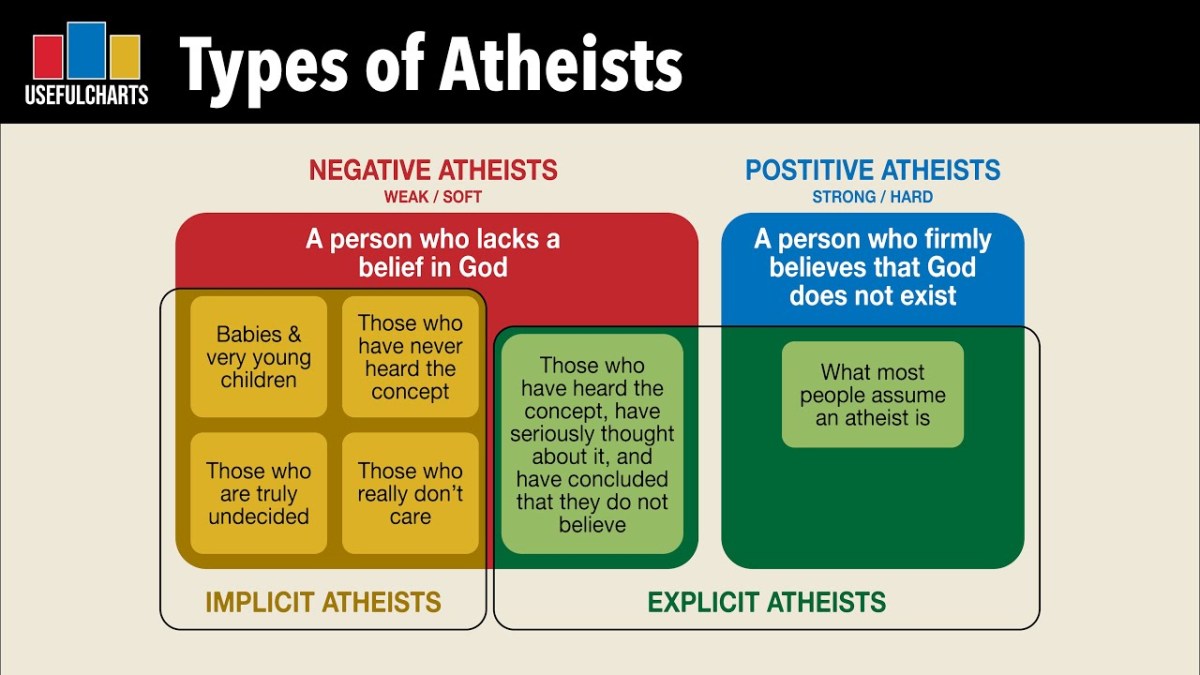
I find this particularly true with the channel Useful Charts created by Matt Baker. Baker’s three videos explaining the types of atheists struct me as particularly clear and insightful. You should watch the series to see exactly what I mean, but I’m going to point out several things he did I thought were particularly good at making his ideas concrete.

I think the chart at the top of the page makes his point far better than if we were to just listen to the video or read the transcript. Of course, if he had written the information in an outline, it might have worked just as well.

  1. Implicit Atheists – A person who lacks a belief in God
    • Babies & very young children
    • Those who have never heard of the concept
    • Those who are truly undecided
    • Those who really don’t care
  2. Explicit Atheists – A person who firmly believes God does not exist
    • Those who have heard the concept, have seriously thought about it, and have concluded that they do not believe
    • What most people assume an atheist is.

But if you had to choose which form, words without graphics, or words with graphics, which helped you to see Baker’s points the easiest and fastest?

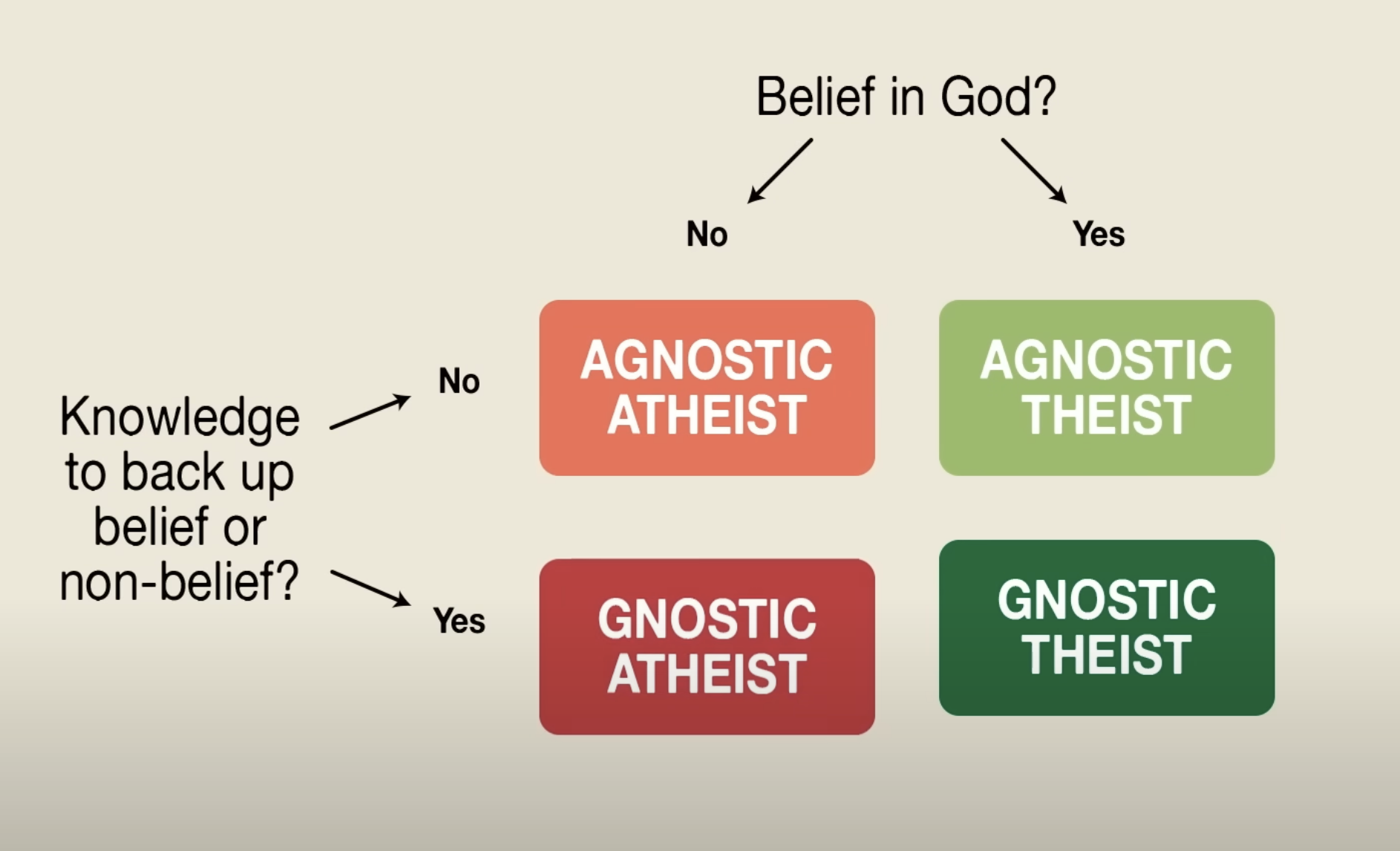
Later, Baker works to prove that people who think being an agnostic is different from being an atheist are wrong. Agnostic refers to a lack of knowledge, while atheist refers to a lack of belief. By Baker’s definition, most agnostics are atheists.

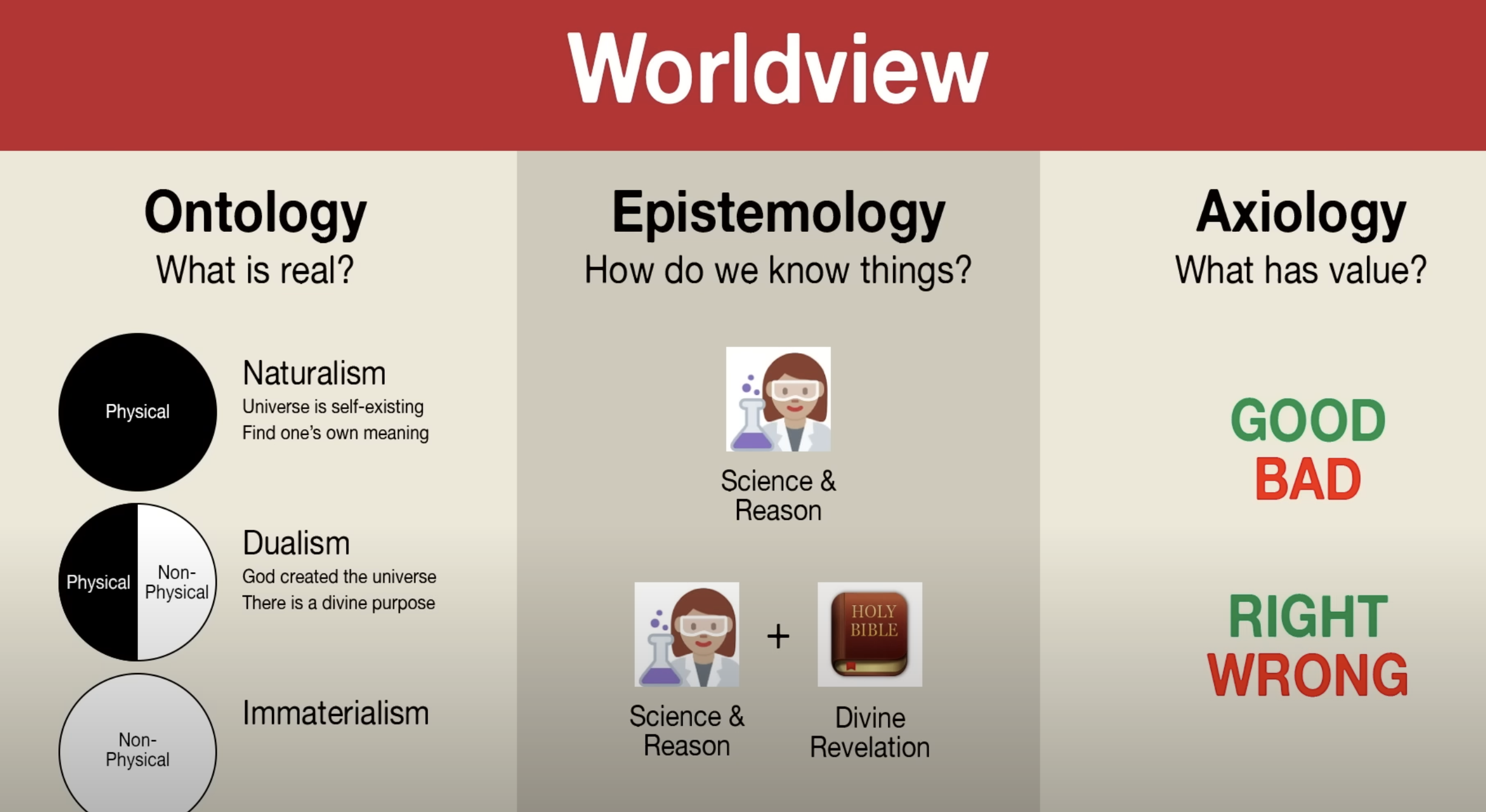
However, as the video progresses, Baker makes a good case that the term atheist isn’t especially useful because it doesn’t convey a worldview. That surprised me. I always tell people I’m an atheist, but Baker is right, the term doesn’t say much. The term atheist only says I’ve rejected the hypothesis that God created reality. It doesn’t say what I believe.

Baker claims that a worldview has three factors, ontology, epistemology, and axiology. From that I see my ontology is naturalism, my epistemology is science and reason, and my axiology is ethics. That particular combination is generally a humanistic worldview.

I should not tell people I’m an atheist but say I’m a humanist. But then, if people don’t understand the definitions Baker is presenting in his video, is that term any more informative? Baker goes into explain humanism and its history and says that humanists are naturalists aligned with science and reason interested in improving the world. That gives me a lot to think about.

The worldview image above is a mini lesson in philosophy, but the whole video is a mini lesson in how to classify your feelings about religion and philosophy.

In part 2 of the series, Baker goes into classifying atheists by personality types. For his dissertation he used the Meyers-Briggs classification system. Glancing through his dissertation, the information seems dense. It would take a bit of work to digest it. I bet the three videos explain his research far easier for most people to understand.

I’m left wondering if I should try to write my blog essays with more infographics. Or even try to write a whole essay in infographics.

Baker’s video on explaining atheists is minor compared to those where he explains larger subjects. Here’s his video on “37 Bible Characters Found Through Archaeology.” Don’t be put off that it’s about The Bible. It’s about how we know things. For example, most of the characters in The Bible that we can connect to history were from the Iron Age. And most of the characters that are considered myths come from the Bronze Age. Seeing that laid out graphically is very impressive.

I highly recommend spending some time watching the videos on Useful Charts. It’s making me rethink how to express ideas and concepts. Baker makes a wonderful video comparing commercial DNA tests people use for genealogy.

I was particularly impressed with his video on the “Western Esotericism Family Tree.” It explains a lot about people I’ve read about over the years.

JWH

What Method of Cursive Handwriting Was I Taught in 1959-1960?

by James Wallace Harris

I’ve been wanting to write by hand again, using cursive handwriting. For decades now, whenever I’ve had to write anything by hand, I printed it with block letters. It’s terribly slow. I keep trying to switch back to cursive so I can write faster and fluidly. However, the muscle memory of whatever cursive technique I was taught is faulty, causing frequent crashes in my penmanship. Such bumps in my inky road cause me to switch back to printing.

My friend Leigh Ann lent me The Art of Cursive Penmanship by Michael R. Sull after I mentioned to her that I wanted to learn handwriting again. Leigh Ann said most older people were taught the Palmer Method of penmanship, which was common in schools until the 1950s. In his book, Sull adapted a consensus of hand movements used in teaching the various forms of the Palmer Method and calls his version American Cursive. However, when he started using it, I realized I hadn’t learned to write certain letters that way, especially the upper-case F Q R and Z or the lower-case z. Here’s an example from Wikipedia.

I have a vague memory of learning cursive writing in school. I think it was in the third grade, which would have been the 1959-1960 school year for me. I completely have no memory of learning to write Qs and Zs this way. Now it’s possible that I’ve just forgotten. I’m forgetting words all the time nowadays, so why not forget some letters too?

According to Wikipedia, the Palmer Method might have been phased out by then and the new teaching method was called the Zaner-Bloser Method. It looks like this:

The differences are very slight. I think the big differences were in the teaching methods, especially how the hand and fingers were positioned and held. I believe each successive method aimed to make it easier for students to write by hand. It’s funny that most of us have forgotten this.

These are still the strange Qs and Zs. And I can’t make myself write zoo in cursive, either with a capital or lower case. It’s like my hand has no memory of writing Zs. Nor can I write anything with a capital Q. I do use that lower-case q.

Wikipedia says the Zaner-Bloser Method began to decline after the D’Nealian Method was introduced in 1978. It looks like this:

What’s weird is all the letters look about the same from method to method. It appears the physical method of writing them differs. I’ve also read that teaching penmanship varied depending on the teacher. I wonder if I had a weird teacher that didn’t like the Qs and Zs and created his/her own? (I went to three different third grade schools, in two states, and had a man, and two women teachers.)

What I’ve been learning this afternoon is my memory, especially my muscle memory, balks at writing some of these letters in the way they are being taught in their specific method. That suggests that the teacher taught me differently, or my teacher wasn’t paying close attention to me developing wayward habits. Do we all put our own spin on lettering? Is that why we have such a tough time reading each other’s cursive handwriting?

The reason I want to learn to write by hand again, using cursive, is because I want to write quickly and smoothly with a pen and have the results be easily readable. I’m not going for beautiful handwriting. I just want to develop a comfortable way to write with pen and paper. I keep reading that using pen and paper is better for my mind and memory than using a computer. I don’t know if that’s true or not, but I will assume it is until proven false.

I also have back trouble if I sit at the computer for too long, so I’m hoping to learn to write with pen and notebook while in my La-Z-Boy.

What I’ve decided to do is practice handwriting by studying these techniques in a general sense to see if I can figure out the smoothest way to cursively move from one letter to another. I want my writing to flow so I don’t have to think about it. If I could handwrite without letters crashing together, I think I would be satisfied.

I doubt I need to study a whole book, but I do need to do a lot of practice until I can figure out how my pen should move from one letter to the next depending on all the combinations. Michael R. Sull has people copy poems and other kinds of writing, and I think that’s a promising idea.

I do find it fascinating I was taught something around 1959/1960 that became muscle memory, and it should be a clue to which writing method I was taught.

JWH