
Is There Any Hope for the Future?

by James Wallace Harris, Tuesday, October 24, 2017

A friend of mine recently posted to her Facebook that her world was rocked when she attended a lecture by Rev. Dr. William Barber who is leading a moral movement to repair the breaches in our society. I assume Laurie found hope in the idea we can save ourselves by creating a new moral order. Even though I’m an atheist, I’m all for this. The trouble is our society is too fractured. Is it even possible to put it back together again? I’ve recently wondered if there is any kind of movement that everyone could embrace and find agreement? I figured it would have to be as powerful as Christianity was in its first four centuries — and yet work with non-Christians and non-believers.

How can we find common ground? Everyone talks about America being politically polarized into conservatives and liberals, but I believe there are far more divisions than that cracking up our society. If every group identity is going to demand society conform to their narrow vision we are doomed. How can we find common ground when so many different viewpoints want to dominate making the rules? Instead of seeking cooperative compromises they all fight to impose their view while demeaning everyone else’s.

In small, homogenous societies, social coherence is found with shared morality. We live in a vast, heterogeneous society with countless ethical/moral visions which makes having shared values almost impossible. In the past, we all tried to agree on some social conventions such as etiquette, acceptable public behaviors, and abiding the laws. Such efforts are almost universally ignored now.

Our greatest obstacle to finding social consensus is defining reality. “I will destroy the wisdom of the wise” is how the apostle Paul began the divide between religion and science by attacking what he called the “empty logic of the philosophers.” Several hundred years later, St. Augustine continued with “There is another form of temptation, even more fraught with danger. This is the disease of curiosity . . . It is this which drives us to try and discover the secrets of nature, those secrets which are beyond our understanding, which can avail us nothing and which man should not wish to learn.”

The-Closing-of-the-Western-Mind-by-Charles-Freeman

I got these quotes from The Closing of the Western Mind: The Rise of Faith and the Fall of Reason by Charles Freeman. They explain perfectly how and why modern believers deny science. The faithful intuitively understand faith is threatened by science. It’s why Christianity embraced Plato and not Aristotle when they discovered the Greeks. It’s why conservatives have a never-ending guerrilla war with education working to undermine K-12 and higher education. They deny the results of science by denying science.

Is it even possible to find a common morality sharable by the sacred and the secular? We can’t even agree murder is evil. How can Christians embrace stand-your-ground laws, gun carrying permits, and AR-15s in light of the Sermon on the Mount? It’s strange that godless liberals support diversity, a concept that St. Paul brought to Christianity when many modern Christians reject it today. Not only is our secular society fractured into countless pieces, but so is Christianity. If believers in a single divine authority can’t agree how can secular society?

The old saying claims money is the root of all evil. I think it’s truer than ever. Money promotes self-interest, and self-interest promotes justifying the acquisition of money by any means. Our plutocratic society has escalated lying to the supreme tool of the greedy. Wealthy people and corporations have learned that lying pays big dividends. A great book that makes that point is The Merchants of Doubt by Naomi Oreskes & Erik M. Conway.

There is a war on science, knowledge, expertise, and intellectualism. The greedy have aligned themselves with the faithful to attack science, and they are winning the war. We can never achieve a universal morality if half the population believes the end justifies the means, thus rationalizing lying. The age of fake news and endless assaults on journalism will never stop before society collapses. I sometimes wonder if the goals of the radical right are to destroy society so they can start over fresh.

There is no hope for any moral movements if we all can’t agree to stop lying. We all need to accept that science is the only tool we have for verifying reality. Science was invented to work across cultures and weed out subjective bias. It is an extremely effective tool for explaining the objective reality we all live in. We must accept that any subjective religion, philosophy, or opinion can’t be a basis for defining what is true. Religion has two choices. It can embrace science or reject it. Religion will strengthen itself if it accepts science, even if science denies it’s metaphysical assumptions. The real value of religion is creating shared values and stable communities — heaven on Earth rather than silly promises in exchange of silly declarations of beliefs.

The greedy are currently using religion to attack science to protect their wealth. The greedy have aligned with the faithful who are also attacking science to defend ancient memes created by primitive folks thousands of years ago. There is a logical synergy to their union but if it succeeds it will destroy our current civilization. Thus, greed is corrupting modern Christianity. I find it hard to accept the faithful who claim the moral high ground when Mammon is their ally.

I don’t know how they can assert America is a Christian nation when our society isn’t even close to resembling the sayings printed in red in their bibles. I believe Jesus tried to teach social action that has more in common with the Democratic party than the Republican. To me, the only valid analysis of Christian philosophy comes from what Jesus said. Everything else said in his name or about him is corrupt. Read The Five Gospels by the Jesus Seminar to understand what I mean, or the books of Bart D. Ehrman.

I believe our only hope is to get the faithful and faithless to agree on common secular morality. This is what the Founding Fathers intended when they created freedom of religion. Because religious beliefs are infinite in variety they need to stay out of politics and remain personal. We need laws and common morals that protect everyone equally. We need to ignore the politics of special interest groups that want special treatment for the few.

We need to agree that science is the only arbiter of explaining reality, promote universal quality education, develop a set of ethics that all agree on which protects both people, animals, the plant world, the environment, that develops a sustainable society. What we need is worldwide Constitution and Bill of Rights for everyone in the 21st century. We need to protect the poor and helpless, but allow the ambitious to succeed without collectively destroying the planet.

The Death of Expertise by Tom Nichols

I’ve read two articles this week that suggests this won’t happen. Both are about the war on science and knowledge. The first is Bill Moyers dialog with Joan Scott at Salon, “In the Trump age, an embolden attack on intellectuals.” And this older article at The Federalist by Tom Nichols, “The Death of Expertise” which later became the book, The Death of Expertise.

Hope involves believing people can change. Since we haven’t for two hundred thousand years, why expect the human race to get its shit together at the last moment to avoid an apocalypse of our own making? We could save ourselves if we weren’t so greedy. Unfortunately, we live in a civilization where greed is the foundation.

JWH


Will Puerto Rico Be The 1st Climate Change Retrofit?

by James Wallace Harris, Saturday, September 30, 2017

The disaster in Puerto Rico is truly horrendous. What’s important now is how we respond. I worry this Mag-10 catastrophe will be shoved off the news and be forgotten. I know Republicans are horrified at the cost of helping Puerto Ricans but we should make Puerto Rico our 51st state and divert all that tax-relief for billionaires into rebuilding their country. The scale of such a project would be awe-inspiring like the Apollo moon program.

You have to admit as a taxpayer, making the rich richer has gotten rather boring. I just can’t work up any more sympathy for people with private jets, and I’m tired of them conning us into giving them more money because of their self-serving lies about helping the middle class. Rebuilding our infrastructure will make America great again. Designing a self-sustaining economy for the 21st-century will make America great again. Cleaning up the environment will make America great again. Creating social equality will make us great again. Inequality in all its forms is only flushing us down the toilet.

The intellectual challenge of retrofitting Puerto Rico to survive future super-hurricanes is thrilling. And it will be great practice for when we need to rebuild all the southeastern coastal states. Is it possible to create an island paradise that can withstand rising seas and periodic Cat-5 hurricanes? Could we design homes that can be sealed like submarines from flooding and aerodynamically shaped to withstand 250 mph winds? Can we create a cell phone, power grid, water, and sewer system that can take a beating and keep on ticking (like a Timex watch in those old commercials on Mutual of Omaha’s Wild Kingdom)? Is it possible to develop a self-sustaining economy for 3.6 million people that can periodically withstand the worst nature can throw at them?

Since we won’t solve global warming we need to learn to take regular spankings from a pissed off Mother Nature.

After we retrofit Puerto Rico and other Carribean islands, we can work on Florida.

SanJuanPuerto Rico is the canary in the coal mine. Those folks down there are Americans even though we treat them like red-headed stepchildren. Congress is driven by greed, so I doubt those bastards will change their stripes, but maybe, just maybe, a disaster of this size will crack open their greedy little hearts just enough to let in a ray of compassion. I don’t think our rich folks need tax relief as bad as 3.6 million Americans without power, water, food, internet, and cell phone coverage.

JWH


Books To Read To Save The World

by James Wallace Harris, Saturday, July 15, 2015

  • We will destroy civilization before the end of the century.
  • Denying science is denying reality.
  • Denying evidence for personal gain is treason to our species
  • Greed is destroying all the species on this planet including our own.
  • Self-interest is leading to species suicide.
  • We have the knowledge and technology to solve our problems.
  • We must change the way we live to save the planet.
  • Human nature is too stupid to survive free market capitalism.
  • We will not save the world just by buying LED light bulbs and driving electric cars.
  • Reading books will not save the Earth, but it will help understand the complexity of the problems we face.
  • Reading these books can be depressing.
  • Not reading these books only makes our problems worse.
  • Read and recommend books that help us understand the reality of your actions.
  • We can only divert the collapse of civilization if we find a new sustainable way to live.
  • Read ten books before deciding if I’m wrong.
  • Read another ten to begin to find hope.

If you know of other good books, recommend them in the comment section.

The Sixth Extinction by Elizabeth Kolbert

This Changes Everything by Naomi Klein

Sapiens: A Brief History of Humankind by Yuval Noah Harari

Homo Deus by Yuval Noah Harari

Countdown: Our Last, Best Hope for a Future on Earth? by Alan Weisman

Learning to Die in the Anthropocene by Roy Scranton

Half the Sky: Turning Oppression into Opportunity for Women Worldwide by Nicholas D. Kristof and Sheryl WuDunn

A Path Appears: Transforming Lives, Creating Opportunity by Nicholas D. Kristof and Sheryl WuDunn

Capital in the Twenty-First Century by Thomas Piketty

The Rise and Fall of American Growth by Robert J. Gordon

Energy and Civilization: A History by Vaclav Smil

How Will Capitalism End? by Wolfgang Streeck

EarthEd: Rethinking Education on a Changing Planet by The Worldwatch Institute

Climate of Hope by Michael Bloomberg and Carl Pope

The Gulf: The Making of an American Sea by Jack E. Davis

The Death and Life of the Great Lakes by Dan Egan

Strangers in Their Own Land by Arlie Russell Hochschild

White Trash: The 400-Year Untol History of Class in America by Nancy Isenberg

The New Jim Crow by Michelle Alexander

Between the World and Me by Ta-Nehisis Coaste

Girls & Sex by Peggy Orenstein

Sex Object by Jessica Valenti

Saving Capitalism: For the Many, Not the Few by Robert B. Reich

Dark Money by Jane Mayer

Getting to Green: Saving Nature – A Bipartisan Solution by Frederic C. Rich

The Great Disruption: Why the Climate Crisis Will Bring On the End of Shopping and the Birth of a New World by Paul Gilding

Merchants of Doubt by Naomi Oreskes & Erik M. Conway

Democracy in Chains: The Deep History of the Radical Right’s Stealth Plan for America by Nancy MacLean

Growing a Revolution: Bringing Our Soil Back to Life by David R. Montgomery

The Carbon Farming Solution by Eric Toensmeier

Are We Smart Enough To Know How Smart Animals Are? by Frans De Waal

Half-Earth: Our Planet’s Fight for Life by Edward O. Wilson

On Tyranny: Twenty Lessons from the Twentieth Century by Timothy Snyder

No Is Not Enough by Naomi Klein

The Ocean of Life: The Fate of Man and the Sea by Callum Roberts

Water: The Epic Struggle for Wealth, Power, and Civilization by Steven Solomon

Climate Change and the Health of Nations by Anthony J. McMichael

Collapse: How Societies Choose to Fail or Succeed by by Jared Diamond

JWH

You’re Going to Need a Bigger Wall

By James Wallace Harris, Tuesday, July 5, 2016

The UNHCR recently reported that 65.3 million people were displaced around the world in 2015, or 24 people per minute. All indications suggest a higher figure for 2016. Civilization is a thin veneer, and when it rubs too thin, people move to a thicker location.

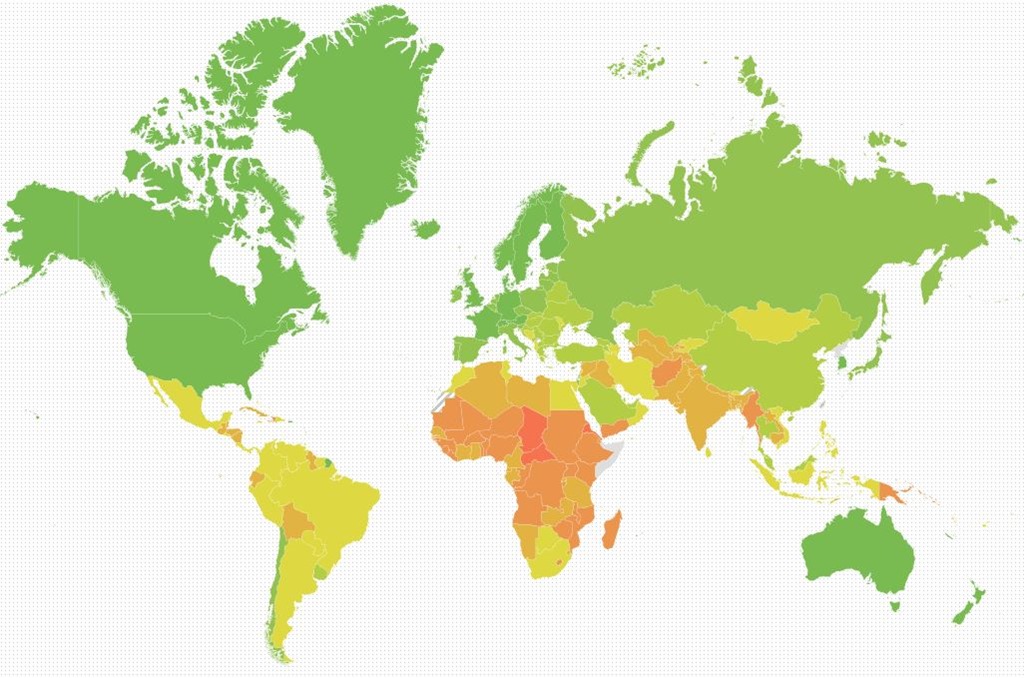
Donald Trump wants to build a wall between the United States and Mexico because he’s worried about immigration from the south. The British voted to leave the European Union partly because of fears over immigration and refuges. Yet many of these same fearful people refuse to believe climate change. Now that might seem like an abrupt change of subject, but it’s not. The major consequence of climate change is mass-migrations. Just look at the University of Notre Dame Global Adaption Index (ND-GAIN). It ranks countries based on projected impact of climate change.
You can see the full ranking of 180+ countries here. Sooner or later, all the top ranked countries will want to build walls to keep refuges from the bottom rankings moving in. The United Kingdom is ranked #4, which makes it a prime destination for most folks fleeing collapsing civilization. The USA is #11. (Maybe England needs to worry about their American cousins moving back home.) Living in a top ranked country might seem lucky because you’ll avoid the worst of climate disasters, but it also means your country will be seen as a lifeboat to those who are drowning.

I have to wonder if climate change deniers are only pretending not know the truth. Just look at ND-GAIN’s map.

Climate Change Vulnerability Map

Most people in trouble will be moving north. I think wall building is either a conscious acceptance of climate change, or an unconscious awareness. It’s reality is starting to sink in.

Notice that most of the refuges the wall builders fear are coming from countries ND-GAIN are listing as vulnerable to climate change. Have climate change migrations already begun? Many countries in the southern hemisphere are suffering from economic collapse, and countries in the middle east are experiencing political, economic and social collapse. All of those locations also suffer from poor weather and limited natural resources. To solve climate change and mass migrations means solving wealth inequality. That’s a very liberal solution, which probably explains why so many conservatives refuse to accept climate change.

Will walls protect the haves from the have-nots? And why haven’t wall builders proposed programs to create stability in countries that are coming undone? Wouldn’t that be more realistic than building Maginot lines on our borders? Instead they want to tear up international trade agreements, which will only make things worse, and thus accelerate mass migrations. If they’d put the money they’d spend on a US-Mexico wall into the Mexican economy, wouldn’t that be more helpful? Wouldn’t a thriving Mexican economy become more effective than a wall?

Venezuela is #107 on the ND-GAIN list. Just read some of the news stories about Venezuela’s economic collapse. Will they become the new Syrian refuges? Brazil isn’t doing well either. How many wealthy South Americans are currently flying over where Trump wants to build his wall? Isn’t it in America’s best interests to make sure South America doesn’t collapse? If the goal of wall building is to stop refuges, isn’t it more practical to stop the creation of refuges than build walls to keep them out?

Rich people have always built walls to protect themselves from poor people. Whether it was walled cities in ancient times, castle walls in medieval times, or gated community walls in modern times, the solution is always the same – protect what I’ve got and to hell with everybody else. And if past walls are indicators, walls only work when the poor aren’t desperate. When wealth inequality gets too extreme, walls fail. And besides, do rich Americans really want to live like Israelis on the West Bank, or Rhodesians in Zimbabwe? (By the way, aren’t the sales of AR-15s a kind of economic indicator? Who are buying more assault rifles, the rich or the poor? And how many of the 99% think they will be walled in with the 1%?)

Donald Trump and all his wall building followers might do well to get into the wealth redistribution business like Bernie Sanders. I highly recommend they read the following books:

These books show us the future. We can solve our problems, or hide behind walls (for a little while).

Building walls are a last-stand tactic. Think how well walls work with zombies. Which makes me wonder if zombies aren’t modern metaphors for poor people, revealing everyone’s underlying fear of being overrun by world poverty. If you don’t want millions of people moving to America, fight climate change and wealth inequality.

What we want is a sustainable economy that is environmentally friendly. Capitalism, as it currently exists, is a Ponzi scheme that’s transferring wealth from the many to the few, with the huge side-effect of creating climate change. It will collapse if we don’t fix it. And we can’t fix climate change without fixing capitalism. If we don’t change things, the 1% will try to wall off us 99%. Trump’s wall is just the first of many that will fail. Denying climate change is merely sticking your head in the sand. Building Trump’s wall is acceptance of climate change, but no actual protection. Trump’s wall is no more practical than The Tower of Babel.

Update:

After writing this I began to wonder how often people and society change. Are we condemned to always follow the same behaviors? That made me think of When Everything Changed by Gail Collins. After I had read that book I realized our society had changed more because of women’s rights than the introduction of computers and smartphones. We’re constantly adapting. And that’s hopeful to realize.

JWH

How To Save The Planet–Without Detailed Instructions

By James Wallace Harris, Tuesday, November 3, 2015

Humans are destroying the biosphere of planet Earth. Homo sapiens have overpopulated the planet, crowding out all the other species, and has initiated a self-destruct countdown. To solve this crisis requires creating a sustainable way of life, one that will ethically accommodate 13 billion people, allow other species to thrive, create a stable weather system, and not poison the biosphere with pollution. This is an immense challenge. There are countless books, studies, organizations, documentaries and pundits claiming they have solutions, but few people agree on anything. (I use the number 13 billion because most people today will see the Earth’s population grow to that number before it starts to shrink.)

The real responsibility falls on us individually. We each have to decide how to live and justify that lifestyle’s sustainability. In other words, any rational for survival you choose must be judged by what impact that lifestyle would have if 13 billion people also followed it. The Lifeboat Earth metaphor applies here. Ethically, we all have a justification to claim one thirteenth billionth of the planet’s resources, excluding the ethical share we first deem is due to all the other species. Our current philosophy is “everyone for themselves” – grab all you can get, and fuck all other humans and all the animals. It is this philosophy that will lead us to self-destruction, and why there is so much hate, violence and stress in the world.

Earthe-Europe1413

Finding an ethical way of living that is equitable to our fellow humans and to all the animals is hard. You will have to do a lot of research, read a lot of books, watch a lot of documentaries, and listen to countless thousands of talking heads argue and argue. One recent documentary I feel is very persuasive is Cowspiracy, a film by Kip Andersen and Keegan Kuhn. I shall use it as an example. At it’s core, the film is trying to do what I’m talking about regarding sustainability. However, I don’t trust it’s numbers, and I’m guessing it’s motivations aren’t entirely honest and straight forward. But understanding these problems I have with the film are exactly the skills we need in evaluating any solution to save the planet.

There is no reason to want or expect us all to decided on the same path. We can each develop our own consumption plan so long as it integrates into the whole, and we each use only our fair share. Before we can begin inventing our individual solutions we need to understand what is our fair share of consumables and pollution. The mathematics of such an undertaking is way beyond my ability. So I never trust other people who claim to have that ability.

I find documentaries that use lots of facts, figures and infographics to be more persuasive than documentaries that don’t. The watchers of these film must deal with is whether or not the film’s figures are accurate. Even cheap, crudely made films can have great impact, such as Cowspiracy. I was far more moved by Cowspiracy than I was the more famous and better made, An Inconvenient Truth. Both appear to be about climate change and environmentalism, but I suspect the underlying motivation by Cowspiracy is animal rights. Andersen and Kuhn contend that raising farm animals has more impact on the environment than all burdens the various transportation industries place on the planet.

Do their numbers add up? Is their basic assumption correct? They are offering a reasonable solution to save the planet. Are they right? They offer a very simplistic path to solving the sustainability problem. First, watch the film Cowspiracy (free on Netflix streaming, $4.95 digital download, $19.95 DVD). Their solution, stop eating meat, poultry, fish and dairy. We must evaluate their plan. Would choosing a plant based diet make a sustainable lifestyle? Cowspiracy defines the sustainability issue properly, but I doubt their numbers justifying their solution, even though I’m personally pursing a vegan lifestyle and I’m for animal rights. I’m willing to consider that there might be ethical ways to eat meat that is sustainable.

Whether or not to eat meat, and whether or not raising food animals has a massive impact on the environment are a highly contentious issues. You can can find people on both sides of the argument claiming they know the truth and throwing out tons of facts and figures. I wish to set the ethical issues of killing animals aside for a moment, and just consider Andersen and Kuhn’s assertion that raising animals for food has a greater impact on the environment than all of the transportation industries combined. Does giving up meat help the environment significantly? More than going to mass transit and switching to a renewable energy based economy?

My guess is we could greatly improve meat and dairy production to make it sustainable, but it might require that people eat a lot less animal products than they do now. And even then, we’d still have to bring back the issue of animal cruelty. Andersen and Kuhn do define many of the issues we have to consider in creating a personal sustainable lifestyle.

  • We all have a fair share of fresh water this is sustainable, but will vary by location.
  • That a sustainable lifestyle will impact specific area of land.
  • That land set aside for humans should leave plenty of natural areas for animals.
  • That the impact of our land requirements not impact the weather, pollution or the biosphere.
  • That our personal energy use must be sustainable.
  • That we shouldn’t let people starve while we feed animals to produce meat.
  • Can we raise animals so they have quality lives before we kill them?
  • Are there humane ways to kill animals?
  • Is it ethical to kill animals?
  • Should you eat any animal that you didn’t personal kill?
  • Should we give land to food animals when wild animals have so little?
  • That factory animal raising is not sustainable.
  • That free range animal raising is less sustainable than factory animal raising.
  • That industrial fishing isn’t sustainable.

I’ve been a vegetarian since the 1960s, and in the last couple years I’ve been veering towards veganism to reduced the clogs in my arteries, so Andersen’s and Kuhn’s solution would be no sacrifice for me. It would demand a tremendous change for most people, and a drastic transformation of society. Can you imagine if all restaurants were vegan and all grocery stores health food stores? I’m going to assume Cowspiracy plays fast and loose with its numbers simply because the film is on the amateur side. On the other hand, I’m going to assume they might be right and explore their solution.

We often admire members of The Greatest Generation because they survived The Depression and WWII. We admire their determination and sacrifice. We admire first responders and soldiers for their dedication and heroism. Often I meet people who wished they had done more good in their lives, or even lament they hadn’t done something extraordinary like their heroes. Some even feel their life has been without meaning. I don’t believe you need to be Pope Francis or Martin Luther King to help other people and make a great sacrifice. Just being decent, law abiding and nonviolent adds a lot to our society. Choosing not to act like an asshole and controlling your temper goes a long way toward bringing peace on Earth. Of course, I think many folks reading this will say they’d prefer to work inside burning buildings or go to war in Afghanistan than give up eating meat. However, from now on out, the best thing we can do for our fellow humans and our descendants is live a sustainable lifestyle. Are we willing to make that sacrifice and dedicate ourselves to meeting the challenge?

You need to see the film to be convinced that animal farming is having a greater impact on the Earth than all forms of transportation combined. Cowspiracy asks why all the major environmental groups are not focusing on the biggest problem the planet faces. If Andersen and Kuhn are right, then the single quickest way to fight climate change, the current mass extinction of animals, the destruction of the oceans, the collapse of civilization and create a sustainable society is to give up eating animals. The documentary points out that a plant based diet is sustainable, and it’s healthy. My own research into healthy diets is uncovering more and more doctors advocating a plant based diet. Giving up meat is better for the planet and better for you, and gives us hope for our descendants. However, I don’t know if Andersen and Kuhn’s numbers are anywhere near accurate.

Will people give up eating meat? I doubt it. Republicans are taking the brunt the responsibility for not doing anything about climate change because they refuse to give up fossil fuels. What if giving up meat could actually solve climate change without waiting on new renewable energy technologies? I doubt even liberals would embrace that solution. Why are bacon and eggs, milk and cheese, beef, chicken, pork and fish so important to us? What if the facts and figures in Cowspiracy are right?

Are there any sustainable sources of animals products? If people raised chickens and rabbits in their backyards, feeding them with yard grown food, would that be sustainable? What about hunters culling deer populations every year, or other animals that could live abundantly in the woods without human support? What if all fishing was from hook and lines? Andersen and Kuhn make it obvious that neither factory animal farms, or free range animal farming are sustainable. But what if everyone hunted their own meat? What if you really wanted to eat meat and were willing to hunt down an animal, kill it and butcher it, you could eat it and be sustainability justified? Andersen and Kuhn assumes all the land that went into grazing or raising food for livestock would be returned to the wild. Would that be true?

We all ignore the fact that we’re consuming more than the Earth can give. Humans are increasing in numbers while everything else is decreasing. We’ve been laughing at The Limits of Growth for forty years because the book hasn’t come true. We always assumed science and technology would continually solve the problems of exponential growth. The Club of Rome didn’t anticipate disruptive technology, but their basic premises were still correct. The Earth’s resources are finite and consumption can’t increase forever.

Table of Contents