If Ignorance is Bliss, is Knowing Suffering?

by James Wallace Harris, 6/27/24

This essay is about how keeping up with current events is hard on our mental health. Is there a point in becoming informed that turns self-destructive? Happiness seems to be a balance between knowing and not knowing, between learning and ignoring.

I’ve always been amazed by the amount of fiction we consume in our lives — the books, movies, television shows, plays, video games, role playing, comics, fantasizing, bullshitting, and so on. Is fiction our way of regulating our awareness of reality?

I’m trying to decide in this essay just how much news I should consume. I believe I have three basic choices:

  1. Ignorance really is bliss.
  2. Learn enough to maximize my own survival.
  3. Learn everything I can to answer why and maybe know what can be changed.

I also consider the first three lines of the Serenity Prayer practical advice:

God grant me the Serenity to accept the things I cannot change,
Courage to change the things I can, and
Wisdom to know the difference.

Mental health depends on knowing what can be changed and what cannot. I believe the old saying, “ignorance is bliss” is merely advising people not to try to change things. Eastern religion and philosophy are all about acceptance, and that might be one path to happiness, or at least contentment. Western religion and philosophy have always been about control, which often leads to frustration and unhappiness. However, Western religion and politics have always been delusional because they don’t know enough to wisely make changes. Too many people think they know, but don’t. And too many people pursuing ignorance follow the people who don’t know. In other words, even if you learn everything you probably won’t be able to do anything.

For most of my life I hoped humanity would evolve into a global humanistic society that was ecologically sustainable, maximizing freedom, and minimizing inequality. That’s obviously not going to happen. Instead, we’re returning to nationalism, xenophobia, and fascism. The growing consensus advocates: get all you can, protect what you have, and let the losers lose. Even Christians have become Darwinians.

The main message in the movies and television shows we consume is the good life is eating, screwing, buying, and travel. But hasn’t that made us the most invasive and destructive species on the planet?

I believe the fiction we consume, and the fantasies we chase, is our way of self-medicating a deep depression caused by seeing too much of reality. If I read or watch too many news programs, documentaries, or nonfiction books about what’s happening around the world I get bummed out and need to retreat. Is that the best thing to do? Or the only thing to do?

How much of learning about reality is educational, soul strengthening, and enlightening? Billions of people are suffering. How important is it to know that the majority of people on this planet spend a good deal of their lives in misery?

If you only watch NBC Nightly News, Fox News, MSNBC, or CNN, you’ll only end up worrying about problems in the United States. And that’s enough to depress most people. But if you take in news from around the world, it can deeply threaten your mental health.

I watch a lot of news from all over, and I’m convinced that our civilization is in decline. The number of failed nations grows every year. The number of weather catastrophes increases every year. Wars and famines are increasing. Life expectancies are declining. Economies are breaking down, and people are dying, becoming homeless or refugees, and suffering in ever-growing numbers. We’re lucky in the United States that we don’t suffer as much, but that’s why millions want to come here.

Decades ago, I stopped watching local news so I wouldn’t be depressed about crime. Even though I live in a high crime city, I seldom hear about it, and thus seldom worry. I could do the same thing with national and international news. That would be good for my mental wellbeing, but shouldn’t I do something?

Liberals believe society should alleviate suffering through laws. Conservatives want to solve the same problems by convincing everyone to pull themselves up by their bootstraps. The reality is liberals want to solve society’s problems by spending the conservative’s money, and the conservatives just want to ignore the problems and keep their money. And it seems the only problem politicians really want to solve is how to get reelected and feed their egos.

Civilization is coming undone. That’s all too obvious if you watch a lot of news and study local, state, federal, international, and world events. However, knowing, and even understanding the problems we face doesn’t empower us to solve them. We either solve them together, or not at all, and if you’re an ardent news watcher, you’ll know we’re living in an age where we don’t work together.

Here’s where I’d love to list and catalog all our problems and assess their chances of being solved. But that would take a book length bit of writing. I’m sure you see enough of the news to know about all the problems we face — or do you? Would knowing more help or hurt you?

I could construct a detailed taxonomy of all the problems we face. I could stop reading novels and watching television and study the heck out of current events. But other than finding enlightenment about why civilization is collapsing, are there any mental, spiritual, or psychological benefits to learning how and why we’re self-destructing?

The real question is: Can we do anything to stop our self-destruction if we all agreed to work together and knew the right solutions? Even if we banned all airplane travel, reduced car travel to a minimum, rebuilt the energy grid that maximized renewable energy, and we all became vegetarians, we’ve already put enough CO2 in the atmosphere to radically change the climate. We may have already destabilized the climate so it can’t be reversed.

And we don’t have to wait until the seas rise above New York and London before climate change will do us in. We’re about to see the collapse of the home insurance industry which will completely destabilize the economy around home ownership. Just that might bring about economic chaos.

I could go on. Aren’t we like cattle in a stockyard? Would knowing about the captive bolt pistol offer any personal benefit in our lives? Or is there a kind enlightenment to be achieved by figuring out how the system works?

JWH

We’re Never Going to Change

by James Wallace Harris, 4/15/24

Years ago, I read This Changes Everything by Naomi Klein. It was a passionate plea to act on climate change because if we didn’t everything would change. Her new book, Doppelganger, is a metaphor about our polarized society and what keeps us from changing even though Klein still makes a case that we need to change.

Between reading these two books I gave up all hope that humanity would change. I read Doppelganger as further proof that we won’t change even though Klein again passionately expresses the rational reasons why we should. I also believe we all need to change, but sadly, I don’t believe we will.

Doppelganger begins with Naomi Klein explaining how people on the internet often confused her with Naomi Wolf, a once respected feminist who is now considered a conspiracy crank. Klein uses the idea of the doppelganger as a metaphor for how to relate to our opposites, whether male/female, black/white, liberal/conservative, religious/atheist, Christian/Jew, Israeli/Palestinian, etc.

Klein goes to great lengths to make the metaphor work in several situations, but I found that distracting. What the book does exceptionally well is to ask: How do we decide what to do when half of us disagree with the other half? We all assume there is one truth, but everyone sees a different side of it.

In many chapters Klein makes Wolf seem ridiculous, but there are quite a few places where Klein recognizes Wolf’s point of view, or even gives her credit for being right.

I believe that extremists on the left act like naive young children, while extremists on the right act like selfish young children. In other words, I believe Klein is unrealistically hopeful, while Wolf is self-centeredly overly positive.

I must assume Klein writes her books believing we can still change. With Doppelganger she’s hoping that if we can get together and endeavor to understand each other we can make rational compromises. That would be lovely if she were successful and right. I believe Klein is right but won’t be successful.

We are doing essentially nothing towards controlling climate change. Wars, collapsing economies, and weather catastrophes are on the increase. Our responses are becoming more irrational, rather than wiser. We must face the fact that evolution works on all levels, and Darwinian conflict will always prevail.

The strong are going to take what they want at the expense of the weak. To solve all the problems Klein covers in her books would require overcoming our Darwinian natures and everyone acting for everyone else’s good. I no longer believe we’re capable of such altruism.

In the early days of Christianity, its philosophy was anti-Darwinian. But modern Christians have lost all their compassion. Christianity has been dissolving for centuries. The compassionate Christians gave up on God and became liberals, and the ones left became conservatives who rewrote Christian ideals with serving rationality that backs evolution.

In other words, I believe early Christianity, and 20th-century secular humanism were two times in history where we tried to fight our Darwinian natures, and in both instances, the movements failed.

We’re not going to change.

Not to end on a completely depressing note, I’ll try to offer a somewhat positive idea. Since we won’t change, the environment will. How can we use our Darwinian nature to build hardened societies that can survive climate catastrophes? Don’t read too much hope into that. What I’m saying is how can the strong survive the coming changes we chose not to avoid?

JWH

Democracy Awakening by Heather Cox Richardson – Review Part One

by James Wallace Harris

Americans have general thought of America as a democracy, although it’s never been a true democracy. When the United States of America was first created a limited number of white males could vote. As time progressed more white males were allowed to vote. As liberals and radicals influenced politics, they advocated for wider suffrage state by state. See this timeline for details, but the Fifteenth Amendment in 1870 gave black men the vote, and in 1920 the Nineteenth amendment was passed that gave women the vote in all states. Whites have always suppressed black voters, and even some men still resent women voting. And political parties have always tried to control who could vote and how, and even suppressing voting.

A true democracy would allow every citizen over a certain age to vote, or universal suffrage. Before the 21st century most Americans didn’t see that as a problem, but as ethnic demographics have changed it has turned some Americans against democracy.

America is supposed to have a representative democracy, but it inspired the formation of political parties supported by various special interest groups fighting for power. In America Awakening Heather Cox Richardson describes how we’ve reached the current state where liberals advocate more democracy and conservatives push for less, apparently wanting authoritarian rule instead. Authoritarians general promote some ideal in the past as the authority of how things should be govern. Most modern American authoritarians look to either the Founding Fathers and the Constitution or to God and The Bible, or a combination of both. Modern American authoritarian leaders tend to be white and paternalistic, and their followers tend to want a strong man, or strong father figure, although more women are wanting to be Republican leaders too.

Richardson says it’s important to understand that many terms like conservative, liberal, radical, Republican, and Democrat have changed over the centuries. In the 19th century Republicans were for African Americans voting, and for gun laws, and in the early 20th century, for regulations on corporations. In the 19th century and through the first half of the 20th century, Democrats tried to keep African Americans from having the vote. The Republican and Democratic parties went through a polarity change in the 1960s. Richardson says its important understand how words have changed meaning because authoritarians often abuse them and justify their abuse by claiming history supports their new definitions. In other words, history gets distorted and abused.

I’m reviewing Democracy Awakening because I think it’s an important book everyone should read for the 2024 U.S. presidential election, but also to push my ability to remember. I love reading nonfiction books, but their information often feels like it goes in one ear and out the other. I can only retain what I learn in the vaguest way. Since I’m also reading about memory and aging, I’ve decided to read Democracy Awakening differently. I’m going to distill what Richardson is saying into my own words but in some concise form that I hope I can remember. I’ll do that in a series of blog posts, outlines, tables, etc.

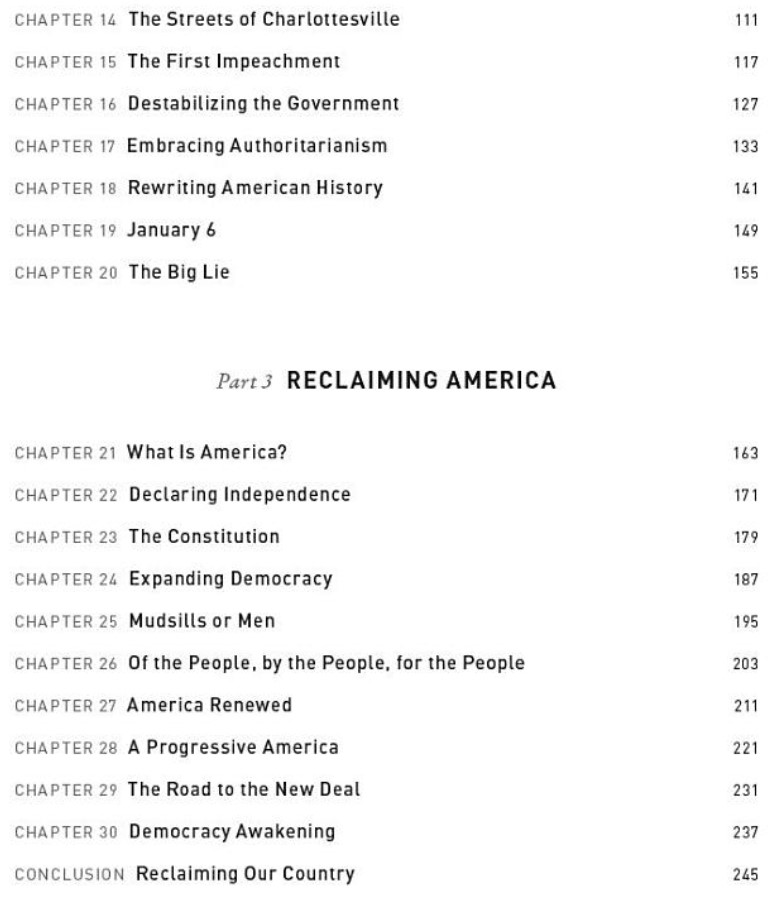
My friend Linda and I are reading Democracy Awakening together and for our first discussion we are covering Part 1, Chapters 1-10, which I hope to cover today. Here is the Table of Contents.

Because I’ve also read other books on this subject already, including watching related documentaries and YouTube videos, I’m going to reference them in this series to show how there’s a synergy in my reading.

Heather Cox Richardson is a history professor who has specialized on the history of the Republican Party through a series of books. I have not read these books, but I have read some about each and it gives me confidence that Richardson is an expert on this subject. On the internet there are zillions of people claiming to be knowledgable on specific subjects but when you check into their creditials, you find little to back their claim of authority.

Richardson makes her points by citing historical events. I wish I could remember all the cited dates and important changes in history because they show an evolution of how we got to today. The first ten chapters progress mostly in a linear fashion, so I hope to eventually create a timeline.

Richardson also quotes significant papers, speeches, books, and other sources to reveal how concepts emerged that cause people to seek political change. Just the history of African Americans seeking Civil Rights reveals many connections to how conservatives and liberals changed their parties and political goals. I’d like to make a list of the most significant quotes to remember. And I’d like to read the books Richardson references, including books by conservative writers. But this will take a lot of time.

And there’s another problem, both conservatives and liberals use the Founding Fathers as historical authority even though members of both political parties distort history for their cause. Republicans like to cite the past, both the Founding Fathers, and The Bible, as how to create or interpret laws. This is rediculous. 2023 isn’t 1776, or 800 BCE. Yet, reading Richardson’s book Democracy Awakening shows the democracy we have today is constantly changing, and how those changes comes from actions in the past.

It is well documented that Republicans feel the United States took a wrong turn in the 1930s when FDR’s administration created the New Deal. They’ve been trying to undo it ever since. And their methods and philosophy of why and how have evolved over the decades. Part of that evolution is moving away from democracy, which is what Richardson’s book is about.

Richardson believes we didn’t fall into fascism in the 1930s because the United States has a long history of various groups fighting for suffrage. That the history of United States is one of a ruling class struggling to keep power from various groups of people wanting to vote. This includes poor whites, African Americans, women, and immigrants. The current Republicans know they cannot win with universal suffrage and fair elections and so they have to do an end run around democracy.

Republicans formed coalitions with special interest groups that the leaders of the party have no interest in supporting. What has changed is the special interest groups have taken over the power from the old Republican elites. Neither the Republicans nor Democrats have a clear majority with voters, and depend on Independents who swing their votes.

The main problem revealed in the first part of Democracy Awakening is the country is dividing itself into two camps. Those who want an authoritarian government based on their version of the Founding Fathers and their version of Christianity, and those people who want universal suffrage and a true democracy.

The authoritarians cannot get what they want by existing voting laws and population demographics. That’s why they are undermining the election process. Since majority rule is 50%, these two groups are polarized. Neither Republicans or Democrats have a majority. They depend on swing votes from Independents.

What I’m hoping to see in the next two parts is whether or not Richardson thinks democracy can survive. I was recently terrified by a New York Times essay, “Trump Has a Master Plan for Destroying the ‘Deep State’” by Donald P. Moynihan. In it Moynihan says Trump has three goals which I’ll take out of context and quote here:

The first is to put Trump loyalists into appointment positions. Mr. Trump believed that “the resistance” to his presidency included his own appointees. Unlike in 2016, he now has a deep bench of loyalists. The Heritage Foundation and dozens of other Trump-aligned organizations are screening candidates to create 20,000 potential MAGA appointees. They will be placed in every agency across government, including the agencies responsible for protecting the environment, regulating workplace safety, collecting taxes, determining immigration policy, maintaining safety net programs, representing American interests overseas and ensuring the impartial rule of law.

...

The second part of the Trump plan is to terrify career civil servants into submission. To do so, he would reimpose an executive order that he signed but never implemented at the end of his first administration. The Schedule F order would allow him to convert many of these officials into political appointees.

Schedule F would be the most profound change to the civil service system since its creation in 1883. Presidents can currently fill about 4,000 political appointment positions at the federal level. This already makes the United States an outlier among similar democracies, in terms of the degree of politicization of the government. The authors of Schedule F have suggested it would be used to turn another 50,000 officials — with deep experience of how to run every major federal program we rely on — into appointees. Other Republican presidential candidates have also pledged to use Schedule F aggressively. Ron DeSantis, for example, promised that as president he would “start slitting throats on Day 1.”

...

The third part of Mr. Trump’s authoritarian blueprint is to create a legal framework that would allow him to use government resources to protect himself, attack his political enemies and force through his policy goals without congressional approval. Internal government lawyers can block illegal or unconstitutional actions. Reporters for The New York Times have uncovered a plan to place Trump loyalists in those key positions.

This is not about conservatism. Mr. Trump grew disillusioned with conservative Federalist Society lawyers, despite drawing on them to stock his judicial nominations. It is about finding lawyers willing to create a legal rationale for his authoritarian impulses. Examples from Mr. Trump’s time in office include Mark Paoletta, the former general counsel of the Office of Management and Budget, who approved Mr. Trump’s illegal withholding of aid to Ukraine. Or Jeffrey Clark, who almost became Mr. Trump’s acting attorney general when his superiors refused to advance Mr. Trump’s false claims of election fraud.

This is why I believe everyone should be reading Democracy Awakening. I believe Richardson’s book is defining what the 2024 election will truly mean at the deepest level.

JWH

Sometimes We Really Do Want More Government Regulations

by James Wallace Harris, 4/27/21

Please watch this fifteen minute video from NBC News. It is the most insightful news story I’ve encountered this year because it encapsulates many of the essential issues about the future.

This video illustrates why lack of regulations and resource management leads to ordinary citizens and the environment losing to big business. Corporations and people with money wanting to make more money are searching the globe for places where they can get any kind of competitive edge with their investments. Basically, big business and rich individuals will gentrify every last acre on the planet, pricing ordinary people off their land.

Southeast Arizona has very little surface water and rainfall. For decades homeowners, family owned farms and ranches, and towns have been sipping off the top of their aquifer. As long as rains replenish that aquifer, life in the desert is sustainable. However, global corporations have discovered this Arizona land is essentially unregulated and the water is there for the the price of sinking deeper wells. This makes it profitable for corporations from around the world to exploit this area. Raising hamburgers and cattle feed in the desert seems insane until you realize the real value of water.

Water is the new gold rush, and some locales are trading their water for jobs and investments. However, once that water is gone, that locale, that environment will die. Keep an eye on this trend. You’ll see it everywhere once you start looking.

As the corporations put millions into exploiting this land, drilling ever deeper into the aquifer, they have gained control of the land because ordinary people can’t afford to extend their wells deeper, and are thus force to sell out and move. Local control over land is going to disappear.

A kind of corruption is taking place. Politicians back the corporations because they follow the money. Notice how toady the politician is in this video. People who don’t own land and just want jobs align themselves with the corporations. And even though the corporations claim they are there for the long haul, the reality is they are there as long as they can make a profit. Once they suck the aquifer dry or it becomes too costly to pump that water out of the ground, they will leave.

This is happening all over the world. The long term results is the total land area that is sustainable for life on Earth is shrinking. The dynamics of what’s happening here also reveals various kinds of inequality in action. Ordinary people can’t compete. Neither can nature. Basically, outsiders with money have all the power. If the local government had regulations about land and water use they could preserve their old way of life. They could build a sustainable society. Corporations have played the democratic system to get what they want. Read Dark Money by Jane Meyer or Evil Geniuses by Kurt Anderson for fuller explanations.

Right now we have an exploitation society. The rules are simple. Anything you can do that others can’t stop you from doing, you can do. Individuals can’t compete against corporations. And since corporations are rigging the laws, there’s little people can do – unless people take back their democracy. But it might be too late. There is little demand for sustainability. Corporations want to make money, and individuals want jobs. Unless people can create jobs that coexist with sustainable economies, things won’t change.

When you watch this video think about the two opposing groups. On one hand, you have the global demand for meat and dairy, which includes all of us, and a few individuals who have been living in southeast Arizona for decades. Corporations just fulfill the global demand. But what if the global demand becomes greater for sustainability and the environment? We all have to want it, or it won’t happen.

JWH

The Future Is About Jobs

by James Wallace Harris, Saturday, 1/16/21

Most people assume the best possible society will be one where everyone has a good job and can be self reliant along with the freedom to make what they want out of their life. That was the direction America was taking until a revolution in the 1970s, when a few people had a new vision of the future. Since then the best possible society was decided in favor of the wellbeing of corporations over a the last five decades. Unfortunately, corporate success depends on having fewer employees. They have chosen profits and automation over people. The citizens of America want jobs, but the citizens of corporations want profits. Whose future will win out?

If you put your faith in politicians and think they will bring happiness to Americans with more jobs then you are deluded. The past four years were Trump feeding his massive ego which distracted us from the real issues. But electing Biden is not going to save us either. Arguing over partisan politics is like brawling in the ballroom of the Titanic an hour before hitting the iceberg.

If we stay on our present course America will collapse economically before climate change can do us in. If we want to avoid both hells then we must decide on a better final destination. It will require cooperation. It will also require knowledge, but not the kind of knowledge you can get off the internet or cable news. The amount of knowledge needed will require studying books, lots of books, and not books written by egomaniacs trying to become rich.

The problems we’re facing and will face are so enormous that it will take a significant percentage of the population working together to solve them. If we want that future where everyone has a good job it will require a new kind of education. We used to believe higher education guaranteed a successful future. But the kind of education I’m talking about is not technical job training or academic enrichment. What we need is to educate ourselves about a holistic understanding of our present reality. However, most citizens of this society have chosen to deny reality, or accept it and just enjoy themselves as much as possible before the apocalypse.

Remember in The Matrix when Neo was told he’d need a lot of guns to overthrow the machines, and rows and rows or armaments sped past him? Yeah, well we need to read lots of books, rows and rows of bookcases. At a guess, a good portion of the voting population needs to start reading one important nonfiction book a month to alter our path and avoid the twin icebergs of climate change and wealth inequality. Will that happen? I doubt it.

We’re now more polarized politically than anytime in my lifetime. The country is almost perfectly divided into two opposing philosophies. The conservatives want free market capitalism with winners take all. The liberals want capitalism supplemented with socialism to protect the losers. Strangely, I see it as the Darwinians v. Christians, even though the conservatives see themselves as Christian, I see them as advocates of survival of the fittest, while liberals want to follow the teachings from the Sermon on the Mount, yet expect the Darwinians to pay for the sick, lame, and homeless.

If we continue on the current path blazed by libertarian free-market true believers, all the wealth will be sucked out of the middle and lower classes, and probably even from the lower upper classes. The future promises a small wealthy class with their robots and corporations, and a vast lower class, struggling to survive off a small basic income. If you believe in trickle down economics then why are the richest cities in America being overrun by homeless encampments and decay? If you don’t believe me watch these videos about L.A., San Francisco, and Miami.

These are just a few images that show the result of our present economic policies. They are like the early signs of climate change that everyone wants to ignore. I’m old enough to look back over 50-60 years of history and change. Most people believe things stay the same. They don’t. The societal erosion you see in these films will spread like kudzu unless we change course. But how?

In physics we’ve learned that space and time are really one thing and we should refer to it as spacetime. And we’ve also learned that the mind and body are not separate and should refer to it as the mindbody. Well, the same is true for politics and economy, it’s really the politicaleconomy. When new concepts emerge they go through a phase first as two words, then as two-words, and finally as oneword. We’re still thinking in the political economy phase, but after reading Evil Geniuses by Kurt Andersen I’m going to think of it as the politicaleconomy, and even bypass the hyphen phase.

If you only see politics in terms of liberal and conservative, or Democrats and Republicans then you’re only seeing the tip of the iceberg. If you only look at the economy in terms of gains and losses then you’re not even seeing the tip. Evil Geniuses will not give you a complete holistic view of current politicaleconomic reality, but it will hint at it. Andersen is a synthesizer who has written a history of the politicaleconomy beginning in the late 1950s to show how our present state of the politicaleconomy evolved. It’s very complicated, and like Einstein working to develop a Grand Unified Theory Andersen does not succeed.

It comes down to simplex, complex, and multiplex. Most humans want simplex answers to explain reality. The more we study reality, the more complex reality appears. Focusing on single systems causing complexity in our minds. It’s only until we try to see how multiple systems work together that we develop multiplexity of thinking.

Personally, I’m smart enough to see complexity and intuit a bit of multiplexity. I believe Andersen is able to mentally juggle several complexities and visualize a certain level of multiplexity to be able to write about it. I envy him that ability. I envy that because simplex thinking is very satisfying. Complex thinking is stressful, even painful and discordant. It’s only until we get into the multiplexity stage do things become calm again, and we hear the harmony of relationships between system interactions.

Reading Evil Geniuses and exploring the individual observations Andersen makes has reduced some of the political anxiety I acquired from 2016-2020. Donald Trump wasn’t the real issue even though we’ve agonized over his impact for years. He was just a rash and not the underlying disease. Most Americans are riled up politically but are looking for answers in all the wrong places. We keep trying to cure symptoms and not the disease. Until we think of the politicaleconomy as one holistic system that includes all life on Earth we’re going to stay the course towards extinction. We need to be working towards a new word, the politicaleconomybiosphere.

I cannot properly review this book without restating almost everything that’s in it, and Kurt Andersen has already done that, so just read it. Don’t expect to accept everything he says. I haven’t yet. But if you’re like me, do expect to want to read his sources, or at least other books about the issues covered. For example, I bought a Milton Friedman book to understand the other side of things. One book ain’t going to cut it. If you’ve ever gotten fascinated by a subject and had to read everything you can about it, that’s how I feel now about the politicaleconomy.

Reading Evil Geniuses made me realize I wasn’t paying proper attention to the history of the last fifty years. Andersen chronicles no secret cabal of conspirators, all those evil geniuses were working completely out in the open. Another realization I take away from the book is don’t assume the nightly news will tell us what we need to know. Following the sensational stories on TV and the internet is watching the delusional argue over how many angels fit on the head of a pin.

Understanding comes from longer essays, like those in The Atlantic or The Economist, or from good solidly researched books. And that reading never ends, because there’s always need for deeper insights. For example, I think I need to read The Rise and Fall of American Growth by Robert J. Gordon to understand the history before the history outlined in Evil Geniuses and Dark Money by Jane Mayer. But it’s also important to read opposing views, like Age of Discovery by Ian Goldin and Chris Kutarna.

That’s a lot of relentless reading. Is it practical to imagine that a significant portion of the voting public will do this kind of reading? No, not really. That’s why the movers and shakers of the economic right were able to achieve their goals. They used their knowledge to change just a few institutions and people to alter the course of history. Can liberals make such surgical decisions to reflate the wealth of the middle and lower classes? I won’t know until I read a lot more. If you know of any books that offer such insights, let me know.

JWH