Would You Hitch a Ride on an Alien Spacecraft?

Over at the Classic Science Fiction book club a member said she would gladly go off with an alien visitor to see their world.  We were reading Calculating God by Robert Sawyer last month, and the main character has to make that decision.  Other members in the club also said they would go if they didn’t have wives and/or children.  The original replier even said she’s take an anal probe if that’s what it took to hitch a ride as long as the aliens provided her with the necessities of life.  She thought it would be the grandest experience possible.

I’ve seen this discussion before and many people claim they would hitch a ride on an alien spacecraft.  But why?  When I was young I would have said the same thing because I had space fever so bad, but now that I’m older it doesn’t seem wise.  Don’t get me wrong, I want to know about life on other planets, and I’d love to see other worlds, but HD video will be plenty good for me.

Has science fiction oversold the romance of space travel?

Now this discussion is for a one way trip only.  All or nothing.  And it still get takers.  When NASA was first planning trips to the Moon there was even discussion of one-way trips, and one-way trips to Mars have also been discussed, and there’s always folks claiming they would volunteer in second.

How bad do people want to go into space?  How much do they want to see another habitable world?  Evidently quite a lot.

Now in the book Calculating God the main character is dying of cancer and his decision is whether to die on Earth or out in space, so the hardest part of the decision was whether to leave his wife and kid, losing his last few months with them.  But I’m hearing from people they would go even if they weren’t dying.

I have to compare this to Christians who want the Rapture to hurry up and come.  It seems some people want certain answers very badly.  In Calculating God the whole world knows about the alien visitors.  They are scientists who come to Earth to work with other scientists, and when they leave they ask a few human friends if they’d like to come along exploring with them.  Under those circumstances my questions about life on other planets would already be answered.  The aliens brought lots of data and video with them about their worlds and the worlds they had already explored, so that would have been good enough for me.  So why do some people just have to go no matter what to see for themselves?

Do some people need a deeply mind-blowing adventure to make their lives worthwhile?  Is a portion of our population totally dissatisfied with a normal life on Earth?  Or is there a travel gene that makes some people want to roam?

Or has science fiction sold us a romantic view that’s irresistible to some?

Or consider the reverse, maybe we love science fiction because we have genes that want to explore the universe and we can’t go.

I’ve always compared science fiction to religion, and outer space is the modern substitute for heaven, and aliens are the angels.

A couple of book club people mentioned they’d like to be ambassadors for the human race.  And one member said if he was the only one going it would be more important than if he was one of hundreds, so the desire to have a unique experience is a factor.  Another member reminded us of Close Encounters of the Third Kind where the Richard Dreyfuss character leaves seemingly without thinking about his wife and children.  That implies a very strong desire to go joyriding with aliens.

This overwhelming desire to go to an alien world reminds me of love and sex.  How often have you been overwhelmed with love and sexual desire and then got lucky with the person of your desire, only to discover that the sex and relationship wasn’t everything you dreamed it would be?

Is travel to the stars so irresistible because it’s something we can’t have?  What if we got to consummate this love and the aliens turned out to be annoying as hell, and you became jaded over their beautiful exotic world after six weeks?

This desire to go to the stars seems very powerful.  I wonder if Freud or Jung ever examined it?

JWH – 8/2/11

Can a New Science Fiction Inspire a New Space Program?

Many people firmly believe that science fiction was the original inspiration for sending men into space and going to the Moon.  I don’t know if that could ever be proven, but there’s a certain logic in thinking dreams come even before the horse or the cart.

The space program has lost its way.  The Shuttles are being mothballed, and we’ve never left LEO for four decades now.  If we’re honest, we’ll admit it was the cold war politics that got us to spend billions on NASA, and  I’m afraid real science has made space a far less appealing destination than the fanciful vistas of old pulp fiction.  Robotic probes have toured the solar system and we have a very realistic view of off Earth real estate, and the sites are far from the exotic locales described by our cherished space opera.

Yet, I have to ask:  Can a new kind of realistic science fiction, incorporating the latest scientific knowledge about space, make the final frontier sexy again?  I remember talking many years ago with a young woman about space exploration.  She said unless we had spaceships like the Enterprise in Star Trek: The  Next Generation then it wasn’t worth traveling in space.  I have a feeling most people think that too. 

I told her it was unlikely we’d ever have spaceships like NCC-1701-D and she acted like I had told her there was no Santa Claus.  She had assumed such luxury space travel would be available soon, or at least well within her lifetime.  Her attitude was, if we can’t travel in comfort, why go into space at all.

And there’s the rub.  The final frontier will be rougher than any frontier a pioneer has experienced in the history of our species.  Science fiction originally sold space exploration as an colorful adventure vacation.  Now we know it’s going to be more like years of reconstructive surgery and physical rehabilitation with little hope of full recovery.

There are only two destinations for people in our solar system: the Moon and Mars.  Forget the satellites of Jupiter and Saturn, they are much too cold and those systems have tremendous radiation levels.  The Moon and Mars are far from habitable, but with determination we might colonize them.  But we can’t oversell those two worlds like Kim Stanley Robinson did in his Red, Green, Blue Mars series.  That trilogy was among the best “realistic” science fiction in recent decades, but it had way too much fantasy for the kind of science fiction I’m suggesting here.

Can a new generation of science fiction writers envision practical human life on the Moon and Mars in such a way as to sell the idea to the tax paying public?  So far a majority of the public refuse to believe in evolution, so I find it hard to imagine such scientific science fiction selling, but it’s still a possibility.

JWH – 6/21/11

The Ethics of Interstellar Colonization

We science fiction fans have always assumed the destiny of mankind is expanding our habitat across the galaxy, exploring new worlds, conquering new frontiers, expanding our territory, because that’s the kind of species we are.  But what are the ethical issues involved.  Think of the Federation policies in Star Trek, and it’s rules about first contact.  It’s pretty obvious that we should leave emerging civilizations alone, to let them find their own way, but what are the right ethical conditions for us to land on a planet and start colonizing it?

If it’s a rocky world like Mars I would think there would be no problems at all, even though some people do advocate leaving Mars untouched.  I think we at least have to establish two ends of the spectrum.  On the left is a dead world, and the right is emerging intelligent life, somewhere in between is where we need to place our mark as the beginning point for not interfering.

Let’s say we landed on a planet that had life like in the Jurassic, tiny brains and big bodies, and no chance of intelligent life appearing for a hundred million years, would it be okay to stay there and setup a colony?  Ignoring the butterfly effect, it should be possible to colonize this world without misdirecting the path of its evolution.  Now we couldn’t utilize this world like we’ve done Earth, using up all the resources and killing off endless species, but it might be possible to coexist with the indigenous life without doing much harm or changing its evolutionary direction.

It would be unethical to use up the heavy metals and other minerals, so we should import them from off planet and make sure we didn’t produce significant waste.

So how close in time to an emerging self aware intelligence should we stay?  Could we live on a planet with a homo erectus type intelligence and just avoid contact with them?

What about bringing other species with us from Earth?

What if we found a planet with simple life in the ocean, and simple plant life on the land, maybe just grasses and fern type species.  Should we introduce fish, trees, vegetables and fruits, along with dogs, cats, chickens, pigs, sheep, cows and horses?  Or should we believe that given enough time complex life would emerge on this planet and the life forms we bring with us would keep them from emerging?

Should the ethnical rule be that only intelligent species should travel to other planets.  So for dogs to go to the stars they would have to evolve and build their own space ships.  But what if we find worlds that have no life on them whatsoever and we terraform them for life, can we bring our animal and plant friends with us?  I would think yes.

How dangerous is the bacteria in our bodies?

But what about all the bacteria and viruses that live inside of us, won’t those contaminate a world and harm its evolution?  we might could live without viruses, but I don’t know, but it’s doubtful we could live without our bacteria friends.  We have a symbiotic relationship with them.

Are we alone?

Are we alone because there’s no other intelligent species near us, or because it would be unethical to contact us?  Are there wise beings all around us waiting for us to grow up?  If we are alone, and humans are the miracle of the galaxy does that give us ethical clout to colonize like crazy?  Would the greatest ethical crime of all reality be the one where we destroy ourselves or let ourselves be destroyed?  Or what if humans go extinct, and other animals and life continue living on the Earth for millions of years without ever becoming self-aware like we are?  Does it matter?  If a self-aware being arises in reality and dies and there’s no other aware beings to notice, do we make a sound?  Do we have an ethical obligation to expand our territory to other worlds so our species can live as long as possible?

What if we don’t go to the stars?

What if we never go to the stars, either because our bodies can’t handle living in space, or we can’t conquer the physics to travel such distances, and just continue to live on Earth, maybe for millions of years.  What does that mean philosophically?  What if we become fish in an aquarium looking at the glass forever?  Is just existing a good enough ethical existence?  What if expanding our abilities, influence and habitats define our meaning in reality?  What if it’s unethical for us not to try to colonize space?

JWH – 4/17/11

The Decline of Science Fiction

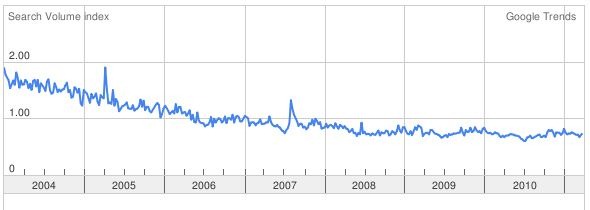
I was playing with Google Insights for Search and Google Trends and discovered that science fiction is in decline, or at least the popularity of searching on the term in Google.  I started with this Google Trends chart on science fiction:

SF-trands

I then switched to Google Insights for the rest of the comparisons.

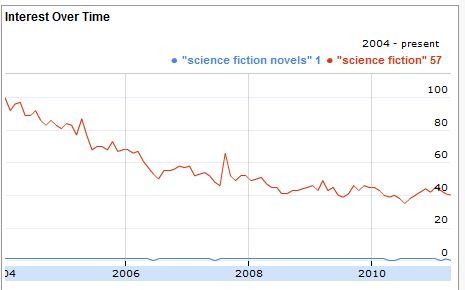
Warning, the totals given on the graphs are not always accurate – they vary with the cursor position on the time graph.  So ignore them.  Just look at the lines, or I’ll give you the averages from the Google page.

decline-of-science-fiction

Trying to understand what the numbered scale means is hard, but here is Google’s explanation,

The numbers on the graph reflect how many searches have been done for a particular term, relative to the total number of searches done on Google over time. They don’t represent absolute search volume numbers, because the data is normalized and presented on a scale from 0-100. Each point on the graph is divided by the highest point, or 100. When we don’t have enough data, 0 is shown. The numbers next to the search terms above the graph are summaries, or totals.

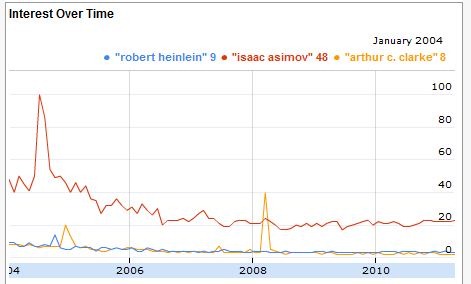
When I was growing up they talked about the big three of SF writers, Heinlein, Asimov and Clarke, so I did a graph of them.

big-three-SF-authors

Asimov is by far the more popular writer now, but all three writers show a decline in interest.  And why did Asimov have a spike in July 2004, and Clarke in March, 2008?

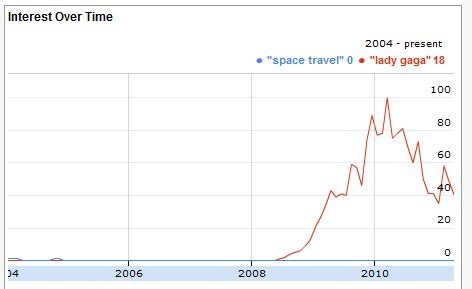
Because Google doesn’t give actual numbers it’s hard to gauge absolute interest, so I plotted “space travel” versus “Lady Gaga” and got a rather sad graph:

lady-gaga-space-travel

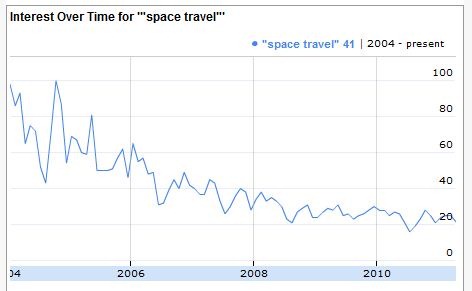
Space travel hits the 0 mark in comparison.  So I did space travel by itself and got this:

space-travel

Interest in space travel is in sharp decline.  So I wondered how science compared to science fiction and created this chart:

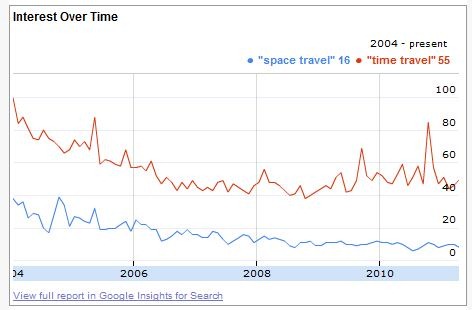
time-travel-v-space-travel

Now I’m starting to doubt my methodology.  Why is time travel so much more popular than space travel?  Or is it a matter of how the phrases are used in popular culture.  I thought I try another comparison to test things.

science-fiction-v-nasa

Science fiction is 2 compared to NASA’s 19.  But notice, interest in NASA is in decline too.

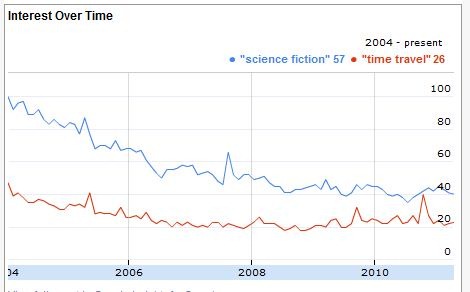
time-travel-v-sf

But science fiction is 57 compared to time travel’s 26.  Time travel is probably a common term that’s well used in popular culture outside of the field of science fiction, as is science fiction, but it’s hard to gauge phrase from genre.

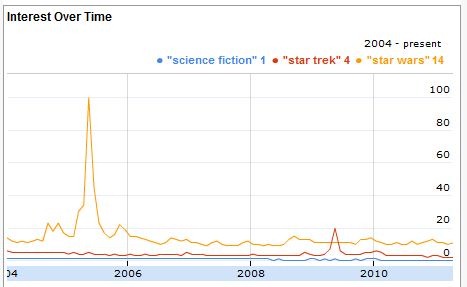
st-sw-sf

Star Wars is way more popular than Star Trek and both are more popular than science fiction.   Is that huge spike for Star Wars due to films or the discussion of the defense anti-missile program?

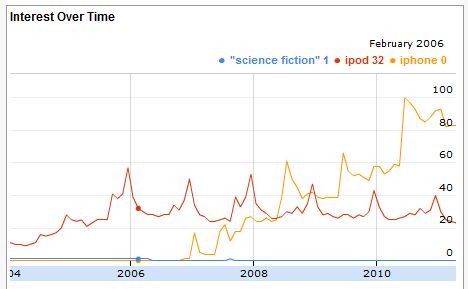
To get some real world perspective I did a comparison to iPods and iPhones.  On the Google page the totals were SF is 0 and the iPhone and iPods averaged 28 each.

sf-ipod-iphone

Trying to zero in on the popularity of science fiction I tried:

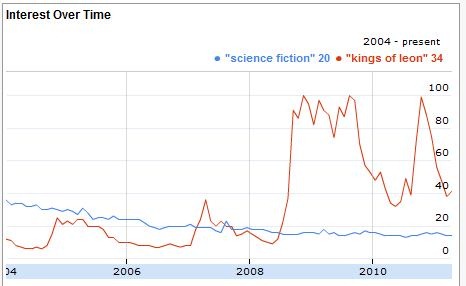
sf-kings-of-leon

So science fiction is about as popular as the Kings of Leon before they hit the big time – or at least on Google.

Finally, how does science fiction compare to other genres.

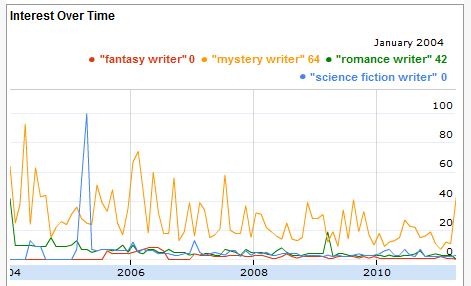
writers

On the web page fantasy and science fiction each get a 2, romance gets a 6, and mystery gets a 28.

Why is murder a more a interesting fictional topic than the future?  Go figure.

I don’t know if any of this means anything, but it is interesting to play with.  I linked to the two services at the top, so go test them yourself.

JWH – 4/9/11

Robot Evolution

Will we see self aware robots in our lifetime?  At least the most rabid proponents of the Singularity think so.  Science fiction created the idea of space travel, and now humans travel in space.  Science fiction’s next big speculation about first contact hasn’t panned out yet.  Neither has time travel.  But after those concepts came robots, and science fiction has prepared us well for that near future.

Are we ready for thinking machines?  How will our lives be different if intelligent robots existed?  I think it’s going to be a Charles Darwin size challenge to religion, especially if robots become more human than us.  And by that I mean, if robots show greater spiritual qualities, such as empathy, ethics, compassion, creativity, philosophy, charity, etc.  Is that even possible?  Imagine a sky pilot android that had every holy book memorized along with every book ever written about religion and could eloquently preach about leading the spiritual life.

Just getting robots to see, hear and walk was a major challenge for science, but in the last decade scientists have been evolving robots at a faster pace.  It’s an extremely long way before robots will think much less show empathy, but I think it’s possible.  I think we need to be prepared for a breakthrough.  Sooner of later computers that wake up like in The Moon is a Harsh Mistress, When H.A.R.L.I.E Was One, and Galatea 2.2 will appear on the NBC Nightly News.  How will people react?

There are two schools of robot building.  The oldest is we program machines to have all the functions we specify.  The other is to create a learning machine and see what functions it acquires.  As long as robots have function calls like

           show_empathy() 

does it really count as true intelligence?  I don’t think so, but do we show empathy because it’s built into our genes or because we learn it from people wiser than us?

Jeff Hawkins has theorized that our neo-cortex is a general purpose pattern processor built in our brains.  What if we could build an artificial neo-cortex and let robots grow up and learn whatever they learn, like how people learn.  Would that be possible?  This is why I see artificial intelligence as a threat to religion in the same way evolution threatens the faithful.  If we can build a soul it suggests that souls are not divine.  It also implies souls won’t be immortal because they are tied to physical processes.
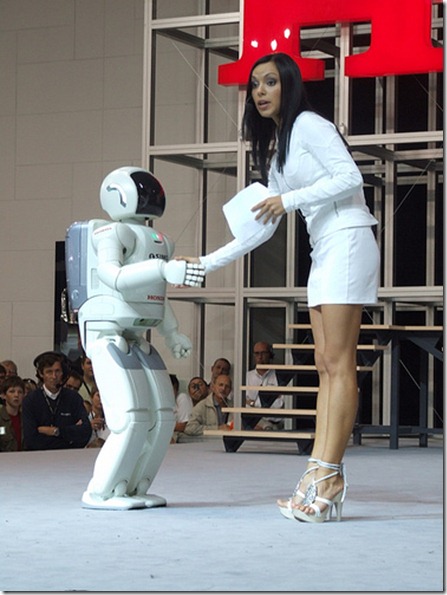
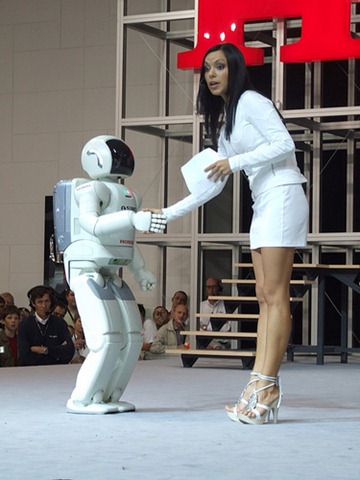
robot-and-girl

Science fiction has often focused on either warnings about the future, or promises of wonder.  Stories about robots are commonly shown as metal monsters wanting to exterminate mankind.  Other writers see robots as being our allies in fighting the chaos of ignorance.  Other people don’t doubt that intelligent machines can be built, but they fear they will judge us harshly. 

What if we create a species of intelligent machines and they say to us, “Hey guys, you’ve really screwed up this planet.”   Is it paranoid to worry that their solution will be to eliminate us.  Is that a valid conclusion?  Life appears to be eat or be eaten, and we’re the biggest eaters around, so why would robots care?  In fact, we must ask, what will robots care about?

They won’t have a sex drive, but they might want to reproduce.  They should desire power and resources to stay alive, and maybe resources to build more of their kind, not to populate the world, but merely to build better models.  Personally, I’d bet they will quickly figure out that Earth isn’t the best place for their species and want to claim the Moon for their own.  I think they will say, “Thanks Mom and Dad, but we’re out of here.”  Our bio rich environment is hard on machines.

gort

Once on the Moon I’d expect them to start building bigger and bigger artificial minds, and develop ways to leave the solar system.  I’d also expect them to get into SETI (or SETAI), and look for other intelligent machine species.  Some of them would stay behind because they like us, and want to study life.  Those robots might even offer to help with our evolution.  And they might expect us to play nice with the other life forms on planet Earth.  What if they acquire the power to make us?

On the other hand, people love robots.  If we program them to always be our equals or less, I think the general public will embrace them enthusiastically.  Many people would love a robotic companion.  Before my mother died at 91, she fiercely maintained her desire to live along, but I often wished she at least had a robotic companion.  I know I hope they invent them before I get physically helpless.  Would it reduce medical costs if our robotic companions had the brains of doctors and nurses and the senses to monitor our bodies closely?

My reading these past few months has been a perfect storm of robot stories.  I’m about to finish the third book in the Hyperion Cantos by Dan Simmons, which has developed into war between the Catholic Church and the AI TechnoCore.  I’m rereading The Caves of Steel, the first of Asimov’s robotic mystery novels.  I’m also reading We Think Therefore We Are, a short story collection about artificial intelligence. 

Last month I read the Martian Time-Slip by Philip K. Dick.  At one point repair man Jack Bohlen visits his son’s school to fix a teaching robot.  Each robot is fashioned after a famous person from history.  That made me wonder if each of our K-12 students had a robotic mentor would we even be in the educational crisis that so many write about?  Sounds like even more property taxes, huh? 

Well, what if those mentors were cheap virtual robots that communicated with our children via their cell phones, laptops or gaming consoles.  Would kids think of it as cruel nagging harassment or would they learn more with constant customized supervision?  What if their virtual robot mentor appeared as a child equal to their age and grew up with them, so they were friends?  Or even imagine as an adult and you wanted to go back to college, having a virtual study companion.

Now imagine if our houses were intelligent and could watch over us and our property.  Wouldn’t that be far more comforting than a burglar alarm system?  For people who are frightened of living alone this would be company too.  And it would be better than any medical alert medallion.  Think about a house that could monitor itself and warn you as soon as a pipe leaked or its insulation thinned in the back room.  And what about robotic cars with a personality for safety?

For most of the history of robots people thought of them as extra muscle.  Mechanical slaves.  People are now thinking of them as extra intelligence, and friends.  What will that mean to society?   Anyone who has read Jack Williamson’s “With Folded Hands” knows that robots can love and protect us too much.  Would having helping metal hands and AI companionship weaken us? 

Can you imagine a world where everyone had a constant robot sidekick, like a mechanical Jeeves, or a Commander Data.  Would it be cruel to have a switch “Only Speak When Spoken To” on your AI friend?  Would kids become more social or less social if they all had one friend to begin with?  Would it be slavery to own a self-aware robot?  And what about sex?

sexy-robot

Just how far would people go for companionship?   I’ve already explored “The Implications of Sexbots.”  But I will ask again, what will happen to human relationships if each person can buy a sexual companion?  What if people get along better with their store-bought lover than people they meet on eHarmony?  I’m strangely puritanical about this issue.  I can imagine becoming good friends with an AI, but I think humping one would be a strange kind of perversion.  I’m sure horny teenage boys would have no such qualms, and women have already taken to mechanical friends and might even like them better if they look like Colin Firth.  To show what a puritanical atheist I am, I would figure this whole topic would be a non-issue, but research shows the idea of sex with robots is about as old as the concept of robots.

Ultimately we end up asking:  What is a person?  Among the faithful they like to believe we’re a divine spark of God, a unique entity called a soul.  Science says were a self aware biological function, a side-effect of evolution.  We are animals that evolved to the point where they are aware of themselves and could separate reality into endless parts.  If that’s true, such self awareness could exist in advanced computer systems.  Whether through biology or computers, we’re all just points of awareness.  What if the word “person” only means “a self aware” identity?  Then, how much self awareness do animals have?  

Self awareness has a direct relationship with sense organs.  Will robots need equal levels of sensory input to achieve self awareness?  We think of ourselves as a little being riding in our brain just behind our eyes, but that’s because our visual senses overwhelm all others.  If you go into a darkroom your sense of self awareness location will change and your ears will take over.  But it is possible to be your body.  Have you ever notice that during sex your center of awareness moves south?  Have you ever contemplated how illness alters your sense of awareness?  Meditation will teach you about physical awareness and how it relates to identity.

Can robots achieve consciousness with only two senses?  Or will they feel their electronics and wires like we feel our bodies with our nerves?  Is so, they will have three senses.  We already have electronic noses and palates that far exceed anything in the animal world.  We only see a tiny band from the E-M spectrum.  Robots could be made to “see” and “hear” more.  Will they crave certain stimulations?

We know our conscious minds are finely tuned chemical balances.  Disease, drugs, and injury throw that chemical soup recipe of self awareness into chaos.  How many millions of years of evolution did it take to tune the human consciousness?  How quick can we do the same for robots?  Would it be possible to transfer the settings in our minds to mechanical minds?

There are many people living today that refuse to believe our reality is 13.7 billion years old.  They completely reject the idea that the universe is evolving and life represents relentless change over very long periods of time.  Humans will be just a small blip on the timeline.  What if robots are Homo Sapiens 2.0?   Or what if robots are Life 2.0?  Or what if robots are Intelligence 2.0?  Doesn’t it seem strange when it time to go to the stars that we invent AI?  Our bodies aren’t designed for space travel, but robots are.

In Childhood’s End and 2001: A Space Odyssey, Arthur C. Clarke predicted that mankind would go through a transformation and become the star child, our next evolutionary step.  What if he was wrong, and HAL is the next step?  We are pushing the limits of our impact on the environment at the same time as we approach the Singularity.  I’m not saying we’re going extinct, although we might, but just wondering if we’re going to be surpassed in the great chain of being.  Even among atheist scientists humans are the crown of creation, but we figured that was only true until we met a smarter life form from the stars or built Homo Roboticus.

JWH – 3/11/10