The End of Civilization – Again

by James Wallace Harris, 11/29/21

When I was growing up in the 1950s annihilation by atomic war was a common worry. Kids were taught duck and cover drills, people built fallout shelters, we routinely heard Conalrad tests on the radio, and popular culture was full of stories about WWIII. The famous Doomsday Clock stayed set just minutes from doomsday.

Over the decades there has always been the world is ending forecasts. Some chicken little is always yelling the sky is falling. The new vogue is to claim civilization is collapsing. Routinely following the news makes it hard to ignore such fears.

What if civilization is collapsing? What should we do? The science is quite solid on climate change, and we’ve been warned for decades, but for decades we’ve done nothing significant. A fair number of folks are buying rural plots of land and AR15s but that hardly seems to be a practical solution for everyone.

My guess is most people are ignoring all the gloom and doom, or else going crazy in their own quiet squirrely way. I don’t think there is much we can do. The reason why many analyzed trends lead to possible apocalypses is that the natural thing for everyone to do is to keep doing what we’re always been doing. Humans aren’t big on intentionally making drastic changes to their lives.

If we’re not going to do anything to avert the forecasted catastrophes, then what are we going to do instead? Anxiety and depression are so self-destructive. It’s much too early to panic. We could party like it’s 1999, but the end isn’t that close yet. Enduring resignation will probably be a common plan, but that’s emotionally draining. Taking up Zen Buddhism or meditation might be useful. Enjoying the simple pleasures of life has always been an excellent choice. Ditto for pursuing creative hobbies.

Developing a positive perspective should be helpful. Civilizations always collapse, but often over decades or centuries. There will be a rush to hoard or consume everything left. The well-to-do will grab what they want, which is always more than they need. The practical will learn to live with less without agonizing over what they no longer have. For most citizens the collapse of civilization will be in such slow motion they will hardly notice it. It’s only the unfortunate who become refugees from random catastrophes that will feel the harshest impacts. So knowing how to relocate will be a valuable skill. There are certain preparedness precautions to take, but since nothing is certain, it’s not practical to go overboard with such measures.

Probably most useful is the ability for understanding the true reality of things. Don’t get caught up in delusions, fears, panics, but also avoid over-optimism and Pollyanish thinking.

I bring all this up because of some videos I’ve been watching. I have no idea how valid they are, but I consider the increase of such thinking as a kind of pulse-taking. What do you think of these videos? These three accept doom but try to find a positive perspective with dealing with such doom. They offer wisdom.

If you are a routine YouTube watcher and are signed in, watching these three videos will cause YouTube to offer you more of the same. There are quite a lot of these videos, so be careful. Don’t get overwhelmed.

JWH
CRISPR: Book v. Documentary

by James Wallace Harris, 8/18/21

I’ve been learning about the gene editing tool CRISPR for years in bits and pieces. From reading news and magazines articles I had a vague idea that science had made a tremendous breakthrough, one akin to science fiction imagined in GATTACA and Brave New World. CRISPR/Cas9 will allow us to heal people with inheritable genetic diseases or cure people with conditions caused by defective genes, but more than that, it will allow us to program our own evolutionary developments, and change our reproductive germlines.

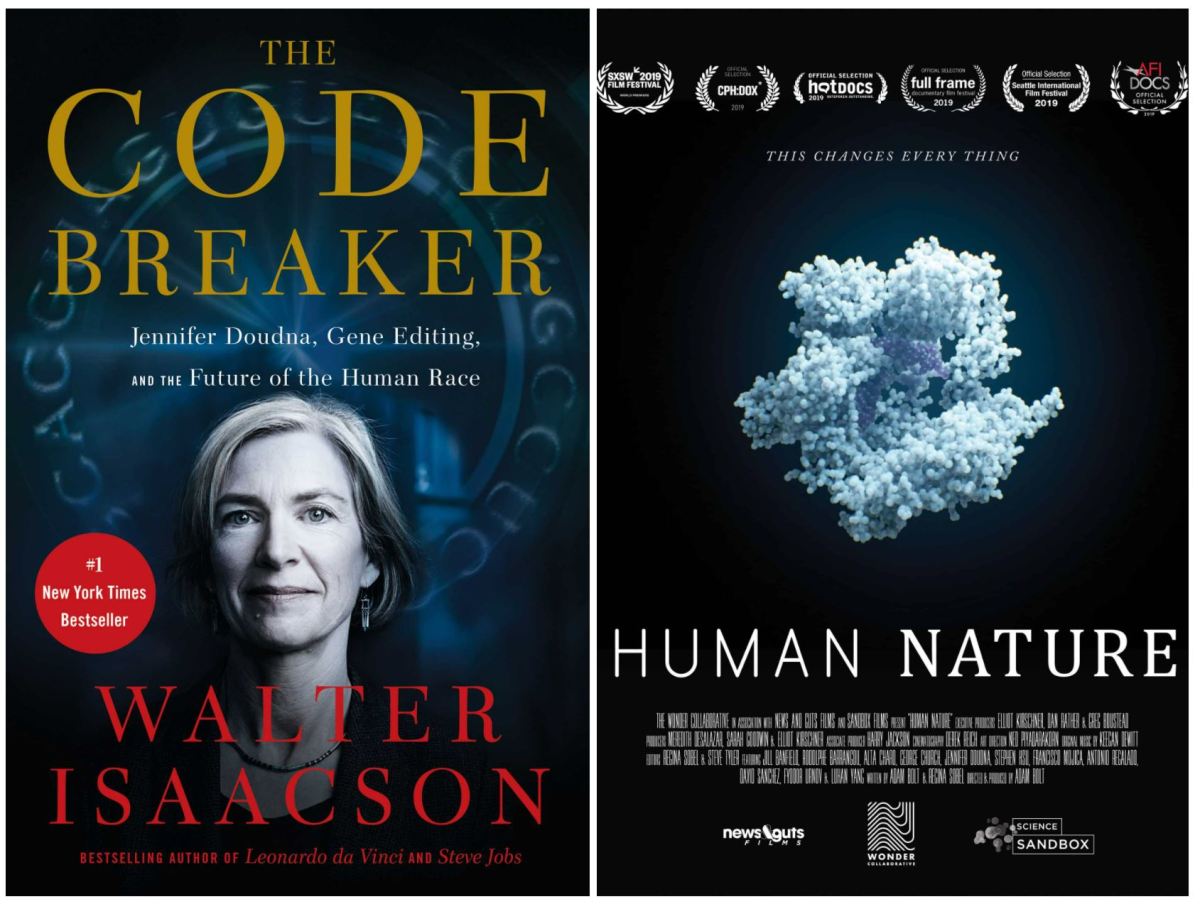
I don’t want to try and summarize CRISPR/Cas9 to you in detail because I’m recommending your read The Code Breakers by Walter Isaacson or watching Human Nature. But if you want a quick overview, here’s the Wikipedia entry.

My focus is to compare learning from a book versus a documentary. I’ve already acquired what I would consider rumors about CRISPR via Flipboard and The New York Times. Those are casual, everyday ways to absorb tidbits of information. But what’s the next level up? That depends on the time you’re willing to spend, and the amount of details you wish to digest.

Human Nature (2019) is a 1 hour and 35 minute documentary that’s currently available to Netflix or PBS Documentaries on Amazon subscribers, or to rent or buy from Amazon and other video sources. It’s a superior documentary that quickly covers the background of CRISPR with impressive infographic and animations, while interviewing the major scientists, then moving into the thorny ethical issues of gene editing, before finally wrapping things up by speculating about the future. After watching Human Nature you’ll have a good sense of what CRISPR can do and its science fictional impact on society. The documentary claims CRISPR will change the world more than the internet.

On the other hand, if you want go beyond the Gosh-Wow level, you could read Walter Isaacson’s new book, The Code Breakers. It’s 16 hours and 4 minutes on audio, or 552 pages of reading. The book tells the same story as the documentary but with far more detail. The framing of the book is a semi-biography of Jennifer Doudna, who shared the Nobel Prize with Emmanuelle Charpentier in 2020. Walter Isaacson is noted for his biographies (Leonardo da Vinci, Albert Einstein, Steve Jobs, Ben Franklin), and The Code Breakers is sort of a biography of Doudna, at least when it comes to her scientific career.

But The Code Breakers is much more. It’s a history of a technology that has emerged in our lifetime, and a chronicle how scientists work to discover and apply that new technology. We learn about publishing papers, going to conferences, building labs, forming startup companies, and competing for the Nobel Prize. If you loved books like The Double Helix by James Watson, The First Three Minutes by Steven Weinberg, or The Inflationary Universe by Alan Guth, then you should love this one too. I especially admired how Isaacson’s interviewed the various scientists competing for fame and glory, because he knew that they knew he was giving Doudna the scientific fame over them. Recognizing who came first in a discovery is a challenging piece of detective work that Isaacson pulls off with the skill of a master lawyer working the jury.

What also impressed me was how Isaacson told this complex story. I can’t imagine amassing so much information and then weaving it together into a compelling narrative. I’d love to see a documentary about how Isaacson researches and writes his books.

The Code Breakers will take you much further than the Human Nature regarding how genetic editing history unfolded, but the documentary has its own virtues, especially in compelling visuals. However, I wanted to go even further into learning how CRISPR works. Neither the book nor the documentary gave me the step-by-step concepts of what the lab work was like. Because CRISPR is so damn interesting, I went searching for even more information on YouTube. Both the book and film claims using CRISPR is easy, and that anyone can order educational kits to use the technology. I just couldn’t visualize that.

This short clip gave me more of what I wanted, but it’s still not enough, but I’m going to continue looking for more videos like this one. However, I also found this video about one of the CRISPR kits.

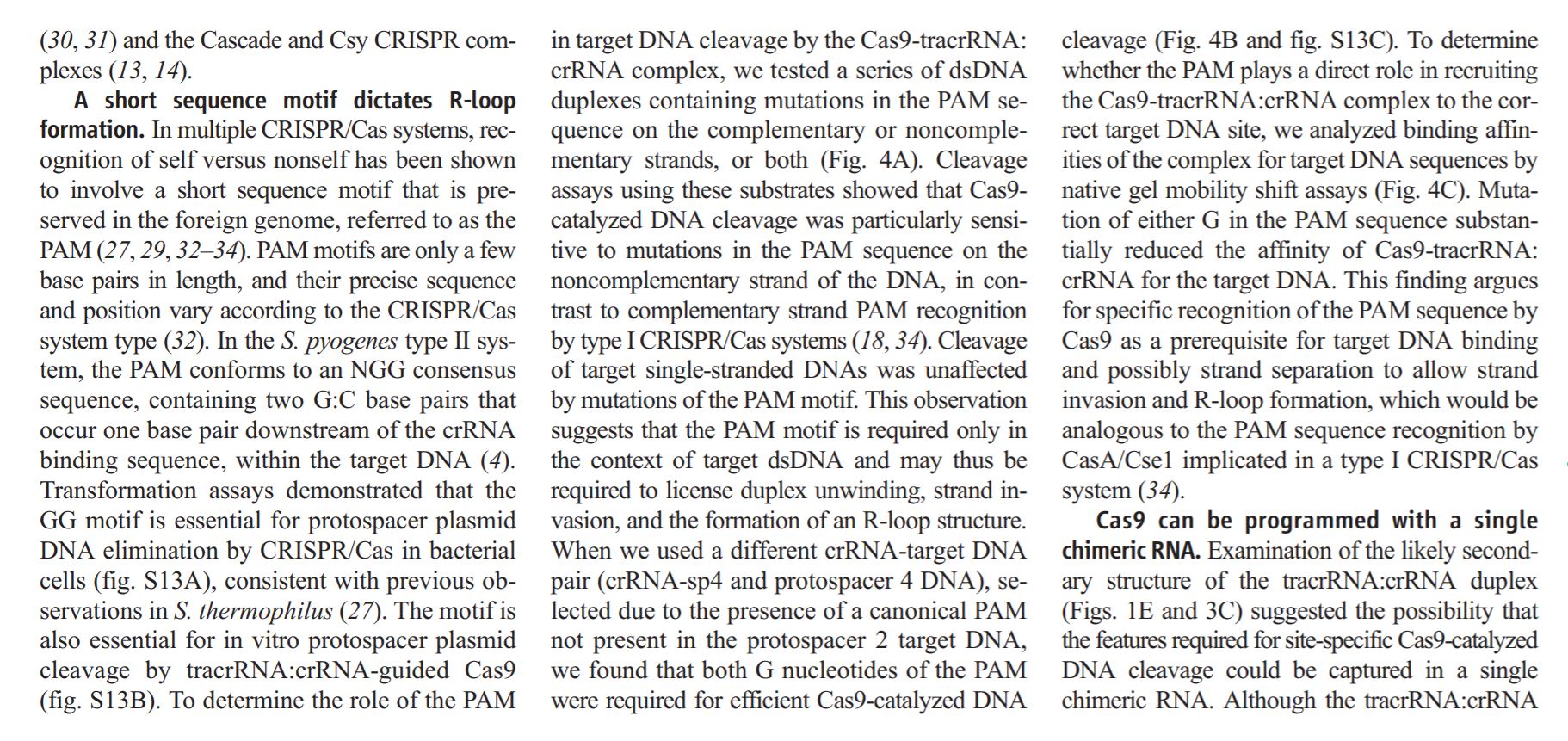
The trouble with wanting to understand even more is I run into the limits of my understanding. I found the 2012 article from Science that’s at the heart of the book. I can read it, and even spot ideas covered in the book and documentary, but 95% lies behind an event horizon of jargon I can’t penetrate. Just look at this one paragraph:

I love popular science books and magazines, but I have to take the working of real science on faith. I don’t like that. I’m hoping to find other books and documentaries that will help me in my quest to visualize how scientists do their work in a step-by-step process. Throughout the book Isaacson wrote about the experiments involved in discovering CRISPR, but I have no mental picture of what they were like.

For example, x-ray crystallography was often mentioned as a vital skill in this lab work. Seeing this video helps me visualize more of the narrative. What I would love is a Ken Burns type documentary, a 10-part series that visually illustrated The Code Breakers.

CRISPR is another example of the positive potential for our future, and another example that validates science. Sure, CRISPR offers all the potential evils of H-Bombs, but it also proves we have great abilities to solve incredibly complex problems.

I feel lucky to have experienced digital revolution, and I’d love to live long enough watch the gene editing revolution unfold. By the time the 2040s and 2050s roll around, society will be transformed again. But then, there will be other transformation happening in the same time frame. Our efforts to slow climate or our failure to do so will reveal another massive transformation. Talk about Future Shock…

JWH

A Bright Vision of a Positive Future

by James Wallace Harris, August 12, 2021

Last night I had an epiphany while watching the NOVA episode entitled “Great Electric Airplane Race” on my Roku PBS channel. It’s available to view online or stream with the PBS channel (but it might require a Passport membership).

The show was overwhelmingly positive about the future, and it conveyed that hope by showing rather than telling. To avert the catastrophes of climate change will require leaving fossil fuels in the ground. That means converting to other forms of energy. Air travel is a big contributor of CO2, but designing electric airplanes has tremendous challenges. The example given was for a Boeing 737. It uses 40,000 pounds of jet fuel, but the weight of the batteries to replace that jet fuel would total 1.2 million pounds. How is it even possible to overcome such a Mt. Everest of a technical obstacle?

The answer is science. The rest of the show was about how science and engineering is actually tackling the problem. Expect a great transformation in the airline industry over the next two decades. One person in the show called it Air Travel 3.0. I had no idea that these inventions were that close to going into production.

And the new technology wasn’t even the most inspiring part of the show. Miles O’Brien interviewed and profiled many entrepreneurs, scientists, and engineers who were creating these new aircraft, business plans, and air control systems, and it uplifting to see so many women and minorities in leadership roles. This show proved social progress is happening too.

While I watched this episode I realized it was a vision of how things could be. We could solve our environmental, social, economic, and technical problems if we choose. That is, if we choose to be rational and scientific. This show was practically utopian in its scenes and implications. If you can, watch this episode of NOVA and meditate on what positives each scene suggests.

Of course, this isn’t proof we’ll solve our problems, just a vision of what it would be like if we tried. To succeed we need to overcome denialism. Denialism is holding us back. It’s why the pandemic rages on, it’s why we don’t commit to solving climate change. The denialists are going to destroy us.

The epiphany I had is we will succeed if everyone accepts science. Science is capable of solving our problems. The deniers don’t want to believe that for various philosophical reasons. I’m not sure if it’s possible to convert deniers into scientific believers, but that’s our pivot point between future success and failure.

For my own peace of mind, I’ve got to find more sources of inspiration like this episode of NOVA. Up till now I had given up on the future because I was convinced the deniers will bring us down. Now I want to focus on the doers. If you’re going to bet, especially psychological capital, bet on the winners.

JWH

Understanding Uncertainty

by James Wallace Harris, 5/1/21

Most people are binary in their thinking. They don’t like juggling shades of gray. We want to know yes or no, it is, or it isn’t, is it good or bad, friend or foe, us versus them, and so on. For several decades now science has been under attack because it confuses people with complicated and even contradictory results.

Reality is not simple. It contains infinite variables working through infinite combinations. Science is about statistics. It looks for patterns, making hunches to test. And the results are never absolute. Last night I came across a film that visually illustrates this better than anything I’ve seen before.

This video is well worth 25 minutes it takes to watch. Actually, it’s worth watching over and over again. Don’t be put off because the film uses climate change as a teaching example if you’re burned out on the topic. Just watch it for how science works.

Digesting the daily news has become a survivalist skill. That skill should be combined with reading, writing, and arithmetic as part of every K-12 curriculum. Even though we’ve all had a lifetime of practice consuming new information, most of us would fail this subject, even the most studious would only be getting Ds and Cs. I’m no exception, failing most tests.

It’s not a matter of knowing the right answers, but learning to live with uncertainty. It’s developing an intuition for data, both numerical and narrative. We need to consume our daily information like Sherlock Holmes, always looking for clues. In the old days, teachers would talk about developing a rule of thumb for rough guessing. Other people talk about bullshit detectors. The trouble is humans aren’t rational, but rationalizing creatures. We constantly fool ourselves with false assumptions. We feel we’re being logical, and sometimes we are, but all too often we’ve started our chain of logic after making a bad initial assumption. If you’ve ever played the game MasterMind, you’ll understand this basic trait.

Learning to think clearly is unnatural for human beings because we tend to make up our minds quickly and stick to our decisions. We decide in childhood, when we’re uneducated, on many beliefs we choose to defend for the rest of our lives. Science is all about constantly reevaluating data, and that goes against common human habits. Humans aren’t Vulcans, but we all need to think like Mr. Spock, but that requires constant effort, constant vigilance. Always learning new insights feels like we’re always swimming against the current, when the urge is to relax and to drift with the current. That’s as natural as entropy. But understanding reality is anti-entropic, it is swimming against the current.

JWH

Will We Reach Herd Intelligence Before We Crash Our Civilization?

by James Wallace Harris, 4/19/21

  • Collapsed: How Societies Choose to Fail or Succeed by Jared Diamond
  • Falter: Has the Human Game Begun to Play Itself Out? by Bill McKibben
  • Seaspiracy – a documentary on Netflix

All indicators point to the collapse of civilization sometimes this century. Despite all the press about this perfect storm of self destruction, few people are willing to worry, and even fewer willing to do anything. Must the conclusion be that failure is our only option?

Most of humanity is either preoccupied with personal problems, or if they contemplate the future at all, assume our species will muddle through as it always has in the past. All the evidence suggests otherwise, that the biosphere cannot absorb the impacts of Homo sapiens without a significant destabilization of its system, which in turn will alter the course of civilization.

Civilizations have always come and gone, and so have species. Nothing lasts forever, not even the Earth or the Sun. It’s rather disheartening to consider what we could have become. We almost had the intelligence to create a global civilization that could have lasted thousands, if not millions of years. Theoretically, we still have a chance, but few people who think about such things give that chance much hope. It would have required everyone pulling together towards a common cause, and we’re just not that kind of species.

However, don’t worry, don’t get depressed or do anything irrational. No need to become a prepper assuming an Armageddon is just around every corner. The collapse of civilization will probably be so slow you might not even notice it. Humans are very adaptable to hard times and excellent at rationalizing things aren’t what they seem. Just take every day one day at a time and enjoy the passing parade of history.

As an individual who reads many books and watch many documentaries like the ones above, I keep thinking we should be doing something. But I realize there’s a problem with that assumption. First, we all need to be doing the same thing, and second, we should all stop what we’ve been doing our whole lives. Now is that going to happen? Is humanity a ship that can be steered or a bullet on a trajectory? It really comes down to the Serenity Prayer,

God grant me the serenity to accept the things I cannot change,
Courage to change the things I can,
and Wisdom to know the difference.

It’s the last line that’s so hard to achieve. What can we change, and what can’t we change? Theoretically we could change everything in society if we could just change ourselves. Is it Pollyannaish to think we could, and fatalistic to think we can’t? I wonder if people have always believed in God just to redirect that burden of responsibility?

If you read the above books maybe you will also ask who is smart enough to understand and solve these problems? If we built giant AI minds that could think their way through these immense challenges, would we take their advice? Aren’t we too egotistical to listen? Or even if a God spoke directly to the world would we obey? I’m not sure that’s in our nature either.

Maybe the only path an individual can take and stay sane is learning to accept and endure. But that doesn’t seem to be the way either because too many people today are angry. Anger means still trying to control. If you watch the news pay attention to anger. Too many hate what’s happening to them. And it’s on both sides of the political spectrum. All the people who fight for freedom and all the people who want rules and regulations are motivated by anger. That’s what I dread about the collapse of civilization, living with all these angry people. And the only solution to that is find a place away from them, but that’s not really possible either, is it?

This is a strange book review. But I find it’s getting harder and harder to review books like these by talking about the issues they cover. I’m down to evaluating their emotional impact. The penultimate question is: Can we do anything? The answer is yes. The ultimate question is: Will we? I used to hope that was a yes too, but my faith is fading.

JWH