Robot Evolution

Will we see self aware robots in our lifetime?  At least the most rabid proponents of the Singularity think so.  Science fiction created the idea of space travel, and now humans travel in space.  Science fiction’s next big speculation about first contact hasn’t panned out yet.  Neither has time travel.  But after those concepts came robots, and science fiction has prepared us well for that near future.

Are we ready for thinking machines?  How will our lives be different if intelligent robots existed?  I think it’s going to be a Charles Darwin size challenge to religion, especially if robots become more human than us.  And by that I mean, if robots show greater spiritual qualities, such as empathy, ethics, compassion, creativity, philosophy, charity, etc.  Is that even possible?  Imagine a sky pilot android that had every holy book memorized along with every book ever written about religion and could eloquently preach about leading the spiritual life.

Just getting robots to see, hear and walk was a major challenge for science, but in the last decade scientists have been evolving robots at a faster pace.  It’s an extremely long way before robots will think much less show empathy, but I think it’s possible.  I think we need to be prepared for a breakthrough.  Sooner of later computers that wake up like in The Moon is a Harsh Mistress, When H.A.R.L.I.E Was One, and Galatea 2.2 will appear on the NBC Nightly News.  How will people react?

There are two schools of robot building.  The oldest is we program machines to have all the functions we specify.  The other is to create a learning machine and see what functions it acquires.  As long as robots have function calls like

           show_empathy() 

does it really count as true intelligence?  I don’t think so, but do we show empathy because it’s built into our genes or because we learn it from people wiser than us?

Jeff Hawkins has theorized that our neo-cortex is a general purpose pattern processor built in our brains.  What if we could build an artificial neo-cortex and let robots grow up and learn whatever they learn, like how people learn.  Would that be possible?  This is why I see artificial intelligence as a threat to religion in the same way evolution threatens the faithful.  If we can build a soul it suggests that souls are not divine.  It also implies souls won’t be immortal because they are tied to physical processes.
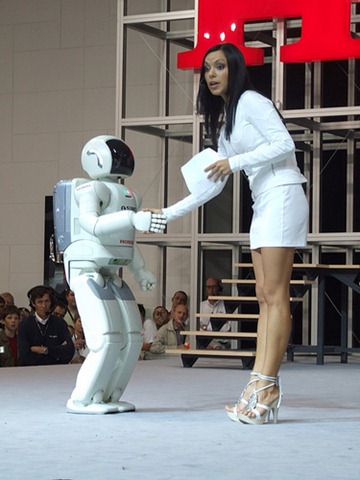
robot-and-girl

Science fiction has often focused on either warnings about the future, or promises of wonder.  Stories about robots are commonly shown as metal monsters wanting to exterminate mankind.  Other writers see robots as being our allies in fighting the chaos of ignorance.  Other people don’t doubt that intelligent machines can be built, but they fear they will judge us harshly. 

What if we create a species of intelligent machines and they say to us, “Hey guys, you’ve really screwed up this planet.”   Is it paranoid to worry that their solution will be to eliminate us.  Is that a valid conclusion?  Life appears to be eat or be eaten, and we’re the biggest eaters around, so why would robots care?  In fact, we must ask, what will robots care about?

They won’t have a sex drive, but they might want to reproduce.  They should desire power and resources to stay alive, and maybe resources to build more of their kind, not to populate the world, but merely to build better models.  Personally, I’d bet they will quickly figure out that Earth isn’t the best place for their species and want to claim the Moon for their own.  I think they will say, “Thanks Mom and Dad, but we’re out of here.”  Our bio rich environment is hard on machines.

gort

Once on the Moon I’d expect them to start building bigger and bigger artificial minds, and develop ways to leave the solar system.  I’d also expect them to get into SETI (or SETAI), and look for other intelligent machine species.  Some of them would stay behind because they like us, and want to study life.  Those robots might even offer to help with our evolution.  And they might expect us to play nice with the other life forms on planet Earth.  What if they acquire the power to make us?

On the other hand, people love robots.  If we program them to always be our equals or less, I think the general public will embrace them enthusiastically.  Many people would love a robotic companion.  Before my mother died at 91, she fiercely maintained her desire to live along, but I often wished she at least had a robotic companion.  I know I hope they invent them before I get physically helpless.  Would it reduce medical costs if our robotic companions had the brains of doctors and nurses and the senses to monitor our bodies closely?

My reading these past few months has been a perfect storm of robot stories.  I’m about to finish the third book in the Hyperion Cantos by Dan Simmons, which has developed into war between the Catholic Church and the AI TechnoCore.  I’m rereading The Caves of Steel, the first of Asimov’s robotic mystery novels.  I’m also reading We Think Therefore We Are, a short story collection about artificial intelligence. 

Last month I read the Martian Time-Slip by Philip K. Dick.  At one point repair man Jack Bohlen visits his son’s school to fix a teaching robot.  Each robot is fashioned after a famous person from history.  That made me wonder if each of our K-12 students had a robotic mentor would we even be in the educational crisis that so many write about?  Sounds like even more property taxes, huh? 

Well, what if those mentors were cheap virtual robots that communicated with our children via their cell phones, laptops or gaming consoles.  Would kids think of it as cruel nagging harassment or would they learn more with constant customized supervision?  What if their virtual robot mentor appeared as a child equal to their age and grew up with them, so they were friends?  Or even imagine as an adult and you wanted to go back to college, having a virtual study companion.

Now imagine if our houses were intelligent and could watch over us and our property.  Wouldn’t that be far more comforting than a burglar alarm system?  For people who are frightened of living alone this would be company too.  And it would be better than any medical alert medallion.  Think about a house that could monitor itself and warn you as soon as a pipe leaked or its insulation thinned in the back room.  And what about robotic cars with a personality for safety?

For most of the history of robots people thought of them as extra muscle.  Mechanical slaves.  People are now thinking of them as extra intelligence, and friends.  What will that mean to society?   Anyone who has read Jack Williamson’s “With Folded Hands” knows that robots can love and protect us too much.  Would having helping metal hands and AI companionship weaken us? 

Can you imagine a world where everyone had a constant robot sidekick, like a mechanical Jeeves, or a Commander Data.  Would it be cruel to have a switch “Only Speak When Spoken To” on your AI friend?  Would kids become more social or less social if they all had one friend to begin with?  Would it be slavery to own a self-aware robot?  And what about sex?

sexy-robot

Just how far would people go for companionship?   I’ve already explored “The Implications of Sexbots.”  But I will ask again, what will happen to human relationships if each person can buy a sexual companion?  What if people get along better with their store-bought lover than people they meet on eHarmony?  I’m strangely puritanical about this issue.  I can imagine becoming good friends with an AI, but I think humping one would be a strange kind of perversion.  I’m sure horny teenage boys would have no such qualms, and women have already taken to mechanical friends and might even like them better if they look like Colin Firth.  To show what a puritanical atheist I am, I would figure this whole topic would be a non-issue, but research shows the idea of sex with robots is about as old as the concept of robots.

Ultimately we end up asking:  What is a person?  Among the faithful they like to believe we’re a divine spark of God, a unique entity called a soul.  Science says were a self aware biological function, a side-effect of evolution.  We are animals that evolved to the point where they are aware of themselves and could separate reality into endless parts.  If that’s true, such self awareness could exist in advanced computer systems.  Whether through biology or computers, we’re all just points of awareness.  What if the word “person” only means “a self aware” identity?  Then, how much self awareness do animals have?  

Self awareness has a direct relationship with sense organs.  Will robots need equal levels of sensory input to achieve self awareness?  We think of ourselves as a little being riding in our brain just behind our eyes, but that’s because our visual senses overwhelm all others.  If you go into a darkroom your sense of self awareness location will change and your ears will take over.  But it is possible to be your body.  Have you ever notice that during sex your center of awareness moves south?  Have you ever contemplated how illness alters your sense of awareness?  Meditation will teach you about physical awareness and how it relates to identity.

Can robots achieve consciousness with only two senses?  Or will they feel their electronics and wires like we feel our bodies with our nerves?  Is so, they will have three senses.  We already have electronic noses and palates that far exceed anything in the animal world.  We only see a tiny band from the E-M spectrum.  Robots could be made to “see” and “hear” more.  Will they crave certain stimulations?

We know our conscious minds are finely tuned chemical balances.  Disease, drugs, and injury throw that chemical soup recipe of self awareness into chaos.  How many millions of years of evolution did it take to tune the human consciousness?  How quick can we do the same for robots?  Would it be possible to transfer the settings in our minds to mechanical minds?

There are many people living today that refuse to believe our reality is 13.7 billion years old.  They completely reject the idea that the universe is evolving and life represents relentless change over very long periods of time.  Humans will be just a small blip on the timeline.  What if robots are Homo Sapiens 2.0?   Or what if robots are Life 2.0?  Or what if robots are Intelligence 2.0?  Doesn’t it seem strange when it time to go to the stars that we invent AI?  Our bodies aren’t designed for space travel, but robots are.

In Childhood’s End and 2001: A Space Odyssey, Arthur C. Clarke predicted that mankind would go through a transformation and become the star child, our next evolutionary step.  What if he was wrong, and HAL is the next step?  We are pushing the limits of our impact on the environment at the same time as we approach the Singularity.  I’m not saying we’re going extinct, although we might, but just wondering if we’re going to be surpassed in the great chain of being.  Even among atheist scientists humans are the crown of creation, but we figured that was only true until we met a smarter life form from the stars or built Homo Roboticus.

JWH – 3/11/10
What I Want To Be When I Get Old

I’ve picked twelve areas of knowledge to pursue in the last third of life.  It’s a conscious effort to organize my thoughts and actions.  Twelve specialties sounds like too many, but I’ve selected them like building blocks to work together as a whole.  Essentially what I have done is analyze what I’ve been doing for years unconsciously and state them here publicly to make them clear to me.  The pains of aging remind me of my limited time left on Earth and inspire me to change.  What I’m really doing is deciding what I want to be when I get old.  

Areas of knowledge might sound too lofty.  I could say I have twelve self-improvement topics I want to study, or even call them twelve goals for going the distance.  We do not have the language to express ideas of self-programming.  I’ve always loved John Lily’s book title Programming and Metaprogramming in the Human Biocomputer, but sadly the book is about a great scientist going off the deep end with hallucinatory drugs and sensory deprivation.  But I digress.  Self-improvement is a vast topic for the publishing industry but has a poor connotation, but that phrase might come closest to my task.

I am a fat, lazy, late middle-aged man who has tumbled through life like big rolling weed acquiring random knowledge and wisdom through undisciplined osmosis.  Since I’m a programmer and work with computers, I think with cyber concepts, so picture an old PC that’s been running Windows XP for years.  This dusty old machine takes forever to boot up, and runs  slower and slower each day.  It’s time for a tune-up!  I want to delete all the clutter and crapware, cleanse the registry, run malware utilities, uninstall all the programs I don’t use, and decide on which programs are the most productive to keep.  I’m realistic.  I don’t expect to suddenly become a new Intel i7 machine running Windows 7, but I can make the old hardware run much more efficiently.

When we are young we have great ambitions about growing up.  We want to be somebody special and find the perfect mate.  During our middle years we expand our ambitions, seeking security, wealth and success.  But for the last third of life our goal is retirement, where we reduce our workloads and seek simple pleasures.  I say bullshit to that.  Maybe it’s because I didn’t find the success I wanted in youth and middle age that I hold out hope for an ambitious last third of life.

I’m not worried about the outward appearance of aging, the wrinkles, baldness, age spots or hobbled gait, what I’ve discovered that’s hard to see as a young person, is getting old is a state of mind that deals with wearing out mentally.  Avoiding pain, illness and injury becomes a relentless occupation.  My daily pains are minor compared to what I’ve seen in others, but the decline in health I’ve experience so far is wonderfully educational.  So for my first study goal is pretty obvious, and probably universal.

1. Maximize Health

I don’t need to become an authority or expert on this subject, but I do require major studying and practice.  Hell, I know the basics, eat right and exercise. Where I need to specialize is in the discipline of of mind over matter, or more precisely, mind over body.  I could greatly improve both the quality and quantity of my sunset years if I could lose weight.  I’ve been slowly gaining weight since my late twenties, and the only time I was actually able to lose poundage was due to illness, not a practical long term solution.  Of course, the secret to weight loss is knowledge many have sought and few have found.  I need to study books about the mind, and maybe even woo-woo subjects like yoga, meditation and will power.  This is one subject I wished I had mastered in childhood and practiced lifelong.

2. Enlightened Citizenship

I wanted to become an expert in green living, but I’ve decided that focus is too narrow.  I am deeply disturbed by partisan politics and our lack of will to make tough decisions about all our problems.  I believe in social democracy; we vote daily on countless issues with our every decision.  I am reading The Great Transformation by Karen Armstrong and I’m reminded of her description of how the ancient Chinese practiced their religion.  Instead of being concerned with invisible gods and abstract concepts of the sacred, these people sought perfection by improving the simple acts of everyday life.  In other words, how you clean your house is more spiritual than religious rituals you embrace. 

3. XHTML/CSS/PHP/JavaScript/JQuery/CodeIgniter

After thirteen years of programming in classic ASP  I need to learn a whole new suite of programming languages and tools.  This is putting me way out of my comfort zone, but it’s my chance to prove that an old dog can learn new tricks.

4. Internet Living

I’ve been living on the net since the mid-80s with BBSes, Genie, CompuServe and Prodigy.  I’ve embraced digital life.  I’m fascinated by it’s potential.  I don’t think we’ve seen anything yet, so I want to explore all the emerging possibilities and even write about what will happen in the future.

5.  Clear Writing

I want to be a much better writer.  I love blogging, but I want to go beyond dumping out my thoughts.  I’m a wordy bastard that can’t structure an essay, much less a book.  I need to remove the clutter from my sentences and learn to assemble  paragraphs into larger structures that build coherent ideas.  I’m best at 500-1,000 words, but I want to write larger essays and even a book.

6.  Techniques of Fiction

I’ve been trying to write fiction since a high school creative writing class.  Like my failure at dieting, I can’t break through the writing discipline barrier either.  I’ve taken many writing courses and workshops.  At best, I can crank out words, but except for one time in endless tries, I can’t reach the critical mass of fictional fusion.   I need to master the language of fiction in the same way I write a computer program, so the story works without major bugs.

7.  Robot Novel

I’m struggling to write the great American robot novel.  After space travel, time travel, and alien encounters, robots are about the most over-written topic in science fiction.  Yet, I believe I have a fresh idea if I can crank out 100,000 readable words of fiction.  Notice how specializations 5-10 relate?  I’m not going off in twelve different directions, but hope I’m pursuing twelve skills I can integrated into a synergy of effort.

8.  Evolution of Mind

To say anything fictional about robots will require understanding artificial intelligence, and AI has always depended on studies of the mind.  I find my library is full of books on robots, AI, mind and evolution.  I bought all those books because they were individually interesting, but now I’m going to read them as fuel for my novel.  If we are the pinnacle of intelligent life on Earth now, what will occupy that position in a million years?  Or a billion?

9.  Sense of Wonder

I’ve been a reader and scholar of science fiction my whole life.  People who adore science fiction claim its because it generates sense of wonder.  Sense of wonder has been around far longer than science fiction so it can’t claim exclusive rights, but I do believe that science provides a special kind of sense of wonder.  For too long now science fiction has been living off past glories.  It’s time to find new concepts that push our sense of wonder button.

10.  Cosmological Perspective

Our perceived position in the universe has always been very philosophical.  It is very hard to grasp our location in relationship to the rest of reality.  Even the shape of the universe is impossible to fathom.  If we are God’s supreme creation, why are we so small?  And can any religion or philosophy be valid that doesn’t fully incorporate our knowledge of cosmology?

11.  Learning in Old Age

What are the limits of acquiring new knowledge in an old brain?  Could I learn something in my last third years that I wasn’t able to learn in my first third years?  Could I go back and finish Calculus II, or learn to play the guitar?  There is a discipline barrier that I’ve never been able to crash through.  I find my wisdom grows as my body declines, but will I ever be wise enough to overcome the limitations of my body?

12.  Our Existential Relationship with Fiction

We can’t understand reality so we make up stories.  It is impossible to predict the future yet we constantly create fiction to envision what will come.  And I don’t mean science fiction.  These twelve areas of knowledge I am pursing are a fiction.  The odds are I’ll just get older, fatter, suffer more, watch even more television while waiting to die.  I invent fictions about how I will change myself and fight the inevitable.   But that’s my point about programming and metaprogramming in the human biocomputer.  Is life no more than meta-fiction?

* * *

These twelve topics of specialization are ambitious, but I don’t think impossible to achieve.  It will make me a Renaissance (old) man.  And success can be measured across a range of achievement levels.  No one gets out of here alive, so death can’t be considered a failure of life.  I am reminded of the many books I’ve read about Eastern religions where the last third of life is set aside for spiritual pursuits.  At the end of the rat race, wisdom is the only possession worth pursuing.  But I grew up with a Western world mindset.  Reality is a savage land meant to be conquered, not accepted like our friends, the Eastern gurus teach.

Christians love the concept of the eternal soul.  As an atheist I’m not sure souls exist, at least not in the past.  That doesn’t mean we don’t want to fashion our own souls.  That doesn’t mean we aren’t evolving towards creating souls.  Through discipline we program our identities.  Through metaprogramming we program our programming.

JWH – 2/27/10 

Can You Call Yourself an Expert in Any Subject?

I would think most people could call themselves master in the subject of themselves.  But do you have any topics that you feel you are an expert?  Think small when considering this unless you’re really the leading authority in a bigger subject.  For example, I might be an authority on Lady Dorothy Mills, a forgotten writer from the 1920s. 

I’ve kept a web site about Lady Mills for years trying to find anyone still interested in her work.  About once a year I get an email from someone who has run across her name and wants to know more, or has a tidbit of information for me.  I recently learned that Lady Mills has a sister in her 90s living in New Zealand, so I’m going to consider her the Master of the Topic.

Also, I’ve maintain a web site on the classics of science fiction – but there are many people interested in this topic, so maybe I’m only a scholar.  Topics are relative.  Some topics are too big to rank their specialists, like astronomy, but it might be possible to rank astronomers on a narrower topic, like studying cosmic background radiation.

From reading this essay I hope the next time you meet a person that asks you what you’re in to you can be a bit more specific than “I like music and movies.”  Think about what you like to read.  What topics perk up your ears when the television is on.  What do you like to argue about at parties.  Maybe once you think about this idea of ranking specialists you might like to specialize in a topic.

For the purposes of this essay I created a rough way to rank the levels knowledge on any topic.

Membership Levels in Knowledge of a Topic
Master 1
Authority 2 – 9
Expert 10 – 99
Scholar 100 – 999
Student 1,000 – 9,999
Amateur 10,000 – 100,000
Fan 100,001 – 1,000,000

For big academic subjects a person needs to have a Ph.D. and written widely on a particular subfield to call themselves an authority or expert.  But it’s possible to narrow your focus, say pick a dead person, or work of art, and master the topic.  For example, we might consider David McCullough the master of the topic of John Adams. 

Or I would guess Bill Patterson is the master on the topic of the science fiction writer Robert A. Heinlein, but he might have rivals.  We have to wait and read Patterson’s first volume of Heinlein’s biography when comes out in August.  In the tempest in a teapot world of Heinlein knowledge there’s a contentious society fighting to claim authority turf.  If the going is tough at the top, it’s easier to claim a smaller peak, like Joseph T. Major did by mastering the topic of Heinlein’s juveniles with his book Heinlein’s Children.

At 58 I’m rather old to be thinking about what I want to be when I grow up, but I don’t think I’m too old to become ambitious about studying a specialized topic and trying to master it.  After my last post, Xmind Mapping LibraryThing Tags, I’ve been inspired to discover what subjects I’m the most interested in and start systematically studying them.  Hell, I could become a specialist in online library cataloging programs with not too much work. 

Everyone should have twelve topics they love at the moment.  These topics should be subjects that would thoroughly delight you to discuss at parties and around the water cooler at work.  I’m actively studying all the topics I’m interest in and want to pick twelve to consciously pursue.  The trouble is I need to narrow down my specialties.  I can say I like to read books about artificial intelligence (AI) and robots, but that’s way to big a topic other than just being a general fan. 

The other day I saw a video of a robot that solves a Rubik’s Cube in 12 seconds or less.  I wonder if the guy who built this robot is the absolute master of the topic, or if there are other robots that can do the Rubik’s Cube.  As a fantasy, I’d love to program a computer to read science fiction novels and write scholarly papers about any SF story I fed it, but that’s way too ambitious.  I might could become a scholar of robot characters in science fiction, maybe even an expert.  

Right now I’m just having fun contemplating this idea and what topics I want to pursue.  I hope to come up with a list soon.

JWH – 2/22/10

Rethinking Interstellar Travel for Science Fiction

If you read science fiction we live in a small universe, but if you read science, the universe if horrendously huge.  There is no way with words to convey the immensity of space – even math fails to give us a feeling for the size of reality.  If we drove over to Proxima Centauri in a Camry it would take 50,000,000 years and if Voyager 1 was going that way, it would take 76,000 years.  Of course, if we could travel as fast as light it would take a mere 4.28 years.

So what does it say about our SciFi fundamentalist belief when we imagine Hans Solo or James T. Kirk making the trip in a matter of hours?  How close is this to believing a man in  a red suit can visit every house in the world in one night?  Now I know all the science fiction true believers will come back at me with testimony about a short-cut to the the stars can be discovered any day now.  Just for the sake of this argument, lets assume Albert Einstein is right (we have no real other reason to believe otherwise).  Hell, even if there were no FTL speed limits we’d find it it damn hard to build anything that could travel even at 1/10th the speed of light.

Let’s say we create the technology that gets that trip down to Proxima Centauri to 100 years, and thus need to rethink science fiction.  (My personal feeling is we’ll have tremendous trouble getting the trip down to 1,000 years, but none of us will ever know that final answer.)  To get an astronaut to another star when the trip takes 100 years means either using generational ships, extending the life of the astronaut or developing some kind of suspended animation technology, or so the SciFi gospel has preached so far.

I have some weird alternate ideas – I mean, there’s always more than one way to skin a flat cat.  We could send machines that have the ability to grow people from an in vitro culture.  Imagine being born on a spaceship in its last years approaching the target stellar system?  Of course, if the destination lacked a habitable planet, those poor souls would be doom to a limited existence – but it might  make for a fantastic philosophical SF novel.

Another idea is just give the job of interstellar travel to robots.  Then whenever they find a potential womb for biological life they could whip up a DNA soufflé from a recipe book inspired by life on Earth.  Our AI children could be the Johnny Appleseeds spreading carbon life forms across the galaxy, and given enough time, intelligent life would re-evolve.  We just wait for our star children to phone home.  OK, we’ll need to develop some real patience.

Using our SciFi minds I think we could all come up with many kinds of seed pods to shoot at the stars.  We could even engineer life to live where our kind of DNA couldn’t.  But that doesn’t sound like much fun for us, does it?  What if we built huge robotic telescopes to launch in all the directions of the celestial compass that we could tap into as a hive mind VR input and commune with the stars?  We could become cyborg space minds – I’m sure this will appeal to the Spocks among us more than it does to the action oriented Kirks types – those guys can invent STL travel and crawl to the stars.  

The more I study science and cosmology it feels like life on Earth is about as practical as one atom somewhere on Earth becoming conscious and wondering why none of his buddy atoms ever talk back.  If life is important, why is it such a tiny aspect of reality?  If life isn’t common, maybe it’s our duty to spread the complexity. 

Life is all around us, so living things dominates our awareness, but if we measure our world against the rest of the universe, life is freakishly well hidden.  If there is a God, why did she make us so small compared to the rest of existence?  We’re hardly the center of the universe.  From our perspective, if we played God, comparing the size of the Universe to the Earth, the children of Homo Sapiens would live on a world no larger than a charm quark in size.  Good luck getting our little beings to spot us.

My guess is we don’t have a creator other than reality churning through all the possibilities.  Intelligent, self-aware life, is a fluke that may exist elsewhere in reality, but maybe not, or maybe not close by.  We are doomed to be snuffed out with the same indifference by reality as all the other millions of species that have become extinct on this planet so far.  Interstellar travel could extend humankind’s lifetime a few billion years, until we needed to travel further afield.

Travel between galaxies is well beyond speculation but imagine if we could spread our species across the entire universe, so it was finally obvious that our strange self-aware kudzu filled the universe, would any being outside our reality take notice?  Maybe there is no one to impress or judge us, but isn’t it a better aspiration than letting ourselves go extinct while assuming we get to live in another reality after this one.  Like man, what are the odds of our personal self-awareness striking two existences in a row?

Star Trek’s Enterprise like space travel will probably soon be seen as a fun fantasy like It’s A Wonderful Life angels or Harry Potter wizards, so I think science fiction needs to rethink interstellar travel.  From Doc Smith to Stephen Baxter, we’ve had some fantastically fun science fiction, but just how realistically visionary has it been?  When science fiction fans die, and their last thoughts are on future possibilities, is Star Trek really any better than fantasies of Heaven’s streets of gold and immortal life with wings?  We can’t know the future, but it’s science fiction’s job to try harder than we’ve done so far.

JWH – 10/12/9

Science Fiction: 1951

We like to think we live in the present, interacting with the now, but how much of our conscious awareness is influenced by the past?  Much of Christian thought can be tied to the year 1611, when the first edition of the King James Bible was published.  But the stories in that book go back to the dawn of civilization.  Last year when I was listening to the Old Testament on my iPod I realized I was listening to thoughts that were thousands of years old.  Wouldn’t it be fun when recalling a thought if we also visualized its inception dates?

Every external idea in our mind originated sometime in the past, and for many big ideas we could probably date their origin, like the heliocentric hypothesis of Copernicus from 1514.  Actually, there can be two dates for each idea, the first, for when it was created and the second, for when we acquired the idea ourselves.  I didn’t hear about Copernicus’ revolutionary insight until grade school in the 1950s.

H. G. Wells invented the time machine in 1895, but when did you discover it?  Wells’ idea came to me via the classic movie in 1962.  Our minds are filled with ideas of all sizes, from tiny fleeting thoughts about reorganizing the kitchen cabinet, to magnificent giants like evolution.  They can be scientific, religious, political, philosophical, personal and so on.  And ideas are hard to transmit, often coming to us in fragments and distorted.  For those people who reject Darwin’s brilliant vision into how mother nature works, it could be because they never experienced the thousands of ideas that Darwin discovered before he formulated his hypothesis.  Nor have they experienced the millions of ideas  scientists have explored to verify that evolution is far from theoretical.

Let’s pretend I want to write the most brilliant science fiction novel for the year 2011.  This is a much smaller ambition than understanding evolution, but still quite complex, so let’s also pretend that lazy-ass me is willing to to do some major research.  I could start with the year 1818, for when Mary Shelley created Frankenstein, and try to make a list of all the great breakthrough science fictional ideas that were put forth since then.  After doing this research I’d have a good genealogy of the science fictional tree of knowledge and whatever branch I followed to place my novel, I should be in good shape for imagining the next bud.

Well, I’m not going to actually do that, I don’t have the time, but it would be a wonderfully fun project.  Instead, I’m going to test the idea out on 1951, the year I was born, and build a list of science fiction books that were published in 1951 that I consider major, and are still remembered today, and add to that list any major story that appeared in a SF magazine in 1951 that’s I’ve read or can research, and finally ice the cake with important science fiction movies from the same year.

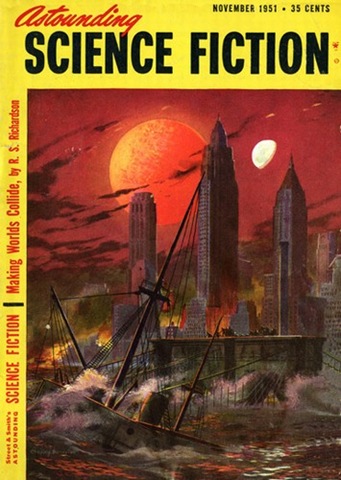
ASF-Nov51

I’m a science fiction addict, which explains why I’m intrigued with the idea of dating all the great science fictional ideas, but you could do this too with your own favorite subject area.  Hell, this idea itself popped into my mind when I noticed that the book I’m reading, The Illustrated Man by Ray Bradbury, came out in 1951, the year I was born.  This got me to thinking about the state of science fiction that year.  Bradbury is a cautionary writer, so his science fiction seems afraid of the future, but then again Heinlein’s The Puppet Master didn’t paint a rosy picture either.  Nor could you find upbeat escapism by going to the movies and watching The Day the Earth Stood Still, When Worlds Collide and The Thing From Another World.

How in the world did I grow up thinking science fiction paved the way for exciting futures?  The most famous science fiction novels of the 20th century to the world at large are Brave New World, 1984, A Clockwork Orange and Slaughterhouse Five.  When did the future become a Disney destination – well certainly not in 1951.  Or maybe all the gosh-wow sense of wonder stories of 1951 where not the big public movies, but the cherished stories that only the fans embraced.

All around the world in 1951, but mainly in the U.S. and Great Britain, science fiction writers were creating their visions of the future.  Few people took them seriously.  Some of their tales are still in print today, The Illustrated Man is set for its second movie production, and a remake of The Day the Earth Stood Still came out last year.  Why is science fiction from 1951 still being read and seen today?

I’ll work with these books:

And consider these anthologized stories from the magazines:

And use these memorable movies:

We stand 57 years into their future and know what will happen.  We can judge the hopes and fears of the people of 1951 and psychoanalyze their paranoia.  The opening story in The Illustrated Man, “The Veldt” is about a high tech nursery that is a lot like the holodeck from Star Trek: The Next Generation.  Bradbury’s story worries that technology will change the children of his times.  How do you interpret a story where the kids kill the parents with their futuristic nursery?  But wasn’t Bradbury right?  The innocent minds of 1951 don’t exist anymore.  If Ray Bradbury could have known what the Internet shows the children of today wouldn’t he have written an even scarier story?

Juveniles delinquency was one of the major problems people feared in the 1950s, so what if Bradbury could have foretold the Columbine massacre?  I include Catcher in the Rye in my list because it was probably the best literary novel of the year, and decade, but it also represented the same kind of fears about children changing that Bradbury was writing about.  Children were rejecting innocence, turning against the status quo and their parents and this scared the bejesus out of the conservatives of the times.

What we have to do is imagine what it would be like to be an average Dick or Jane in 1951 encountering these stories for the first time.  My father and mother, George and Virginia, didn’t have a clue about science fiction, but let’s imagine them going to see The Day the Earth Stood Still.  How many Americans, much less citizens of the world, really believed in aliens from other planets?  The UFO craze started in the late 1940s, so the idea was in the news for people to ponder.  Of course there had been the 1938 scare when Orson Welles broadcast H. G. Wells story of The War of the Worlds that terrified millions.  Even my parents told me about that when I was little.

By 1951, anyone in the U.S. that wasn’t too poor to have a radio or TV set had been exposed to the idea of aliens from other planets.  Another popular movie of the year was The Thing From Another World.  With two movies, three major science fictional concepts were inserted into the public mind:  interstellar flight, wise powerful beings not mentioned in the Bible, and intelligent robots.  Science fiction readers had known about these concepts for decades, but in 1951 the number of SF readers were very small.

Because of the atomic bomb in 1945, the idea of a man-made end of the world event had also been introduced to the public.  That idea was more powerful than alien visitors, because Klaatu and Gort’s real purpose was to warn us not to wipe ourselves out.  Then George Pal produces When Worlds Collide to let us know there were other ways for life on Earth to end, and John Wyndham gave readers yet another idea of how human life could be threatened.  Heinlein even combined the fear of Reds with the fear of aliens.

Many of the SF books and movies that came out after 1951 were about the end of civilization, or the end of mankind, or the end of the world.  The paranoia of the 1950s is very hard to top, but occasionally a writer will try, and Cormac McCarthy recently succeeded vividly with The Road.

Fritz Leiber’s classic a “A Pail of Air” reminds me of the film When Worlds Collide, because they each have a roaming astronomical body coming into our solar system and changing life on Earth.  In Leiber’s story, a dark star pulls Earth out past the orbit of Pluto, and in When Worlds Collide, a movie based on the 1933 book by Philip Wylie and Edwin Balmer, two planets from outside our system get captured by the Sun, and one destroys the Earth.  Ever since I’ve been reading science fiction as a kid I’ve been living with hundreds of ideas on how our world might be destroyed.  I guess that’s no big deal because before science fiction, religious people lived with the idea that God would stomp our world.  Maybe science fiction end of the world stories are just variations on biblically inspired end of the world tales.  However, to me, rogue stars and atomic wars seemed far more real than the wrath of God.

Science fiction is never very far from religion.  In “The Quest for Saint Aquin” Anthony Boucher, the legendary founding co-editor of The Magazine of Fantasy and Science Fiction, pictures a future where religion is threatened.  This story promotes the great science fictional idea of machine intelligence, and even suggests if pure AI thinking can believe in God, then why shouldn’t humans.

Now here’s an original SF idea that has not been carried forward to the present and evolved?  I guess people don’t believe that AI and robots will also believe in God?  I’ve never thought they would, but what if they did?  Here’s a potential story idea.  However, this reminds me of a famous joke from the 1950s.  Scientists wanted to know if there was a God, so they built a giant IBM machine and fed it all knowledge and typed in the question:  Is there a God?  They got back:  There is now.

1951 was a long time before most people thought that space travel could be real.  Most of the public when they thought of rocketships to the Moon and Mars pictured them from what they learned in the Sunday comics reading Buck Rogers or Flash Gordon.  They didn’t know they were just six years from the Russians orbiting a satellite and a decade before the Russians put a man into orbit.  The future was closing in far faster than anyone knew, except for Robert A. Heinlein, Arthur C. Clark and Isaac Asimov.  These men ruled 1950s science fiction as a triumvirate.

Heinlein’s 1950 classic film Destination Moon helped the public to realistically picture the first mission to the Moon.  Clarke and Heinlein wrote stories and books about early space explorers to nearby destinations.  Asimov thought huge and promoted the major SF idea of a galactic civilization, much like the Roman Empire, but spread across thousands of star systems.  Asimov’s vision wouldn’t attain wide public recognition until Stars Wars in 1977, with a good bump from Star Trek in 1966.

By 1951 Heinlein and Clarke were writing stories that realistically tried to show astronauts working on the Moon and Mars.  In the tiny world of science fiction fans, these ideas were ancient, but I think Heinlein and Clarke felt if a fictional idea was ever to give birth to reality they needed to promote space travel to millions.

How does someone born in 1966, the year of Star Trek, and 1977, the year of Star Wars, feel when they discover these ancient ideas for the first time?  1951 is Darwin voyaging on the Beagle, while 1969’s Armstrong’s giant step for mankind is science fiction’s 1859’s On the Origin of Species publication.   It’s the time between a few thinking about an idea till when the idea hits the public in a big way.

If you turn on Turner Classic Movies and eventually watch every movie from 1951 except for a handful of SF films, you will begin to get the idea of just how little that world of 1951 thought about the great ideas of science fiction.  In 2009 you can’t escape these ideas unless you live in that proverbial cave like a fundamentalist Muslim, and I bet even cave dwelling terrorists have thought about aliens from other worlds, space travel, and intelligent robots.

The question is, will in 2051, or 2151. how many of the great science fictional ideas of the 20th century will still be around?  How many will have come true and how many will be thought of as quaint fantasies of ignorant people of the past, like the Oneida Community?

And what if I continued my research, could I show how 1911, 1921, 1931, 1941 and 1961, 1971, 1981, 1991 where different from 1951 regarding the evolution of science fictional ideas?  It would take a lot of work, but I think the answer is a definite yes.  Could I write a novel to be published in 2011 that would stand out with radically new evolutionary science fictional traits?  I don’t know if I can do it, but I’m hoping someone will.

JWH – 2/14/9