Reading Vonnegut’s Slaughterhouse-Five at Ages 18, 55, and 72

by James Wallace Harris, 2/8/24

When I first read Slaughterhouse-Five by Kurt Vonnegut back in 1970 I thought of it as an antiwar novel. The Vietnam War overshadowed everything back then, and I was old enough to be drafted. 1970 was the year M.A.S.H. and Catch-22 came out in the movie theaters. I went to see Catch-22 and was so blown away that I bought the book, read it in a day, and then went to see the movie version again. I didn’t read the book version of M.A.S.H. for another year but saw the film in 1970 too. Ever since I’ve thought of Slaughterhouse-Five, Catch-22, and M.A.S.H. as the trilogy of anti-war novels of my generation. The books were all about hating war.

When I read Slaughterhouse-Five again, in 2006 when I was 55, I listened it on audio. That time it was a completely different novel. That time it was hilarious. It was over-the-top silly, slapstick, and viciously satirical. At that time I focused on the Tralfamadorians and Kilgore Trout, and Vonnegut’s commentary on science fiction. In 2006 I noticed the antiwar parts, but they didn’t seem to be the primary point of the novel. They were still horrifying, but I found it hard to take Slaughterhouse-Five as a serious novel about WWII. That happened to me last year when I tried to reread Catch-22.

Now in 2024, when I’m 72, I listened to the book again. This time the story was bittersweet, heavy on the bitter, gentle on the sweet, and deeply philosophical. This time Slaughterhouse-Five was a condemnation of humanity. It was dark, very dark, but strangely not depressing. Both Billy Pilgrim, the protagonist, and Vonnegut were accepting that humans do horrible things and there is nothing we could do about it. This time it was obvious that Vonnegut believes we have no free will, and the best we can do in life is enjoy those moments when life is pleasant. This time around Slaughterhouse-Five was incredibly stoic.

When I read Slaughterhouse-Five the first time I thought the main goal of the novel was to horrify readers that we bombed Dresden in 1945 and make them outraged. I thought Vonnegut was testifying to an Allied war crime. This time around I realized Vonnegut wasn’t doing that at all. He was completely accepting that we had to bomb Dresden.

I think both times before, I thought Billy Pilgrim was a stand-in for Vonnegut. However, this time it was quite explicit that Billy Pilgrim and Vonnegut were distinctly two different characters in the book. At the end of the audiobook, there was a ten-minute conversation between Vonnegut and another unnamed WWII vet. In that conversation Vonnegut even tells us the name of the man he based Billy Pilgrim on.

The vet Vonnegut was talking to kept trying to praise Vonnegut, and Vonnegut kept deflecting the compliments. But one thing the other guy said stood out. He said that all of Vonnegut’s books were in print because they have multigenerational appeal. Since I have read the book when I was young, middle aged, and old, I can attest to that.

When I read Slaughterhouse-Five back in 1970, I thought the book was a protest. It was Vonnegut telling his readers that we need to change. And back then I thought humans could change. When I read it in 2006, I still had hope that humanity could evolve into something better. But in 2024, I didn’t find Vonnegut protesting at all. Vonnegut advised acceptance. Why didn’t I see that at 18?

Slaughterhouse-Five is neither an antiwar novel, nor even a misanthropic novel. In 2024 it seems obvious that Vonnegut was saying we have no choice but to accept the life we’re given, both as an individual and as a species.

Vonnegut was around 42 when Slaughterhouse-Five was published in 1969. How is it he now seems like a wise old man when I read it at 72 in 2024? Every time I read Slaughterhouse-Five I thought of Kurt Vonnegut as a modern-day Mark Twain. I was very into Twain when I was young, but I pictured him as a bitter old man from his later fiction and autobiography.

I wonder now if Vonnegut eventually turned bitter like Twain. Even though for the 2024 reading many scenes felt bitter, now that I write this, I’m not even sure that’s what Vonnegut intended. Could he have intended a total beatific point of view? I need to rewatch the 2021 documentary about Vonnegut called Unstuck in Time. And I need to read And So It Goes: Kurt Vonnegut: A Life by Charles J. Shields.

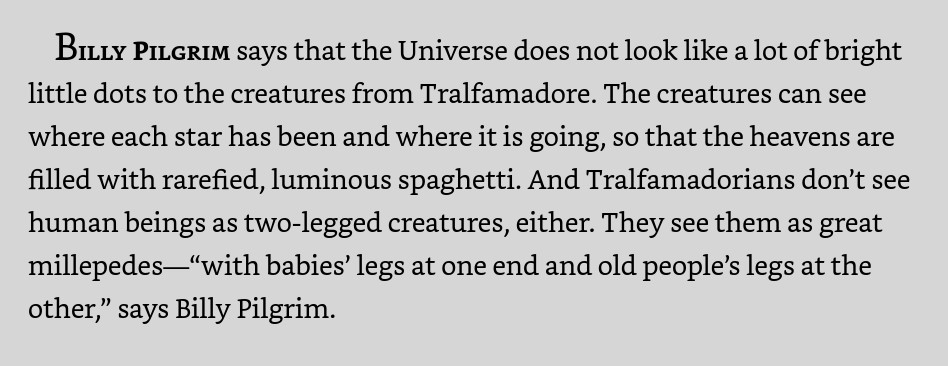
This time around I’ve been thinking more about the Tralfamadorians, the alien race who kidnaps Billy Pilgrim in a flying saucer and takes him to their home world where they exhibit him in a zoo. The Tralfamadorians don’t see time like we do. Existence is all of one piece.

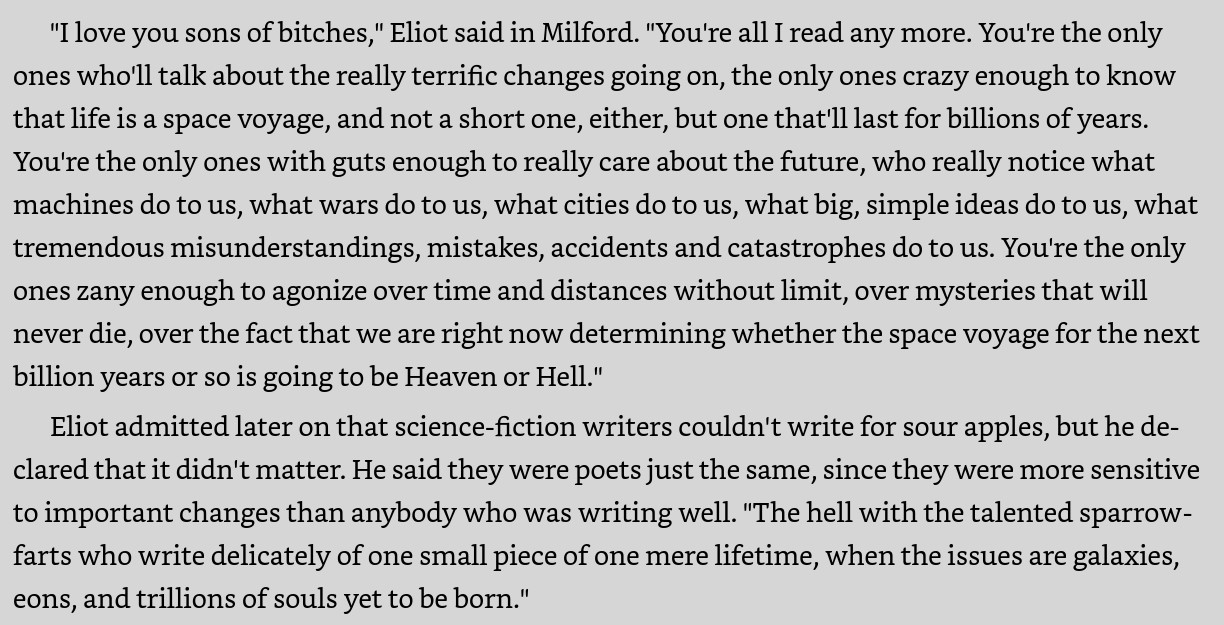
These aliens are like Zen Masters. Vonnegut uses them as enlightened teachers. But then, he gives a rather pitiful assessment of science fiction with his portrayal of Kilgore Trout. However, in a later novel, God Bless You, Mr. Rosewater, where Kilgore Trout is again featured, its hero, Elliot Rosewater attends a science fiction convention and gives this speech.

Science fiction didn’t come across so positively in Slaughterhouse-Five. Kilgore Trout wrote dozens of books that never sell. He’s a surly old man who makes his living by managing paperboys. Billy Pilgrim finds Kilgore Trout’s books only by accident. One time he finds four of them in a porn bookstore used as window dressing.

Wikipedia has an illuminating entry on Kilgore Trout. It says Vonnegut based Kilgore on Theodore Sturgeon. I’ve always wanted to know more about Theodore Sturgeon. Sturgeon’s fiction suggests he’s both eccentric and beat.

There are certain writers that haunt me. I think Vonnegut is becoming one of the ghosts that I need to get to know a whole lot better. And I might need to give Catch-22 and M.A.S.H. another read too.

JWH

Reading Comprehension: Books vs. Audiobooks

by James Wallace Harris, 1/3/24

At 72, I’m still learning how to read.

I recently finished the audiobook of The Simulacra by Philip K. Dick and started to write a review for my science fiction blog. That’s when I realized I needed to read the book with my eyes before I could write a proper review. The Simulacra was a complex novel involving several plot threads and dozens of named characters. (Read the plot summary at Wikipedia. Get the book at Amazon.)

From my audiobook experience I found the book compelling, fun, and I was always anxious to get back to listening to the story. I was never confused by what was going on, but when I tried to summarize the novel for my review, I discovered I couldn’t recall all the details I needed to make a coherent description of the story. There were just too many science-fictional concepts. Nor could I describe all the plot threads without researching them.

I won’t describe the book in detail, I’ll do that in my review, but for now, The Simulacra is about a post-apocalyptic world where China attacked America with atomic missiles in 1980, and the U.S. government and Germany combined to form a totalitarian regime called The United States of Europe and America (USEA). It appears to be run by a captivating 23-year-old first lady named Nicole Thibodeaux. However, she has been married to five presidents and always remains young. Since this book was written in the summer of 1963, I assume Dick was inspired by Jackie Kennedy because Nicole spends most of her time charming people, decorating the White House and gardens, and putting on nightly cultural events. But Nicole is also ruthless enough to have people summarily executed, evidently wielding unlimited power. She has access to time travel no less, and one subplot involves her negotiating with Nazis to change the course of WWII. Other subplots involve an insane psychic pianist Nicole wants to play at the White House, the outlawing of psychiatry pushed by the pharmaceutical industry, what happens to the last legal psychiatrist, a pair of ordinary guys who have a jug band that plays classical music who want to perform at the White House, a trio of sound engineers who are trying to chase down the psychic pianist to record, and a small company that hopes to get the contract to construct the next president. This long paragraph barely scratches the surface of the whole novel.

My failure of completely understanding the novel from listening to the audiobook was partly due to aging memory and partly due to the complexity of Dick’s prose. I could have hashed out several thousand words describing what I remembered, although it would have been a bundle of vague impressions. Summarizing what PKD was trying to do was evasive from just listening to the audiobook.

Audiobooks are bad for remembering exact details, which I knew, but was painfully revealed when I tried to read the novel and take notes. I called up The Simulacra on my PC in the Kindle app on the left side of the screen, and launched Obsidian, a note taking program on the left side of the screen. I started reading The Simulacra again, but with my eyes. After two days, getting to the 29% read position on the Kindle edition, I had twenty-eight names, twenty-six plot points, several lists of other details, and several quotes in my notes. I figure there are three to five main plot threads, each involving three or more characters.

More than that, I realized Philip K. Dick had riffed on hundreds of ideas. As I read them, I remembered them, but I realized that while listening, I had not put most of them within the context of the story. It wasn’t until my second reading that I saw all these hundreds of creative speculations as being part of one jigsaw puzzle picture. And I’m not talking about the characters and plots. I’m talking about worldbuilding.

Rereading with my eyes allowed me to stop and ponder. Rereading allowed me to remember the bigger picture. However, listening to the audiobook let me enjoy the story more. The narrator, Peter Berkrot, did voices for each of the characters, and acted out their personalities. Listening to the novel, it felt like I was listening to an old-time radio drama where many actors performed a story.

At one point I got too tired to read and went to bed. But before I fell asleep, I listened to the part I had just read. Berkrot expressed emotions I had not picked up while reading with my eyes, but recalling the scenes made me realize that Dick had put them there. In other words, Berkrot had found aspects of the text I missed and was pointing them out with sound.

Over the ten years since I’ve retired, I’ve been learning the value of rereading books. In fact, I now feel reading a story just once is unfair to the author. It takes two or more readings to see the author’s vision. Reading a work of fiction just once provides one layer of understanding. It’s when we see multiple layers within a work that we start to truly understand it.

Switching back and forth between reading with my eyes and reading with my ears reveals both methods have their advantages. If I read once with one sense organ and reread with another, the two combine to create reading synergy.

For most of my life, I’ve always been concerned with reading more books, but the wisdom I’m gaining from getting old is showing me that both speed reading and reading lots of books is a distraction from deep reading.

Right now, I’d recommend:

  1. Listen to an audiobook for the first reading to get the big picture.
  2. Reread with a physical book or ebook to get the details. Read slowly and stop often to ponder.
  3. Write a review to make deeper sense of a book. Putting things into words pushes us to make sense of things.
  4. Read reviews and scholarly articles to get other perspectives.
  5. Reread the book again to bring it all together.

This is what I’m working on with The Simulacra by Philip K. Dick. It’s not considered one of Dick’s better works, but I’m trying to discover if there is more to the novel than its current reputation.

JWH

Reading at the End of Existence

by James Wallace Harris, 12/19/23

I don’t plan to die anytime soon, but the end of my existence looms ahead. That leaves me with a growing anxiety to read all the books I haven’t read but want to. Another growing anxiety is realizing I’m reading less every year. Those problems are acutely revealing that I’ve bought far more books for my retirement years than I could read in several lifetimes. I need either the lifespan of Lazarus, or the ability to reincarnate, or to triage my library.

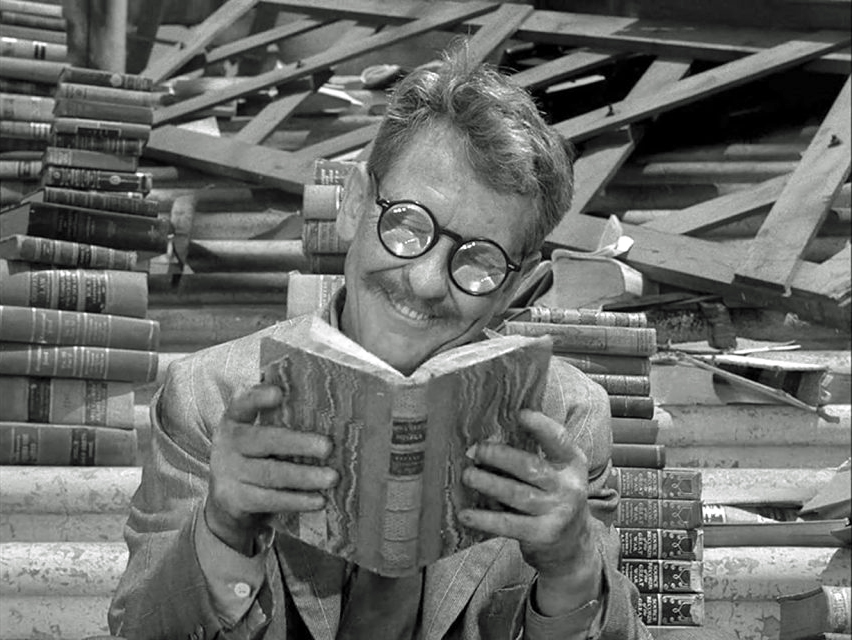
I would feel better if I could only read those books I’m dying to read before I die. There’s that word I’m trying not to say, “dying,” but it does seem literal in this situation. Which books do I want to read the most before I reach a Henry Bemis tragic ending?

The euphemism “dying to read” sounds like I’ll die if I don’t get to read certain books, or it could suggest books I’m so engrossed in reading that I’m dying while I’m not reading them. What I’m really saying is the possibility of dying is pushing me to get down to some deadly serious reading. It would help if I hadn’t developed a YouTube video addiction.

Some people might see retirement years as a time of waiting to die. On the contrary, every day in retirement feels like I’ve got all the time in the world, so I don’t feel the need to hurry. That’s why I’m probably reading less. When I worked, I read more because I had so little free time and it gave me a desperation to read.

However, the problem at hand is I have nine tall bookshelves filled with books waiting to be read. And that’s not counting all the invisible Kindle and Audible books in my digital cloud library. I might read one bookshelf a decade, and I don’t think I have nine decades left. (I kind of think I might have one or two.)

I need to stop wasting time and start reading my ass off.

Unfortunately, it’s not a matter of picking the first book and turning pages. With the sense that my days give me all the time in the world, but my years are running out, it causes anxiety over what to read. If I’m in day mode I can read anything and not feel like it’s a waste of time. If I’m in year mode though, it’s like “Holy Cow, I’ve got to read something great, it might be my last book!”

Lately, I’ve started a lot of books that I want to read and even enjoy reading them but quickly switch to another book I’m also anxious to read. I then forget about the previous book — for a while. This creates a daisy-chain of unfinished books that I’m constantly trying to finish. Here’s a list of unfinished books I’m currently cycling through in my reading:

  • The Science Fiction Century edited by David G. Hartwell
  • Aye, and Gomorrah and Other Stories by Samuel R. Delany
  • Man in His Time: The Best of Brian W. Aldiss
  • The Steps of the Sun by Walter Tevis
  • Davy by Edgar Pangborn
  • Lives of the Stoics by Ryan Holiday and Stephen Hanselman
  • Anthony Powell by Hilary Sperling
  • Songbook by Nick Hornby
  • Lila: An Inquiry into Morals by Robert M. Pirsig
  • The Magic Mountain by Thomas Mann
  • Determined by Robert M. Sapolsky
  • The Simulacra by Philip K. Dick
  • The Rise of Democracy by Sean Wilentz

And these are just the ones lying nearby that tick my memory.

Of course, I rushed through and speedily finished Lessons in Chemistry by Bonnie Garmus and Democracy Awakening by Heather Cox Richardson. Why do I read some books without stopping but not others? Well, some books you really can’t put down. However, I worry my television affliction is carrying over to my reading. That worries me. For the past several years, I have had a tough time watching TV by myself. If I’m watching with other people I can sit through an entire show or movie, but when I’m alone, I end up clicking around every few minutes. I think the internet has ruined my attention span.

Last year I read 52 books, which is about average. That’s about one book a week. This year, with two weeks left to go, I’ve only finished 32 books. If I read books as fast as I read Lessons in Chemistry and Democracy Awakening, I would have finished 75-100 books this year. That 1.5 to 2 books a week.

When I really love a book, I can finish it in 2-5 days depending on length. Since I’m worried about running out of reading time, I should try to read those kinds of books all the time. But I have trouble finding such addictive titles.

If I had a Genie that granted me wishes, I’d wish that he/she would put all my unread books in order of how passionately I’d want to read each of them. But would I start with the most potent? That would put me on a downhill slope of reading enjoyment. Maybe a good procedure would be to pick #52 and read toward #1, so the year would be one reading pinnacle after another. Then take a long break and do it again. But in the second year, would I really want to read 52 books that were less enjoyable than all the books I read the previous year?

Whoops! I wasted my first wish.

Books often complement each other. Reading a history book, along with a biography and historical novel often creates a synergistic reading high. I still want to read the best books first, but I’d also want them blended by subject so that the highs came in waves as I wander from topic to topic. Right now, I’m reading about democracy in America in the 19th century. Susan and I are watching The Gilded Age on television. Supplementing those with some novels and additional nonfiction books about 19th century art and science would make for a very educational month or two.

However, I know I’ll get burned out on America history soon enough. Not only do I not stick to books, but I flit from subject to subject. While I have that Genie, I wish I knew which subjects I wanted to study the most before I die. Not only do I need to abandon some books in my collection, but I also need to abandon some subject areas.

I keep standing in front of my bookcases thinking the sight of so many books is paralyzing me from deciding what to read and sticking to it. My two all-time favorite periods of reading in my life were when I was a teen and could barely afford any books, so I cherished each as I bought and read them. And when I first joined Audible and had two credits a month, that made me incredibly careful to pick what I wanted to listen to and finish. In both cases, I’d finish what I owned, and spend days anticipating what I could buy and read next.

I know I can’t make an end of the world reading plan because I never stick to my plans. Over the years I’m slowly getting a handle on my book buying addiction. Although, I might have slowed on book purchasing because it’s finally hitting me that I’ve already bought far more books than I’ve got time to read. That reality has gotten to feel very real, so I no longer buy books like I used to. But it’s also adding to the anxiety that I need to read as much as I can over the time I’ve got left.

What I need now is a sense of what I will read and what I won’t. Over the coming years I’d like to read more and get rid of books I know I can’t or won’t read until I end up on my deathbed with just one book. But this desire isn’t really about numbers. It’s about the topic of the last book I will be reading. Not only do I have too many books to read, but I’m trying to cover too many subjects.

More than ever, I know my mind can only hold so much. And after a lifetime of reading, I get the feeling I’m heading towards an ultimate distillation of interests. When I leave this existence, I want to feel tranquil satisfaction that I’ve completed my life’s education. I worry I’ll be like one of those foolish Hindu guys who think of a beautiful stag just before they die and must reincarnate as one. If I leave wanting to read more, I’ll come back as a bookworm again. (Or come back as a book.)

JWH

On Rereading

by James Wallace Harris, 10/2/23

This week I started rereading Catch-22 by Joseph Heller, a novel first published in 1961. I was shocked by how much I disliked it. In my memory it was a terrific book. Back in 1970 I went to see Catch-22 the movie when it came out. I was so impressed I went to a bookstore, bought the book, went home, read it, and then went back to see the film again. For over fifty years I’ve thought of Catch-22 as a classic.

This week I listened to two hours of the novel before giving up. I can’t believe I ever loved that book. It’s sort of like how I feel when I catch Gilligan’s Island on TV, I can’t believe that in the eighth grade it was my favorite television show. Whenever I see a clip of Gilligan’s Island now, I assume I must have been brain damaged as a kid. I wondered the same thing when listening to Catch-22.

Maybe I’ve just lost my sense of humor. I loved Saturday Night Live when it came out back in 1975, but I’ve found it painful to watch for decades now. I’ve come to realize that I truly dislike lame satire. Heller appeared to take one absurdist point-of-view and stretched it out over a 21-hour audiobook. It felt like hearing a Who’s on First routine that never ended.

I came to the book expecting to find philosophical insight into WWII, and it just wasn’t there. Catch-22 is considered an anti-war classic, but I didn’t feel that in 2023. The film version of M.A.S.H. also came out in 1970. That was the height of the Vietnam War. Both stories felt like anti-war brilliance in 1970, but insane in 2023. Fifty-three years later, and after many other wars, such silliness no longer seems appropriate.

Obviously, I’ve changed over the decades, but I think there’s something else that’s changed. Postmodernism has crashed and burned. Postmodernism took us down a wrong path, and it’s time to retrace our steps.

I still reread my childhood favorite book, Have Space Suit-Will Travel which came out in 1958. It continues to work. It seems to be a genuine touchstone to my past. I find great insight into who I was as a kid and who I wanted to be when I grew up. To me, it was a science fiction version of Great Expectations — including the cynicism I give it in retrospect.

I also read an abridged version of Great Expectations in high school and have reread the full novel since. It seems to grow in maturity, especially as I read more about Charles Dickens. As a teenage boy I identified with Pip and his frustration with Estella. But as an old man, I figure Pip was a stand-in for the older 1858 Dickens, and Estella and Miss Havisham were stand-ins for Ellen Turan and her mother. The depth of Great Expectations grows with every rereading.

This morning I watched a video about rereading books by Anthony Vicino called “You Should Read These 12 Books Every Year.” Vicino is one of those people who want to get ahead in life quickly by reading self-help books. Because he wanted to succeed quickly, and many successful CEOs read fifty-two books a year, Vicino decided to read one hundred books in a year and get ahead twice as fast. What Vicino learned was to read fewer books. And rereading was the secret to success.

I’ve been thinking I need to do more rereading. This video made me wonder what twelve books I would reread every year. Would they be fiction or nonfiction? And would they be modern or postmodern? I’m starting to think we all took a wrong turn around 1960, at least in fiction. The trouble is since 1960 nonfiction has been overwhelming us with expanding knowledge that we need. Art and philosophy couldn’t handle that explosion of information and we got postmodernism.

I need to do a lot of rereading, and rethinking. What books will be ruined by my maturity and what books will reveal their own deeper maturity?

JWH

Rebecca (1940)

by James Wallace Harris, 9/11/23

This is not a review, but my reactions to watching Rebecca, the 1940 Alfred Hitchcock movie with my friend Olivia. I’ve decided I don’t want to review books and movies because that would involve withholding spoilers. I want to talk about how I react to fiction — how fiction works on me.

I don’t think I’ve seen Rebecca before. I’ve started it a few times recently, but in recent years I have had trouble watching movies by myself, so I didn’t watch it all the way through until Olivia wanted to see it too. I’m thankful she came over to join me. Over the past year I’ve encountered several women friends who have told me they’ve read the 1938 novel Rebecca by Daphne du Maurier. They all loved the book, and I bought a copy. I started the book a couple of times but didn’t stick with it. I loved the writing. I adore the open paragraphs. du Maurier description of nature taking over the old estate is exactly how I picture nature taking back cities when civilization falls.

Last night I dreamed I went to Manderley again. It seemed to me I stood by the iron gate leading to the drive, and for a while I could not enter, for the way was barred to me. There was a padlock and a chain upon the gate. I called in my dream to the lodge keeper, and had no answer, and peering closer through the rusted spokes of the gate I saw that the lodge was uninhabited. 

No smoke came from the chimney, and the little lattice windows gaped forlorn. Then, like all dreamers, I was possessed of a sudden with supernatural powers and passed like a spirit through the barrier before me. The drive wound away in front of me, twisting and turning as it had always done, but as I advanced I was aware that a change had come upon it; it was narrow and unkept, not the drive that we had known. At first I was puzzled and did not understand, and it was only when I bent my head to avoid the low swinging branch of a tree that I realized what had happened. Nature had come into her own again and, little by little, in her stealthy, insidious way had encroached upon the drive with long, tenacious fingers. The woods, always a menace even in the past, had triumphed in the end. They crowded, dark and uncontrolled, to the borders of the drive. The beeches with white, naked limbs leaned close to one another, their branches intermingled in a strange embrace, making a vault above my head like the archway of a church. And there were other trees as well, trees that I did not recognize, squat oaks and tortured elms that straggled cheek by jowl with the beeches, and had thrust themselves out of the quiet earth, along with monster shrubs and plants, none of which I remembered. 

The drive was a ribbon now, a thread of its former self, with gravel surface gone, and choked with grass and moss. The trees had thrown out low branches, making an impediment to progress; the gnarled roots looked like skeleton claws. Scattered here and again among this jungle growth I would recognize shrubs that had been landmarks in our time, things of culture and grace, hydrangeas whose blue heads had been famous. No hand had checked their progress, and they had gone native now, rearing to monster height without a bloom, black and ugly as the nameless parasites that grew beside them. 

On and on, now east now west, wound the poor thread that once had been our drive. Sometimes I thought it lost, but it appeared again, beneath a fallen tree perhaps, or struggling on the other side of a muddied ditch created by the winter rains. I had not thought the way so long. Surely the miles had multiplied, even as the trees had done, and this path led but to a labyrinth, some choked wilderness, and not to the house at all. I came upon it suddenly; the approach masked by the unnatural growth of a vast shrub that spread in all directions, and I stood, my heart thumping in my breast, the strange prick of tears behind my eyes. 

There was Manderley, our Manderley, secretive and silent as it had always been, the gray stone shining in the moonlight of my dream, the mullioned windows reflecting the green lawns and the terrace. Time could not wreck the perfect symmetry of those walls, nor the site itself, a jewel in the hollow of a hand. 

The terrace sloped to the lawns, and the lawns stretched to the sea, and turning I could see the sheet of silver placid under the moon, like a lake undisturbed by wind or storm. No waves would come to ruffle this dream water, and no bulk of cloud, wind-driven from the west, obscure the clarity of this pale sky. I turned again to the house, and though it stood inviolate, untouched, as though we ourselves had left but yesterday, I saw that the garden had obeyed the jungle law, even as the woods had done. The rhododendrons stood fifty feet high, twisted and entwined with bracken, and they had entered into alien marriage with a host of nameless shrubs, poor, bastard things that clung about their roots as though conscious of their spurious origin. A lilac had mated with a copper beech, and to bind them yet more closely to one another the malevolent ivy, always an enemy to grace, had thrown her tendrils about the pair and made them prisoners. Ivy held prior place in this lost garden, the long strands crept across the lawns, and soon would encroach upon the house itself. There was another plant too, some half-breed from the woods, whose seed had been scattered long ago beneath the trees and then forgotten, and now, marching in unison with the ivy, thrust its ugly form like a giant rhubarb towards the soft grass where the daffodils had blown. 

Nettles were everywhere, the vanguard of the army. They choked the terrace, they sprawled about the paths, they leaned, vulgar and lanky, against the very windows of the house. They made indifferent sentinels, for in many places their ranks had been broken by the rhubarb plant, and they lay with crumpled heads and listless stems, making a pathway for the rabbits. I left the drive and went onto the terrace, for the nettles were no barrier to me, a dreamer. I walked enchanted, and nothing held me back.

du Maurier, Daphne. Rebecca (pp. 1-3). Little, Brown and Company. Kindle Edition. 

This is why I wanted to see the movie and finish the book. I wanted to see it even more when I discovered there was a 2020 remake with Lily James, and a 1997 Masterpiece Theater version. What makes this story so compelling that it gets filmed many times? It’s immensely popular, and Hitchcock’s film won an Oscar for best picture. I find such enduring tales intriguing to study. Watching Rebecca with Olivia was just my beginning of studying du Maurier’s novel.

I didn’t know that when I watched Rebecca last Thursday, but reading about the film reveals that Rebecca was the movie David O. Selznick produced right after Gone with the Wind. Two movies about strong-will women. Gone with the Wind could have been titled Scarlett. Rebecca is never shown in Rebecca, but I now picture her as Vivian Leigh.

I was somewhat disappointed with Rebecca. It’s slow to get into. My wife Susan bailed on it after the first hour and left Olivia and I to finish it on our own. But more importantly, it’s the kind of story that withholds information to create suspense, and I dislike that plot trick. Overall, I did enjoy the film.

Don’t read any further if you haven’t seen the film or read the book, because I’m going to give away big spoilers.

The film begins by recreating the dream sequence I’ve quoted above from the book, but it’s shortened and somewhat changed. There are clues to what happens in this dream sequence, but the real mystery is why the dreamer can’t return to Manderley.

The story then cuts to Monte Carlo where a young naive woman (Joan Fontaine), a paid companion to a Mrs. Van Hopper, meets the mysterious Maxim de Winter (Laurence Olivier), aged forty-two. At this point in the movie, the scenes are light and somewhat humorous. Joan Fontaine plays the unnamed young woman as drab, skittish, fearful, clumsy, and innocent. We don’t know why the older, rich, sophisticated man takes an interest in her, but he does, and they quickly marry. This opening is a kind of Cinderella story, and I assume why women like the picture so much.

I didn’t buy it. Maxim came across as a tortured soul, both wise and educated, but mentally imbalanced. If age of consent was based on a relative scale of maturity, then the young girl should have been out-of-bounds. But a discerning Sherlock Holmes might have guessed something here. If Maxim was honest with Mrs. de Winter 2 the whole rest of the picture which turns into a gothic torture tale could have been avoided and we could have continued with a light romantic comedy.

Now we arrive at Manderley and slowly learn about Mrs. de Winter 1, who was named Rebecca. This whole middle 80% of the film is about misdirection. Both the audience and Mrs. de Winter 2 slowly learns about Rebecca and gets an entirely false picture of her. This is exactly the kind of plotting that Alfred Hitchcock loves. He tells this part of the story with many tense sequences, building us up, and then backing off a bit. Hitchcock has hooked an enormous fish and reals us in slowly.

A good part of this action involves Mrs. Danvers (Judith Anderson), who is the creepy housekeeper of Manderley. She loved Rebecca. Obviously, du Maurier was a huge fan of Charlotte and Emily Brontë. It’s worth reading the Wikipedia entry on Rebecca, especially the sections on “Derivation and inspiration” and “Plagiarism allegations.” Du Maurier was jealous of her husband’s former lover and claimed it gave her the idea for the novel. Other people thought differently.

Finally, the movie takes a weird twist. We were told Rebecca had drowned and her body recovered. Eventually, her sunken boat is found by divers, and her body is found inside with clues to suggest she was murdered. Jack Favell (George Sanders) shows up and we learned that Rebecca had been fooling around with him. Favell starts accusing Maxim of murdering Rebecca and the plot really thickens. Poor Mrs. de Winter 2 starts going crazy trying to figure out what was going on. It’s then that Maxim confesses what happened.

Up till then Mrs. de Winter 2 thought Rebecca was an angel and perfect wife she could never measure up to. Maxim tells her that Rebecca was a cheating sack of shit who began destroying his life just days into their honeymoon. Mrs. de Winter 2 is immensely relieved because she finally realized Maxim loves her for herself. Of course, there’s the matter of Maxim might be a murderer. But she still loves him. In fact, these revelations empower her to fight for her man.

The film goes through a few more twists and turns to wrap things up with a happy conclusion after the crazy housekeeper burns down Manderley with herself inside. That’s why people can’t go back.

If du Maurier and Hitchcock had not withheld information at the beginning of the story, we wouldn’t have had such a tortured-tension plot. If Maxim, back in Monte Carlo, had told the innocent lady’s companion that he liked her because his dead wife was everything he hated, we would have needed a different plot. That would have been the natural thing to do for most men.

And it’s illogical that Maxim kept Mrs. Danvers on, who worshipped Rebecca and kept half of Manderley as a shrine to her. Most guys would have fired her and gotten rid of everything that reminded them of Rebecca. In fact, the premise that Rebecca could do what she wanted because Maxim wouldn’t want her indiscretions to ruin his reputation is also ridiculous. Maybe it’s better explained in the book, but I find that to be an extremely weak point of the story. Divorce was common enough in England in the 1930s.

Why didn’t Maxim pull Rhett Butler and tell Rebecca he didn’t give a damn about her threats? Both Maxim and his new bride are weak and retreating. Is there another story here? What if Rebecca wasn’t bad? What if Rebecca had to live with a mentally ill husband, the reverse of Mr. Rochester in Jane Eyre?

Rebecca is essentially a thriller with a major plot twist. That’s the trouble with thrillers and mysteries, they often depend on unbelievable plot points. They contrive and contort their stories. I understand why Hitchcock does this because he loves to manipulate his audience. But I’ve got to ask: Why does the audience accept being manipulated? In one interview I saw with Hitchcock he compared what he did to scary amusement rides at carnivals. Riders know they are safe but love to pretend to be scared. This suggests that most moviegoers loved to be manipulated. I’ve gotten tired of it.

I’m anxious to read the book to see if du Maurier makes the same kind of contrivances in her story. Did Hitchcock bend it to his needs, or did du Maurier have better explanations? Her opening describing how plants take over is very realistic. I’m hoping to find more of that realism in her novel.

Plus, I’ve thought of some things after watching the movie. Why does the crazy housekeeper trick Mrs. de Winter 2 into dressing up as Rebecca for the costume party? She probably knew that Maxim hated Rebecca. On my first viewing of the film, I assumed that Maxim loved Rebecca and blew up at Mrs. de Winter 2 for recreating a painful good memory. But as we know now, it’s a painful bad memory. We knew Mrs. Danvers wanted to kill Rebecca’s replacement, so I should have guessed a different motive for her getting Mrs. de Winter 2 to dress as Rebecca.

This is why rereading books and rewatching movies are important. Since I know the information that du Maurier and Hitchcock withheld, will the story still work? Or will it fall apart? Or will it even work better as I see deeper into a multidimension structure?

JWH