Keeping Up In The 21st Century

by James Wallace Harris, Thursday, August 8, 2019

I’m reading a rather disturbing book, LikeWar: The Weaponization of Social Media by P. W. Singer and Emerson T. Brooking. It’s disturbing for a number of reasons. First, it shows how completely out of touch I am. Second, it’s very relevant about today’s politics, problems, and conflicts, but makes me realize that I don’t have the tech skills I thought I had – and I’ve been working with computers since 1971. And it’s about a new stage in human communications that I might not be able to join or want to join. I might need to accept I’m too old and let a new stage of human consciousness pass me by.

It’s very difficult to explain why people need to read this book. But here’s a setup that might help. It’s my take on things but relates to what I learn from the book. It’s about the different stages of communications.

  1. Language. This gave us a tremendous boost compared to the other animals, and it’s probably why we’re sentient.
  2. Writing. Let us store knowledge and communicate at a distance.
  3. Printing. Let us mass-produce knowledge.
  4. Telegraph. Let us communicate over distances very fast. This was a tremendous boom for business, war, and journalism.
  5. Telephone. Faster two-way communication without codes.
  6. Radio. The beginning of mass communication. For example, LikeWar quotes Joseph Goebbels saying the Nazis couldn’t have gained power without radio.
  7. Television. More effective mass communication. Truly transformed society.
  8. Computers. They magnified our thinking power and speed.
  9. Networks. Created a world-wide digital nervous system.
  10. Social media. Mass communication with mass participation, or two-way mass communication. LikeWar is about how social media is transforming politics, crime, business, and war. One example LikeWar uses is ISIS, which used social media to overpower traditional national powers.

If you don’t have social media skills you’ll be left behind. Most people’s reactions will be, “Too bad, I don’t care about Facebook.” LikeWar provides significant evidence that all future political power will come from the people who can master social media. LikeWar showed how Trump gained his power with Twitter. Don’t dismiss that out of hand. Singer and Brooking make a powerful case for it being true.

I’m 67 and barely use social media. I blog, I keep up with family, friends, fellow hobbyists on Facebook, I use Twitter to keep up with news about science fiction. That’s essentially nothing. Here’s an example of what I’m talking about. When I was growing up I watched the CBS News every night to follow the Vietnam War. The news was about 24-48 hours old. Some people today keep up with wars in real-time, watching people conduct war using the internet to outmaneuver people conducting war at television and print journalism speeds. LikeWar showed how ISIS used social media users worldwide as recruits in their local battles.

In other words, in any field of endeavor, any conflict, if you’re using print, radio, or television to keep up you’re way behind. We really are developing a global hive mind, and it involves new skills. I can use the excuse that I’m too old to chase that bus. But younger people or older folks who want to compete can’t. And I think that’s stressful. I think a lot of stress in our society is because we’re stratifying by the speed in which we can compete.

I’ll predict there will be a new class of Luddites, those people who choose not to race at social media speeds. But it means giving up power. We’ve had wealth inequality forever, and education inequality for hundreds of years, but what LikeWar envisions is a new kind of inequality. I’m not sure what percentage of the population will be able to keep up.

LikeWar

JWH


Young vs. Old Voters

by James Wallace Harris, Saturday, July 13, 2019

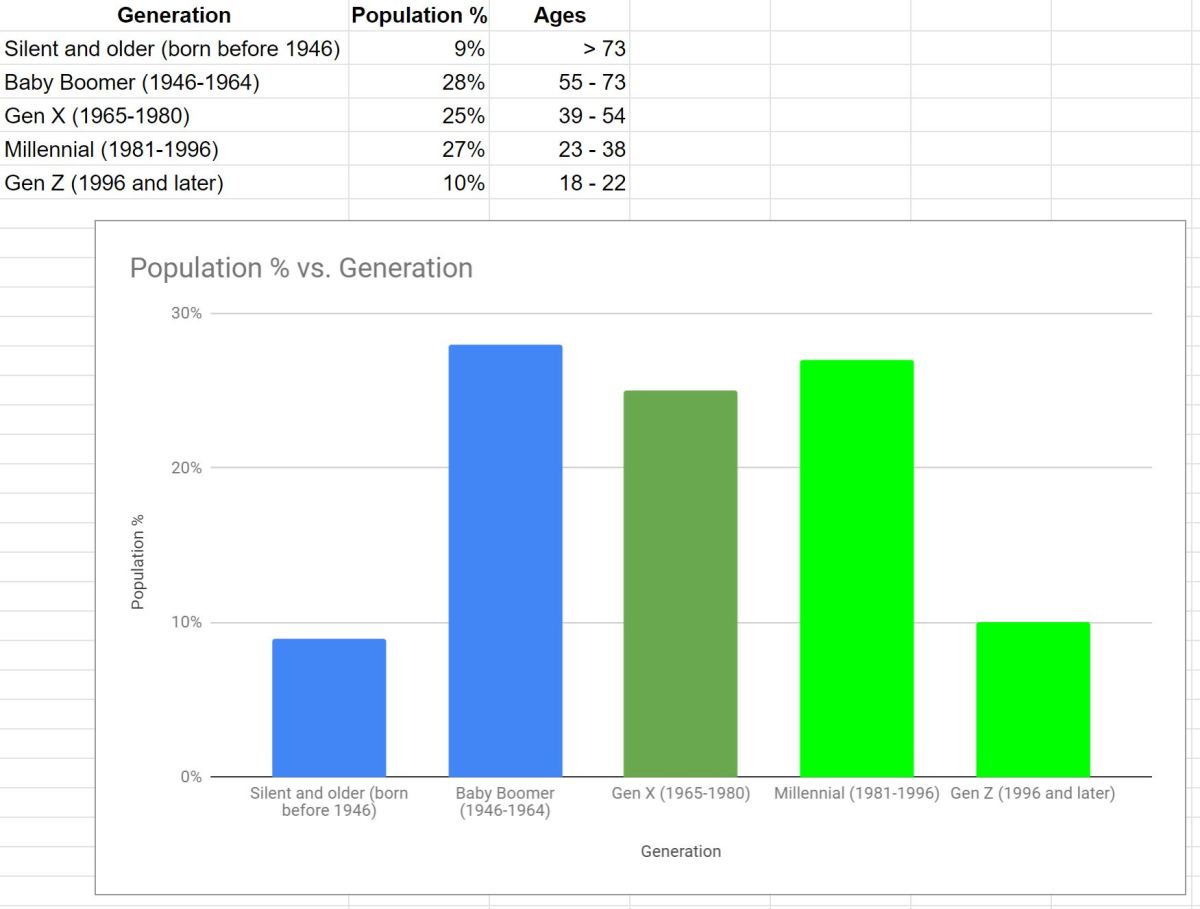
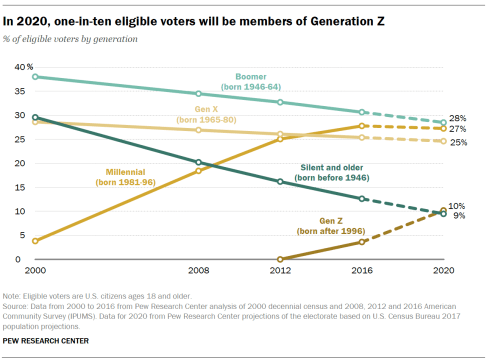
I’m using statistics from Pew Research Center’sAn early look at the 2020 electorate.” I’ve graphed them so blue is older voters, light green the younger voters, and middle-age voters are dark green. There is a certain symmetry to this graph. I’m going to “borrow” a PEW graph that shows the change vectors of each generation.

population trends

It’s obvious that Baby Boomer and Silent generations are in decline, but if you look closer, Millennial and Gen X generations have already started their decline. You’d think the 2020 election should reflect a generation shift.

If you look at PEW’s other graph in that article,

Voters by ethnic groups

you’ll see the shift that Republicans fear. Why do Republicans keep alienating minorities? Haven’t they even considered embracing diversity?

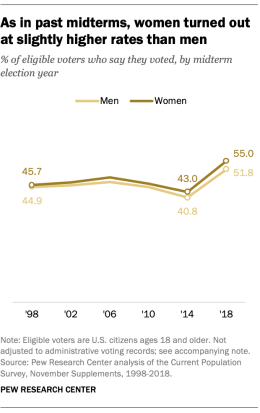
Finally, if we consider gender,

Voters by gender

where we see that woman voters are also increasing.

I have no way to predict how the U.S. 2020 presidential election will go. There are too many factors. But if population demographics are good indicators, then youth, minorities, and women should play a bigger role. But are they a large enough factor for Democrats to shun running another old white guy? Which side of the graph should the Democrats bet on?

Trump won in 2016 by finding the right dissatisfaction in America. I think that same dissatisfied voting block still exists, but are they satisfied with Trump? Many independent voters voted for Obama and then Trump because they hoped for significant change. Should the Democrats pick someone promising to make big changes? What do younger voters – liberals, conservatives, independents – really want?

We never seem to know the deciding issue in a U.S. presidential election until after its over. The face-palm slap factor is always a black swan that surprises us. You’d think with all the artificial intelligence out there that data scientists could tell us ahead of time. But I doubt they will.

As of now, I’m going to bet that the 2020 election will be about youth. I’ve been reading articles lately about climate change depression. Young people are bummed out about the future, and who can blame them? I’m guessing they might be the reactionaries in the 2020 election. Maybe I feel this because I don’t want to see the young giving up on the future. Climate change isn’t the end of the world, but voters who don’t vote about the future could be.

JWH

The 2020 Election Will Be A Referendum

by James Wallace Harris, Monday, July 1, 2019

The 2020 election will be a referendum for a single issue, we just don’t know what that issue is yet. If Bernie Sanders or Elizebeth Warren get the nomination the referendum will be:

  • Vote Yes for Medicare-for-All
  • Vote No for Medicare-for-All

Right now, the Democrats think it will be:

  • Vote Yes for Trump
  • Vote No for Trump

Every Democrat in the debates offered a freebie as if they could buy voters. But that’s not going to work. Free education or forgiveness of college loans will only appeal to a fraction of the voters, so it won’t work as a clear decisive referendum. Medicare-for-All would affect every voter, that’s why it’s possible referendum question.

The Democrats could pick a vital issue and make a stand, for example:

  • Vote Yes to Stop Climate Change
  • Vote No to Keep Doing Nothing

Which would essentially be a referendum that says:

  • Save the future
  • Fuck the future

But I think the Democrats are afraid to commit to such an issue. To save the future would require sacrifice and we aren’t the Greatest Generation. We’re the Greed Generation.

Bernie Sanders wants Medicare-for-All. It’s logical. It would eventually save money. It’s pro-equality. And it’s egalitarian. But it’s not a critical issue to the future. The future doesn’t depend on equality of medical care. Only those issues that will destroy us in the future are universally applicable. Of course, the issue of climate change is global, so our greed affects a lot of people who can’t vote in the U.S. 2020 election.

Donald Trump and his flock have decided the referendum is:

  • It’s every person for themselves
  • The parable of the fishes and loaves

I expect the Republicans to find ways to spread their “Think Selfish” philosophy to all voters, even to voters who never voted Republican before. I find it rather ironic that Republicans live by a Darwinian philosophy. They say they’re Christian, but they live by survival-of-the-fittest — and let the weak die.

Politics is not logical. I keep thinking we should be logical, but it’s much easier to be selfish. Not that I’m a saint. I’m quite selfish. I just think we should be logical just enough to avoid self-destruction. You’d think that would be considered a healthy kind of selfishness. But it’s like that psychological experiment where they offered kids a choice between a cookie they could eat now or two cookies if they waited for fifteen minutes. Most kids took the immediate cookie.

JWH


Abortion and Democracy

by James Wallace Harris, Friday, May 31, 2019

[The above graph is borrowed without permission from this webpage.]

This essay is not about a woman’s decision to terminate her pregnancy but the impact of passing laws on abortion on our democracy. Right now, many states are passing restrictive laws limiting abortion or even trying to ban it outright. According to the latest Gallup polls, 29% of Americans want abortion legal under any circumstances, 50% legal under conditions, and 18% want abortion made illegal under all circumstances. That means 79% of the nation want women to have the right to choose to some degree, and 18% want to take that right away completely. It also means 68% of the country want to limit abortions in some way. And it also means 47% of the population occupy both extreme ends of the spectrum.

We’re living in times where politically active special interest groups can get laws changed, often against the majority’s will. Is that fair? Shouldn’t the laws in a democracy reflect the will of the majority?

We often teeter between extreme positions rather than compromises. Shouldn’t a law that demand absolutes be suspect? Having laws that demand no abortions under any conditions or laws that say abortions are legal under any conditions only make extremists happy. The same religious people who demand that there should be no exceptions to Thou Shalt Not Kill regarding abortions often make exceptions with the murder of adults – self-defense, war, capital punishment, law enforcement, etc. And if we asked the 29% of the population that believe abortion should always be legal about specific instances wouldn’t they make exceptions too?

It’s doubtful we can make laws that 100% of the population accept. But what percentage of the population should we aim to please to create a stable society? A simple majority leaves half the country unhappy. Even a two-thirds majority (66%) leaves one-third dissatisfied. A three-fourths majority (75%) to four-fifths majority (80%) should be our goal, but it’s doubtful Americans will ever agree that much.

I believe we should always work to have a minimum of a two-thirds majority. Right now, 68% of the population want some limits on abortion and 79% want women to have the right to choose. That suggests we could find a compromise that satisfies a large portion of the population.

Passing laws that only 29% or 18% want seems unethical, undemocratic, and oppressive.

Many believe that men should have no say whatsoever regarding abortion. But like I said, this essay isn’t about abortion, but democracy. Could we have voting by one gender only for a special issue, or restrict voting to a subset of the voters for unique voting situations? Should men have any say in women’s issues after hundreds of thousands of years of enslaving women? Or should democracy always be by all the people all the time?

The reason why we can have minority rule on certain legal issues is that special interest groups have played the representative political system to their advantage. It’s possible for millions to game the system when only dozens or hundreds pass the laws, even when those millions are a small minority of voters. I’m not sure that would be possible if we made decisions by referendums.

And even if we did decide by referendum, is a simple majority enough to maintain a stable democracy? I believe controversial laws should be based on a two-thirds rule. Although shouldn’t we really should strive for three-fourths compromises?

Is there a date after conception that 66-75% of the population would agree on where abortions could be restricted? We know that 18% percent of the population want conception as the cutoff. Ensoulment is a controversial issue, and religion and philosophers have been speculating about it since pre-history.

People who want the date of ensoulment to be at conception is base it on the idea that the soul exists, and there’s never been a shred of evidence that souls do exist, or that they come into existence at conception. This means a belief in a myth from ancient times by a small minority is being imposed on a much larger modern majority. Is that constitutional, democratic, or ethical? Our democracy is based on freedom of religion, but what happens when a religious belief demands that the entire population follows its beliefs?

The social conflict is between the rights of women to control both their bodies and their fate, and the freedom to hold religious beliefs. The extreme religious voters will not allow women to make their own moral decision as to when to have an abortion. This minority demands that 100% of the population follow their beliefs. This begs the question: When does a minority in a democracy have the right to decide for the majority?

Right now, because we have a representative democracy, an extremely tiny fraction of the population decides for the whole. We assume our political representatives are voting on laws based on what their constituents want. However, corruption has distorted representative democracy. Would a referendum system remove that corruption?

If the United States had a referendum on abortion how would it work? Up till now, referendums pass with a simple majority. But they often leave half the voters unhappy. Wouldn’t it be better to create referendums where we all try to find a compromise? Could we find a compromise on abortion that satisfies 66% of the voters, or even 75%? For example, would 75% of Americans agree on unlimited abortions for the first 12 weeks? (I’m not taking a position here, just an example.)

Too many voters are all or nothing with their opinions. Is it even possible to create a large consensus? Since the voters who want no abortions and the voters who want no restrictions on abortion are adamant and won’t compromise, and their totals equal 47%, that means there’s no way to reach a 66-75% compromise. Would some of them change their minds if they knew the 53% wanted a larger consensus? What if the laws of referendums demanded a two-thirds majority to pass a law? Are we to be held hostage by voters with extreme positions?

Representative democracy works well when our political leaders are wiser than the population. If you look at the history of our laws, it’s obvious on every issue the goalpost is always moving. We’re never satisfied with our final decisions. If we had a referendum democracy, we’d probably need to revote on laws periodically. Maybe once a decade, or generation. Could over time we learn how to compromise as a whole? To make group decisions that make a significant majority of voters satisfied.

Our current system has distilled into a political stalemate, resulting in a contentious polarized population. We need to work together to make each other happy. We need to let go of our extreme positions. We need to learn to compromise in the middle. There will always be extremists who think in black and white terms. We can’t let them rule us. I’m assuming 66-75% of the population aren’t extreme thinkers. That’s just a guess. If it’s true, we should find ways to work together.

JWH


What Would Give Us Hope for the Future?

by James Wallace Harris, Saturday, May 25, 2019

I have little hope for the future. I’m not alone, my most popular essay with over 60,000 hits is “50 Reasons Why the Human Race is Too Stupid to Survive.” So I keep asking myself: “What would give us hope for the future?”

If certain changes were made in our laws I might change my mind about the future and be hopeful. However, I seriously doubt they will be made because the current state of corruption is too ingrained. Until we can solve these five problems I don’t think there can be any hope for the future.

  • Greed
  • Corruption
  • Deception
  • Inequality
  • Pollution

Our current system has wired our society for self-destruction. If we don’t do something to alter course our civilization will collapse in the next 50-75 years. Just count the countries that have collapsed around the world in recent years. There are several bald spots on civilization right now. Civilization is thinning around the globe. We need to repair those bald spots and make civilization sustainable economically and ecologically.

I no longer feel electing a new leader every four years is a solution. We need to tweak our political system so that it’s more democratic. We need to redesign capitalism so it’s equitable and ecological. Our current political polarization leaves a majority of the population depressed because we effectively have minority rule. Even we got rid of the Electoral College it will only help a little. We’d also need to get rid of all the corruption in the voting process such as gerrymandering and unfair laws to control who votes.

Even if we overhauled the voting system so that it’s 100% fair and open, we’d still have lethal problems. The most important of which is corruption. People with money control too much. We live in a plutocracy. The solution here is to remove all campaign contributions. The government should pay for all campaigning so every candidate has equal resources and no reason to be beholding to any special interests.

Ending political contributions would not end corruption. We’d also need to overhaul the tax system so businesses couldn’t strive to get a better deal. By allowing tax breaks for certain industries or to lure them to specific locations we create a structure for corruption. The influence of greed needs to be removed from politics.

Some people don’t want a true democracy because they fear it would bring mob rule. I’m not so sure. But we might need to change the definition of majority. Winning with 50% causes polarization. We’ve coalesced around two parties by forming coalitions of special interests. We need to get back to bipartisan compromises. We should change the percentage to win an election to 55%, and maybe eventually larger. We should change the percentage for a law to pass to 66%. And more laws should be based on referendums, rather than politicians.

We need to elect leaders who work for 100% of the people. Every political issue, no matter how divisive needs be base on solid compromises. Right now everyone wants extreme solutions, ban all guns – allow all guns, ban all abortions – allow all abortions, etc. We need to find middle paths that satisfy at least 66% of the country. If two-thirds of the population were satisfied, I feel the country would eventually heal itself.

And we need to stop endlessly arguing. Our polarized politics have made the country into one giant trench warfare where the lines never move. We need to find compromises, and then shut up for a while. We need to make a decision and stick with it for at least a decade before we argue over it again.

Part of our problem is we argue with lies and deception. We need to learn how to validate the information we club each other with. People with power and money know how to deceive. If we had a true democracy, those who want to influence change would have to appeal to everyone, and not just a few corruptible politicians. We need to eliminate lobbyists to politicians shift lobbying to the voters.

Part of the problem is inequality. A powerful minority are born with decisive advantages while too many are born without the opportunity to compete.

Capitalism is the only mechanism we have to create wealth and inspire innovation, but it unfairly creates too many losers. We want a system that rewards effort, but we don’t want a system that allows unjust competition. All of us are born on Lifeboat Earth without our choosing, but some were giving more of the provisions than others at the start. We are a greedy species, so we couldn’t stand a society that divided everything equally. However, for stability, we do need a fairer divvy up of what we have.

I would have hope for the future if everyone had an equal say, had equal opportunity, and the winners of society left the losers with at least a respectable life.

And we have to do all this while preserving the Earth. Seven billion people cause a lot of pollution. Climate change is a byproduct of pollution. Our pollution is destroying the environment for us and all other species. Not only should we seek equality for all humans, but other species deserve a share of equality too.

I think it’s possible to create a fairer sustainable society, but I’m not sure we will. As you consume the news each day, pay attention to these five problems. Are we moving to solve them, or increase them? Keep your own scorecard. How would you bet on the future?

JWH