How To Save The Planet–Without Detailed Instructions

By James Wallace Harris, Tuesday, November 3, 2015

Humans are destroying the biosphere of planet Earth. Homo sapiens have overpopulated the planet, crowding out all the other species, and has initiated a self-destruct countdown. To solve this crisis requires creating a sustainable way of life, one that will ethically accommodate 13 billion people, allow other species to thrive, create a stable weather system, and not poison the biosphere with pollution. This is an immense challenge. There are countless books, studies, organizations, documentaries and pundits claiming they have solutions, but few people agree on anything. (I use the number 13 billion because most people today will see the Earth’s population grow to that number before it starts to shrink.)

The real responsibility falls on us individually. We each have to decide how to live and justify that lifestyle’s sustainability. In other words, any rational for survival you choose must be judged by what impact that lifestyle would have if 13 billion people also followed it. The Lifeboat Earth metaphor applies here. Ethically, we all have a justification to claim one thirteenth billionth of the planet’s resources, excluding the ethical share we first deem is due to all the other species. Our current philosophy is “everyone for themselves” – grab all you can get, and fuck all other humans and all the animals. It is this philosophy that will lead us to self-destruction, and why there is so much hate, violence and stress in the world.

Earthe-Europe1413

Finding an ethical way of living that is equitable to our fellow humans and to all the animals is hard. You will have to do a lot of research, read a lot of books, watch a lot of documentaries, and listen to countless thousands of talking heads argue and argue. One recent documentary I feel is very persuasive is Cowspiracy, a film by Kip Andersen and Keegan Kuhn. I shall use it as an example. At it’s core, the film is trying to do what I’m talking about regarding sustainability. However, I don’t trust it’s numbers, and I’m guessing it’s motivations aren’t entirely honest and straight forward. But understanding these problems I have with the film are exactly the skills we need in evaluating any solution to save the planet.

There is no reason to want or expect us all to decided on the same path. We can each develop our own consumption plan so long as it integrates into the whole, and we each use only our fair share. Before we can begin inventing our individual solutions we need to understand what is our fair share of consumables and pollution. The mathematics of such an undertaking is way beyond my ability. So I never trust other people who claim to have that ability.

I find documentaries that use lots of facts, figures and infographics to be more persuasive than documentaries that don’t. The watchers of these film must deal with is whether or not the film’s figures are accurate. Even cheap, crudely made films can have great impact, such as Cowspiracy. I was far more moved by Cowspiracy than I was the more famous and better made, An Inconvenient Truth. Both appear to be about climate change and environmentalism, but I suspect the underlying motivation by Cowspiracy is animal rights. Andersen and Kuhn contend that raising farm animals has more impact on the environment than all burdens the various transportation industries place on the planet.

Do their numbers add up? Is their basic assumption correct? They are offering a reasonable solution to save the planet. Are they right? They offer a very simplistic path to solving the sustainability problem. First, watch the film Cowspiracy (free on Netflix streaming, $4.95 digital download, $19.95 DVD). Their solution, stop eating meat, poultry, fish and dairy. We must evaluate their plan. Would choosing a plant based diet make a sustainable lifestyle? Cowspiracy defines the sustainability issue properly, but I doubt their numbers justifying their solution, even though I’m personally pursing a vegan lifestyle and I’m for animal rights. I’m willing to consider that there might be ethical ways to eat meat that is sustainable.

Whether or not to eat meat, and whether or not raising food animals has a massive impact on the environment are a highly contentious issues. You can can find people on both sides of the argument claiming they know the truth and throwing out tons of facts and figures. I wish to set the ethical issues of killing animals aside for a moment, and just consider Andersen and Kuhn’s assertion that raising animals for food has a greater impact on the environment than all of the transportation industries combined. Does giving up meat help the environment significantly? More than going to mass transit and switching to a renewable energy based economy?

My guess is we could greatly improve meat and dairy production to make it sustainable, but it might require that people eat a lot less animal products than they do now. And even then, we’d still have to bring back the issue of animal cruelty. Andersen and Kuhn do define many of the issues we have to consider in creating a personal sustainable lifestyle.

  • We all have a fair share of fresh water this is sustainable, but will vary by location.
  • That a sustainable lifestyle will impact specific area of land.
  • That land set aside for humans should leave plenty of natural areas for animals.
  • That the impact of our land requirements not impact the weather, pollution or the biosphere.
  • That our personal energy use must be sustainable.
  • That we shouldn’t let people starve while we feed animals to produce meat.
  • Can we raise animals so they have quality lives before we kill them?
  • Are there humane ways to kill animals?
  • Is it ethical to kill animals?
  • Should you eat any animal that you didn’t personal kill?
  • Should we give land to food animals when wild animals have so little?
  • That factory animal raising is not sustainable.
  • That free range animal raising is less sustainable than factory animal raising.
  • That industrial fishing isn’t sustainable.

I’ve been a vegetarian since the 1960s, and in the last couple years I’ve been veering towards veganism to reduced the clogs in my arteries, so Andersen’s and Kuhn’s solution would be no sacrifice for me. It would demand a tremendous change for most people, and a drastic transformation of society. Can you imagine if all restaurants were vegan and all grocery stores health food stores? I’m going to assume Cowspiracy plays fast and loose with its numbers simply because the film is on the amateur side. On the other hand, I’m going to assume they might be right and explore their solution.

We often admire members of The Greatest Generation because they survived The Depression and WWII. We admire their determination and sacrifice. We admire first responders and soldiers for their dedication and heroism. Often I meet people who wished they had done more good in their lives, or even lament they hadn’t done something extraordinary like their heroes. Some even feel their life has been without meaning. I don’t believe you need to be Pope Francis or Martin Luther King to help other people and make a great sacrifice. Just being decent, law abiding and nonviolent adds a lot to our society. Choosing not to act like an asshole and controlling your temper goes a long way toward bringing peace on Earth. Of course, I think many folks reading this will say they’d prefer to work inside burning buildings or go to war in Afghanistan than give up eating meat. However, from now on out, the best thing we can do for our fellow humans and our descendants is live a sustainable lifestyle. Are we willing to make that sacrifice and dedicate ourselves to meeting the challenge?

You need to see the film to be convinced that animal farming is having a greater impact on the Earth than all forms of transportation combined. Cowspiracy asks why all the major environmental groups are not focusing on the biggest problem the planet faces. If Andersen and Kuhn are right, then the single quickest way to fight climate change, the current mass extinction of animals, the destruction of the oceans, the collapse of civilization and create a sustainable society is to give up eating animals. The documentary points out that a plant based diet is sustainable, and it’s healthy. My own research into healthy diets is uncovering more and more doctors advocating a plant based diet. Giving up meat is better for the planet and better for you, and gives us hope for our descendants. However, I don’t know if Andersen and Kuhn’s numbers are anywhere near accurate.

Will people give up eating meat? I doubt it. Republicans are taking the brunt the responsibility for not doing anything about climate change because they refuse to give up fossil fuels. What if giving up meat could actually solve climate change without waiting on new renewable energy technologies? I doubt even liberals would embrace that solution. Why are bacon and eggs, milk and cheese, beef, chicken, pork and fish so important to us? What if the facts and figures in Cowspiracy are right?

Are there any sustainable sources of animals products? If people raised chickens and rabbits in their backyards, feeding them with yard grown food, would that be sustainable? What about hunters culling deer populations every year, or other animals that could live abundantly in the woods without human support? What if all fishing was from hook and lines? Andersen and Kuhn make it obvious that neither factory animal farms, or free range animal farming are sustainable. But what if everyone hunted their own meat? What if you really wanted to eat meat and were willing to hunt down an animal, kill it and butcher it, you could eat it and be sustainability justified? Andersen and Kuhn assumes all the land that went into grazing or raising food for livestock would be returned to the wild. Would that be true?

We all ignore the fact that we’re consuming more than the Earth can give. Humans are increasing in numbers while everything else is decreasing. We’ve been laughing at The Limits of Growth for forty years because the book hasn’t come true. We always assumed science and technology would continually solve the problems of exponential growth. The Club of Rome didn’t anticipate disruptive technology, but their basic premises were still correct. The Earth’s resources are finite and consumption can’t increase forever.

Table of Contents

Sex and the Soul

By James Wallace Harris, Wednesday, October 21, 2015

If your soul was drawn to this essay because of the word “sex” then you need to be asking yourself why. By the way, this is no prurient clickbait come on. This is a philosophical exploration of why the soul is influenced by sexual chemistry. And full disclosure, I’m an atheist, so you might find it a bit discombobulating to hear me use the word soul. I could have called this essay “Sex and The Observer” but that could create all kinds of kinky misunderstandings. And I could have labeled this discussion, “Sex and The Self-Awareness,” but that’s kind of clunky and maybe onanistic. I happen to like the word soul, and I’m willing to accept that some folks believe they have an immortal soul. Since I’m an atheist, I believe my soul expires with the body.

Now, to the point. When you yearn for physical contact with another person, is that your soul or your body doing the yearning? In other words, is horniness inside your soul, or outside? Many readers are going to think this is a silly, pointless question. But if you know this history of the concept of the soul, it’s a fair question. Just study Plato and Aristotle, or St. Augustine or St. Aquinas, to see what I mean. Christians fervently believe they have a soul. Most don’t spend much time contemplating it—they just believe if they say the magic words, “I believe in Jesus” their souls get a free pass to heaven to hang out with friends and family for eternity. The main selling point to Christianity and Islam, is we have a soul that won’t die, but I doubt if even one percent of those populations ever contemplated the nature of the soul. They might be disappointed. In fact, when most people study the soul, they quickly get bored. The philosophy and theology behind the concept is deep and tedious, and often borders on the effort of counting the number of angels that can fit on the head of a pin.

To catch up on the 2,500 year discussion of the soul, I recommend reading A Brief History of the Soul by Stewart Goetz and Charles Taliaferro, and The Rise and Fall of Soul and Self by Raymond Martin and John Barresi.

a-brief-history-of-the-soulthe-rise-and-fall-of-the-soul-and-self

If you’ve ever studied meditation, then you’ve come across the concept of the observer. If you’ve ever studied artificial intelligence or brain science, then you’re familiar with the concept of self-awareness. It’s just easier to call it the soul. (My atheist friends cringe when I do this.) Once you understand why philosophers have been examining the concept for the last several thousand years, then this essay will make more sense. Or you can just practice meditation, and sooner or later you’ll notice that you can watch your thoughts. Then you can ask questions like: “Is the observer, my soul, the self-awareness that lives in this body, writing this essay, or my thinking mind?” This implies dualism, which is a black-hole of a topic. Modern thinkers see humans as a whole, with completely integrated parts. But if you meditate on your wholeness you’ll notice it has parts. The act of observing gives the illusions that the observer is separate from the observed.

Sexuality feels like part of the whole because people mostly think “I want to get laid.” But contemplate this thought problem: “If I die, will I still get horny in heaven?” I keep bringing up heaven and the afterlife, even though I don’t believe in them, because conceptually it helps to analyze the problem. In ancient times Christians believed they would be reunited with their bodies before they went to heaven. That’s why they wanted to be buried properly. Modern believers know the body deteriorates, and even allow for cremation. This allowed people to believe the soul leaves the body upon death. There is a subset of Christians who are concerned with abortion, who believe the soul is created at conception. And there are other believers who believe the soul exists before birth. The ancient Greeks thought the soul animated bodies. They observed when people died, their bodies became inert, and assumed whatever mechanism that animated those bodies had departed. This little bit of logic probably got the whole ball of wax rolling.

I take a totally different view of the soul. Brain and computer scientists want to discover what creates self-awareness. They assume it’s a bio-chemical process that can be replicated in silicon. In both the spiritual or materialistic sense, the soul is the driver of the body, whether it’s a human body, or a future robot body. Like I said, if you meditate, you can get to a place where you feel like you’re a passenger in the body, and you can watch it be driven around. Are you the driver, or something else? Strangely, the observer can only observe. A vast unconscious mind does most of the work.

One of the things the body likes to do is have sex. The question I’m asking is: “Does the soul desire sex or does desire originate in the body?” Many people will think this is a silly question. But if you are plagued by tormenting horniness or depressed because you can land Mr. Right, it might not. You might want to study Buddhism. If you’re unhappy because you’re not getting laid, is that the observer, or the body?

I think the soul is what’s created in our complex brain that allows us to be self-aware and conscious of reality. I think animals have this feature to a lesser degree, but they lack language, or the thinker. I believe our souls can evolve, become more complex, and more aware. I believe it’s possible to move further and further away from our animal nature. Currently, I think the observer/soul is different from the thinking mind because as we get older, or suffer disease or injury, it’s possible to damage the thinking mind, but the observer can still exist and even grow. Just read The Mind’s Eye by Oliver Sack for evidence. However, the soul can be damaged, or diminished too.

Modern thinkers don’t like the concept of the soul. They don’t like dualism. But they accidently bring up this problem when they speculate about brain downloading. This is a mostly science fictional concept that real scientists are exploring. What if you could record whatever makes up a person before he/she dies and then write that to a clone body or robot body. I doubt this is possible, but a lot of people hope it will be. I’m not a dualist. Brain downloading is the secular version of rebirth and immortality. I find it a fascinating topic because it opens up the question: “What is a person?” I believe we could call this theoretical entity that we hope to transfer to another body, the soul. Religious people have been using the same concept for thousands of years, why not repurpose the word for modern times?

We know a person can lose a leg, arm, eye, etc. and still be the same person. What if they lose a whole body? I believe, like modern scientists, that who we are is an integrated whole, and we can’t separate soul from body. But I do think it’s possible to create new souls in computers—which is the goal of artificial intelligence.

By now, you’re probably wondering when I’m going to get to the juicy sex discussion. Science is learning more about gender identification and sexual preference every day. Studies with transgender children only emphasize how deep gender identification goes into our programming. We’ve also come to accept that sexual desire comes from a deep genetic level and not layered on cultural conditioning. So, does the soul have gender? Does it have a sexual preference? Or is that the body? For those who don’t separate soul and body, this is no problem. But if you plan on residing in heaven or hope to reincarnate in a robot body, it might. I think it’s also an interesting question for meditation. Is the observer, the mechanism that is self-aware and watches reality, an observer of gender and sex, or a participant?

Ultimately, this is a theoretical discussion. It has no answer, at least until science can recreate consciousness and self-awareness in the laboratory. Yet, it’s a great philosophy exploration in the vein of “Know thyself.” It’s also very important to asceticism. The world has a long history of people who seek to avoid suffering, and maybe gain enlightenment, from detaching themselves from the physical desires of the body.

Spiritual believers feel we are a soul that is visiting physical reality to inhabit a body for a limited time. Materialists believe we are accidental self-aware beings that have evolved inside biological creatures through brain complexity. Spiritual people believe the body corrupts the soul. I wonder if the body dominates the soul and if its possible for the soul to dominate the body. Why are some people are civilized and other people little better than savvy animals? Is that a choice? Is it cultural conditioning? Is it genetics? Is it a matter of seeing your soul separate from your body?

JWH

What Is Outside of the Box?

By James Wallace Harris, Friday, October 9, 2015

We are constantly advised to think outside of the box. This usually comes on the job, when a breakthrough is needed because doing things the old ways are obviously no longer working. But what is outside the box? For a CPA, it might be new ways to shelter taxes, or for a NASA engineer, a completely novel way to land a rover on Mars, but for most people it means, “Try thinking other than the way you’ve always thought.”

Think-Outside-the-Box

To understand how that’s done really requires knowing what’s in the box and what’s outside the box. I like to think of the box as our skull. Our brains are inside a bone box, connected to the outer world by five sensory input ports. You can read 2,500 years of philosophy about what’s outside the box, but it essentially comes down to three things. Solipsistic thinkers believe only the self exists and there’s nothing outside the box. It’s all an illusion. Theistic thinkers believe we are souls embedded in a physical reality created by God, that obscures a greater spiritual reality . Finally, scientific thinkers believe there is a vast singular objective reality outside our heads that can be understood through gathering evidence with scientific and statistical methods using our five senses.

Each of these viewpoints can hinder the perception of what’s outside of the box through rigid adherence to beliefs about what might potentially be outside the box. Which is why we’re constantly told to think outside the box. If you believe your religion explains what’s outside the box, then why are there so many other religions? Which one explains reality? If you believe the religion you were brought up to believe, how can you know if you’re not culturally brainwashed? To think outside the box would require studying a good sampling of all religions, and then deciding which theological ontology is the most valid, if any. Any scientist who’s heard the phrase paradigm shift will understand their own potential for rigid thinking that blinds them to something new.

Inside our heads, we build the walls of our box with cultural brainwashing. Most people think the way they do because they were taught to think that way by parents and peers. We seldom escape that original packaging. Anyone who is completely confident in believing what they were taught are delusional. And even when taking on new views, it’s very easy to take on new delusions about what’s outside the box. Can we ever really know what’s exists outside our skulls?

It’s very easy to find masters of hidden wisdom who to claim to teach the ultimate secrets to what’s outside of the box. Just watch this entertaining video about thinking outside the box. It’s a come-on for the esoteric belief in hidden knowledge called Kabbalah. I highly recommend watching this video because it’s very convincing. And that’s the trouble, there’s an infinity of convincing cases made to what’s outside the box. There are plenty of other ancient systems of hidden knowledge, like Gnosticism and Pythagoreanism. Folks have been trying to figure out what’s outside the box for thousands and thousands of years. Yuval Noah Harari suggests in his book Sapiens that humans have been inventing ideas since the cognitive revolution 17,000 years ago. Homo sapiens are experts as making shit up—it might be our defining characteristic.

For the last five hundred years, science has been trying to measure data from outside the box by looking for consistent behavior. During the time it has developed an extremely statistically consistent view of what’s outside the box. It’s precise down to enough decimal places to allow scientists to send probes to Pluto billions of miles away or let giant heavy-than-air jumbo jets fly around the world.

We all live in a subjective reality created by our minds which give us delusions that we know what’s outside the box. We’d like to believe there an objective reality that is the same for all seven billion of us to perceive. Subjective reality might be too powerful to ever let us comprehend what’s outside the box. Culturally we carry the baggage of thousands of years of religious and philosophical thinking that provide no actual evidence to what’s outside the box. Zen Buddhists work to teach people to see directly with their senses and forget corrupting concepts, but few people can do that.

Often to think outside of the box requires us to stop thinking inside the box. It helps to let new concepts inside.

If you’re following the 2016 U.S. Presidential campaign, so far all the candidates are rigidly thinking inside their boxes, and so are the voters. Essentially politics have become a way to form coalitions of like minded subjective thinkers, usually based on the same moldy old issues inspired by subjective desires. If there is an objective reality out there, we must work on the actual problems that we face to let us live safely in that objective reality. If it’s a solipsistic or metaphysical reality, it hardly matters. Sadly, most voters are seeking candidates that validate their delusions. Isn’t time we all start wondering what’s actually outside our boxes?

Flammarion_Woodcut

JWH #971

If God Created Everything, Who Created God?

By James Wallace Harris, Wednesday, June 3, 2015

Do we still ask the same philosophical questions at 60 that we did at 6?

Many youngsters will ask their mom who created the world, and when they are told God, the smart alack kids will ask, “Who created God?” Because of this who created the creator problem I always wondered as a kid why wasn’t there nothing. I kept trying to imagine a void without time or space ever starting anything. This caused a lot of philosophical agony in my little kid self. To put my mind to rest, I concluded that nothing can’t exist, and reality is everything that can be, because if nothing could have existed, nothing would have existed. That was my best solution to that philosophical conundrum.

Science had another solution – The Big Bang – which on the surface seemed a clever explanation to the origin of everything, but we still have to ask where that original singularity came from. Now that we’re exploring the idea of a multiverse, we’re back to how was the multiverse created. Philosophically, we’re no better off than it’s turtles all the way down.

As I got older, I encountered another impossible question – “How can bad things happen to good people?” I eventually solved that one by accepting the theory of evolution. Evolution is indifferent to our suffering. We can’t take it personally. Bad things happen by chance.

There are a lot of impossible questions out there that torment little kids. With countless religions how can one be right and the rest wrong? If God is all powerful why can’t he make his message obvious? If God is all powerful why does Satan exist? One of my solutions to that last one is Satan doesn’t exist, but is the illusion created by false ideas about God. Of course, that creates another impossible question – if all gods are Satan but one, which is the real God. And if God is all power why are there so many illusions?

Is it any wonder that I became an atheist by the eighth grade? As a kid I wanted to know the answers to those impossible questions. One problem with atheism was I’d never know. I use to fantasized that dying would grant me answers. I imagined being told the answers to all my agonizing questions before being shown the door to oblivion.

Now that I’m older I feel like I’ve found all the answers, and I know the reality of reality. Of course I don’t, but like religious people, I’m just going to assume I have. It’s easier that way. In case your curious, here are my answers.

I use the word reality to describe the whole shebang. The universe has gotten too small to encompass everything. Reality has always existed, and will always exist. It’s infinite in all directions. Humans are infinitely small, but there’s an infinity of things smaller than us, and an infinity of bigger things. There’s no edge, either expanding larger, or shrinking smaller. Time had no beginning or no end. We exist on the Earth by accident of cosmological and biological evolution. Humans will exist on this planet until we go extinct or the Earth is destroyed. Reality will continue without us. As individuals we are conscious of being in reality, but that awareness expires when we die. Ideas about gods were invented by earlier humans to explain reality but now that we see more of reality those explanations no longer work. There is no intelligent designer. There is no creator. We don’t have ask who created God because there is no God. We don’t have to wonder about good and evil because there is no good or evil. We exist. There is no why.

Some people answer childhood questions by accepting religion. I don’t think I had the religious gene, so I answered them differently. But does it matter.

My bit of personal philosophy does explain why I’m so concerned with climate change. Humans exist on Earth by accident, and are aware of reality by accident, but if we want to continue to exist we need to preserve the Earth. The reality of reality is we will exist as long as we do, and then reality will continue without us. It’s not personal. It is personal to want to stay alive, and it is personal to want your species not to expire. And although reality is indifferent to our desires, it is also indifferent to us making something of ourselves. We can do whatever we want within the limits of reality.

A human can push life for about a century if they are lucky. Humanity could push existence for billions of years. It’s only a matter if we choose to do so, otherwise the odds of reality are against us. Nothing in reality has everlasting life except reality. As a being aware of reality, I dislike the idea of nonexistence but that’s part of reality. I wonder how many other beings in far flung reality are aware of its existence. It seems tragic that as a race of reality aware beings would let ourselves go extinct. If we do, that’s how reality works. If we don’t, that’s how reality works too.

I no longer suffer impossible philosophical questions. I enjoy existence and study reality. The only thing that makes me suffer is my declining health and my species insanity to each other and how we’re collectively committing species suicide. It’s a comfort to know it’s not personal. From Buddhism, I know my suffering is caused by attachment and desire. A modern Buddha would now say suffering is caused by trying to control reality.

But reality allows that too. We are aware of reality, and we can shape it to the extent of our powers, and the cost is suffering the effort and desire.

Now that I’m in my sixties, I’ve stopped asking such questions. Along the way I found some answers I can live with.

JWH

What Are The Most Useful Concepts You’ve Learned From Science Fiction?

By James Wallace Harris, Monday, June 1, 2015

Science fiction has always thrilled me with far out ideas, giving me a life-long sense of wonder. Science fiction constantly reminds me that reality is immense and my everyday life is just one limited view. For the most part, science fiction has been entertainment, yet, I often find myself solving problems in everyday life by applying a concept acquired from my reading.

I’ve been reading SF for over fifty years, and it has programmed my thinking just as much as any Bible thumper has been influenced by their good book. Science fiction has tinted my view of reality, even though I know most of its ideas are far from scientific. When I was young science fiction fueled my hopes for the future, but now that I’m old, I’m curious what useful knowledge I actually acquired from this genre I love so much. For example, when I look back on high school, I see that a six-weeks typing course helped me get more jobs than anything else I studied. Now, I wonder if I found anything in science fiction that has been equally useful.

My favorite science fiction growing up was Heinlein’s twelve juvenile novels he wrote for Charles Scribner’s Sons.  Heinlein worked to teach his youthful readers to prepare for the future by studying math and science. Yet, when I look deeper, I got my best lessons about reality from two stories from Samuel R. Delany, the short novel Empire Star and the novella, “The Star Pit.”

Empire-Star---Samuel-Delany

Delany taught me three useful concepts in these two stories. I’ve expanded them with my own interpretation, as all readers do. But I credit Delany with presenting me with these three philosophical observations:

  • People think in three modes: simplex, complex and multiplex
  • No matter how original you feel you will always meet people who have already discovered everything you did
  • We all live within barriers we can’t escape, like fish in an aquarium, and we’ll always meet other people who can go beyond our barriers

In Empire Star, a boy, Comet Jo, from a backwater moon is thrust into a galaxy spanning adventure. Before he leaves home, he is warned that he has a simplex mind, and once he goes into space he will encounter complex and multiplex thinking. I was a young teen when I first read this story, so I was in a transition phase between what my parents taught me and learning to think for myself. This was the 1960s, and so it was a very complex time. We like to assume we’re all working from the same page, have equal thinking ability, and the standards by which we judge reality are the same standards by which other people see the same reality.

Simplex thinkers believe everyone should convert to their way of seeing things. Complex thinkers understand reality is very complicated, and there’s a certain amount of negotiating and compromise involved with coexisting in reality. Multiplex thinkers often let simplex and complex thinkers be themselves, and work around them. Take for instance religion. Fundamentalists are simplex, ecumenical believers are complex, and our Founding Fathers were multiplex.

Ever since reading Empire Star I always ask myself if the person I’m trying to communicate with is coming from a simplex, complex or multiplex thought process. It does no good to use complex or multiplex logic on a simplex thinker. And it’s all relative. If we ever encounter an alien civilization, no matter how much commonality we can find, our parochial humanness will make our initial approach to them simplex. We’ll have to progress through stages that involve complex and multiplex thinking.

When dealing with individuals or cultures, using this concept will help understand various social realities. People can be simplex, complex and multiplex simultaneously on different beliefs. Just watch the news. People who refuse to negotiate are coming from a simplex take on reality. Willingness to bend reflects an understanding of others. Multiplex thinkers will come up with King Solomon like solutions that can satisfy both simplex and complex thinkers.

Comet Jo begins his travels feeling everything he discovers is unique to him. He feels special. Then he meets Ni Ty Lee who has done everything Comet Jo has, and even has the ability to predict what he will experience. This shatters Comet Jo’s ego. I’ve always wondered if Delany was a child prodigy who wrote this after meeting older child prodigies.

Finally, in “The Star Pit” we meet Vyme, a man with a long tragic past who owns a starship garage out on the edge of the galaxy. In this story, humans have discovered that travel between the galaxies is impossible except for a very few people who have a special psychological makeup. They get labeled The Golden. Vyme takes in a street kid named Ratlit who hates he’s not Golden. Between the two characters we learn how each discover the limits of their aquarium, and how they learn to deal with the barriers in their life. I’ve written about his before – “The Limits of Limitations.”

The older I get, the more I realize that humanity is probably confined to living on Earth. And for the most part, we each evolve through the same stages as those who came before us, and like King Solomon observed, there’s nothing new under the sun. Finally, nearly all our conflicts are due to the failure of simplex, complex and multiplex thinkers not being able to communicate. I’ve often wondered if simplex and complex beings are two different species, and Homo Sapiens have already forked, and we’re already seeing signs of Humans 3.0.

Yet, I still have hope because of one concept I got from a science fiction movie written by Robert A. Heinlein.

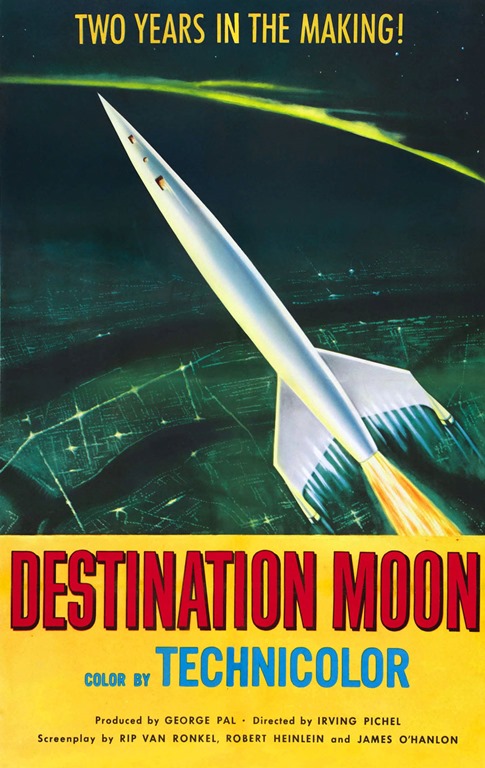
Destination-Moon-Poster

When the astronauts in Destination Moon discover they don’t have enough fuel to return to Earth after making the first Moon landing, their solution is to throw out enough mass to make their rocket light enough to match their fuel. Throughout life I’ve had moments where I couldn’t take off, and I realized that I needed to jettison the extra weight. Now that I’ve gotten older, and my body isn’t as energetic as it was, I’m learning to get further in my social security years, I need to throw out the past, all that extra mass is holding me down.

If humanity is ever to take off it will have to jettison a lot of mass from its past. To reach the next stage, whether Humanity 2.0 or 3.0, we need to give up religion and most of philosophy. Their mass keeps us from launching. Even on an individual level, I realize I have my own mental baggage that weighs me down. Much of it comes from reading science fiction.

Learning that I have limited mental fuel offers all kinds of philosophical parallels to rocket travel and Newton’s famous laws. And it’s not just energy, but cognitive ability. We all love the idea we have unlimited potential, but we don’t. Science fiction taught me that too.

Stand on Zanzibar - John Brunner

Stand on Zanzibar came out in 1968, and was about the world of 2010. I read it in 1968, and I’ve lived through 2010. We can never know the future, but some science fiction writers can make us seriously think about the possibilities. I remember being a kid reading this book and horrified at the terrorism that takes place in the story. I wasn’t savvy enough then to know that terrorism is common in all times, or that in 1970 there would be over 450 terrorist attacks in the U.S. Since 2000, there’s been less than 50 a year. What science fiction teaches us is to understand our fears, even when it’s wrong.

To value science fiction I also need to know its limitations.

Stand on Zanzibar and Harry Harrison’s Make Room! Make Room! scared me into thinking the future would be an overpopulated nightmare. What’s funny, our world is suffering horribly from overpopulation, but not how science fiction imagined. Science fiction failed to see climate change and the Internet. It also failed to see we’d never leave low Earth Orbit for 43 years. Nor did it imagine The Hubble Telescope and renaissance in astronomy.

It’s strange to credit science fiction being a success for failing to predict, but that’s also a valuable lesson.

The Long Tomorrow - Leigh BrackettOn the Beach - Nevil ShuteAlas Babylong - Pat Frank

The real question we should ask: Does science fiction warn us away from following paths into bad futures? Did all those 1950s books about nuclear war keep us from blowing ourselves up? Or is it just another case of science fiction being bad at predicting the future? I’d like to think science fiction made us wiser in this case. I can’t help but believe Nineteen Eighty-Four is a great lesson in how not to govern. Yet, if you study how Republicans use rhetorical trickery to dispute science, you can’t help but wonder if Orwell’s story isn’t coming true. Dystopias are handbooks on how to avoid certain futures.

Using multiplex thinking science fiction can predict and fail to predict the future and still be a success. It’s much too simplex to assume a specific future will come to pass. It’s complex to think we should look at all the possibilities. It’s multiplex thinking to perceive how science fiction is both wrong and right at the same time.

— If you have the time, post a reply about how science fiction has been useful to you. —

JWH